Tribal Birth
Born into a minor Jie tribal chieftain family in Wuxiang; grew into an athletic, brave youth adept at horsemanship and archery.
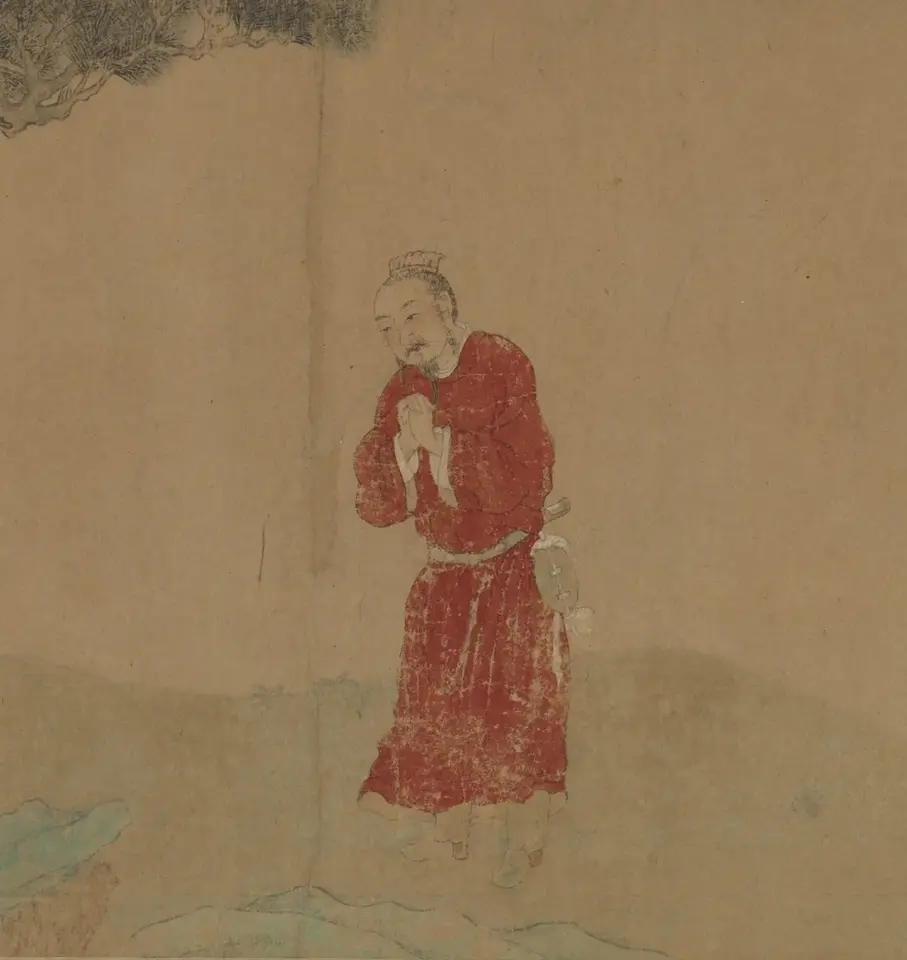
319 CE–333 CE
石勒
Shi Lei (石勒, 274 – August 17, 333), courtesy name Shilong, originally named Bo Le, was the founding emperor of Later Zhao during the Sixteen Kingdoms period and one of the most remarkable military figures in Chinese imperial history. Born of Jie ethnic background in Shangdang Commandery, he endured severe poverty during the chaos of the War of the Eight Princes and was seized by Jin provincial armies and sold as an enslaved…
Shi Lei (石勒, 274 – August 17, 333), courtesy name Shilong, originally named Bo Le, was the founding emperor of Later Zhao during the Sixteen Kingdoms period and one of the most remarkable military figures in Chinese imperial history. Born of Jie ethnic background in Shangdang Commandery, he endured severe poverty during the chaos of the War of the Eight Princes and was seized by Jin provincial armies and sold as an enslaved laborer in Shandong. After obtaining manumission from his master Shi Huan, he assembled eighteen formidable cavalrymen and joined the rebellion led by Ji Sang, receiving the Chinese surname and personal name Shi Lei. Following Ji Sang's demise, he submitted to the Han-Zhao monarch Liu Yuan, conducting extensive operations across the Central Plains and establishing the Gentlemen Camp to recruit displaced Han literati under chief counselor Zhang Bin. In 311, Shi Lei annihilated over one hundred thousand Western Jin troops under Chancellor Wang Yan at the Battle of Ningping City, participating in the capture of Luoyang during the Disaster of Yongjia. In 312, he established a permanent strategic base at Xiangguo, systematically destroying regional warlords including Wang Mi, Wang Jun, Liu Kun, and the Duan Xianbei to annex the northern provinces. In 319, he broke with Former Zhao to declare himself Prince of Zhao, establishing Later Zhao. In 328, he decisively routed Former Zhao armies at Luoyang and captured Liu Yao, unifying almost all of northern China. Assuming the imperial title in 330, Shi Lei instituted dual-track administration balancing nomadic tribal governance through the Grand Chanyu office with classical Han civil bureaucracy, promulgated the Xinhai Code to safeguard smallholder agriculture, patronized classical state academies, and revered the Buddhist master Fotudeng, significantly mitigating societal violence. He died in 333 at the age of sixty, receiving the temple name Gaozu and posthumous title Emperor Ming.
Born into a minor Jie tribal chieftain family in Wuxiang; grew into an athletic, brave youth adept at horsemanship and archery.
Traveled to Luoyang as an itinerant merchant; his whistling by the Shangdong Gate alarmed Chancellor Wang Yan, who foresaw his future ambition.
Fled regional famine in Bingzhou; captured by Jin general Sima Teng's forces and sold into chattel slavery to Shi Huan in Chiping.
Manumitted by Shi Huan; partnered with stable master Ji Sang to recruit Wang Yang, Kui An, and other horsemen, forming the Eighteen Riders.
Rose in revolt alongside Ji Sang in support of Prince Sima Ying; received the formal Chinese name Shi Lei and joined the anti-Jin insurgencies.
Sacked Yecheng and killed Sima Teng with Ji Sang; subsequently defeated by Gou Xi at Chiqiao and fled into hiding after Ji Sang's death.
Surrendered remnants to Liu Yuan; commissioned General Pacifying the East, capturing Yecheng and surrounding commanderies with an army of 100,000.
Established the Gentlemen Camp to enlist Han Confucian scholars; appointed strategist Zhang Bin as Chief of Staff to formulate northern unification plans.
Decimated over 100,000 Jin soldiers and ministers at Ningping City; sacked Luoyang with Liu Yao and Wang Mi, capturing Emperor Huai.
Lured rival commander Wang Mi into a banquet trap at Jiwu and assassinated him, absorbing his entire army into his command.
Escaped epidemic and floods at Gepi on Zhang Bin's advice; marched north to fortify Xiangguo as a permanent capital and agrarian base.
Feigned subservience toward Youzhou governor Wang Jun before launching a lightning cavalry assault on Ji, executing Wang Jun and taking Youzhou.
Sacked Jinyang in a surprise offensive, expelling Jin loyalist Liu Kun and securing complete mastery over Bingzhou's thirteen commanderies.
Severed relations with Liu Yao after Jin Zhun's coup; declared himself Prince of Zhao at Xiangguo, founding the state of Later Zhao.
Dispatched Shi Hu to vanquish regional warlord Cao Yi at Guanggu, incorporating the entire Shandong peninsula into Later Zhao borders.
Personally led the main field army through Taihang Pass, routing Former Zhao forces and capturing Emperor Liu Yao in battle.
Formally ascended the imperial throne as Emperor; established dual-track administration, state academies, and the Xinhai Code.
Succumbed to illness caused by mineral elixir poisoning on August 17 at the Western Pavilion in Xiangguo at the age of sixty; temple name Gaozu.
Shi Lei was born in 274 in Wuxiang County, Shangdang Commandery, Bingzhou (north of modern Wuxiang, Shanxi). He belonged to the Jie ethnicity, an ethnic group descended from the Qiangqu branch of the Xiongnu federation. Characterized by high nasal bridges, deep-set eyes, and thick facial beards, the Jie were regarded by the Chinese as distinct non-Han foreigners. Both his grandfather Shi Yeyiyu and father Shi Zhouhezhu (also known as Qijijia) served as minor clan headmen within their tribal community. Under the Western Jin dynasty, nomadic populations in Shanxi were subjected to intense bureaucratic subordination and compulsory labor levies.
Originally named Bo Le, he displayed an imposing physical constitution and reckless courage from adolescence, mastering equestrian combat and archery. Because his father possessed a harsh and volatile temperament that alienated fellow tribesmen, the young Shi Lei was frequently entrusted with overseeing tribal matters. His evenhanded judgments and personal bravery earned him widespread respect across diverse nomadic clans. In 287, at the age of fourteen, Shi Lei accompanied traveling merchants from his native community to the imperial capital of Luoyang.
While resting near the Shangdong Gate in Luoyang, Shi Lei leaned against the city wall and let out a series of resonant, high-pitched whistles. Wang Yan, the influential aristocratic statesman and future Chancellor of Western Jin, happened to pass by in his carriage. Wang Yan was astonished by the youth's piercing gaze and commanding posture. Turning to his retainers, Wang Yan remarked with grave foreboding that the barbarian youth possessed an extraordinary countenance and vaulting ambition, warning that if he were not eliminated immediately, he would inevitably bring calamity upon the Central Plains. Wang Yan sent guards to arrest him, but Shi Lei had already vanished into the bustling crowds.
Prominent local landowners in Bingzhou, including Guo Jing of Taiyuan and Ning Qu of Yangqu, recognized Shi Lei's unusual potential and frequently extended material provisions to sustain him. Shi Lei remembered their patronage with gratitude and applied himself to agricultural farming. Although professional diviners in his home district proclaimed that the youth possessed celestial marks of greatness, ordinary villagers dismissed such predictions with mockery, leaving Guo Jing and Ning Qu as his sole early benefactors.
In 303, widespread crop failures and catastrophic famine devastated Bingzhou, precipitating violent social collapse. Separated from his fellow laborers while fleeing the famine, Shi Lei returned from Yanmen Pass to seek refuge with Ning Qu. When local security commander Liu Jian sought to capture him for human trafficking, Ning Qu concealed Shi Lei inside a hidden room at great personal risk. Shi Lei subsequently journeyed toward the camp of military officer Li Chuan, but suffered severe hunger on the road until he unexpectedly encountered Guo Jing.
Shi Lei prostrated himself before Guo Jing in tears, describing his desperate plight. Moved by pity, Guo Jing sold his entire trade cargo to buy provisions and warm clothing for the youth. Shortly thereafter, Western Jin general Yan Cui advised Sima Teng, the Governor of Bingzhou and Duke of Dongying, to round up thousands of indigenous nomads and sell them into servitude in Shandong to finance military budgets. Sima Teng dispatched commanders Guo Yang and Zhang Long to round up nomadic families across Shanxi, binding captives together in heavy wooden yokes for transport to eastern slave markets.
At approximately twenty-nine years of age, Shi Lei was captured and endured brutal beatings from Zhang Long during the forced march. Fortunately, Guo Jing had secretly entrusted Shi Lei to his kinship relatives Guo Yang and Guo Shi within the escort detachment, who intervened repeatedly to save his life. Upon arrival in Shandong, Shi Lei was purchased as an agricultural slave by Shi Huan, a wealthy resident of Chiping. Recognizing the slave's remarkable physical prowess and natural authority, Shi Huan soon released him from servitude.
Shi Huan maintained close relations with Ji Sang, the superintendent of an adjacent imperial horse pasturage. Following his manumission, Shi Lei utilized his consummate mastery of horse breeding and riding to win Ji Sang's deep admiration, forging an unbreakable bond. Exploiting this strategic post, Shi Lei organized a covert network of hardy horsemen and displaced warriors. He first enlisted eight intrepid riders: Wang Yang, Kui An, Zhi Xiong, Ji Bao, Wu Yu, Liu Ying, Tao Bao, and Lu Ming. Ten additional champions—Guo Ao, Liu Zheng, Liu Bao, Zhang Yipu, Huyan Mo, Guo Helüe, Zhang Yue, Kong Tun, Zhao Lu, and Zhi Quliu—subsequently pledged allegiance, forming the renowned cohort known to history as the Eighteen Riders.
The War of the Eight Princes plunged the Western Jin dynasty into terminal decline. In late 304, Prince Sima Ying of Chengdu suffered severe setbacks at the hands of Prince Sima Yue of Donghai, prompting former general Gongshifan to assemble hundreds of thousands of insurgents in Hebei. In 305, Ji Sang and Shi Lei mobilized hundreds of crack cavalry from the Chiping pastures to join Gongshifan's campaign. At their inaugural swearing-in ceremony, Ji Sang conferred upon his companion the Chinese surname Shi and personal name Lei, launching his meteoric military career.
Shi Lei fought with fearless ferocity, consistently leading the vanguard into enemy formations. In 306, Gongshifan was intercepted and killed in battle near Nanpi by Jin general Gou Xi. Shi Lei and Ji Sang retreated to Chiping, quietly recruiting thousands of equestrian raiders and amassing weapons. In May 307, Ji Sang proclaimed himself Grand Commander, appointing Shi Lei General Sweeping Barbarians, and launched an assault on the strategic citadel of Yecheng, garrisoned by Sima Teng.
Shi Lei's vanguard breached the defenses, storming the city and executing Sima Teng. Shi Lei ordered the imperial palaces of Yecheng burned to ashes in a conflagration that blazed for months. Prince Sima Yue countered by dispatching Gou Xi and Ding Shao with imperial field forces. At the Battle of Chiqiao, Ji Sang and Shi Lei suffered a crushing defeat due to exhaustion and lack of supplies. Ji Sang was slain by Jin pursuit units at Pingyuan, while Shi Lei escaped with a handful of horsemen into the mountains of Leping.
Recognizing that an isolated band could not survive in the contested Central Plains, Shi Lei resolved to affiliate with a major political movement. At Pingyang, the Xiongnu leader Liu Yuan had established the Han dynasty (later termed Former Zhao), claiming imperial authority. Shi Lei dispatched envoys to submit his allegiance. Liu Yuan joyfully appointed him Commissioner with Special Powers, Prince Pacifying the Jin, and General Supporting the Han. Utilizing imperial authority, Shi Lei rallied thousands of Jie and Xiongnu cavalry under local chieftains Zhang Baidu and Feng Motu, reemerging as the preeminent field commander for Han-Zhao in eastern China.
Operating under Han-Zhao authority, Shi Lei exhibited brilliant strategic mobility. In 308, he led his army across the Taihang Mountains into the Hebei plains, capturing Changshan, Julu, and Zhongshan. With thousands of local warriors surrendering to his banner, his forces swelled beyond one hundred thousand. Liu Yuan elevated him to General Pacifying the East, granting him full command over military operations in Hebei. However, his early campaigns were marred by habitual looting and mass slaughter, creating profound terror among northern Han aristocrats.
During his advance toward Handan, Zhang Bin, a visionary Han scholar from a prominent bureaucratic family, arrived at Shi Lei's headquarters to offer his counsel. Zhang Bin possessed comprehensive mastery of history and military strategy, frequently comparing himself to Han dynasty strategist Zhang Liang. Recognizing Shi Lei's rare imperial qualities, Zhang Bin urged the warlord to abandon indiscriminate plunder and instead embrace Chinese institutional traditions, recruit educated Han gentry, and govern through Confucian benevolence.
Profoundly enlightened by Zhang Bin's counsel, Shi Lei elevated him to Chief of Staff and principal strategist, honoring him with the affectionate title Right Marquis and refusing to utter his personal name. Under Zhang Bin's guidance, Shi Lei established the celebrated Gentlemen Camp. This specialized institution recruited captured or volunteer Han literati and aristocratic intellectuals, shielding them from nomadic violence and tasking them with formulating military regulations, drafting administrative edicts, and governing occupied territories.
The creation of the Gentlemen Camp transformed Shi Lei's movement from a predatory nomadic warband into an institutionalized, disciplined imperial contender with an elite bureaucratic apparatus. Influential northern gentry families recognized his regime as a stabilizing force, lending crucial financial, logistic, and administrative support that secured his supremacy across northern China.
Between 309 and 310, Shi Lei crossed the Yellow River under Han-Zhao orders, campaigning through Henan and the Huai River basin, seizing Xiangcheng and Nanyang. Meanwhile, mortal factional conflict between Prince Sima Yue and Emperor Huai paralyzed the imperial court in Luoyang. In the winter of 310, facing catastrophic grain shortages, Sima Yue evacuated Luoyang with over two hundred thousand soldiers, ministers, and aristocratic households, marching toward Xiang County.
In April 311, Sima Yue died suddenly of illness on the march. The assembled generals selected Chancellor Wang Yan and Prince Sima Fan to escort the prince's funerary carriage east toward Donghai. Receiving intelligence of the disorganized retreat, Shi Lei personally commanded tens of thousands of elite cavalry in a relentless pursuit. At Ningping City in Ku County (modern Luyi, Henan), Shi Lei's horsemen enveloped the retreating Western Jin army. Concentrated cavalry archery threw the dense refugee columns into sheer panic; over one hundred thousand soldiers, court officials, and civilians were slaughtered or trampled to death in mounds of corpses.
The annihilation of the Western Jin field army at Ningping City resulted in the capture of the entire civilian and military leadership of the empire. Shi Lei convened an open tribunal to interrogate Chancellor Wang Yan. Confronted with his catastrophe, Wang Yan attempted to evade responsibility by claiming he had never taken an active interest in public affairs, even flatteringly advising Shi Lei to declare himself emperor. Shi Lei rebuked him with fury, declaring that a grand statesman who held supreme office for decades could not disclaim guilt, and that it was precisely Wang Yan's superficial philosophical discourse that had ruined the empire. Reluctant to spill noble blood with steel weapons, Shi Lei ordered his troops to push down a heavy earthen wall during the night, burying Wang Yan and dozens of senior ministers alive, before burning Sima Yue's casket.
The destruction of the imperial field army left Luoyang defenseless. In May 311, Shi Lei joined forces with Han-Zhao generals Liu Yao and Wang Mi to besiege the capital. In June, the barbarian armies breached the city gates, capturing Emperor Huai, putting over thirty thousand officials and residents to the sword, plundering the imperial palaces, and excavating the ancestral mausoleums of the Western Jin dynasty. This historic catastrophe, known as the Disaster of Yongjia, marked the complete collapse of Western Jin rule in northern China.
Following the fall of Luoyang, mutual suspicion fractured the Han-Zhao high command. General Wang Mi, hailing from a distinguished gentry family in Donglai, commanded a powerful, well-equipped army. Jealous of Shi Lei's burgeoning prestige, Wang Mi plotted with his advisor Liu Tun to assassinate Shi Lei and seize his troops in order to conquer Qingzhou. When Shi Lei's scout patrols captured Liu Tun and intercepted Wang Mi's private letters outlining the conspiracy, Shi Lei concealed the intelligence and consulted Zhang Bin on counter-measures.
An opportunity arose when Wang Mi suffered severe battlefield reverses against Jin loyalist commander Liu Rui and sent urgent appeals for help. Zhang Bin advised Shi Lei to rescue Wang Mi immediately to dispel all suspicions. Shi Lei marched day and night, crushing the Jin force and rescuing his rival. Overjoyed by this timely assistance, Wang Mi abandoned all caution. In October 311, Shi Lei hosted a lavish banquet in Jiwu to celebrate their victory. After Wang Mi became thoroughly intoxicated, Shi Lei signaled hidden assassins, personally striking down Wang Mi and annexing his entire force.
With Wang Mi eliminated, Shi Lei led an enormous army southward into Huai River territory, encamping at Gepi (north of modern Xincai, Henan). He constructed massive encampments, cultivated agricultural plots, and ordered the construction of war vessels, preparing for an amphibious crossing of the Yangtze River to destroy Sima Rui's fledging Eastern Jin regime in Jiankang (modern Nanjing). However, catastrophic continuous torrential rains struck the Huai basin for three consecutive months, turning the encampments into a vast sea of mud.
With supply lines submerged, a devastating epidemic of typhoid swept through the camps, killing more than half of the soldiers and horses. Meanwhile, Sima Rui mobilized the full military resources of southern China, massing imperial forces at Shouchun. Shi Lei assembled his commanders to deliberate on their survival. Most officers favored an impetuous assault across the river, while Chief Clerk Diao Ying timidly urged Shi Lei to surrender to Jiankang. Shi Lei reacted with fury.
Zhang Bin stepped forward with decisive clarity, explaining that continuous rain was heaven's warning against lingering in the south, that Jiankang was protected by the Yangtze barrier, and that lingering would invite total destruction. Zhang Bin pointed out that Wang Jun in Youzhou and Liu Kun in Bingzhou constituted their true existential threats, advising Shi Lei to abandon his southern ambitions, march north to occupy Xiangguo in Hebei, build impregnable fortifications, and amass agricultural grain. Shi Lei embraced this strategic guidance, ordering the Gepi fortifications and naval fleet burned before leading his surviving forces back to the Central Plains.
In July 312, Shi Lei arrived at Xiangguo (modern Xingtai, Hebei). Situated against the Taihang Mountains to the west and overlooking the fertile northern plains to the east, Xiangguo offered ideal defensive terrain and strategic communications across northern China. Embracing Zhang Bin's proposal, Shi Lei designated Xiangguo as his permanent strategic capital. He mobilized over one hundred thousand laborers to fortify the perimeter walls, deepen the moats, and organize extensive military agricultural colonies, constructing an impregnable defensive sanctuary.
The occupation of Xiangguo alarmed neighboring powers. Youzhou governor Wang Jun persuaded Duan Xianbei chieftains Duan Jiluojuan and Duan Pidi to mobilize tens of thousands of elite cavalry to lay siege to the new citadel. With enemy forces encircling the walls, Shi Lei's generals counseled passive defense. Zhang Bin counter-argued that the nomadic invaders were arrogant and overextended, proposing an ambush. Shi Lei personally led a sortie through the northern gate, feigning retreat to lure the enemy into concealed trenches, where his reserves routed the Xianbei and captured their principal vanguard general, Duan Mopei.
Demonstrating consummate diplomatic wisdom, Shi Lei did not execute Duan Mopei. Instead, he released him from his bonds, seated him in the place of honor, provided him with lavish gifts, and escorted him back to his clan to negotiate peace. Deeply touched by Shi Lei's magnanimity, the Duan Xianbei swore a solemn blood pact with him and withdrew their cavalry, severing their alliance with Wang Jun. This diplomatic triumph secured Xiangguo from immediate northern invasion and prompted independent fortified communities throughout Hebei to declare allegiance to Shi Lei.
With his southern and eastern flanks secure, Shi Lei executed a brilliant campaign to destroy Wang Jun between 313 and 314. Wang Jun ruled Youzhou with despotic cruelty and hubris, harboring open ambitions to proclaim himself emperor in Ji. Shi Lei and Zhang Bin orchestrated an elaborate deception: Shi Lei dispatched his emissary Wang Zichun to Ji with vast treasures of gold and jewels, submitting a fawning memorial urging Wang Jun to assume the imperial crown and offering to serve as his vassal commander.
Blinded by flattery, Wang Jun lowered all defensive preparations. In February 314, Shi Lei mobilized several thousand veteran cavalry, marching through day and night on the pretext of paying imperial homage. Arriving beneath the gates of Ji, his cavalry stormed through the open portals, seizing Wang Jun inside his palace hall without resistance. After enumerating his oppressive crimes against the people, Shi Lei had Wang Jun executed and absorbed Youzhou into his domain.
Shi Lei then moved against Liu Kun, the Western Jin governor of Bingzhou. In 316, his cavalry launched a surprise offensive against Jinyang, shattering the defending forces. Liu Kun fled north to join the Duan clan, allowing Shi Lei to incorporate all thirteen commanderies of Shanxi. Within five years of selecting Xiangguo, Shi Lei had eliminated every rival warlord in northern China, establishing total dominance over Youzhou, Jizhou, and Bingzhou.
In 318, Emperor Liu Cong of Han-Zhao passed away, succeeded by his unstable son Liu Can. Grand Commander Jin Zhun staged a violent palace coup in the capital of Pingyang, slaughtering the entire imperial family, desecrating the tombs of Liu Yuan and Liu Cong, and torching the ancestral temples. From Chang'an, general Liu Yao mobilized to crush the regicides, while Shi Lei launched a massive punitive expedition from Xiangguo. En route to Pingyang, Liu Yao assumed the imperial throne, altering the dynastic name to Zhao (Former Zhao) and conferring upon Shi Lei the titles of Grand Marshal, Supreme General, and Duke of Zhao.
Shi Lei's cavalry enveloped Pingyang, crushing Jin Zhun's rebel forces and recovering the imperial seals. However, Liu Yao grew intensely fearful of Shi Lei's overwhelming military strength, seeking to strip him of authority and ambushing Shi Lei's envoys who were transporting the regalia. Enraged by this treachery, Shi Lei severed all ties with Former Zhao, proclaiming his full independence.
In November 319, court ministers at Xiangguo urged Shi Lei to assume sovereign authority. He ascended the throne as Prince of Zhao, inaugurating the Taihe era and founding the state historically designated as Later Zhao. He established central governmental organs including the Department of State Affairs and the Secretariat modeled after classical dynasties, while preserving the Grand Chanyu administration to oversee nomadic tribes. In external diplomacy, he maintained a defensive frontier along the Huai River against Eastern Jin while containing the Murong Xianbei and Tuoba Xianbei to the north.
In 323, Shi Lei dispatched his nephew, Prince of Zhongshan Shi Hu, with forty thousand infantry and cavalry to annex Qingzhou, destroying the entrenched warlord Cao Yi at Guanggu. Shi Hu slaughtered over thirty thousand captured troops, bringing the entire Shandong peninsula under Later Zhao control. Subsequent campaigns pacified Henan, Yanzhou, and Yuzhou, extending Later Zhao's southern frontier firmly to the Huai River.
The ultimate clash between Former Zhao and Later Zhao for mastery of northern China erupted in the autumn of 328. Emperor Liu Yao of Former Zhao mobilized over one hundred thousand troops from Chang'an, capturing the Jinyong fortress at Luoyang and besieging Shi Hu's relieving forces. With Former Zhao armies entrenched around Luoyang, panic swept through the court in Xiangguo, where ministers urged Shi Lei to retreat behind the Taihang passes.
Shi Lei rejected this timid counsel with fiery resolve, declaring that Liu Yao had concentrated his entire imperial military strength before a single isolated fortress, and that allowing him to cross the Yellow River would bring ruin upon the Zhao state. Proclaiming that the fate of the empire hung in the balance, Shi Lei personally took command of a relief army of one hundred thousand elite cavalry and infantry, advancing with secret speed through Tianjing Pass and crossing the Yellow River toward Luoyang.
When Later Zhao battle standards suddenly appeared at Chenggao, Liu Yao was stunned. On January 329, the two imperial hosts collided on the plains west of Luoyang. Severely impaired by heavy alcohol consumption prior to the engagement, Liu Yao lost tactical control of his battle lines. Shi Lei personally led the assault vanguard, his heavy cavalry shattering the enemy center. Former Zhao forces collapsed into a catastrophic rout. Liu Yao's mount threw him into a frozen river during the flight, where he was captured alive by Zhao general Shi Kan.
The victory at Luoyang delivered a fatal blow to Former Zhao, resulting in the destruction or capture of tens of thousands of enemy troops. Shi Lei escorted Liu Yao to Xiangguo and had him executed, subsequently dispatching Shi Hu to storm Chang'an and Shanggui, extinguishing the last remnants of Former Zhao authority. From the borders of the Western Regions to the Pacific Ocean, and from the Great Wall to the Huai River, all of northern China was unified under Later Zhao authority, completing the largest territorial integration of the early Sixteen Kingdoms era.
In February 330, Shi Lei formally ascended the imperial throne at Xiangguo, proclaiming a nationwide amnesty and changing the reign era to Jianping. He honored his grandfather Shi Yeyiyu as Emperor Yuan and his father Shi Zhouhezhu as Emperor Xuan, invested his son Shi Hong as Crown Prince, created his nephew Shi Hu as Prince of Zhongshan, and rewarded meritorious civil and military ministers. Shi Lei concentrated on rebuilding the devastated agrarian economy of the north, patronizing classical education, and erecting the Mingtang Hall, Imperial Academy, and Lingtai Observatory at Xiangguo.
However, the question of imperial succession posed severe political hazards. Crown Prince Shi Hong was an erudite, gentle scholar devoted to classical poetry and Confucian propriety, but utterly lacked the ruthlessness required to command fierce nomadic warbands. Conversely, his battle-hardened cousin Shi Hu commanded supreme military authority, possessed a sadistic and violent temperament, and harbored clear usurpation ambitions. Senior officials Xu Guang and Cheng Xia repeatedly warned Shi Lei in secret audience that Shi Hu would inevitably destroy the dynasty if not purged.
Although fully aware of his nephew's insatiable ambition, Shi Lei could not bear to execute the general who had fought at his side for three decades and whom he had raised like a son. Instead, he attempted half-hearted measures, such as moving Shi Hu away from Yecheng and establishing regional command centers. In the summer of 333, Shi Lei's physical health deteriorated severely from chronic toxic reactions to mineral longevity elixirs. In his final edict, he pleaded with Shi Hong and Shi Hu to cooperate harmoniously like the Duke of Zhou and King Cheng, strictly forbidding fratricidal violence.
On August 17, 333, Shi Lei died in the Western Pavilion of the Xiangguo imperial palace at the age of sixty. He was conferred the temple name Gaozu and posthumous title Emperor Ming. To prevent tomb robbery and desecration by enemies, his court buried his body in absolute secrecy within a remote Taihang mountain ravine during the night, while erecting an empty cenotaph at Gaoping Mausoleum to mislead posterity. Shortly after his death, Shi Hu staged a violent coup, executing Crown Prince Shi Hong and exterminating Shi Lei's direct lineage.
Shi Lei stands as one of the most brilliant military commanders in imperial Chinese history, having risen from an enslaved captive to an imperial conqueror through hundreds of victorious engagements. His generalship was characterized by exceptional strategic mobility, decisive cavalry encirclement, and masterly tactical deception. At Ningping City, he accurately identified the vulnerabilities of a retreating host, executing a long-range cavalry encirclement that annihilated over one hundred thousand soldiers with minimal casualties.
His strategic clarity was demonstrated during the retreat from Gepi. Recognizing the perils of flood, disease, and overextended lines against Eastern Jin, he resisted the vanity of southern conquest, accepting Zhang Bin's guidance to withdraw to Xiangguo and lay the enduring institutional foundation of his dynasty. His campaign against Wang Jun remains an enduring masterpiece of psychological warfare and long-distance cavalry raid, feigning utter servility before marching swiftly across northern Hebei to capture the regional despot inside his stronghold.
During the climactic 328 Battle of Luoyang, Shi Lei demonstrated flawless operational nerve, crossing the Taihang passes at lightning speed to strike Former Zhao's scattered siege forces while their commander was incapacitated by wine. Recognized by generations of military historians as the preeminent general of the Sixteen Kingdoms, his tactical genius combined nomadic cavalry speed with sophisticated Chinese strategic doctrine.
To govern a fractured multiethnic realm, Shi Lei pioneered an innovative dual-track political structure that harmonized nomadic military organization with classical Chinese bureaucratic traditions. Recognizing that raw barbarian force would destroy civil society while pure Chinese institutions could not discipline nomadic clansmen, he established the Office of the Grand Chanyu to oversee judicial, administrative, and military affairs for Xiongnu, Jie, Xianbei, Di, and Qiang populations.
Concurrently, he revived the bureaucratic machinery of the Han and Cao-Wei dynasties across the central provinces. He instituted the Department of State Affairs, the Secretariat, the Chancellery, and the Nine Courts, staffing administrative posts with prominent northern Han gentry scholars. To prevent ethnic oppression, he forbade nomadic warriors from plundering Chinese communities, designating Han civilians as State Citizens and nomadic cavalrymen as Sons of the State. He instituted strict criminal statutes prohibiting interethnic brawling and abolished derogatory public references to the Jie as barbarians. This institutional synthesis fostered unprecedented political stability across northern China following decades of catastrophic warfare.
Although born illiterate without formal Chinese schooling, Shi Lei exhibited profound reverence for classical Confucian scholarship and imperial historiography. During military marches, he frequently ordered educated courtiers to recite the Spring and Autumn Annals, Records of the Grand Historian, and Book of Han in plain spoken language, deducing profound insights regarding political governance. When hearing how Zhang Liang successfully dissuaded Han Gaozu from enfeoffing descendants of the Warring States, Shi Lei struck his table in admiration, marveling at the necessity of visionary counselors.
Upon capturing Xiangguo, Shi Lei established an Imperial Academy to educate hundreds of selected youths in classical texts. He mandated the establishment of local Confucian schools across all commanderies, stationing two Libationer Erudites and one hundred and fifty registered students in each jurisdiction. Students who completed three rigorous academic examinations were elevated directly to central ministries and regional commanderies. He constructed the Mingtang Hall, Imperial Academy, and Observatory west of Xiangguo, annually inspecting student dissertations and commissioning exceptional graduates as Editorial Assistants to compile contemporary dynastic histories.
In socio-economic governance, Shi Lei pursued policies centered on agricultural revival and refugee relief. Confronting widespread depopulation and abandoned lands, he ordered provincial administrators to conduct comprehensive cadastral surveys, abolishing extortionate wartime levies. He established uniform agrarian tax obligations, requiring each farming household to remit merely two bolts of cloth and two piculs of grain annually, drastically easing the burdens of common cultivators.
In 331, seeking to eliminate judicial corruption and conflicting imperial decrees, he directed Legal Secretary Guan Zhi to extract core principles from classical Han and Wei statutes, synthesizing them into the concise, five-thousand-word Xinhai Code. This pioneering legal corpus prohibited the arbitrary enslavement of free civilians, protected private landownership for smallholder farmers, and established standardized criminal penalties. Promulgated nationwide for over a decade, the code provided essential legal protections that facilitated the economic restoration of northern China.
Shi Lei cultivated an atmosphere of political tolerance and institutional remonstrance throughout his administration. During a hunting excursion near Xiangguo, Secretariat Recorder Cheng Lang boldly remonstrated against the outing, citing Sun Ce's tragic assassination and the hazards of concealed terrain. Although initially dismissive, Shi Lei's mount collided with a rotten tree trunk during the gallop, nearly crushing the emperor to death. Returning to his palace, Shi Lei praised Cheng Lang's integrity, elevating him to Marquis of Guannei and rewarding him with embroidered robes.
During the construction of the Ye palace, Chamberlain for Law Enforcement Xu Xian submitted an urgent memorial condemning the extravagance. Though infuriated initially, Shi Lei accepted the counsel of Xu Guang, who reminded him that an enlightened monarch should never execute honest ministers. Relenting with laughter, Shi Lei cancelled construction and awarded Xu Xian one hundred bolts of silk. On another occasion, Shi Lei wandered in disguise through the city gates at night, attempting to bribe gatekeeper Wang Jia with gold to pass. Wang Jia incorruptibly arrested the sovereign until palace guards intervened. The following morning, Shi Lei elevated Wang Jia to Commandant of Loyalty, celebrating his adherence to law.
Shi Lei played a pivotal role in the early propagation and Sinicization of Buddhism in northern China. In 310, the Kuchean Buddhist master Fotudeng arrived in Luoyang amidst the widespread carnage of civil war. Seeking to curb the bloodshed, Fotudeng joined the camp of Zhao general Guo Helüe, who won consecutive battlefield victories through the monk's prophetic guidance. Astonished by these reports, Shi Lei summoned the master to an imperial audience.
Before Shi Lei and his assembled officers, Fotudeng filled a begging bowl with water, burned incense, and recited incantations, causing a brilliant blue lotus to blossom instantly from the water. Deeply awed, Shi Lei appointed Fotudeng State Preceptor, revering him as the Great Monk and seeking his advice on state affairs. Fotudeng utilized his spiritual influence to advocate mercy, warning the ruler that true imperial power lay in protecting civilian life. Under Fotudeng's compassionate influence, Shi Lei revoked death sentences for tens of thousands of captured soldiers and civilians. He sanctioned the construction of hundreds of Buddhist monasteries across northern China and permitted ethnic Chinese subjects to enter monastic orders for the first time in history.
Shi Lei's lifetime movements spanned almost the entirety of northern China, covering the Fen River valley, the Taihang Mountains, the Yellow River floodplain, and the Huai River basin. Born in Shangdang in the highlands of Shanxi, his youth involved commercial travels to Luoyang and exile to Yanmen Pass. Transported as an enslaved captive across the Taihang Mountains to western Shandong, he launched his military uprising around Chiping, Qinghe, and Yecheng.
Under Han-Zhao, his cavalry swept through Changshan, Julu, and Handan in Hebei, striking south through Luoyang, Xuchang, Xiangcheng, and Nanyang in Henan, and penetrating as far as Gepi in Anhui near the Yangtze riverfront. Establishing his imperial capital at Xiangguo, his campaigns reached Ji in Youzhou to the north, Jinyang in Shanxi to the west, and Guanggu in Shandong to the east. In his final years, he personally crossed the Yellow River ford at Mengjin to triumph at Luoyang. His military itineraries connected the foremost strategic fortresses and cultural centers of ancient northern China.
Shi Lei possessed an extraordinary capacity to attract and trust gifted subordinates. In his relationship with Zhang Bin, he extended unreserved confidence, weeping bitterly at his death and mourning that heaven had deprived him of his right arm. Upon conquering Bingzhou, he safeguarded the family tombs of Liu Kun and treated Wang Jun's former staff with honor. When his former village adversary Li Yang—with whom he had frequently engaged in fistfights over hemp-retting ponds—timidly sought an audience, Shi Lei laughed heartily, grasped his arm, and appointed him Military Adjutant, dismissing past poverty-stricken grudges.
During an imperial banquet following his accession, Shi Lei famously reflected upon his historical legacy before foreign ambassadors and ministers: "If I had met Emperor Gaozu of Han, I would have bowed my head to serve him alongside Han Xin and Peng Yue. If I had lived alongside Emperor Guangwu of Han, we would have driven our chariots across the Central Plains in equal rivalry. A true hero acts with the open brilliance of the sun and moon, and could never stoop to the deceit of Cao Cao and Sima Yi, who bullied widows and orphans to steal an empire." This candid assessment remains celebrated by historians as testament to his unvarnished heroic spirit.
FIGURES ASSOCIATED WITH THIS DYNASTY