Biography
Family Background and Early Career
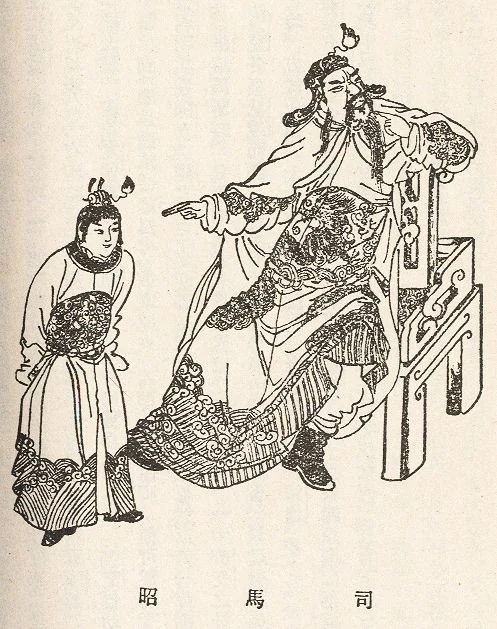
Sima Zhao came from the Sima clan of Henei. His father Sima Yi was a major official of Cao Wei, and his mother was Zhang Chunhua. In 238, the second year of the Jingchu era, Sima Zhao was enfeoffed as Marquis of Xincheng Township. In 240 he became Agricultural Intendant of Luoyang. During the reign of Emperor Ming of Wei, Cao Rui, when costly construction and luxury had placed burdens on the population, Sima Zhao reduced petty exactions and did not interfere with the agricultural seasons, winning approval among the people. He was later transferred to the post of Regular Mounted Attendant.
Battle of Xingshi and the Incident at the Gaoping Tombs
In 244, the fifth year of the Zhengshi era, General-in-Chief Cao Shuang launched a campaign against Shu. Sima Zhao served as General Who Conquers Shu and as deputy to Xiahou Xuan, leading troops through Luo Valley and encamping at Xingshi. Shu commander Wang Lin launched a night attack on Sima Zhao's camp, but Sima Zhao held his position without reacting, and Wang Lin withdrew. Afterward Sima Zhao told Xiahou Xuan that Fei Yi was holding advantageous terrain and that the Wei army could neither force an engagement nor capture the fortified positions, so it should withdraw promptly and plan again later. Cao Shuang and the other commanders pulled back. Fei Yi indeed rushed to the Three Ridges to cut off the route of retreat, and the Wei army escaped only after seizing the critical passes. After returning to the capital, Sima Zhao was appointed Court Gentleman.
In 249, the first year of the Jiaping era, Sima Yi launched the Incident at the Gaoping Tombs. Sima Zhao led troops to protect the two imperial palaces and received an additional thousand households in his fief. In the same year, Shu general Jiang Wei threatened Longyou. General Who Conquers the West Guo Huai departed Chang'an to resist him. Sima Zhao was promoted to General Who Pacifies the West, granted credentials of authority, and stationed in Guanzhong to coordinate the armies. Guo Huai had long been unable to defeat Jiang Wei's subordinate Gou An at Qu. Sima Zhao advanced to Changcheng and placed deceptive troops southward toward Luo Valley. Jiang Wei, alarmed, withdrew to Nanzheng. Cut off from support, Gou An surrendered with his men. Sima Zhao was then transferred to General Who Pacifies the East, with credentials of authority, and stationed at Xuchang.
Succeeding His Brother in Government
In 251, the third year of the Jiaping era, Sima Yi died, and Sima Shi served as General-in-Chief Who Pacifies the Army while directing government. In 252 Sima Zhao was given a supervisory military command and led General Who Conquers the East Hu Zun and General Who Pacifies the East Zhuge Dan against Wu at Dongguan. Hu Zun and Zhuge Dan suffered a major defeat. After the Battle of Dongxing, Sima Zhao asked who should bear responsibility. Campaign Army Marshal Wang Yi replied that responsibility lay with the commander. Enraged, Sima Zhao ordered Wang Yi executed. Sima Zhao himself was stripped of his marquisate because of the defeat.
In the summer of 253, Jiang Wei again threatened Longyou and claimed he would attack Didao. Sima Zhao, serving as General Who Conquers the West, was stationed at Chang'an. Inspector Chen Tai of Yong Province wanted to occupy Didao first, but Sima Zhao judged that Jiang Wei's real goal was to win over the Qiang and that the announced attack on Didao was intended to cover a withdrawal. Jiang Wei indeed burned his camp and retreated. At the same time, Qiang and Hu groups in Xinping rebelled. Sima Zhao led troops to defeat them and displayed his army at Lingzhou, intimidating the northern peoples and inducing the rebels to surrender again. For this success he was restored as Marquis of Xincheng Township.
In 254, the sixth year of the Jiaping era, Cao Fang plotted a coup with Li Feng, Zhang Ji, and others. The plot was exposed, and Sima Shi executed Li Feng and his associates. Later that year, Sima Shi deposed Cao Fang and enthroned Cao Mao. Sima Zhao participated in planning the succession and was advanced to Marquis of Gaodu with an additional two thousand households.
In 255, the second year of the Zhengyuan era, Guanqiu Jian and Wen Qin rebelled in Huainan. Sima Shi led the army east while Sima Zhao concurrently served as Central Army Commander and remained to guard Luoyang. Wen Yang's attack on the camp aggravated Sima Shi's eye disease. When Sima Shi became seriously ill, Sima Zhao came from the capital to Xuchang to visit him and was appointed General of the Guards. After Sima Shi died, Emperor Cao Mao ordered Sima Zhao to remain at Xuchang and instructed Secretariat official Fu Gu to lead the Six Armies back to the capital. Following the advice of Fu Gu and Zhong Hui, Sima Zhao instead personally led the army back. On reaching Luoyang, he was promoted to General-in-Chief, additionally made Attendant-in-Ordinary, placed in command of all forces inside and outside the capital, and appointed Supervisor of the Affairs of the Secretariat, thereby assuming control of government.
Suppression of the Huainan Rebellion and the Killing of the Emperor
In the first month of 256, the first year of the Ganlu era, Sima Zhao received the additional title Grand Commander and the privilege of having memorials presented without his name being announced. In the sixth month he was promoted to Duke of Gaodu and offered the Nine Bestowments, an axe of authority, and the title of Grand Commander, but declined. In the eighth month he was granted the Yellow Axe and three additional counties in his fief.
On the first day of the fifth month of 257, the second year of the Ganlu era, General Who Conquers the East Zhuge Dan killed Inspector Yue Lin of Yang Province and rebelled from Huainan. He sent his son Zhuge Jing as a hostage to seek military assistance from Wu. Sima Zhao memorialized that the emperor should personally accompany the campaign. In the seventh month, he took Cao Mao and Empress Dowager Guo eastward and mobilized troops from Qing, Xu, Jing, and Yu provinces, assembling north of the Huai River. After the army reached Xiang, Sima Zhao advanced to Qiutou. Wu sent Wen Qin, Tang Zi, Quan Duan, Quan Yi, and more than thirty thousand men to reinforce the rebels. Sima Zhao surrounded the city and, following Zhong Hui's strategy, induced the five Quan brothers to surrender, causing great fear inside.
In the first month of 258, Zhuge Dan and Wen Qin left the city to attack the besieging army but were repulsed. The two rebel leaders then quarreled, and Zhuge Dan personally killed Wen Qin. Wen Qin's sons Wen Yang and Wen Hu surrendered to Wei. Sima Zhao appointed Wen Yang a general, enfeoffed him as a marquis, and ordered him to ride around the city calling on the defenders to surrender. On the twentieth day of the second month, the Wei army stormed the city, killed Zhuge Dan, and exterminated his clan. Wu commander Tang Zi and others surrendered with their men. Sima Zhao petitioned for ranks for them and provided food and medicine. When someone proposed burying the surrendered Wu soldiers alive, Sima Zhao replied that releasing them would better demonstrate the magnanimity of Great Wei. The surrendered troops were later resettled in the Three Henei Commanderies. Sima Zhao returned to the capital in the fourth month. Cao Mao ordered the place name Qiutou changed to Wuqiu to commemorate the military success.
In the fourth month of 260, the fifth year of the Ganlu era, Emperor Cao Mao met Wang Shen, Wang Jing, Wang Ye, and others and declared in anger: “Sima Zhao's intentions are known to everyone in the street. I cannot sit and accept deposition and humiliation; today I will go out with you to attack him myself.” He led more than three hundred palace attendants against Sima Zhao's faction. Central Army Commander Jia Chong confronted them below the southern gate and ordered Cheng Ji to kill Cao Mao. Cheng Ji stabbed the emperor to death with a spear. Afterward Sima Zhao executed Cheng Ji and his clan for the killing and installed Cao Huan as emperor.
Conquest of Shu and Advancement to Prince of Jin
In the summer of 263, the fourth year of the Jingyuan era, Sima Zhao decided to launch a final campaign against Shu Han. He sent three armies under Zhong Hui, Deng Ai, and Zhuge Xu. Deng Ai crossed Yinping by an unexpected route, seized Fucheng, defeated and killed Zhuge Zhan at Mianzhu, and advanced on Chengdu. The Shu Han ruler Liu Shan surrendered, bringing Shu Han to an end. For this victory, Sima Zhao was enfeoffed as Duke of Jin.
In the third month of 264, the first year of the Xianxi era, Emperor Yuan of Wei, Cao Huan, issued an edict appointing Sima Zhao Chancellor of State and advancing him to Prince of Jin. He was granted the Nine Bestowments, ranked above the other princes, and was permitted to submit memorials without referring to himself as a subject and to receive imperial edicts without bowing. On the xin-mao day of the eighth month of the second year of the Xianxi era (September 6, 265), Sima Zhao died at the age of fifty-five. He received the posthumous title Prince Wen and was buried at Chongyang Mausoleum. On the bing-yin day of the twelfth month of the same year (February 8, 266), his son Sima Yan replaced Wei with Jin and posthumously honored Sima Zhao as Emperor Wen, with temple name Taizu.
Putting Down Zhuge Dan: The Emperor's Personal Campaign, the Siege, and Divide and Rule
On the first day of the fifth month of 257, Zhuge Dan, general of the eastern expedition, killed the governor of Yangzhou, Yue Lin, rose in Huaainan, and sent his son Zhuge Jing as a hostage to Wu to ask for aid. Those who debated the matter wished to attack at once, but Sima Zhao said that Zhuge Dan, thinking that Guanqiu Jian had failed through haste, would surely now join hands with the Wu bandits, so that the rebellion would be on a large scale but slow in movement, and that he would join forces with the generals of the four quarters and crush it by sure means; and he memorialized the emperor asking to lead the campaign in person, saying that as in old days when Ying Bu rebelled the Han founder went himself, when Wei Xiao turned against him Guangwu campaigned in the west, and the emperor Ming of glorious memory also took the field, so the emperor should come to the army for a time so that officers and men might lean on the majesty of heaven, with five hundred thousand men to strike the few, which could not fail. In the seventh month he conducted the emperor and the empress dowager east, called up troops from Qing, Xu, Jing and Yu, drew off the mobile forces of Guanzhong, and assembled all at the north of the Huai; the army halted at Xiang, he gave the minister of justice He Zhen the staff of authority and sent him into Huainan to comfort the officers and men, make plain to them rebellion and obedience, and show them rewards and punishments, and then advanced to Qiutou. Wu sent Wen Qin, Tang Zi, Quan Duan and Quan Yi with more than thirty thousand men to relieve Zhuge Dan, and the generals met them and could not hold; the general Li Guang failed to advance against the enemy and the governor of Taishan, Chang Shi, pleaded illness and did not come out, and both were beheaded and shown to the army.
In the eighth month the Wu general Zhu Yi came with more than ten thousand men, leaving his baggage at Dulu and advancing with light troops to Lijiang; the supervising general Shi Bao and the governor of Yanzhou, Zhou Tai, held him and he withdrew, whereupon the governor of Taishan, Hu Lie, with a surprise force raided Dulu and burned his grain, and Bao and Tai attacked again and broke him utterly, so that his remnant, starving, ate kudzu leaves and fled, and the men of Wu killed him. Sima Zhao judged that Zhu Yi's failure to reach Shouchun was not his own fault, and that Wu had killed him only to excuse themselves to Zhuge Dan and stiffen his resolve so that he still hoped for relief; otherwise he would break out and stake all on one throw, or would think the great army could not last and would husband his food and wait for some other change — and that the rebel's choices could not go beyond these three. So he ordered the ring closed, sent the weak and sick away to the north of the Huai to feed themselves, gave the front-line soldiers three pints of beans each, showed himself the more wasted to them, and let loose many agents to spread the word that Wu's relief was coming. Wen Qin, hearing it, was delighted, and Zhuge Dan and the rest, relaxing, ate their fill, so that the town soon ran short of grain. Shi Bao and Wang Ji both asked to attack, but Sima Zhao held that Zhuge Dan's treason was no matter of a day, that he had stored grain and completed his defences and allied with Wu, thinking himself able to hold Huainan, and that Wen Qin, sharing his guilt, would not lightly run away; to attack in haste would waste the mobile troops, and if the outer enemy came suddenly they would be attacked from within and without, which was the road to ruin. The three rebels were together in one isolated town, perhaps heaven meant them to perish together; he would hold them by a long strategy, keeping three sides only and holding his ground, and if the enemy's relief came by land its grain must be little, so that with light mobile troops he could cut its transport and break the outer enemy without fighting, and once that was done Wen Qin and the rest must be taken. He further used the fact that Quan Yi's mother was a daughter of Sun Quan and that Quan Duan's nephews Quan Yi and Quan Yi had brought her over, and on Zhong Hui's plan forged letters from them to deceive Quan Jing, still in Shouchun, so that Quan Jing and his four brothers came over with their troops and the town was greatly shaken.
In the first month of 258 Zhuge Dan and Wen Qin came out against the long siege line and were driven back; the two had never been of one mind, and in their extremity grew suspicious of each other, and when Wen Qin's proposals clashed with his, Zhuge Dan killed him with his own hand. Wen Qin's son Wen Yang attacked the town without success and came over the wall to surrender; Sima Zhao made him a general and a marquis and had him ride round the walls calling on the defenders to submit. Seeing the men on the wall drawing their bows without shooting, Sima Zhao told his generals, "Now we may attack"; on the yi-you day of the second month the army stormed and took the town the same day, Zhuge Dan was beheaded and his kin to the third degree wiped out, and several hundred of his men who would not surrender were also killed. The Wu generals Tang Zi, Sun Mi and Xu Shao surrendered with their commands, and Sima Zhao memorialized to give them rank, and gave food and medicine to the hungry and sick. Some asked to bury the Wu soldiers alive, and Sima Zhao said that even if they went home it would only show the magnanimity of the central state, and had them moved to the three commanderies of the north. In the fourth month he returned to the capital, and the Wei emperor ordered Qiutou renamed Wuqiu to proclaim the military achievement. In the fifth month the emperor, with the eight commanderies of Taiyuan, Shangdang, Xihe, Leping, Xinxing, Yanmen, Hedong and Pingyang — seven hundred li square — enfeoffed Sima Zhao as duke of Jin with the nine bestowals, advanced him to chancellor, and gave the state of Jin its own offices; he declined nine times and it was dropped, whereupon his fief was raised by ten thousand households and three counties, and all his sons without rank were made marquises. In the seventh month he memorialized that the sons of the famous ministers and great servants of former generations be employed according to their ability.
The Death of Cao Mao and Its Aftermath
In 260, the Wei emperor Cao Mao, unable to bear the daily loss of his authority and filled with anger, summoned the attendant Wang Shen, the president Wang Jing and the cavalier attendant Wang Ye, saying: "Sima Zhao's heart is known to every passer-by. I cannot sit and suffer deposition and disgrace; today I shall go out with you and attack him." Wang Jing warned him that in old days Duke Zhao of Lu could not bear the Ji family, fled and lost his state, and was laughed at by the world; that the power had long been in that house and the court and the four quarters would die for it, heedless of the right or wrong of it; and that with the guards emptied and arms few, what could the emperor rely on, and would he not, in trying to cure the disease, only make it worse, with consequences beyond guessing; he should consider the matter again. Cao Mao threw the tablet from his breast to the ground and said, "It is decided; even if I die, what is there to fear — much less if I do not die!" He then went in to tell the empress dowager, while Wang Shen and Wang Ye ran to warn Sima Zhao, who made his preparations. Cao Mao came out with a few hundred servants beating drums and shouting; Sima Zhao's younger brother, the colonel of the garrison cavalry Sima Zhou, met him at the eastern carriage gate, and when his followers shouted at him, Zhou's men scattered. The palace guard commander Jia Chong met him in arms beneath the southern gate-tower, and Cao Mao fought with his own sword; the men wished to retire, and the heir apparent's household officer Cheng Ji asked Jia Chong what should be done, and Jia Chong said, "To keep and feed you men was precisely for today — of today's business ask nothing." Cheng Ji went forward and stabbed the emperor, the blade coming out at his back.
Sima Zhao, hearing of it, was greatly alarmed and threw himself on the ground, saying, "What will the world say of me!" The grand tutor Sima Fu ran to the spot, laid his head on the emperor's thigh and wept bitterly, saying, "It is your servant's crime that slew your majesty." Sima Zhao summoned the officials to consider the matter, and the president Chen Tai did not come; so he sent Chen Tai's uncle Xun Yi to bring him in a carriage, and in a private room asked him, "Xuanbo, what is the world to think of me?" Chen Tai said, "Only by cutting Jia Chong in two at the waist can you somewhat answer to the world," and when Sima Zhao asked him to think of a next step, Chen Tai answered that he could see what was above that but not what was below it. So Sima Zhao laid the guilt on Cheng Ji, had him beheaded and his kin to the third degree wiped out; and Cheng Ji and his brother, refusing to submit at once, stripped to the waist and climbed onto the roof, abusing him foully, and were shot down from below. The empress dowager ordered that as the prince of Changyi had in former days been reduced to commoner for his crimes, this boy too should be buried with the rites of a commoner, that all within and without should know what he had done; and Sima Zhao killed the president Wang Jing for being of two minds toward him. On the geng-yin day he memorialized the empress dowager, recounting how Cao Mao had come with his attendants, sword drawn and drums beating, toward his own residence, that he had feared a clash of arms and had at once ordered his officers to do no hurt to anyone, and that it was Cheng Ji who had forced his way into the ranks and brought about the catastrophe; he had therefore handed Cheng Ji's household to the minister of justice, and the empress dowager agreed. He then took counsel with the nobles and set up Cao Huang, the prince of Changdao township, son of Cao Yu, prince of Yan, as emperor, and changed the era in the sixth month.
The Death of Ji Kang
During Sima Zhao's regency the famous writer Ji Kang died because of a quarrel with Zhong Hui. Ji Kang was poor and used to forge iron under a great tree with Xiang Xiu to support himself; Zhong Hui, a young gentleman of Yingchuan, refined and eloquent, came to call on him, and Ji Kang gave him no greeting but went on hammering; after a long while, when Zhong Hui was leaving, Ji Kang asked him, "What did you hear that brought you? What did you see that takes you away?" and Zhong Hui answered, "I heard what I heard and came; I saw what I saw and go" — and from this Zhong Hui bore him a grudge. Now Zhong Hui told Sima Zhao that "Ji Kang is a crouching dragon and must not be roused; my lord need not worry about the empire, but only about Kang," adding that Ji Kang had wished to help Guanqiu Jian and that his and Lü An's "loose talk, which slanders the ancient models," should not be tolerated by a king, and that he should be removed on some pretext to purify morals. Sima Zhao, being fond of and trusting Zhong Hui, destroyed them together. When Shan Tao, as gentleman of the personnel bureau, recommended Ji Kang in his own place, Ji Kang wrote to Shan Tao saying that he could not bear the common world and slighted Tang and Wu, and Sima Zhao was angry to hear of it. When Ji Kang was to be executed in the eastern market, three thousand students of the imperial academy begged that he be made their teacher, which was refused; he looked at the shadow of the sun, called for his lute and played, saying, "In former days Yuan Xiaoni wished to learn the Guangling San from me and I grudged it him; the Guangling San is lost from today." He was then forty, and all the scholars of the realm grieved for him; and Sima Zhao afterwards awoke to it and regretted it.