Age one | Born late in Zhuge Liang's life.
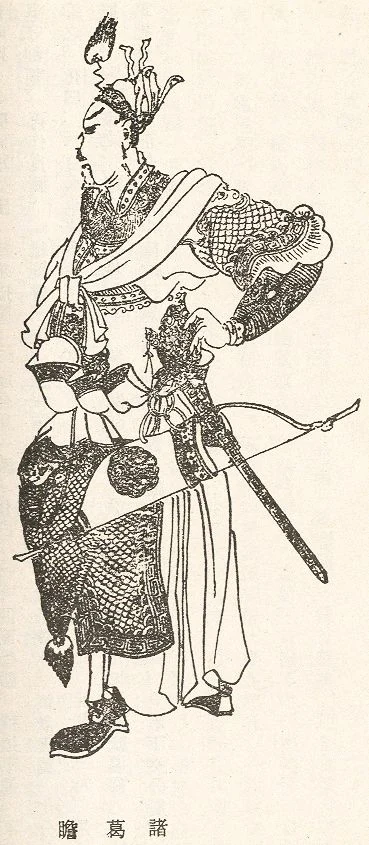
227 CE–263 CE
General
Zhuge Zhan
诸葛瞻
Zhuge Zhan was the son of Zhuge Liang. He married a Shu Han princess, rose to the office of General of the Guards, and died resisting Deng Ai's army at the Battle of Mianzhu when the city fell.
227 CE–263 CEShu Han
PROFILE
Zhuge Zhan was the son of Zhuge Liang. He married a Shu Han princess, rose to the office of General of the Guards, and died resisting Deng Ai's army at the Battle of Mianzhu when the city fell.
- Alternate Name
- Zhuge Siyuan
- Courtesy Name
- Siyuan
- Period
- Shu Han
- Date of Birth
- 227
- Date of Death
- 263
- Dynasty/State
- Shu Han
- Identity
- General
- Ethnicity/Ethnic Affiliation
- Not recorded in historical sources
- Native Place
- Yangdu County, Langya Commandery (south of present-day Yinan County, Shandong)
- Place of Birth
- Not recorded in historical sources
- Major Achievements
- Son of Zhuge Liang; married a Shu Han princess and rose to General of the Guards; died fighting Deng Ai's army at the Battle of Mianzhu when the city fell.
LIFE TIMELINE
Age eight | Zhuge Liang died at Wuzhang Plains; Zhuge Zhan inherited the title Marquis of Wuxiang.
Age seventeen | Married a Shu Han princess and was appointed Commandant of Cavalry.
Age eighteen | Appointed General of the Gentlemen of the Feathered Forest; later served as Colonel of the Archers, Palace Attendant, Director of the Department of State Affairs, and General of Military Counsel.
Age twenty-seven | While serving as Palace Attendant, received a letter from Zhang Ni warning of the dangers of Zhuge Ke's planned campaign against Cao Wei.
Age thirty-two | Succeeded as Director of the Department of State Affairs and entered the Imperial Secretariat.
Age thirty-five | Served as Acting Protector-General and General of the Guards; together with Dong Jue, handled affairs of the Imperial Secretariat and shared direction of state government.
Age thirty-six | Joined Dong Jue and others in memorializing to have Jiang Wei deprived of military command.
Age thirty-seven | Defeated at the Battle of Mianzhu and killed together with his eldest son Zhuge Shang.
BIOGRAPHY
Biography
Family Background and Early Life
Zhuge Zhan was born in 227, the fifth year of the Jianxing era, when his father Zhuge Liang was already forty-six. He was Zhuge Liang's biological son. His mother was Lady Huang, popularly identified as Huang Yueying, daughter of Huang Chengyan. At the time of Zhuge Zhan's birth, Zhuge Liang was serving as Grand Councilor of Shu Han and bearing responsibility for northern campaigns and the restoration of the Han house.
In 234, the twelfth year of Jianxing, Zhuge Liang campaigned in Wugong County. During the campaign he wrote to his elder brother Zhuge Jin that Zhuge Zhan, then eight years old, was intelligent and lovable but that he feared the boy was maturing too early and might not become a man of great substance. Before his death, Zhuge Liang also composed the “Letter of Admonition to His Son” for Zhuge Zhan. After Zhuge Liang died, Zhuge Zhan inherited the title Marquis of Wuxiang.
Early Success and Entry into Office
In 243, the sixth year of Yanxi, the seventeen-year-old Zhuge Zhan married a Shu Han princess and was appointed Commandant of Cavalry. The marriage created a direct tie with the Shu Han imperial family. In 244 he became General of the Gentlemen of the Feathered Forest, responsible for palace security, and later served as Colonel of the Archers and Palace Attendant.
Because people in Shu Han deeply remembered Zhuge Liang, and because Zhuge Zhan himself was skilled in calligraphy and painting and possessed a strong memory, he became widely admired for his quick intelligence. Whenever the court issued a beneficial policy, even if Zhuge Zhan had not proposed it, people reportedly told one another, “This is the doing of Marquis Zhuge of Wuxiang.” As a result, his reputation grew beyond what his actual achievements warranted.
In 253, the sixteenth year of Yanxi, Zhuge Ke, Grand Tutor of Eastern Wu, planned a major offensive against Cao Wei after his victory at the Battle of Dongxing. Zhuge Zhan was then serving as Palace Attendant. Zhang Ni wrote to him warning that Zhuge Ke's aggressive campaigning could lead to disaster. Zhuge Ke indeed returned from the campaign in defeat later that year and was killed by Sun Jun.
Entry into the Central Government
In 258, the first year of the Jingyao era, Prefect of the Masters of Writing Chen Zhi died. Dong Jue was promoted from Director of the Department of State Affairs to Prefect of the Masters of Writing, while Zhuge Zhan succeeded Dong Jue as Director and entered the Imperial Secretariat. In 261, the fourth year of Jingyao, Zhuge Zhan served as Acting Protector-General and General of the Guards. Together with Dong Jue, General-in-Chief Who Assists the State and Marquis of Nanxiang, he handled the affairs of the Imperial Secretariat and directed state government. Fan Jian acted as Prefect of the Masters of Writing, and the three shared responsibility for government affairs.
At the time, the eunuch Huang Hao was abusing power. Court officials largely accommodated or protected him, and few tried to correct the problem, although Fan Jian refused to associate closely with Huang Hao. Chen Shou later criticized Dong Jue, Zhuge Zhan, and others for holding high office without successfully curbing Huang Hao's dominance. Liao Hua once invited Zong Yu to visit Zhuge Zhan. Zong Yu refused, remarking that they were already over seventy and had gained enough in life except for death itself, so there was no reason to trouble themselves by seeking favors from a younger generation.
In 262, the fifth year of Jingyao, Jiang Wei returned from a failed northern campaign. Huang Hao sought to remove him and elevate Yan Yu, Great General of the Right. Jiang Wei, fearing Huang Hao, did not dare return to Chengdu. Sun Sheng's Yitong Ji records that Zhuge Zhan, Dong Jue, and others believed Jiang Wei's repeated warfare had achieved little while exhausting the state. They therefore memorialized Liu Shan, proposing that Jiang Wei be made Inspector of Yi Province and deprived of military command. Elders in Shu reportedly still remembered a tradition that Zhuge Zhan had memorialized in favor of replacing Jiang Wei with Yan Yu.
The Battle of Mianzhu and Death
In the winter of 263, the first year of the Yanxing era, Deng Ai, General Who Conquers the West of Cao Wei, launched a surprise advance through Yinping, in present-day Wen County, Gansu, and entered Shu by the Jinggu route. Zhuge Zhan led a force to resist him, accompanied by Master of Writing Zhang Zun, a grandson of Zhang Fei; Gentleman of the Masters of Writing Huang Chong, son of Huang Quan; and Li Qiu, Right Division Commander of the Feathered Forest, a nephew of Li Hui.
After reaching Fu County, Zhuge Zhan hesitated and did not advance. Huang Chong repeatedly urged him to seize the mountain passes quickly and prevent the enemy from entering the plains. Zhuge Zhan hesitated and rejected the advice, and Huang Chong wept over what he regarded as a grave mistake. Deng Ai advanced rapidly, defeated the Shu vanguard, and forced Zhuge Zhan to retreat to Mianzhu.
Deng Ai sent an envoy offering terms: if Zhuge Zhan surrendered, Deng Ai would memorialize the court to enfeoff him as Prince of Langya. Zhuge Zhan became furious, killed the envoy, and led his troops out to fight. Huang Chong urged the soldiers to fight to the death, and Li Qiu also committed himself to battle. The Battle of Mianzhu followed.
Zhuge Zhan formed his troops at Mianzhu and waited for Deng Ai. Deng Ai sent his son Deng Zhong around the right flank and Shi Zuan around the left, but both were initially defeated and forced to withdraw. Deng Ai was enraged and threatened to execute them. They returned to battle, defeated the Shu forces, and Zhuge Zhan, Huang Chong, Zhang Zun, Li Qiu, and others were killed. Zhuge Zhan was thirty-seven.
When Zhuge Zhan's eldest son Zhuge Shang heard of the defeat, he lamented that father and son had received great favor from the state yet had failed to eliminate Huang Hao before disaster struck, and asked how they could continue living with honor. He then charged into the fighting and was killed. Deng Ai sent Zhuge Zhan's severed head to the Cao Wei capital.
In 264, the first year of the Xianxi era of Wei, Zhuge Zhan's younger son Zhuge Jing and his clansman Zhuge Xian, son of Zhuge Pan, were relocated to Hedong Commandery.
Zhuge Zhan was born in 227, the fifth year of Jianxing. In 234, when Zhuge Liang took the field at Wugong, he wrote to his elder brother Zhuge Jin that Zhan was now eight, clever and lovable, but that he feared an early ripening would keep him from becoming a vessel of weight; and before his death he wrote him a letter of instruction. When Zhuge Liang died, Zhuge Zhan inherited the marquisate of Wuxiang. In 243, at seventeen, he married a princess of Shu Han and was made a cavalry commandant, and the next year was made a general of the palace forest guards, afterward serving as commandant of archers, attendant of the palace, and rising to be vice-president of the department of state affairs with the title of general of strategy.
When the Wu grand tutor Zhuge Ke, having beaten the Wei at Dongxing, raised great forces for a campaign of conquest, Zhang Yi wrote to Zhuge Zhan — then a palace attendant and a cousin of Zhuge Ke — citing the examples of the duke of Zhou and of Huo Guang, who held the charge of a young ruler and had to face slander and revolt, and warning that for the grand tutor to leave his young sovereign and enter the enemy's country was no sound plan; he begged him to speak frankly to Zhuge Ke, advising him to withdraw his troops, attend to agriculture and practise kindness, so that after some years the east and the west might move together, which would be soon enough. Zhuge Ke would not listen, was heavily defeated that year and destroyed with his clan. The men of Shu Han cherished the memory of Zhuge Liang, and Zhuge Zhan being skilled in painting and calligraphy and of a strong memory, all admired his quick talent. Whenever the court issued a good measure, though it were not his proposal, the people told one another that it was the work of the marquis of Ge, so that his fine reputation was exaggerated beyond the truth.
In 261, Zhuge Zhan was made acting protector and general of the guards, holding the affairs of the department of state affairs with the general-in-chief of the auxiliary state, Dong Jue, while the palace attendant Fan Jian was made acting president of the department; the three of them directed the government. The eunuch Huang Hao then grasped power, and the ministers mostly accommodated and shielded him, so that none corrected the evil; only Fan Jian would have nothing to do with him. When the protector Zhuge Zhan first took charge of the government, Liao Hua wished to go with Zong Yu to pay their respects to him, but Zong Yu said that they were past seventy, had received more than their share and lacked only death, and that they had no business to be running to their juniors; and he did not go. According to the Record of Differences and Similarities, Zhuge Zhan and Dong Jue, holding that Jiang Wei's constant campaigning had won nothing and had exhausted the state, memorialized the throne to recall him as governor of Yizhou and strip him of his troops; old men of Shu still told of a memorial by Zhuge Zhan to replace Jiang Wei with Yan Yu, while the Shu historian Chang Qu held that Chen Shou, having been wronged by Zhuge Zhan when in his service, laid the blame on Huang Hao and said that Zhuge Zhan had failed to correct him.
In the winter of 263 the Wei general Deng Ai came into Shu from Yinping along the Jinggu road. Zhuge Zhan led the armies as far as Fu county and halted there; his vanguard was beaten and he fell back to Mianzhu. The imperial secretariat gentleman Huang Chong urged him again and again to seize the passes quickly so as not to let the enemy into the plain, but Zhuge Zhan hesitated and did not take his advice, and Huang Chong wept for it. Deng Ai came on at speed and sent an envoy to lure Zhuge Zhan into surrender, promising to memorialize for his enfeoffment as prince of Langya; Zhuge Zhan in a rage killed the envoy, led out his army and drew it up at Mianzhu to await Deng Ai. Deng Ai sent his son Deng Zhong and Shi Zuan to turn his flanks; beaten back, they reported the enemy hard to break, and Deng Ai in anger said that on this action hung life and death and that nothing was impossible, and would have beheaded them, whereupon they went out again and broke the Shu army. Zhuge Zhan fell in the field at thirty-seven, and with him his eldest son Zhuge Shang, Zhang Zun, Huang Chong and Li Qiu. His son Zhuge Shang died with his father, both giving their lives together; his second son Zhuge Jing moved inward after the fall of Shu and afterward held office under the Jin. Later judgments of Zhuge Zhan differ: that he stood firm in extremity and died with his son answered the standard of loyalty, while on the other hand he hesitated in command, failed to hold the passes, and at court could not correct the abuses of Huang Hao, so that he was thought to have been praised beyond his deserts and to have fallen short of his father. The records and comments of Sun Sheng and Chang Qu also reflect the tangled relations between the government of Shu's last years and the writing of its history.
Major Activities
Political Activity
After entering office in 243, Zhuge Zhan successively served as Commandant of Cavalry, General of the Gentlemen of the Feathered Forest, Colonel of the Archers, Palace Attendant, Director of the Department of State Affairs, and General of Military Counsel. In 261, the fourth year of Jingyao, he became Acting Protector-General and General of the Guards and, together with Dong Jue, handled the affairs of the Imperial Secretariat, placing him at the center of Shu Han government.
In 262, Zhuge Zhan, Dong Jue, and others concluded that Jiang Wei's repeated campaigns had produced few results and had exhausted the state. They memorialized Liu Shan to recall Jiang Wei to Chengdu and deprive him of military command. The proposal aligned in outcome with Huang Hao's desire to replace Jiang Wei with Yan Yu, though the source text presents Zhuge Zhan's motive as concern for the state's strength rather than Huang Hao's factional aims.
Battle of Mianzhu
In 263, Deng Ai entered Shu through Yinping and Zhuge Zhan led troops to resist him. At Fu County, Zhuge Zhan failed to accept Huang Chong's advice to seize defensible terrain rapidly and thereby lost an important opportunity. After retreating to Mianzhu, he rejected Deng Ai's offer of surrender, killed the envoy, and chose to fight. His troops initially repelled attacks by Deng Zhong and Shi Zuan, but were ultimately defeated and Zhuge Zhan was killed.
Calligraphy and Painting
Chen Shou wrote that Zhuge Zhan was skilled in calligraphy and painting and had a strong memory. Because people in Shu continued to revere Zhuge Liang and Zhuge Zhan himself possessed real talent, he enjoyed great popularity. Chen Shou nevertheless noted that the people attributed beneficial court policies to Zhuge Zhan even when he had not proposed them, so that his reputation exceeded his actual accomplishments.
Relations with Contemporaries
- Zhang Ni: in 253, wrote to Zhuge Zhan warning of the risks of Zhuge Ke's planned campaign against Wei; Zhuge Ke was later defeated and killed as warned.
- Zong Yu: declined to accompany Liao Hua on a visit to Zhuge Zhan, saying that men over seventy had little reason to seek favors from a younger generation.
- Dong Jue: jointly handled the affairs of the Imperial Secretariat with Zhuge Zhan and shared responsibility for government.
- Huang Chong: followed Zhuge Zhan against Deng Ai, repeatedly urged him to seize strategic ground, and died in the final battle.
- Jiang Wei: Zhuge Zhan and Dong Jue regarded his campaigns as costly and unproductive and memorialized to deprive him of military command.
Personal Relations
- Ancestor: Zhuge Feng, who served as Colonel Director of Retainers under Emperor Yuan of Han and was known for strict law enforcement and an upright character.
- Grandfather: Zhuge Gui, who served as an assistant administrator of Taishan Commandery in the late Eastern Han.
- Father: Zhuge Liang, Grand Councilor of Shu Han and Marquis of Wuxiang.
- Mother: Lady Huang, popularly identified as Huang Yueying, daughter of Huang Chengyan.
- Uncle: Zhuge Jun, Shu Han official who reached the post of Colonel of Changshui.
- Paternal uncle: Zhuge Jin, Eastern Wu official who reached General-in-Chief.
- Cousin once removed: Zhuge Dan, General Who Conquers the East of Cao Wei, later defeated and killed after rebelling against Sima Zhao.
- Elder brother: Zhuge Qiao, second son of Zhuge Jin and adopted son of Zhuge Liang; served as General Who Assists Martial Affairs and died young.
- Wife: Lady Liu, a Shu Han princess and daughter of Liu Shan, the Later Ruler of Shu Han.
- Eldest son: Zhuge Shang, killed with his father at Mianzhu.
- Younger son: Zhuge Jing, later an official of Western Jin who rose to Inspector of Jiangzhou.
- Zhang Ni: Shu Han general who wrote to Zhuge Zhan warning of the danger facing Zhuge Ke.
- Dong Jue: shared responsibility with Zhuge Zhan for affairs of the Imperial Secretariat and government.
- Fan Jian: shared government leadership with Zhuge Zhan and Dong Jue and refused close association with Huang Hao.
- Huang Chong: accompanied Zhuge Zhan against Deng Ai, urged him to seize strategic terrain, and died in battle.
- Li Qiu: Right Division Commander of the Feathered Forest who died fighting Deng Ai with Zhuge Zhan.
- Zhang Zun: grandson of Zhang Fei who fought and died with Zhuge Zhan.
- Liu Shan: Later Ruler of Shu Han and Zhuge Zhan's father-in-law.
- Huang Hao: powerful eunuch whose abuses Zhuge Zhan failed to correct.
- Jiang Wei: General-in-Chief of Shu Han; Zhuge Zhan once memorialized to have him deprived of military command.
- Deng Ai: Cao Wei General Who Conquers the West who defeated and killed Zhuge Zhan at Mianzhu.
Historical Assessment
Shu Han / Contemporary
- Zhuge Liang: “Zhan is now eight years old, intelligent and lovable. I worry that he has matured too early and may not become a man of great substance.” (Records of the Three Kingdoms, Biography of Zhuge Liang)
- Chen Shou: Zhuge Zhan was skilled in calligraphy and painting and had a strong memory; the people of Shu loved his talent because they remembered Zhuge Liang, and they attributed good government to him even when he had not proposed it, so “his fine reputation overflowed and exceeded the reality.” (Records of the Three Kingdoms, Biography of Zhuge Liang)
- Zhong Hui: “There are many worthy and wise men, civil and military, in Ba and Shu. As for you and Zhuge Siyuan, among plants and trees you are of my own kind.” (Records of the Three Kingdoms, Biography of Zhong Hui)
- Zhang Ni: his warning letter concerning Zhuge Ke suggests that he expected Zhuge Zhan to exercise political judgment.
Jin and Northern and Southern Dynasties
- Gan Bao: “Although Zhan's wisdom was insufficient to rescue a crisis and his courage insufficient to resist the enemy, outwardly he did not betray the state, and inwardly he did not change his father's purpose. Loyalty and filial devotion remained.” (Chronicle of Jin)
- Sima Yan: “Zhuge Liang exhausted his heart and strength for Shu, and his son Zhan died for righteousness in a time of peril; this is one of the great goods under Heaven.” (Court Diary of the Taishi Era of Jin)
- Shan Tao: in writing of Zhuge Jing, observed that Zhuge Liang and his descendants had become separated during the Han turmoil but, though they did not comprehend Heaven's mandate, gave themselves fully to those they served.
- Chang Qu: recorded that Chen Shou had once served under Zhuge Zhan and suffered humiliation, and therefore attributed blame in the Records of the Three Kingdoms both to Huang Hao and to Zhuge Zhan's inability to correct abuses. (Chronicles of Huayang)
Song, Yuan, Ming, and Qing
- Chen Pu praised the Zhuge family's loyalty and linked the deaths of father and son to the enduring fame of Longzhong.
- Hao Jing, in the Continuation of the Book of the Later Han, praised Zhuge Zhan and Zhuge Shang for choosing death with the state and treated their loyalty as exceptional.
- Wang Yinglin, in Kunxue Jiwen, preserved a debate over whether Zhuge Zhan's death should be praised, noting criticism that a man who held both civil and military authority failed to remove Huang Hao before dying in battle.
- Luo Guanzhong's Romance of the Three Kingdoms praised the Zhuge descendants for dying for Shu while lamenting the dynasty's fall.
- Wang Shizhen contrasted other historical examples with the father-and-son deaths at Mianzhu, praising their dignified sacrifice.
- Mao Zonggang wrote that Zhuge Zhan and Zhuge Shang repaid the state with death and that the spirit of Mianzhu continued the spirit of Zhuge Liang at Wuzhang Plains.
Modern Period
- Cai Dongfan criticized Zhuge Zhan for rejecting Huang Chong's advice and allowing the enemy to penetrate deeply, holding him responsible for the resulting defeat.
- Modern historians generally consider Zhuge Zhan less capable than his father and regard his refusal to accept Huang Chong's advice at Mianzhu as a military mistake, while still recognizing his courage in refusing surrender and dying for the state.
FIGURES ASSOCIATED WITH THIS DYNASTY
Bibliography
- Records of the Three Kingdoms
- Records of the Three Kingdoms
- Records of the Three Kingdoms
- Book of Jin, et al.
- Continuation of the Book of the Later Han