Birth in Xinye
Born to Liu Bei's consort Lady Gan while Liu Bei was stationed at Xinye in Jingzhou, receiving the infant name Adou.
207 CE–271 CE
刘禅
Liu Shan (刘禅, 207–271), courtesy name Gongsi and infant name Adou, was a native of Zhuo County in Zhuo Commandery (modern Zhuozhou, Hebei Province). He was the second and final sovereign of the Shu Han dynasty during the Three Kingdoms era, reigning for forty-one years from 223 to 263, making him the longest-reigning monarch of the period. Born to Liu Bei and Lady Gan while his father was garrisoned at Xinye, Liu Shan…
Liu Shan (刘禅, 207–271), courtesy name Gongsi and infant name Adou, was a native of Zhuo County in Zhuo Commandery (modern Zhuozhou, Hebei Province). He was the second and final sovereign of the Shu Han dynasty during the Three Kingdoms era, reigning for forty-one years from 223 to 263, making him the longest-reigning monarch of the period. Born to Liu Bei and Lady Gan while his father was garrisoned at Xinye, Liu Shan survived extreme hazards during his infancy, notably being rescued from Cao Cao's elite cavalry at the Battle of Changban and saved from being carried to Eastern Wu by general Zhao Yun. Upon Liu Bei's death at Baidicheng in 223, Liu Shan ascended the imperial throne in Chengdu at age seventeen. During the first phase of his lengthy reign, Liu Shan faithfully observed his father's testamentary instructions by entrusting civil administration and military campaigns to Chancellor Zhuge Liang, endorsing the Southern Campaign and subsequent northern expeditions. Following Zhuge Liang's demise in 234, Liu Shan sustained institutional continuity by successively employing capable ministers including Jiang Wan, Fei Yi, and Dong Yun, while restructuring bureaucratic powers to prevent excessive administrative centralization. Later in his reign, eunuch influence grew under Huang Hao as ministerial checks weakened. In 263, when Wei commander Deng Ai executed a daring mountain crossing via Yinping to menace Chengdu, Liu Shan surrendered to preserve civilian lives, subsequently being enfeoffed as Duke of Anle in Luoyang. He passed away in 271 at sixty-five and was posthumously honored as Duke Si by Western Jin and Emperor Xiaohuai by Han-Zhao.
Born to Liu Bei's consort Lady Gan while Liu Bei was stationed at Xinye in Jingzhou, receiving the infant name Adou.
Caught in Cao Cao's surprise cavalry assault at Changban; saved alongside his mother by general Zhao Yun's heroic defense.
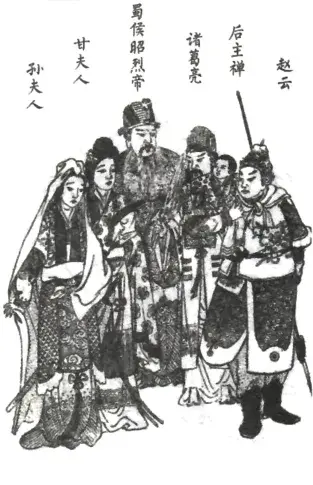
Lady Sun attempted to take child Liu Shan to Eastern Wu; intercepted on the river by Zhao Yun and Zhang Fei.
Liu Bei proclaimed himself Prince of Hanzhong, appointing Liu Shan as heir apparent to study classical statecraft.
Liu Bei founded Shu Han and ascended the throne in Chengdu, formally creating Liu Shan Imperial Crown Prince.
Liu Bei died at Baidicheng; Liu Shan succeeded to the throne in Chengdu, appointing Zhuge Liang to direct state affairs.
Chancellor Zhuge Liang passed away at Wuzhang Plains; Liu Shan mourned in white, appointing Jiang Wan to lead the administration.
Grand Marshal Jiang Wan died; Liu Shan assumed direct imperial oversight and elevated Fei Yi to oversee the Imperial Secretariat.
Cao Wei general Xiahou Ba fled to Shu following the Gaoping Tomb Incident; Liu Shan warmly consoled and honored him.
Deng Ai bypassed fortifications via Yinping; Liu Shan surrendered upon Qiao Zhou's counsel to spare the city from destruction.
Passed away peacefully in the Western Jin capital of Luoyang at age sixty-five; granted the posthumous title Duke Si.
Liu Shan was born in the twelfth year of Jian'an (207) while his father Liu Bei was garrisoned at Xinye under the nominal patronage of Liu Biao. In the autumn of 208, Cao Cao dispatched Cao Chun with five thousand elite Tiger-and-Leopard cavalry to pursue Liu Bei's fleeing forces at Changban. In the ensuing rout, Liu Bei was forced to abandon his family, but general Zhao Yun cradled the infant Liu Shan and shielded Lady Gan through enemy encirclement, ensuring their miraculous survival. In 211, when Liu Bei advanced westward into Yizhou, Lady Sun attempted to carry Liu Shan back to Eastern Wu, but Zhao Yun and Zhang Fei intercepted her vessel upon the Yangtze River and secured the child. Following Liu Bei's assumption of the title Prince of Hanzhong in 219, Liu Shan was established as heir apparent.
Upon Liu Bei's formal ascension as Emperor of Shu Han in 221, Liu Shan was created Imperial Crown Prince. To prepare the young prince for statecraft, Liu Bei required him to study classical administrative treatises including the Shenzi, Hanfeizi, Guanzi, and Six Secret Teachings, with Chancellor Zhuge Liang personally copying these manuscripts for his instruction, while Yin Mo taught him the Zuo Tradition. Furthermore, Liu Shan received rigorous training in horsemanship and martial archery, practicing frequently at She Mountain north of Chengdu. In 222, after the defeat at Yiling, Liu Bei fell gravely ill at Yong'an, prompting rebel commander Huang Yuan to seize Lingqiong County.
In the third month of 223, when Huang Yuan advanced toward the capital, Liu Shan dispatched imperial palace guards under commanders Chen Hu and Zheng Chuo to suppress the rebellion, capturing and executing the rebel leader. Following Liu Bei's death in the fourth month, Liu Shan ascended the throne in Chengdu in the fifth month at the age of seventeen, adopting the reign title Jianxing and creating Lady Zhang, daughter of Zhang Fei, as empress. In accordance with Liu Bei's testament, Liu Shan delegated governmental operations to Chancellor Zhuge Liang, authorizing all civil and military decisions to be determined by the Chancellor's office while he maintained formal sovereign authority.
During the first year of his reign, internal rebellions flared across southern commanderies under Zhu Bao and Gao Ding. While Zhuge Liang dispatched Deng Zhi to restore diplomatic alliance with Sun Quan of Eastern Wu, the Shu court implemented agricultural recovery policies in 224 to restore domestic stability. In 225, Zhuge Liang led imperial armies southward to subjugate the southern tribes, reorganizing the regional administrative structure into Jianning, Yunnan, and Xinggu commanderies. Between 228 and 234, Zhuge Liang initiated several northern expeditions against Cao Wei, maintaining intense military confrontation across the Qinling Mountains.
In 229, Sun Quan proclaimed himself Emperor of Eastern Wu and concluded a mutual partition treaty with Shu Han to divide Cao Wei's territories upon anticipated conquest. As administrative disputes arose, Chancellor Zhuge Liang impeached Protector Li Ping for fabricating logistical reports and dismissed him to civilian status. In the eighth month of 234, Zhuge Liang died of illness at Wuzhang Plains. When military dispute erupted between vanguard general Wei Yan and administrative secretary Yang Yi, Liu Shan consulted ministers Jiang Wan and Dong Yun, ultimately supporting Yang Yi while ordering Ma Dai to execute Wei Yan.
Following the army's safe return to Chengdu, Liu Shan issued a general amnesty, appointing Wu Yi as General of Chariots and Cavalry to defend Hanzhong, while appointing Jiang Wan as Prefect of the Masters of Writing to lead the central government. In 236, Liu Shan conducted imperial tours to Guanban in Qian County to inspect water conservancy along the Wen River. In 238, following the demise of Empress Zhang, Liu Shan elevated her younger sister to empress and invested his eldest son Liu Xuan as crown prince. In 240, General Zhang Ni suppressed indigenous unrest in Yuexi Commandery, restoring overland transit links to Chengdu.
In 242, Grand Marshal Jiang Wan proposed building a major fluvial fleet along the Han River to capture Shangyong, but ministerial debate concluded that river routes presented extreme tactical vulnerability during retreats. Demonstrating prudent strategic oversight, Liu Shan dispatched Fei Yi and Jiang Wei to Hanzhong to redirect Jiang Wan's strategic focus toward diplomatic ties with the Qiang and Di tribes. Concurring with this assessment, Liu Shan commissioned Jiang Wei as Inspector of Liangzhou to oversee border confederations, while elevating Ma Zhong to General Guarding the South to stabilize regional governance.
Liu Shan consistently demonstrated exceptional personal magnanimity and diplomatic tact in assimilating defecting commanders from rival states. In the first month of 249, when Sima Yi launched the Gaoping Tomb coup d'état in Cao Wei, prominent general Xiahou Ba fled toward Shu Han in extreme distress, losing his way among rugged mountain ravines until his horse perished. Upon learning of his plight, Liu Shan dispatched welcoming escorts to rescue him. At their formal imperial audience, Liu Shan personally comforted Xiahou Ba by emphasizing that his father Xiahou Yuan had perished in ordinary combat rather than through personal malice, gesturing affectionately to his imperial sons as maternal kin of the Xiahou clan before conferring high court ranks upon the distinguished general.
Chen Shou in the Records of the Three Kingdoms (Book of Shu: Biography of the Later Lord) evaluated: "The Later Lord was a ruler who followed principle when employing worthy ministers, yet became benighted when deluded by eunuchs. The proverb says: 'White silk has no constant hue; it takes whatever color it is dyed in.' How true this is! In imperial succession, changing the reign title traditionally occurred after the inaugural mourning year, yet in the third year of Zhangwu, the title was immediately altered to Jianxing, which transgressed classical precedent. Furthermore, the state established no official historians, leaving astronomical anomalies and civil actions largely unrecorded. While Zhuge Liang was exceptionally skilled in governance, institutional details such as these remained imperfect. Nonetheless, for twelve years the reign title was never altered, campaigns were frequently mounted without arbitrary pardons, which was truly remarkable! Following Liang's demise, these standards deteriorated, and the contrast between success and decline became manifest."
Sima Zhao remarked in the Chronicles of Han and Jin: "Can a human being truly be so devoid of emotion? Even had Zhuge Liang survived, he could not have preserved this ruler for long, much less Jiang Wei!" Jia Chong replied: "Had he not been so, how could Your Highness have annexed his domain so easily?"
Li Mi of Western Jin observed in response to Emperor Wu: "Duke Huan of Qi achieved hegemony when employing Guan Zhong, yet died disgraced when indulging Shudiao. The Duke of Anle resisted Wei when guided by Zhuge Liang, yet lost his kingdom when entrusting Huang Hao; their ultimate fates arose from identical causes."
FIGURES ASSOCIATED WITH THIS DYNASTY