About age thirty-seven | Recommended by Changshan Commandery and led volunteer officials and soldiers to join Gongsun Zan; met Liu Bei during this period
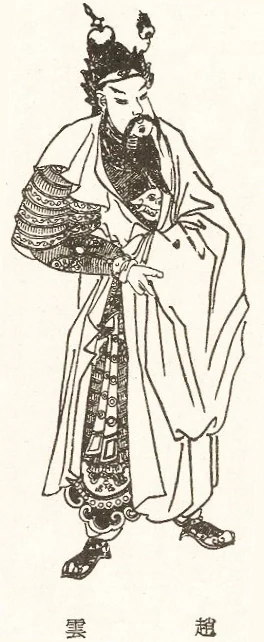
154 CE–229 CE
General
Zhao Yun
赵云
Zhao Yun (d. 229), courtesy name Zilong, was a native of Zhending in Changshan, present-day Zhengding in Shijiazhuang, Hebei, and a renowned general of Shu Han. He was described as eight chi tall and imposing in appearance and, together with Guan Yu and Zhang Fei, was known as one of the “Three Heroes of Yan South.” In 191, the second year of the Chuping era, Zhao Yun led volunteer troops from Changshan Commandery and joined…
154 CE–229 CEShu Han
PROFILE
Zhao Yun (d. 229), courtesy name Zilong, was a native of Zhending in Changshan, present-day Zhengding in Shijiazhuang, Hebei, and a renowned general of Shu Han. He was described as eight chi tall and imposing in appearance and, together with Guan Yu and Zhang Fei, was known as one of the “Three Heroes of Yan South.” In 191, the second year of the Chuping era, Zhao Yun led volunteer troops from Changshan Commandery and joined Gongsun Zan. In 200, the fifth year of the Jian'an era, he met Liu Bei at Ye and thereafter followed Liu Bei for nearly thirty years. He took part in the battles of Bowang Slope and Changban Slope, the pacification of Jiangnan, and later independently commanded forces in the campaigns into Yi Province, at the Han River, and at Jigu. In addition to campaigning, Zhao Yun served as General of the Household and concurrently as Administrator of Guiyang, as Rear-Camp Major while guarding Gong'an, and as General Who Supports the Army while overseeing Jiangzhou. After the pacification of Yi Province, he invoked the example of Huo Qubing to urge Liu Bei to return houses and farmland to the people. After Guan Yu and Zhang Fei were killed, he also advised Liu Bei not to attack Wu. Later generations praised him as a cultivated general with the judgment of a high minister. In 261, the fourth year of the Jingyao era of Shu Han, Zhao Yun was posthumously titled Marquis Shunping.
- Other names
- Zhao Zilong; Zhao Zilong of Changshan
- Courtesy name
- Zilong
- Era
- Shu Han
- Dynasty/Regime
- Shu Han
- Identity
- General
- Date of Birth
- Not recorded in historical sources
- Date of Death
- 229
- Ethnicity
- Han Chinese
- Ancestral home
- Zhending, Changshan (present-day Zhengding, Shijiazhuang, Hebei)
- Place of birth
- Not recorded in historical sources
- Major achievement
- Famous general of Shu Han; rescued the young Liu Shan single-handedly; remembered for loyalty and courage and often idealized by later generations as an exemplary military commander.
LIFE TIMELINE
CE – 195 CE(2nd year of the Chuping era – 2nd year of the Xingping
191 CE – 195 CE(2nd year of the Chuping era – 2nd year of the Xingping era) | Campaigned with Gongsun Zan | Campaigned with Gongsun Zan; followed Liu Bei in assisting Tian Kai against Yuan Shao and commanded Liu Bei's cavalry; later returned home after the death of his elder brother
About age forty-six | Met Liu Bei at Ye; the two shared sleeping quarters, and Zhao Yun secretly recruited several hundred soldiers; from this point he followed Liu Bei
About age forty-eight | Took part in the Battle of Bowang Slope, captured his fellow townsman Xiahou Lan alive, and recommended him for appointment as military legal officer
About age fifty-four | At the Battle of Changban Slope, carried Liu Shan and protected Lady Gan to safety; afterward appointed General of the Gate Corps
About age fifty-five | Followed Liu Bei in pacifying the four commanderies of Jing Province; appointed General of the Household and concurrently Administrator of Guiyang; politely refused Zhao Fan's proposal that he marry Fan, Zhao Fan's widowed sister-in-law
About age fifty-seven | Served as Rear-Camp Major and managed internal military affairs; together with Zhang Fei intercepted boats on the Yangtze and recovered Liu Shan
About age fifty-nine | Advanced westward up the river with Zhuge Liang and Zhang Fei, separately pacifying Jiangyang and Qianwei and taking part in the encirclement of Chengdu
About age sixty | After Chengdu was pacified, appointed General Who Supports the Army; urged Liu Bei to return houses and farmland to the people of Yi Province
About age sixty-five | At the Battle of the Han River, ordered the camp gates opened and the banners lowered, then heavily defeated Cao's troops; Liu Bei praised him by saying, “Zilong is courage all through,” and the army called him General of Tiger's Might
About age sixty-seven | Advised Liu Bei not to attack Eastern Wu; the advice was not accepted; remained as commander overseeing Jiangzhou
About age sixty-eight | After Liu Bei's defeat at the Battle of Yiling, Zhao Yun advanced to Yongan, by which time the Wu army had withdrawn
About age sixty-nine | Appointed Central Protector of the Army and General Who Conquers the South; enfeoffed as Marquis of Yongchang Village, later promoted to General Who Guards the East
About age seventy-four | With Deng Zhi held Jigu as a diversionary force; defeated because of inferior numbers, but gathered the troops and held firm; personally covered the retreat and preserved military supplies; demoted to General Who Guards the Army
About age seventy-five | Died
Posthumously titled Marquis Shunping | Posthumously titled Marquis Shunping
BIOGRAPHY
Biography
Family Background and Early Life
Zhao Yun came from Zhending in Changshan, present-day Zhengding, Hebei. His birth year is unknown; the source text places it approximately in the Jianning era, around 154. Historical records describe him as eight chi tall and imposing in appearance. Changshan Commandery was then part of Ji Province. In 191, the second year of the Chuping era, Gongsun Zan's younger brother Gongsun Yue aided Yuan Shu and Sun Jian in attacking Zhou Ang, who belonged to Yuan Shao's faction, and was killed by an arrow. Gongsun Zan blamed Yuan Shao, stationed troops at Panhe, submitted a memorial listing ten charges against Yuan Shao, and called on the provinces and commanderies to oppose him. Officers of Changshan Commandery, then under Yuan Shao, discussed the situation, decided to rebel against Yuan Shao, and selected Zhao Yun to lead the commandery's volunteer officials and soldiers to join Gongsun Zan.
Gongsun Zan asked Zhao Yun, “I hear that everyone in Ji Province wishes to attach themselves to Yuan Shao. How is it that you alone have found your way back from error?” Zhao Yun replied, “The realm is in great disorder and no one knows who is the enlightened ruler. The people are in extreme peril. We of Changshan discussed the matter and decided to follow the side capable of practicing benevolent government. It is not that we wished to turn away from Yuan Shao and favor you, General.” Gongsun Zan was deeply impressed, and from then on Zhao Yun followed him on campaign.
Liu Bei was also attached to Gongsun Zan at the time, allowing the two men to form a close relationship. During Gongsun Zan's war with Yuan Shao, he sent the Inspector of Qing Province, Tian Kai, to occupy territory in northwestern Qing Province, while Yuan Shao also sent tens of thousands of troops to contest it. Gongsun Zan memorialized for Liu Bei to be promoted to Major of a Separate Command and sent him to assist Tian Kai against Yuan Shao. Zhao Yun accompanied Liu Bei and commanded his cavalry. Their cooperation left both men with a favorable impression of the other.
Later Zhao Yun requested leave from Gongsun Zan to return home after his elder brother died. Liu Bei understood that Zhao Yun was unlikely to return and held his hand reluctantly at their parting. Zhao Yun told him, “I will never betray virtue.”
Following Liu Bei
In 200, the fifth year of the Jian'an era, after Liu Bei was defeated in Xu Province by Cao Cao, he attached himself to Yuan Shao. Zhao Yun came to Ye to meet Liu Bei, and the two men shared sleeping quarters and became close. Liu Bei secretly ordered Zhao Yun to recruit several hundred soldiers, publicly describing them as troops under Left General Liu Bei; Yuan Shao was unaware of the arrangement. After Liu Bei failed in an attempt to disrupt Cao Cao's rear from Runan, Zhao Yun followed Liu Bei to Jing Province, where Liu Bei attached himself to Liu Biao.
In 202, the seventh year of the Jian'an era, Liu Bei was stationed at Xinye. Cao Cao sent Xiahou Dun, Yu Jin, and others to attack, and the armies fought at Bowang. Liu Bei feigned retreat and used an ambush to defeat Cao's troops. During the battle Zhao Yun captured the opposing officer Xiahou Lan alive. Because Zhao Yun and Xiahou Lan were fellow townsmen and had known one another since youth, Zhao Yun asked Liu Bei to spare him. Xiahou Lan was also knowledgeable about law, and Liu Bei appointed him military legal officer. Zhao Yun did not place his personal acquaintance under his own command, an example used in the source text to illustrate his caution and judgment.
In 208, the thirteenth year of the Jian'an era, Cao Cao's main army moved south into Jing Province. Liu Biao's younger son Liu Cong first surrendered the province and only afterward sent word to Liu Bei, who was stationed at Fancheng. Liu Bei could not resist and withdrew without battle. As he passed Xiangyang, more than one hundred thousand civilians spontaneously followed him, greatly slowing the march. Cao Cao pursued with five thousand elite cavalry, reportedly covering more than three hundred li in a day and night, and caught up at Changban in Dangyang. In the emergency Liu Bei abandoned his wife and children and escaped with only several dozen horsemen including Zhang Fei, Zhuge Liang, and Zhao Yun. Zhao Yun disappeared in the confusion, and someone reported that he had gone north. Liu Bei immediately struck at the speaker with his hand halberd and said, “Zilong would never abandon me and flee.” Zhao Yun then returned carrying Liu Bei's young son Liu Shan and protecting Lady Gan, Liu Bei's wife, bringing them safely back. After the battle Liu Bei appointed him General of the Gate Corps.
Guarding Jing Province
After the Battle of Red Cliffs, Zhao Yun followed Liu Bei in pacifying the four southern commanderies of Jing Province. Liu Bei appointed him General of the Household and made him concurrently Administrator of Guiyang in place of the surrendered Zhao Fan. Zhao Fan had a widowed sister-in-law of the Fan clan, described as exceptionally beautiful, and wished to marry her to Zhao Yun. Zhao Yun refused, saying, “We share the same surname; your elder brother's wife is like my own elder brother's wife.” Others urged him to accept the marriage, but Zhao Yun replied, “Zhao Fan surrendered under compulsion and his intentions cannot be known. Besides, there is no shortage of women in the world.” Zhao Fan soon escaped at an opportunity, while Zhao Yun remained uninvolved.
In 209, after Liu Bei pacified the four southern commanderies of Jing Province and gained more than ten thousand troops formerly under Liu Biao, he became Governor of Jing Province and his power increased. Sun Quan proposed a marriage alliance, and Liu Bei married Sun Quan's younger sister, Lady Sun. Two years later, Liu Zhang, Governor of Yi Province, sought Liu Bei's aid against Cao Cao. Liu Bei led thirty thousand troops into Yi Province, leaving Zhuge Liang, Guan Yu, Zhang Fei, Zhao Yun, and others to guard Jing Province. Zhao Yun was appointed Rear-Camp Major and placed in charge of military affairs. Lady Sun was arrogant and indulgent, while the guards and officials she had brought from Eastern Wu often acted unlawfully. Liu Bei considered Zhao Yun stern and cautious enough to impose order and specifically entrusted him with internal affairs.
In 211, the sixteenth year of the Jian'an era, Sun Quan learned that Liu Bei had gone west into Yi Province and sent many vessels to bring Lady Sun back. She attempted to take Liu Shan with her. Zhao Yun and Zhang Fei led troops to intercept the boats on the Yangtze and successfully recovered Liu Shan, an episode later known as the “interception on the river and recovery of Adou.”
Campaign in Ba and Shu
In 213, the eighteenth year of the Jian'an era, Liu Bei broke with Liu Zhang, advanced from Jiameng against him, and summoned Zhuge Liang and others into Shu as reinforcements. Zhuge Liang, Zhao Yun, Zhang Fei, and their troops moved westward upstream, pacifying commanderies and counties along the way. After taking Jiangzhou they divided into two routes. Zhao Yun led his force along the outer river, captured Jiangyang, Qianwei, and other commanderies, and by the following year completed the encirclement of Liu Zhang from the south of Chengdu. After Liu Bei captured Chengdu, Zhao Yun was appointed General Who Supports the Army.
After Liu Bei pacified Yi Province, some proposed distributing the houses within Chengdu and the gardens, mulberry fields, and farmland outside the city among the generals. Zhao Yun opposed the proposal, quoting Huo Qubing's statement, “The Xiongnu are not yet destroyed; there can be no home for me,” and argued that the state's enemies were not limited to a single Xiongnu-like foe and that the time for settling down had not arrived. Only after the realm was pacified, he said, should people return home to cultivate their fields. The people of Yi Province had just suffered war, so their homes and property should be returned to them so that they could settle and work; only then could the government call on them for military service and household taxes and thereby win the people's support. Liu Bei immediately accepted Zhao Yun's advice.
Display of Power at the Han River
In the first month of 219, the twenty-fourth year of the Jian'an era, Liu Bei followed the advice of Fa Zheng, Huang Quan, and others and attacked Hanzhong. Xiahou Yuan, the defender of Hanzhong, was killed by Huang Zhong. In the third month Cao Cao personally led a large army to contest Hanzhong and transported an enormous quantity of grain to the foot of Beishan, described as tens of millions of sacks. Huang Zhong believed the supplies could be seized, and Zhao Yun assigned troops to support the attempt. When Huang Zhong failed to return at the appointed time, Zhao Yun rode out of camp with several dozen cavalrymen to investigate and encountered a large force sent by Cao Cao.
Cao's vanguard attacked Zhao Yun. As soon as fighting began, Cao Cao's main force arrived in imposing strength. Zhao Yun repeatedly charged the enemy formation while fighting a withdrawal. Cao's troops scattered and re-formed; Zhao Yun broke through and returned to the Han camp. His subordinate Zhang Zhu had been wounded and surrounded, so Zhao Yun charged again, rescued him, and brought him back. Cao's army pursued to the camp. The Magistrate of Mianyang, Zhang Yi, was preparing to close the gates and defend the position, but Zhao Yun instead ordered the camp gates thrown open and the Han banners lowered and drums silenced. Suspecting an ambush, Cao's troops withdrew. Zhao Yun then ordered the war drums sounded and crossbowmen to shoot. Cao's soldiers panicked, trampled one another, and many fell into the Han River and drowned.
The next day Liu Bei personally came to Zhao Yun's camp to inspect the battlefield and exclaimed, “Zilong is courage all through!” He held a celebratory banquet until evening. The army thereafter called Zhao Yun General of Tiger's Might.
Advice against the Eastern Campaign and Later Years
In 221, the first year of the Zhangwu era, Liu Bei proclaimed himself emperor and wished to attack Eastern Wu in revenge for Sun Quan's seizure of Jing Province and the killing of Guan Yu. Zhao Yun remonstrated: “The enemy of the state is Cao Cao, not Sun Quan. Once Cao Wei is destroyed, Sun Quan of Eastern Wu will naturally submit. Although Cao Cao is dead, his son Cao Pi has usurped the throne and aroused public anger. We should use that anger to seize Guanzhong and occupy the upper Yellow and Wei river valleys in order to punish the usurper. Then loyal men east of the passes will bring provisions and ride out to welcome the royal army. We should not set Cao Wei aside and attack Eastern Wu first. Once war with Eastern Wu begins, it will be difficult to stop. Attacking Wu is not the best policy.” Liu Bei, angered by Guan Yu's death, rejected the advice and insisted on campaigning east, leaving Zhao Yun to oversee Jiangzhou.
In 222, the second year of the Zhangwu era, Liu Bei's eastern army was defeated at the Battle of Yiling and retreated from Zigui to Yongan. Zhao Yun advanced to Yongan, but the Wu army had already withdrawn. In 223, the third year of the Zhangwu era, Liu Bei died at Yongan and Liu Shan succeeded him. Zhao Yun was appointed Central Protector of the Army and General Who Conquers the South, enfeoffed as Marquis of Yongchang Village, and later promoted to General Who Guards the East.
In 227, the fifth year of the Jianxing era, after the pacification of Nanzhong and the renewal of alliance with Eastern Wu, Zhuge Liang led the generals into Hanzhong in preparation for a northern expedition. Zhao Yun moved to Hanzhong with him. In 228, the sixth year of the Jianxing era, Zhuge Liang launched the northern expedition and announced that the main force would advance through the Xie Valley route, ordering Zhao Yun and Deng Zhi to hold Jigu as a diversion. The Wei General-in-Chief Cao Zhen led a large army against them. Because Zhao Yun and Deng Zhi had weaker forces, they were defeated at Jigu, but they quickly rallied their troops and held firm, preventing a major disaster. During the withdrawal Zhao Yun personally covered the rear and stopped Wei pursuit, so losses in personnel and military supplies remained small.
Zhuge Liang later asked, “When our forces withdrew from Jieting, the formations were thrown into complete disorder. Yet when the troops withdrew from Jigu, their organization was as orderly as when they set out. Why was this?” Deng Zhi replied, “General Zhao personally covered the rear, so no military supplies were lost and the units remained orderly.” Zhao Yun's troops still had surplus silk cloth, and Zhuge Liang ordered it distributed to the soldiers. Zhao Yun said, “Our army suffered defeat; how can we accept rewards? Put all these materials into the storehouses at Chi'an and distribute them to the soldiers during the cold of the tenth month.” Zhuge Liang greatly praised his conduct.
The northern expedition ended in failure. Zhuge Liang submitted a memorial taking responsibility and demoted himself by three ranks, while Zhao Yun was also demoted to General Who Guards the Army. Zhao Yun died in 229, the seventh year of the Jianxing era.
From Changshan to Gongsun Zan, and the Capture of Xiahou Lan at Bowang
Zhao Yun was a man of Zhending in Changshan, his birth year unknown, and is described as eight feet tall and of magnificent appearance. Changshan commandery belonged to Jizhou; and in 191, when Gongsun Zan's brother Gongsun Yue, aiding Yuan Shu and Sun Jian against Yuan Shao's officer Zhou Ang, was killed by a stray arrow, Gongsun Zan laid the blame on Yuan Shao, camped at the Pan river, memorialized listing ten crimes of Yuan Shao and called on the provinces and commanderies to attack him together. The officers of Changshan, then under Yuan Shao, took counsel and resolved to turn against him, and chose Zhao Yun to lead the commandery's volunteers and officials to join Gongsun Zan. Gongsun Zan asked him how it was that, when all Jizhou wished to attach itself to Yuan Shao, he alone had come back from his error; and Zhao Yun answered that with the empire in disorder and no one knowing who the true lord was, and the people hanging as if upside down, the men of Changshan had taken counsel and resolved to follow wherever good government was practised, not because they wished to leave Yuan Shao and favour the general. Gongsun Zan was much pleased, and Zhao Yun afterwards campaigned with him everywhere. At that time Liu Bei was also attached to Gongsun Zan and the two became close: when Gongsun Zan fought Yuan Shao he sent the governor of Qingzhou, Tian Kai, to occupy the north-west of Qingzhou while Yuan Shao sent several tens of thousands to contest it, and Gongsun Zan memorialized to promote Liu Bei to be a detached commandant and sent him to help Tian Kai resist Yuan Shao, Zhao Yun going with him and taking charge of his cavalry. Later, when Zhao Yun asked leave to go home on his elder brother's death, Liu Bei, knowing he would not return, held his hand and could not bear to part, and Zhao Yun took leave of him with the words that he would never betray virtue. In 200, when Liu Bei, beaten by Cao Cao at Xuzhou, attached himself to Yuan Shao, Zhao Yun came to see him at Ye and the two slept on the same mat; and Liu Bei secretly had Zhao Yun recruit several hundred soldiers, giving them out as the retainers of the general of the left, of which Yuan Shao knew nothing. After Liu Bei's raid on Cao Cao's rear at Runan failed, Zhao Yun went with him to Jingzhou to attach himself to Liu Biao. In 202 Liu Bei camped at Xinye; and when Cao Cao sent Xiahou Dun, Yu Jin and others against him and the two sides fought at Bowang, Liu Bei by a feigned retreat broke the Cao army with an ambush, and Zhao Yun in the fighting took the enemy general Xiahou Lan alive. Zhao Yun and Xiahou Lan being of the same district and known to each other from boyhood, he begged Liu Bei for his life; and Xiahou Lan being versed in law, Liu Bei made him provost marshal — so that Zhao Yun would not employ those close to him, in which his caution and forethought may be seen.
Saving the Heir at Changban, Refusing a Marriage at Guiyang, and Managing the Inner Household
In 208, when Cao Cao's great army came south into Jingzhou, Liu Biao's second son Liu Zong surrendered the province and only then informed Liu Bei at Fancheng. Liu Bei, unable to resist, withdrew without fighting; and passing Xiangyang more than a hundred thousand people of the city followed of their own accord, so that the march was very slow. Cao Cao with five thousand picked cavalry pursued, covering more than three hundred li in a day and a night, and came up with him at Changban in Dangyang. In the crisis Liu Bei abandoned his wife and children and fled with only Zhang Fei, Zhuge Liang, Zhao Yun and a few dozen riders; and when Zhao Yun was missing in the confusion and someone said he had gone north, Liu Bei struck at him with his own halberd and said that Zilong would never leave him. Afterwards Zhao Yun, holding Liu Bei's young son Liu Shan in his arms and protecting Liu Bei's wife Lady Gan, brought them safely back; and for this Liu Bei made him general of the gate. After the Red Cliffs, Zhao Yun with Liu Bei reduced the four commanderies of Jingzhou, and Liu Bei made him general of the subordinate guard and gave him the governorship of Guiyang in place of the surrendered Zhao Fan. Zhao Fan had a widowed sister-in-law named Fan of beauty that could overthrow a state, and wished to give her to Zhao Yun, who declined, saying that since they shared a surname her husband's brother was as his own brother; and when others urged him to take her he answered that Fan had surrendered under compulsion and his mind could not be gauged, and that the empire held no lack of women. Presently Zhao Fan took the occasion to flee, and Zhao Yun was in no way implicated. In 209, when Liu Bei, having reduced the four southern commanderies of Jingzhou and gained ten thousand former retainers of Liu Biao, became governor of Jingzhou, Sun Quan proposed a marriage and Liu Bei took his sister, Lady Sun; and two years later, when the governor of Yizhou, Liu Zhang, asked his help against Cao Cao, Liu Bei led thirty thousand men into Yizhou, leaving Zhuge Liang, Guan Yu, Zhang Fei and Zhao Yun to hold Jingzhou and making Zhao Yun marshal of the resident camp to manage military business. Lady Sun being then arrogant and unrestrained, and the guards and officials she had brought from Wu often breaking the law, Liu Bei, holding Zhao Yun grave and careful and therefore able to bring them into order, gave him special charge of the inner household. In 211, when Sun Quan learned that Liu Bei had gone west into Yizhou and sent many ships to bring his sister home, she took the occasion to carry off Liu Shan as well; and Zhao Yun with Zhang Fei brought troops to bar the river and recovered Liu Shan — the affair later known as "seizing Liu Shan on the river," which the Spring and Autumn of the Han and Jin records rather as Zhuge Liang sending Zhao Yun to bar the river and keep the heir.
The Campaign into Ba and Shu, and the Display at the Han River
In 213, when Liu Bei broke with Liu Zhang and attacked him from Jiameng, he summoned Zhuge Liang and the others into Shu. Zhuge Liang with Zhao Yun and Zhang Fei went up the river, reducing commanderies and counties on the way; and after taking Jiangzhou they divided, Zhao Yun going by the outer water to take Jiangyang and Jianwei and the rest, so that by the next year Liu Zhang was enclosed to the south of Chengdu. After Chengdu fell Liu Bei made him general of the wings. When Yizhou was pacified some proposed to distribute the houses of Chengdu and the gardens, mulberry fields and farmland outside it among the generals, and Zhao Yun objected, saying that Huo Qubing had held that while the Xiongnu remained undestroyed a man had no use for a home, that the enemies of the state were now more than the Xiongnu and the time for seeking ease had not come, that only when the empire was settled should men return each to his own place and to the ploughing of his own fields, which would be right; and that the people of Yizhou, but lately visited by war, should have their lands and houses returned to them so that they might live and work in peace, after which they could be called on for service and taxes and their hearts won. And Liu Bei adopted it at once. It is worth noting that before Chengdu was taken Liu Bei had agreed with his officers not to interfere in their plundering of the treasuries, which left him in serious financial difficulty until Liu Ba advised minting a "straight hundred" coin, steadying prices and having officers set up government markets; and it was against this background that some still proposed distributing land and houses to the generals, so that Zhao Yun's objection citing Huo Qubing and his plea for restoring the property to the people stands in contrast with the straits of the treasury at the time.
In the first month of 219, Liu Bei, taking the advice of Fa Zheng and Huang Quan and others, attacked Hanzhong, and its commander Xiahou Yuan was killed by Huang Zhong. In the third month Cao Cao came in person with a great army to contest Hanzhong and sent great quantities of grain to the north hill, several tens of millions of sacks; and Huang Zhong thinking it might be seized, Zhao Yun gave him troops to fetch it, but Huang Zhong did not return at the appointed time. Zhao Yun then went out with a few dozen riders to see how matters stood and happened upon the great army Cao Cao had sent: attacked by the Cao vanguard, he had but engaged when Cao Cao's main force arrived with overbearing strength, and Zhao Yun charged the Cao ranks again and again, fighting and retiring; and the Cao troops, having scattered, closed again, so that Zhao Yun broke out and withdrew into his camp. His officer Zhang Zhu being wounded and surrounded by the Cao troops, Zhao Yun again galloped out against them, brought Zhang Zhu out and took him back to camp; and the Cao troops pursuing to the camp, where the chief of Mianyang, Zhang Yi, was about to shut the gates and hold out, Zhao Yun on entering ordered the gates thrown wide open and the banners furled and the drums silenced. The Cao troops, seeing this, suspected an ambush and drew back; whereupon Zhao Yun ordered the drums beaten until they shook the sky and had his men shoot at the Cao troops with crossbows, so that they were terrified, trampled one another and many drowned in the Han river. The next day Liu Bei came in person to the camp and looked at the ground of the day before, and cried out that Zilong was all courage; and they feasted until dusk, and the army called Zhao Yun the general of tiger might.
His Remonstrance against the Eastern Campaign, the Rearguard at Jigu, and His Posthumous Name
In 221, when Liu Bei took the imperial title and wished to attack Wu to avenge Sun Quan's seizure of Jingzhou and the killing of Guan Yu, Zhao Yun remonstrated, saying that the enemy of the state was Cao Cao and not Sun Quan, and that with Wei destroyed Wu would submit of itself; that though Cao Cao was dead his son Cao Pi had usurped the throne and roused public anger, so that they should use that anger to take Guanzhong first and hold the upper waters of the Yellow and Wei rivers to punish the rebels, whereupon the righteous men east of the passes would bring grain and spur their horses to welcome the royal army; that they should not set Wei aside and fight Wu first; and that once the armies engaged it could not be quickly ended. But Liu Bei in anger would not listen, insisted on the eastern campaign and left Zhao Yun in command at Jiangzhou. In 222 the eastern army was beaten at Yiling and fled from Zigui to Yongan, and Zhao Yun advanced to Yongan, the Wu troops having withdrawn. In 223 Liu Bei died at Yongan and the heir Liu Shan came to the throne, and Zhao Yun was made colonel of the central guards and general of the southern expedition, enfeoffed marquis of the Yongchang pavilion and afterwards advanced to general of the east. In 227 Zhuge Liang with the generals entered Hanzhong to prepare the northern campaign, and Zhao Yun went with him; and in 228, when Zhuge Liang marched out, giving out that he would go by the Xiegu road, he had Zhao Yun and Deng Zhi take a feigned force to hold Jigu while he himself attacked Qishan. The Wei general-in-chief Cao Zhen led a great army to block them, and Zhao Yun and Deng Zhi, being weak against a strong enemy, were defeated at Jigu, but gathering their troops in time and holding firm they suffered no great loss; and in the withdrawal Zhao Yun himself brought up the rear and checked the pursuit, so that neither stores nor men were much lost. Zhuge Liang asked how it was that at the retreat from Jieting the troops and officers had lost all order, while at the retreat from Jigu the order was as on the day they marched out; and Deng Zhi answered that General Zhao had himself brought up the rear, so that no stores were abandoned and officers and men had no chance to be separated. There being surplus silk in Zhao Yun's stores, Zhuge Liang ordered it distributed to his troops, and Zhao Yun said that with the campaign unsuccessful there was no ground for reward, and asked that it all be lodged in the treasury at Chi'an to be given as winter bounty in the tenth month; and Zhuge Liang much approved of it. The campaign failed because on the Qishan front the officer in charge disobeyed orders and was beaten by the Wei general, and Zhuge Liang memorialized to demote himself three grades, Zhao Yun being reduced to general of the garrison (the Record of Huayang giving it as a reduction of his stipend). In 229 Zhao Yun died and was given the posthumous name marquis Shunping. It is recorded that under the first emperor only Fa Zheng had received a posthumous name, and under the heir apparent Zhuge Liang of world-covering merit, Jiang Wan and Fei Yi bearing the weight of the state, and others specially favoured; and then Guan Yu, Zhang Fei, Ma Chao, Pang Tong, Huang Zhong and Zhao Yun were all posthumously honoured, which men of the day thought an honour; the heir's edict said that Zhao Yun had followed the late emperor with conspicuous merit and that he, being young, had passed through hardships and relied on his loyalty and obedience to come safe out of danger, and that a posthumous name was the means of recording great service; and the general-in-chief Jiang Wei and others judged that at Changyang his righteousness pierced metal and stone, that loyal in guarding his lord he was remembered for reward and that courteous in dealing with those below he forgot death, and that by the statutes of posthumous naming the gentle, worthy and kind is "Shun" and the one who keeps his place in office is "Ping," so that he should be called marquis Shunping. His son Zhao Tong inherited and rose to be commandant of the tiger guards and acting army commander; his second son Zhao Guang, a general of the gate, died in battle with Jiang Wei at Tazhong.
Major Activities
Rescue at Changban Slope
In 208, the thirteenth year of the Jian'an era, Cao Cao's army advanced south into Jing Province and his elite cavalry caught Liu Bei at Changban in Dangyang. Liu Bei fled south after abandoning his wife and children. Amid the fighting Zhao Yun carried Liu Bei's young son Liu Shan, protected Lady Gan, broke through Cao's encirclement, and safely returned to Liu Bei. The episode established Zhao Yun's image as a loyal and courageous protector and became one of the most representative events of his life.
Interception on the Yangtze and Recovery of Adou
In 211, the sixteenth year of the Jian'an era, Sun Quan sent ships to bring Lady Sun back to Eastern Wu, and she attempted to take Liu Shan with her. Zhao Yun and Zhang Fei led troops to intercept the boats on the Yangtze and successfully recovered Liu Shan, preventing Eastern Wu from taking him away.
Empty-Camp Tactic at the Han River
In 219, the twenty-fourth year of the Jian'an era, after rescuing Zhang Zhu at the Battle of the Han River, Zhao Yun faced Cao Cao's approaching army and ordered the camp gates opened and the banners lowered and drums silenced. Cao's troops suspected an ambush and withdrew. Zhao Yun then ordered drums sounded and arrows loosed, causing the enemy to trample one another and many to fall into the Han River and drown. Liu Bei came to inspect the battlefield the next day and praised Zhao Yun as “courage all through.” The army called him General of Tiger's Might.
Remonstrance to Liu Bei
Two major remonstrances in Zhao Yun's career were later cited as evidence of political foresight. After the pacification of Yi Province, he quoted Huo Qubing's statement, “The Xiongnu are not yet destroyed; there can be no home for me,” and urged Liu Bei to return houses and farmland to the people, helping stabilize local support. In 221, when Liu Bei wished to attack Wu in revenge, Zhao Yun argued that Cao Wei, not Eastern Wu, was the principal enemy and that the state should first seek to seize Guanzhong and punish the usurper. Liu Bei did not accept the advice; the subsequent defeat at Yiling was later viewed as confirming Zhao Yun's judgment.
Rearguard at Jigu
In 228, the sixth year of the Jianxing era, Zhao Yun and Deng Zhi led the diversionary force at Jigu and were defeated because they faced a stronger enemy with fewer troops. Zhao Yun rallied his men, maintained order, and personally covered the retreat, keeping losses of personnel and supplies very small. Zhuge Liang remarked that the Jigu troops returned in the same orderly formation in which they had marched out. Zhao Yun also refused distribution of surplus silk cloth and asked that it be stored for winter use, conduct that Zhuge Liang highly praised.
Refusal to Marry Lady Fan
While serving as Administrator of Guiyang, Zhao Fan proposed that Zhao Yun marry his widowed sister-in-law, Lady Fan. Zhao Yun politely refused on the grounds that he and Zhao Fan shared the same surname and also judged that Zhao Fan had surrendered under compulsion and could not yet be trusted. Zhao Fan soon fled, and Zhao Yun remained uninvolved, an episode later cited as evidence of his caution and foresight.
The Political Content of His Two Remonstrances, and the Layers of the Sources on His "Caution"
Zhao Yun's two great remonstrances each had concrete policy content. Against distributing the houses of Chengdu and the gardens, mulberry fields and farmland outside it among the generals, he cited Huo Qubing's saying that while the Xiongnu remained a man had no use for a home, but the point was not personal austerity alone: it was that only when the empire was settled should men go home to their own fields, and that the people of Yizhou, but lately visited by war, should have their lands and houses restored so that they might live and work in peace and could then be called on for service and taxes and their hearts won — linking restitution to the revival of production, the levying of taxes and the winning of the people's allegiance; and this, like his answer at Guiyang that Fan had surrendered under compulsion and his mind could not be gauged, was a judgement made from the standpoint of whether the place could be governed in the long run. In 221 he distinguished the enemy of the state from a private grudge, urged that advantage be taken of the people's anger to seize Guanzhong and hold the upper waters of the Yellow and Wei, and pointed out that once the armies engaged it could not be quickly ended; and Liu Bei not listening and the defeat at Yiling following, this judgement has often been cited as evidence of Zhao Yun's strategic sense. In command and conduct the affair at Jigu shows his manner best: beaten where weak against strong, he could gather his troops and hold, so as not to be greatly defeated; in withdrawing he "brought up the rear himself, so that no stores were abandoned"; and he lodged the surplus silk in the treasury at Chi'an as a winter bounty, which Zhuge Liang much approved. His refusal of the marriage at Guiyang, and his asking mercy for his fellow provincial Xiahou Lan while not employing those close to him, show his caution and his separation of public from private from two sides.
As to the sources, it should be noted that many of Zhao Yun's deeds come from the attached traditions such as the Separate Traditions of Yun and from later miscellanies, whose narratives are fuller than the biography in the Records of the Three Kingdoms. The detailed course of the fight at the Han river, the detail that Liu Bei struck with his own halberd at Changban, and the three differing accounts of the seizing of Liu Shan on the river (the Comprehensive Mirror giving Zhang Fei and Zhao Yun barring the river, the Separate Traditions the same, and the Spring and Autumn of the Han and Jin Zhuge Liang sending Zhao Yun to bar the river and keep the heir) differ in detail; and so later ages have summed him up as both fearless and cautious, though the fullness of that image differs from book to book. What can be confirmed is the framework: that in his youth he led the volunteers of Changshan to Gongsun Zan and answered that he sought where good government was; that he managed Liu Bei's cavalry and saved Liu Shan and Lady Gan at Changban; that as governor of Guiyang he refused Zhao Fan's sister-in-law; that as marshal of the resident camp he managed the inner household and took part in the seizure on the river; that he went with Zhuge Liang into Shu and took Jiangyang and Jianwei; that in the Hanzhong campaign he turned back the Cao army with an empty camp and won the praise of being all courage; that he remonstrated against the eastern campaign; that he lost at Jigu but brought his force away and was reduced in rank for it; and that he was posthumously named marquis Shunping. On the whole he was not a commander who held a theatre alone, but in guarding his lord, in discipline, in bringing up the rear and in remonstrance he left concrete and checkable records, which agrees with a career in Shu-Han that never reached the highest rank (going no higher than general of the east and general of the garrison).
Personal Relations
- Elder brother: died early; Zhao Yun once left Gongsun Zan to return home for the funeral
- Zhao Tong: elder son; inherited the marquisate of Yongchang Village after Zhao Yun's death and later served as Commander of the Tiger Guards and acting army commander
- Zhao Guang: younger son; served as Gate General and was killed while fighting Wei forces alongside Jiang Wei at Tazhong
- Lady Zhao: according to the Qing Gazetteer of Jiangling County, wife of Guan Ping and mother of Guan Yue; doubtful
- Liu Bei: the ruler whom Zhao Yun followed throughout his career. They first met under Gongsun Zan in 191 and remained associated for nearly thirty years. Liu Bei trusted Zhao Yun deeply, insisting at Changban that “Zilong would not abandon me,” and after the Han River battle praised him as “courage all through.”
- Liu Shan: the young ruler whom Zhao Yun rescued at Changban. In gratitude for Zhao Yun's life-saving service, Liu Shan posthumously titled him Marquis Shunping in 261, the fourth year of the Jingyao era.
- Zhuge Liang: Zhao Yun's superior during the northern expeditions and an admirer of his character and military ability.
- Gongsun Zan: the warlord whom Zhao Yun first joined; Zhao Yun later left after the death of his elder brother.
- Guan Yu and Zhang Fei: together with Zhao Yun known as the “Three Heroes of Yan South”; all were prominent Shu Han generals.
- Huang Zhong: fought alongside Zhao Yun at the Han River; Zhao Yun led troops to support him.
- Deng Zhi: Zhao Yun's partner at Jigu, where the two commanded a diversionary force against Cao Zhen.
- Zhang Fei: acted together with Zhao Yun in recovering Liu Shan from Lady Sun's convoy.
- Xiahou Lan: fellow townsman and old acquaintance captured at Bowang; Zhao Yun asked Liu Bei to spare him and recommended him as military legal officer.
Historical Assessment
Shu Han and Contemporary Views
- Liu Bei: “Zilong is courage all through.” (Yun Biezhuan)
- Liu Shan: “Yun formerly followed the late emperor and accumulated manifest merit. When I was young and inexperienced and passed through hardship and danger, I relied upon his loyalty and obedience to be delivered from peril.” (Records of the Three Kingdoms: Biography of Zhao Yun, Pei Songzhi's annotations)
- Chen Shou: “Huang Zhong and Zhao Yun were strong, resolute, brave, and fierce, serving as claws and teeth. Were they not men of the type of Guan Ying and Xiahou Ying?” (Records of the Three Kingdoms, collective biography of Guan Yu, Zhang Fei, Ma Chao, Huang Zhong, and Zhao Yun)
- Jiang Wei and others: “Yun formerly followed the late emperor; his labors and achievements were already manifest. In managing the realm he upheld laws and standards, and his accomplishments deserve record. In the battle at Dangyang, his righteousness was as firm as metal and stone and his loyalty protected his lord.” (Records of the Three Kingdoms: Biography of Zhao Yun, Pei Songzhi's annotations)
Song and Yuan Periods
- Xiao Chang: “Even among famous generals of antiquity, none surpassed Yun.” (Continuation of the Book of the Later Han)
- Hao Jing: “Yun's loyalty penetrated metal and stone, and his righteousness moved the spirits. In the battle at Dangyang he may indeed be called a minister who protected the altars of state.” (Continuation of the Book of the Later Han)
- Cheng Gongxu: “Zhao Yun's remonstrance against attacking Wu differed from Kongming's in form but was the same in substance; both were the best plans for the state.” (Cangzhou Chenfou Bian)
Ming and Qing Periods
- Li Zhi: “Zhao Yun's remonstrance against attacking Wu differed from Kongming's in form but was the same in substance; both were the best plans for the state.” (Cangshu)
- Wang Fuzhi: “Zhao Yun's refusal of Zhao Fan's sister-in-law was stricter than Guan Yu's refusal of marriage; his remonstrance against attacking Wu was more correct than Fa Zheng's advice to attack Wei. He possessed the capacity of a great minister.” (Du Tongjian Lun)
- Mao Zonggang: “Zilong was not merely the bravest of the armies; his insight was especially high, beyond that of the other generals.” Commentary on Romance of the Three Kingdoms
Modern Period
- Lü Simian: “Zhao Yun was a figure of considerable bearing in the Three Kingdoms era; his judgment and character were above those of ordinary military officers.” (Stories from Three Kingdoms History)
- Zhang Dake: “Zhao Yun was one of the most politically clear-headed generals in the Shu Han group. His insight in opposing the attack on Wu was not inferior to Zhuge Liang's.” (Studies of Three Kingdoms History)
- Tian Yuqing: “Among the Shu Han generals, Zhao Yun was known for loyalty, caution, and steadiness. His words and actions followed proper standards; he may be called an excellent general of his age.” (Studies in Qin, Han, Wei, and Jin History)
FIGURES ASSOCIATED WITH THIS DYNASTY
Bibliography
- Chen Shou, Records of the Three Kingdoms, Book of Shu, collective biography of Guan Yu, Zhang Fei, Ma Chao, Huang Zhong, and Zhao Yun
- Pei Songzhi, Annotated Records of the Three Kingdoms, citing Yun Biezhuan
- Hao Jing, Continuation of the Book of the Later Han
- Lü Simian, Stories from Three Kingdoms History