Birth in Zhuo Commandery
Born in northern Zhuo Commandery, growing into an imposing warrior of unmatched ferocity.
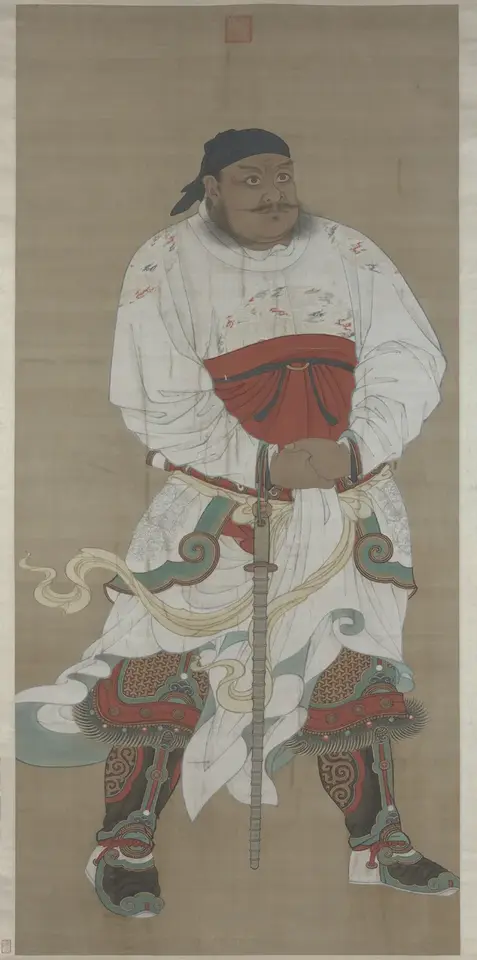
166 CE–221 CE
张飞
Zhang Fei (d. 221 CE), courtesy name Yide, was a native of Zhuo Commandery in You Province (modern Zhuozhou, Hebei). He was a legendary military commander and founding pillar of the Shu Han state during the Three Kingdoms period. Celebrated alongside Guan Yu as a "champion capable of confronting ten thousand foes" and a "tiger among men," he was revered as one of the elite "Five Tiger Generals." He attained the rank of…
Zhang Fei (d. 221 CE), courtesy name Yide, was a native of Zhuo Commandery in You Province (modern Zhuozhou, Hebei). He was a legendary military commander and founding pillar of the Shu Han state during the Three Kingdoms period. Celebrated alongside Guan Yu as a "champion capable of confronting ten thousand foes" and a "tiger among men," he was revered as one of the elite "Five Tiger Generals." He attained the rank of General of Chariots and Cavalry, served as Director of Retainers, was created Marquis of Xixiang, and was posthumously honored as Marquis Huan. In his youth, Zhang Fei joined Liu Bei during the Yellow Turban Rebellion, forming an indissoluble bond of brotherhood with Liu Bei and Guan Yu, sharing hardships across northern and central China for decades. During the Battle of Changban in 208 CE, when Liu Bei's forces suffered total collapse before Cao Cao's elite cavalry, Zhang Fei commanded a rearguard of merely twenty riders. Dismantling the bridge, he braced his horse across the river, leveled his serpent spear, and issued a thunderous challenge that halted tens of thousands of enemy horsemen, securing Liu Bei's escape. During the invasion of Yi Province, Zhang Fei spearheaded the upstream riverine campaign, capturing Jiangzhou and famously releasing the defiant elder commander Yan Yan from his bonds to treat him as an honored guest, prompting regional commanderies to surrender without resistance. In 218 CE at the Battle of Wakou Pass, Zhang Fei deployed mountain ambushes to thoroughly rout the famed Wei general Zhang He, consolidating control over the perimeter of Hanzhong. Elevated to General of Chariots and Cavalry upon Liu Bei's coronation, he was tragically assassinated on the eve of the campaign against Wu by disgruntled subordinates Zhang Da and Fan Qiang. Revered for his indomitable valor and fiery chivalry, Zhang Fei remains a towering icon in Chinese military lore.
Born in northern Zhuo Commandery, growing into an imposing warrior of unmatched ferocity.
Joined Liu Bei and Guan Yu at the outbreak of the Yellow Turban Rebellion, pledging lifelong mutual devotion.
Left to guard Xiapi, clashing with Cao Bao and suffering a surprise raid by Lv Bu, retreating to Haixi.
Dispersed following Cao Cao's conquest of Xuzhou; fought as a guerrilla at Mount Mangdang before reuniting at Gucheng.
Commanded twenty riders at Changban, dismantling the bridge and shouting down Cao Cao's pursuing cavalry.
Following the pacification of Jingnan, appointed Administrator of Yidu and General Who Conquers Bandits.
Advanced up the Yangtze River into Yi Province, capturing Jiangzhou and releasing Yan Yan to win over western Sichuan.
Ambushed Wei vanguard commander Zhang He at Wakou Pass, forcing him to abandon his horse and flee on foot.
Elevated to General of the Right with imperial staff upon Liu Bei's accession as King of Hanzhong.
Promoted to General of Chariots and Cavalry and Director of Retainers; murdered in his tent at Langzhong by subordinates (posthumously commemorated by Liu Shan in 260 CE as Marquis Huan).
Zhang Fei was born in Zhuo Commandery in You Province, a northern border region famous for producing hardy warriors. In 184 CE, the Yellow Turban Rebellion erupted across the empire. Liu Bei recruited a volunteer militia in Zhuo Commandery, attracting both Guan Yu and the young Zhang Fei. The three men shared common ideals and boundless ambition. Being the senior, Liu Bei was treated as an elder brother by Guan Yu and Zhang Fei. In private quarters, the three shared a single bed and ate from the same table, bound by affection deeper than blood. In formal assemblies, Guan Yu and Zhang Fei stood in guard behind Liu Bei throughout the day, braving deadly perils without hesitation.
Throughout the Chuping and Jian'an eras, Zhang Fei accompanied Liu Bei across northern China, serving in Pingyuan and Xu Province. In 196 CE, when Yuan Shu launched an invasion of Xu Province, Liu Bei marched to Xuyi to resist him, leaving Zhang Fei to garrison the provincial capital of Xiapi. A violent dispute erupted between Zhang Fei and local commander Cao Bao. Taking advantage of the municipal disorder, the opportunistic warlord Lv Bu launched a midnight surprise attack on Xiapi, capturing Liu Bei's family and forcing Zhang Fei to cut his way out to Haixi. Reassembling their scattered troops, Liu Bei and Zhang Fei submitted to Cao Cao. In 200 CE, when Cao Cao personally led an expedition to retake Xu Province, Liu Bei was routed, Guan Yu was captured, and Zhang Fei retreated into the hills of Mount Mangdang, conducting guerrilla operations before reuniting with Liu Bei and marching south to seek shelter under Liu Biao in Jing Province.
In 208 CE, having eliminated northern rivals, Cao Cao mobilized his legions to conquer Jing Province. The young governor Liu Cong surrendered without resistance. Refusing to submit, Liu Bei led over one hundred thousand retreating soldiers and civilians south toward the military storehouses of Jiangling. Alarmed that Liu Bei might secure the strategic citadel, Cao Cao selected five thousand elite riders from the Tiger and Leopard Cavalry, riding three hundred li in a single day and night to overtake the column at Changban in Dangyang.
Caught completely unprepared, Liu Bei's forces dissolved into chaos. With his family captured and his vanguard shattered, Liu Bei fled with only Zhuge Liang, Xu Shu, and a handful of horsemen. At this mortal juncture, Zhang Fei was ordered to hold the rear with merely twenty horsemen. Arriving at the river crossing at Dangyang Bridge, Zhang Fei ordered his troopers to tear down the bridge planks. Alone on his warhorse, Zhang Fei braced his serpent spear across the saddle on the western bank, glaring fiercely across the waters at the gathering ocean of enemy cavalry. Drawing breath, Zhang Fei unleashed a booming roar that echoed through the river ravines: "I am Zhang Yide! Come forward and let us fight to the death!"
Awe-struck by his terrifying reputation and boundless ferocity, Cao Cao's vanguard commanders halted in their tracks. Convinced that the broken bridge concealed an ambush in the surrounding reeds, not a single enemy rider dared step into the water to advance. Zhang Fei's solitary defiance held off the entire cavalry vanguard, buying vital hours for Liu Bei to reach Hanjin and link up with Guan Yu's naval fleet, averting complete annihilation. Following the allied triumph at Red Cliffs and the pacification of southern Jing Province, Zhang Fei was appointed Administrator of Yidu, General Who Conquers Bandits, and created Marquis of Xinting.
In 211 CE, Liu Bei entered Yi Province at the invitation of Governor Liu Zhang, but relations subsequently disintegrated into open warfare. In 213 CE, Liu Bei summoned reinforcements from Jing Province, ordering Zhuge Liang, Zhang Fei, and Zhao Yun to lead expeditionary armies up the Yangtze River into Sichuan.
Zhang Fei commanded the main assault column, sweeping through river gorges and capturing cities along the route. Reaching Jiangzhou (modern Chongqing), he was opposed by Yan Yan, a venerable general of Ba Commandery who fortified the mountain citadel and fiercely resisted. Zhang Fei stormed the defenses, breached the walls, and captured Yan Yan alive. High upon the commander's platform, Zhang Fei shouted: "When our mighty army arrived, why did you refuse to surrender and dare to resist?" Yan Yan held his head high and retorted calmly: "Your lords waged an unrighteous war to steal our province! Here in Ba Commandery, we have generals who will lose their heads, but none who will surrender!" Infuriated by his defiance, Zhang Fei ordered guards to drag Yan Yan out for immediate beheading. Yan Yan's expression did not change; smiling coldly, he remarked: "If you take my head, take it; why indulge in the rage of a petty ruffian?"
Observing Yan Yan's absolute serenity before execution, Zhang Fei's anger dissolved into profound admiration. Descending from his seat, Zhang Fei personally untied the cords binding the old warrior, escorted him to the seat of honor, and hosted a banquet with wine and meat to express his respect. Overwhelmed by Zhang Fei's magnanimity and chivalrous spirit, Yan Yan pledged his allegiance and rode ahead to persuade garrisons across Ba Commandery to submit. Paving his way with goodwill, Zhang Fei marched unopposed to Chengdu, joining Liu Bei in forcing Liu Zhang's surrender. For his monumental service, Liu Bei rewarded Zhang Fei with five hundred catties of gold, one thousand catties of silver, fifty million cash, and one thousand bolts of fine brocade, appointing him Administrator of Baxi.
In 215 CE, Cao Cao conquered Hanzhong and dispatched his formidable general Zhang He with tens of thousands of infantry and cavalry to penetrate south into Baxi, aiming to forcibly relocate civilian populations to the north. Zhang He advanced to Dangqu and Mengtou. Zhang Fei garrisoned Baxi and held the enemy in check for over fifty days. Familiarizing himself with the treacherous mountainous defiles, Zhang Fei secretly led several thousand elite shock troops through narrow mountain goat tracks, circling behind Zhang He's fortified camp at Wakou Pass.
Wakou Pass was a narrow mountain bottleneck that prevented cavalry maneuvers. Zhang Fei launched a ferocious ambush, striking the enemy column from high ground and cutting it in two. Trapped in the defile, Zhang He's army panicked and trampled each other by the thousands. Thoroughly crushed, Zhang He abandoned his warhorse and supplies, scrambling on hands and knees with only a dozen retainers up mountain cliffs to escape to Nanzheng. The decisive triumph at Wakou eliminated the northern threat to Sichuan and laid the foundation for Liu Bei's subsequent conquest of Hanzhong. In 219 CE, when Liu Bei assumed the title King of Hanzhong, Zhang Fei was elevated to General of the Right with the imperial staff.
In 221 CE, Liu Bei formally ascended the imperial throne, establishing the Shu Han dynasty. He appointed Zhang Fei General of Chariots and Cavalry, Director of Retainers, and created him Marquis of Xixiang with an estate of five thousand households. In the imperial proclamation, Liu Bei praised him: "With your martial fortitude and lightning majesty, you have swept away treason and brought peace to the realm."
However, Zhang Fei's personality harbored a fatal flaw: while he deeply revered Confucian scholars and refined gentlemen, he treated common soldiers and junior officers with merciless brutality. He frequently whipped his subordinates for minor infractions and, despite their resentment, kept them stationed around his person. Liu Bei frequently admonished him: "You mete out excessive corporal punishment and flog your brave men daily, yet you keep them as personal bodyguards; this is the direct highway to catastrophe!" Though aware of his fault, Zhang Fei failed to change.
In the autumn of 221 CE, Liu Bei prepared an empire-wide offensive against Sun Wu to avenge Guan Yu. Zhang Fei assembled ten thousand troops at Langzhong, preparing to march south to join the emperor at Jiangzhou. On the eve of departure, two subordinate officers, Zhang Da and Fan Qiang, terrified of further floggings and retribution under military law, crept into Zhang Fei's tent while he was in deep sleep. Murdering the sleeping general with their daggers, they severed his head, boarded a fast skiff under cover of night, and fled down the Yangtze to surrender to Eastern Wu. When Liu Bei received an urgent dispatch from Langzhong, he sighed in grief before reading the paper, remarking: "Alas, Zhang Fei is dead!" In 260 CE, Emperor Liu Shan conferred upon him the posthumous title Marquis Huan ("Marquis of Resolute Valor"), commemorating his territory-expanding martial deeds.
In 208 CE, with only twenty riders, Zhang Fei dismantled Changban Bridge and issued a thunderous verbal challenge that paralyzed Cao Cao's elite cavalry vanguard, securing Liu Bei's retreat and etching his name into the annals of legendary rearguard actions.
During the 213 CE Sichuan campaign, Zhang Fei demonstrated martial speed and chivalric statesmanship, capturing Jiangzhou and releasing general Yan Yan from his bonds, transforming enemy resistance into willing submission and securing western Sichuan.
At the Battle of Wakou Pass in 218 CE, Zhang Fei utilized intricate mountain topography to execute a devastating ambush that shattered the legions of Wei general Zhang He, preserving Baxi and paving the way for the conquest of Hanzhong.
Appointed General of Chariots and Cavalry and Director of Retainers upon Liu Bei's coronation, Zhang Fei held supreme authority over imperial security and judicial discipline, honored in imperial edicts as a pillar of "lightning majesty" who pacified the empire.
FIGURES ASSOCIATED WITH THIS DYNASTY