Birth in Zhuo Commandery
Born in Zhuo County, Zhuo Commandery (present-day Zhuozhou, Hebei).
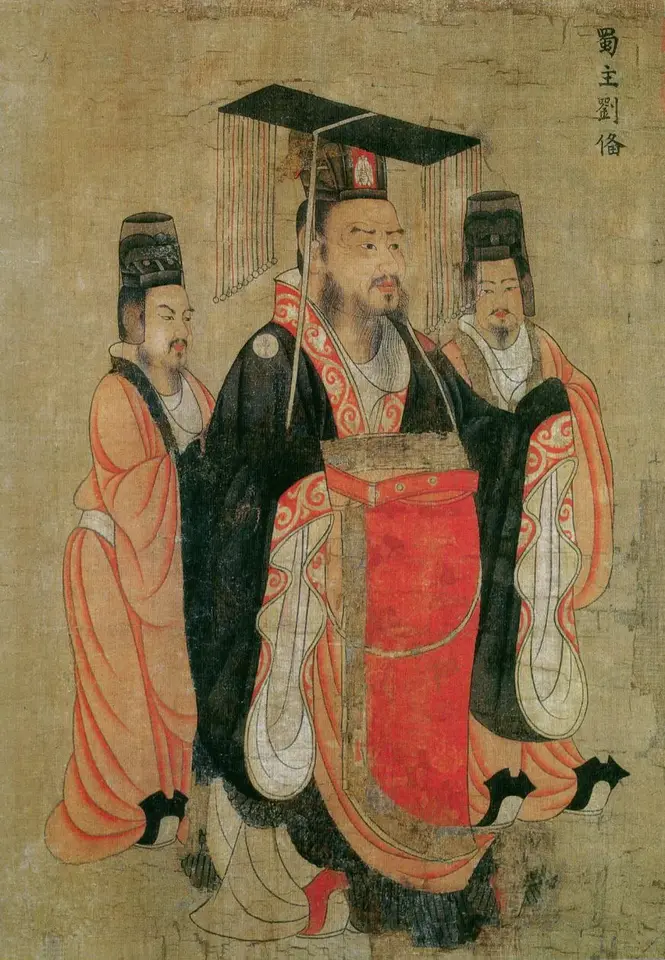
161 CE–223 CE
刘备
Liu Bei (刘备; 161 – June 10, 223), courtesy name Xuande (玄德), was a native of Zhuo County in Zhuo Commandery (present-day Zhuozhou, Hebei), tracing his lineage to Prince Jing of Zhongshan (Liu Sheng) of the Western Han dynasty. A prominent warlord during the tumultuous late Eastern Han dynasty, he became the founding emperor of Shu Han during the Three Kingdoms Period, known posthumously in historiography as Emperor…
Liu Bei (刘备; 161 – June 10, 223), courtesy name Xuande (玄德), was a native of Zhuo County in Zhuo Commandery (present-day Zhuozhou, Hebei), tracing his lineage to Prince Jing of Zhongshan (Liu Sheng) of the Western Han dynasty. A prominent warlord during the tumultuous late Eastern Han dynasty, he became the founding emperor of Shu Han during the Three Kingdoms Period, known posthumously in historiography as Emperor Zhaolie of Han or the First Sovereign (Xianzhu). Having lost his father at an early age, Liu Bei lived in straitened circumstances with his mother, making a living by weaving straw mats and selling hemp shoes. In his youth, he took up arms against the Yellow Turban Rebellion and subsequently endured repeated tribulations amidst the chaotic civil conflicts among regional warlords, seeking temporary shelter under Gongsun Zan, Tao Qian, Cao Cao, Yuan Shao, and Liu Biao. In 208 CE (the thirteenth year of the Jian'an era), Liu Bei forged an alliance with Sun Quan and inflicted a decisive defeat upon Cao Cao at the Battle of Red Cliffs. Capitalizing on this victory, he secured southern Jing Province and later acquired Yi Province, laying the foundation of the Shu Han realm. In 221 CE (the first year of the Zhangwu era), he ascended the imperial throne in Chengdu, adopting the era name Zhangwu. Following the execution of his sworn brother Guan Yu by Eastern Wu, he launched a major punitive expedition against Sun Quan in 222 CE, which culminated in a catastrophic defeat at the Battle of Yiling. In June 223 CE, he succumbed to illness at Baidicheng at the age of sixty-three, received the posthumous name Emperor Zhaolie, and was interred at Huiling in Chengdu.
Born in Zhuo County, Zhuo Commandery (present-day Zhuozhou, Hebei).
Sent away by his mother to study under the renowned scholar Lu Zhi alongside Gongsun Zan.
Raised a militia to suppress the Yellow Turban Rebellion; appointed Vice Magistrate of Anxi, but later flogged an inspecting courier and resigned.
Joined Gongsun Zan; commissioned as Major of a Separate Unit and later appointed Chancellor of Pingyuan.
Dispatched troops to relieve Tao Qian in Xu Province; assumed the post of Shepherd of Xu Province upon Tao Qian's deathbed behest.
Suffered a surprise assault on Xiapi by Lu Bu, losing his family to captivity; negotiated a fragile truce and withdrew to Xiaopei.
Subordinated himself to Cao Cao; titled General of the Left and collaborated in the final destruction of Lu Bu at Xiapi.
Participated in Dong Cheng's girdle decree conspiracy; subsequently assassinated Che Zhou, Inspector of Xu Province, and reoccupied the region.
Defeated by Cao Cao's eastern expedition; fled to Yuan Shao and subsequently sought refuge under Liu Biao, garrisoning Xinye.
Undertook the Three Visits to the Thatched Cottage, securing the strategic allegiance of Zhuge Liang.
Allied with Sun Quan to crush Cao Cao at Red Cliffs; subsequently gained control over the four southern commanderies of Jing Province.
Entered Yi Province upon the invitation of Liu Zhang, initiating the campaign for the southwest.
Captured Chengdu; accepted the surrender of Liu Zhang and assumed the governorship as Shepherd of Yi Province.
Defeated Cao Cao's forces in the Hanzhong Campaign; proclaimed himself King of Hanzhong.
Proclaimed emperor in Chengdu, declaring the state title Han and establishing the Zhangwu era.
Commanded a full-scale campaign against Eastern Wu; suffered an overwhelming reverse against Lu Xun at the Battle of Yiling.
Passed away at the Yong'an Palace in Baidicheng; posthumously honored as Emperor Zhaolie and entombed at Huiling.
Liu Bei claimed descent from Liu Sheng, Prince Jing of Zhongshan, a son of Emperor Jing of the Western Han. According to the Records of the Three Kingdoms, Liu Sheng's son, Liu Zhen, was enfeoffed as Marquis of Lucheng Pavilion in Zhuo County in 117 BCE (the sixth year of the Yuanshou era). However, Liu Zhen was stripped of his peerage during the ritual wine offering scandal, settling his family permanently in Zhuo Commandery. Liu Bei's grandfather, Liu Xiong, was recommended as a Filial and Incorrupt candidate and attained the post of Magistrate of Fan County in Dong Commandery. His father, Liu Hong, held modest provincial appointments but died prematurely. Thus, Liu Bei was orphaned at a tender age and lived in acute poverty with his mother, depending upon the weaving of rush mats and the vending of hemp sandals for their basic sustenance.
Southeast of the Liu household stood an enormous mulberry tree rising over five rods in height. Viewed from a distance, its lush crown resembled the rounded imperial carriage parasol, leading passersby to marvel at its auspicious canopy and predict that an illustrious figure would emerge from the family. In his childhood, while playing under the canopy with his clan playmates, Liu Bei boldly pointed upward and declared that he would one day ride in a carriage adorned with such feathered plumes and parasols. His uncle Liu Zijing sharply rebuked him, warning that such reckless speech could bring extermination upon their entire lineage.
In 175 CE (the fourth year of the Xiping era), when Liu Bei was fifteen years of age, his mother sent him out to pursue formal classical education. Alongside his kinsman Liu Deran and Gongsun Zan of Liaoxi, Liu Bei studied under the renowned classical master Lu Zhi, a fellow townsman and former Grand Administrator of Jiujiang. Liu Deran's father, Liu Yuanqi, consistently provided financial assistance to Liu Bei on an equal footing with his own son, declaring to his skeptical wife that Liu Bei was no ordinary youth. During this period, Liu Bei developed a profound friendship with Gongsun Zan, treating the older scholar as an elder brother. Liu Bei possessed little inclination toward dry scholastic texts, preferring the pursuits of hunting hounds, fine horses, musical performances, and resplendent garments. Standing seven chi and five cun in height, with arms that dropped below his knees and ears so prominent that he could glimpse them with his own eyes, his physical bearing was deemed extraordinary. He was naturally taciturn, magnanimous in dealing with others, rarely betraying joy or wrath on his countenance, and delighted in associating with local knights-errant, who flocked eagerly to his circle. Wealthy horse merchants from Zhongshan, including Zhang Shiping and Su Shuang, perceived his exceptional character during their travels in Zhuo Commandery and bestowed upon him substantial funds, enabling Liu Bei to gather an armed retinue.
In 184 CE (the first year of the Zhongping era), the Yellow Turban Rebellion erupted across the empire. Liu Bei led his followers to join Commandant Zou Jing in suppressing the insurgent forces. For his battlefield valor, he was appointed Vice Magistrate of Anxi County. When an imperial edict later mandated the dismissal of military appointees who had entered the bureaucracy through irregular martial merits, an inspecting courier arrived at Anxi with the intent of dismissing Liu Bei. When Liu Bei sought an audience, the courier claimed illness and refused him entry. Incensed by this insult, Liu Bei forced his way into the courier station, bound the official, subjected him to two hundred strokes with a staff, tied his official seal around the courier's neck, fastened him to a hitching post, and abandoned his office to flee into hiding alongside Guan Yu and Zhang Fei. Shortly thereafter, he accompanied Commandant Guanqiu Yi, who was dispatched by General-in-Chief He Jin to recruit troops in Danyang. Encountering bandits in Xiapi, Liu Bei fought heroically and was awarded the assistant magistracy of Xiami, which he subsequently resigned. He later served as Police Magistrate of Gaotang and was promoted to Magistrate; when Gaotang was overrun by marauders, he sought refuge under his former schoolmate, General of the Household Gongsun Zan.
In 191 CE (the second year of Chuping), Gongsun Zan commissioned Liu Bei as Major of a Separate Unit and assigned him to collaborate with Tian Kai, Inspector of Qing Province, in resisting Yuan Shao, Shepherd of Ji Province. Through a succession of military achievements, Liu Bei was appointed Acting Magistrate of Pingyuan County and later elevated to Chancellor of Pingyuan. During his tenure at Pingyuan, Liu Bei effectively defended the borders against raiders while implementing benevolent administrative measures internally. He dined from the same vessel and sat on the same mat as ordinary commoners, making no social distinctions, which won him immense popular devotion. A disgruntled resident named Liu Ping refused to submit to his authority and dispatched an assassin to eliminate him. Unaware of the plot, Liu Bei received the assassin with such extraordinary warmth and courtesy that the assassin was moved to tears, confessed the assassination plot, and departed without inflicting harm.
In 192 CE (the third year of Chuping), conflict broke out between Yuan Shu and Yuan Shao. Yuan Shu sought assistance from Gongsun Zan, who dispatched Liu Bei to garrison Gaotang to menace Yuan Shao's flanks, though Liu Bei was eventually repulsed by the combined forces of Yuan Shao and Cao Cao. Later, when remnants of the Yellow Turbans under Guan Hai besieged Kong Rong, Chancellor of Beihai, Kong Rong dispatched Taishi Ci to break through the encirclement and solicit aid from Liu Bei. Liu Bei remarked with astonishment that Chancellor Kong of Beihai actually knew of Liu Bei's existence in the world. He immediately detached three thousand elite infantry under Taishi Ci to lift the siege, and the rebel forces dispersed upon their approach.
In 194 CE (the first year of Xingping), Cao Cao launched a devastating invasion of Xu Province under the pretext of avenging his father's death. Tao Qian, Shepherd of Xu Province, sent desperate appeals to Tian Kai. Liu Bei accompanied Tian Kai to relieve the province, bringing a force of over one thousand personal troops, mixed Wuhuan cavalry from You Province, and several thousand displaced peasants. Tao Qian reinforced Liu Bei with four thousand seasoned troops from Danyang, prompting Liu Bei to leave Tian Kai and attach himself to Tao Qian. Tao Qian memorialized to appoint Liu Bei as Inspector of Yu Province, stationing him at Xiaopei. That same year, Tao Qian fell critically ill and expressed to his Assistant Officer of the Headquarters Mi Zhu that none other than Liu Bei could bring tranquility to the province. Following Tao Qian's demise, Mi Zhu led the gentry and populace of Xu Province to invite Liu Bei to take charge of the administration. Liu Bei initially declined, suggesting that Yuan Shu, whose clan had produced high ministers over four generations, was better suited for the burden. However, Chen Deng and Kong Rong vigorously persuaded him, emphasizing the urgency of saving the million households of Xu Province amidst imperial collapse. Convinced by their earnest entreaties, Liu Bei assumed the office of Shepherd of Xu Province.
In 195 CE (the second year of Xingping), Lu Bu, having been routed by Cao Cao in Yan Province, arrived to seek shelter under Liu Bei. Treating Lu Bu with honor and generosity, Liu Bei permitted him to garrison Xiaopei. In 196 CE (the first year of Jian'an), Yuan Shu launched a campaign against Xu Province. Liu Bei led his army south to engage Yuan Shu, maintaining a month-long standoff around Xuyi and Huaiyin. Taking advantage of the vacuum, Lu Bu colluded with local defector Cao Bao, launched a surprise assault on Xiapi, defeated Zhang Fei, and captured Liu Bei's family and dependents. Liu Bei's army disintegrated on its return march, forcing him to retreat to Haixi in Guangling. Reduced to extreme distress, his troops resorted to cannibalism. Mi Zhu of Donghai came to his salvation, offering his family fortune, two thousand private retainers, and the hand of his younger sister in marriage, which allowed Liu Bei to reconstitute his shattered force. Liu Bei then negotiated peace with Lu Bu, who returned his wives and dependents and permitted him to return to Xiaopei.
Subsequently, Yuan Shu dispatched his general Ji Ling with thirty thousand infantry and cavalry to crush Liu Bei at Xiaopei. Outmatched, Liu Bei solicited intervention from Lu Bu. Despite his subordinates' counsel to let Yuan Shu destroy Liu Bei, Lu Bu recognized that Liu Bei's annihilation would leave him exposed to Yuan Shu. Lu Bu marched with a thousand cavalry, invited Ji Ling and Liu Bei to a banquet outside the walls, and famously brokered a truce by piercing the small side-prong of a halberd planted at the camp gate with a single arrow shot from a great distance. Astounded by Lu Bu's marksmanship, Ji Ling and his officers agreed to withdraw their forces. Nevertheless, in 198 CE (the third year of Jian'an), relations between Liu Bei and Lu Bu deteriorated again when Lu Bu dispatched Gao Shun and Zhang Liao to besiege Xiaopei. Liu Bei was routed, his family captured once more, and he fled alone to join Cao Cao. Cao Cao treated him with lavish courtesy, sharing his carriage and dining at the same table, and joined forces with Liu Bei to lay siege to Xiapi. Upon Lu Bu's capture at White Gate Tower, Lu Bu pleaded for his life, offering to command cavalry under Cao Cao. Liu Bei reminded Cao Cao of Lu Bu's treacherous betrayals of Ding Yuan and Dong Zhuo, prompting Cao Cao to order Lu Bu's execution. Returning to the capital at Xu, Cao Cao recommended Liu Bei as General of the Left.
In 199 CE (the fourth year of Jian'an), Emperor Xian secretly issued the girdle decree to his uncle-in-law, General of Chariots and Cavalry Dong Cheng, ordering the execution of Cao Cao. Liu Bei joined the secret compact. Around this time, Cao Cao casually remarked to Liu Bei during an intimate meal that the only genuine heroes under Heaven were Liu Bei and himself, dismissing Yuan Shao as beneath notice. Startled by this piercing appraisal, Liu Bei dropped his chopsticks. Fortunately, a sudden roll of thunder intervened, allowing Liu Bei to cleverly deflect Cao Cao's suspicion by claiming that the thunderstorm had unnerved him. Soon after, Liu Bei found a pretext to lead an army east under the banner of intercepting Yuan Shu. Once in Xu Province, he assassinated the provincial inspector Che Zhou, reasserted control over Xiapi, and formed an alliance with Yuan Shao.
In 200 CE (the fifth year of Jian'an), Cao Cao personally commanded an eastern expedition against Xu Province. Recognizing that Liu Bei was a heroic figure who posed a graver threat than Yuan Shao, Cao Cao struck swiftly. Liu Bei was crushed in battle, his camp overrun, and Guan Yu was captured at Xiapi while safeguarding Liu Bei's family. Liu Bei fled to Qing Province and was escorted to Yuan Shao's court at Ye. Following the Battle of Guandu and the death of Wen Chou, Liu Bei severed ties with Yuan Shao and traveled south to Jing Province to join Liu Biao, who received him with high honors and stationed him at Xinye as a northern bulwark.
During his years in Jing Province, Liu Bei actively recruited talented strategists. In 207 CE (the twelfth year of Jian'an), he visited the secluded scholar Zhuge Liang three times at his cottage in Longzhong. Zhuge Liang presented the renowned Longzhong Plan, formulating a grand strategy to seize Jing and Yi provinces, maintain harmony with the southwestern tribes, form a firm alliance with Sun Quan, and await the opportune moment to launch a two-pronged offensive against the north to restore the Han dynasty. In 208 CE, Cao Cao launched his massive southern campaign. Liu Biao died of illness, and his younger son Liu Zong surrendered Jing Province without a fight. Liu Bei abandoned Fancheng and led a massive southward retreat accompanied by over one hundred thousand civilian refugees and thousands of supply carts, refusing to abandon the populace despite the extreme tactical danger. Overtaken by five thousand elite cavalry under Cao Cao at Changban in Dangyang, Liu Bei suffered heavy losses, barely escaping with Zhuge Liang, Zhang Fei, and Zhao Yun. Reaching the Han River, he joined Guan Yu's naval fleet and Liu Qi's force at Xiakou. Recognizing the mutual peril, Sun Quan dispatched Lu Su to propose an alliance. Zhuge Liang accompanied Lu Su to Jiangdong, successfully persuading Sun Quan to commit his forces. In late 208 CE, the allied forces commanded by Zhou Yu and Cheng Pu achieved a monumental triumph over Cao Cao's armada at the Battle of Red Cliffs. Following the victory, Liu Bei pacified the four southern commanderies of Wuling, Changsha, Guiyang, and Lingling, subsequently borrowing Nan Commandery from Sun Quan to secure a strategic foothold on the northern bank of the Yangtze.
In 211 CE (the sixteenth year of Jian'an), Liu Zhang, Shepherd of Yi Province, grew terrified of Cao Cao's impending conquest of Hanzhong and invited Liu Bei into the Shu region upon the secret advice of Zhang Song and Fa Zheng. Leaving Zhuge Liang, Guan Yu, and Zhang Fei to secure Jing Province, Liu Bei marched upriver with Pang Tong, Huang Zhong, and several tens of thousands of infantry. Welcomed lavishly by Liu Zhang at Fucheng, Liu Bei was urged by Pang Tong to stage a preemptive coup, but he refused to act precipitously. Instead, he advanced to Jiameng to win the hearts of the frontier populace through benevolent distributions. In 212 CE, open conflict erupted between Liu Bei and Liu Zhang. Executing Yang Huai and Gao Pei at Baishui Pass, Liu Bei advanced steadily through Sichuan. Despite the tragic death of Pang Tong at Luocheng, reinforcements led by Zhuge Liang, Zhang Fei, and Zhao Yun converged on Chengdu. In 214 CE, following the arrival of Ma Chao, Liu Zhang surrendered Chengdu to avoid further bloodshed. Liu Bei assumed the office of Shepherd of Yi Province, establishing complete dominion over the southwest.
In 219 CE (the twenty-fourth year of Jian'an), Liu Bei challenged Cao Cao for mastery of Hanzhong. At the Battle of Mount Dingjun, veteran general Huang Zhong executed Cao Cao's western commander Xiaohou Yuan in a dramatic assault. When Cao Cao personally led a massive relief force from Chang'an, Liu Bei held the mountain fortresses and refused open combat, forcing Cao Cao to withdraw after months of attrition. Having secured Hanzhong, Liu Bei erected an altar at Mianyang in July 219 CE and proclaimed himself King of Hanzhong. However, triumph was swiftly shadowed by catastrophe. Later that year, Sun Quan dispatched Lu Meng in a covert campaign against Guan Yu, capturing Jiangling and executing Guan Yu and his son Guan Ping, which resulted in the total loss of Jing Province to Eastern Wu.
In 220 CE (the twenty-fifth year of Jian'an), Cao Pi usurped the throne, deposed Emperor Xian, and proclaimed the state of Cao Wei. Reports reached Chengdu that the deposed Han emperor had been murdered. Liu Bei declared formal imperial mourning, bestowed the posthumous title Emperor Xiaomin upon the Han monarch, and prepared for imperial elevation. On May 15, 221 CE (the twenty-sixth year of Jian'an, later designated the first year of the Zhangwu era), Liu Bei ascended the imperial throne south of Mount Wudan in Chengdu, preserving the state title Han (historically termed Shu Han) and proclaiming the Zhangwu era. He appointed Zhuge Liang as Chancellor and Xu Jing as Minister of Education, establishing imperial ancestral temples to perform the seasonal union sacrifices to Emperor Gaozu and his successors, formally presenting his dynasty as the direct continuation of Han legitimacy.
Driven by grief and fury over the loss of Guan Yu and the betrayal of Eastern Wu, Liu Bei resolved to launch a punitive war against Sun Quan, disregarding the vehement protests of Zhao Yun and other senior advisers. In July 221 CE, he personally led an expeditionary force east. The Shu armies initially drove deep into Wu territory, sweeping through Wu and Zigui and enlisting the military support of the Wuling tribal chieftains. Sun Quan appointed Lu Xun as Grand Commander to direct defensive operations. Lu Xun adopted a strategy of persistent defense, refusing general engagement while the Shu Han army extended its camps along steep, forested terrain stretching hundreds of li. In June 222 CE, taking advantage of dry winds and the exhaustion of the Shu forces, Lu Xun unleashed a devastating fire attack at Xiaoting in Yiling, collapsing Liu Bei's multi-tiered fortified line. Senior generals Feng Xi and Zhang Nan were slain, and Liu Bei barely retreated through the mountain tracks to Baidicheng, renaming the surrounding county Yong'an.
Broken in spirit and afflicted by dysentery and chronic ailments, Liu Bei remained at the Yong'an Palace throughout the winter. In the spring of 223 CE, sensing his impending end, he summoned Chancellor Zhuge Liang from Chengdu to entrust him with the state and his successor. In his famous deathbed testament, Liu Bei spoke to Zhuge Liang with candid humility, affirming that Zhuge Liang possessed ten times the ability of Cao Pi and would surely pacify the realm. He instructed Zhuge Liang to assist his heir Liu Shan, adding that if Liu Shan proved devoid of talent, Zhuge Liang should assume governance himself. Weeping, Zhuge Liang pledged unconditional loyalty unto death. Liu Bei also issued a final imperial edict to the crown prince, counseling him to treat Zhuge Liang as a father and leaving behind the celebrated moral injunction: Do not commit an evil act simply because it is small; do not neglect a good deed simply because it is slight. Only virtue and talent can genuinely command the respect of others. On June 10, 223 CE (the twenty-fourth day of the fourth month of the third year of Zhangwu), Liu Bei passed away at the age of sixty-three. His coffin was escorted back to Chengdu, where he was interred at Huiling and bestowed the posthumous name Emperor Zhaolie.
Throughout his entire life, Liu Bei consistently pursued the restoration of the Han dynasty as his primary political mission. From his initial uprising in Zhuo Commandery to his imperial enthronement in Chengdu, he presented himself as a scion of the Han imperial house and the defender of its ancestral mandates. Every major institutional step—assuming the governance of Xu Province, taking the office of Shepherd of Yi Province, ascending as King of Hanzhong, and proclaiming himself emperor—was framed as an act of dynastic preservation. When Cao Pi forced the abdication of Emperor Xian in 220 CE, Liu Bei maintained the dynasty's formal title of Han, rejecting any appearance of establishing an entirely new dynasty.
Liu Bei's governance was characterized by an emphasis on winning popular support through moral benevolence. As Chancellor of Pingyuan, his accessible style of governance won widespread admiration. Upon his arrival in Sichuan, he mitigated the harsher aspects of local extraction while balancing the interests of native Sichuan lineages and immigrant Jingzhou elites.
In establishing the institutional framework of Shu Han, Liu Bei and Zhuge Liang instituted a synthesis of Legalist rigor and Confucian moral cultivation. According to historical records, the administration of Shu ensured that rewards were conferred on the worthy even if they were personal enemies, while penalties were inflicted on lawbreakers even if they were close relatives. Zhuge Liang observed that Liu Zhang's prior administration in Sichuan had failed because it relied on superficial indulgences, granting excessive offices and exemptions that eroded legal authority. Under Liu Bei, the state promulgated the Statutes of Shu (Shu Ke), authored collaboratively by Zhuge Liang, Fa Zheng, Liu Ba, Li Yan, and Yi Ji. The administrative ethos combined clear statutory enforcement with ethical instruction, establishing a transparent system where imperial grace and institutional discipline functioned in harmony.
Liu Bei spent nearly four decades on the battlefield. While his strategic and operational capabilities were occasionally outmatched by Cao Cao or Lu Xun, his resilience, organizational persistence, and capacity to inspire devotion allowed him to recover from numerous catastrophic reverses.
His key military campaigns encompass:
The Hanzhong victory represented the culmination of Liu Bei's military achievements, securing the mountain passes essential to the survival of Shu Han. Conversely, the disaster at Yiling permanently crippled the offensive capabilities of the Shu Han state and doomed its long-term strategic prospects.
Liu Bei's most extraordinary talent lay in his profound discernment of human character and his ability to command the enduring loyalty of exceptional men. His recruitment of Zhuge Liang through the Three Visits to the Thatched Cottage and his total entrustment of state affairs on his deathbed created an enduring paradigm of sovereign-minister harmony throughout Chinese imperial history.
He recognized the martial greatness of Guan Yu and Zhang Fei during his earliest years in Zhuo Commandery, treating them with fraternal intimacy, sharing beds and dining together while maintaining strict military obedience on the battlefield. He elevated Zhao Yun from Gongsun Zan's service, entrusted the strategic direction of his Sichuan campaigns to Pang Tong and Fa Zheng, and incorporated seasoned generals like Ma Chao and Huang Zhong into his highest military ranks.
Liu Bei's penetrating discernment was equally demonstrated in his evaluation of Ma Su. On his deathbed, he explicitly cautioned Zhuge Liang that Ma Su's words outstripped his practical abilities and that he must not be entrusted with critical independent commands. This prophetic assessment was tragicallly vindicated years later when Ma Su lost Jieting during Zhuge Liang's first northern expedition.
Upon securing Sichuan, Liu Bei demonstrated remarkable political breadth. He harmonized competing factions by granting prominent offices to Liu Zhang's former officials (such as Dong He, Huang Quan, and Li Yan), relatives of the Liu clan (Wu Yi and Fei Guan), and scholars who had previously displayed hostility toward him (such as Liu Ba). When Xu Jing sought employment despite possessing a hollow reputation, Fa Zheng advised Liu Bei that because Xu Jing's fame was renowned throughout the empire, snubbing him would cause scholars to question Liu Bei's respect for talent; Liu Bei prudently appointed Xu Jing as Chief Clerk and later elevated him to Minister of Education.
Benevolence (ren) stood as the central banner of Liu Bei's statecraft, functioning both as a political strategy and as a genuine personal ethic that contrasted sharply with Cao Cao's pragmatic ruthlessness.
During the chaotic flight from Fancheng in 208 CE, over one hundred thousand civilians followed his retreat. When military advisers urged him to abandon the refugees and race forward to secure Jiangling's arsenals, Liu Bei famously refused, declaring that the foundation of any great enterprise must be the people, and he could not bear to abandon those who had entrusted their lives to him. Although this delay invited Cao Cao's swift cavalry strike at Changban, it cemented Liu Bei's reputation as a compassionate sovereign across the realm.
Similar demonstrations of magnanimity recur throughout his life: the assassin dispatched by Liu Ping in Pingyuan laid down his blade after being treated with consummate respect; Tao Qian and Liu Biao both offered their provincial domains to him on their deathbeds; and when Huang Quan was forced to surrender to Cao Wei following the severance of his retreat at Yiling, legal officers demanded the execution of Huang Quan's family in Chengdu, but Liu Bei refused, acknowledging that he had failed Huang Quan rather than Huang Quan failing him.
His dying admonition to Crown Prince Liu Shan—Do not commit an evil act simply because it is small; do not neglect a good deed simply because it is slight. Only virtue and talent can genuinely command the respect of others—endures as one of the most celebrated ethical testaments in Chinese political thought.
FIGURES ASSOCIATED WITH THIS DYNASTY