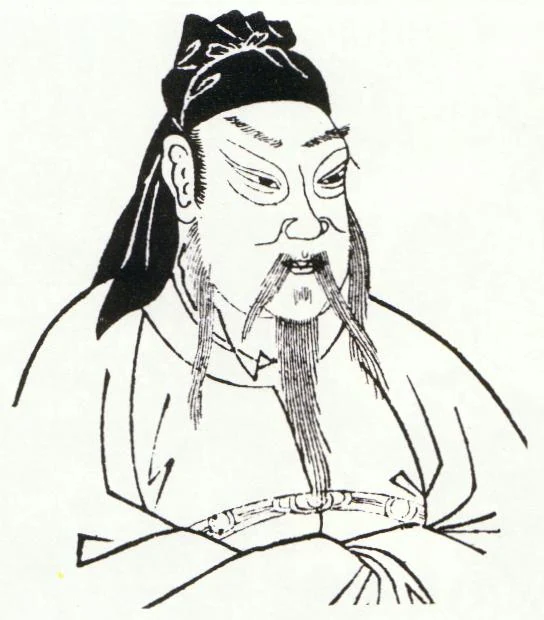
Biography
Early Years and Following Liu Bei The *Records of the Three Kingdoms: Shu, Biographies of Guan Yu, Zhang Fei, Ma Chao, Huang Zhong, and Zhao Yun* records that Guan Yu's original courtesy name was Changsheng and that he later changed it to Yunzhang. It also says that he “fled the law and went to Zhuo Commandery,” but does not explain why he left home or record his date of birth. later tomb inscriptions and local gazetteers that give 160 as his birth year, with the lunar date variously stated as the 22nd or 24th day of the sixth month. The year or a specific birthday therefore cannot be presented as established biographical data. In 184 (Zhongping 1, Eastern Han), Guan Yu and Zhang Fei joined the forces organized by Liu Bei in Zhuo County. After Liu Bei became Chancellor of Pingyuan, he appointed the two as Majors of Separate Commands, each commanding troops. Chen Shou wrote that the affection between Liu Bei, Guan Yu, and Zhang Fei was “like that of brothers,” indicating a close relationship. The standard histories do not record a formal “Oath of the Peach Garden”; that episode belongs to later literary representation. ### Campaigns in Xu Province and Return from Cao Cao to Liu Bei In 194 (Xingping 1, Eastern Han), Guan Yu accompanied Liu Bei to Xu Province to assist Tao Qian. After Tao Qian died, Liu Bei assumed the governorship of Xu Province, and Guan Yu continued to serve with his army. In 198 (Jian'an 3, Eastern Han), Liu Bei and Cao Cao jointly besieged Xiapi and captured and killed Lü Bu. Guan Yu then returned with the army to Xudu. In 199 (Jian'an 4, Eastern Han), Liu Bei rose against Cao Cao in Xu Province and ordered Guan Yu to defend Xiapi and exercise the duties of its governor. The following year, 200 (Jian'an 5, Eastern Han), Cao Cao campaigned east. Liu Bei was defeated, and Guan Yu was captured and temporarily submitted to Cao Cao, receiving the post of subordinate general. Cao Cao sent Zhang Liao to ask about his intentions. Guan Yu said that he had received great favor from Liu Bei and would leave after repaying Cao Cao. At the Battle of Baima, Guan Yu charged into Yuan Shao's army and killed Yan Liang. Cao Cao then petitioned for him to be enfeoffed as Marquis of Hanshou Village. Guan Yu later sealed up the gifts Cao Cao had given him, left a letter of farewell, and went to rejoin Liu Bei; Cao Cao stopped his followers from pursuing him. This episode is recorded in the *Records of the Three Kingdoms: Biography of Guan Yu*. Later expressions such as “riding alone for a thousand li” were shaped by fiction and popular narrative. ### Guarding Jing Province and Relations between Wu and Shu In 201 (Jian'an 6, Eastern Han), Guan Yu followed Liu Bei in seeking refuge with Liu Biao, Governor of Jing Province, and was stationed at Xinye. In 208 (Jian'an 13, Eastern Han), when Cao Cao advanced south, Liu Bei withdrew toward Xiakou, and Guan Yu led a fleet to meet him at Hanjin. After the Battle of Red Cliffs, Liu Bei and Zhou Yu, among others, besieged Jiangling, which was defended by Cao Ren, and Guan Yu was ordered to cut the northern route of Cao Cao's army. After Liu Bei gained the commanderies south of the Yangzi in Jing Province, Guan Yu became Governor of Xiangyang and General Who Sweeps Away Bandits and was stationed north of the river. In 211 (Jian'an 16, Eastern Han), Liu Bei entered Yi Province, while Guan Yu and others remained in Jing Province. After Liu Bei took Yi Province in 214 (Jian'an 19, Eastern Han), Guan Yu was placed in overall charge of affairs in Jing Province. The territory under his administration was the portion of Jing Province actually controlled by Liu Bei. The nominal ownership of the commanderies and the agreements between Liu Bei and Sun Quan changed several times, so it is inaccurate to describe Guan Yu as independently controlling the whole of Jing Province. In 215 (Jian'an 20, Eastern Han), Sun Quan demanded the return of Changsha, Lingling, Guiyang, and other commanderies, producing a military confrontation. Lu Su invited Guan Yu to a meeting at Yiyang. Both sides brought attendants rather than armies to fight; the episode later became known as the “single-blade meeting.” Liu Bei and Sun Quan subsequently redrew control in Jing Province, using the Xiang River as a boundary for the allocation of some commanderies and counties. Fiction expanded the *Single-Sword Meeting* into a story in which Guan Yu attended a Wu banquet alone and escaped calmly; those details cannot be treated as historical fact. Lu Su died in 217 (Jian'an 22, Eastern Han), and Lü Meng took over military affairs at Lukou. Sun Wu remained wary of Guan Yu's control of Jing Province and its strategic position upstream. The outwardly civil exchanges between Guan Yu and Lü Meng did not eliminate the underlying dispute between Sun Quan and Liu Bei over Jing Province. ### Battle of Fancheng, Loss of Jing Province, and Death In the seventh month of 219 (Jian'an 24, Eastern Han), Liu Bei assumed the title King of Hanzhong and appointed Guan Yu General of the Vanguard and granted him the designation Acting with the Imperial Tally and Axe. Guan Yu advanced north from Jiangling, besieged Cao Ren at Fancheng, and sent troops to surround Xiangyang. In the eighth month, the Han River flooded. The Seven Armies under Yu Jin were affected by the flood, and Guan Yu attacked at the opportunity. Yu Jin surrendered. Pang De refused to surrender and was captured and executed. Cao Cao sent Xu Huang and other forces as reinforcements, and the military situation then changed. Guan Yu's reputation for a time shook the realm, but he did not take Fancheng. While Guan Yu was campaigning north, Mi Fang, Governor of Nan Commandery, was stationed at Jiangling, while General Fu Shiren held Gong'an and the two were responsible for rear-area supplies. The histories record that both had poor relations with Guan Yu and that supplies were inadequate during the campaign. Guan Yu also stated that he would hold them accountable after returning, leaving them uneasy. Sun Wu took the opportunity to send Lü Meng to seize Gong'an and Jiangling. Mi Fang and Fu Shiren surrendered in succession. Guan Yu's line of retreat was cut, his troops dispersed, and he withdrew to Maicheng. Guan Yu at one point feigned surrender and then broke out with only a little over ten horsemen remaining. He was ultimately captured by Wu troops at Linju. Sun Wu executed Guan Yu and his son Guan Ping and sent Guan Yu's head to Cao Cao. Guan Yu's death occurred around January 220 or February 220 (the 12th month of Jian'an 24, Eastern Han). The sources differ on the exact date and its calendrical conversion, so this article does not specify a single day. His death and the loss of Jing Province contributed to the breakdown of Wu-Shu relations, but the northern campaign, rear-area defense, the Sun-Liu alliance, and Wei-Wu military actions together formed the background to this outcome; it should not be reduced to a single cause.
Guan Yu, styled Yunchang and originally Changsheng, was a native of Xie county in Hedong. In his youth he fled his home for an offence and took refuge in Zhuojun, where Liu Bei was gathering followers, and he and Zhang Fei served as his champions. When Liu Bei was chancellor of Pingyuan he made Guan Yu and Zhang Fei officers of a detached division with their own troops; he slept on the same mat with the two and their bond was as that of brothers, while in crowded gatherings the two stood in attendance all day, following him through every peril. After taking Xuzhou, Liu Bei killed its inspector and left Guan Yu to hold the city of Xiapi as acting governor, returning himself to Xiaopei. In 200 Cao Cao marched east, Liu Bei was beaten and fled to Yuan Shao, and Guan Yu was taken and brought back, made general of the unequal side and treated with great honour. When Yuan Shao's general Yan Liang attacked Liu Yan at Baima, Cao Cao sent Zhang Liao and Guan Yu as his vanguard; and Guan Yu, seeing Yan Liang's standard, galloped into the midst of the host and killed him, cut off his head with his own sword and returned, none of Yuan's officers being able to stop him, so that the siege of Baima was raised and Cao Cao memorialised to make him Marquis of Hanshou. Cao Cao, admiring him and seeing that his heart was not in staying, asked Zhang Liao to sound him; and Guan Yu answered with a sigh that he knew well how Cao Cao had treated him, but that he had received Liu Bei's great kindness and had sworn to die with him and could not turn his back on it, that he would not remain, and that he would take his leave after doing one service to repay Cao Cao. Zhang Liao reported it, and Cao Cao thought him righteous; and when he had killed Yan Liang, Cao Cao, knowing he would go, gave him greater gifts, whereupon Guan Yu sealed up all that had been given him, wrote a letter of farewell and went to Liu Bei in Yuan Shao's camp, and when his attendants would have pursued him Cao Cao said that each served his own master and they should not follow. The Fuzi relates that Zhang Liao, fearing that to report it would bring Cao Cao to kill him and that to conceal it would be a breach of duty, sighed that Cao Cao was his lord and father and Guan Yu but a brother, and reported it; and that Cao Cao called him a righteous man who in serving his lord did not forget his origin, and asked when he would go, Zhang Liao answering that Guan Yu, having received his kindness, would repay it before departing. In 208, when Cao Cao came south, Liu Bei fled and sent Guan Yu with several hundred ships towards Jiangling; overtaken at Changban, he met Guan Yu's ships at Hanjin and they went together to Xiakou. Afterwards Liu Bei and Zhou Yu besieged Cao Ren at Jiangling and sent Guan Yu to cut the northern road, where Li Tong attacked him and, dismounting to pull up the abattis, fought his way forward to meet Cao Ren's army and died of illness soon after. When Sun Quan sent troops to help Liu Bei repulse Cao Cao and Cao Cao withdrew, Liu Bei took the commanderies south of the river and rewarded his officers, making Guan Yu governor of Xiangyang and general who smashes the caitiffs, posted north of the river. Leaving Zhuge Liang and Guan Yu to hold Jingzhou, he entered Yizhou with several tens of thousands of foot; and in 212, when Cao Cao marched against Sun Quan and Sun Quan called on him for help, he sought leave to go east on the ground that Le Jin was facing Guan Yu at Qingni and that if he did not go to his relief Le Jin would break him and overrun the province, after which his secret ally Zhang Song was discovered and killed. Guan Yu held Jingzhou while Liu Bei was in Shu, and when Shu was pacified he was given the supervision of Jingzhou; and on the pacification of Yizhou Zhuge Liang, Fa Zheng, Zhang Fei and Guan Yu were each given five hundred catties of gold, a thousand of silver, fifty million cash and a thousand bolts of silk. When Sun Quan, because Liu Bei had gained Yizhou, sent Zhuge Jin to ask for the commanderies of Jingzhou, Liu Bei refused, saying that he was then planning to take Liangzhou and would give up Jingzhou when it was taken; and Sun Quan said that this was to borrow without returning and to put him off with empty words, and appointed his own officers to the three southern commanderies, whom Guan Yu drove out. Sun Quan in anger sent Lü Meng with twenty thousand men against Changsha, Lingling and Guiyang and Lu Su with ten thousand to Baling to hold Guan Yu, while Sun Quan lay at Lukou to direct them. Lü Meng took two of the commanderies by letter, only the governor of Lingling holding out; and when Liu Bei came to Gong'an and sent Guan Yu with thirty thousand men to Yiyang, Sun Quan called Lü Meng back to help Lu Su, and Lü Meng lured the governor of Lingling into surrender and secured all three. Liu Bei led fifty thousand men to Gong'an and sent Guan Yu into Yiyang, where Lu Su faced him and invited him to a meeting, each keeping his troops a hundred paces off and coming with a single sword. Lu Su reproached him that the state had lent them the land because their army was beaten and they had come far without means, and that now, having gained Yizhou, they would neither return it nor grant the three commanderies; and before he had finished, a man in the company said that land belonged to the virtuous and had no fixed owner, at which Lu Su rebuked him sharply and Guan Yu, rising with his sword, said that this was a matter between the two states and that the man knew nothing of it, and motioned him away, so that the meeting broke up without agreement. Since the two sides had not yet gone to war and Liu Bei feared to lose Yizhou, he sent to sue for peace, and Sun Quan sent Zhuge Jin back and they renewed their alliance, dividing Jingzhou so that Changsha, Jiangxia and Guiyang went to Sun Quan and Nanjun, Lingling and Wuling to Liu Bei. After Lu Su's death Lü Meng camped west at Lukou, taking over all his troops and being made governor of Hanchang with the towns of Xiajun, Liuyang, Hanchang and Zhouling; and sharing a frontier with Guan Yu, knowing him valiant and ambitious and placed upstream of the state, he judged that the situation could not last. Where Lu Su and the rest had held that with Cao Cao still alive they should support one another against their common enemy, Lü Meng secretly advised that the general of the expedition should hold Nanjun, Pan Zhang Baidi, and Jiang Qin a flying column to move up and down the river, and told Sun Quan that Guan Yu and his master, proud of their cunning and strength, were always turning, and were not to be trusted as confidants; that Guan Yu did not move east only because Sun Quan was wise and Lü Meng and the rest still lived; and that if they did not act while they were strong, when they fell, their strength would be gone. Sun Quan accepted his plan and asked him about taking Xuzhou, and Lü Meng answered that Xuzhou was open country good for cavalry, and that it were better to take Guan Yu and hold the whole Yangzi; and Sun Quan approved. When Lü Meng succeeded Lu Su and first came to Lukou he showed Guan Yu redoubled kindness and made friends with him. But Sun Quan did not carry out the plan, gathering instead the whole strength of Wu against Hefei, where Zhang Liao with eight hundred volunteers broke his army; and Guan Yu in that period kept the agreement of the Xiang river boundary and did not attack Wu while it was weak. In the first month of 218 Ji Ben, the imperial physician, with Geng Ji and Wei Huang, rose against Wei, attacking Xu and burning the camp of Wang Bi, the chancellor's chief clerk, in a plot to seize the emperor and go south to Liu Bei, in which the conspirators led a thousand retainers and servants to burn the gates by night and one of them with a bow wounded Wang Bi in the shoulder, so that he died of the wound some ten days later; and before that Hou Yin of Wancheng, where the people were ground down by the levies, had seized the governor, joined with the officials and people in revolt and made common cause with Guan Yu, until Cao Ren and Pang De took the city and killed Hou Yin and Wei Kai and camped south at Fan against Guan Yu. In the seventh month of 219 Liu Bei took the title King of Hanzhong with the altar at Mianyang, and made Guan Yu general of the van, Zhang Fei general of the right, Ma Chao general of the left and Huang Zhong general of the rear. Fei Shi was sent to give Guan Yu his seal, and on hearing that Huang Zhong stood with him he cried in anger that a great man would never rank with an old soldier and refused it; and Fei Shi told him that founders of dynasties had never used men all of a kind, that Xiao He and Cao Shen were old friends of Gaozu while Chen Ping and Han Xin came later as fugitives, and that no one had heard of their resenting Han Xin's place above them; that the King honoured Huang Zhong for a single service and that the King and Guan Yu were as one body, sharing fortune and misfortune, so that he should not weigh titles and stipends; and that he himself was but an envoy and would go back, but that he would grieve to see such a step and feared regret. Guan Yu, greatly moved, at once accepted. That year he besieged Cao Ren at Xiangyang and Cao Cao sent Yu Jin against him with thirty thousand men of seven armies; and in the eighth month, after more than ten days of rain, the Han overflowed so that the level ground below Fan was five or six fathoms under water, and Guan Yu attacked in boats, drowning the seven armies, so that Yu Jin surrendered. Pang De, camped ten li north of Fan, took refuge with his officers on the dike, and Guan Yu attacked him in boats shooting from all sides; Pang De, armoured and bow in hand and never missing, killed the officers Dong Heng and Dong Chao who would have surrendered, and fought from dawn past midday, and when his arrows were gone fought hand to hand, telling his provost Cheng He that a good general would not fear death to save himself nor a brave man break his honour to live, so that he fought the fiercer while the water rose and his officers surrendered. Pang De, with one officer and five guards in a small boat, tried to reach Cao Ren's camp, but the boat capsized and he, losing bow and arrows, clung to the upturned hull and was taken, refusing to kneel. Guan Yu told him that his elder brother was in Hanzhong and that he would make him a general and asked why he would not surrender; and Pang De cursed him, saying that the King of Wei had a million men and shook the world, that Liu Bei was a mediocrity who could not stand against him, and that he would be a ghost of his state rather than a general of rebels, and Guan Yu killed him. With the whole relieving army gone, Cao Ren's few thousand held the city with the walls not a few planks above water, cut off from within and without, their food failing and no relief in sight; and Guan Yu's troops lay about the city in boats, encircling it severalfold. In 218, when the people of Luhun were called out for service at Hanzhong and murmured, Sun Lang and others rose, killed the clerk and rebelled and afterwards joined Guan Yu, who gave them seals and troops; and after the drowning of the seven armies bandits throughout the south of Xu received Guan Yu's seals and became his partisans, and the inspector of Jingzhou, Hu Xiu, and the governor of Nanjun, Fu Fang, went over to him, so that the history says the bandits of Liang, Jia and Luhun received his seal and became his partisans and his power shook the realm of Huaxia. Cao Cao, because the Han emperor lay at Xu and the rebels were near, thought to move the capital; and Sima Yi and Jiang Ji told him that the loss of Yu Jin by water was no loss in war and no harm to the great design, and that Liu Bei and Sun Quan were outwardly friends and inwardly distant, so that Sun Quan would not wish Guan Yu to succeed and might be persuaded to fall on his rear in return for the promise of Jiangnan, whereby the siege of Fan would be raised of itself; and Cao Cao did as they said. Sun Quan, dreading Guan Yu and wishing the credit, wrote to Cao Cao offering to attack him, sending word that he would seize Jiangling and Gong'an so that Guan Yu must flee and the siege would be raised without fighting, and asking that it be kept secret lest Guan Yu be on his guard. Cao Cao, on Dong Zhao's advice, had the letter sent by post to the front and shot into Guan Yu's camp and the besieged city, Dong Zhao arguing that in war one took circumstance as guide, that the promise of secrecy should be kept to Sun Quan but the news let out, since if Guan Yu turned back the siege would be quickly raised, while if the besieged knew of no relief they might do something desperate, and that Guan Yu, being headstrong and trusting in the two cities, would not quickly withdraw; and Cao Cao approving, the relieving general Xu Huang shot the letter into the city and the camp, where the defenders took heart and Guan Yu hesitated. Xu Huang, thinking his own force too weak, was reinforced by Cao Cao with twelve camps of troops; and Guan Yu had a camp at Weitou and another at Sizhong, and Xu Huang, announcing that he would attack Weitou, secretly attacked Sizhong; and Guan Yu, seeing it in danger, came out himself with five thousand horse and foot, and Xu Huang met and drove him back. Guan Yu had ringed his position with tenfold abattis, but Xu Huang pressed him so hard that pursuers and fugitives entered the ring together, the enclosure was broken, Fu Fang and Hu Xiu were killed, and Guan Yu raised the siege and fell back to the south bank of the Mian, keeping his boats on the river, and Xiangyang was cut off from all communication. Sun Quan had sent to ask Guan Yu's daughter in marriage for his son, and Guan Yu abused the envoy and refused, so that Sun Quan hated him; and it is recorded that while besieging Fan he cursed Sun Quan for the slowness of his help as a mere puppy and said that once Fan was taken he could destroy Sun Quan, who, hearing it, wrote in pretended apology while in heart already hostile. Guan Yu had always treated his soldiers well but despised the manners of the gentry; and the governor of Nanjun, Mi Fang, at Jiangling and the general Fu Shiren at Gong'an both resented his contempt, and when he marched out they supplied his army late and insufficiently, and he said he would deal with them on his return, so that both were frightened, and Sun Quan secretly offered them terms and they sent to welcome him. Lü Meng, reaching Xunyang, hid his picked troops in the boats and had men in white clothing rowing in merchants' dress, travelling day and night, and took all Guan Yu's river watch-posts so that he knew nothing; and Lü Meng had Yu Fan write to Fu Shiren setting out his case, so that he surrendered at once; and Yu Fan told Lü Meng that this was a stratagem, that Fu Shiren should be taken along and troops left to guard the city, and he was brought to Nanjun, where Mi Fang held the city until Lü Meng showed him Fu Shiren, and Mi Fang opened the gates. Lü Meng entered Jiangling and released Yu Jin from prison, took Guan Yu's family and the families of his officers and comforted them, ordering that the army should not trespass on houses or take anything; and when one of his own countrymen in his command took a peasant's straw hat to cover a suit of official armour, Lü Meng, though the armour was public property, held it a breach of his orders and would not set aside the law for a fellow countryman, and weeping had him executed, so that the army shuddered and nothing was picked up on the road; and he sent his attendants morning and evening to comfort the aged, to supply what was lacking, to give medicine to the sick and clothes and food to the cold and hungry, sealing up Guan Yu's treasure to await Sun Quan. Learning that Nanjun had fallen, Guan Yu turned south at once, and on the way sent envoys to Lü Meng, who treated them generously, let them walk about the city and carried comfort to the families of Guan Yu's officers, some of whom wrote letters to be taken as proof that all was well; and when the envoys returned and the officers questioned them privately, learning that their homes were safe and well treated, they lost all heart for fighting and the army melted away. Guan Yu fell back through Dangyang to Maicheng, where Sun Quan sent to entice him, and he feigned surrender, setting up banners and dummy figures on the wall and escaping with a dozen horsemen; but Sun Quan had first sent Zhu Ran and Pan Zhang to cut his road, and in the twelfth month Pan Zhang's provost Ma Zhong took Guan Yu with his son Guan Ping and his provost Zhao Lei at Zhangxiang, and Jingzhou was subdued. The record of Wu Fan relates that Guan Yu at Maicheng sent to ask terms, and Sun Quan asked Wu Fan whether he would really surrender, and Wu Fan said that he had the air of a man about to flee and his surrender was a trick; that Sun Quan sent Pan Zhang to intercept him and the watchers reported that he had gone, and Wu Fan said that though gone he would not escape, naming noon the next day, and when noon passed Sun Quan asked why, and Wu Fan said that the hour was not yet exactly noon; and when a wind stirred the curtain he clapped his hands and said that Guan Yu had come, and in a moment the cry of joy went up outside and it was told that Guan Yu was taken. When Guan Yu was defeated Yu Fan divined for Sun Quan and casting the Jie with Dui below and Kan above with the fifth line changing to the Lin, said that within two days his head would be cut off, as it was. Sun Quan sent Guan Yu's head to Cao Cao and buried his body with the honours of a prince. The Shu ji relates that Pang De's son Pang Hui, following Zhong Hui and Deng Ai against Shu, destroyed the whole Guan family when Shu fell; and the inscription at the Yuquan temple says that Guan Yu, holding Jingzhou, dreamed that a pig bit his foot and knew it for a bad omen, and was afterwards killed by the men of Lü Meng of Wu, the Shu ji adding that when he first marched against Fan he dreamed the same and told his son Guan Ping that he was growing old and would not return.