Filial and Incorruptible
Began service as a commandery clerk in Baxi; recommended as Filial and Incorruptible and made Magistrate of Hanchang.
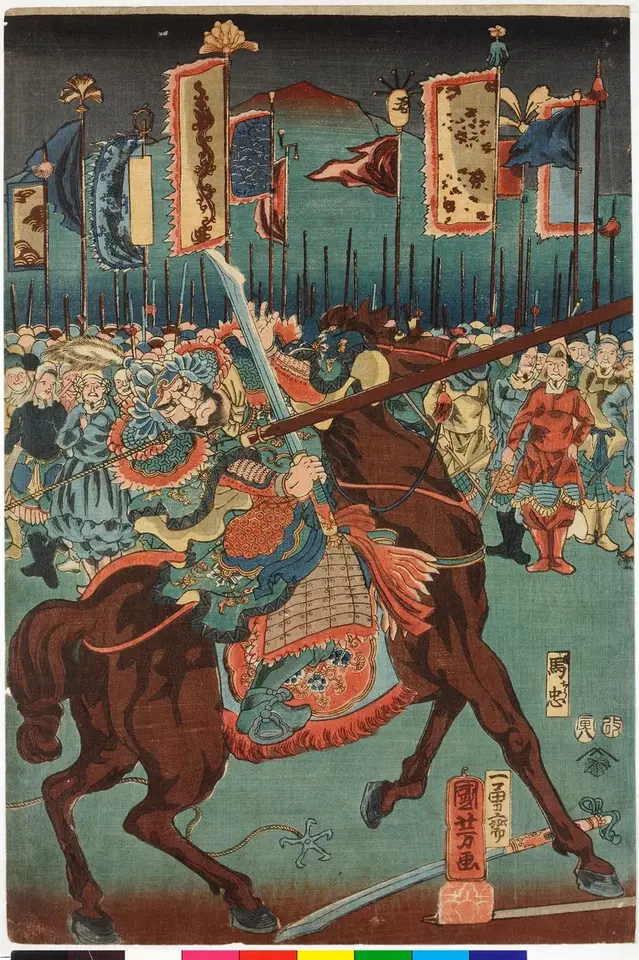
194 CE–249 CE
马忠
Ma Zhong (马忠, c. 194–249 CE), courtesy name Dexin (德信), originally named Hu Du (狐笃), was a distinguished statesman and military commander of Shu Han during the Three Kingdoms period, best known for his long-term tenure as Area Commander of Laijiang governing the southwestern frontier of Nanzhong. Raised in his maternal grandfather's household under the surname Hu, he later reverted to his paternal surname Ma. In 222 CE,…
Ma Zhong (马忠, c. 194–249 CE), courtesy name Dexin (德信), originally named Hu Du (狐笃), was a distinguished statesman and military commander of Shu Han during the Three Kingdoms period, best known for his long-term tenure as Area Commander of Laijiang governing the southwestern frontier of Nanzhong. Raised in his maternal grandfather's household under the surname Hu, he later reverted to his paternal surname Ma. In 222 CE, following the defeat at the Battle of Xiaoting, Ma Zhong led reinforcement troops to Yong'an, where Liu Bei met him and praised his exceptional talent, comparing him to Huang Quan. Following Zhuge Liang's Southern Campaign, Ma Zhong served as Governor of Zangke and Army Advisor to the Chancellor. In 233 CE, he replaced Zhang Yi as Area Commander of Laijiang, swiftly slaying the insurgent tribal leader Liu Zhou and pacifying Nanzhong. Governing with a balanced combination of benevolent conciliation and decisive authority, he partnered with his trusted general Zhang Ni to stabilize the frontier, reopen the ancient post roads connecting Yuexi Commandery to Chengdu, and foster agricultural development. Rising to Senior General Pacifying the South and Manager of Affairs of the Masters of Writing, enfeoffed as Marquis of Pengxiang, he served both as a frontline frontier commander and a high court minister, securing decades of durable peace on Shu Han's southern borders.
Began service as a commandery clerk in Baxi; recommended as Filial and Incorruptible and made Magistrate of Hanchang.
Dispatched by Baxi Governor Yan Zhi to lead reinforcement troops to Yong'an; praised by Liu Bei as a rare talent.
Liu Shan ascended the throne; Zhuge Liang established his chancellor's office and appointed Ma Zhong Director of the Gate.
Participated in Zhuge Liang's Southern Campaign; appointed Governor of Zangke, executing rebel leader Zhu Bao.
Summoned to the capital as Army Advisor to the Chancellor, assisting Chief Clerk Jiang Wan in overseeing the retained chancellor's office.
Coordinated supplies during Zhuge Liang's fourth northern expedition; subsequently supervised Zhang Ni in pacifying the Wenshan Qiang rebellion.
Succeeded Zhang Yi as Area Commander of Laijiang; decapitated insurgent chieftain Liu Zhou and was named Marquis of Boyang District.
Relocated commandery headquarters to Wei County in Jianning; partnered with Zhang Ni to restore Yuexi and became Marquis of Pengxiang.
Conveyed imperial decrees to Grand Marshal Jiang Wan in Hanzhong to halt the eastern riverine campaign; promoted to Senior General Pacifying the South.
During Cao Shuang's invasion of Hanzhong, remained in Chengdu to manage state affairs while Fei Yi led forces to the northern front.
Passed away in office in Nanzhong; indigenous and Han populations grieved deeply and erected commemorative ancestral temples.
Ma Zhong was born in Langzhong County within Baxi Commandery. During his early childhood, he was fostered in his maternal grandfather's household, taking his mother's surname Hu and the given name Du. Upon reaching adulthood, he resumed his ancestral surname Ma and assumed the personal name Zhong, adopting the courtesy name Dexin.
He commenced his public career as a petty administrative clerk in Baxi Commandery. Toward the end of the Jian'an era around 215 CE, regional authorities recommended him as Filial and Incorruptible, and he was appointed Magistrate of Hanchang.
Throughout his tenure in Hanchang, Ma Zhong governed with compassion, comforting vulnerable populations and administering judicial penalties with strict equity. This extensive grassroots experience across ethnically diverse border territories laid the foundation for his later mastery in managing complex multi-tribal frontier affairs.
In 222 CE, First Sovereign Liu Bei suffered a catastrophic military defeat against Eastern Wu at the Battle of Xiaoting, retreating to the fortress of Baidicheng in Yong'an. Governor Yan Zhi of Baxi Commandery mobilized five thousand conscript reinforcements across his counties, designating Magistrate Ma Zhong to command the force.
Liu Bei summoned Ma Zhong for a personal interview, engaging him in thorough discussions regarding military strategy and civil governance. Astounded by Ma Zhong's composed demeanor and penetrating strategic vision, Liu Bei remarked to Director of the Imperial Secretariat Liu Ba that although the state had lost Huang Quan, it had gained Hu Du, demonstrating that the realm was never bereft of extraordinary talents.
In the fourth month of 223 CE, Liu Bei passed away at the Palace of Yong'an. Following Crown Prince Liu Shan's coronation in Chengdu, Chancellor Zhuge Liang opened his chancellery and recruited Ma Zhong as Director of the Gate, inducting him into the core inner circle of the central government.
In 225 CE, Zhuge Liang mobilized a three-pronged southern expedition to pacify regional insurrections in Nanzhong, appointing Ma Zhong Governor of Zangke. Rebel commander Zhu Bao had seized control of the commandery and allied with local tribal leaders. Ma Zhong advanced decisively, launching a surprise tactical march that shattered Zhu Bao's forces and executed the rebel leader.
Following the victory, Ma Zhong distributed grain relief and stabilized civil order across Zangke, earning deep trust among indigenous inhabitants. In 230 CE, as Zhuge Liang massed armies in Hanzhong to launch northern expeditions against Cao Wei, Ma Zhong was recalled to the capital as Army Advisor to the Chancellor, assisting Chief Clerk Jiang Wan in managing the domestic administration.
In 231 CE, during Zhuge Liang's fourth northern expedition to Qishan, torrential rains destroyed plank mountain roads, severing the army's supply lines. Vice Commander Li Yan dispatched Ma Zhong to the frontline camp to coordinate logistical measures. Following the army's orderly withdrawal, Ma Zhong was ordered to suppress rebellious Qiang tribes in Wenshan Commandery. Equipping veteran commander Zhang Ni as his vanguard, Ma Zhong combined strategic intimidation with generous amnesties, rapidly compelling the tribal leaders to lay down their arms.
In 233 CE, Area Commander of Laijiang Zhang Yi alienated indigenous populations through inflexible judicial punishments, provoking a widespread uprising led by the charismatic chieftain Liu Zhou. The imperial court recalled Zhang Yi, and Zhuge Liang designated Ma Zhong to succeed him.
Arriving in Nanzhong, Ma Zhong launched an energetic campaign, slaying Liu Zhou in combat and pacifying the southwestern territories. He was appointed Army Supervisor and General Inspiring Awe, receiving the peerage of Marquis of Boyang District.
Analyzing the geopolitical geography of Nanzhong, Ma Zhong relocated the commandery headquarters from Pingyi in Zangke to Wei County in Jianning (modern Qujing, Yunnan), situating his administration squarely between Han settlements and tribal heartlands. For over two decades, Yuexi Commandery had descended into ungoverned chaos, with tribal warriors killing two successive governors, forcing previous administrators to reside eight hundred miles away in Anshang.
Ma Zhong appointed Zhang Ni as Governor of Yuexi, coordinating military patrols and civil reconstruction. Together, they rebuilt fortifications, resumed state iron and salt operations, and reopened the ancient imperial post road to Chengdu, fully integrating Yuexi back into central administrative control. For these foundational accomplishments, Ma Zhong was elevated to General Pacifying the South and enfeoffed as Marquis of Pengxiang.
In 242 CE, Ma Zhong was summoned to court. Grand Marshal Jiang Wan, stationed in Hanzhong, advocated constructing naval transports to launch an offensive down the Han River toward Wei territory, a plan that met resistance among court ministers. Emperor Liu Shan dispatched the respected Ma Zhong to Hanzhong to deliver imperial directives advising against the riverine assault, convincing Jiang Wan to abandon the campaign. Ma Zhong was consequently promoted to Senior General Pacifying the South.
In 244 CE, Cao Wei regent Cao Shuang massed over one hundred thousand troops to invade Hanzhong. Grand General Fei Yi marched north with relief forces, entrusting Ma Zhong with the vital post of Manager of Affairs of the Masters of Writing in Chengdu to oversee the capital and supply lines.
Once the northern invasion was repulsed, Ma Zhong returned to Nanzhong to resume his border command. In 249 CE, Ma Zhong passed away in office. Indigenous tribal chieftains and Han commoners wept inconsolably upon his death, with diverse communities erecting ancestral shrines throughout the southwestern commanderies to worship his memory across generations.
Presiding over the Area Command of Laijiang for sixteen years, Ma Zhong relocated the administrative seat to Wei County and governed with combined benevolence and judicial authority, securing durable frontier peace and supplying essential manpower and resources for Shu Han's northern campaigns.
Taking command during the tribal rebellion of 233 CE, Ma Zhong decapitated insurgent leader Liu Zhou and directed General Zhang Ni in pacifying Yuexi, ending twenty years of administrative vacancy and repairing the ancient courier highways connecting the southwest to Chengdu.
Equally proficient in military command and central statecraft, Ma Zhong managed the chancellor's headquarters under Zhuge Liang, persuaded Jiang Wan to suspend hazardous riverine operations in Hanzhong, and administered the central government as Manager of Affairs of the Masters of Writing during the 244 CE invasion.
FIGURES ASSOCIATED WITH THIS DYNASTY