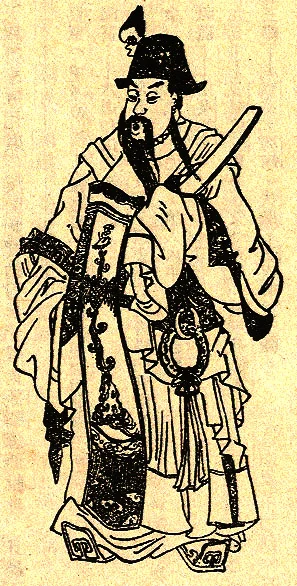
Biography
Family Background and Early Life
Yuan Shao was born into the Runan Yuan clan, one of the most powerful official families of the late Eastern Han. Beginning with his great-great-grandfather Yuan An, five men of the clan held one of the Three Excellencies across four generations: Yuan An served as Minister of Education; his younger relative Yuan Chang served as Minister of Works; Yuan Shao's grandfather Yuan Tang served as Minister of Works, Minister of Education, and Defender-in-chief; his biological father Yuan Feng served as Minister of Works; and his uncle Yuan Wei served as Minister of Education and Grand Tutor. Their students and former subordinates were spread throughout the empire, and the family became famous as “four generations and three excellencies.”
Yuan Shao's biological mother was a low-status maidservant. According to Yuan Shansong's *Book of the Later Han*, Yuan Shao was an illegitimate son of Yuan Feng, Minister of Works. Because Yuan Feng's elder brother Yuan Cheng, Left General of the Household, died young without a son, Yuan Feng adopted Yuan Shao into Yuan Cheng's line. Yuan Shao was therefore a paternal half-brother of Yuan Ji and Yuan Shu by blood, but the ritual son of Yuan Cheng. He was born in Luoyang, the imperial capital, and Yuan Cheng died around the time of his birth. He was raised by Yuan Cheng's principal wife and other women of the household and received particular affection from his uncle Yuan Wei.
As a boy, Yuan Shao served as a Gentleman. Because of his handsome appearance, dignified bearing, and controlled movements, others often imitated him. Around the age of twenty he became Chief of Puyang and gained a reputation for clean and capable administration. When his mother died, he resigned and observed three years of mourning. After completing it, he reflected on having lost his adoptive father in infancy and observed another three years of mourning for Yuan Cheng. These six years of mourning greatly enhanced Yuan Shao's reputation.
Afterward Yuan Shao moved to Luoyang. He was handsome and imposing, treated others with benevolence, valued reputation, and lowered himself to cultivate relations with scholars, receiving men of high and low status alike with equal courtesy. Visitors' carriages crowded the streets and lanes around his residence. At the time, eunuch domination was intensifying and members of the upright partisan movement were being severely persecuted. Yuan Shao publicly claimed to live in seclusion and not receive guests casually, but in fact secretly associated with partisans and men of action, forming close ties with Zhang Miao, He Yong, Xu You, Wu Ziqing, and others. During the Disasters of the Partisan Prohibitions, He Yong secretly entered Luoyang several times a year and followed Yuan Shao's plans in helping partisans escape danger. Yuan sought assistance for those in poverty and used various stratagems to hide people being pursued; many were saved.
His activity drew the attention of the eunuchs. Palace Attendant Zhao Zhong angrily remarked inside the palace that Yuan Benchu deliberately manufactured a reputation and liked supporting desperate retainers, and wondered what he ultimately intended to do. Yuan Wei heard of the concern and reprimanded Yuan Shao, but Yuan remained unmoved.
Entering Office and Exterminating the Eunuchs
In 184, the first year of the Zhongping era, the Yellow Turban Rebellion forced the Eastern Han court to lift the partisan prohibitions and pardon those affected. Yuan Shao reluctantly accepted recruitment by General-in-Chief He Jin. He received a high evaluation, was promoted to Attendant Censor, and later became General of the Gentlemen of the Rapid-as-Tigers Guard.
He Jin was a half-brother of Empress He, wife of Emperor Ling of Han. As an imperial in-law he became powerful and commanded the left and right Yulin guards, but he opposed eunuch control of government. Yuan Shao intended to use He Jin's power to eliminate the eunuchs, while He Jin trusted Yuan because of the prestige of the Yuan clan. In 188, the fifth year of Zhongping, the court formed a new Western Garden army and created the Eight Colonels of the Western Garden. Yuan Shao was appointed Colonel Who Assists the Army—though the *Records of the Three Kingdoms* calls the post Colonel of the Central Army—but real authority lay with Jian Shuo, the eunuch who served as Colonel of the Upper Army.
In the fourth lunar month of 189, Emperor Ling fell gravely ill and no crown prince had been formally designated. Jian Shuo and other eunuchs feared that power would fall to He Jin and planned to kill him first and then enthrone Liu Xie. He Jin learned of the scheme, led troops to the Hundred Offices Residence, and claimed illness rather than entering the palace. After Liu Bian ascended the throne, Empress Dowager He governed as regent. He Jin and Grand Tutor Yuan Wei assisted the government and supervised the affairs of the Secretariat.
He Jin secretly decided to eliminate the eunuchs, and Yuan Shao had long been planning the same. Through He Jin's retainer Zhang Jin, Yuan advised that the Yellow Gates and Palace Attendants had monopolized power for a long time and privately pursued profit with the Empress Dowager of Changle; He Jin should choose worthy men, restore the state, and remove this harm from the empire. He Jin strongly approved and brought strategists such as Feng Ji, He Yong, and Xun You into his inner circle.
Jian Shuo, alarmed, again planned to kill He Jin but was betrayed by one of his associates. He Jin ordered Jian's arrest and execution and took control of his troops. Yuan Shao again urged He Jin to seize the opportunity and wipe out the eunuchs completely. He argued that Dou Wu had once attempted to eliminate palace favorites but was destroyed because the plan was not kept secret and words leaked; He Jin, as the emperor's maternal uncle with brothers controlling strong forces, now held an opportunity granted by Heaven and should remove the empire's scourge in one stroke and leave a great name to later ages. He Jin agreed in principle, but Empress Dowager He firmly opposed the plan and he did not dare defy her. The empress dowager's mother, Lady Wuyang, and He Jin's brother He Miao had repeatedly accepted bribes from the eunuchs and obstructed the scheme.
When Yuan saw that the matter remained unresolved, he proposed summoning powerful generals and heroes from the provinces to bring troops toward the capital and pressure the empress dowager militarily. He Jin accepted. He summoned Former General Dong Zhuo to encamp at Shanglin Park in Guanzhong, had Wang Kuang recruit strong crossbowmen, ordered Administrator Qiao Mao of Dong Commandery to station at Chenggao, and had Commandant of Martial Ferocity Ding Yuan set fire to Mengjin so that the glow lit the city red; all announced the intention to execute the eunuchs. Empress Dowager He still refused. Yuan feared that He Jin would change his mind and warned that the conflict was already formed and the situation exposed, asking what more the general was waiting for. He Jin then appointed Yuan Shao Colonel Director of Retainers with Acting Imperial Tally and granted him authority to make decisions. Yuan placed capable Luoyang officers to watch the eunuchs and urged Dong Zhuo and the others to advance toward Pingle Observatory.
He Jin nevertheless continued to hesitate. In the eighth lunar month, when he entered the palace to meet Empress Dowager He, eunuchs Zhang Rang, Duan Gui, and others ambushed and killed him in front of Jiade Hall. On hearing the news, Yuan Shao immediately led troops into the palace, closed the gates, and hunted the eunuchs, killing them indiscriminately regardless of age. More than two thousand died. Zhang Rang and others seized the young emperor Liu Bian and Prince Liu Xie of Chenliu and fled, but Lu Zhi, Min Gong, and others recovered them. By the time Yuan Shao had exterminated the eunuchs, the capital had already descended into chaos.
Flight from the Capital and the Coalition Against Dong Zhuo
Dong Zhuo took advantage of the disorder to absorb the troops formerly belonging to He Jin and He Miao, and also gained the forces of Lü Bu and Ding Yuan, Bearer of the Gilded Mace. He summoned Yuan Shao to discuss deposing the young emperor Liu Bian and enthroning Liu Xie, Prince of Chenliu. Yuan opposed the plan privately, pretended outwardly to agree, and then fled toward Jizhou. Dong Zhuo understood that the Yuan clan's students and former officials filled the empire and feared that Yuan Shao might gather heroes and raise followers, causing further resistance. Rather than punish him, Dong Zhuo appointed him Administrator of Bohai and Marquis of Kangxiang.
In the first lunar month of 190, regional governors and administrators in the eastern provinces simultaneously raised armies against Dong Zhuo, each fielding tens of thousands of troops. Yuan Shao raised forces in Bohai, styled himself General of Chariots and Cavalry, and was selected as leader of the coalition. Fearing the coalition's strength, Dong Zhuo burned Luoyang and forced the court to move to Chang'an. The eastern coalition, however, fractured because its members failed to cooperate. Yuan Shao and Han Fu, Inspector of Jizhou, also plotted to enthrone Liu Yu, Inspector of Youzhou, but Liu Yu sternly refused.
Seizing Jizhou and Unifying Hebei
After Dong Zhuo moved west, the eastern armies began annexing one another. Yuan Shao's adviser Feng Ji proposed seizing Jizhou. Han Fu was timid, and Gongsun Zan had also led troops against him. Yuan used the situation to send his nephew Gao Gan and adviser Xun Chen to persuade Han Fu to surrender the province. In 191, the second year of Chuping, Han Fu was forced to hand over the office of Inspector of Jizhou. Yuan Shao assumed the post himself and made Han Fu General Who Displays Might. Han Fu soon fled in fear to Zhang Miao and later committed suicide.
After securing Jizhou, Yuan fought Gongsun Zan for control of the north. Gongsun Zan's power had risen greatly after victories over the Yellow Turbans; he appointed Yan Gang as Inspector of Jizhou, Tian Kai as Inspector of Qingzhou, and Shan Jing as Inspector of Yanzhou, directly challenging Yuan's territorial claims. In 192 the two sides fought the Battle of Jieqiao. Gongsun Zan placed thirty thousand infantry in square formations and stationed more than five thousand cavalry on each wing. Yuan Shao sent Qu Yi with eight hundred elite troops in the vanguard supported by one thousand strong crossbows. Qu Yi's force waited calmly until Gongsun's cavalry drew near, then the ambush rose at once and killed Yan Gang; Gongsun Zan suffered a major defeat.
During the battle Yuan himself was at one point surrounded by more than two thousand of Gongsun's cavalry as arrows fell like rain. Tian Feng tried to lead him behind an empty wall. Yuan threw his helmet to the ground and declared that a great man should die fighting and should not crawl behind a wall merely to prolong his life. He ordered his crossbowmen to counterattack, inflicting many casualties, and the encirclement was broken only when Qu Yi arrived in support.
Yuan and Gongsun Zan continued fighting for years. In 193 Yuan defeated the Yu Du faction of the Black Mountain Army. In 195 he sent his eldest son Yuan Tan to seize Qingzhou. In 199 he launched the Battle of Yijing; Gongsun Zan died by self-immolation. Yuan Shao now controlled Jizhou, Qingzhou, Bingzhou, and Youzhou and commanded several hundred thousand men, becoming the strongest regional power of the time.
Defeat at Guandu and Death
In 196, the first year of Jian'an, Cao Cao welcomed Emperor Xian of Han and established the imperial court at Xu. In the emperor's name he appointed Yuan Shao Defender-in-chief and Marquis of Ye. Yuan was ashamed to hold a rank below Cao Cao and refused. Cao was forced to relinquish the office of General-in-Chief and instead have Yuan appointed General-in-Chief.
In 200, the fifth year of Jian'an, Yuan led more than one hundred thousand troops south against Xu. Adviser Ju Shou urged a prolonged strategy, while Tian Feng recommended attacking Xu while Cao Cao was away campaigning against Liu Bei. Yuan rejected both plans. He refused Tian Feng's surprise-attack proposal because his young son was ill; Tian struck the ground with his staff and exclaimed that a great opportunity was being lost for the sake of one child. Yuan became angry and imprisoned him.
At the Battle of Guandu, Yuan first lost the generals Yan Liang and Wen Chou at Boma and Yanjin. Later, during the attack on Wuchao, he rejected Zhang He's advice and failed to send a strong force to save the grain depot. Cao Cao personally led a surprise assault and burned the supplies. After Wuchao fell, Yuan's army lost morale; Zhang He, Gao Lan, and others defected to Cao Cao, and Yuan's forces collapsed. Yuan escaped north across the Yellow River with only eight hundred cavalry.
In 201, the sixth year of Jian'an, Yuan rebuilt his forces and fought Cao Cao again at Cangting, suffering another defeat. After the disasters he became ashamed and resentful and fell ill. On the gengxu day, the twenty-first day of the fifth lunar month in the seventh year of Jian'an—June 28, 202—he vomited blood and died.
His Lineage and His Years of Mourning
The descent of the Yuan of Runan may be traced in several sources. Pei Songzhi's note quotes Hua Qiao's Han History that "Yuan An, styled Shaogong, was fond of learning and of grave authority; under Emperor Ming he was governor of Chu commandery and judged the case of the king of Chu, righting more than four hundred families, all of whom were saved, and so An became a minister of name; under Emperor Zhang he rose to be minister of education and begot Yuan Jing, governor of Shu commandery; Jing's younger brother Chang was minister of works; Jing's son Tang was grand commandant; Tang had four sons, the eldest Ping, and Ping's younger brother Cheng, general of the left household troops, both dying young, and Cheng's younger brothers Feng and Kui, both dukes". The New Tang History's table of chancellors' lineages traces the line further back, that "the Yuan descend from the Gui surname; Chen Hugong Man begot Shengong Xihou... at the end of Qin a descendant Gao fled for refuge to the region of the He and Luo, and his youngest son Zheng took Yuan as his surname", and records that "the eighth generation descendant Liang had two sons, Chang and Zhang; Chang, magistrate of Chengwu, begot the Han minister of education An, styled Shaogong, whose three sons were Shang, Jing and Chang; Jing, governor of Shu commandery, had two sons, Peng and Tang; Tang, styled Zhonghe, was grand commandant and the marquis of Anguo Kang; his three sons were Cheng, Feng and Kui; Cheng, general of the left household troops, begot Shao, whose second son Xi had descendants who long dwelt at Dongguang in Leling". Of his mourning the histories say that "when the three years of mourning were done Yuan Shao, reflecting with a sigh that he had been fatherless from birth, went into mourning afresh for his father Yuan Cheng; and when the mourning was over he moved to Luoyang. He was of handsome person and dignified bearing, benevolent by nature and careful of his name, and, lowering himself to make friends, was sought by scholars in crowds; and to all who came, of high or low degree, he gave the courtesy of an equal, so that the carriages of his guests filled the streets and lanes of Luoyang."
The Joint Command of the Guards and the Beginning of the Plot
The plot against the eunuchs had its beginnings early. The Later Han History records that "Yuan Shao was then in joint command of the guards with the imperial clan officer Liu Yu and the colonel of the assisting army Jian Shuo, who said to Yu and Shao that 'I have again and again seen the emperor, and he is most intelligent, but is hedged about by those about him; if we join our strength to destroy the favourites and then call up the able and worthy to revive the Han house, retiring when the work is done, would that not be a joy?' Yu and Shao too had long had their plans and so joined hands with him, but before they could act Jian Shuo was recommended by the censor-in-chief Zhang Wen as governor of Jingzhao; and the emperor, wishing to receive him, was dissuaded by Jian Shuo and his fellows, who feared him, so that he was made governor of Jingzhao." Afterwards, when Lingdi lay gravely ill, he entrusted Liu Xie to Jian Shuo, "who, having received the testamentary charge and always lightly esteeming and envying the He brothers, was within the palace when the emperor died and wished first to kill He Jin and set up Xie; but as He Jin came in from without, Jian Shuo's secretary Pan Yin, an old friend of He Jin, met him and looked at him by way of warning, so that He Jin, alarmed, galloped back by a side road to his camp and led his troops to quarter in the Hundred Commanderies' lodging, pleading illness and not entering. Jian Shuo's plan came to nothing, and the prince of Bian took the throne, the empress dowager He held court, and He Jin with the grand tutor Yuan Kui became regent and recorder of the secretariat." When He Jin took the government he "had long known that the eunuchs were hated by the world and resented Jian Shuo's plot against him, and so secretly planned to destroy them; and Yuan Shao too had long had his plans, and through He Jin's friend Zhang Jin urged him that 'the yellow gate and regular attendants have held power long and have shared their illicit gains with the empress dowager of Changle; the general should choose the worthy and good afresh and set the realm in order, ridding the world of a scourge'. He Jin thought him right; and because the Yuan house had been favoured for generations and the world looked to it, and Shao had long kept retainers and could win stalwarts to his use, and his cousin the general of the imperial household troops, Shu, was also full of spirit and gallantry, he treated them both well and called in many men of counsel, such as Pang Ji, He Yong and Xun You, to be his intimates". By Pei Songzhi's note, "Shao sent his retainer Zhang Jin to say to He Jin that 'the yellow gate and regular attendants have held power long, and the empress dowager of Yongle and the regular attendants have shared their gains; let the general set the world in order and rid the seas of a scourge', and He Jin thought him right and joined his plans with Shao; but the empress dowager would not consent, and so he summoned Dong Zhuo to overawe her. The regular attendants, hearing of it, came to He Jin to apologise and awaited his disposal; and Shao urged him to decide the matter then and there again and again, but He Jin would not consent. He had Shao send out armed officers of Luoyang to search out and watch the eunuchs, and ordered Shao's brother, the general of the imperial household troops Shu, to choose two hundred gentle braves to enter the forbidden palace and replace the armed yellow-gate men at the gates."
The Hesitation of He Jin and the Wiles of Yuan Shao
Yuan Shao's words to He Jin are given in full: "that of old Dou Wu, wishing to destroy the favourites, was himself destroyed, because his words leaked out and because the officers of the five camps and the hundred offices stood in awe of the eunuchs; now the general has the weight of the empress's brother, and his brothers all command strong troops, and his officers are all men of talent and fame who gladly lay down their lives, and the matter is in his grasp — this is the season Heaven lends; the general should once for all rid the world of its scourge and leave a name for after ages; even Shen Bo of Zhou is not worth mentioning. And now the late emperor lies in the front hall, and the general, having received the edict, commands the guards, and should not lightly go in and out of the palace." He Jin "much approved, and so pleaded illness and did not attend the mourning nor escort the coffin to the tomb, and made his plans with Shao and laid them before the empress dowager". But "the empress dowager would not hear, saying that 'the eunuchs commanding the forbidden palace has been the usage of the Han house from ancient times to this, and cannot be abolished; and the late emperor has but newly left the world — how should I stand awkwardly to do business with scholars?'" He Jin "found it hard to go against her will and wished only to destroy the more licentious among them; but Shao held that the eunuchs, being near the sovereign and giving their orders, must all be removed or they would prove a trouble hereafter. And the empress's mother the lady of Wuyang and He Miao had received bribes from the eunuchs and knew that He Jin meant to destroy them, and often shielded them before the empress, saying that 'the general kills those about the sovereign at will and usurps power to weaken the altars of state', at which the empress began to believe them. And the eunuchs in the palace had been there some for decades, enfeoffed and honoured, bound to all within and without; and He Jin, newly come to his great charge, had always stood in awe of them, and though he had great fame abroad he could not decide within, so that the matter long hung fire." He Miao said to He Jin that "we came together from Nanyang, poor and humble, and by reliance on the palace attained wealth and honour; the affairs of state are not so easy — spilt water cannot be gathered up; you should think deeply and be at peace with the palace", so that "He Jin's mind wavered the more"; and Yuan Shao, "fearing that He Jin would change his plan, pressed him, saying that 'the plot is already formed and the situation revealed; if the matter is left, change will come — what are you waiting for, and why not decide at once?', and He Jin then made Shao censor-in-chief with the staff of authority and sole power to strike, and the army secretary Wang Yun prefect of Henan; and Shao had the armed officers of Luoyang watch the eunuchs while he urged Dong Zhuo and the others by post to advance and encamp at the Pingguan park." Afterwards "the empress dowager took fright and dismissed all the regular attendants and lesser yellow gates to their homes, keeping only men of He Jin's own choosing to guard the palace, and the attendants all came to He Jin to apologise and awaited his disposal, and He Jin told them that 'it is you, sirs, of whom the world complains; now Dong Zhuo is at hand, why do you not each retire to your fiefs?', and Yuan Shao urged him to settle the matter then and there again and again, but He Jin would not consent; and Shao then sent letters to the provinces, falsely declaring He Jin's will, bidding them arrest the kinsmen of the palace eunuchs."
The Death of He Jin and the Slaughter of the Eunuchs
The day of the crisis was violent. The eunuchs "with several dozen of their partisans lured He Jin into the palace and killed him before the Jiade hall". "When He Jin's officers heard that he had been killed they led troops into the palace, and the general of the imperial household troops, Yuan Shu, attacked the palace city and burned the Qingguo gate, and Zhang Rang and the others then seized the young emperor Liu Bian, and the prince of Chenliu Liu Xie, and fled in haste from the double walled passage. Yuan Shao and Yuan Kui, forging an edict, summoned the kinsmen of the eunuchs and killed them, and then with He Miao drew up troops below the rose-finial gate, seizing and killing the eunuch Zhao Zhong and others who had not yet fled; and he closed the northern palace gate, forbidding passage, and led his soldiers to search the palace for eunuchs, killing great and small alike, until more than two thousand died, some beardless men being killed by mistake and some escaping only by exposing themselves. Yuan Shao advanced and pressed into the palace, some mounting the roof of the Duan gate to attack within; and in this Yuan Shao with Wang Kuang and others forced the Duan gate and killed the regular attendants Gao Wang and another on the Chengming hall." The Comprehensive Mirror is fuller still: "Yuan Shao and his uncle Kui, forging an edict, summoned Fan Ling and Xu Xiang and killed them; and Shao with He Miao drew troops below the rose-finial gate, seized Zhao Zhong and the others and killed them. Wu Kuang and his fellows, long resenting that Miao did not share He Jin's mind and suspecting him of dealings with the eunuchs, had it proclaimed in the camp that 'he who killed the general is the chariot and horse general — can you soldiers avenge him?', and all wept and said 'we will die for it', and Kuang led troops with Dong Zhuo's brother, the coachman Wu Min, and killed Miao, casting his body into the park; and Shao then shut the northern palace gate and led his troops to seize the eunuchs, killing them without regard to age, more than two thousand in all, and some beardless men died by mistake. Shao then pressed into the palace, some mounting the roof of the Duan gate to attack within." The Later Han History adds the end: "Zhang Rang, Duan Gui and the others, hard pressed, took the emperor and the prince of Chenliu, some dozens of men, out on foot by the Gu gate and fled to Xiaoping ford; and the ministers all went out to the Pingguan park, none able to follow, save the president of the secretariat Lu Zhi, who galloped by night to the river, and Wang Yun, who sent the Henan assistant Min Gong after him; and Min Gong, arriving, cut down several with his own sword and the rest threw themselves into the river and died."
The Dispute over the Deposition and His Flight to Jizhou
With Dong Zhuo's entry into Luoyang, Yuan Shao contested the deposition. "Dong Zhuo led his army to the western suburb of Luoyang and met the young emperor and the prince of Chenliu below the Beimang slope; having hit by chance on a trump card, he brought the young emperor along and marched his army in full array into Luoyang. Bao Xin told Yuan Shao that 'Dong Zhuo has strong troops and his mind is not to be plumbed; if no step is taken early we shall be at his mercy, and if we strike suddenly while his men and horses are wearied with the long march, we may yet seize him'; but Yuan Shao, seeing Dong Zhuo's troops strong and his horses in good condition, dared not act rashly." Of the dispute the Later Han History records that "Dong Zhuo, wishing to change the succession, said to Shao that 'the ruler of the world should be a man of worth and wisdom; every time I think of Emperor Ling it makes me burn with anger. The prince of Dong seems fit, and should now be set up', and Shao said that 'the present emperor is in the flower of youth and has done nothing unkind that is spread abroad; if you go against the rites and set aside the legitimate for the base, I fear men's judgement will not be at ease', at which Dong Zhuo, hand on sword, shouted at him that 'does the churl dare? Are the affairs of the world not in my hands? What I wish to do, who dares disobey?', and Shao answered craftily that 'this is a great matter of state; let me go out and take counsel with the grand tutor', and Dong Zhuo adding that 'the Liu seed is not worth preserving', Shao in a fury said that 'are there no strong men in the world but the duke of Dong?', and, laying his sword across, bowed deeply and went straight out, hanging his staff of authority on the Shangdong gate, and fled to Jizhou." Dong Zhuo sought to buy him, but Zhou Bi, Wu Qiong and others explained him away: "the palace attendant Zhou Bi, the gate captain Wu Qiong and the gentleman of the interior He Yong were all men of name, trusted by Dong Zhuo though secretly for Shao, and they said to him that 'the deposing of an emperor is a great matter beyond common men; Shao has not seen the greater interest and, being afraid, has fled, with no other design. If he is now hunted hard he must turn desperate. The Yuan house, favoured for four generations, has its old officers all over the world, and if he gathers the bold and draws a following, and heroes rise with him, Shandong will not be yours; better to pardon him and give him a commandery, and he will be glad to escape and give no trouble.' Dong Zhuo thought it right and made Shao governor of Bohai and lord of Kuang township", Shao still styling himself assisting censor-in-chief.
The Eastern Coalition, the Oath and the Cession of Jizhou
In the first month of the first year of Chuping "all the provinces east of the passes rose to chastise Dong Zhuo and made the governor of Bohai, Yuan Shao, their leader; he styled himself chariot and horse general, and all the generals were given nominal titles. Shao with the governor of Henei, Wang Kuang, camped at Henei; the governor of Jizhou, Han Fu, remained at Ye and supplied their grain; the governor of Yuzhou, Kong Zhou, camped at Yingchuan; the governor of Yanzhou, Liu Dai, the governor of Chenliu, Zhang Miao, his brother the governor of Guangling, Zhang Chao, the governor of Dongjun, Qiao Mao, the governor of Shanyang, Yuan Yi, and the chancellor of Jibei, Bao Xin, with Cao Cao camped at Suanzao; and the general of the rear, Yuan Shu, at Luyang, with several tens of thousands in all". Pei's note gives their styles, that "Kong Zhou was styled Gongxu, a man of Chenliu; Wang Kuang was styled Gongjie, a man of Taishan; Yuan Yi was styled Boye; Shao's cousin Shu was styled Gonglu, a man of Ruyang in Runan; Qiao Mao was styled Yuanwei, a kinsman of Qiao Xuan, who had been governor of Yanzhou with much authority and kindness", and cites the Wei Annals that "Liu Dai hated and killed him". The Spring and Autumn of Emperor Xian records the oath: "Shao gathered the governors and chancellors of the ten commanderies of Jizhou, several hundred thousand in all, and ascended the altar and smeared the blood, swearing that 'the traitor minister Dong Zhuo, taking advantage of the decline of the Han house and relying on his host of arms, has overrun the imperial city and trampled on the dynasty, has secretly poisoned the empress dowager and killed the prince of Hongnong, has seized the young sovereign and dragged him to Qin, has murdered the ministers of the court and beheaded the loyal and good, burned the palaces, defiled the palace women and opened the tombs, wreaking cruelty on the gods; his crimes reek to Heaven and his filth pollutes the earth; the spirits resent and have no stay, the myriads weep blood and have no appeal; the good and wise are sick at heart and the righteous spring up in clouds and mists, all wishing to punish the guilty by the sovereign's command and to carry out the vengeance of Heaven. All we who are of this league shall exhaust our strength and give our lives to smite the evil and uphold the royal house and support the Son of Heaven; and whoever breaks this oath, may the gods destroy him, cast down his army, and cut off his house against the state!'" Afterwards they proposed to set up Liu Yu: "in the second year the governor of Jizhou, Han Fu, the governor of Bohai, Yuan Shao, and the generals of Shandong, holding that the court was young and pressed by Dong Zhuo, the Emperor Xian being then ten years old, and being cut off by the passes so that it was not known whether he lived, wished to set up Yu, as an elder of the imperial clan, and so sent the former governor of Lelang, Zhang Qi, and others with their proposal and the titles for Yu; but Yu rebuked Zhang Qi and his fellows with a stern face... and firmly refused; and Fu and the rest asked him to take the office of recorder of the secretariat and to appoint and enfeoff by imperial authority, and again he would not hear." Of the cession of Jizhou the Three Kingdoms gives the fullest account: "when Dong Zhuo had gone west into the passes Shao moved his army back to Yanjin, and taking advantage of Han Fu's panic had the man of Chenliu, Gao Gan, and the man of Yingchuan, Xun Chen, say to Fu that 'Gongsun Zan is riding the wave of his victories southward and the commanderies are answering him, while General Yuan is leading his troops eastward with a purpose not to be known, and I fear for you, general', and Fu asked what was to be done, and Xun Chen said that 'Gongsun Zan leads the picked troops of Yan and Dai whose edge cannot be withstood, and the Yuan house is the hero of the age and will never stand below the general; Jizhou is the great resource of the world, and if the two heroes join their strength and fight beneath the walls, ruin will be at hand. The Yuan house is your old friend and your ally, and the best plan for the general is to hand Jizhou over to him. If the Yuan house gets Jizhou, Gongsun Zan cannot contend with him and must be deeply grateful to the general; and by giving Jizhou to a friend you win the name of yielding to worth and stand as safe as Mount Tai. Let the general not doubt it', and Fu, being timid by nature, agreed." But "Fu's chief secretary Geng Wu, his assistant Min Chun and his administrator Li Li remonstrated that 'Jizhou, poor though it be, has a million armed men and grain for ten years; Yuan Shao is a lone stranger with a starving army who looks to us for his breath, like an infant in the palm of the hand, whom by cutting off its milk you may starve at once — how then would you give him the province?', and Fu said that 'I am an old officer of the Yuan house and my talent is not equal to Benchu's; to yield by measuring one's worth has been prized by the ancients — what fault do you find in it?', and his officers Zhao Fu and Cheng Huan asked leave to resist Shao with troops, and Fu again would not hear, and so yielded, and Shao took the governorship of Jizhou." Pei's note quotes the Spring and Autumn of the Nine Provinces on the plot of Zhao Fu and the rest in full: "Fu sent the commander Zhao Fu and Cheng Huan with ten thousand crossbows to camp at Heyang, and when they heard that Fu meant to give Jizhou to Shao they galloped east from Mengjin; and Shao being then at the mouth of the clear water at Chaoge, they came up behind him with several hundred boats and more than ten thousand men, and passing his camp by night with drums and ordered ranks, at which Shao was much displeased. Reaching Fu they told him that 'Yuan Benchu has not a peck of grain and his men are already scattered, and though Zhang Yang and Yufu Luo have newly submitted they will not be used for him; he is not to be feared, and we beg leave with our present troops to resist him, and within ten days he must crumble; let the general but open his gate and sleep on a high pillow — what is there to fear or dread?', but Fu would not hear, and so vacated his seat and went out to dwell in the old house of Zhao Zhong, sending his son with the seals of Jizhou to Shao at Liyang."
The Brutality of Zhu Han and the Counsel of Ju Shou
Having taken Jizhou, Shao's rule had its severities. Pei's note quotes the Records of Heroes that "Shao made Zhu Han of Henei his officer of the capital, and Han, whom Fu had formerly slighted and who bore a grudge within, and wishing besides to please Shao, raised troops from the city without authority and surrounded Fu's house, drawing his sword and mounting the roof; and Fu fled up to the upper storey, but they seized his eldest son and broke both his legs; and Shao at once arrested and killed Han. Fu was still in terror and so asked leave of Shao and departed." And the Later Han History records Shao's words in summoning Ju Shou: "Shao, having taken the governorship of Jizhou, made Fu general of the awing-might by imperial authority but gave him no troops; and he took Ju Shou as his assistant and said to him that 'now the traitor minister has made trouble and the court has moved; I have been favoured for generations and mean to exhaust my strength and life to revive the Han house. But Huan of Qi could not have become hegemon without Yi Wu, nor Goujian have preserved his state without Fan Li; now I would join strength and heart with you to set the altars of state at peace — by what means shall we bring it about?'" Ju Shou's answer best shows the ambition of the hour: "the administrator Ju Shou said to Shao that 'the general took office at his coming of age and spread his name through the seas; in the time of the change of succession he roused his loyalty and righteousness; riding out alone he made Dong Zhuo afraid; crossing the river northward he made Bohai bow its head. Rousing the troops of one commandery and gathering the host of Jizhou, you have shaken Hebei with your might and made your name heavy in the world. Though the Yellow Turbans be crafty and the Black Mountain insolent, if you turn your army east Qingzhou may be settled; turning back against the Black Mountain, Zhang Yan may be destroyed; wheeling north, Gongsun must perish; overawing the Rong and Di, the Xiongnu must submit. Laying your hand across the north of the great river, joining the lands of four provinces, gathering the talents of heroes and holding a million men, you may welcome the imperial carriage from the western capital and restore the ancestral temple at Luoyang, and give orders to the world and punish the unsubdued; and contending thus, who can withstand you? And within a few years this merit is not hard.' And Shao said gladly that 'this is my own mind', and at once memorialised making Ju Shou inspector of the armies and general of the awing-might."
The Rising at Ye and the Taking of Yijing
The rising at Ye shows how Shao met sudden change. Pei's note says that "Shao, having broken Gongsun Zan, led his army south to Boluojin and was feasting with his guests and generals when he heard that the troops of Wei commandery had risen with the Black Mountain bandit Yu Du and overthrown Ye, killing its governor Li Cheng; the bandits, in more than ten parties and several tens of thousands, gathered in Ye, and the guests at table who had families there all turned pale with fear or rose weeping, while Shao's countenance did not change but remained as ever". One who saved his household was a clerk: "the bandit Tao Sheng, formerly a petty clerk of Neihuang, had a good heart and alone led his men over the western wall, shut and held the provincial gate, refusing the other bandits, and carried Shao's household and the men of cap and gown in the province in his carts, guarding them in person as far as Chiqu and returning; and Shao, arriving, camped at Chiqu and made Tao Sheng general of the establishing righteousness by imperial authority. He then led his army into the Chaoge deer-park hills and the Cangyan valley against Yu Du, besieged him five days and broke him, killing Yu Du and the governor of Jizhou appointed by Chang'an, Hu Shou. Going north along the hills he fell upon the bandit chiefs Zuo Zizhangba and others and killed them all, and attacked Liu Shi, Qingniujiao, Huang Long, Zuoxiao, Guo Daxian, Li Damu and Yu Digeng and destroyed their camps and walls, so that they fled with the loss of tens of thousands of heads; and Shao returned to camp at Ye." Gongsun Zan's end came at Yijing: by the Later Han History, in the spring of the fourth year of Jian'an "the Black Mountain chief Zhang Yan with Xu led a hundred thousand men in three columns to save Zan, and before they arrived Zan secretly sent a messenger with a letter to Xu saying that 'in the disorders at the end of Zhou the dead covered the ground, and by my reckoning such things could not be believed; little did I think to face their edge myself today. The Yuan attack is like a god or a ghost: scaling ladders and assault towers dance on my towers and drums and horns sound from the earth, and day fails and month hurries, with no rest or ease... you should beat your head against Zhang Yan and gallop to bring help; father and son are one by nature and move without words. And keep five thousand iron horse in the northern marsh and raise fire as the signal, and I will come out from within and display our might and settle it there. Otherwise, when I am dead, though the world be wide, there will be no room for your foot'"; and Shao "intercepted the letter and raised the fire at the appointed time, so that Zan thought the relief had come and came out to fight; and Shao set an ambush and Zan was utterly beaten and fell back on the middle and inner cities; reckoning that he could not be saved, he strangled all his sisters, wives and children and then set fire to himself, and Shao's soldiers hurried up the tower and cut off his head". Afterwards "Gongsun Xu was killed by the Tuge, and Zhang Yan's power too declined, being broken by Shao".
The Proposal of Geng Bao and the Loss of the Emperor
Having taken the four provinces, Shao grew arrogant. Li Xian's note says that "Shao, having taken the lands of four provinces and several hundred thousand men, grew ever prouder and his tribute and presents grew scant; and his registrar Geng Bao secretly told him that 'the virtue of red is exhausted and the Yuan are the descendants of the yellow, and should follow the will of Heaven to follow the people's mind'", the note adding that "the Yuan were descendants of Shun, and yellow should replace red, and so Bao spoke thus"; and that "Shao showed Bao's words to his staff, and those in council held Bao's words a portent and him worthy of death; and Shao, knowing the minds of the many were not with him, was forced to kill Bao to cover his traces". The matter of welcoming the emperor was the great failure of his life. The Tradition of Emperor Xian records that "Ju Shou said to Shao that 'the general has for generations been a support of the throne and his house has continued in loyalty and righteousness; now the court is tossed about and the ancestral temple ruined, and looking at the provinces, they make righteousness their outward cry and slaughter one another within, and none preserves the sovereign or pities the people. The province being now roughly settled, you should welcome the imperial carriage and set the palace at Ye, and, holding the Son of Heaven, give orders to the feudal lords and gather men and horses to punish the disobedient — who can withstand you?' and Shao was pleased and would have done it, but Guo Tu and Chunyu Qiong said that 'the Han house has been declining for long, and to revive it now is not easy; and the heroes hold the provinces and their hosts are counted by myriads, so that it is as when Qin lost its deer, and the first to get it became king; if you welcome the Son of Heaven near you, every step must be reported, and to obey him lessens your power and to disobey is rebellion — this is no good plan', and Ju Shou said that 'to welcome the court now is the highest righteousness and the great plan of the times; if you do not take thought early another will forestall you; the grasp of power must not lose the moment and merit lies in speed — let the general take thought', but Shao would not use him." The Later Han History adds what followed: "whenever Shao received an edict he feared it might be against his interests, and so wished to move the Son of Heaven near himself, and had it said to Cao Cao that Xu was low and damp and Luoyang ruined, and that the capital should be moved to Zhencheng to a whole and rich region; but Cao Cao refused. And Tian Feng said to Shao that 'since the plan of moving the capital cannot be carried out you should take thought early for Xu and welcome the Son of Heaven, and issue your commands by his authority and sound your call through the seas — this is the best plan; otherwise you will in the end be taken by another, and regret will be useless', but Shao would not hear."
The Partition among His Sons, the Uplands and the Last Counsels
The disaster of his posterity was sown here. Pei's note says that "the eldest son Tan was sent out to Qingzhou, and Ju Shou remonstrated that 'this will be the beginning of trouble', but Shao would not hear, saying that 'I wish my sons each to hold a province'", and quotes the Spring and Autumn of the Nine Provinces for Ju Shou's words that "it is said that when one hare runs down the street ten thousand chase it, and when one has taken it the greedy all stop, because the division is fixed; and where years and worth are equal, worth decides, and where worth is equal the oracle decides — this is the ancient rule; may you look up to the warnings of former ages and down to the meaning of the divided hare", and that "Ju Shou, going out, said 'trouble begins here'"; and that Shao "made his second son Xi governor of Youzhou and his nephew Gao Gan governor of Bingzhou". The histories add that Shao "doted on his second wife the Lady Liu and especially favoured Yuan Shang, meaning to make him his heir, sending Yuan Tan out to Qingzhou, and saying to Ju Shou that 'I wish the four of them to hold a province each, to see what they can do'". Of the north there is the matter of the Wuhuan: the Later Han History records that "in the Chuping years of Emperor Xian, Qiu Liju died and his son Louban being young, his kinsman Tadun, a man of martial ability, took his place and commanded the three commanderies, all following his orders; and at the beginning of Jian'an, when the governor of Jizhou, Yuan Shao, was locked in an undecided struggle with Gongsun Zan, Tadun sent envoys to Shao asking for marriage and alliance and sent troops to help attack Zan, breaking him; and Shao, by forged authority, gave Tadun, Nanlou, Supuyan and Wuyan the seals of the Shanyu. Afterwards Nanlou and Supuyan with their tribes set up Louban as Shanyu and Tadun as king, but Tadun still held the plans; and Yan Rou of Guangyang, who in youth had been carried off among the Wuhuan and Xianbei and was trusted by their people, slew the Wuhuan colonel Xing Ju by means of the Xianbei and took his place, and Shao favoured and comforted him to keep the north quiet." Before the southern campaign Ju Shou remonstrated again in vain: the Later Han History records that "Ju Shou advised that 'in the recent campaign against Gongsun the army was in the field for years, the people are worn out and the granaries empty, and the levies and corvées are heavy — this is the deep trouble of the state. You should first send envoys to present the trophies of victory to the Son of Heaven and encourage farming to rest the people; and if this cannot get through, memorialise that Cao Cao blocks our road to the king, and then advance to camp at Liyang, gradually manage Henan, build more boats, repair weapons, and send picked cavalry to harry his borders, so that he has no rest while we take our ease — and thus it may be settled from the seat'"; and he spoke of the difference between righteous and arrogant armies, saying that "to save the troubled and destroy the violent is called a righteous army, to rely on numbers and strength is called an arrogant army; the righteous are without an enemy and the arrogant perish first. Cao Cao has welcomed the Son of Heaven and built his palace at Xu; to raise our army southward now is against righteousness, and moreover the winning of the temple is not in strength; Cao Cao's laws are carried out and his soldiers are well drilled, and he is not one who will sit and be besieged like Gongsun Zan; to abandon the sure plan and raise an unnamed army — I fear for you". The Tradition of Emperor Xian records his remonstrance at the crossing, that "as Shao was about to cross the river Ju Shou said that 'the changes of victory and defeat must be weighed with care; you should now camp at Yanjin and divide your troops to Guandu, and if they succeed you may welcome them back later, and if they meet disaster the army cannot return', but Shao would not hear; and Ju Shou, as he crossed, sighed that 'above they swell with ambition, below they seek merit; O long river, shall I not return?', and pleaded illness; and Shao hated him and took away his troops and gave them to Guo Tu". The Later Han History adds the slander of Guo Tu and the rest: "they said to Shao that 'Ju Shou commands within and without and his might shakes the three armies, and if he grows strong how will you control him? For when subject and lord are of one mind they flourish and when lord and subject are of one mind they perish — this is what the Yellow Stone warns of; and one who commands troops abroad should not know of matters within', and so Shao divided Ju Shou's command into three, giving one army each to Ju Shou, Guo Tu and Chunyu Qiong, before the campaign began."
The Counsels of Tian Feng, the Defeat at Guandu and What Followed
Tian Feng remonstrated twice, and twice in vain. The Later Han History records that in the fifth year "the general of the left, Liu Bei, killed the governor of Xuzhou, Che Zhou, and held Pei in revolt against Cao Cao, who, in fear, went himself against Liu Bei; and Tian Feng said to Shao that 'he who contends with you for the world is Cao Cao; he is now striking east against Liu Bei and his armies cannot be quickly disengaged, and if you raise your whole army and strike his rear you may settle it in one march; the army moves by opportunity, and this is the moment', but Shao pleaded his son's illness and did not march, and Tian Feng, striking the ground with his staff, said that 'alas, the time is gone; to let slip an opportunity that comes hard and lose it for a child's sickness — what a pity!', at which Shao, hearing it, was angered and from that time estranged from him". Afterwards "Cao Cao, fearing that Shao would cross the river, struck Liu Bei quickly and broke him; and Liu Bei fled to Shao, who then marched to attack Xu. But Tian Feng, holding that the moment had been lost and that they should not now march, said that 'Cao Cao having broken Liu Bei, Xu is no longer empty; and Cao Cao is skilled in war and of endless changes, and though his troops be few he is not lightly to be slighted. Better to hold him at length: the general holds the strength of mountains and rivers and the host of four provinces, and should bind the heroes abroad and encourage farming and war within, and then choose the picked troops and divide them into flying columns to come out at his weak points and harass Henan, so that where he goes to the right we strike the left and where he goes to the left we strike the right, making the enemy run himself weary so that no man has rest, while we are untired and he already exhausted; and within three years he may be taken from the seat. To abandon the plan of the temple for the deciding of all in one battle — if it go not as we wish, repentance will be too late', but Shao would not hear; and Tian Feng pressing him too hard and offending him, Shao held him to be damping the armies and had him put in chains". Of Guandu the Three Kingdoms records that "in the eighth month Shao advanced his linked camps by degrees and camped against the sand mounds, east and west for several tens of li, and Cao Cao too divided his camps to face him, and the fighting went ill; at that time Cao Cao had not ten thousand men and of them a tenth or three-tenths wounded, and Shao advanced again to Guandu and raised earthen hills and tunnels", and that "Shao made high towers and raised hills and shot into the camp, and all in the camp held up their shields, so that the host was in great fear; and Cao Cao made stone-throwing carts and broke Shao's towers, and Shao's men called them the thunder-carts". The ninth book of Wei records that "Cao Cao and Yuan Shao were long locked together at Guandu, and Shao sent Liu Bei to reduce the counties about Yinjiang and many rose with him, so that south of Xu the officials and people were unsettled and Cao Cao was troubled; and Cao Ren said that 'the south looks only to the present danger of the great army and cannot save them, and Liu Bei with strong troops upon them will surely make them turn; but Liu Bei has newly taken command of Shao's troops and cannot use them well, and may be broken by a blow', and Cao Cao approved and sent cavalry against Liu Bei, driving him off, and Cao Ren recovered all the rebel counties and returned; and Shao sent a detached general, Han Xun, to cut the western road, and Cao Ren struck him at Jiluo hill and broke him utterly, so that Shao dared not send out detached troops again". Of Wuchao the Three Kingdoms records that "Shao sent cavalry to save Chunyu Qiong, and some about Cao Cao said that the rebel horse were drawing near and asked leave to divide troops against them, and Cao Cao angrily said that 'when the rebels are at your back you tell me', and his soldiers all fought to the death and broke Chunyu Qiong and the others, killing them all"; and the Tradition of Cao Man records its cruelty: "he broke them utterly and burned all their grain and treasures, cutting off the heads of the supervisor Sui Yuanjin, the cavalry overseers Han Juzi, Lü Weihuang and Zhao Rui, and cutting off the nose of the general Chunyu Zhongjian, who was not yet dead, and killing more than a thousand soldiers, all of whose noses were taken, and cutting the lips and tongues of oxen and horses, and showing them to Shao's army". After the defeat one act of his dealing with his men is worth recording: the Later Han History records that "at the defeat of Guandu, Shen Pei's two sons were taken by Cao Cao, and Meng Dai, who had a feud with Pei, through Jiang Ji said to Shao that 'Pei holds sole power in his post, his clan is great and his troops strong, and his two sons are in the south, and he must be plotting revolt', and Guo Tu and Xin Ping agreed; and Shao made Meng Dai inspector of the armies in Pei's place as keeper of Ye; but the protector Feng Ji, being at odds with Pei, was asked by Shao, and answered that 'Pei is by nature stern and upright and in all he says and does emulates the ancients, and he will not be untrue for his two sons being in the south; do not doubt him', and Shao asked whether he did not hate him, and Feng Ji said that 'what we disputed before was private feeling; what I state now is the business of state', and Shao said 'good', and did not remove Pei, and Pei and Feng Ji were reconciled". Of the ruin of his sons the Later Han History records that "in the twelfth month Cao Cao attacked Yuan Tan and invested his gate, and Tan fled by night to Nanpi and camped by the Qing river; in the first month of the next year Cao Cao attacked hard, and Tan would have come out to fight, but his ranks were broken before they were formed; and Tan with hair loose galloped, and the pursuers, thinking he was no common man, ran after him, and he fell from his horse and looked back, saying 'here, boy, if you pass me I can make you rich and noble', and before his words were out his head was on the ground; and Guo Tu and the others were killed and their wives and children destroyed. Yuan Xi and Yuan Shang, attacked by their generals Jiao Chu and Zhang Nan, fled to the Wuhuan of Liaoxi"; and "in the twelfth year Cao Cao went against Liaoxi and struck the Wuhuan, and Shang and Xi with the Wuhuan met Cao Cao's army and were beaten and fled, and with several thousand of their own troops went to Gongsun Kang in Liaodong. Shang, being of strength, first said to Xi that 'when we reach Liaodong, Kang is sure to see me, and I will strike him down with my own hand for you, and hold his commandery, and so we may yet make our position wide'; and Kang too meant in his heart to take Shang for his own merit, and so first set picked braves in the stables and then invited Shang and Xi, and Xi, suspecting, would not go, but Shang pressed him, and so they went in together; and before they were seated Kang shouted and the ambushed men seized them and sat them on the frozen ground, and Shang said to Kang that 'before I die the cold is past bearing; let us be given a mat', and Kang answered that 'your head is about to travel ten thousand li — what use is a mat?', and had them beheaded and the heads sent."
The Quarrel over Zhou Ang, the Alliance at Henei and the Grant of Yanzhou
The feud between Yuan Shao and Gongsun Zan in fact began with Zhou Ang's seizure of ground. The eighth book of the Three Kingdoms records that "Zan, fearing that Yuan Shu would hear of it and resent him, sent his cousin Yue with a thousand horse to Yuan Shu to bind himself to him, secretly advising Shu to seize Liu He and take his troops; and so Yu and Zan fell the more at odds. Liu He, fleeing from Shu, came north and was again detained by Shao. At that time Shu sent Sun Jian to camp at Yangcheng against Dong Zhuo, and Shao sent Zhou Ang to seize the place; and Shu sent Yue with Sun Jian against Zhou Ang and they could not win, and Yue was killed by a stray arrow. Zan in anger said that 'my brother is dead and the trouble arises from Shao', and led out his army to camp at Pan river to take vengeance on Shao; and Shao, in fear, gave the seals of governor of Bohai which he wore to Zan's cousin Fan and sent him to that commandery to bind him for aid, and Fan with the troops of Bohai helped Zan break the Yellow Turbans of Qing and Xu, so that his army grew and he advanced to Jieqiao." The alliance at Henei appears in the life of Zhang Yang: "Yuan Shao reached Henei and Yang joined him, and together with the Xiongnu Shanyu Yufu Luo they camped on the Zhang river; and the Shanyu wished to rebel, but Shao and Yang would not, and the Shanyu seized Yang and carried him off, whereupon Shao sent Qu Yi in pursuit and broke him south of Ye." Of the grant of Yanzhou, the Later Han History of Xie Cheng records that "Yuan Shao made Cao Cao governor of Dongjun; Liu Gongshan held Yanzhou and was killed by the Yellow Turbans, and so Cao Cao was made governor of Yanzhou"; and Yuan Shao's memorial to Emperor Xian says that "I then acted by imperial authority, foolishly comparing myself to Dou Rong, and made the gentleman of the interior Cao Cao acting governor of Yanzhou", while the Proclamation against Yuzhou says that "the headquarters again detached picked troops, repaired and made good, and memorialised appointing him governor of Dongjun and Yanzhou". The holding of Wei commandery appears from Cheng Yu's subordinate: the fourteenth book of the Three Kingdoms records that "when the governor of Wei commandery, Li Pan, was killed by soldiers, Shao made Cheng Zhao governor of Wei; and the commandery being then in great disorder, with bandits by the ten thousand who sent envoys to and fro and traded in the market, Cheng Zhao treated them well and used them as spies, and striking where they were unprepared broke them utterly, three urgent despatches arriving in two days. Cheng Zhao's brother Cheng Fang was in Zhang Miao's army, and Miao being at odds with Shao, Shao, listening to slander, was about to punish Cheng Zhao, who wished to go to Emperor Xian but was detained by Zhang Yang at Henei." The surrender at Shequan came as Shao was about to march south: the Three Kingdoms records that "Zhang Yang's general Yang Chou killed Yang, and Sui Gu killed Chou and gave their troops to Yuan Shao, camping at Shequan. In the fourth month Cao Cao advanced to the river and sent Shi Huan and Cao Ren across to attack him; and Sui Gu left Yang's former chief secretary Xue Hong and the governor of Henei, Miao Shang, to hold the place while he went north himself to Shao for help, meeting Shi Huan and Cao Ren at Quancheng; and in the battle he was utterly broken, and Sui Gu was killed; and Cao Cao then crossed the river and besieged Shequan, where Xue Hong and Miao Shang surrendered with their troops and were made marquises, and he returned to camp at Aocang and made Wei Zhong governor of Henei with charge of the affairs of Hebei."
The End of Yuan Shu, the Alliance with Liu Bei and the Judgement of Xun Yu
Yuan Shu's ruin was also bound up with Shao. The Three Kingdoms records that "Yuan Shu, having first been broken by Lü Bu and afterwards by Cao Cao, fled to his officers Lei Bo and Chen Lan in the Qian hills and was again refused by them, and in fear knew not what to do; and he meant to give up the imperial title to Shao and go to Yuan Tan in Qingzhou, but fell ill on the way and died"; and that "when Yuan Shu wished to go north by Xuzhou to Yuan Shao, Cao Cao sent the forefather with Zhu Ling and Lu Zhao to intercept him; and before they arrived Yuan Shu died of illness... the forefather then held Xiapi, and when Zhu Ling and the others had gone he killed the governor of Xuzhou, Che Zhou, left Guan Yu to hold Xiapi and returned himself to Xiaopei; and Chang Ba of Donghai rose and many commanderies and counties revolted from Cao Cao for the forefather, several tens of thousands in all, and Sun Qian was sent to league with Yuan Shao." Of Cao Cao's resolve against Shao there is the answer of Xun Yu: the Three Kingdoms records that "Shao, having united Hebei, was feared by the world for his strength, while Cao Cao was anxious about Lü Bu in the east and resisting Zhang Xiu in the south, and Zhang Xiu had beaten Cao Cao's army at Wan; and Shao grew the prouder and wrote to Cao Cao with arrogant words... and Cao Cao showed the letter to Xun Yu, saying that 'I am now to chastise the unrighteous, but my strength is not equal — what shall I do?', and Xun Yu said that 'of the winners and losers of old, all truly had ability... what can the strength of Shao do?', at which Cao Cao was pleased; and Xun Yu added that 'unless Lü Bu is first taken, Hebei will not easily be dealt with', and Cao Cao said that it was so."
The Aftermath of the Black Mountain and the Advance of Cao Cao
The Black Mountain troubles could not be wholly settled by Yuan Shao alone. By the annals of Emperor Wu of Wei, "in the spring of the third year Cao Cao camped at Dunqiu, and Yu Du and his fellows attacked Dongwuyang; Cao Cao then led his troops west into the hills and attacked Yu Du's own camp, and Yu Du, hearing of it, abandoned Wuyang and returned; and Cao Cao struck Sui Gu in passing and attacked the Xiongnu Yufu Luo at Neihuang, breaking them utterly." So the settling of Yu Du, Sui Gu and Yufu Luo had also to do with Cao Cao; while Yuan Shao, having entered the Cangyan valley of the deer-park hills at Chaoge, broke Yu Du and killed Hu Shou, and then fell upon the other bandits and destroyed their camps, so that the power of the Black Mountain waned. Afterwards, though Zhang Yan with Gongsun Xu led a hundred thousand to save Gongsun Zan, he was at last weakened by Shao's victory. All this shows the whole of Yuan Shao's management of Hebei, and not the merit of the battle of Jieqiao alone.
Cao Cao's Advance to the River and the Rift between the Two Heroes
As Yijing was about to fall, Cao Cao too made a move toward Ye. The Spring and Autumn of Emperor Xian records that "Cao Cao led his army to the river, pretending to aid Shao but in truth meaning to surprise Ye and to be a help to Gongsun Zan; but Zan being destroyed, Shao perceived it, and Cao Cao withdrew his army and camped at Aocang"; and the Proclamation against Yuzhou says the same, that "Cao Cao, because he was not yet broken, secretly exchanged letters, outwardly aiding the royal army and inwardly plotting a surprise, and so led his troops to the river and crossed north with his boats side by side; but his messenger was discovered and Gongsun Zan was beheaded, so that his edge was blunted and his design came to nothing". So the rift between the two heroes did not begin at Guandu.