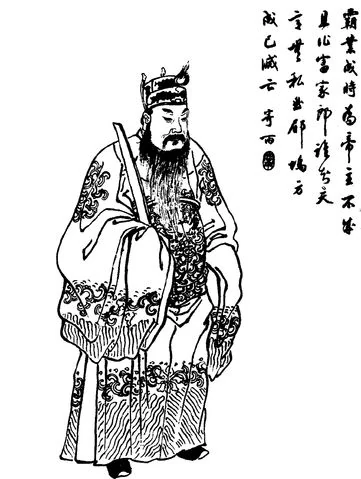
Biography
Family Background and Early Life
Dong Zhuo's father, Dong Junya, served as Commandant of Lunshi County in Yingchuan Commandery, Yu Province. Dong Zhuo and his younger brother Dong Min were born while their father held office there. Dong Zhuo's courtesy name was therefore Zhongying, while Dong Min's was Shuying. After his father left office, the family returned to Lintao in Longxi. As a youth Dong enjoyed a chivalrous lifestyle and frequently traveled among Qiang communities, forming ties with their local chiefs. After he returned home to farm, Qiang leaders once came to visit him. Dong slaughtered an ox used for plowing to entertain them, and the chiefs were so impressed that, after returning home, they gathered more than a thousand head of livestock and sent them to him in return. As an adult, Dong served as a local official in the Longxi commandery administration and was responsible for public security. He was exceptionally strong, could carry two quivers, and could shoot to either side while riding. Qiang and other frontier peoples feared his martial ability. Cheng Jiu, Inspector of Liangzhou, recruited him as an Assistant Officer and gave him troops to suppress raiders, whom he defeated with reported captures numbering in the thousands.
Frontier Service and Early Distinction
During the Yanxi era of Emperor Huan, Duan Jiong served as Colonel for the Protection of the Qiang and recognized Dong Zhuo's ability. In 163, the sixth year of Yanxi, Duan became Inspector of Bing Province and recommended Dong for service in a central government office. Excellency over the Masses Yuan Wei recruited him to his staff. In 166, Dong entered service as a Yulin Cavalryman from the Six Commanderies and later became a Military Adjutant under Zhang Huan, General of the Gentlemen of the Household Who Protects the Xiongnu. He campaigned in Bing Province and was appointed Gentleman of the Interior for his achievements. He received nine thousand bolts of silk, all of which he distributed among his officers and soldiers. In 167, when Qiang forces entered the Three Capital Districts, Zhang Huan sent Dong Zhuo and Yin Duan to attack them. They won a major victory, killed the enemy leaders, and captured more than ten thousand people. The following year, after Zhang Huan returned from campaign, Dong was promoted to Magistrate of Guangwu. He later served as Northern Commandant of Shu Commandery and Wuji Colonel of the Western Regions before being removed from office. Yuan Wei later recruited him again, after which Dong served as Inspector of Bing Province and Administrator of Hedong. Despite Dong's repeated military successes, Zhang Huan disliked his character. Dong sent his elder brother, whose name is also romanized as Dong Zhuo, with one hundred bolts of silk as a gift, but Zhang Huan refused it.
Middle Career: Yellow Turbans and the Liangzhou Rebellion
In 184, the seventh year of Guanghe, the Yellow Turban Rebellion broke out. In the sixth lunar month, Lu Zhi was removed as General of the Gentlemen of the Household for the North, and Dong Zhuo was appointed General of the Gentlemen of the Household for the East to take over military operations in Ji Province. Dong abandoned the siege of Zhang Jue at Guangzong and led the main force north to attack Zhang Bao at Xiaquyang, but failed to take the position after a two-month siege. In the eighth lunar month, the court ordered Huangfu Song north as General of the Gentlemen of the Household for the Left. Dong was dismissed and handed over to the Court of Judicial Review, which reduced his death sentence by one degree. He was pardoned in a general amnesty that winter.
In 185, rebels in Liangzhou including Beigong Boyu, Li Wenhou, Bian Zhang, and Han Sui advanced into the Three Capital Districts under the slogan of attacking the eunuchs. Dong was appointed General of the Gentlemen of the Household and served as deputy to Huangfu Song, General of Chariots and Cavalry of the Left. Huangfu was dismissed in the seventh lunar month, and in the eighth lunar month Minister of Works Zhang Wen was made General of Chariots and Cavalry. Dong was appointed General Who Defeats the Caitiffs and, together with General Who Sweeps Away Bandits Zhou Shen and others, led more than 100,000 infantry and cavalry to Meiyang. The first fighting went poorly. In the eleventh lunar month, a meteor was reported to have fallen into the rebel camp. Dong and Bao Hong, Administrator of Youfufeng, took advantage of the omen to attack and routed the rebels, reportedly taking several thousand heads. The rebels retreated to Yuzhong in Jincheng. Zhang Wen sent Zhou Shen in pursuit. Dong offered to serve as support, but Zhang refused and instead ordered him to attack the Xianling Qiang. North of Wangyuan County, Qiang and other frontier forces surrounded Dong's army and cut off its supplies. Dong constructed a false dam in the Wei River under the pretext of catching fish, then secretly moved his troops across beneath it. His entire army escaped. Of six government columns in the campaign, five suffered defeat; Dong's alone returned intact. He then stationed troops in Youfufeng and was enfeoffed as Marquis of Lixiang with one thousand households.
In 188, the fifth year of Zhongping, the Liangzhou rebel Wang Guo attacked Chencang. The court appointed Huangfu Song General of the Left and placed General of the Van Dong Zhuo under his command, each with twenty thousand men. Dong urged an immediate advance, while Huangfu judged the city too strong to fall and preferred to wait until the rebels exhausted themselves. Dong objected and the two quarreled. In the second lunar month of 189, after more than eighty days without taking the city, the rebel army withdrew in exhaustion. Huangfu ordered a pursuit. Dong advised against it, invoking the principle that a desperate enemy should not be pressed. Huangfu ignored him, pursued with Dong covering the rear, and won repeated victories, reportedly taking more than ten thousand heads. Dong was deeply humiliated and thereafter bore Huangfu a grudge.
Entry into the Capital and Seizure of Power
In the fourth lunar month of 189, Emperor Ling died and the Young Emperor Liu Bian succeeded him. General-in-Chief He Jin dominated the government and conspired with Yuan Shao to eliminate the eunuchs. Empress Dowager He refused to approve the plan, so He Jin and Yuan Shao secretly summoned Dong Zhuo to the capital to pressure her. Dong immediately set out and submitted a memorial attacking the eunuchs. While stationed in Hedong and advancing as far as Mianchi, he received an imperial order delivered by Zhong Shao to withdraw. Suspicious, he retreated only as far as Xiyang Pavilion. He Jin was then killed by the eunuchs, and Yuan Shao and others entered the palace and slaughtered them, throwing the capital into chaos. Dong led his army to Beimang and met the Young Emperor and Liu Xie, Prince of Chenliu. Civil and military officials joined him in receiving the emperor below Mangshan.
Dong entered Luoyang with only three thousand troops. To create the impression that a much larger army was arriving, he repeatedly sent soldiers out of the city at night and had them re-enter in daylight with banners displayed. After several days, the population believed that Dong commanded a massive force. Dong also ordered his brother Dong Min to join Wu Kuang in killing He Miao, and induced Lü Bu to kill Ding Yuan and absorb Ding's troops. Dong then deposed Liu Bian as Prince of Hongnong and enthroned Liu Xie as Emperor Xian of Han. Soon afterward, he poisoned Empress Dowager He and abolished the temple names or honorifics of Emperor He, Emperor An, Emperor Shun, Emperor Huan, and Empress Gonghuai. Dong became Defender-in-chief while retaining command as General of the Van, was enfeoffed as Marquis of Mei, and later advanced to Grand Councilor; his mother was created Lady of Chiyang.
After taking power, Dong also tried to win over prominent scholars. He rehabilitated party figures such as Chen Fan, Dou Wu, and Li Ying and appointed scholars including Xun Shuang and Cai Yong. After Yuan Shao quarreled with Dong and fled, Dong initially wished to kill him, but Wu Qiong, Zhou Bi, and others persuaded him instead to appoint Yuan Administrator of Bohai. He also promoted Zhang Miao, Han Fu, Kong Zhou, and other prominent men, many of whom later became leading participants in the coalition against him. Dong's own close followers were mostly assigned to colonel-level commands rather than the highest civil offices.
Downfall and Death
In 190, the first year of Chuping, regional lords east of the passes raised armies against Dong. He decided to transfer the capital to Chang'an and ordered the burning of Luoyang's palaces, ancestral temples, government storehouses, and civilian homes, while imperial tombs were opened and looted. He also sent troops to Yangcheng, where people attending a communal sacrifice were slaughtered and their women and property seized. The severed heads were tied to cart shafts and presented as those of defeated rebels. Dong ordered Li Ru to poison the deposed Prince of Hongnong, Liu Bian. The eastern coalition soon fractured because of internal conflict. Cao Cao pursued Dong's forces independently but was defeated by Xu Rong at the Bian River near Xingyang.
In 191, the second year of Chuping, Dong reached Chang'an and appointed himself Grand Preceptor, placing himself above the princes. He usurped elements of imperial dress and carriage protocol, summoned the Three Excellencies directly, and required officials from the Secretariat and below to bypass the court and deliberate at his residence. In Mei County he built the fortified Mei estate, storing thirty years' worth of grain along with reportedly twenty or thirty thousand jin of gold, eighty or ninety thousand jin of silver, and mountains of pearls, jade, silk, and embroidered fabrics.
On May 22, 192, the xinsi day of the fourth lunar month of the third year of Chuping, Dong went to Weiyang Palace to congratulate Emperor Xian on recovering from illness. Lü Bu, together with Li Su, Qin Yi, Chen Wei, and more than ten others disguised as guards, ambushed him. Li Su struck Dong with a halberd and Dong fell from his carriage, crying out for Lü Bu. Lü answered that an imperial order had been issued to punish the traitorous minister and killed him with a spear. Dong's Registrar Tian Yi and a servant threw themselves over his corpse and were also killed. His body was exposed in the marketplace, where guards reportedly inserted a wick into his navel and lit it, and the flame burned through the night. Wang Yun ordered the extermination of Dong's entire household at the Mei estate. Dong's mother, Lady of Chiyang, then ninety years old, was also killed.
His Early Years and Liangzhou
Dong Zhuo, courtesy name Zhongying, was a man of Lintao in Longxi commandery. He grew up in Liangzhou and loved the company of the Qiang; in youth he was fond of the knight-errant's way and travelled among the Qiang, making friends with many of their chiefs. Later, when Dong Zhuo returned to farming in his district, some of the Qiang chiefs came to visit him, and Dong Zhuo went home with them and killed his plough ox to feast them, at which the chiefs were much moved and, going back, gathered more than a thousand head of cattle and other livestock and gave them to him. The commandery summoned Dong Zhuo as a clerk and had him oversee the suppression of robbers; and when the Hu came out raiding and carried off many of the people, the inspector of Liangzhou, Cheng Jiu, called Dong Zhuo to be his attendant and had him lead troops and horse to hunt them down, which he did heavily, taking a thousand or more. The inspector of Bingzhou, Duan Jiong, recommended him to the government office, and the minister over the masses Yuan Kui called him to be his secretary. Dong Zhuo had martial skill and unmatched strength, was good at wearing two quivers and shooting to left and right at the gallop, and was feared by the Qiang and the Hu. At the end of the reign of Emperor Huan, as a good son of six commanderies, he became a guard of the feathered forest, then master of horse of the army, and following the palace general Zhang Huan against Bingzhou won merit and was made a gentleman of the interior with nine thousand bolts of fine silk, all of which Dong Zhuo distributed to his officers and men, keeping nothing, saying that the doing was his own but the having belonged to the soldiers. He was afterwards made magistrate of Guangwu, commandant of the northern part of Shujun and colonel of the Wuji of the Western Regions, dismissed on some matter, and then summoned as inspector of Bingzhou and grand administrator of Hedong.
Under Zhang Huan against the Qiang and His Refusal to Give up His Troops
In the first year of Yongkang the eastern Qiang and the Xianling, five or six thousand horse, raided the passes, investing Zhuyu and plundering Yunyang; and in winter the Qiang chiefs Anwei and Mobie with their tribesmen again plundered the three districts; and Zhang Huan sent his masters of horse Yin Duan and Dong Zhuo against them together, broke them heavily, beheaded their chiefs and took more than ten thousand, and the three provinces were cleared. Dong Zhuo admired Zhang Huan and sent him a hundred bolts of silk by his brother, but Zhang Huan, disliking Dong Zhuo's character, refused them outright. In the first year of Zhongping the northern Qiang of the Xianling and the bandits of Fuhan and Heguan rose, making the Yicong Hu of Huangzhong, Beigong Boyu and Li Wenhou, their generals, and killed the protector of the Qiang, Ling Zheng; and Beigong Boyu and the rest seized Bian Zhang and Han Sui of Jincheng and made them take charge of military government, killed the grand administrator of Jincheng Chen Yi, and attacked and burned the commanderies. The next spring Bian Zhang and the rest with several tens of thousands of horse raided the three districts and pressed on the imperial tombs, in the name of destroying the eunuchs; and Dong Zhuo was made palace general under the left general of chariots and cavalry Huangfu Song against them; but Huangfu Song, having won nothing, was recalled, and Bian Zhang and Han Sui grew strong. The court then made the master of works Zhang Wen general of chariots and cavalry with the tally and the bearer of the golden mace Yuan Pang as his deputy, and made Dong Zhuo general who breaks the rebels, with the general who sweeps away bandits Zhou Shen, all under Zhang Wen, and with the troops of the several commanderies, a hundred thousand foot and horse, they camped at Meiyang to guard the tombs. Dong Zhuo grew more and more arrogant, and Zhang Wen summoning him by decree, he came only after a long while and answered out of temper, and Sun Jian urged Zhang Wen to apply the military law and behead him for coming late by summons; but Zhang Wen said that Dong Zhuo had long had a name for majesty between Long and Shu and that to kill him now would leave nothing to lean on in the western expedition, and did not act. One night in the eleventh month a meteor like fire crossed the sky, its light more than ten zhang long, shining into the rebels' camp so that the asses and horses all brayed, and the rebels thought it an evil omen and meant to withdraw; and Dong Zhuo, hearing of it, was delighted, and the next day joining with the right Fufeng Bao Hong in a joint attack broke them heavily, beheading several thousand. Zhang Wen sent Zhou Shen with thirty thousand to pursue, and Dong Zhuo asked to lead troops in support of Zhou Shen, which Zhang Wen would not allow, sending Dong Zhuo instead with thirty thousand against the Xianling Qiang. Dong Zhuo sent his detached master of horse Liu Jing with four thousand to camp in Anding commandery and then advanced, and his army was surrounded by the Qiang and Xiongnu north of Wangyuan with its grain gone and its position critical; and Dong Zhuo had his men pretend in the Wei river to dam the water and build a dike, proclaiming that they were fishing, while the army passed quickly under the dike, so that when the rebels found out they could not catch them. Of the six columns Zhang Wen had sent, five, including Zhou Shen's, failed, and only Dong Zhuo's army came back whole, camping at Fufeng, and he was enfeoffed as marquis of the township of Liaoxiang with a thousand households. In the fifth year of Zhongping the Liangzhou rebel Wang Guo invested Chencang, and Huangfu Song was again made general of the left to command the general of the van Dong Zhuo, each with twenty thousand men, against him; and Dong Zhuo wished to march quickly to the relief of Chencang, but Huangfu Song would not listen, saying that the city's defences being strong the rebels could not take it and that they had only to hold still and await the rebels' exhaustion for a complete victory. Wang Guo invested Chencang from winter to spring, more than eighty days, and the city held firm and he could not take it; and the rebels being worn out did indeed withdraw of themselves, and Huangfu Song advanced against them; and Dong Zhuo said they should not, for by the art of war a desperate foe should not be pursued nor a homeward-bound host pressed; but Huangfu Song said it was not so, for he had not attacked before in order to avoid their keenness and now attacked to await their decline, and that what he struck was a weary army and not a homeward host, and that Wang Guo's men were moreover on the run with no spirit for battle, so that to strike disorder with order was not to pursue a desperate foe. And so he advanced alone against them and made Dong Zhuo the rear guard, and in battle after battle broke them heavily, beheading more than ten thousand, and Wang Guo fled and died; and Dong Zhuo was much ashamed and hated him, and from this bore him a grudge. In the sixth year of Zhongping, Emperor Ling being gravely ill, Dong Zhuo was made shepherd of Bingzhou by decree, with his troops to be given to Huangfu Song; and Dong Zhuo accepted the office but would not give up his troops, memorialising that he had held troops for ten years and that officers and men high and low were so long used to him and cherished his kindness that they would spend their lives for him, and that he begged to take them to the northern province to serve on the frontier. Huangfu Song's nephew Huangfu Li advised him to take the chance and remove Dong Zhuo, but Huangfu Song would not, only memorialising the refusal to the court; and the emperor reproved Dong Zhuo by decree, at which he bore Huangfu Song the more grudge. At last Dong Zhuo set out for Bingzhou with five thousand men and halted in Hedong to watch the times.
His Entry into Luoyang and the Deposition
When the emperor died, the general-in-chief He Jin and the colonel of the capital Yuan Shao plotted to destroy the eunuchs, and the empress dowager refusing, they privately called Dong Zhuo to bring troops to court to overawe her. Dong Zhuo, getting the summons, set out at once and memorialised that the regular palace attendants Zhang Rang and the rest had stolen favour and disordered the realm, and that as Zhao Yang had once raised the armour of Jinyang to drive out the wicked from the ruler's side, so he would now sound the bells and drums and come to Luoyang to arrest Zhang Rang and the rest and cleanse the court of corruption. Under the pressure of his advance the empress dowager at last agreed to decree the dismissal of the eunuchs. When Dong Zhuo's army reached the outskirts of Luoyang it met Zhong Shao come out to feast the troops and again demanding his withdrawal, and Dong Zhuo had his soldiers threaten him; and Zhong Shao angrily denounced him, and Dong Zhuo, knowing himself in the wrong, withdrew with his army twenty li west of the city to the Xiyang pavilion. Before Dong Zhuo arrived He Jin was defeated, and the general of the imperial braves Yuan Shu burned the southern palace meaning to attack the eunuchs, while the regular palace attendant Duan Gui and the rest carried off the young emperor and the prince of Chenliu by night to Xiaopingjin; and Dong Zhuo, seeing the fire from afar, urged his troops on and reached the west of the city before dawn and, hearing that the young emperor was at Beimang, went to receive him. The emperor, seeing Dong Zhuo's troops come suddenly, wept in terror; and Dong Zhuo speaking with him could get no answer, but speaking with the prince of Chenliu came to the matter of the troubles, the prince being nine and answering fluently. Dong Zhuo thought the prince worthy and he had moreover been brought up by the empress dowager Dong, and Dong Zhuo, holding himself of the same clan as that empress, had the mind to depose. The ministers and the hundred officials received them below the slope of Beimang with the former grand commandant Cui Lie leading, and Cui Lie shouted at Dong Zhuo to give way, and Dong Zhuo cursed him, asking whether, having come three hundred li by day and night, he should give way, and whether he could not cut off his head. Then Dong Zhuo entered the train of the escort, first saluting Liu Bian and asking whether he had let the regular palace attendants and the lesser yellow-gates make such trouble as to bring this disaster, and whether the fault was not great; and then going up to the prince of Chenliu he said that he was Dong Zhuo and that the prince should come and be carried by him, and took the prince from Min Gong's arms. When the ministers told Dong Zhuo to withdraw his troops, he asked in return how it was that they, the great ministers of the state, could not set the royal house right and had let the state be overthrown and the Son of Heaven wander, and what ground they had for telling him to withdraw. Ho Jin's brother, the general of chariots and cavalry He Miao, having been killed by He Jin's men, the troops of He Jin and He Miao were left without a master and all went over to Dong Zhuo; and Dong Zhuo also had Lü Bu kill the bearer of the golden mace Ding Yuan and take over his troops, so that the military power of the capital was wholly Dong Zhuo's. Dong Zhuo summoned Yuan Shao and proposed deposing the emperor and setting up the prince of Chenliu; and Yuan Shao opposed it plainly, saying that the Han had held the realm some four hundred years and that its grace was deep and the people had long borne it up, and that though the emperor was young nothing ill of him was heard in the realm, and that if Dong Zhuo wished to depose the legitimate and set up a concubine's son the many would not follow. Dong Zhuo said in great anger that the realm's affairs were surely not decided by him, that he would do it now and who dared disobey, and asked whether Yuan Shao thought Dong Zhuo's blade was not sharp; and Yuan Shao said that the strong men of the realm were not Dong Zhuo alone, and drawing his sword and making a bow with it horizontally he went out and fled to Jizhou. Dong Zhuo then asked the grand tutor Yuan Kui about the deposition, and Yuan Kui agreed. Dong Zhuo assembled the ministers in the court hall and proposed, in the manner of Yi Yin and Huo Guang, to set up the prince of Chenliu, and only the master of the secretariat Lu Zhi stood up to argue that the present emperor was in the prime of life and had done no wrong, and that it was not to be compared with those cases; and Dong Zhuo, in anger, broke up the council and would have killed Lu Zhi, but was dissuaded by the palace attendant Cai Yong and escaped. So Dong Zhuo deposed the emperor as prince of Hongnong, and at the ceremony in the Chongde hall the grand tutor Yuan Kui led Liu Bian down from the throne, took the seals and cords and gave them to Liu Xie, and set Liu Xie on the throne as Emperor Xian; and Dong Zhuo then had the master of the secretariat read the decree accusing the empress dowager He of having caused the death of the empress dowager Dong, and had her moved to the Yong'an palace. On the third day of the ninth month the empress dowager He was poisoned by Dong Zhuo; and Dong Zhuo would not allow the court to hold mourning for her, but had Liu Xie mourn at the Fengchang pavilion in Luoyang while the ministers went to court in white for three days.
The Burning of Luoyang and the Move to Chang'an
Dong Zhuo, to overawe them, had the attendant censor Rao Longzong killed on the spot with a staff for coming to him on business without taking off his sword, at which the capital was shaken; and he had He Miao's coffin opened and the corpse dismembered and the pieces thrown by the roadside, and had He Miao's mother, the lady of Wuyang, seized and killed and her body thrown among the thorn fences of the park and never gathered. At that time the houses of the nobles and consort kin in Luoyang stood one after another and every house had laid up gold and silk, and Dong Zhuo let his soldiers loose to burst into their dwellings, ravish the women and plunder the goods, which was called the search-and-secure; and men's hearts broke with terror so that none was sure of the day's end. And at the burial of the empress He, when the Wen tomb was opened, Dong Zhuo took all the treasures within; and he debauched princesses and took the palace women, punished cruelly and fined at random, so that a glance of displeasure meant death and none within or without could be sure of himself. Dong Zhuo once sent troops to Yangcheng, and it being then the second month and the spring sacrifice, when the people were each at their altars, they cut off all the men's heads, drove their carts and oxen, loaded the women and goods and hung the severed heads on the shafts and axles, and came back to Luoyang in a long line saying that they had greatly beaten the rebels, and shouted the ten thousand years; and entering by the Kaiyang gate they burned the heads and gave the women to the armoured soldiers as maids and concubines. At the end of the reign of Emperor Ling the remaining party of the Yellow Turbans, Guo Tai and others, had risen again in the White Wave valley of Xihe, raiding Taiyuan and breaking Hedong so that the people drifted into the three districts, and were called the White Wave bandits, more than a hundred thousand; and Dong Zhuo sent the palace general Niu Fu against them and could not drive them back. And hearing that armies were rising in the east he was afraid, and poisoned the prince of Hongnong and wished to move the capital to Chang'an. When the ministers were consulted the grand commandant Huang Wan and the minister over the masses Yang Biao argued in the court and could not prevail, and Wu Qiong and Zhou Bi remonstrated firmly, at which Dong Zhuo in a rage said that when he first came to court those two had urged the use of good men and he had followed them, and that now the very men he had raised took to arms against him, so that those two had sold him and he owed them nothing; and he beheaded Wu Qiong and Zhou Bi. Yang Biao and Huang Wan in fear came to Dong Zhuo to apologise, saying that it was the small men's fondness for the old ways and not a wish to hinder the state's affairs, and Dong Zhuo, having killed the two, presently repented and made Yang Biao and Huang Wan grandees of brilliant emolument. So the Son of Heaven was moved west. Dong Zhuo camped in the Bigui park and burned all the palaces, temples, government offices and houses, so that within two hundred li nothing was left alive; and he had Lü Bu open the imperial tombs and the graves of ministers and below and gather their treasures; and the libraries of the Eastern Han government lost most of their books on the way.
His Defeat by Sun Jian and the Defence of the Passes
The next year Sun Jian gathered his scattered troops and advanced to camp at Yangren in Liang county, and Dong Zhuo sent his generals Hu Zhen and Lü Bu against him; but Lü Bu and Hu Zhen were not on good terms and the army panicked of itself and the men scattered, and Sun Jian pursued and Hu Zhen and Lü Bu fled. Dong Zhuo sent his general Li Jue to seek peace with Sun Jian, who refused it, and advanced to Dagu, ninety li from Luoyang; and Dong Zhuo came out himself and fought Sun Jian among the tombs and was beaten and fell back on Mianchi and massed his troops at Shan. Sun Jian advanced to the Xuanyang gate of Luoyang and attacked Lü Bu again, who was beaten and fled; and Sun Jian then swept the ancestral temples and levelled the tombs and sent troops out through the Hangu pass to Xinan and Mianchi to cut off Dong Zhuo's rear. Dong Zhuo told his chief secretary Liu Ai that the generals east of the pass had been beaten many times and could do nothing, and that only Sun Jian was a little simple and resolute, and that the generals should be careful of him. So he had the general of the eastern household troops Dong Yue camp at Mianchi, the palace general Duan Wei at Huayin and the palace general Niu Fu at Anyi, with the other palace generals and colonels distributed through the counties to hold off Shandong. And taking Niu Fu as his son-in-law and long trusted, he had him hold Shan with troops; and Niu Fu sent his colonels Li Jue, Guo Si and Zhang Ji with several tens of thousands of foot and horse, who broke the governor of Henan, Zhu Jun, at Zhongmu, and plundered Chenliu and Yingchuan, killing and plundering men and women so that nothing was left where they passed.
The Mei Fortress, His Cruelty, and His Death
Coming to the western capital Dong Zhuo was made grand tutor with the title of Shangfu; he rode in a carriage with a blue canopy and ornamented wheels and claw-painted side boards, which men of the time called the pole-stroking carriage; his brother Dong Min was general of the left and marquis of Hu, and his brother's son Dong Huang palace attendant and colonel of the central army in charge of troops, and his clan within and without all held rank in the court, so that the ministers saluted Dong Zhuo below his carriage and he did not return the salute, and the masters of the secretariat and all below were summoned to his house to report business. His retainers and troops proposed to honour him as the grand duke and call him Shangfu, and Dong Zhuo consulted Cai Yong, who said that the grand duke had aided Zhou and received the mandate to cut off Shang and so had that title, and that while his own majesty and virtue were indeed lofty, to compare him with Shangfu seemed to him not yet fitting, and that it should wait until Shandong was pacified and the imperial carriage returned to the old capital; and Dong Zhuo followed him. Dong Zhuo then built himself a fort east of Chang'an city, and raised a fortress at Mei, seven zhang high and thick, called the fortress of ten thousand years, storing grain for thirty years; and he said of himself that if the thing succeeded he would hold the realm as a hero, and if it failed he could keep this and live out his years. He once went to Mei to inspect the fortress, and the ministers and all below feasted him in farewell outside the Heng gate; and Dong Zhuo set up tents and a drinking feast and lured several hundred surrendered rebels of the north to be killed in the midst of the seats, first cutting off their tongues, then their hands and feet, then gouging out their eyes, then boiling them in a cauldron, so that before they died they rolled about among the cups and tables, and the guests trembled and dropped their spoons and chopsticks while Dong Zhuo ate and drank as if nothing were. If any general stumbled in his speech he was killed before him; and he put to death by degrees the old clans of the passes, charging them with treason. At that time the grand astrologer, watching the vapours, said that a great minister would be put to death; and Dong Zhuo, fearing the prophecy would fall on himself, and remembering that the commandant of the guards Zhang Wen had not been on good terms with him, had men falsely accuse Zhang Wen of dealings with Yuan Shu and had him beaten to death in the market of Chang'an to stop the portent. There were indeed many who plotted to kill Dong Zhuo, and songs spread among the people to prepare for it, as that the thousand-li grass was how green, and that the divination of the ten days would not live. Wu Fu hid a sword in his clothes and went to visit Dong Zhuo, who received him unsuspecting and even saw him off himself; and in the gallery Dong Zhuo put his arm about Wu Fu's shoulder with great intimacy, and Wu Fu suddenly drew the sword and stabbed at him, and Dong Zhuo, quick to move, stepped back several paces and cried out to the guards about him to seize Wu Fu, who after denouncing Dong Zhuo was killed; and Dong Zhuo then had his party investigated, and He Yong and Xun You were imprisoned. On the twenty-third day of the fourth month of the third year of Chuping Dong Zhuo rode to the Weiyang palace for the congratulations on the emperor's recovery, with Lü Bu in attendance as guard; and before he went out his horse shied and threw him in the mud, and he went back to change his clothes, his young wife urging him not to go, but he would not listen. When his train came to the northern side gate Li Su and others came out with long halberds and stabbed at him; Dong Zhuo wore armour under his court dress, so that the vital parts were not reached, but Li Su wounded his arm and dragged him down from the carriage, and Dong Zhuo cried out asking where Lü Bu was; and Lü Bu shouted that there was a decree against the traitorous minister, and only then did Dong Zhuo find that Lü Bu had betrayed him and cursed him as a common dog daring such a thing; and Lü Bu and the others came forward and killed Dong Zhuo on the spot. The master of records of the grand tutor's office, Tian Jing, and a servant came forward and clasped the body, and Lü Bu killed them too; and when those three had been killed none of the others present dared move. Wang Yun at once sent messengers with a decree of pardon to every office of the court, and had all the men and women of Dong Zhuo's clan killed to the last, and from the Mei fortress took out twenty-three thousand catties of gold and eighty or ninety thousand of silver and piles like hills of brocade, figured silk and rare toys. And because Wang Yun would not pardon the men of Liangzhou, Dong Zhuo's general Li Jue and the rest joined together and turned back against Chang'an, and Lü Bu, beaten by Li Jue, took several hundred riders and, tying Dong Zhuo's head to his saddle, went out at the Wu pass and fled to Nanyang.