Biography
Founding the Way of Great Peace and Gathering Followers
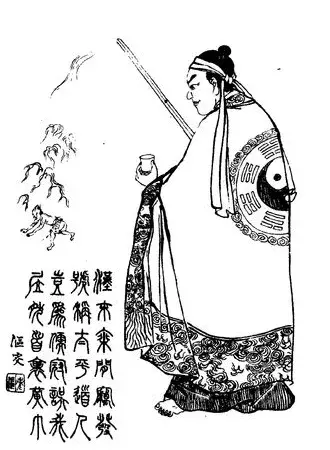
Zhang Jiao was a native of Julu Commandery in Jizhou Province (modern Pingxiang County, Hebei Province). Throughout the Han period, belief in spirits, immortality arts, and apocryphal prognostication ran deep across society. From the mid-Eastern Han onward, alternating domination by consort clans and eunuchs, official corruption, ruthless land annexation by powerful landlords, and recurring floods, droughts, and epidemics during the reigns of Emperors An, Huan, and Ling left the common people destitute and helpless, prompting multitudes of peasants and refugees to seek solace in religious healers. Earlier, Gong Chong of Langya, a disciple of the master Gan Ji, had presented the early Daoist scripture The Scripture of Great Peace (also known as The Book of Great Peace and Pure Guidance) to the court during the reign of Emperor Shun; although rejected by the court, the scripture circulated among the populace and was acquired by Zhang Jiao as the doctrinal basis of his movement.
During the Jianning era (168–172) of Emperor Ling of Han, Zhang Jiao—initially a follower of Huang-Lao teachings—venerated the deity Supreme Unity of Central Yellow (Zhonghuang Taiyi), adopted The Scripture of Great Peace as his core text, and taught incantations and healing arts to found the Way of Great Peace (Taiping Dao). Drawing on a passage in The Scripture of Great Peace, he styled himself the "Great Worthy and Good Teacher" (Daxian Liangshi), while his younger brothers Zhang Bao and Zhang Liang called themselves "Great Physicians" (Dayi). Beneath them, eight emissaries traveled in all directions to recruit converts under the banner of moral instruction and charity.
Beginning in Wei Commandery (around modern Linzhang and Wei County in Hebei and Guan County in Shandong) and across the Hebei plain, Zhang Jiao preached while holding a nine-section staff. He proclaimed that the "breath of Great Peace" was about to arrive, opposed rapacious exploitation, and advocated aiding the poor and needy. To treat illness, he instructed patients to kneel and confess their transgressions (guibai shouguo) and drink water over which talismans had been burned and incantations recited. Because many sick people recovered and revered him as a divine teacher, his followers multiplied within little more than a decade to several hundred thousand across the eight provinces of Qingzhou, Xuzhou, Youzhou, Jizhou, Jingzhou, Yangzhou, Yanzhou, and Yuzhou. Local commandery and county officials failed to perceive his political designs, praising him instead for civilizing the populace through moral teaching.
The Thirty-Six Divisions and Betrayal of the Uprising Plan
To prepare for an armed uprising, Zhang Jiao transformed the Way of Great Peace from a loose religious fellowship into a disciplined military organization by dividing his followers across the eight provinces into thirty-six fang ("divisions"). Each fang functioned as an army: a large fang comprised more than ten thousand men and a small fang six or seven thousand, each commanded by a divisional chieftain (qushuai) under Zhang Jiao's supreme authority. With a recognized leader, unified scripture, shared faith, and hierarchical organization, the Way of Great Peace marked the formal emergence of organized Daoism.
Zhang Jiao originally planned to launch a coordinated uprising across the empire on the fifth day of the third month of the first year of the Zhongping era (184, the jiazi year). He circulated the slogan "The Blue Heaven is dead; the Yellow Heaven shall stand; when the year is jiazi, great auspiciousness shall fill the realm," and instructed believers to write the two characters jiazi in white clay on the gates of capital offices in Luoyang and on government walls in the provinces and commanderies as signals for the attack. He also ordered the grand division commander Ma Yuanyi to assemble tens of thousands of followers from Jingzhou and Yangzhou at Ye (modern Linzhang, Hebei) and travel secretly to Luoyang towin over the Regular Palace Attendants Feng Xu and Xu Feng as inside collaborators for a simultaneous uprising on the fifth day of the third month.
Before the appointed date arrived, however, Zhang Jiao's disciple Tang Zhou of Jinan submitted a memorial to the court betraying the entire conspiracy. Emperor Ling immediately had Ma Yuanyi arrested and executed by tearing apart by chariots in Luoyang, ordered an investigation that executed more than a thousand palace eunuchs, officials, and adherents of the Way of Great Peace inside and outside the capital, and commanded the authorities in Jizhou to arrest Zhang Jiao and his brothers.
The Yellow Turban Rebellion and Death at Guangzong
Realizing in the second month of 184 (1st year of the Zhongping era) that the plot had been exposed, Zhang Jiao dispatched urgent couriers through the night ordering all thirty-six divisions to rise at once. Sacrificing to Heaven, Zhang Jiao proclaimed himself "General of Heaven" (Tiangong Jiangjun), while his younger brothers Zhang Bao and Zhang Liang took the titles "General of Earth" (Digong Jiangjun) and "General of the People" (Rengong Jiangjun). Leading 360,000 followers who bound their heads with yellow cloth as a badge—from which they were called the "Yellow Turbans"—they rose in rebellion on the same day.
The Yellow Turban forces burned government offices, stormed the fortified manors of powerful landlords, and overran commanderies and counties across the empire; in Hebei, the rebels even captured the imperial princes Liu Xu, King of Anping, and Liu Zhong, King of Ganling. Within ten days the entire realm responded, forming three major theaters in Hebei (under Zhang Jiao and his brothers), Yingchuan, and Nanyang that threatened Luoyang from north and south. Alarmed, Emperor Ling appointed his brother-in-law He Jin as General-in-Chief to guard the capital, established commandants at the eight strategic passes around Luoyang, pardoned the proscribed partisan scholars (dangren) to rally gentry support, and dispatched imperial armies against the rebels.
In the third month of 184, Northern General of the Household Lu Zhi led imperial forces against Zhang Jiao in Hebei, winning a series of engagements and decapitating over ten thousand men, which forced Zhang Jiao to withdraw into the fortified city of Guangzong (east of modern Wei County, Hebei). Lu Zhi surrounded Guangzong with earthworks and trenches and built siege ladders, but just as the city was about to fall, the eunuch envoy Zuo Feng slandered Lu Zhi for refusing to pay a bribe, and Lu Zhi was brought back to Luoyang in a prison cart. Eastern General of the Household Dong Zhuo took over the command, only to be defeated by Zhang Jiao at Xiaquyang (northwest of modern Jinzhou, Hebei), prompting Emperor Ling in the eighth month to transfer Left General of the Household Huangfu Song to attack Guangzong.
Shortly after Huangfu Song arrived before Guangzong, Zhang Jiao died of illness inside the besieged city. Command of the Guangzong garrison passed to his brother Zhang Liang, who held out against Huangfu Song for another two months. In the tenth month of 184, Huangfu Song feigned inactivity by ordering his troops to rest behind closed gates, then launched a surprise night assault at cockcrow when the Yellow Turbans relaxed their guard. Fighting until dusk, the Han army stormed Guangzong, killing Zhang Liang and decapitating over 30,000 rebels while another 50,000 drowned in the river. Huangfu Song then ordered Zhang Jiao's grave dug up, broke open his coffin to mutilate the corpse, and sent his severed head to Luoyang; in the eleventh month, Zhang Bao was likewise defeated and killed at Xiaquyang.
Together with the Way of the Five Pecks of Rice, the Way of Great Peace founded by Zhang Jiao—possessing a recognized religious leader, unified scripture (The Scripture of Great Peace), shared faith, and thirty-six divisional organizations—marked the formal beginning of organized Daoism and its liturgical music, transforming pre-Qin philosophical Daoism into an active religious movement. Politically and socially, although the Yellow Turban Rebellion failed to topple the Eastern Han directly, it dealt a heavy blow to imperial rule and the fortified manors of northern landlords, inaugurated the tradition of religiously organized peasant uprisings in imperial China, and compelled the Eastern Han court to devolve military and civil power to provincial governors (zhoumu), directly precipitating the warlord fragmentation that ended the dynasty.