Birth in Heir Palace
Born in Chang'an Crown Prince Palace; beloved by grandfather Emperor Xuan, who gave him the courtesy name Taisun.
51 BCE–7 BCE
刘骜
Liu Ao (51 BC – 7 BC), posthumously known as Emperor Cheng of Han (汉成帝), was the twelfth emperor of the Western Han dynasty, reigning from 33 BC to 7 BC. He was the grandson of Emperor Xuan, the eldest legitimate son of Emperor Yuan, and his mother was Empress Wang Zhengjun. In his early years, Liu Ao was praised for his diligence in studying classical texts, his generous nature, and his respectful demeanor, winning the…
Liu Ao (51 BC – 7 BC), posthumously known as Emperor Cheng of Han (汉成帝), was the twelfth emperor of the Western Han dynasty, reigning from 33 BC to 7 BC. He was the grandson of Emperor Xuan, the eldest legitimate son of Emperor Yuan, and his mother was Empress Wang Zhengjun. In his early years, Liu Ao was praised for his diligence in studying classical texts, his generous nature, and his respectful demeanor, winning the profound affection of Emperor Xuan and receiving appointment as Crown Prince in 47 BC. However, as he matured, he succumbed to luxurious banquets and sensual pursuits, narrowly retaining his heir apparent status only through the tearful intercession of Palace Attendant Shi Dan. Upon ascending the throne at nineteen, Emperor Cheng surrendered executive governance almost entirely to his maternal clan. He successively elevated his maternal uncles Wang Feng, Wang Yin, Wang Shang, and Wang Gen to the post of Commander-in-Chief, establishing the unassailable hegemony of the Wang clan where nine members were enfeoffed as marquis and five held supreme military-administrative office. In the palace, Emperor Cheng neglected regular state affairs to pursue anonymous night excursions into the capital and obsessively favored dancing courtesans Zhao Feiyan and Zhao Hede. Succumbing to Zhao Hede's ruthless jealousy, Emperor Cheng depose Empress Xu and notoriously orchestrated or consented to the murder of his own infant sons born to palace maidens Cao Gong and Consort Xu, completely extinguishing his royal lineage in the tragic episode known as the Swallows Pecking Imperial Offspring. In his twilight years, Emperor Cheng designated his nephew Liu Xin as crown prince and appointed his outwardly virtuous cousin Wang Mang as Commander-in-Chief. In 7 BC, Emperor Cheng died suddenly in Zhao Hede's bedchamber at age forty-five, leaving an exhausted empire that collapsed into Wang Mang's usurpation.
Born in Chang'an Crown Prince Palace; beloved by grandfather Emperor Xuan, who gave him the courtesy name Taisun.
Emperor Yuan ascended the imperial throne and officially designated eight-year-old Liu Ao as Crown Prince.
Emperor Yuan contemplated replacing Liu Ao with Prince Liu Kang due to his dissipation; Shi Dan tearfully dissuaded the monarch.
Emperor Yuan died; Liu Ao ascended the throne, honoring mother Wang Zhengjun as Empress Dowager and placing Wang Feng in charge of state affairs.
Commander-in-Chief Wang Feng died; his cousin Wang Yin succeeded him, firmly consolidating the Wang family's political monopoly.
Discovered talented courtesan Zhao Feiyan during an anonymous outing to Princess Yang'a's estate, summoning her and sister Zhao Hede to the palace.
Deposed Empress Xu following fabricated sorcery allegations and elevated courtesan Zhao Feiyan to Empress.
Palace maid Cao Gong birthed an imperial son; under Zhao Hede's furious pressure, Emperor Cheng ordered both mother and child poisoned.
Confiscated and murdered Consort Xu's newborn son; designated King of Dingtao Liu Xin as Crown Prince that same month.
Accepted dying Wang Gen's recommendation, appointing thirty-eight-year-old maternal cousin Wang Mang as Commander-in-Chief.
Collapsed and died abruptly in Weiyang Palace after drinking in Zhao Hede's chamber; Zhao Hede committed suicide.
Liu Ao was born in the Crown Prince's palace during the third year of Ganlu under the reign of Emperor Xuan. As the eldest legitimate son of Emperor Yuan, his birth brought profound joy to his grandfather Emperor Xuan, who personally named him Ao and bestowed upon him the courtesy name Taisun, frequently keeping the young prince by his side to supervise his upbringing. When Emperor Xuan died and Emperor Yuan ascended the throne, eight-year-old Liu Ao was officially invested as Crown Prince in the second year of Chuyuan. In his formative years, Liu Ao exhibited keen intellect, affable demeanor, and a fondness for Confucian classics, earning widespread admiration among imperial courtiers as the beacon of dynastic continuation.
However, as he entered adolescence, Liu Ao grew increasingly addicted to banquets, hunting, and music, gradually neglecting statecraft and classical studies. Emperor Yuan grew deeply disillusioned with his heir's growing frivolity, especially when contrasting him with Prince Liu Kang of Shanyang, who was exceptionally studious, skilled in ritual, and proficient in music. On multiple occasions, Emperor Yuan resolved to disinherit Liu Ao in favor of Prince Liu Kang. Only through the desperate, tearful intercessions of Palace Attendant Shi Dan, who threw himself before the throne in defense of dynastic stability, combined with the Emperor's lingering respect for Empress Wang Zhengjun, did Liu Ao narrowly preserve his succession rights.
In 33 BC, Emperor Yuan passed away in Weiyang Palace, and nineteen-year-old Liu Ao ascended the imperial throne as Emperor Cheng, adopting the era title Jianshi and honoring his biological mother Wang Zhengjun as Empress Dowager. Lacking executive experience and political resolve, Emperor Cheng immediately delegated supreme power to his maternal uncles, appointing Wang Feng as Commander-in-Chief and General-in-Chief supervising the Imperial Secretariat. This fateful transfer surrendered the empire's central military apparatus and bureaucratic machinery to the Wang lineage, inaugurating a dangerous period of maternal clan monopoly that progressively hollowed out imperial sovereignty.
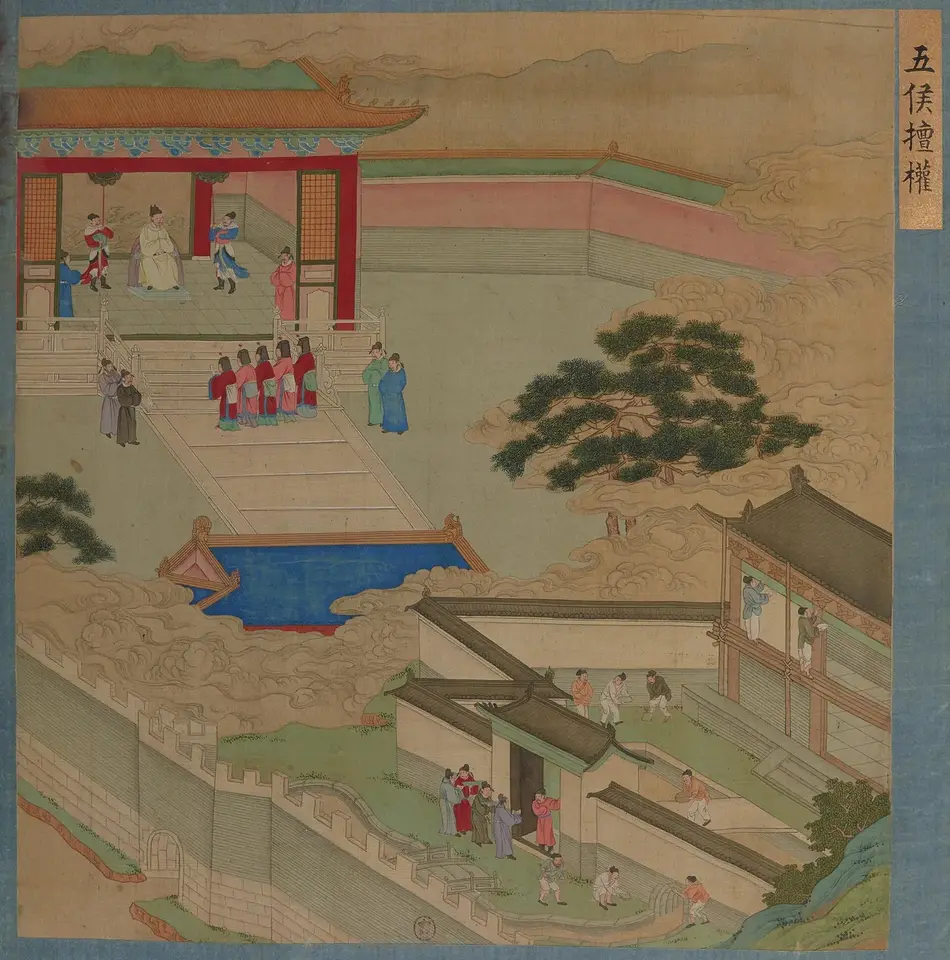
During his tenure as regent, Wang Feng governed with an iron fist, terrorizing cabinet officials and dictating national policy. Chancellor Wang Shang, who steadfastly refused to pander to Wang Feng's autocratic overreach, was framed on trumped-up charges and driven to suicide, while Intendant of the Capital Wang Zhang was arrested and executed for daring to memorialize against Wang clan usurpation. Court officials fell into terrified silence, allowing Wang Feng to arrange marquisates and cabinet appointments for his brothers Wang Chong, Wang Tan, Wang Shang, Wang Li, Wang Gen, and Wang Fengshi—five of whom were enfeoffed on a single day as the Five Marquis—solidifying the family's complete dominance.
Possessing a genial temperament but an aversion to bureaucratic toil, Emperor Cheng chose to surrender state responsibilities to his maternal kin while abandoning himself to sensory indulgence and undercover escapades. He developed an intense infatuation with Zhang Fang, the Marquis of Fuping, who was renowned for his extraordinary physical grace and wit. The two became inseparable companions, dining, riding, and sharing beds together. Disguising themselves as wealthy merchants or servants, Emperor Cheng and Zhang Fang frequently slipped out of the palace at night to roam the streets of Chang'an, mingling in disreputable taverns, betting on cockfights, and consorting with courtesans while state governance deteriorated.
These reckless excursions provoked severe alarm and condemnation from Empress Dowager Wang and senior court officials, who repeatedly petitioned against such threats to imperial dignity and personal safety. Yielding to overwhelming political pressure from the regency, Emperor Cheng was reluctantly compelled on multiple occasions to banish Zhang Fang to his provincial fiefdom, parting with tearful laments each time. Deprived of his closest companion, Emperor Cheng immersed himself even deeper into the pleasures of the inner palace chambers, using sensory hedonism as a psychological refuge to escape the suffocating realities of his ceremonial throne.
In his domestic life, Emperor Cheng had initially favored Empress Xu and the scholarly Consort Ban, but neither consort had managed to produce a surviving male heir over long years of marriage. In 18 BC, during an incognito visit to the estate of Princess Yang'a, the emperor was mesmerized by Zhao Feiyan, a dancing courtesan of gossamer grace and peerless beauty, and immediately brought her into the palace, shortly followed by her equally captivating sister Zhao Hede. Armed with captivating charms and ruthless cunning, the Zhao sisters completely monopolized the emperor's affections, eclipsing all other palace consorts and causing Empress Xu and Consort Ban to be discarded into desolate secondary courtyards.
The Zhao sisters' political ambitions expanded swiftly once they secured undivided imperial favor. In 16 BC, Zhao Feiyan engineered false accusations of sorcery against Empress Xu and Consort Ban; Emperor Cheng deposed Empress Xu without genuine investigation, while Consort Ban withdrew to attend the Empress Dowager to escape mortal peril. Overcoming unified ministerial opposition, Emperor Cheng formally installed the former dancing girl Zhao Feiyan as Empress and invested Zhao Hede as Brilliant Companion. For over a decade, the Zhao sisters maintained undisputed dominion over the inner quarters, elevating their male relatives to noble rank, yet tragically failed to conceive a single biological child.
Tormented by their own infertility and terrified that another consort might produce an imperial heir and supplant their influence, the Zhao sisters erected a tyrannical spy network across the harem, systematically forcing abortions upon any pregnant maid. In 12 BC, palace attendant Cao Gong gave birth to a healthy male infant. Overjoyed upon hearing the news, Emperor Cheng secretly celebrated, but Zhao Hede launched into hysterical rages and hunger strikes, coercing the emperor to surrender the child. In an unbelievable abdication of moral duty, Emperor Cheng sent poison to execute Cao Gong and permitted the newborn prince to be suffocated in a reed basket, eradicating his own flesh and blood.
In 8 BC, Consort Xu, the younger sister of the deposed empress, miraculously gave birth to another male infant in deep seclusion, but Zhao Hede once again discovered the secret and violently demanded the child's surrender. Emperor Cheng personally entered the birthing chamber, snatched the wailing newborn from Consort Xu's arms, and delivered the infant behind closed doors to Zhao Hede's servants to be murdered and discarded inside palace walls. For a reigning sovereign to knowingly exterminate his own seed merely to appease a favored concubine was an unprecedented tragedy that horrified the empire, extinguishing the direct line of descent and plunging the Western Han into dynastic peril.
While Emperor Cheng surrendered to hedonism and child slaughter, the Wang maternal clan underwent critical generational transitions. Following the deaths of Wang Feng and Wang Yin, cousins Wang Shang and Wang Gen consecutively assumed the supreme post of Commander-in-Chief. The spoiled offspring of the Five Marquis flaunted their astronomical wealth across Chang'an, constructing palatial mansions and maintaining private militias. Amidst this decadent family network, Wang Mang, the son of early-deceased Wang Man, deliberately fashioned an image of austere virtue, living with extreme frugality, studying classical rites, and humbly serving his powerful uncles to manufacture moral renown.
Wang Mang's calculated display of filial piety and humility captivated both Empress Dowager Wang and Emperor Cheng, winning him exceptional praise across the capital. In 8 BC, as Commander-in-Chief Wang Gen lay dying, he formally recommended his thirty-eight-year-old nephew Wang Mang to succeed him at the helm of state. Emperor Cheng promptly appointed Wang Mang as Commander-in-Chief, entrusting him with total military and administrative stewardship. Little did the decadent monarch realize that the unassuming cousin he elevated would ultimately ring the death knell for the four-century-old Han empire and orchestrate the Xin usurpation.
Throughout the latter half of Emperor Cheng's reign, the empire was convulsed by recurring natural calamities, including catastrophic breaches of the Yellow River, solar eclipses, earthquakes, and widespread peasant dislocations driven by unchecked land concentration. Facing mounting anxieties over an empty throne as he crossed forty without surviving sons, Emperor Cheng was bombarded with petitions demanding the urgent installation of an imperial heir. In 8 BC, the emperor summoned regional princes to Chang'an for imperial inspection, with Prince Liu Xing of Zhongshan and Prince Liu Xin of Dingtao emerging as the leading contenders for the crown.
Prince Liu Xin of Dingtao was exceptionally articulate and well-versed in ritual, while his grandmother, Consort Fu, deployed vast fortunes in gold to bribe Zhao Hede and Commander-in-Chief Wang Gen. Swayed by incessant lobbying from his favorite concubine and key regency ministers, Emperor Cheng officially proclaimed Liu Xin as Crown Prince in the third month of 8 BC, appeasing the Prince of Zhongshan's maternal kin with marquisates. Deluded into believing that the succession was permanently secured, Emperor Cheng dismissed lingering dynastic concerns and returned to unrestrained indulgence in the bedchambers of Weiyang Palace.
In the third month of 7 BC, Emperor Cheng spent the entire night drinking and carousing in Zhao Hede's private quarters. When he attempted to rise from his bed the following morning to dress, he was struck by a sudden paralytic seizure, collapsing onto the floor unable to speak, his limbs turning icy cold before he expired upon Zhao Hede's bed at age forty-five. The emperor's abrupt death shocked the court; Grand Empress Dowager Wang took immediate charge, commissioning Wang Mang to investigate the demise, whereupon Zhao Hede committed suicide by poison to escape horrific public execution. Reigining for twenty-six turbulent years, Emperor Cheng left behind an exhausted realm, an extinguished lineage, and an irrevocably fractured crown.
Emperor Cheng's most catastrophic administrative failing lay in his continuous, uncritical surrender of imperial governance to his mother's clan, the Wang family. From his coronation day, he entrusted the supreme military-administrative apparatus to his uncle Wang Feng, followed by Wang Yin, Wang Shang, and Wang Gen, resulting in nine family members attaining marquisates and five holding supreme command. Emperor Cheng's congenital weakness and utter lack of political vision led him to indulge the Wang clan's monopolistic ambitions without enacting checks, effectively transforming the central court into a family fiefdom.
This abdication shattered the constitutional equilibrium between imperial sovereign, ministerial chancellery, and founding nobility that had sustained the Western Han since Emperor Gaozu. The Wang clan consolidated armed palace guards, monopolized official promotions, and utilized the Imperial Secretariat to sideline the traditional Three Excellencies into decorative figureheads. Unchecked by imperial authority, the Wang family aggressively annexed agrarian estates and accumulated unbridled fortunes across the commanderies, corrupting the civil bureaucracy and creating the institutional machinery that permitted Wang Mang to usurpt the throne smoothly.
By discarding his legitimate empress and virtuous concubine in favor of dancing courtesans Zhao Feiyan and Zhao Hede, Emperor Cheng established a disastrous precedent of harem factionalism and unchecked feminine overreach. The Zhao sisters not only dominated intimate palace life for over a decade, but directly meddled in judicial matters, high ministerial appointments, and crown succession, with the emperor bending every state ritual to satisfy their vanity. The utter collapse of internal palace discipline transformed the imperial residence into an arena of lethal intrigue and debauchery, devastating the sacred majesty of the Son of Heaven.
Driven by Zhao Hede's murderous jealousy, Emperor Cheng committed the unspeakable crime of permitting and personally assisting in the murder of his own biological sons born to Cao Gong and Consort Xu. In committing this infanticide, known infamously as the Swallows Pecking Imperial Offspring, Emperor Cheng dismantled every shred of paternal decency and sovereign duty, deliberately cutting off his own bloodline. The resulting extinction of Emperor Xuan's direct male lineage triggered an existential succession crisis, forcing the court to import collaterals and unleashing catastrophic factional warfare between rival maternal clans.
Throughout his reign, Emperor Cheng executed arbitrary, poorly conceived reforms in state religion and central government organs. Influenced by pedantic Confucian classicists like Kuang Heng and Zhang Yu, he repeatedly altered state sacrificial sites, moving altars between Chang'an and regional shrines at immense public expense without achieving moral or spiritual renewal. In central administration, he redefined the post of Commander-in-Chief into a permanent ministerial head, diminishing chancellery autonomy and pursuing retrogressive classical models that destabilized bureaucratic continuity and paralyzed governance.
Emperor Cheng's persistent obsession with anonymous excursions into Chang'an's urban markets, accompanied by favorite courtier Zhang Fang, represented an unprecedented dereliction of sovereign responsibility. Wandering the capital in commoner disguise to engage in cockfighting, gambling, and tavern carousing, he treated the dignity of the throne and his personal safety as trifles. This systematic abdication of authority paralyzed policy implementation, encouraged widespread corruption among courtiers who emulated imperial cynicism, and dissipated the immense socioeconomic reserves accumulated during the Zhao-Xuan golden age.
Having murdered his own progeny, Emperor Cheng faced an empty palace in his final years and bungled the imperial succession through corrupt compromise. Swayed by Zhao Hede's pillow talk and Wang Gen's political calculations, Emperor Cheng passed over more capable candidates to install Prince Liu Xin of Dingtao as Crown Prince. This hasty succession tossed the Han dynasty into the violent vortex of conflict between the Fu-Ding and Wang clans, completely disarming the Liu family's defenses and paving the inevitable path toward Wang Mang's usurpation.
FIGURES ASSOCIATED WITH THIS DYNASTY