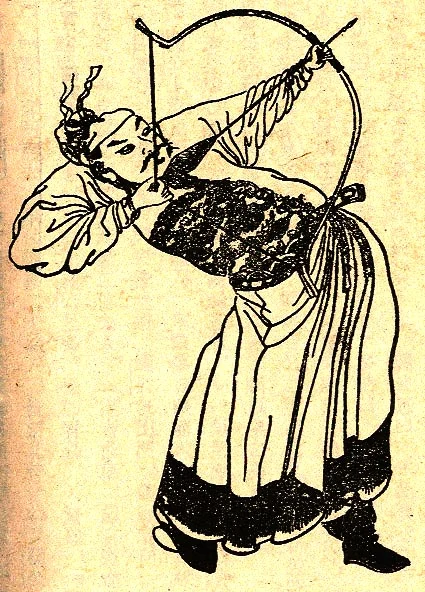
Biography
Family Background and Early Life
Zhang Liao was born in Mayi County, Yanmen Commandery of Bingzhou, in present-day Shuozhou, Shanxi. His ancestor was said to be Nie Yi, associated with the Western Han “Mayi Ambush,” after whose time the family changed its surname to Zhang to avoid hostility. Yanmen lay on the northern frontier and was repeatedly affected by warfare with steppe peoples such as the Xianbei. In 177, the sixth year of Xiping, Han frontier forces and allied Xiongnu mounted a counterattack against the Xianbei under Tanshihuai but suffered heavy losses. Zhang Liao thus grew up amid persistent frontier conflict and served as a minor official in Yanmen while still young.
Service under Several Lords
In 188, after Bingzhou Inspector Zhang Yi was killed and Ding Yuan succeeded him, Ding Yuan recruited Zhang Liao for his martial ability and ordered him to lead troops to Luoyang under General-in-Chief He Jin. He Jin sent Zhang Liao to Hebei to raise soldiers, and he returned with more than a thousand men. In 189, He Jin was killed by the eunuchs and Dong Zhuo entered the capital; Zhang Liao and his troops came under Dong Zhuo. After Dong Zhuo was killed in 192, Zhang Liao transferred his troops to Lü Bu and was promoted to Commandant of Cavalry. When Lü Bu was later defeated by Li Jue and others, Zhang Liao followed him east to Xuzhou. In 196, after Lü Bu seized Xuzhou, he appointed the twenty-eight-year-old Zhang Liao Chancellor of Lu. In 198 Zhang Liao and Gao Shun attacked Liu Bei and took Pei. In the twelfth month, when Cao Cao defeated Lü Bu at Xiapi, Zhang Liao led his followers in surrender. Cao Cao appointed him General of the Household and granted him the rank Marquis Within the Passes.
Achievements under Cao Cao
In 200 the Battle of Guandu began. Zhang Liao and Guan Yu served as vanguard commanders and defeated Yuan Shao's general Yan Liang at the Battle of Boma. Zhang Liao subsequently gained repeated merit and was promoted to General of a Separate Command. After Yuan Shao's defeat, he was ordered to pacify the counties of Lu. In 201 he besieged Chang Xi in Donghai together with Xiahou Yuan. When supplies were nearly exhausted, Zhang Liao went alone to Mount Sangong and persuaded Chang Xi to surrender. Cao Cao criticized the danger he had taken but praised his courage. In 202 he campaigned against Yuan Tan and Yuan Shang at Liyang and acted as General of the Central Army. In 203 he attacked Yinan with Yue Jin and relocated local inhabitants south of the Yellow River. In 204 he followed Cao Cao against Ye and accepted the surrender of Sun Qing and other Black Mountain leaders. In 205 he again campaigned against Yuan Tan and defeated the Liaodong commander Liu Yi. On returning to Ye, Cao Cao personally came out to meet him and shared a carriage with him, then recommended him for promotion to General Who Sweeps Away Bandits and enfeoffed him as Marquis of Duting.
Fame on the Northern Frontier
In 207 Cao Cao marched north against the Wuhuan. Zhang Liao strongly urged immediate battle and was entrusted with the command banner as vanguard. At the Battle of White Wolf Mountain he led the sudden assault in which the Wuhuan chanyu Tadun was killed and the Wuhuan army was routed. The source text states that more than two hundred thousand people submitted afterward, greatly reducing the northern threat. Later, while stationed at Changshe, Zhang Liao calmly suppressed a mutiny within the army. In 209 he commanded Zhang He and others against Chen Lan and Mei Cheng at Mount Tianzhu, urging his troops forward with the principle that in a one-on-one contest the brave man advances. Both rebel leaders were killed, and Cao Cao increased Zhang Liao's fief and granted him delegated authority.
The Battle of Hefei and Later Years
In 213, after returning from a campaign against Sun Quan, Cao Cao left Zhang Liao, Yue Jin, and Li Dian with more than seven thousand men at Hefei. In 215 Sun Quan attacked the city with an army said in the source text to number one hundred thousand. Following Cao Cao's sealed instructions, Zhang Liao selected eight hundred men for a sudden assault on the Wu camp. They charged directly toward Sun Quan's banner. Sun Quan withdrew to high ground while Zhang Liao challenged him to battle. When Wu troops surrounded the attackers, Zhang Liao broke out, then turned back to rescue comrades who had been cut off, repeatedly charging through the enemy line. After more than ten days Sun Quan abandoned the siege. During the withdrawal Zhang Liao pursued him at Xiaoyao Ford and nearly captured him. The victory made Zhang Liao famous throughout Jiangdong and gave rise to the tradition that the sound of his name could stop children from crying. Cao Cao promoted him to General Who Conquers the East. In 216 Zhang Liao again accompanied Cao Cao against Sun Quan and served in the vanguard with Zang Ba. In 219, after Guan Yu besieged Fan, Zhang Liao led reinforcements south, though Xu Huang had already defeated Guan Yu before he arrived, and he then met Cao Cao at Mopo.
After Cao Pi succeeded Cao Cao, Zhang Liao became General of the Vanguard and Marquis of Duxiang and was later advanced to Marquis of Jinyang, with a fief of 2,600 households. In 221 Cao Pi received him at Jianshi Hall in Luoyang and asked about his victory over Wu, praising him as comparable to the ancient hero Shao Hu. He had a residence constructed for Zhang Liao and a hall built for Zhang Liao's mother. When Zhang Liao became gravely ill, Cao Pi personally visited the camp, held his hand, and bestowed imperial clothing and food. In 222, when Sun Quan again opposed Wei, Zhang Liao, despite his illness, joined Cao Xiu and defeated the Wu commander Lü Fan. Sun Quan warned his officers that even a sick Zhang Liao was not to be confronted lightly. Zhang Liao died later that year at Jiangdu and received the posthumous name Gang.
The Frontier and His Succession of Lords
By the Later Han History's account of the Xianbei, under Emperor Ling "the frontier commanderies of You, Bing and Liang were raided by the Xianbei every year, and the slain and captured were beyond counting", and the annals record raids into You and Bing in successive years; in the sixth year of Xiping the Southern Xiongnu Shanyu and the commandant Zang Min went out through Yanmen against the Xianbei Tanshihuai and "returned in great defeat", a disaster showing how heavy were the wars in Zhang Liao's homeland. His own biography says that he was "styled Wenyuan, a man of Mayi in Yanmen, a descendant of Nie Yi, who changed his surname to avoid a feud, and was a clerk of the commandery in youth"; after the governor of Bingzhou, Zhang Yi, was killed by the Xiutu Tuge barbarians, Ding Yuan succeeded him and "summoned Liao as a retainer because of his surpassing strength, ordering him to lead troops to the capital". He Xian then "sent him to Hebei to raise troops, and he raised more than a thousand and returned"; and when He Xian fell, he "gave his troops to Dong Zhuo; when Zhuo fell, he gave them to Lü Bu, and was promoted to cavalry commandant", going east with Lü Bu to Xuzhou, "taking the chancellorship of Lu at the age of twenty-eight". Lü Bu's group fought Cao Cao in Yanzhou, where "Cao Cao fought Lü Bu at Puyang and was several times worsted; locusts came and the two sides drew off", so that Cao Cao, having lost Yanzhou and exhausted his provisions, thought of sending his family to Ye and joining Yuan Shao, and desisted only at Cheng Yu's words that "Yuan Shao holds the lands of Yan and Zhao and has the will to swallow the world, but lacks the wisdom to bring it off... though Yanzhou is crippled, three cities remain, and fighting men no fewer than ten thousand". Of Zhang Liao's place in Lü Bu's army, Fang Shiming observes that the Bingzhou military group which formed after the escape from the Liangzhou troops comprised the forces of Lü Bu, Zhang Liao and Zhang Yang, Zhang Yang holding Henei and in constant touch with Lü Bu, while "Zhang Liao, though 'giving his troops to Lü Bu', retained a relatively independent position under the title of governor of Beidi or chancellor of Lu".
In the third year of Jian'an, Lü Bu sent men with gold to buy horses in Henei and they were robbed by Liu Bei's troops, whereupon Lü Bu sent the general Gao Shun and the governor of Beidi, Zhang Liao, against Liu Bei, and in the ninth month they broke Peicheng, "Liu Bei fleeing alone and his wife and children taken"; and when Cao Cao sent Xiahou Dun to the rescue he "was beaten by Shun and his fellows". Afterwards Cao Cao came against Lü Bu at Xiapi and, "repeatedly fighting without taking it and his soldiers weary", thought of withdrawing, until Xun You and Guo Jia said that "Lü Bu is brave but without strategy, and having now been beaten three times his spirit is gone... press the attack at once and Bu can be taken", whereupon they diverted the Yi and Si rivers to flood the city, and it broke and Lü Bu was taken alive. His officers Hou Cheng, Song Xian and Wei Xu "bound Chen Gong and surrendered with their troops", and Lü Bu with his guards mounted the White Gate tower and, "the siege being urgent, came down"; Zhang Liao also "surrendered with his troops", and Cao Cao made him a commandant and gave him the title of marquis within the pass. In the same period Chen Qun and his father were honoured and employed, while Yuan Huan "would only bow ceremonially" and Cao Cao "stood in great awe of him". After breaking Lü Bu, Cao Cao "had Zang Ba summon the Guan brothers, and treated them all generously", and sent Zhang Liao, who had held Lu, to pacify the counties of Lu, since many commanderies of Yan and Yu "had received Yuan Shao's orders" when he invaded.
Persuading Chang Xi and the Eastern Campaigns
In the sixth year of Jian'an, Zhang Liao and Xiahou Dun besieged Chang Xi at Donghai and "after months the grain was exhausted and they took counsel to withdraw", but Zhang Liao said to Xiahou Dun that "for several days past, whenever I have gone round the camps, Chang Xi has followed me with his eyes, and his archers shoot ever more sparsely; this must mean that he wavers and so does not fight hard. I would like to probe him with words, and perhaps he may be drawn." So he sent word that "the duke has an order, and has sent Liao to convey it", and Chang Xi indeed came down to speak with him, and Zhang Liao told him that "the grand ancestor is divine in war and now wins the four quarters by virtue, and those who submit first receive great reward", and Chang Xi agreed to surrender; and Zhang Liao "went alone up Mount Sangong into Chang Xi's house and bowed to his wife and children", so that Chang Xi rejoiced and went with him to Cao Cao. Cao Cao afterwards reproached him that "this is not the way of a great general", and Zhang Liao answered that "since your majesty's prestige is known throughout the four seas and I bore the imperial command, Chang Xi dared not harm me, and so I did it". He then "followed against Yuan Tan and Yuan Shang at Liyang and had merit, acting as general of the centre"; in the eighth year Cao Cao attacked Yuan Shang at Ye and, "Shang holding firm and the city not falling", returned to Xu and "sent Liao with Yue Jin to take Yin'an and move its people south of the river"; in the ninth year, Ye having fallen, "Liao went separately through Zhao and Changshan, receiving the surrender of the bandits of the hills and of Sun Qing of the Black Mountain"; and in the tenth year, Yuan Tan being destroyed, "he went separately along the sea and broke the Liaodong bandit Liu Yi", and on his return to Ye "the grand ancestor came out himself to meet him, took him into the same carriage and made him general who sweeps away bandits". In the eleventh year Cao Cao memorialised the emperor, praising Yue Jin, Yu Jin and Zhang Liao as men who "are both mighty in arms and complete in strategy, single in loyalty and firm in keeping faith, who on every campaign take command and press the strong and storm the firm so that nothing is unshaken, who beat the drum with their own hands and know no weariness; and when sent on separate expeditions they lead the armies with harmony, obey orders without breach, and decide on the field with no error", and so Yu Jin was made awe-inspiring general, Yue Jin the charging general, and Zhang Liao the general who sweeps away bandits. Afterwards he "went separately against Jingzhou, settled the counties of Jiangxia, and returned to camp at Linying with the title of marquis of the pavilion".
The Victory at White Wolf Mountain, the Mutiny at Changshe and Mount Tianzhu
In the twelfth year of Jian'an, when Cao Cao would march against Liucheng, Zhang Liao remonstrated that "Xu is where the Son of Heaven is; if while you are far north Liu Biao sends Liu Bei to seize Xu and use it to command the four quarters, your power is gone", but Cao Cao judged that Liu Biao would not employ Liu Bei and went. In the eighth month Cao Cao ascended White Wolf mountain and "suddenly met the enemy, whose numbers were great, his baggage still behind him and few in armour, so that those about him were afraid"; Zhang Liao urged battle "with great spirit", and Cao Cao, admiring him, "gave him his own standard", and so they attacked and broke the enemy utterly, "beheading the Shanyu Tadun". By the military ordinances of Cao Cao, "at the standard, forward; behind the standard, back; left, left; right, right; and whoever moves otherwise without the order is beheaded", so that the direction and moment of every attack lay with Zhang Liao. Tadun "was fierce in war, and the elders of the frontier compared him" to the great captains, but the Wuhuan ranks were not yet formed and Zhang Liao pressed the attack, "swift as the wind, so that the barbarian host broke utterly and two hundred thousand of Hu and Han surrendered". In the thirteenth year Cao Cao "again sent Liao to camp at Changshe; on the point of departure, some in the army rebelled and set fire by night in the confusion, so that the whole army was disturbed", and Zhang Liao told those about him that "do not move; it is not that the whole camp has rebelled, but that some maker of mutiny wishes to disturb men thereby", and ordered that "those who are not rebels sit still", while he himself with several dozen guards "stood in the middle of the array", and "in a little while it was settled and the chief conspirator was found and killed". In the fourteenth year Chen Lan and Mei Cheng rebelled with the six counties of the Di, and Cao Cao sent Yu Jin and Zang Ba against Mei Cheng and Zhang Liao, with Zhang He and Niu Gai, against Chen Lan; Mei Cheng surrendered falsely to Yu Jin, who returned, and then joined Chen Lan in the Qian hills, where Mount Tianzhu "rose twenty li high with narrow and perilous paths and a footway barely passable, and Lan and his men walled themselves on the summit". Zhang Liao wished to advance and his officers said that "our troops are few and the road perilous, and it is hard to penetrate deep", but Zhang Liao answered that "this is what is called one against one, where the brave man gets through", and so advanced, camped at the foot, attacked and took the heads of Chen Lan and Mei Cheng, "taking all their men". Cao Cao, weighing the merits of his officers, said that "to climb the heavenly mountain and tread the perilous passes to take Lan and Cheng was the merit of the general who sweeps away bandits", and increased his fief and gave him the staff of authority. Fan Qin's Rhapsody on the Campaign to the Heavenly Mountains celebrates the affair.
The Whole Course of the Hefei Battle
In the first month of the eighteenth year of Jian'an Zhang Liao went with Cao Cao against Sun Quan and attacked Ruxu, and Cao Cao broke Sun Quan's camp west of the river and took his commissioner Gongsun Yang before withdrawing. In the nineteenth year, when Sun Quan attacked Wan, "Zhang Liao hastened to its relief from Hefei, and reaching Xiashi, hearing that the city had fallen, built a rampart south of Xiashi and returned, which was called the Southern Xiashi garrison", to serve as Hefei's outpost. In the twentieth year, when Cao Cao went against Zhang Lu, he "left Liao with Yue Jin, Li Dian and others with more than seven thousand men at Hefei", and "gave instructions sealed to the protector Xue Ti, writing on the sealed edge 'open when the rebels come'". In the eighth month Sun Quan with a hundred thousand men besieged Hefei, and the officers opened the instructions, which said that "if Sun Quan comes, generals Zhang and Li shall give battle; general Yue shall hold the city, and the protector shall not join the battle", at which "all the officers doubted". Zhang Liao said: "The duke is on campaign far away, and before help could come they would have broken us; therefore the instruction means that while they are not yet united we should strike them and break the force of their onset, to steady men's hearts, and then we may hold. The hinge of success lies in this one battle; why do you doubt?" Li Dian agreed with him. So that night Zhang Liao "raised eight hundred men willing to follow him and slaughtered oxen to feast them", and gave battle the next day: "At dawn, Liao, in armour with halberd, was first over the wall into the ranks, killing several dozen, beheading two officers, shouting his own name aloud, and bursting into the camp up to Sun Quan's standard. Quan was greatly alarmed and his officers knew not what to do, and he fled up a high mound and defended himself with a long halberd. Liao shouted at Quan to come down and fight, but Quan did not dare move; then, seeing how few Liao had with him, he gathered and surrounded him in several rings. Liao wheeled his men left and right and charged straight forward, breaking the ring, and led several dozen of his men out; but the rest cried out, 'Does the general abandon us?' and Liao turned back into the ring and brought the rest out. Quan's men and horses were scattered and none dared face him." By the account of Wei, "Zhang Liao, surrounded by Sun Quan, broke out, and turning back in, put Quan's men to flight", and from that time "his name shook Jiangdong, so that when a child would not stop crying its parents frightened it with Liao". In this battle the Wu officers also suffered: Chen Wu "fought and died", Pan Zhang "reined his horse across and beheaded two of the fleeing soldiers of Qian and Sheng, so that the troops turned back to fight", and Xu Sheng "was wounded and lost his spear", recovered by He Qi. From dawn to midday they fought, "and the men of Wu lost heart and went back to their defenses, so that all hearts were steadied and the officers were all convinced"; and Sun Quan "held Hefei for more than ten days and the city could not be taken, so he withdrew". Zhang Liao led the armies in pursuit and "had almost taken Quan again", calculating his line of escape and sending troops round to destroy the bridge. By the Spring and Autumn of Emperor Xian, Zhang Liao asked a Wu deserter "who was that general with the purple beard, long above and short below, who rides well and shoots well?", and was told that "it was Sun of Kuaiji"; and meeting Yue Jin he said that "had we known earlier we should have taken him at once", at which "the whole army sighed with regret". Cao Cao "greatly admired Liao and made him general of the east". In the twenty-first year, when Cao Cao came against Sun Quan again, "reaching Hefei he walked over the ground where Liao had fought and sighed for a long while, then increased Liao's troops, left more of the armies there and moved the camp to Juchao"; and in the twenty-second year he moved to Juchao, advanced to Haoxi, forced Sun Quan back, and returning, "left Xiahou Dun, Cao Ren and Zhang Liao at Juchao". In the twenty-fourth year, when Guan Yu besieged Cao Ren at Fancheng and Sun Quan declared himself a vassal, Cao Cao "summoned Liao and all the armies back to save Ren", but "before Liao arrived Xu Huang had broken Guan Yu and the siege was raised; Liao met the grand ancestor at Mopi", where "the grand ancestor came out in his carriage to greet him, and he returned to camp at Chenjun".
The Reign of Cao Pi and After His Death
When Cao Pi took the princely title, Zhang Liao "was transferred to general of the front" and "his brother Zhang Fan and one of his sons were made marquises"; when Sun Quan rebelled again, Zhang Liao was sent back to camp at Hefei and "advanced to marquis of the district", and Cao Pi "gave his mother a carriage, sending her with troops and horses to his camp, and when his mother arrived ordered escorts to go out to meet her", so that "the officers of all the armies he commanded bowed in ranks by the roadside, and those who saw it thought it an honour". On Cao Pi's accession Zhang Liao was made marquis of Jinyang with a thousand more households, making two thousand six hundred. In the second year of Huangchu Zhang Liao came to the palace at Luoyang, and Cao Pi received him in the Jianshi hall and "asked him himself of the manner of his breaking of Wu", and when he had told it Cao Pi sighed and said to those about him that "this is a Tiger of Zhao of old", and "built him a mansion, and particularly built a hall for his mother, and made all the soldiers who had volunteered with him to break the Wu lines into imperial guards". When Sun Quan submitted again, Zhang Liao returned to camp at Yongqiu and fell ill, and Cao Pi "sent the attendant Liu Ye with an imperial physician to see him, and the guards came asking news until the roads were crowded"; the historians note that "when a Han minister of state was ill an inner eunuch was sent to ask after him, and under Wei and Jin a gentleman of the yellow gate, or for the most honoured a palace attendant; Liao's rank did not reach that of a duke, yet a palace attendant was sent, so greatly was he favoured". His illness not mending, Cao Pi "brought him to his own quarters and came himself in his carriage, took his hand and gave him imperial robes, and the master of the table sent imperial food daily"; a little better, he returned to his camp. In the third year of Huangchu, Sun Quan rebelling again, Cao Pi "sent Liao by boat with Cao Xiu to Hailing, facing the river", and Sun Quan "feared him greatly", ordering his officers that "Zhang Liao, though ill, cannot be withstood; be careful"; that year Zhang Liao with the other generals broke Sun Quan's general Lü Fan, as the life of Wang Ling records: "facing the river, a great wind by night blew the ships of the Wu general Lü Fan to the northern bank, and Ling with the generals attacked them, taking heads and prisoners and capturing boats". Afterwards Zhang Liao "grew gravely ill and died at Jiangdu", and Cao Pi wept for him, giving him the posthumous name Gang, and his son Zhang Hu succeeded. In the sixth year of Huangchu Cao Pi, remembering the merit of Zhang Liao and Li Dian at Hefei, decreed that "in the battle of Hefei, Liao and Dian with eight hundred foot broke a hundred thousand of the rebels, such a thing as never was in the use of arms since antiquity, so that the rebels to this day have lost heart; they may be called the claws and teeth of the state", and "gave each of their houses a hundred more households and one son the title of marquis within the pass"; Zhang Hu became a general and died, and his son Zhang Tong succeeded. In the seventh month of the fourth year of Zhengshi an edict ordered sacrifices in the temple of the grand ancestor to Cao Zhen, Cao Xiu and the rest, including "the general of the front, Zhang Liao". Later ages kept him among the famous commanders: in the third year of Jianzhong of the Tang, at Yan Zhenqing's suggestion, sixty-four ancient generals were granted posthumous honours, and Zhang Liao was among them; and in the fifth year of Xuanhe of the Song, by Tang precedent, a temple was set up for seventy-two famous generals, among them Zhang Liao. Of his tomb, a cenotaph survives on an island in the inner lake, with a Zhang Liao exhibition hall, a Xiaoyao pavilion and a ferry bridge, and a bronze statue of him with sword and horse; while the Song Biographies of Eminent Monks records that "in the fifth year of Yuanhe, when the minister Li Yong governed Guangling... within the temple is the tomb of the grand general Zhang Liao", placing it at Guangling, in disagreement with the other account.
Divergent Accounts and the Succession of His Titles
The accounts of the battle of Hefei differ in their times and places and must be read together. His own biography tells of the fight after sunrise and of the pursuit when Sun Quan withdrew; the Record of Wu tells that Cao Cao, seeing Sun Quan's ships, weapons and ranks in good order, "sighed deeply and said, 'to have a son one should have one like Sun Zhongmou; the sons of Liu Jingsheng are mere pigs and dogs!'", and that Sun Quan sent Cao Cao a letter saying that "the spring floods are rising and you should leave quickly", and on another sheet that "while you live, I cannot be at peace", to which Cao Cao told his officers that "Sun Quan does not deceive me", and withdrew his army; while the History of Wei is briefer still: "Sun Quan with a hundred thousand men besieged Hefei, and Liao raised eight hundred men willing to die, charged the ranks and broke them utterly." The affairs of the Wu officers are scattered through their lives: that of Chen Wu records that "in the twentieth year of Jian'an he followed the attack on Hefei and fought to the death"; that of Pan Zhang that "in the battle of Hefei Zhang Liao came suddenly upon them and the officers were unprepared, Chen Wu died fighting and Song Qian and Xu Sheng both fled, but Zhang, being next behind, rode forward at once and reined his horse across, beheading two of the fleeing soldiers of Qian and Sheng, so that the men all turned back to fight"; and that of He Qi that "in the twentieth year he followed Sun Quan against Hefei; when the men of the city came out to fight, Xu Sheng was wounded and lost his spear, and He Qi's own troops drove the enemy off and recovered what he had lost". Of the pursuit and Sun Quan's escape the Spring and Autumn of Emperor Xian is fullest, as already told; while the Veritable Record of Jiankang says that "Cao Ren withdrew, and the armies, taking advantage, broke Cao Xiu and Zhang Liao and the Wei withdrew", which does not agree with the lives of Zhao Yan and He Qi, where the Wu fell back on the Yangtze and the Wei drew off, and must be a later variant.
Zhang Liao's titles changed often: at his surrender he was "made a commandant and given the title of marquis within the pass", after the eastern campaigns "made general who sweeps away bandits", after settling the counties of Jiangxia "returned to camp at Linying with the title of marquis of the pavilion", after taking Chen Lan and Mei Cheng "had his fief increased and was given the staff of authority", after Hefei was "made general of the east", on Cao Pi's accession "transferred to general of the front", when Sun Quan rebelled again "advanced to marquis of the district", and on Cao Pi's enthronement "made marquis of Jinyang with a thousand more households, making two thousand six hundred", with "his brother Zhang Fan and one of his sons made marquises"; and the soldiers who volunteered to break the Wu lines were "all made imperial guards". Of the weight of the favour shown him, the historians note that "when a Han minister of state was ill an inner eunuch was sent to ask after him, and under Wei and Jin a gentleman of the yellow gate, or for the most honoured a palace attendant; Liao's rank did not reach that of a duke, yet a palace attendant was sent, so greatly was he favoured".
The Surrender and the Charge of Lu
Of the day Xiapi fell, the Abbreviated Records say that "when Xiapi was broken the soldiers took Lü Bu and Chen Gong, and the grand ancestor saw them all and spoke with them of old times"; Lü Bu with his guards mounted the White Gate tower and, "the siege being urgent, came down", while his officers Hou Cheng, Song Xian and Wei Xu first "bound Chen Gong and surrendered with their troops". Zhang Liao too "surrendered with his troops" at this time, and Cao Cao "made him a commandant and gave him the title of marquis within the pass", employing him alongside Chen Qun and his father — for "when Lü Bu was broken, Chen Qun and his father were also in his army and bowed to the grand ancestor", while Yuan Huan "would only bow ceremonially", and Cao Cao "stood in great awe of him". Zhang Liao's surrender in fact came later than the fall of Xiapi, as at least five passages of the histories of the period attest; and because he had once held Lu, Cao Cao sent him to pacify the counties of Lu, since many commanderies of Yan and Yu "had received Yuan Shao's orders" when he invaded and needed able men to settle them.
The Cooperation of Compatriots at Hefei and Old Frictions
The defense of Hefei was entrusted by Cao Cao to three men, Zhang Liao, Yue Jin and Li Dian, with the protector Xue Ti over them, and the instructions given them were "sealed on the edge with the words 'open when the rebels come'". When Sun Quan's hundred thousand arrived, the instruction said that "generals Zhang and Li shall give battle; general Yue shall hold the city, and the protector shall not join the battle"; and after Zhang Liao had set out his reasoning, "Li Dian too agreed with him", while Yue Jin held the city and did not move, so that when the fighting was done "all hearts were steadied and the officers were all convinced". This arrangement was fixed beforehand by Cao Cao, showing that he knew the three to be "long at odds" and used them by the division of their duties. Since Zhang Liao had fought bitterly in Lü Bu's army against Cao Cao's old officers, he was at odds with Yu Jin, Yue Jin and others, and Cao Cao once had Zhao Yan reconcile them; and with Li Dian he had the older feud of the Li family of Chengshi, on whom Lü Bu's men had taken vengeance after their defeat, killing Li Dian's close kin. Yet beneath the walls of Hefei both were able to set the old grievance aside and fight the same battle, so that later ages have paired them as examples of putting the greater interest first.
The Peace of Donghai and the Second Rebellion of Chang Xi
After Zhang Liao went alone up Mount Sangong to bring Chang Xi to surrender, the commandery of Donghai "kept its peace for as long as five years", showing how much one act of daring won. Yet Chang Xi was not one to remain long in submission: the life of Xiahou Yuan records that "when Chang Xi rebelled, Yu Jin was sent against him and could not reduce him, and Xiahou Dun was sent with Yu Jin to join forces, and they attacked Chang Xi, taking more than ten of his camps, and Chang Xi surrendered to Yu Jin" — so that Zhang Liao's earlier settling of the region brought only a season of quiet, and Chang Xi's repeated changes of allegiance needed the weight of arms to correct. Though Cao Cao reproached Zhang Liao for daring, saying that "this is not the way of a great general", his words that Zhang Liao's "prestige is known throughout the four seas" show that he was in truth pleased that his officer could win men by prestige rather than by force alone.
The Situation on the Huai Around Juchao
In the first month of the twenty-second year of Jian'an Cao Cao "camped the royal army at Juchao" and in the second month "advanced to camp at Haoxi west of the river", while Sun Quan "held the mouth of Ruxu, walled it and stood on the defensive", and Cao Cao "pressed the attack and Sun Quan withdrew", after which in the third month Cao Cao led the army back, "leaving Xiahou Dun, Cao Ren and Zhang Liao at Juchao"; and in the spring of that year "Sun Quan sent the commandant Xu Xiang to Cao Cao to sue for peace". Zhang Liao remained encamped at Juchao thereafter to hold the Huai, until in the twenty-fourth year, when Guan Yu besieged Fancheng, he was summoned west. In the defense of the Hefei line Cao Cao invariably kept Zhang Liao in place, first at Hefei and then at Juchao, the two points on which Wei and Wu faced each other; and the effect of his "might shaking Jiangdong" lay precisely in this long holding of the frontier.