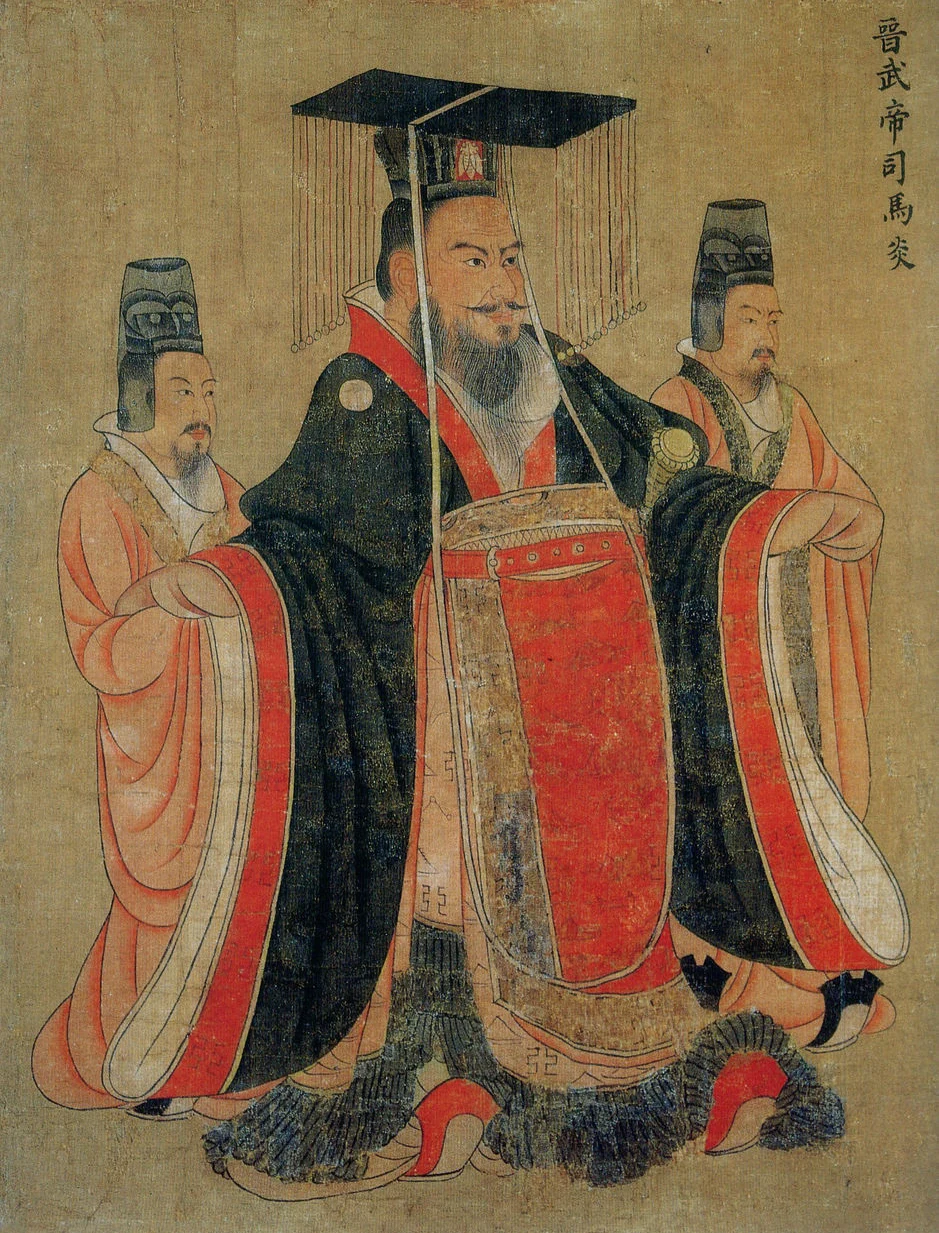
Biography
Succession to Sima family power
Sima Yan was a grandson of Sima Yi and the eldest son of Sima Zhao. Sima Yi, Sima Shi, and Sima Zhao successively dominated the Cao Wei government, creating the basis for Sima Yan's accession. Sima Zhao considered Sima You in the succession discussions but named Sima Yan heir to the Jin princedom in 264 (Xianxi 1 of Wei). After Zhao's death, Yan inherited his positions as chancellor and Prince of Jin.
Replacement of Wei and conquest of Wu
On February 8, 266 (17th day of the twelfth month, Taishi 1 of Jin), Sima Yan accepted Cao Huan's abdication and established Jin, conventionally called Western Jin. Early in his reign he enfeoffed many kinsmen as princes, seeking to avoid the isolation of the Wei imperial family, and assigned some of them to strategic commands. Whether to attack Wu was debated at court. Yang Hu prepared the Jingzhou frontier and urged a campaign; after his death, Sima Yan adopted the plan and launched the attack in 279 (Xianning 5 of Jin). Jin forces advanced along several sections of the Yangtze, and Sun Hao surrendered in 280 (Taikang 1 of Jin).
Institutions and later reign
Sima Yan promulgated the Jin Code and introduced landholding, cultivation, and household tax regulations to manage population and revenue before and after unification. The economy recovered during the Taikang era, but traditional historians criticized his later extravagance and reduced attention to government. He kept Sima Zhong as heir while princely kinsmen held military and political resources. The later War of the Eight Princes cannot be reduced to one policy, but these succession and enfeoffment arrangements were important parts of its background. Sima Yan died in 290 (Taixi 1 of Jin), and Sima Zhong succeeded him.
Sima Yan was born in 236 into the Sima family of the great houses of the Wei, the son of Sima Zhao and his wife Wang Yuanji. His grandfather Sima Yi, his uncle Sima Shi and his father Sima Zhao held the government of Wei in succession: after Sima Yi's death his sons took power one after the other, and Sima Zhao was made prince of Jin in the third month of 264, controlling the court entirely. Sima Yan was enfeoffed marquis of Beiping in the Zhenguan years and afterward advanced to be the heir of the prince of Jin; he is said to have had hair that reached the ground and arms that hung below his knees — the marks, in the lore of the time, of one not destined to be a subject — and stood as the eldest legitimate son among Sima Zhao's children. But his younger brother Sima You, given in adoption to Sima Shi, was filial, friendly and accomplished, of a mild and even temper, and better loved by their father, who said that the empire had been won by his elder brother Sima Shi and that the princedom should therefore go to Sima You. To secure the succession Sima Yan courted the men about his father, and with the support of He Zeng, Jia Chong, Pei Xiu and Yang Hu he was named heir three months before Sima Zhao's death; on his father's death in 265 he succeeded as prince of Jin and chancellor, and in the twelfth month of that year forced the Wei emperor Cao Huan to abdicate, founding the Jin dynasty with the era name Taishi as Emperor Wu.
At his accession, mindful that the Wei imperial house had fallen because its kinsmen had no power to protect it, he enfeoffed many princes of his own surname and gave several of them command of strong troops at key places, meaning to use the imperial clan as a screen; at the same time he set about internal reform: he abolished the harsh measures of the late Wei, remitted collective punishments, tolerated the various schools of thought and revived learning; he attended to the revision of the law, promulgating the first systematic and Confucianized code in Chinese history, the Code of Taishi, with the Jin ordinances providing a model of administrative legislation for the Chinese legal tradition, and established the state academy and restored the lectures at the imperial college. In the economy he introduced the systems of land allotment and taxed fields, encouraged farming and mulberry, and abolished the armed forces of the provinces, so that order steadied, the population grew and society was said to be at peace in its customs. In 279 he sent his armies south, and the next year destroyed Wu, ending the division that had lasted since the end of the Eastern Han and completing the unification of the Three Kingdoms.
With the empire at peace, however, he came to neglect government for banquets and pleasure, and extravagance spread widely among the ruling class — the contests in wealth between Shi Chong and Wang Kai belong to these years — and his own palace held more than ten thousand women, whence the mockery of the goat cart. On the succession he named his second son Sima Zhong, a man of defective understanding, as heir and married him to Jia Nanfeng, daughter of Jia Chong; and with the princes enfeoffed and commanding troops while provincial armaments were abolished, he left deep dangers for the dynasty's brief life. He died at the Hanzhang hall in Luoyang in 290 at fifty-five, buried at the Junyang tomb with the posthumous name Wu and the temple name Shizu; soon after his death the princes' struggle for power produced the rebellion of the eight princes, and the Jin unification collapsed swiftly.
His accession and the founding of Jin were accomplished between 264 and 266. In the tenth month of 264 he was formally established as heir of the prince of Jin, having earlier been given by the Wei emperor Cao Huan the title of deputy chancellor, in the sense of the old rule for the heir of the duke of Lu. In the fifth month of 265 Cao Huan granted Sima Zhao the nine bestowals, made his consort princess and his heir the heir apparent, so that Sima Yan became heir apparent of Jin; in the eighth month Sima Zhao died, and Sima Yan inherited his offices and the princedom with the whole military and civil power of the state. At the end of that year Cao Huan yielded to the pressure of his ministers and agreed to abdicate; on the seventeenth day of the twelfth month Sima Yan, after repeated urgings by the assembled officials, took the throne, changed the dynastic name to Jin and the era name to Taishi, and the next day enfeoffed the abdicated Cao Huan as prince of Chenliu. He was then only thirty.
Once emperor he combined the use of his kinsmen as a screen, generous treatment of the officials and families who had made him emperor, and the removal of Wei abuses. In appointments he also tried not to bear old grudges, employing men of the former Wei party: when an official of ability had been exiled and died for plotting the deposition of Sima Shi, Sima Yan promoted his son over the objections of others. In rewards he enfeoffed more than five hundred men of other surnames as dukes and marquises, with fief revenues fixed at a tenth of the taxes of the households concerned and later raised to a third.
With internal institutions under way, Sima Yan turned to the south and the north. In the south he prepared for unification: in the ninth month of 268 he succeeded in taking from the grand marshal Shi Bao, long famous for his defense of Huainan, the command of his troops, freeing his hands for a longer strategy; and since Jiangdong under Sun Hao was already in deep trouble, the situation offered the Western Jin its chance. In 269 he made the capable president of the secretariat Yang Hu commander of the forces of Xuzhou and posted him to Xiangyang. Yang Hu, though not of the Sima clan, was the brother-in-law of Sima Shi and an important kinsman by marriage of the imperial house, and after the abdication he held the highest military and civil posts at once; reaching Xiangyang he set about steadying the people, lightening taxes and building up military stores, so that the standoff between Jin and Wu turned steadily in Jin's favor. He afterward employed a number of men who had served the Shu-Han government, among them well-known scholars, to prepare the talent for the conquest of Wu.
In the north a long frontier problem arose. One branch of the Xianbei led by its tribal chief moved from beyond the frontier to the Hexi and became known as the Hexi Xianbei; after the founding of the Jin, Sima Yan, fearing their growing strength, carved six commanderies out of Yong, Liang and Liangzhou to form Qinzhou and appointed an official as its governor to keep them quiet. But their revolt came of the contempt of their rulers: in the conquest of Shu the Liangzhou troops had won great merit, and when the rewards were given the five thousand Xianbei fighting men received no fair share, so that under their chief Tufa Shujineng they rose in the sixth month of 270 and killed the governor Hu Lie when he came against them. Having killed him, Tufa Shujineng frightened off the prince of Fuling, Sima Liang, who was stationed at Chang'an; the news from Hexi greatly alarmed Sima Yan, who removed Sima Liang from command of Qin and Liang and sent the prince of Ruyin, Sima Jun, to hold Guanzhong in his place, appointing the minister Shi Jian to command in Qinzhou and put down the revolt. Reaching Qinzhou, Shi Jian ordered the new governor Du Yu, with whom he was at odds, to march, and was refused; Du Yu offered a sounder plan and was ignored, and Shi Jian, arresting him, took the field himself and was badly beaten.
Thereafter Tufa Shujineng's forces grew stronger with each engagement, and the peoples around them rose in encouragement. In the fourth month of 271 the Northern Di of Liangzhou rose with him against Jincheng and killed the governor of Liangzhou, and he killed another governor after that, so that the western war grew more serious. Sima Yan, much worried, was advised by the attendant Ren Kai to put a man of authority and resource such as Jia Chong in command, and he appointed Jia Chong to command Qin and Liang and take the field in the west. Jia Chong was then attendant gentleman and general of chariots and cavalry, the most powerful minister at court, and Ren Kai and others, disliking him, recommended him precisely to get him away from the court. Unwilling to go, Jia Chong asked Xun Xu for a plan, and Xun Xu advised a marriage alliance with the heir; Jia Chong's party accordingly bribed the empress, and the marriage of the heir Sima Zhong to Jia Chong's daughter Jia Nanfeng was arranged, keeping Jia Chong at court. That alliance had far-reaching consequences for the politics of the Western Jin.
The Taikang years from 280 to 289 were the height of the Western Jin and the time when Sima Yan's attention shifted to preserving what he had and to family matters. After the conquest of Wu he abolished the provincial troops and the inspectors' commands, proclaimed amnesties, lightened taxes and service and rewarded farming: a number of edicts forbidding extravagance, lavish burials and private coining belong to these years, and the registers and land figures are said to have reached their highest level since the end of the Eastern Han. Within the imperial clan he met continuing trouble over the succession: the prince of Qi, Sima You, given in adoption to Sima Shi, was both respected and able and long regarded by officials as the best alternative to the heir, and in 282 Sima Yan ordered him out to Qingzhou, where the officials' remonstrances were useless, and Sima You died the next year of grief and anger, sharpening the tension between clan and court. On the heir he never changed his mind: Sima Zhong was of defective understanding, Wei Guan, stroking the imperial seat when drunk, said it was a pity, and He Jiao called the heir a man of plain virtue; when Sima Yan tested him with sealed documents of state, the consort Jia Nanfeng had answers written for him by another hand, and Sima Yan, thinking them adequate, said no more of replacing him. Jia Nanfeng was jealous, fierce and full of stratagem and ran much of the heir's household, laying up the palace coups to come.
At the end of the Taikang years and in 290 he dealt with matters bearing on what would follow: in 289 he adjusted the military commands and posted his sons to key places, and in the same year he fell ill, when the consort kin Yang Jun, father of the empress, took the offices of grand commander of all military affairs, pushed the prince of Runan out to Xuchang and took the government into his own hands; he died at the Hanzhang hall in 290 at fifty-five. His son Sima Zhong succeeded as Emperor Hui with Yang Jun as regent; the next year the empress Jia killed Yang Jun and then the princes of Runan and Chu, and the rebellion of the eight princes began. Barely a decade passed from unification to civil war, and later ages have generally ascribed the swift fall to the disbanding of the provincial armies, the princes' commands with their troops, the extravagance of clan and gentry, and the bad choice of heir with the empress Jia's intervention.
The decision to attack Wu shows how he used men and made up his mind. Yang Hu, after ten years at Xiangyang, memorialized repeatedly for the campaign, while Jia Chong, Xun Xu and Feng Dan at court argued that Wu could not yet be taken; only the chancellor Zhang Hua, the general Du Yu and the governor of Yizhou, Wang Jun, pressed for it. In 278 Yang Hu, gravely ill, returned to court and on his deathbed recommended Du Yu in his place; in 279 Du Yu and Wang Jun memorialized in turn, arguing that Sun Hao was so vicious that if he died and a better ruler succeeded the conquest would be far harder, and Sima Yan resolved on war. The troops marched in the eleventh month and Wu fell in the third month of the next year. In the distribution of credit the general Wang Hun, resenting that Wang Jun had not obeyed his orders and had entered Jianye first, demanded his punishment, and Sima Yan neither punished him nor slighted Wang Hun, making Wang Jun a general-in-chief for his service and giving Wang Hun another command and enlarged fief, with rewards graded for the rest, to settle the quarrel; and he honored Yang Hu posthumously as attendant gentleman and grand tutor, noting that the plan of conquest had in fact been his.
In appointments the men he relied on in his early years fell into three groups: the ministers who had made him emperor, such as Jia Chong, He Zeng and Pei Xiu; practical men of ability such as Zhang Hua, Du Yu and Yang Hu; and the consort kin and princes, such as Yang Jun, Yang Yao, Sima Liang and Sima You. Through the conquest he worked smoothly with Zhang Hua and Du Yu, while after the Taikang years he leaned more on kin. In his last years he made Yang Jun a general of chariots and cavalry and marquis, and with Yang Yao and Yang Ji formed the "three Yangs", letting the consort family swell again, while continuing to adjust the princes' commands so that they held troops in Guanzhong, Jingzhou, Yangzhou and Youzhou. These arrangements kept a balance while he lived; the moment he died, the conflict between consort kin and clan broke out.
The conquest of Wu is a set piece in military history. Wang Jun at Yizhou built great ships, the largest a hundred and twenty paces square and carrying more than two thousand men, with wooden walls, towers and four gates, and horses could be galloped about their decks; when the campaign opened in 279 his Ba-Shu fleet came down the Yangtze, breaking Danyang, Xiling, Jingmen and Yidao, joining Du Yu at Lexiang, taking Wuchang and sailing on to Xunyang; in the third month of 280 his ships reached the Shitou fort at Jianye, where the Wu ruler Sun Hao came out bound with his coffin at the head of his ministers and surrendered, and Wu ended. Sun Hao was sent to Luoyang and made marquis of Guiming; Sima Yan received him in the hall and had him sing a mocking song, a scene the histories record as the humiliation of a ruler who had lost his state. Afterward Wang Jun and Wang Hun impeached each other over the credit, and Sima Yan soothed both: Wang Jun was made a general-in-chief and marquis of Xiangyang, Wang Hun given another high command, and an edict issued to say that each had his own merit, so that the quarrel went no further.
In the Taikang years he also took up, without acting on, the question of the northern peoples within the frontier. By then the Xiongnu of Bingzhou, the Di and Qiang of Guanzhong and the Xianbei of You and Bing had long since moved inward and lived among the Chinese, and the Jin followed the Wei practice of keeping their chiefs in nominal office. The censor Guo Qin memorialized that these peoples were many and near the capital region, that in any upheaval Guanzhong and Bingzhou would be the first to suffer, and proposed using the prestige of the conquest of Wu to move them back to the frontier; Sima Yan did not adopt it. Within decades the risings of the Five Barbarians broke out first in Bingzhou and Guanzhong, and Guo Qin's proposal has been cited ever since. In the southwest, after the conquest of Wu he attended to the government and pacification of the old Shu-Han lands, bringing the sons of former Shu officials and local families into office to steady the region.
In the Taishi years the arguments over appointments and the conquest of Wu were bound up with several personal factions. The attendants Ren Kai and Yu Chun, at odds with Jia Chong, first tried to send him west to command Qin and Liang under the name of a campaign, and then, by marrying his daughter to the heir, kept him at court; afterward Jia Chong's party struck back, Ren Kai was dismissed and Yu Chun sent out, and Zhang Hua was pushed aside for advocating the conquest. Zhang Hua, though ennobled for his part in the victory, was posted out as commander of Youzhou and protector of the Wuhuan, where he steadied the northern frontier, while Du Yu held Xiangyang and went on building up Jingzhou; Yang Hu was honored posthumously and many of the men he had recommended were employed. These shifts show that in his later years appointments were held in the balance between the consort families and the princes, and that the earlier practice of appointing by ability was not maintained to the end.
He also left a record of facing criticism. In the Taishi years, with calamities frequent, he repeatedly called for plain speech, ordered the ministers to recommend men of worth and uprightness and heard suits in person; when a minister observed that there were too many officials and too little business, he ordered the superfluous posts abolished; and he issued edicts against the extravagance of the clan and the meritorious. The effect was limited, and the luxury of the great families reached its height under Taikang. His treatment of remonstrance varied: some who spoke were indulged, others suffered for it, as Yu Chun was for a while dismissed after quarreling with Jia Chong. On the whole the government of the Taishi years may be called clean, and after Taikang it grew lax.
The handling of Jiangnan after the conquest was among the more effective parts of his unification policy. On the fall of Wu in 280 he abolished the harsh measures of the Wu state: the land and household taxes of the region were remitted for the year, many of the extra levies and heavy labor services imposed by Sun Hao were cancelled, and Wu people enslaved to the government were freed, while the commanderies were ordered to relieve those displaced by the war; the Wu royal house and its old ministers were treated generously, those not suspected of disloyalty keeping their titles and property, Sun Hao being made marquis of Guiming and his heir given office. To the southern gentry he applied the principle of employing men according to ability, north and south serving together, so that the old families of Danyang, Wujun and Kuaiji came into office at Luoyang in turn and the rule of Jiangdong steadied fairly quickly; the Wu people, the histories say, were content, and households and production recovered under Taikang.
Calamity and relief were constant business of the reign. Drought, flood, locusts and earthquakes are recorded repeatedly from Taishi to Taikang, and he issued edict after edict remitting land and household taxes in the stricken regions, opening the granaries, sending envoys to inspect and console, and vacating the main hall, reducing his table and stopping music because of portents; those driven to flight by famine were to be settled where they were and freed of taxes and service for a term. Together with the systems of allotted and taxed fields these measures brought the registered population to its highest point since the end of the Eastern Han: by the geographical treatise of the Book of Jin, after the conquest of Wu in 280 the empire had two million four hundred and fifty-nine thousand eight hundred and forty households and sixteen million one hundred and sixty-three thousand eight hundred and sixty-three persons; and the economic treatise says that the empire was at peace, taxes even, and men at ease in their work and happy in their affairs — the chief ground for what later ages called the peace of Taikang.
After his death the Western Jin went from strength to collapse within a dozen years, in direct consequence of his arrangements. He died in 290 and the heir Sima Zhong took the throne as Emperor Hui, with the consort kin Yang Jun as regent; the next year the empress Jia Nanfeng, with the prince of Chu, staged a coup, killing Yang Jun and his party and then the prince of Runan, Wei Guan and the prince of Chu, after which she governed with Zhang Hua and Pei Wei for nearly ten years of comparative quiet. In 299 she deposed and killed the heir Sima Yu, provoking the princes; in 300 the prince of Zhao rose, killed the empress and made himself chancellor, and the next year deposed the emperor and took the throne, whereupon the princes of Qi, Chengdu and Hejian rose against him and the princes fell to destroying one another in turn — the rebellion of the eight princes. In 306 the emperor was poisoned, the prince of Donghai set Sima Chi on the throne as Emperor Huai, and the civil war ended with the dynasty's armies and finances exhausted.
Amid the fighting the settled frontier peoples rose: in 304 Liu Yuan the Xiongnu took the title king of Han at Zuoguocheng and Shi Le the Jie joined him; in 308 Liu Yuan was emperor, in 310 his son Liu Cong succeeded, and in 311 the Han armies took Luoyang and captured the emperor Huai in the troubles of Yongjia; in 316 Liu Yao took Chang'an and captured Emperor Min, and the Western Jin ended, Sima Rui founding the Eastern Jin at Jiankang soon after. From his death to the fall of the dynasty was twenty-six years, and the sources of the disorder can mostly be traced to his arrangements: princes commanding strong troops in the provinces while local forces were abolished, a bad choice of heir leaving consort kin and then the empress to intervene, and the settled northern peoples concentrated near the capital without proper provision.
His court and household also shaped the politics of the dynasty. He had two empresses in succession: the first, Yang Yan, bore the heir Sima Zhong and the prince of Qin, Sima Jian, while the second, Yang Zhi, was a daughter of Yang Jun, so that the Yang family held power within and without the palace; of his consorts Hu Fang and Zuo Fen are among those recorded, and the size of his palace is repeatedly noted. He had twenty-six sons, among them Sima Zhong, Sima Jian, Sima Wei, Sima Yun, Sima Yi and Sima Ying: Sima Jian was known for a mild and slow temper, Sima Wei for sharpness and a taste for punishments, and the others came forward one after another in the rebellion of the eight princes. In 289 he adjusted the titles and seats of his sons, posting the prince of Chu to the command of Jingzhou, the prince of Huainan to Yang and Jiang, and the prince of Chengdu to Yecheng, placing them at the strategic points, and in the same year gave offices at the center to princes of collateral lines, so that the imperial clan held posts both at court and in the provinces.
This arrangement interacted with his handling of the succession: the heir could not govern, his consort Jia Nanfeng was jealous, fierce and full of stratagem, and the emperor relied on a balance among his sons and the princes, keeping both clan and consort kin high in the hope of holding them in check. That balance held while he lived and broke at once when he died: Yang Jun as consort kin took the regency alone, the empress with a prince staged a coup, and the princes then destroyed one another. In the event, his arrangements for the succession and the regency worked against his own intention of using the clan as a screen, and became the direct condition of civil war.
In matters of the palace and the empress's family he left behind several decisions of direct consequence. In 274 the empress Yang Yan, gravely ill, asked him to marry her younger kinswoman Yang Zhi after her death, and he agreed, making Yang Zhi empress the next year, so that her father Yang Jun and her uncles Yang Yao and Yang Ji held high office, the "three Yangs". When the question of conquering Wu arose in the Xianning years, Jia Chong and Xun Xu opposed it and the Yangs also favored delay; and after the conquest he was at pains to reward and place the generals without offending Jia Chong's party or slighting Zhang Hua, Du Yu and Wang Jun, so that beyond titles there was a series of transfers — Zhang Hua sent out to Youzhou, Wang Jun moved to other posts, Du Yu left at Xiangyang. Under Taikang he gave Yang Jun and Yang Yao command of the guards and the secret business, and posted the princes Sima Liang and Sima You to key places, making consort kin and clan stand side by side.
On the succession, the remonstrances of Wei Guan and He Jiao and his replies are also recorded: Wei Guan, at a drinking party, stroked the imperial seat and said it was a pity, and He Jiao said plainly that the heir was unequal to the throne, but Sima Yan, though he understood, sought a face-saving way by testing the heir with sealed documents, and the answers supplied by Jia Nanfeng and Zhang Hong let the matter drop. He meanwhile gave the heir a strong body of assistants, making Wei Guan and the prince of Runan grand tutor and grand guardian, in the hope that weighty regents would offset a weak sovereign. These arrangements held while he lived, but as the power of Yang Jun and the empress Jia swelled, his dispositions failed at once after his death.
Two further institutional matters belong to his last years. One was the abolition of the local forces of the commanderies, carried out during the Taikang years, leaving only a small body of armed clerks for order while local defense passed to the military governors and the princes' troops; this was then seen as lightening the local burden and preventing separatism, but in the rebellion of the eight princes and the troubles of Yongjia it exposed the provinces' inability to defend themselves. The other was the precise regulation of sheltered clients and kin: officials of the first to the ninth rank were allowed to shelter different numbers of clients and tenants, the figures being written into statute, at once an acknowledgment of the great families' gains and an attempt by the state to bring the population they sheltered into its registers. Both measures show the direction of his government — to keep central authority while accepting the aristocratic order — and the limits of that direction were shown by the disorders of the twenty-odd years that followed.