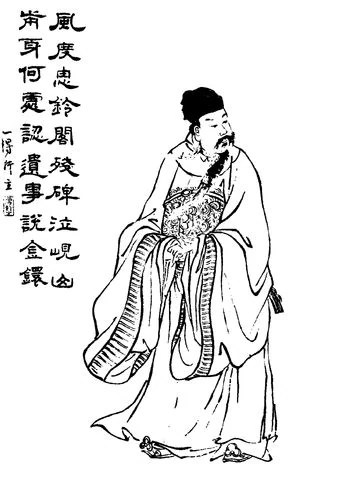
Biography
Family Background and Early Life
Yang Hu came from the distinguished Taishan Yang clan of the Han and Wei periods. Looking back nine generations from him, members of the family had repeatedly held offices of two-thousand-*shi* rank or above and were known for integrity and virtue. His grandfather Yang Xu had served as Grand Administrator of Nanyang in the late Han and was famous for the story of hanging up a fish to reject a bribe. His father Yang Dao was Grand Administrator of Shangdang under Cao Wei. His mother, Lady Cai, was a daughter of the renowned Han scholar and Left Gentleman General Cai Yong. Yang Hu’s elder sister Yang Huiyu married Sima Shi, son of Sima Yi, a marriage connection that deeply influenced his political career.
Yang lost his father at the age of twelve. He mourned with exceptional devotion and served his uncle Yang Dan very respectfully. According to one story, while still young he was playing by the Wen River when an old man told him: “Your appearance is extraordinary. Before you reach sixty, you will certainly accomplish great merit for the realm.” The old man then disappeared and his identity was never known. As an adult Yang was broadly learned, talented in writing, composed in bearing, said to stand seven chi and three cun tall, with handsome beard and brows, and skilled in debate. Xiahou Wei, a local military official in Taishan, considered him exceptional and arranged his marriage to the daughter of his elder brother Xiahou Ba.
Career and Political Judgment under Cao Wei
Yang Hu was recommended as an annual reporting official. The Yanzhou provincial administration recruited him four times as a staff officer or distinguished candidate, while five major offices also tried to appoint him, but he declined them all. During the Zhengshi era the struggle between Cao Shuang and Sima Yi grew increasingly intense. Although still young, Yang judged that Cao Shuang would ultimately lose. When Cao Shuang recruited both him and Wang Shen, Wang urged Yang to accept. Yang replied that risking one’s family and life in another man’s service was no easy matter. Wang Shen went alone. After Cao Shuang fell in the Incident at the Gaoping Tombs in 249, Wang was removed as a former retainer of Cao Shuang and came to admire Yang’s foresight.
Yang’s father-in-law Xiahou Ba later defected to Shu Han to escape danger. Most of Xiahou Ba’s relatives severed ties with his household for fear of implication, but Yang alone reassured and cared for them with even greater courtesy than before. Soon his mother and elder brother Yang Fa died in succession. Yang observed mourning rites for more than a decade, living plainly and gravely in the manner of a Confucian scholar.
In 255 Sima Zhao recruited Yang to the staff of the General-in-Chief, but Yang did not accept. He was later formally summoned by the court and appointed Gentleman of the Secretariat, then promoted to Gentleman Attendant at the Yellow Gate. Emperor Cao Mao of Wei enjoyed literature, and many court officials offered poems and fu. Yang maintained a principled position at court and did not permit personal closeness or distance to affect him, earning the respect of discerning men. After Cao Huan, Emperor Yuan of Wei, took the throne, Yang was enfeoffed as Marquis within the Passes with one hundred households. Because the emperor was young, Yang did not wish to remain a palace attendant and requested transfer, becoming Director of the Palace Library.
When Cao Wei introduced the five-rank nobility system in 264, Yang was enfeoffed as Viscount of Juping with six hundred households. Zhong Hui, favored by Sima Zhao and jealous of talented men, also made Yang wary. After Zhong Hui was executed that same year, Yang became a staff officer to the Chancellor and shared confidential affairs with Xun Xu, a close associate of Sima Zhao’s son Sima Yan. On the eve of the Jin succession, Sima Yan, now Chancellor, transferred Yang to Central Commander of the Army, with responsibility for palace guards and participation in internal and external political affairs.
Founding of Western Jin and Command in Jingzhou
In the twelfth month of the second Xianxi year, January 266, Sima Yan accepted the abdication and established Western Jin. Because Yang Hu had assisted in supporting the new dynasty, he was promoted to General of the Central Army, additionally made Palace Attendant, and raised to a commandery duke with three thousand households. Fearing the jealousy of powerful figures such as Jia Chong, he firmly declined the ducal rank and accepted only elevation of his existing title from Viscount of Juping to Marquis of Juping. Early in the Taishi era, Sima Yan appointed him Right Vice Director of the Department of State Affairs and General of the Guards, with his own military establishment. Since Wang You, Jia Chong, Pei Xiu, and others were senior men of great reputation from the previous dynasty, Yang repeatedly showed them deference.
Sima Yan had long intended to conquer Eastern Wu. In 269 he specially appointed Yang Commander of the Military Affairs of Jingzhou with acting authority, while retaining his offices as Palace Attendant and General of the Guards. At the time both Western Jin and Wu had a Jingzhou, confronting one another north and south. The border through Jingzhou was the longest section of the Jin-Wu frontier and was crucial to the planned conquest.
On taking office, Yang found Jingzhou unstable, its people unsettled, and the garrison short of grain. He first concentrated on development: establishing schools, promoting education, pacifying residents, attracting people from afar, and dealing candidly with people from Wu. Those who surrendered were free to stay or leave, and demolition of old government buildings was prohibited. Most importantly, he devised a way to induce Wu to withdraw the Shicheng garrison that posed the greatest threat to Xiangyang. He then divided his troops in half: one group patrolled and guarded the frontier, while the other cultivated fields. In that year the army opened more than eight hundred qing of farmland. When Yang arrived, the force had less than one hundred days of grain; later, reserves were sufficient for ten years. To recognize his achievements, Sima Yan abolished all the commander posts north of the Yangtze and appointed Yang General of the Southern Interior, placing all forces in the Handong and Jiangxia region under his command.
In camp Yang often wore a light warm fur robe with a loose sash rather than armor, and only a little more than a dozen guards attended him. He liked hunting and fishing and sometimes neglected official duties for them. One night he wished to leave camp, but the army marshal Xu Yin stood at the gate holding a wooden halberd and told him that a commander responsible for a vast frontier could not behave so carelessly, since his safety was the safety of the state; unless Xu died, the gate would not open that night. Yang changed his expression, apologized repeatedly, and thereafter went out much less often.
Defeat at Xiling and Strategic Adjustment
In 270 the celebrated Wu general Lu Kang became commander in Jingzhou. He quickly noticed Jin’s movements and submitted seventeen recommendations to the Wu ruler Sun Hao concerning the situation. Lu Kang’s arrival made Yang Hu more cautious. While strengthening military preparations in Jingzhou, Yang secretly memorialized Sima Yan that the conquest of Wu should exploit the advantages of the upper Yangtze and that a large navy should be built in Yizhou.
In the eighth month of 272, Sun Hao removed Bu Chan from command at Xiling. Fearing execution, Bu surrendered the city to Jin in the ninth month. Lu Kang immediately besieged Xiling. Emperor Wu ordered Yang Hu and Xu Yin, military supervisor of Baxi, to attack Jiangling and Jianping respectively in order to divide Lu Kang’s forces, while Inspector Yang Zhao of Jingzhou was to move directly to Xiling to rescue Bu Chan. Lu Kang, however, destroyed the roads north of Jiangling, creating severe supply problems for fifty thousand Jin troops. Jiangling’s defenses were also strong, and Yang’s army stalled below the city. Yang Zhao, with too few troops and an exposed supply line, was defeated by Lu Kang. Xiling fell, Bu Chan was captured, and his clan was killed.
Officials impeached Yang, arguing that he had commanded more than eighty thousand men against fewer than thirty thousand enemy troops, yet had remained before Jiangling while the enemy completed its defenses and had sent Yang Zhao’s smaller force into difficult ground with inadequate supplies. They charged him with violating the imperial order and lacking the conduct expected of a great minister, proposing dismissal. Yang was ultimately demoted to General Who Pacifies the South, while Yang Zhao was reduced to commoner status.
After Xiling, Yang changed his strategy. Proceeding cautiously and step by step, he expanded Jin territory through fortifications until the lands between the Han and Yangtze rivers were under Jin control. At the same time he treated the Wu military and population with conciliation, trust, and good faith, gradually undermining the loyalty of Wu commanders. Several Wu officers defected to Jin, and people in Wu came to respect him as “Lord Yang.” Lu Kang himself praised Yang’s virtue and breadth of character, saying that even Yue Yi and Zhuge Kongming could not surpass him.
Later Years and Final Recommendation
Early in the Xianning era Yang was appointed General-in-Chief Who Conquers the South and Commander Unequalled in Honor. He continued planning the conquest of Wu and argued that success required a fleet to descend the Yangtze from the upper river. A children’s rhyme in Wu said, “ATongFuATong,Xian DaoFuDuJiang。BuWeiAnShang Shou,Dan Book of Weii Zhong Long.” Yang therefore recommended Wang Jun, inspector of Yizhou and nicknamed Atong, to remain in Yizhou supervising military affairs. Emperor Wu promoted Wang Jun to General of the Dragon-Soaring Army and ordered him secretly to build warships.
Once his forces were trained, Yang memorialized that Wu ruler Sun Hao’s cruelty and loss of military loyalty created the opportunity for a decisive conquest. Emperor Wu agreed, but recent defeat in the Qin and Liang regions led most ministers to oppose a campaign at that time, and the plan was again delayed. The emperor wished to enfeoff Yang as Marquis of Nancheng Commandery, but Yang cited the example of Emperor Gaozu of Han granting Zhang Liang the title Marquis of Liu and politely declined, asking only for the title Marquis of Juping County.
Yang became gravely ill before seeing the conquest of Wu. He traveled to Luoyang and personally explained his strategy to the emperor. Emperor Wu later sent Secretariat Director Zhang Hua to Yang’s residence for further advice. Yang strongly urged that Jin act while Sun Hao was still alive, lest Wu gain a capable ruler after his death. On the xinmao day of the eleventh month in the fourth year of Xianning, December 27, 278, Yang’s illness worsened. Soon after recommending Du Yu as his successor, he died at the age of fifty-eight. Emperor Wu mourned deeply and posthumously granted him the offices of Attendant and Grand Tutor. People throughout his jurisdiction closed markets in mourning, and even Wu frontier soldiers wept for him.
Foreknowledge Without Boasting, His Protection of Xiahou Ba's Household, and His Modesty
When Guo Yi of Taiyuan saw Yang Hu he said that this was the Yan Hui of the day. He had been summoned along with Wang Shen by Cao Shuang, and when Wang Shen urged him to accept Yang Hu said that to give oneself body and life in another's service was no easy matter; and when Cao Shuang fell and Wang Shen was dismissed as his former officer, Wang Shen told Yang Hu that he had often remembered his words, and Yang Hu answered that he himself had not foreseen such an end — so little did he boast of his foresight. When his father-in-law Xiahou Ba went over to Shu, most of his connexions by marriage broke with his house, and Yang Hu alone comforted his family and treated them with more kindness than before. He served two reigns and held the secrets of government, being consulted on every gain and loss of policy, yet "had nothing to do with the pursuit of power or profit"; all his good counsels he "burned the drafts of, so that the world never heard them," and of those he advanced "no one knew from whom it came." When someone said he was too secretive he answered that to speak in a ruler's ear and then talk elsewhere was the very warning against a subject's leakiness, of which he feared only that he fell short; that not to be able to bring forward worthies and men of parts left one ashamed before the difficulty of knowing men; and that to be given rank in the court and then to go and thank a private patron was not what he would do. When his son-in-law advised him to acquire lands and property so as to have a refuge after office, he said nothing at the time, but told his sons afterwards that this was to know one thing and not the other, for a subject who builds up private wealth turns his back on public duty, which was a great delusion, and that they should understand his mind. He wrote to his younger cousin Yang Xiu that with the frontier settled he should retire to his native place with a kerchief and go east, to make there a plot for his coffin, for a plain scholar in high office could hardly avoid reproach for fullness, and that Shu Guang was his master. When he memorialized declining the honours of a staff of his own, it was on the ground that "if one who is not yet accepted in virtue receives high rank, the talented will not advance; and if one to whom merit has not accrued bears rich stipend, the laborious will not be encouraged," and he named three grand masters of light whose purity and simplicity had gone unrewarded while he was to pass over them, and asked how he could answer the empire's expectation. When an edict made the five counties of Wuyang, Mou, Nancheng, Liangfu and Pingyang south of Mount Tai into the commandery of Nancheng and would have enfeoffed him as its marquis, he firmly declined, saying that Zhang Liang had asked for ten thousand households at Liu and the Han founder had not thwarted his wish, whereas he had received Juping from the late emperor and would not presume to a heavier title and invite censure, and he refused the ceremony until the court gave way.
The Government of Jingzhou and the Concrete Practice of Conciliatory Good Faith
On reaching Jingzhou Yang Hu attended first to grain and order: he "opened schools and soothed and drew in far and near, greatly winning the hearts of the Jiang and Han," and dealt with the men of Wu in open good faith, "allowing those who surrendered to go if they wished"; and because officials who died in office were disliked by their successors and the old offices were often pulled down, he held that life and death were fated and had nothing to do with a dwelling, and sent orders prohibiting the practice in all the military provinces. The Wu garrison at Shicheng, seven hundred li from Xiangyang, did constant harm on the frontier, and Yang Hu, troubled by it, "by a stratagem caused Wu to withdraw the garrison." He then halved the patrols and used the other half to open eight hundred and more qing of military farms, so that where at his arrival the army had not a hundred days' grain, by his last year it had ten years' store. In practice, whenever he fought the men of Wu he fixed the time of battle beforehand and never struck by surprise, and against officers who proposed raids he used wine to make them drunk and stop their talk; when his men captured on the frontier the children of two Wu commanders he at once sent them back, and later, when the Wu commanders Xia Xiang and Shao Xie came over, the fathers of those boys brought their troops with them; when Wu commanders raided and were killed he honoured their loyalty, buried them richly and returned them with ceremony to their families; when the Wu commander Deng Xiang raided Xiakou he put a price on his capture and, having taken him, let him go, so that Deng Xiang in gratitude brought his men over; when his troops passing through Wu territory cut the rice for their rations they always repaid it in silk by the amount taken; and in hunting he forbade his men to cross the border, and if game first wounded by the men of Wu was taken by his soldiers he returned it. By such means the people of Wu were won over and respected him, calling him not by name but "Duke Yang." Lu Kang understood this well and used to warn his garrison commanders that the other side won men by virtue while they used only force, so that they would be conquered without fighting, and that they should simply hold their own side of the line and not contend for small gains. When Sun Hao heard of the peace along the two frontiers and questioned him, Lu Kang answered that a single town or village could not do without good faith, much less a great state, and that for him not to do so would only make the other's virtue the plainer, doing Yang Hu no harm; and men of the day said that the friendship of Hua Yuan and Zifan lived again. Once, when Lu Kang fell ill, Yang Hu sent him medicine, saying it was of his own compounding and untasted and that hearing of his illness he sent it first; and though the Wu officers urged him not to take it, Lu Kang had no doubt, saying that Yang Hu was not a man to poison anyone, and drank it down.
His Readjustment after the Western Fortress, and His Plan for the Conquest of Wu
In 272, when the Wu commander of Xiling, Bu Chan, came over to Jin, Lu Kang attacked Xiling in haste, and the emperor ordered Yang Hu and Xu Yin to attack Jiangling and Jianping separately so as to divide Lu Kang's force, while the governor of Jingzhou, Yang Zhao, went straight to relieve Bu Chan. But Lu Kang destroyed the roads north of Jiangling, so that the transport of grain for fifty thousand Jin troops became difficult, and Jiangling being strongly walled and hard to attack, Yang Hu sat before it without moving; and Yang Zhao, with few men and no grain, was beaten by Lu Kang, while Bu Chan was taken when the city fell and his whole clan killed. The officers memorialized that Yang Hu with more than eighty thousand men against a rebel force of no more than thirty thousand had sat at Jiangling and let the enemy prepare, and had sent a detached force into danger with few men and no grain so that the army was checked — that he had disobeyed the imperial command and shown no spirit of a great minister, and should be dismissed to his marquisate; and Yang Hu was accordingly reduced to general of the pacified south and Yang Zhao made a commoner. He afterwards drew the lesson and took to a double policy of nibbling at Wu's territory and practising good faith, extending Jin's land by building forts and stockades until all between the Han and the Yangtze was Jin's. On the plan for conquest he held that the advantage of the upper waters must be used; and when a Wu children's song ran that "A Tong, A Tong, carries a blade and crosses the river by float; the beasts on the bank he does not fear, but the dragon in the water," he said this must mean that the conquest would be won by a fleet and that they had only to find the man who answered to the name; and when Wang Jun, governor of Yizhou, was to be brought to the capital as minister of agriculture, Yang Hu, knowing him fit for the work and that his boyhood name was A Tong, memorialized to keep him as commander of the military affairs of Yizhou and made him general of the soaring dragon, secretly ordering him to build ships for the descent. He trained his troops and made ample preparation, and after seven years the Jin forces on the Jingzhou frontier far exceeded those of Wu. In his memorial on the conquest he argued that Shu, perilous as it was with mountains reaching the clouds and valleys without sunlight, had "no fence at all" to stop the invaders, not because its men lacked the will to fight but because their strength could not match; and he compared the present case, saying that the difficulties of the Huai and the Yangtze were no greater than those of Jiange, the dangers of the mountains no greater than those of Min and Han, that Sun Hao was more cruel than Liu Shan and the men of Wu more wretched than those of Ba and Shu, while Jin's armies were more numerous than before and its stores and arms better, so that "the empire should be settled now." His deployment was to bring the troops of Liang and Yi down by land and water, the host of Jing and Chu to Jiangling, the forces of Pingnan and Yuzhou straight at Xiakou and those of Xu, Yang, Qing and Yan toward Moling, "with drums and banners to confuse them and many devices to mislead them," so that Wu, one corner against the empire's host, would be scattered and forced to defend everywhere at once, and then with a surprise force from Ba and Han against an empty interior "one place broken would shake all above and below." He added that the men of Wu were quick by custom and could not last, and were inferior in bows, crossbows, halberds and shields, having only river fighting to their advantage, so that once the army entered their country the Yangtze would no longer be their defence, and falling back on their towns they would lose their strength and take on weakness, while the government troops, having advanced far from home, would have the will to die rather than yield; whereupon "the conquest may be certain within a season." The emperor took his words deeply to heart, but because the Jin armies had suffered defeats in Qin and Liang and most of the ministers did not agree, the plan was again delayed, and Yang Hu sighed that "of the things in the world that do not go as one wishes, seven or eight in ten," and that men who would not decide when decision was needed and would not take when the taking was offered could only leave regret to men of understanding afterwards.
His Handling of the Frontier, His Judgement of Men, and the Mourning after His Death
On frontier business, when the men of Wu raided the households of Yiyang and Jiangxia and the court sent an attendant with a letter reproaching Yang Hu for not pursuing them and proposing to move the provincial seat, Yang Hu answered that Jiangxia was eight hundred li from Xiangyang, so that by the time the raid was known the enemy had been gone a day already, and how could infantry sent out rescue the people; that to tire the army in order to escape blame was hardly fitting; that the Wei founder had placed his commanders near the provincial seats because an army does best united and worst dispersed; that on a frontier where now one side and now the other had the advantage the only wisdom was to hold firm, which was the good teaching of the ancients; and that to move the seat at random, when the rebels came and went without rule, would leave no place from which the province could properly be held — and the envoy had no answer. As to judging men, his nephew by marriage Wang Yan once came to discuss business with him, eloquent and brilliant, and Yang Hu disapproved; and Wang Yan, flinging his sleeve, rose to go, whereupon Yang Hu told his guests that Wang Yifu might hold a great place on the strength of a great name, but that he would corrupt custom and injure the moral order, and that this was certainly the man. In the affair of Bu Chan he had been about to put Wang Rong to death under military law, and so Wang Rong and Wang Yan both resented him and spoke against him at every opportunity, until men said that with the two Wangs in power Duke Yang had no virtue; and Xun Xu and Feng Dan and their like were much jealous of him — all of which shows that in the aristocratic politics of the day his honesty and uprightness were not always tolerated. He loved mountains and waters: "Hu delighted in mountains and waters, and whenever there was fine weather he must go, drinking and singing on Mount Xian all day without weariness," and he left the saying that of the things in the world that do not go as one wishes there are always seven or eight in ten. After his death the people of Xiangyang built a temple and set up a stele on Mount Xian where he had rested, the "stele of Duke Yang Hu, general of the southern expedition of Jin," and thereafter at the festivals the people would sacrifice and weep at the sight of it, so that his successor Du Yu called it the "stele of falling tears"; and the people of Jingzhou avoided his name, saying "door" rather than "household" and changing the office of "household bureau" to the "bureau of declining."