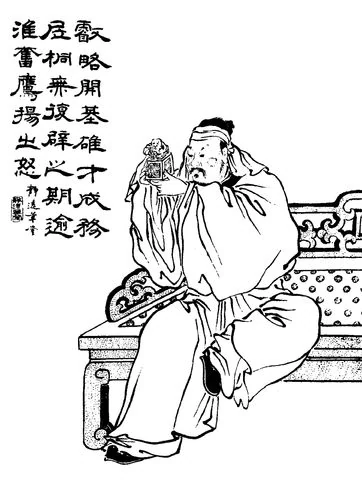
Biography
Family Background and Early Life
Sima Shi was born in 208, the thirteenth year of the Jian'an era, as the eldest son of Sima Yi. The Sima family was a prominent lineage of Wen County in Henei with a Confucian scholarly background; Sima Yi's father Sima Fang had served as Intendant of the Capital. Sima Shi received a strong Confucian education from childhood. He was elegant in bearing, calm and resolute in temperament, and possessed far-reaching strategic ambition. He acquired a strong reputation while still young and associated with celebrated men of the time. According to the *Wei Shi Chunqiu*, Xiahou Xuan and He Yan were then famous, and Sima Shi was counted among them. He Yan once praised him: “Only one who discerns the subtle can bring the affairs of the world to completion; Sima Ziyuan is such a man.”
Sima Shi first married Xiahou Hui, daughter of Xiahou Shang. Xiahou Hui was the younger sister of Xiahou Xuan, and her mother, Lady Cao, was Princess of Deyang Township and a member of the Cao Wei imperial clan. Xiahou Hui was perceptive and capable and often assisted Sima Shi in planning. According to the *Book of Jin*, however, she understood that Sima Shi was not loyal to Cao Wei, while Sima Shi was wary of his wife's ties to the Xiahou family. In 234, the second year of the Qinglong era, Sima Shi poisoned Xiahou Hui, ending this political marriage with the Xiahou clan.
Entry into Office and Service as Central Protector of the Army
During the Jingchu era of Cao Wei (237–239), Sima Shi was appointed Regular Mounted Attendant. After several promotions he became Central Protector of the Army, an important office responsible for the imperial guard and the selection of military officers. While serving in this post, Sima Shi established rules for choosing personnel so that recommendations would not exceed a candidate's merit and officials would have less opportunity to practice favoritism. In 247, the eighth year of the Zhengshi era, his mother Zhang Chunhua died. Sima Shi observed mourning for her and became known for exceptional filial devotion.
The Incident at the Gaoping Tombs and Assumption of Power
In 249, the first year of the Jiaping era, Sima Yi launched the Incident at the Gaoping Tombs and eliminated the powerful official Cao Shuang. Before the coup, Sima Yi had planned it only with Sima Shi, without informing Sima Zhao. Not until the night before the operation did Sima Yi tell Sima Zhao. He then secretly sent people to observe the two sons' reactions: Sima Shi slept as soundly as usual, whereas Sima Zhao was so anxious that he remained awake all night. The next morning Sima Shi personally led troops to station at the Sima Gate, secured the capital, maintained order inside and outside the palace, and arrayed the forces with great discipline. Sima Yi remarked, “This son is indeed capable.”
Sima Shi had privately maintained three thousand retainers prepared to die for him. In ordinary times they were dispersed among the population, but on the day of the coup they assembled and played a crucial role, to the surprise of those who did not know where they had come from. After the operation succeeded, Sima Yi replaced Cao Shuang as the dominant holder of Cao Wei's military and political power. Sima Shi was enfeoffed as Marquis of Changping Township with a fief of one thousand households and soon afterward was appointed General of the Guards.
In 251, the third year of the Jiaping era, Wang Ling rebelled and Sima Yi personally led the campaign against him, leaving Sima Shi to guard Luoyang. After Sima Yi's death, court officials invoked the precedent of Yi Yin being succeeded in political authority by his son Yi Zhi. Emperor Cao Fang therefore issued an edict appointing Sima Shi to assist the government as General-in-Chief Who Pacifies the Army, placing the military and political affairs of Wei in his hands.
Control of the Government and External Wars
In 252, the fourth year of the Jiaping era, Sima Shi was promoted to General-in-Chief. In the tenth month of that year, the Wu emperor Sun Quan died. Wei sought to seize the new embankment works established by Eastern Wu. Wang Chang, Guanqiu Jian, and Hu Zun each proposed plans for attacking Wu. Because the generals differed in strategy, Sima Shi ultimately decided on a three-pronged offensive. In the twelfth month, Wei forces attacked Dongxing. Sima Shi appointed Sima Zhao as commander and placed the General Who Attacks the East Hu Zun and General Who Guards the East Zhuge Dan under him, but they were defeated by Zhuge Ke. Wei suffered heavy casualties, and the Wu army captured great quantities of equipment and supplies. Many court officials called for demoting Zhuge Dan and the other participating commanders. Sima Shi instead took responsibility, saying, “I failed to follow Gongxiu's advice, and matters came to this. The fault is mine; what crime have the generals committed?” Sima Zhao, as overall commander, was punished most severely and stripped of his title, while the other officers received no major punishment and merely had their defense assignments exchanged.
In the fifth month of 253, the fifth year of the Jiaping era, Wu Grand Tutor Zhuge Ke led an army of 200,000 to besiege Hefei New City. At court many feared that he would divide his forces to attack the Huai and Si regions and proposed defending the various river outlets. Sima Shi judged that Zhuge Ke, having only recently gained authority in Wu, wished to exploit his current prestige by concentrating his army at Hefei New City in hope of another quick success and therefore would have no spare strength to attack Qingzhou or Xuzhou. Events unfolded as Sima Shi predicted. He sent Sima Fu to supervise 200,000 troops in defense. General Who Guards the East Guanqiu Jian and Yangzhou Inspector Wen Qin asked to fight, but Sima Shi said, “Zhuge Ke's army has advanced lightly and deeply, throwing itself into a desperate position. Its initial edge cannot easily be resisted. Moreover, New City is small but strong, and cannot be taken at once.” He therefore ordered the generals to remain behind high defenses. After several months of stalemate, Zhuge Ke's besieging army was exhausted and had lost more than half its men to death and injury. Sima Shi then ordered Wen Qin to lead elite troops forward and join the defense with the intention of cutting off Zhuge Ke's retreat, while Guanqiu Jian and others prepared to close behind him. Zhuge Ke became afraid and withdrew; Wen Qin pursued and badly defeated the retreating army, reportedly taking more than ten thousand heads.
Deposing and Installing Emperors and the Second Huainan Rebellion
In the second month of 254, the sixth year of the Jiaping era, Emperor Cao Fang, Secretariat Director Li Feng, Grand Master of Splendid Happiness Zhang Ji, and others planned a coup to remove Sima Shi and appoint Minister of Ceremonies Xiahou Xuan as General-in-Chief. The plan was exposed, and Sima Shi executed Li Feng, Zhang Ji, and Xiahou Xuan together with their three kin groups. In the third month, he deposed Empress Zhang, daughter of Zhang Ji. Wei was thrown into turmoil.
Later that year, Sima Shi, suspicious of Cao Fang, joined with senior officials in submitting a memorial to Empress Dowager Guo. They accused the emperor of having reached adulthood without personally governing, indulging in women, neglecting lectures, insulting scholars, and engaging in debauched entertainments with performers, and requested that he be deposed according to the precedent of Huo Guang and reduced to Prince of Qi. Sima Shi originally intended to enthrone Cao Ju, Prince of Pengcheng, but Empress Dowager Guo demanded that Cao Mao, Marquis of Gaogui Township, become emperor. Unable to prevail in the dispute, Sima Shi followed the empress dowager's decision and sent envoys to bring Cao Mao to Luoyang for enthronement. Sima Shi and his brother Sima Zhao continued to hold real power.
In 255, the second year of the Zhengyuan era, General Who Guards the East Guanqiu Jian and Yangzhou Inspector Wen Qin rebelled in protest against Sima Shi's arbitrary deposition and installation of emperors, each sending four sons to Eastern Wu as hostages. Guanqiu Jian and Wen Qin crossed the Huai River and advanced west from Shouchun, halting at Xiang County. Sima Shi ordered Army Inspector Wang Ji to lead the vanguard to Nandun and watch the rebels. He also sent Zhuge Dan with troops from Yuzhou to attack Shouchun and Hu Zun with forces from Qingzhou and Xuzhou to cut off the rebels' route back from Xiang County to Shouchun. Sima Shi personally led the main army and encamped at Ruyang. He further ordered Deng Ai to take more than ten thousand troops from the Taishan commands to Lejia County and deliberately appear weak in order to lure the rebels out. Guanqiu Jian indeed sent Wen Qin against Deng Ai, whereupon Sima Shi led a large cavalry force to strike Wen Qin from the rear and defeated him. When Guanqiu Jian heard the news in Xiang County, he abandoned the city in panic. He fled to Shen County and hid in grass by a river, where local people shot him dead. Wen Qin escaped to Eastern Wu. Members of the Guanqiu and Wen families who remained in Wei were all executed.
Death and Posthumous Honors
In the intercalary first month of 255, the second year of the Zhengyuan era, Wen Qin's son Wen Yang led troops in a raid on Sima Shi's camp. Sima Shi was badly startled. He already suffered from a tumor near one eye that frequently discharged pus, and the shock caused the eye to protrude from its socket, worsening his condition. He eventually died at Xuchang on the xinhai day of the second month (March 23), aged forty-eight. Cao Mao dressed in mourning clothes to pay his respects and granted him the posthumous title Marquis Zhongwu. After Sima Zhao was enfeoffed as Prince of Jin, he posthumously honored Sima Shi as Prince Jing of Jin. When Sima Yan established the Jin dynasty, he elevated Sima Shi to Emperor Jing of Jin, named his tomb Junping, and gave him the temple name Shizong.