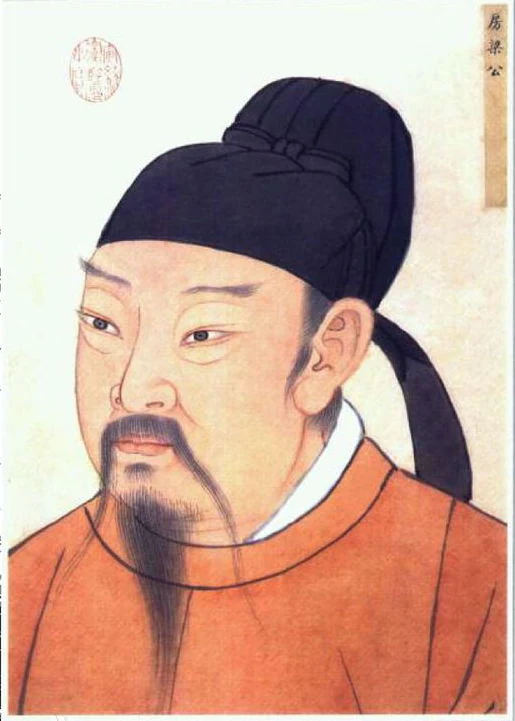
Biography
Family Background and Early Years
Fang Xuanling came from an official family with a strong scholarly tradition. His great-grandfather Fang Yi, a grandson of Fang Fashou, served in Northern Wei as General Who Guards Afar and administrator of Song'an Commandery, and inherited the title Earl of Zhuangwu. His grandfather Fang Xiong, courtesy name Ziyi, served as a prefectural secretary. His father Fang Yanqian was devoted to learning, had mastered the *Five Classics*, and served under the Sui as magistrate of Jingyang County and Inspector of the Capital Region; he has a biography in the *Book of Sui*. This family background gave Fang Xuanling a strong education from childhood, while his natural intelligence made his talent evident at an early age.
In 595, the 15th year of the Kaihuang era, Fang Xuanling was eighteen. He was recommended locally as a jinshi and appointed Feathered Cavalry Commandant. Gao Gou, then Vice Minister of Personnel, had evaluated many men but considered none comparable to Fang and predicted that Fang would achieve extraordinary distinction, lamenting only that he himself would not live to see it. Fang was soon appointed magistrate of Xicheng County. As the Sui descended into disorder and rival powers arose, he judged that the dynasty’s fortunes were exhausted and resolved to seek a worthy ruler.
Joining a Ruler in an Age of Disorder and Service in the Prince of Qin’s Establishment
In 617, the 13th year of Daye under the Sui, Li Yuan and his sons rose against the dynasty. Fang Xuanling joined Prince of Qin Li Shimin in the Weibei region. Thereafter he became one of the prince’s key strategists, advising Li Shimin and managing documentary affairs. In the following years, Fang accompanied the prince on campaigns across north and south, including the major operations that defeated Xue Rengao, Liu Wuzhou, Dou Jiande, and Wang Shichong, and made important contributions to Tang unification.
During his service in the Prince of Qin’s establishment, Fang displayed not only military strategic ability but also notable political foresight. Recognizing Li Shimin’s great ambitions and willingness to recruit talented men, he served him wholeheartedly. Whenever a territory was taken, others competed to collect valuables, while Fang instead sought out talented people, recommending local strategists and commanders to Li Shimin and thereby helping build the prince’s pool of capable followers.
The Xuanwu Gate Incident and a Leading Grand Councilor of Zhenguan
In 626, the ninth year of Wude, conflict between Crown Prince Li Jiancheng and Prince of Qin Li Shimin intensified. Fang Xuanling and Du Ruhui strongly urged Li Shimin to act first and participated actively in planning the Xuanwu Gate Incident. On the fourth day of the sixth lunar month, Li Shimin launched the coup at Xuanwu Gate and killed Crown Prince Li Jiancheng and Prince of Qi Li Yuanji. Afterward Fang, Du Ruhui, Zhangsun Wuji, Yuchi Jingde, and Hou Junji were jointly ranked first in merit.
After Li Shimin became Emperor Taizong of Tang, Fang Xuanling served as Secretariat Director. In the second lunar month of 629, the third year of Zhenguan, he became Left Vice Director of the Department of State Affairs and oversaw state administration. In 637, the 11th year of Zhenguan, he was enfeoffed as Duke of Liang. In the seventh lunar month of 642, the 16th year of Zhenguan, he was promoted to Minister of Works while continuing to manage court affairs. During more than twenty years as a Grand Councilor, Fang worked conscientiously and fulfilled his duties with care, making major contributions to the political, economic, and cultural development of the early Tang and to the creation of the “Zhenguan era of good government.”
Later Years and Posthumous Events
On the guimao day, the 24th day of the seventh lunar month in the 22nd year of Zhenguan (August 18, 648), Fang Xuanling died of illness. He received the posthumous name Wenzhao and was posthumously granted the office of Grand Commandant. His posthumous fortunes, however, were unsettled. In 652, the third year of Yonghui under Emperor Gaozong of Tang, his second son Fang Yi'ai and Princess Gaoyang were accused of rebellion. Fang Yi'ai was executed, the princess was ordered to commit suicide, and their sons were exiled to Lingnan. Fang Xuanling’s heir Fang Yizhi was also implicated and demoted to county commandant of Tongling. Fang Xuanling’s privilege of being enshrined in the imperial ancestral temple was consequently revoked.
Family and Entry into the Qin Princely Household
Fang Xuanling, whose given name was Qiao and whose courtesy name was Xuanling, was a native of Linzi in Qizhou and came of the Fang clan of Qinghe; his father was Fang Yanqian, magistrate of Jingyang under the Sui. Clever from childhood, he read widely in the classics and histories, was skilled in cursive and clerical script and good at composition. At eighteen he passed the examination as a presented scholar and was made a cavalry commandant, collating books in the secretariat. The vice minister of personnel Gao Xiaoji, who was a good judge of men, saw him and thought him remarkable, saying that he had read many men but had never seen one like this youth, who must become a great vessel. When disorder rose at the end of Sui, Fang Xuanling entered the service of Li Shimin, becoming clerk of the household of the Prince of Qin and taking part in all counsels, great and small.
From Army Secretariat to Chancellor
For more than ten years in the household of the Prince of Qin Fang Xuanling held the office of secretary, and whenever there was a military dispatch or a memorial he would finish it standing by his horse, spare in words and rich in sense. Emperor Gaozu of Tang, Li Yuan, admired him greatly and told his attendants that this man understood the essentials deeply and could well be entrusted with heavy charge, and that whenever he spoke for the Prince of Qin he understood men's minds, so that a thousand li away was like speaking face to face. At the change at the Xuanwu Gate Fang Xuanling took part with Zhangsun Wuji and Du Ruhui. When Li Shimin took the throne he was created Duke of Liang and served successively as director of the secretariat, left vice director of the department of state affairs and minister of works, presiding over all the bureaus and holding the government for twenty years. He died in the twenty-second year of Zhenguan, 648; at the end Taizong came to his sickbed, took his hand in farewell and at once granted his son Fang Yiai the title of imperial son-in-law. His portrait was later placed in the Lingyan Pavilion, among the twenty-four founding meritorious ministers.
Family and Entry into Tang Service
Fang Xuanling's ancestral home was in Qizhou of that time, and his father Fang Yanqian was magistrate of Jingyang and a scholar of note, posthumously made commander of Xuzhou and Duke of Linzi with the posthumous name Ding; his great-grandfather Fang Yi had been general of distant defence under the Northern Wei and governor of Song'an commandery, holding the title of Baron of Zhuangwu. Fang Xuanling was clever from childhood, good at poetry and prose, widely read in the classics and histories, versed in the Confucian canon, and learned from his father a fine hand at calligraphy, being skilled in cursive and clerical script. At eighteen he was recommended by Qizhou as a presented scholar and was given successive offices including cavalry commandant. At the end of the Sui, when the realm fell into disorder and the Duke of Tang, Li Yuan, held Jinyang and led his troops into the passes, Fang Xuanling went over to Li Shimin north of the Wei river and was made clerk of the household of the Prince of Qin, recommending men of talent during the campaigns and taking part in plans as keeper of the records.
Ten Years in the Princely Household and the Xuanwu Gate
For more than ten years in Li Shimin's household Fang Xuanling managed the great matters of war and was charged with the household's dispatches; the papers of the household were finished at his horse's side, spare in words and complete in sense, with no draft needed. To repay Li Shimin's recognition he spent himself in planning military and civil affairs, and he drew in men of talent: seeing Du Ruhui to be spirited and resourceful, he recommended him to Li Shimin, who made him a chariot and cavalry general of the household of the Prince of Qin and entrusted him as a heart and backbone; and others of quick mind, such as Zhang Liang, were all brought to Li Shimin's use after Fang Xuanling recommended them and afterwards rose to the highest offices. In the planning of the change at the Xuanwu Gate Fang Xuanling took part, helping Li Shimin to win the throne, and Li Shimin praised him for planning within the tent and settling the altars of the state; when merit was rewarded, Fang Xuanling and four others were placed in the first rank, and for his merit he was advanced to be Duke of Xing.
The Chancellorship and the Fate of His House
In the second month of the third year of Zhenguan, 629, Fang Xuanling was transferred to be Duke of Wei; after Li Shimin took the throne he was created Duke of Liang and held the offices of director of the secretariat, left vice director of the department of state affairs and minister of works, presiding over all the bureaus and holding the government for twenty years, during which he was also charged to remain in the capital and manage all business. In the ninth year of Zhenguan, 635, he had charge of the rules for the burial of Emperor Gaozu and was advanced for his merit. In the eighteenth year of Zhenguan, 644, when Li Shimin went in person against Liaodong, Fang Xuanling remained in the capital. On the twenty-fourth day of the seventh month of the twenty-second year of Zhenguan, 648, Fang Xuanling died at the age of seventy; Li Shimin suspended court for three days and granted him posthumous honours, and in his lifetime he had been able to see his two sons rise to eminence. His wife was of the Lu family; when he was still poor and fell ill, she put out one of her own eyes to show her constancy, and when he was made Duke of Liang she became by custom Lady of Liang. In the third year of Yonghui, 652, his second son Fang Yiai and his wife Princess Gaoyang were accused of treason; Fang Yiai was put to death, the princess ordered to take her own life, his sons banished to Lingnan, and his heir Fang Yizhi degraded to commoner, and the sacrifices of Fang Xuanling in the imperial temple were therefore stopped.