Birth into Nobility
Born in Tiao County, Bohai, to Gao Mai, Prince of Le'an in Northern Qi.
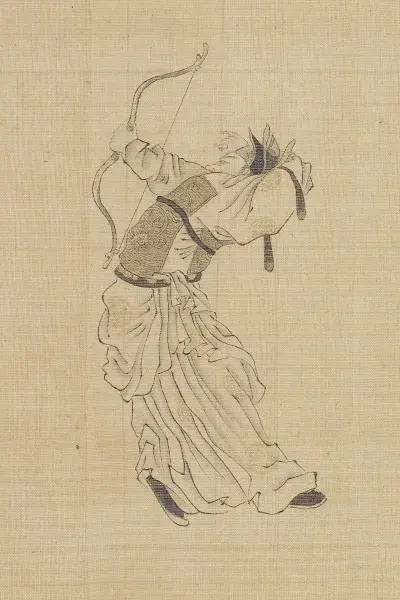
576 CE–647 CE
高士廉
Gao Shilian (高士廉, 576–647), born Gao Jian with the courtesy name Shilian, was a native of Tiao County in Bohai Commandery and a prominent statesman of the early Tang Dynasty. He was ranked sixth among the Twenty-four Meritorious Officials of Lingyan Pavilion and was the maternal uncle of Empress Wende and the senior statesman Zhangsun Wuji. Born into the eminent Bohai Gao clan of Northern dynasties nobility, he displayed…
Gao Shilian (高士廉, 576–647), born Gao Jian with the courtesy name Shilian, was a native of Tiao County in Bohai Commandery and a prominent statesman of the early Tang Dynasty. He was ranked sixth among the Twenty-four Meritorious Officials of Lingyan Pavilion and was the maternal uncle of Empress Wende and the senior statesman Zhangsun Wuji. Born into the eminent Bohai Gao clan of Northern dynasties nobility, he displayed profound learning and early discernment, initially living in reclusion at Mount Zhongnan before serving as Master of Ceremonial in the Sui Dynasty. Following the death of his brother-in-law Zhangsun Sheng, he provided shelter to his sister and her children, and arranged the marriage of his niece to Li Shimin, forging a pivotal alliance. Exiled to Jiaozhi during the late Sui era due to political connections, Gao assisted the local commandery in pacifying uprisings and later facilitated the submission of the southern regions to the newly established Tang regime. During the critical succession conflict in 626, he participated in the covert planning of the Xuanwu Gate Incident, personally opening prison armories to mobilize forces and secure Fanglin Gate. Under Emperor Taizong's reign, he governed the Shu region with distinction, developing vital irrigation works through the Gao Public Canal and revitalizing Confucian schooling. He subsequently spearheaded the compilation of the hundred-volume Treatise on Clans, redefining political hierarchy based on administrative merit and military contributions rather than entrenched hereditary pedigree.
Born in Tiao County, Bohai, to Gao Mai, Prince of Le'an in Northern Qi.
Retreated to the foot of Mount Zhongnan to avoid imperial scrutiny of Northern Qi royalty.
Recommended by Xue Daoheng and appointed Master of Ceremonial in the court of Emperor Yang.
Sheltered his widowed sister and young nephews, arranging the betrothal of his niece to Li Shimin.
Implicated in Husi Zheng's defection and demoted to Clerk of Zhuyuan County in Jiaozhi.
Served as Military Marshal and defeated the tribal assault led by Ning Changzhen.
Journeyed to Chang'an alongside Qiu He to submit southern territories, appointed Attendant Officer of Yong Prefecture.
Coordinated palace coup strategy, mobilized armed levies to guard Fanglin Gate, and became Right Mentor to the Crown Prince.
Elevated to Minister of State and Duke of Yixing, later reassigned to Regional Commander of Anzhou.
Appointed Senior Administrator of Yizhou, constructing the Gao Public Canal and fostering regional scholarship.
Appointed Right Vice Director of the Department of State Affairs and Duke of Shen, overseeing the completion of the Treatise on Clans.
Appointed Grand Tutor of the Heir Apparent to administer state affairs at Dingzhou during Taizong's expedition.
Passed away at his residence in Chang'an at the age of seventy-two, granted burial at Zhao Mausoleum.
Gao Shilian was born into the prestigious Bohai Gao clan in 576. His father, Gao Mai, had served as Prince of Le'an and Left Vice Director of the Department of State Affairs during the Northern Qi Dynasty, subsequently holding provincial governorships under the Sui Dynasty. From early youth, Shilian cultivated extensive erudition across classical and historical works, displaying remarkable restraint and composure. Senior dignitaries including Xue Daoheng and Cui Zujun admired his exceptional talents and formed intimate friendships with him despite age differences, earning him wide esteem among imperial elites.
Recognizing that his kinship with the former Northern Qi imperial house might invite suspicion amid the political purges of the Sui founding, Gao Shilian deliberately withdrew from metropolitan society. He relocated to the foot of Mount Zhongnan, shutting his doors to prominent visitors and dedicating himself to scholarly contemplation for over a decade while closely observing political developments across the empire.
In 605, following the accession of Emperor Yang of Sui, eminent ministers recommended Gao Shilian's governance capabilities to the throne, leading to his appointment as Master of Ceremonial in charge of state rituals. In 609, his brother-in-law Zhangsun Sheng, General of the Right Valiant Guard, passed away. Zhangsun Sheng's elder son by a former marriage expelled his stepmother and her young children from the household.
Upon learning of their distress, Gao Shilian immediately welcomed his sister and her young children, Zhangsun Wuji and the future Empress Wende, into his home, raising them with profound affection and care. During this period, he encountered Li Shimin, the second son of Li Yuan, Duke of Tang. Discerning extraordinary leadership qualities and imperial promise in the young nobleman, Gao arranged the marriage between his thirteen-year-old niece and Li Shimin, cementing an enduring familial alliance that would shape the destiny of the Tang dynasty.
In 613, during Emperor Yang's military campaigns against Goguryeo, Minister of War Husi Zheng fled to the hostile state after his clandestine contacts were discovered. Because of his prior social association with Husi Zheng, Gao Shilian was implicated and demoted to Clerk of Zhuyuan County in remote Jiaozhi. Renowned for filial piety, he recognized that his elderly mother could not survive the perilous journey through tropical terrain infested with pestilence, so he entrusted his wife, Lady Xianyu, with the care of his mother in the north.
To ensure his sister and her children remained properly housed, he sold his expansive family residence in the capital to purchase a modest dwelling for them, distributing the remaining funds equally between his mother and sister before departing alone for the southern border. In Jiaozhi, as imperial communications collapsed with the disintegration of the Sui dynasty, Governor Qiu He engaged Gao as Judicial Clerk to assist in local administration.
In 618, Ning Changzhen, an influential chieftain from Qinzhou, led tens of thousands of tribal warriors to besiege the regional center of Jiaozhi. While Qiu He contemplated surrender, Gao Shilian persuaded him to mount a defense, demonstrating that the besiegers had ventured far from home without reliable logistical support and could easily be disrupted. Commissioned as Military Marshal, Gao directed a coordinated amphibious counterattack that completely routed the rebel forces, securing regional peace across the southern coast.
Following the fall of Sui, Qiu He and Gao Shilian temporarily affiliated with the southern regional regime of Xiao Xian to safeguard their population. In 621, while en route to Jiangling to attend Xiao Xian's court, Gao learned that Tang commander Li Xiaogong had crushed the rebel monarch, and he advised an immediate submission to Tang authority. In 622, Gao Shilian accompanied Qiu He in submitting formal pledges of allegiance to Emperor Gaozu, bringing the southern territories under imperial control.
Upon entering Chang'an, Gao Shilian was appointed Attendant Officer of Yong Prefecture. At the time, Li Shimin held concurrent command over Yong Prefecture. Given Gao's prestige and kinship as the uncle of Princess Consort Zhangsun, Li Shimin relied heavily on his strategic counsel. When rivalry between Li Shimin and Crown Prince Li Jiancheng escalated into an existential confrontation, Gao Shilian joined core advisors in formulating preemptive maneuvers.
On the dawn of July 4, 626, the Xuanwu Gate Incident commenced. Gao Shilian took charge of an audacious assignment: he proceeded directly to the metropolitan prisons, released the inmates, distributed armor and armaments, and mobilized them into a combat detachment. Leading this force to Fanglin Gate, he established defensive positions that sealed off potential counterattacks by Eastern Palace partisans, consolidating Li Shimin's ultimate triumph. Upon Li Shimin's elevation to Crown Prince, Gao was appointed Right Mentor to the Crown Prince.
In 627, Emperor Taizong ascended the throne and elevated Gao Shilian to Minister of State, conferring the title of Commandery Duke of Yixing. Later that year, when Vice Director Wang Gui submitted a confidential memorial for delivery to the emperor, Gao detained the document out of political caution, which led to a temporary demotion as Commander of Anzhou. Recognizing his administrative talents, Emperor Taizong reassigned him in 631 to serve as Senior Administrator of the Superior Area Command of Yizhou.
The Sichuan basin possessed fertile soil but suffered from uncontrolled inundations along the Min River drainage. Gao Shilian inspected regional topography and organized labor levies to construct the Gao Public Canal, diverting waters from the Wen River to irrigate thousands of acres of farmland. Concurrently, he addressed entrenched superstitious customs by renovating official academies, personally lecturing on classical texts such as the Analects and Classic of Filial Piety, thereby cultivating a vibrant scholarly atmosphere across southwestern China.
Recalled to the capital in 635, Gao Shilian served as Minister of Personnel and was ennobled as Duke of Xu. In 638, following the formal recognition of dynastic founders, his title was revised to Duke of Shen, and he was appointed Right Vice Director of the Department of State Affairs concurrently supervising the selection of court officials. In this capacity, he maintained fairness and probity, earning universal acclaim across the bureaucracy.
During this era, ancient aristocratic lineages from the eastern provinces continued to flaunt ancestral pedigrees, looking down upon newer dynastic officials and demanding extravagant betrothal gifts despite centuries of genealogical decline. Determined to dismantle entrenched lineage privileges, Emperor Taizong commissioned Gao Shilian to direct a comprehensive genealogical reform alongside Wei Ting, Cen Wenben, and Linghu Defen.
Gao Shilian and his committee examined genealogical registers nationwide, evaluating historical records and instituting objective criteria centered on moral integrity, contemporary administrative rank, and military achievement. The resulting hundred-volume compilation, the Treatise on Clans, established a new merit-based status hierarchy that displaced entrenched regional clans and reinforced imperial authority. For this accomplishment, Gao received the honorary designation of Commander Unequalled in Honor.
In 643, Emperor Taizong established the Hall of Lingyan, displaying the portraits of twenty-four founding ministers, with Gao Shilian commemorated in the sixth position. When advanced age prompted Gao to request retirement, the emperor relieved him of daily departmental administration while retaining him as an elder advisor to deliberate on vital state matters.
In 645, during Emperor Taizong's personal campaign against Goguryeo, Crown Prince Li Zhi was appointed regent to supervise national affairs from Dingzhou. Gao Shilian was named Grand Tutor of the Heir Apparent, managing state business and providing guidance to the young prince. Returning to the capital in 646, Gao fell gravely ill. Emperor Taizong visited his private residence, where the sovereign and his veteran minister shared emotional reminiscences of their shared struggles.
In February 647, Gao Shilian passed away in Chang'an at the age of seventy-two. Deeply grieved, Emperor Taizong attempted to attend the mourning rites in person, but was dissuaded by senior chancellor Fang Xuanling and Zhangsun Wuji out of concern for the monarch's health. The court posthumously bestowed the offices of Minister of Education and Area Commander of Bingzhou, alongside the posthumous title Wenxian, and granted him burial at Zhao Mausoleum. Upon his accession, Emperor Gaozong posthumously elevated him to Grand Commandant and accorded him sacrifice in the imperial ancestral temple.
FIGURES ASSOCIATED WITH THIS DYNASTY