Birth
Born into a peasant farming household in Zhangnan, Beizhou
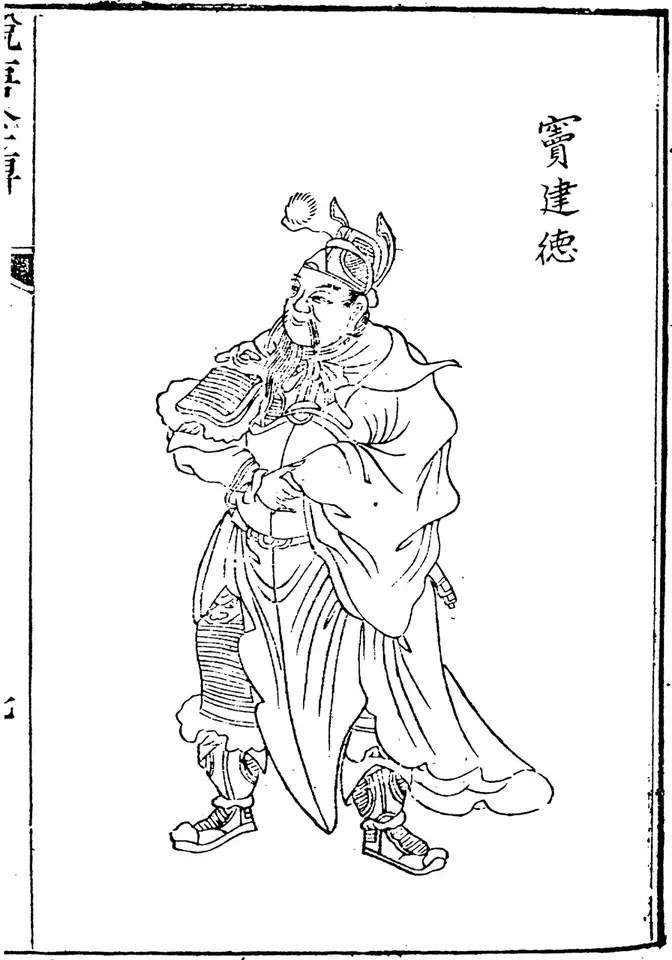
573 CE–621 CE
窦建德
Dou Jiande (窦建德, 573–621) was the supreme insurgent warlord, monarch, and King of Xia (Xia Wang) in northern China during the turbulent Sui-Tang transition. A native of Zhangnan in modern Hebei, he arose from an agrarian peasant lineage, serving in his youth as a local village head (Lizhang) and earning legendary renown throughout Hebei for his chivalry, physical generosity, and integrity. In 611, as Emperor Yang of Sui's…
Dou Jiande (窦建德, 573–621) was the supreme insurgent warlord, monarch, and King of Xia (Xia Wang) in northern China during the turbulent Sui-Tang transition. A native of Zhangnan in modern Hebei, he arose from an agrarian peasant lineage, serving in his youth as a local village head (Lizhang) and earning legendary renown throughout Hebei for his chivalry, physical generosity, and integrity. In 611, as Emperor Yang of Sui's disastrous Goguryeo campaigns sparked widespread peasant uprisings, Dou Jiande was forced into outlawry after Sui authorities slaughtered his family. Taking refuge in the reed marshes of Mount Gaoxi, he joined the insurgent chieftain Gao Shida. Following Gao's death in battle, Dou Jiande assumed supreme command, rapidly consolidating peasant bands across the Central Plains. Demonstrating exceptional operational talent, he annihilated the elite Sui army of Xue Shixiong at the Battle of Qitai in 617, and later destroyed the usurpation army of Yuwen Huaji in 619, avenging the murdered Emperor Yang. Establishing the independent Kingdom of Xia with its capital at Mingzhou (modern Handan), Dou Jiande established a humane, benevolent administration: he lived in Spartan simplicity, consumed only coarse vegetables, freed surrendered soldiers, and patronized Confucian scholars and former Sui officials. In 621, when the rival warlord Wang Shichong was desperately besieged in Luoyang by the Tang prince Li Shimin (future Emperor Taizong), Dou Jiande mobilized an army of over one hundred thousand troops to relieve the city. At the decisive Battle of Hulao Pass, Li Shimin launched an audacious cavalry envelopment, routing the Xia host and capturing Dou Jiande alive. Transported in chains to Chang'an, Dou Jiande was executed by Emperor Gaozu of Tang (Li Yuan) in July 621 at the age of forty-nine. His death incited widespread sorrow across Hebei, sparking the immediate ferocious insurrection of his veteran general Liu Heita.
Born into a peasant farming household in Zhangnan, Beizhou
Recruited for Goguryeo campaign; his family was massacred by Sui magistrates; fled to Gaoxi
Joined Gao Shida's rebel force in the grand marshes of Hebei
Gao Shida fell in battle; Dou Jiande assumed command of the Hebei rebel confederacy
Obliterated Xue Shixiong's 30,000-strong elite Sui garrison army at Mount Qitai
Declared himself King of Xia at Leyou, adopting the reign era Wude
Captured Liaocheng and executed the usurper Yuwen Huaji, recovering imperial seals
Attacked Xiangzhou and Liyang, capturing Princess Tong'an, Li Shentong, and Xu Shiji
Captured Mingzhou, establishing his capital; subjugated eastern Hebei and Henan
Released Princess Tong'an and Li Shentong to the Tang court after Xu Shiji's flight
Attacked Youzhou without success; executed meritorious general Wang Fubao and advisor Song Zhengben
Led 100,000 Xia troops south to relieve Wang Shichong, confronting Li Shimin at Hulao Pass
Decisively defeated by Li Shimin's elite heavy cavalry; captured while wounded
Beheaded in the Western Market of Chang'an at age forty-nine by order of Li Yuan
Dou Jiande claimed distant lineage from the Western Han imperial consort clan of Empress Dou, but by the late sixth century his family had lived as humble farmers in Beizhou for generations. Endowed with a towering physique, exceptional archery skill, and an open, noble temperament, Dou Jiande was revered throughout his home district.
When poor neighbors lacked funds to bury their parents, Dou Jiande would abandon his own farming to labor on their behalf and pay for their coffins. Appointed as a village head (Lizhang), he shielded impoverished tenant families from the crushing tax quotas and corvee conscriptions levied by Emperor Yang of Sui.
In 611, Emperor Yang mobilized millions of conscripts for his catastrophic first invasion of Goguryeo. A devastating flood engulfed the lower Yellow River basin, reducing millions to starvation. When local magistrates continued to seize rations at spearpoint, peasant uprisings erupted across Shandong and Hebei.
Sun Anzu, a fellow villager drafted for military transport, killed an imperial officer and fled. Dou Jiande sheltered Sun in the reed marshes of Mount Gaoxi, providing him with several hundred desperate peasants to raise rebellion.
Learning of this, the local Sui magistrate arrested Dou Jiande's entire household in Zhangnan, butchering his mother, wife, and children. Consumed by grief and rage, Dou Jiande gathered two hundred young villagers and rode into the marshes to join Gao Shida's uprising.
Champion of the Hebei Resistance
In 616, the Sui court dispatched the fierce veteran general Yang Yichen to suppress the Hebei rebels. Gao Shida underestimated the Sui host and was lured into an ambush and killed. Dou Jiande gathered the scattered survivors, buried Gao Shida with full honors, and withdrew into the coastal salt flats of Bohai.
In 617, Emperor Yang dispatched Grand General Xue Shixiong with thirty thousand elite troops from Zhuojun to exterminate Dou Jiande. Arriving at Mount Qitai, Xue Shixiong constructed fortified stockades.
On a night shrouded in dense fog and torrential thunderstorms, Dou Jiande led two hundred elite assault warriors to swim the swollen river, infiltrate the Sui encampment, and ignite the supply tents. Panic erupted, and Dou Jiande unleashed his entire rebel host. Xue Shixiong's thirty thousand troops collapsed into catastrophic rout, and Xue fled back to Zhuojun where he died of shame. The victory at Qitai established Dou Jiande as the undisputed hegemon of northern China.
In early 618, Dou Jiande established an independent dynastic regime at Leyou, proclaiming himself King of Xia (Xia Wang). In early 619, Yuwen Huaji—the guard general who had murdered Emperor Yang at Jiangdu—marched north into Hebei with an army of over one hundred thousand troops, laying siege to Liaocheng.
Dou Jiande marched his army to Liaocheng, encircled Yuwen Huaji's forces, and stormed the citadel. Capturing the usurper, Dou Jiande treated Emperor Yang's grieving empress, Empress Xiao, with sovereign reverence, wearing mourning clothes and weeping before the late emperor's portrait. He then publicly beheaded Yuwen Huaji and his conspirators, sending Emperor Yang's severed head to the Göktürks as a diplomatic gesture. This chivalric adherence to Confucian decorum won the hearts of traditional scholar-officials across northern China.
Unlike contemporary warlords such as Wang Shichong and Li Mi, whose courts were steeped in paranoia and bloody internal purges, Dou Jiande ruled with astonishing personal modesty and benevolence.
He lived in a simple thatched palace in Mingzhou, wore rough linen clothes, ate unpolished rice and boiled vegetables, and refused to keep concubines. His wife, Queen Cao, wore no silks or gold ornaments, spending her days spinning cloth alongside common women and attending to the wounded.
Dou Jiande established civil examination academies, enlisting distinguished scholars such as Kong Deda, Liu Bin, and Song Jingsi to codify equitable tax laws. When his armies captured Sui governors and generals—such as Li Daliang and Pei Ju—Dou Jiande never executed them; instead, he treated them as honored guests, granting them freedom to depart if they refused to serve him.
When peasant farmers across Hebei suffered famines, Dou Jiande opened state granaries, providing free grain and seeds without interest, turning the Kingdom of Xia into an oasis of stability amidst the inferno of the late Sui civil wars.
In late 620, the Tang prince Li Shimin encircled the eastern capital of Luoyang, trapping the warlord Wang Shichong within double siege walls. Facing imminent starvation, Wang Shichong dispatched urgent envoys to Mingzhou, pleading for Dou Jiande's intervention.
Dou Jiande's strategists, including Ling Jing and Queen Cao, strongly advised against marching directly into Henan. Ling Jing urged: "Tang has committed its entire military strength to besieging Luoyang. We should bypass Luoyang, cross the Yellow River into Shanxi, capture Taiyuan, and march directly upon the undefended Tang capital of Chang'an. Tang will be forced to lift the siege of Luoyang to save their own homeland, giving us total victory without risk."
However, Wang Shichong's envoys heavily bribed Dou Jiande's frontline generals, who argued that abandoning Wang Shichong showed cowardice. Dou Jiande sighed: "Wang Shichong faces utter destruction; if I abandon him now, Tang will conquer him today and turn its wrath upon me tomorrow." In March 621, Dou Jiande led an immense host of one hundred thousand troops south to relieve Luoyang.
Arriving at the strategic gorge of Hulao Pass (Sishui), Dou Jiande found his path blocked by Li Shimin, who had occupied the fortified mountain redoubts with a modest force of elite cavalry. For over two months, Li Shimin refused general battle, exhausting the logistical supplies of the massive Xia host.
On May 28, 621, Li Shimin feigned weakness by driving his cavalry horses to graze along the Yellow River. Dou Jiande took the bait, deploying his entire army across twenty miles of flat terrain under the blazing midday sun.
Li Shimin waited until the Xia soldiers were dehydrated, famished, and breaking ranks to drink from the Sishui river. At that precise moment, Li Shimin led thirty-five hundred elite armored heavy cavalry (Xuanjia Jun) in a ferocious charge through the center of the Xia formations, planting Tang battle-flags behind the Xia line.
Panic swept the disorganized Xia troops. In the chaotic rout, over three thousand Xia soldiers were slain, fifty thousand surrendered, and Dou Jiande, suffering from lance wounds, was captured in the river reeds by Tang cavalrymen.
Li Shimin transported Dou Jiande to Luoyang, compelling Wang Shichong to surrender without condition. Dou Jiande was then taken in chains to Chang'an.
Emperor Gaozu of Tang (Li Yuan), fearing Dou Jiande's immense popularity among the population of Hebei, refused to pardon him. In July 621, Dou Jiande was summarily beheaded in the Western Market of Chang'an at the age of forty-nine.
The execution was viewed by the people of Hebei as a monstrous injustice. In late 621, Dou Jiande's former commanders, led by General Liu Heita, rose in an explosive rebellion that annihilated multiple Tang armies and took Li Shimin two full years of brutal warfare to suppress. For centuries after his death, the citizens of Hebei erected shrines and temples to worship Dou Jiande as the "Benevolent King of Xia" (Dou Xia Wang), remembering him as the noblest peasant champion of the medieval era.
FIGURES ASSOCIATED WITH THIS DYNASTY