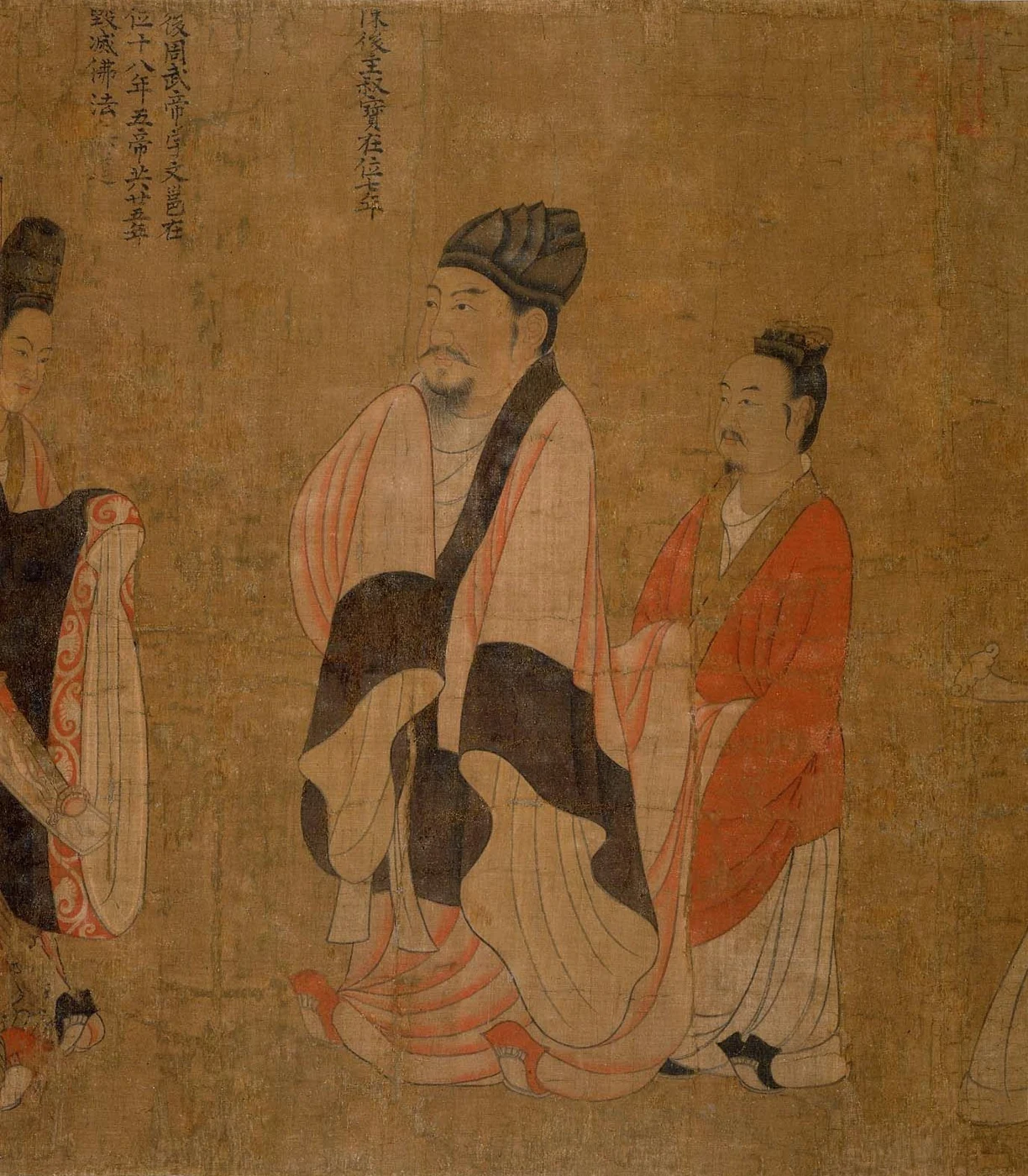
Biography
Family Background and Early Years
Chen Shubao was born on the wuyin day of the eleventh lunar month in the second year of the Chengsheng era of Liang, corresponding to 10 December 553, at Jiangling. His father, Chen Xu, was a nephew of Chen Baxian. At the time, Chen Baxian had already suppressed the Hou Jing Rebellion and held effective power in the Liang dynasty. Emperor Yuan of Liang, Xiao Yi, sought to restrain Chen Baxian by keeping members of his family at Jiangling; Chen Xu and his wives and concubines were among them.
In 554, the third year of the Chengsheng era, Western Wei invaded the south and captured Jiangling. Chen Xu was taken to Chang'an, while Chen Shubao, his mother Lady Liu, and his younger full brother Chen Shuling were held as hostages at Rangcheng, in present-day Deng County, Henan. They remained hostages for nearly ten years. In 557, the second year of the Taiping era, Chen Baxian replaced Liang and founded the Chen dynasty. After Emperor Wen of Chen, Chen Qian, came to the throne, he sent Zhou Hongzheng as an envoy to the northern court. In 562, the third year of the Tianjia era, Chen Xu and the others were allowed to return, and the ten-year-old Chen Shubao came south with his father.
After returning, Chen Xu was enfeoffed as Prince of Ancheng, making Chen Shubao his heir. Chen Shubao had grown up within the palace and had been separated from his father for much of his childhood, being raised largely by his mother Liu Jingyan. The Chinese source states that the absence of his father had a substantial influence on the formation of his later personality.
Crown Prince Period
In 566, the first year of the Tiankang era, the fourteen-year-old Chen Shubao was appointed General of Tranquil Might and assigned a Left Recorder, formally beginning his official career. In 567, the first year of the Guangda era, he became Palace Attendant to the Crown Prince and soon afterward was promoted to Attendant-in-Ordinary. In the first lunar month of 569, the first year of the Taijian era, he was made crown prince.
In the twelfth lunar month of 577, the ninth year of the Taijian era, the Eastern Palace was completed and Chen Shubao formally moved into the crown prince's residence. He studied Confucian classics such as the *Analects* and the *Classic of Filial Piety* under Zhou Hongzheng and personally participated on several occasions in ceremonial offerings at the Imperial Academy. He was particularly fond of literature and brought many writers into his household, frequently holding literary gatherings. The circle around him included Jiang Zong, Yao Cha, Gu Yewang, Chu Jie, Lu Yu, Xie Shen, and Chen Shuda, the Prince of Yiyang, among roughly thirty members.
Accession and Rule
In the first lunar month of 582, the fourteenth year of the Taijian era, Emperor Xuan of Chen, Chen Xu, became gravely ill. Crown Prince Chen Shubao, the Prince of Shixing Chen Shuling, and the Prince of Changsha Chen Shujian attended him. Chen Shuling secretly harbored ambitions for the throne and ordered an official responsible for preparing medicine to sharpen a knife. After Emperor Xuan died, Chen Shubao wept before the coffin. Chen Shuling seized the opportunity to strike him in the neck with the medicine knife. With the help of Empress Liu and his wet nurse Lady Wu, Chen Shubao escaped. He then ordered the general Xiao Mohe to attack Chen Shuling, who was defeated and killed.
After ascending the throne, Chen Shubao recovered from his neck wound in Chengxiang Hall and left affairs of state to the empress dowager, keeping only his favored consort Zhang Lihua with him. After he recovered, his favor toward Zhang increased further. Early in his reign he issued edicts seeking capable men, encouraging agriculture, and reducing taxes. In later years, however, he undertook extravagant construction. In front of Linguang Hall he built the Linchun, Jieqi, and Wangxian pavilions, each several tens of zhang high, made with aromatic hardwoods and lavishly decorated with gold, jade, pearls, and precious stones. Chen Shubao occupied the Linchun Pavilion, Noble Consort Zhang lived in Jieqi Pavilion, and the favored consorts Gong and Kong lived in Wangxian Pavilion. Elevated passageways connected the three structures.
Chen Shubao entrusted government to flattering officials such as Shi Wenqing and Kong Fan. In 583, the first year of the Zhide era, fearing the influence of the Prince of Changsha, Chen Shujian, he sent him away from the capital as governor of Jiang Province. Thereafter court government increasingly deteriorated. Chen Shubao spent days and nights at banquets with consorts and literary officials, composing ornate and sensual verse while neglecting political affairs.
Fall of the Dynasty and Capture
At the end of 588, the second year of the Zhenming era, Emperor Wen of Sui issued an edict enumerating twenty charges against the Later Ruler and distributed two hundred thousand copies beyond the Yangtze. He appointed the Prince of Jin Yang Guang, the Prince of Qin Yang Jun, and the Duke of Qinghe Yang Su as commanders of the expedition. Under them, generals including Han Qinhu and He Ruobi led a force said to number 510,000 in a multi-pronged attack on Chen. Chen Shubao remained secluded in his palace and paid little attention to events outside. Among his ministers, only Yuan Xian, then Left Director of the Department of State Affairs, urged armed resistance, but Chen Shubao refused. Kong Fan argued that “the Yangtze is a natural barrier that has served as a boundary since ancient times,” and the Later Ruler accepted the argument. Court officials continued drinking, listening to music, and writing poetry as before.
In the first lunar month of 589, the third year of the Zhenming era, Sui troops crossed the Yangtze from Guangling. He Ruobi seized Jingkou, while Han Qinhu captured Caishi, and the two armies closed on Jiankang from different directions. Although Jiankang still reportedly held one hundred thousand troops, Chen Shubao panicked and wept day and night. Xiao Mohe asked permission to fight, but was refused; Ren Zhong advised holding the city until relief arrived, but his advice was also rejected. As Sui forces pressed the attack, Chen Shubao hastily arranged the army in a long single-line formation. The Chen army collapsed. Han Qinhu led five hundred elite soldiers across the river at night from Hengjiang to Caishi and was the first to enter the Zhuque Gate. In panic, Chen Shubao ignored Yuan Xian's advice that he dress formally and sit in the main hall, following the precedent of Emperor Wu of Liang when confronted by Hou Jing. Saying only, “I have my own plan,” Chen Shubao hid with his favored consorts Zhang Lihua and Noble Consort Kong in a dry well in Jingyang Hall. Sui soldiers later captured them there.
Life under the Sui
After his capture, Sui commanders ordered Chen Shubao to write letters calling on Chen generals who had not yet surrendered to submit. Zhang Lihua and Noble Consort Kong were beheaded at the central bridge over Qingxi, while Shi Wenqing, Shen Keqing, and other condemned favorites were executed below the Right Gate Tower. The Chen dynasty came to an end, and Emperor Wen of Sui completed the political reunification of north and south, bringing nearly three centuries of division to a close.
Emperor Wen treated Chen Shubao generously, permitting him to attend court with the status of a third-rank official and often inviting him to banquets. Fearing that music from the south might distress him, the emperor initially avoided having it played. Chen Shubao, however, showed little sense of grief over the loss of his state. His guards reported that he was “utterly without heart” and that he frequently drank himself into intoxication. Emperor Wen first ordered him to reduce his drinking, then later said, “Let him drink as he pleases. Otherwise, how is he to pass his days?” Chen Shubao once accompanied Emperor Wen on an eastern tour to Mangshan and composed a poem at a banquet: “Sun and moon illuminate Heaven's virtue; mountains and rivers magnify the imperial abode. I have no way to repay the great peace; I wish only to submit a memorial for the eastern feng sacrifice.” Emperor Wen rejected the proposal.
Emperor Wen later commented that Chen Shubao's failures were all connected to drinking. If he had devoted the time spent drinking and composing poetry to affairs of state, the emperor argued, he would not have fallen so far. He recalled that when He Ruobi attacked Jingkou, frontier reports arrived while Chen Shubao was drinking and went unread, and that when Gao Jiong entered the Chen palace he found unopened emergency memorials lying beneath a bed. Emperor Wen described this conduct as foolish to an extreme.
On the renzi day of the eleventh lunar month in 604, the fourth year of the Renshou era, corresponding to 16 December, Chen Shubao died of illness at Luoyang at the age of fifty-two. He was posthumously granted the rank of Grand General and the title Duke of Changcheng County and was given the posthumous name “Yang.” He was buried at Fengtai Village in Fengtai Township on Mangshan, in the area of present-day Fenghuangtai Village, Songzhuang Town, Mengjin County, Luoyang, Henan.
The Affair of Chen Shuling and the Arrangements of Power at the Accession
In the first month of 582, when Emperor Xuan, Chen Xu, fell gravely ill, the heir Chen Shubao and the princes of Shixing and Changsha, Chen Shuling and Chen Shujian, all attended him. Chen Shuling secretly harboured other designs and told the officer in charge of decocting medicines that the knife for cutting drugs was very blunt and might be whetted, so that he had it sharpened for a stabbing. When the emperor died, in the confusion Chen Shuling ordered his attendants to fetch a sword from outside; they did not take his meaning and brought the wooden sword of court dress, at which he was furious; and the prince of Changsha, Chen Shujian, hearing his words from beside him and fearing a turn, watched what he would do. The heir, weeping before the coffin, was struck at by Chen Shuling with the drug-cutting knife, which took him in the neck so that he fell senseless; his mother the empress Liu ran to save him and was struck several times herself, and the wet nurse lady Wu seized Chen Shuling's elbow from behind so that the heir could rise, and Chen Shuling caught hold of his clothing, from which he wrenched himself free. As all the troops were then guarding the river and the court was empty, Chen Shujian told the empress Liu, and through the heir's household officer Sima Shen had the heir's order summon the right guard general Xiao Mohe to an audience and receive his commission; and he led several hundred horse and foot to the eastern mansion and camped at the western gate of the city. Chen Shuling, in alarm, sent his clerk Wei Liang with his own band of drums and pipes to Xiao Mohe, saying that if the matter succeeded he would make him the tripod of state; and Xiao Mohe answered falsely that he would obey only when the prince's own trusted officers came in person, whereupon Chen Shuling sent his favourites Dai Wen and Tan Qi to him, and Xiao Mohe seized them and sent them to the court, where their heads were cut off and carried about the eastern city. Chen Shuling, knowing he could not succeed, went in and drowned his consort lady Zhang and seven favourite concubines in a well, and with several hundred horse and foot crossed by the small bridge meaning to reach Xinlin and take ship for Sui; but at the Baiyang road he was intercepted by the court troops, most of his men threw off their armour and scattered, and Xiao Mohe's groom Chen Zhishen ran him through so that he fell, and Chen Zhonghua came up and cut off his head, the matter being settled between the hours of yin and si; and Chen Shuling's sons were all ordered to die. Afterwards the prince of Changsha, Chen Shujian, was made general of the flying cavalry, with the ceremonial of the three offices and governor of Yangzhou, Xiao Mohe general of the chariots and cavalry, governor of Xuzhou and duke of Suiyuan, and the whole of the Shixing prince's gold and silk, amounting to vast sums, was given them, Sima Shen being made secretariat reception officer; and the empress was honoured as empress dowager. Chen Shubao, then lying wounded in the Chengxiang hall and unable to hear business, the empress dowager dwelt in the Bailiang hall, and all the business of the hundred offices was decided by her until his wound healed and she returned the government to him.
His Early Edicts Seeking Talent and Remonstrance, and His Frequent Amnesties
At the beginning of his reign Chen Shubao in fact wished to accomplish something and was comparatively diligent and considerate of the people, as his edicts, most of them preserved in the annals of the Chen Shu, show. On the very day of his accession in the first month of 582 he issued an edict speaking of spreading abroad the virtue of the departed and of renewing all things together, intending with the aid of his ministers to extend the former king's virtue to all the people and to carry out reform, and in a humble tone saying that he relied on all the dukes to correct his insufficiency; and such a posture appears from time to time in later edicts, as in the first month of 583, where he says that he has little method in instructing the people and no reckoning in governing them, and fears as if treading on ice and trembles as if driving a worn-out team. In the third month of the same year he issued an edict seeking men able to govern, and then one accepting remonstrance, saying even that if a man would remonstrate at court he should not fear to stroke the dragon's scales backwards — that is, that he would accept even words that crossed the sovereign; and a like edict came again in 586, calling on all from the princes down to recommend men they knew, to inquire even among the storekeepers and down to the meanest servants, since a single capable man or a single usable word he would himself hear and read, waiting for what might be poured in to him. That is, he would not only hear the proposals of princes and officials but inquire for remonstrance even of men who kept the granaries and of the lowest clerks. In the third month of the same year he also issued an edict remitting taxes and encouraging farming, and in the tenth month of 584 one remitting the assessed rent and corvee. In seven years on the throne he proclaimed a general amnesty ten times, and though an amnesty at an accession is an old rule, so frequent a use of it was unusual. He may be said to have understood some principles of government; but to understand principles is not enough, since the crux is to carry decisions through by strong means — and here lay his weakness.
The Three Pavilions, the Inner Palace, and Zhang Lihua's Part in Government
The inner court of Chen had been plain since Chen Baxian founded the state, and Chen Shubao, thinking his quarters too simple, raised before the Lingguang hall the three pavilions Linchun, Jieqi and Wangxian: tens of fathoms high and extending over scores of bays, exhausting the marvels of building and the utmost of craft, with windows, walls and railings all of sandalwood inlaid with gold, jade and pearls, pearl hangings at the doors and jewelled beds and curtains within; below them stones were piled into hills and water led into pools, planted with rare trees and famous flowers, and "when a light wind passed, the scent was smelled for tens of li." He himself dwelt in Linchun, the noble consort Zhang in Jieqi and the two consorts Gong and Kong in Wangxian, the three joined by covered ways; and there were besides two beauties Wang and Ji, two refined ladies Zhang and Xue, and the consorts Yuan, He and Jiang, seven in all, favoured for talent and beauty and summoned by turns. Zhang Lihua had hair seven feet long, black and glossy as lacquer and bright enough to mirror a face; and she was clever, ready of speech, skilled at reading faces and of excellent memory: when the memorials of the hundred officials had first been handled by the eunuchs Cai Tuo'er and Li Shandu and sent in, so that sometimes even the two forgot their contents, Zhang Lihua could answer each item with nothing omitted. At first she managed only inner matters, and afterwards began to take part in outer government, until in affairs of state it came to "setting the noble consort Zhang on his knee and deciding them together"; and when members of the palace households broke the law, if they begged her they were always excused, while princes and ministers who would not follow the inner will were dismissed on a single word from her. Kong Fan was skilled at glossing over the emperor's faults and once told him that the generals outside had risen from the ranks and were worth no more than a single common man apiece, and that no far-sighted views were to be looked for from them, after which officers with troops lost their commands at the smallest fault while clerks of the brush gained power, so that frontier defence grew looser and looser, and officers and people alike fell away in mind. There were then ten "familiar guests" at court, with Gu Zong at their head and Kong Fan next.
The Degradation of Mao Xi, the Acquittal of Chen Shujian, and the Sui Army on the River
In the second month of 583, rejoicing that his wound had healed, Chen Shubao set wine in the rear hall and had the president of the civil office, Jiang Zong, and those below him perform music and make poems, and being drunk called on Mao Xi to compose. As it was then not a year since Emperor Xuan's burial, Mao Xi was displeased at the sight and would have remonstrated, but the emperor was already drunk; so he mounted the steps, pretended a seizure of the heart and fell at the foot of the steps, and was carried out of the palace. The emperor, sobering, suspected the matter and told Jiang Zong that he repented having summoned Mao Xi, who was not in fact ill but only wished to stop his revels, which he did not approve; and he took counsel with Sima Shen to let the Poyang brothers take their revenge, whereupon the secretariat reception officer Fu Zai objected that if revenge were permitted, where would the late emperor be placed; and the emperor made Mao Xi governor of Yongjia instead. In the twelfth month of the same year the prince of Changsha, Chen Shujian, uneasy at heart after being sent out of the capital, turned to sorceries and sacrificed to the sun and moon for blessing; and when this was reported the emperor summoned him and shut him in the western province, meaning to kill him, and had an attendant read out his crimes, to which Chen Shujian answered that his own intent had been nothing else but to seek the emperor's favour, that having offended the heavenly law he deserved ten thousand deaths, and that when he died he would surely see Chen Shuling and begged that an edict might be proclaimed so that he could reproach him in the underworld; and the emperor pardoned him, only removing him from office. At the end of 588 Emperor Wen of Sui issued an edict setting out twenty great crimes of the Chen sovereign, written out on two hundred thousand sheets of paper and circulated beyond the river; and when someone advised that a military move should be kept secret and need not be so advertised, the emperor answered that if the man feared and reformed, what more could he want, and that he would carry out the punishment of Heaven openly and had no need of secrecy. Ships of war were then built and the prince of Jin, Yang Guang, and others were ordered with five hundred and ten thousand men to march by several roads straight on Jiangnan. The frontier commanderies sent the news of the Sui invasion flying to court, but those above and below took no notice, and only a few asked to send troops to resist, whom the sovereign would not hear; and when the Sui army drove deep and the commanderies sent one alarm after another, Chen Shubao still had music played and wine pressed on him and never stopped making poems, laughing to his attendants that the Qi had come three times and the Zhou twice, and had always been broken and gone, and asking what these men were. Kong Fan chimed in that the Yangtze was a natural moat, held since antiquity as the limit dividing north and south, and that the Sui army of today could hardly fly across.
The Fall of Jiankang, the Well at Jingyang Hall, and His Remaining Years under Sui
In the first month of 589 the Sui troops crossed the Yangtze from Guangling. He Ruobi used the stratagem of deceiving the enemy: buying Chen's warships with horses and hiding them, and buying fifty or sixty worn-out boats to lay in the creeks of the river, so as to give the false impression that Sui had no fleet; and having the river garrisons, when they changed over, mass at Guangling with much display, so that the Chen troops, thinking an attack was coming, made hasty preparations, while the Sui shot not a single arrow and went away, until in time the Chen troops knew it was only a relief and grew slack; and he had men hunt along the river on purpose with a great noise of men and horses to deceive them, so that when the Sui crossed the Chen never noticed. Han Qinhu took Caishi at the same time, and Yang Guang camped with the host at Taoye mountain. Only then did Chen Shubao summon his ministers against the enemy, issuing an edict that the dogs and sheep had grown insolent and were encroaching on the outskirts and that, the wasp and scorpion having their poison, the time had come to sweep them away, and that he himself would lead the six armies and clear the eight quarters, all within and without being put under martial law; he put Xiao Mohe and Ren Zhong in command, and raised troops on a great scale, calling up even monks, nuns and Daoist priests. Shi Wenqing and the others told him falsely that the generals thought their merit great and their reward small and were full of complaints, so that they could not be entrusted with weight, and therefore every proposal of the generals was blocked: when He Ruobi attacked Jingkou, Xiao Mohe asked to fight and the sovereign refused; and when He Ruobi had taken Zhongshan, Xiao Mohe advised a surprise attack on the Sui troops, who were deep in hostile ground and not yet firmly placed, and was again refused. Ren Zhong memorialized that by the art of war a visiting army values a quick decision and a defending army a steady holding on, that the state was then well supplied with men and food and should hold fast, that if the northern troops came they should not be fought but be cut off from one another by detached forces, and that he should be given ten thousand picked men and three hundred wing boats to go straight to Liuhe, so that the enemy would think the crossing force had been captured and lose heart, the people of Huainan, who remembered the old days, would welcome him, and a claim to cut the enemy's retreat at Xuzhou would make them withdraw of themselves, while with the rise of the waters in spring the upstream forces would come down to the rescue and so the state might be preserved — and Chen Shubao set this aside as well. In the battle the Chen army put Lu Guangda on the south, Ren Zhong, Fan Yi and Kong Fan next and Xiao Mohe on the north, in a line more than twenty li from north to south, so that head and tail could not help each other; and He Ruobi drove straight at Kong Fan, the Chen army broke utterly with five thousand dead, and Xiao Mohe, nursing anger because the sovereign had debauched his wife, held his troops back and did not fight and was taken by the Sui, only Lu Guangda fighting to the death. Ren Zhong, seeing the rout, went in to say that the sovereign should fight no more since he had no strength left to serve the state; and Chen Shubao gave him two bags of gold to raise troops with, whereupon Ren Zhong said that the only way out now was to prepare boats and go upstream to join the armies, and that he would escort him at the risk of his life. Chen Shubao believed him entirely, sent him out to make the arrangements and had the palace women pack, waiting for him to return so that they might set off together; but Ren Zhong, seeing that all was lost, surrendered with his men. When the Chen troops would have fought, Ren Zhong shouted that if an old man like himself had surrendered, how much more should they, and the army scattered at once, the civil and military officials within the city all fled and the court was left empty, only the president Yuan Xian and the rear hall reception officer Xiahou Gongyun remaining. Chen Shubao meant to hide, and Yuan Xian stopped him, saying that the northern troops would do no harm on entering the city and that in such a pass there was nowhere he could flee, and asking him to dress properly and take the main hall after the precedent of Emperor Wu of Liang; but Chen Shubao, unwilling to tread that road, since Emperor Wu had been besieged in the palace city and starved to death, said in a trembling voice that with blades at hand one could not contend and that he had a plan of his own, and went with a dozen or so of the palace women to the Jingyang hall in the rear, meaning to jump into the well. Yuan Xian begged him not to and he would not hear; Xiahou Gongyun covered the mouth of the well with his own body, and after a long struggle Chen Shubao got in. Soon after, Sui soldiers peered into the well and shouted, and getting no answer threatened to drop stones, and then heard a cry for help and let down a rope, which seemed very heavy, so that they thought the sovereign must be stout; but when they had hauled it up they found to their astonishment that one rope held Chen Shubao, Zhang Lihua and the noble consort Kong together. The Sui had Chen Shubao write to summon the Chen commanders who had not yet surrendered, collected the registers and sealed the treasuries, and beheaded Zhang Lihua with Shi Wenqing, Shen Keqing, Yang Huilang and Ji Huijing in the market. Under Sui, Yang Jian treated Chen Shubao with great favour, allowing him to attend court with the rank of the third degree and often inviting him to feasts, at which, lest he grieve, no southern music was played; and yet he never took the pain of the fallen state to heart. Once his keeper reported that Chen Shubao said he had no rank and it was awkward for him to attend court, and would like an official title, at which Emperor Wen sighed that Chen Shubao had no heart at all; and the keeper further reported that he was often drunk and seldom sober, whereupon Emperor Wen told him to drink less, and soon after said to let him drink as he pleased, since otherwise how was he to get through his days. Asked later what his tastes were, he answered that he liked donkey meat; asked how much he drank, that he drank a picul of wine a day with his sons and brothers. When Emperor Wen made his eastern tour to Mangshan, Chen Shubao was summoned to attend and made a poem at the feast, saying that sun and moon illumine Heaven's virtue and hills and rivers strengthen the emperor's dwelling, and that having nothing with which to repay such peace he begged to present a letter on the Feng and Shan sacrifices — a request the emperor refused. In the eleventh month of 604 Chen Shubao died at Luoyang at the age of fifty-two; he was posthumously made general-in-chief and duke of Changcheng county with the posthumous name Yang, and buried at Mangshan in Henan.