Birth | Born on the xinyou day of the seventh lunar month at Jiankang; sources record an omen of red light filling the hall
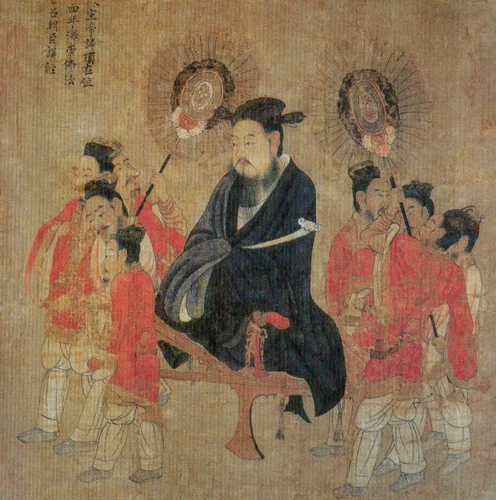
530 CE–582 CE
Emperor
Chen Xu
陈顼
Chen Xu (14 August 530 – 17 February 582), originally named Chen Tanxu, courtesy name Shaoshi and childhood name Shili, was a native of Changcheng in Wuxing, present-day Changxing County, Zhejiang. He was the second son of Chen Daotan, posthumously Prince Zhaolie of Shixing, a nephew of Chen Baxian, Emperor Wu of Chen, and the younger brother of Chen Qian, Emperor Wen of Chen. He was the fourth emperor of the Chen dynasty,…
530 CE–582 CEChen dynasty
PROFILE
Chen Xu (14 August 530 – 17 February 582), originally named Chen Tanxu, courtesy name Shaoshi and childhood name Shili, was a native of Changcheng in Wuxing, present-day Changxing County, Zhejiang. He was the second son of Chen Daotan, posthumously Prince Zhaolie of Shixing, a nephew of Chen Baxian, Emperor Wu of Chen, and the younger brother of Chen Qian, Emperor Wen of Chen. He was the fourth emperor of the Chen dynasty, reigning from 569 to 582 under the era name Taijian. His posthumous name was Emperor Xiaoxuan, his temple name was Gaozong, and he was buried at Xianning Mausoleum. Chen Xu was described as broad-minded, resourceful, physically strong, and skilled in riding and archery. He spent part of his early life as a hostage in the north, returned to Chen territory, gradually took control of government, deposed his nephew Chen Bozong, and made himself emperor. During his reign he promoted irrigation and agriculture. In 573, the fifth year of the Taijian era, he launched a major northern campaign that temporarily recovered territory north of the Yangtze and in the Huai–Si region, although Northern Zhou later took it back. His fourteen-year reign was relatively stable within Chen, but it did not reverse the dynasty's overall strategic decline under pressure from powerful northern states.
- Alternate name
- Emperor Xuan of Chen
- Courtesy name
- Shaoshi
- Period
- Chen dynasty
- Date of Birth
- August 14 530
- Date of Death
- February 17 582
- Dynasty / polity
- Chen dynasty
- Identity
- Emperor
- Ethnicity / ethnic affiliation
- Not recorded in historical sources
- Ancestral home
- Changcheng, Wuxing (present-day Changxing County, Zhejiang)
- Place of birth
- Not recorded in historical sources
- Reign
- 569–582
- Predecessor
- Emperor Fei of Chen (Chen Bozong)
- Successor
- Chen Shubao, Last Ruler of Chen
- Era name
- Taijian
- Temple name
- Gaozong
- Posthumous name
- Emperor Xiaoxuan
- Major achievements
- Younger brother of Emperor Wen of Chen; deposed his nephew and took the throne; during the Taijian northern campaigns, Chen temporarily recovered territory north of the Yangtze
LIFE TIMELINE
Age twenty-two | Sent by Chen Baxian to Jiangling to serve Emperor Yuan of Liang, Xiao Yi; successively rose to General of the Inner Guard and Secretariat Gentleman
Age twenty-four | Jiangling fell; captured by Western Wei and taken to Chang'an
Age twenty-seven | Remotely confirmed as Prince of Shixing with a fief of two thousand households
Age twenty-nine | Chen Qian, Emperor Wen of Chen, came to the throne; Chen Xu was retitled Prince of Ancheng
Age thirty-two | Returned from Northern Zhou; appointed Attendant-in-Ordinary, Director of the Secretariat, and General of the Central Guard; later became governor of Yang Province
Age thirty-five | Promoted to Minister of Works
Age thirty-six | Appointed Director of the Department of State Affairs; received an imperial deathbed commission to assist the government when Emperor Wen became gravely ill
Age thirty-seven | Had Liu Shizhi, Dao Zhongju, and Han Zigao executed and monopolized political power
Age thirty-eight | Promoted to Grand Tutor; in the eleventh lunar month deposed Chen Bozong as Prince of Linhai and took the throne himself
Age thirty-nine | Formally ascended the throne in the first lunar month, adopted the Taijian era name, made Liu Jingyan empress, and named Chen Shubao crown prince
Age forty | Suppressed the rebellion of Ouyang He
Age forty-three | Ordered Wu Mingche and Pei Ji to lead one hundred thousand troops against Northern Qi; recovered territory north of the Yangtze and in the Huai–Si region
Age forty-seven | Northern Zhou destroyed Northern Qi and seized the gains of the Chen northern campaigns
Age forty-eight | Suffered a major defeat by Northern Zhou at Lüliang; Wu Mingche was captured
Age fifty-two | Died on the tenth day of the first lunar month; posthumously titled Emperor Xiaoxuan with temple name Gaozong
BIOGRAPHY
Biography
Family Background and Early Years
Chen Xu came from the Chen clan of Wuxing and belonged to the central ruling family of the Chen dynasty. His father, Chen Daotan, posthumously Prince Zhaolie of Shixing, was an elder brother of Chen Baxian and died relatively young. Chen Xu was Chen Daotan's second son; his elder brother was the future Emperor Wen of Chen, Chen Qian. According to the Book of Chen, Chen Xu was born on the xinyou day of the seventh lunar month in 530, the second year of the Zhongdatong era, and a red light was said to have filled the hall at his birth. As a youth he was described as generous and broad-minded and as possessing strategic ability. As an adult he was said to have been handsome, eight chi three cun tall, with hands reaching below his knees, physically strong, and skilled in riding and archery.
After the Hou Jing Rebellion was suppressed, Chen Baxian was stationed at Jingkou and his power increased. Emperor Yuan of Liang, Xiao Yi, attempted to restrain Chen Baxian by summoning members of his family to Jiangling. Chen Baxian sent Chen Xu, who rose there to the posts of General of the Inner Guard and Secretariat Gentleman. In 554, the third year of the Chengsheng era, Western Wei captured Jiangling and killed Emperor Yuan. Chen Xu was taken to Chang'an, beginning an eight-year period outside the south. During his captivity, Chen Baxian replaced Liang and founded the Chen dynasty in 557, the first year of the Yongding era. From afar, Chen Xu was confirmed as Prince of Shixing with a fief of two thousand households. In 559, the third year of the Yongding era, Chen Baxian died and Chen Xu's elder brother Chen Qian became emperor, retitling Chen Xu Prince of Ancheng.
Return and Rise to Power
In 562, the third year of the Tianjia era, negotiations between the Chen dynasty and Northern Zhou finally secured Chen Xu's return to Jiankang. Emperor Wen of Chen relied heavily on his younger brother and appointed him Attendant-in-Ordinary, Director of the Secretariat, and General of the Central Guard. He was soon made governor of Yang Province and promoted to General of Agile Cavalry. In 563 he received the honor of Opening Office with Ceremonial Privileges Equal to the Three Excellencies; in 565 he became Minister of Works; and in 566 he was appointed Director of the Department of State Affairs. As the emperor's brother, he became one of the most powerful figures at court.
In 566, Emperor Wen became gravely ill. Crown Prince Chen Bozong was young and considered weak. Emperor Wen worried that the prince might not be able to preserve the throne and is said to have told Chen Xu that he wished to imitate the ancient example of Wu Taibo by yielding the succession to a younger brother. Chen Xu fell to the ground weeping and firmly refused. Dao Zhongju, a Director of the Department of State Affairs, Kong Huan, Minister of the Five Arms, and others received the dying emperor's order to assist the government. After Emperor Wen's death, Chen Bozong took the throne, while Chen Xu was appointed Minister over the Masses, General of Agile Cavalry, Supervisor of the Department of State Affairs, and commander of military affairs inside and outside the capital, thereby controlling both civil and military power.
Chen Xu's growing authority alarmed Liu Shizhi, Secretariat Drafter, and Dao Zhongju, who also held a deathbed commission. Liu Shizhi and Wang Xian, Left Assistant Director of the Department of State Affairs, planned to send Chen Xu out of the capital. Yin Buning, an official of the Eastern Palace, forged an order instructing Chen Xu to go to the Eastern Residence to manage provincial affairs. As Chen Xu prepared to leave, Mao Xi, an official of his staff, rushed in to warn him. Citing the disaster that had befallen Cao Shuang, Mao urged him not to leave the capital and place himself under others' control. Chen Xu therefore claimed illness and stayed. He sent Mao Xi into the palace to determine the positions of Empress Dowager Zhang Yao'er and Emperor Chen Bozong and learned that the order had not reflected the empress dowager's wishes. Chen Xu then acted decisively: he detained Liu Shizhi, drafted an edict for imperial approval, had Liu ordered to commit suicide in prison that night, and had Wang Xian executed. Thereafter government power lay almost entirely in Chen Xu's hands.
Chen Xu next removed Dao Zhongju and Right Guard General Han Zigao. Han Zigao had been a favorite of Emperor Wen and commanded the military headquarters with the largest force among the generals in Jiankang. He and Dao Zhongju were accused of plotting against Chen Xu. Mao Xi advised Chen Xu first to reassure them with favors and then to eliminate them when an opportunity arose. Chen Xu followed the plan, eventually arresting Dao Zhongju, Han Zigao, and their associates and ordering their deaths in prison.
Deposing the Emperor and Taking the Throne
In the first lunar month of 568, the second year of the Guangda era, Chen Xu was promoted to Grand Tutor while retaining the office of Minister over the Masses. He received exceptional ceremonial privileges, including the right to wear a sword and shoes in the audience hall, and his fief was increased to three thousand households. Chen Bozong was now older but was still regarded as weak, and Chen Xu began planning a change of ruler. On the jiayin day of the eleventh lunar month, acting in the name of Empress Dowager Zhang Yao'er, Chen Xu issued an edict deposing Chen Bozong as Prince of Linhai and made himself emperor. He also reduced Chen Bozong's younger brother Chen Bomao to Marquis of Wenma and sent men to kill him in his carriage while he was being removed from court. In the fourth lunar month of 570, the deposed Chen Bozong died at the age of nineteen.
After becoming emperor, Chen Xu honored Zhang Yao'er as empress dowager, made his consort Liu Jingyan empress, designated his heir Chen Shubao as crown prince, and enfeoffed his other sons as princes. The Chen imperial house was relatively small. Among Chen Baxian's close male relatives, Chen Chang, Chen Qian, and Chen Xu were among the few major figures; Chen Chang died young, and both Chen Qian and Chen Xu came to the throne outside the straightforward line of succession. The Chinese source attributes this in part to the dynasty's limited number of close imperial clansmen.
The Taijian Government and Northern Campaigns
In the early years of his reign, Chen Xu concentrated on stabilizing politics and restoring the economy. He sponsored irrigation works, opened wasteland, and encouraged agricultural production, bringing a degree of economic recovery. In 569, the first year of the Taijian era, Ouyang He, who had controlled Guangzhou for more than a decade, rebelled. Chen Xu sent the General of Chariots and Cavalry Zhang Zhaoda against him. With support from Lady Xian, a leader among the peoples of Lingnan, the government ultimately restored control over Guangzhou.
In 573, the fifth year of the Taijian era, internal disorder in Northern Qi led Chen Xu to launch a northern campaign. Xu Ling, Left Director of the Department of State Affairs, opposed prevailing opinion and recommended Wu Mingche as commander, arguing that Wu came from the Huai region, understood local conditions, and was unsurpassed in military planning. Chen Xu appointed Wu Mingche commander of the expedition, with Pei Ji, and sent one hundred thousand troops against Northern Qi. Chen forces advanced rapidly. At the battle of Qin Prefecture, Wu Mingche's subordinate Xiao Mohe personally led a picked assault force, killed a prominent Northern Qi warrior, and defeated the opposing army. Huang Faban captured Liyang and Hefei, while Wu Mingche took Shouyang and captured the Northern Qi defender Wang Lin. By 575, the seventh year of the Taijian era, Chen forces had recovered most of the territory north of the Yangtze and in the Huai–Si region, greatly enhancing the dynasty's military prestige.
The Chen armies did not, however, press their advantage to destroy Northern Qi. In 577, the ninth year of the Taijian era, Northern Zhou conquered Northern Qi and unified the north. Northern Zhou then seized the territory Chen had recently recovered. In 578, the tenth year of the Taijian era, Wu Mingche led another northern campaign but was defeated by Northern Zhou at Lüliang near present-day Xuzhou. Wu was captured and the elite troops of Chen suffered devastating losses. After this defeat, the dynasty lacked the strength for further major northern offensives and was forced to defend the Jiangnan region.
Later Years and Death
After the defeat at Lüliang, Chen's military strength declined sharply and Chen Xu became more conservative in his final years. On the tenth day of the first lunar month in 582, the fourteenth year of the Taijian era, corresponding to 17 February, he died at the age of fifty-three. He received the posthumous title Emperor Xiaoxuan and temple name Gaozong and was buried at Xianning Mausoleum, in the area of present-day Nanjing. His son Chen Shubao succeeded him as the Later Ruler of Chen. Only seven years after Chen Xu's death, Sui forces conquered the Chen dynasty, bringing the Southern Dynasties to an end.
Chen Xu was born on the sixth day of the seventh month of 530, and it is said that at his birth a red light filled the hall. Generous and broad-minded in youth and full of stratagem, he grew into a handsome man eight feet three inches tall whose hands hung below his knees, strong and a good rider and archer. When Chen Baxian put down Hou Jing's rebellion and held Jingkou, Emperor Yuan of the Liang called the sons and nephews of Chen Baxian to attend him, and Chen Xu was sent to Jiangling, where he rose to be commander of the palace gate and a palace secretary. In 554 Jiangling fell and Chen Xu was carried off to the region within the passes, living for some years under the northern court. In 557 he was enfeoffed at a distance as prince of Shixing commandery with two thousand households.
Chen Baxian died in 559 and Chen Xu's brother, Emperor Wen of Chen, took the throne, changing his title to prince of Ancheng. In 562 Chen Xu returned from the Northern Zhou and was made palace attendant, director of the secretariat and general of the central guard with a staff of his own; he was soon given the credentials and the command of the military affairs of Yang, Nanxu, Dongyang, Nanyu and Beijiang with the governorship of Yangzhou, and the title of general of the light cavalry. In 563 he was given the privilege of opening a staff, and in 565 made minister of works. As the emperor's brother his power at court and in the country was great, and Bao Sengrui, an officer of his household, acted lawlessly on the strength of it.
The censor-in-chief Xu Ling impeached him, carrying the memorial into the palace with the officers of the censorate. Seeing Xu Ling in full ceremonial dress and of grave countenance, the emperor composed himself and sat upright; as the memorial was read Chen Xu, standing in attendance in the hall, looked up at the emperor, broke into a sweat and changed colour, and Xu Ling had a palace censor lead him down from the hall. The emperor stripped him of the offices of palace attendant and director of the secretariat, and the court was much sobered. In 566 he was given the presidency of the secretariat. That year Emperor Wen fell ill and the executive official, with Chen Xu and the president of the board of personnel, attended him in his sickness; the heir apparent, fearing he could not hold the throne, told Chen Xu that he wished to follow the ancient example of passing the throne to a younger brother, and Chen Xu wept on the ground and firmly refused.
After Emperor Wen's death the heir Chen Bozong came to the throne as the deposed emperor, and Chen Xu governed as his uncle, doing away one after another with the regents Dao Zhongju and Liu Shizhi and growing ever stronger. In 568 he deposed Chen Bozong as prince of Linhai by the empress dowager's order, and the next year took the throne himself with the era name Taijian, becoming Emperor Xuan of Chen. He reigned fourteen years, the longest and one of the more capable rulers of the Chen.
After his accession the politics of Chen grew quieter for a time. He attended to the administration and lightened taxes and corvée, set about restoring the economy of the Huai country that the wars had ruined, and took care in choosing men and testing officials, so that the histories say his government was well ordered. Abroad he largely continued the policy of friendship with the Northern Zhou in the hope of recovering Huainan.
In 573 he sent Wu Mingche north against the Northern Qi. The Chen armies did well, recovering Shouyang and Hefei in Huainan and pushing Chen's northern border back to the Huai — the greatest military success since the founding of the state; in 575 Wu Mingche took Pengcheng and Chen's name stood high. The gain did not last: in 577 the Northern Zhou destroyed the Northern Qi and unified the north, and the buffer between Chen and Zhou disappeared.
Under Zhou pressure Chen Xuan still sent Wu Mingche north to contend for the country north of the Huai. In 578 the Chen army met the Zhou at Lüliang and was heavily defeated, Wu Mingche was taken prisoner, the best of Chen's troops were destroyed and Huainan lost with them. The defeat much weakened Chen, which could afterward only hold the line of the Yangtze and never campaigned north again. Chen Xuan died in 582 at fifty-three and his son Chen Shubao succeeded as the last ruler.
The foreign policy of his reign ran from advance to retreat: the campaigns of the Taijian years recovered Huainan and showed that Chen still had some military strength while the north was divided, but as the Northern Zhou and then the Sui unified the north the balance changed altogether and Chen's defeat became hard to avoid — a course later ages often cite as an illustration of the shift in the political order at the end of the Northern and Southern Dynasties. Of his person the histories say he was generous, full of stratagem and frugal, keeping the palace expenses in check, and that he gave weight to the selection of talent, decreeing that the provinces recommend worthy men. Such judgments have left him a fair name among the later rulers of the Southern Dynasties, though his deposing of his nephew to take the throne has been a matter of comment. After his death the last ruler gave himself to wine and women, the government decayed, and Chen was destroyed by the Sui in 589.
One lasting work of his reign was the recovery of water control and farming in Jiangnan. Chen was founded in the south and its finances rested chiefly on the agriculture of the three Wu and the Jing and Hu regions; Chen Xuan decreed reductions of taxes in stricken districts more than once and had the local authorities repair the ponds and encourage farming and mulberry. Such measures could not reverse Chen's military weakness, but they let the southern economy recover by degrees after the ruin of the late Liang and prepared the prosperity of Jiangnan under the Sui and Tang.
His diplomacy with the Northern Zhou is also worth noting: in the Taijian years the two states exchanged envoys and kept up formal relations of equality, and after the Zhou destroyed the Qi, Chen tried by diplomacy and war to keep its interests north of the Huai without success. His temple name is Gaozong and he was buried at Xianning ling near the modern Nanjing. His reign was long and comparatively settled and he made some advance abroad, yet lost Huainan when the north was unified — a course from strength to decline in keeping with the general tendency of the later Southern Dynasties. Several of his sons held high office, and after his son Chen Shubao succeeded, the quarrels of the imperial house and the court became one of the circumstances of Chen's rapid fall.
The condition of his burial area is noted in the relevant local gazetteers and surveys.
Major Activities
Political Activities
The turning point in Chen Xu's political career was his deposition of the reigning emperor and accession to the throne. Before taking the throne, he eliminated political rivals including Liu Shizhi, Dao Zhongju, and Han Zigao and concentrated government power in his own hands. As emperor, he suppressed Ouyang He's rebellion and stabilized the Chen state. Seeking to avoid the weakness created by a small imperial clan under Emperor Wen, he took many consorts, fathered forty-two sons, and enfeoffed many imperial princes in an effort to build a stronger clan-based support structure for the throne.
Taijian Northern Campaigns
In 573, the fifth year of the Taijian era, Chen Xu took advantage of disorder in Northern Qi and ordered Wu Mingche and Pei Ji to lead one hundred thousand troops north. Chen forces captured Qin Commandery, Liyang, Hefei, Shouyang, and other locations, nearly recovering the territory north of the Yangtze and throughout the Huai–Si region. It was one of the most significant military successes achieved by a southern dynasty against the north in the later Southern Dynasties period. Chen was unable to destroy Northern Qi, however. After Northern Zhou conquered Qi in 577, all the territory recently recovered by Chen was lost. The defeat at Lüliang in 578, where Wu Mingche was captured and much of Chen's best army was destroyed, erased the gains of the earlier campaigns.
Economic Recovery
During Chen Xu's reign, the government repaired and expanded irrigation, brought wasteland under cultivation, encouraged farming, and reduced certain burdens of taxation and labor service. These measures produced a degree of recovery and development in the Chen economy. The Jiangnan region was relatively stable during the Taijian era and agricultural harvests were generally favorable, providing an economic foundation for the dynasty's survival in its later years.
Relations with Contemporaries
Chen Xu was especially close to Mao Xi. As a trusted adviser, Mao played a crucial role in Chen Xu's seizure of power, warning him not to leave the capital during the Liu Shizhi affair and later proposing the strategy used against Han Zigao. Xu Ling, Left Director of the Department of State Affairs, had earlier impeached Chen Xu's subordinate Bao Sengrui, causing Chen Xu temporarily to lose the offices of Attendant-in-Ordinary and Director of the Secretariat. During the Taijian northern campaigns, however, Xu Ling strongly recommended Wu Mingche as commander, demonstrating continued service to Chen Xu's government. Wu Mingche, Pei Ji, Huang Faban, Xiao Mohe, and other generals were key executors of the northern campaigns.
Personal Relations
- Father: Chen Daotan, posthumously Prince Zhaolie of Shixing
- Uncle: Chen Baxian, Emperor Wu of Chen
- Elder brother: Chen Qian, Emperor Wen of Chen
- Empress: Liu Jingyan
- Sons: Chen Shubao, the Later Ruler of Chen; Chen Shuling; Chen Shuying; Chen Shujian; and a total of forty-two sons
- Nephews: Chen Bozong, deposed as Prince of Linhai; Chen Bomao, killed after his demotion
- Mao Xi: Trusted adviser
- Xu Ling: Left Director of the Department of State Affairs; strongly recommended Wu Mingche
- Wu Mingche: Chief commander of the northern campaigns
- Pei Ji: Deputy commander in the northern campaigns
- Xiao Mohe: Prominent general
- Emperor Yuan of Liang, Xiao Yi: Chen Xu served at his court in Jiangling during his youth
- Emperor Wen of Chen, Chen Qian: Elder brother and sovereign
- Chen Bozong: Nephew whom Chen Xu deposed
- Liu Shizhi: Political rival, ordered to die
- Dao Zhongju: Political rival, ordered to die
- Han Zigao: Political rival, ordered to die
- Ouyang He: Rebel whom Chen Xu's government suppressed
Historical Assessment
Tang / Early Historical Accounts
- Yao Silian, author of the Book of Chen, wrote that Gaozong was broad in capacity and generous in temperament and possessed qualities befitting a ruler. (Book of Chen, vol. 5)
- Wei Zheng, in a general assessment included in the Book of Chen, described Emperor Xuan as sound in judgment and intent on strategic affairs, saying that although he lacked a strongly martial bearing, he possessed clear powers of decision. (Book of Chen, vol. 6)
- Tang historian Li Yanshou wrote in the History of the Southern Dynasties that Emperor Xuan was broad-minded and resourceful in youth and, once on the throne, could employ worthy and capable men; for that reason the Taijian era was remembered as a period of modest prosperity. (History of the Southern Dynasties, vol. 10)
Song–Yuan Period
- Sima Guang's Comprehensive Mirror in Aid of Governance records Chen Xu's deposition of the emperor. Although Sima Guang did not provide a direct judgment in the passage, the account of Mao Xi warning Chen Xu with the example of Cao Shuang highlights the political risks surrounding Chen Xu's seizure of power. (Comprehensive Mirror in Aid of Governance, Chen Annals IV, vol. 170)
- Hu Sanxing, in his annotations to the Comprehensive Mirror in Aid of Governance, compared Chen Xu's deposition of Chen Bozong with Xiao Daocheng's deposition of the Liu Song ruler known as the Deposed Emperor of Cangwu, describing both as acts of usurpation committed by close members of the ruling house.
- The Wenxian Tongkao stated that although Emperor Xuan's Taijian campaigns recovered the Huai–Si region, the population had already been exhausted and the territory was ultimately taken by Northern Zhou. (Wenxian Tongkao, Military Institutions section)
Ming–Qing Period
- Wang Fuzhi, in Du Tongjian Lun, wrote that the Taijian armies recovered the Huai–Si region and achieved a success rarely seen among the southern dynasties, but regretted that Chen Xu failed to destroy Northern Qi while he had the opportunity.
- Zhao Yi, in Notes on the Twenty-Two Histories, compared Chen Xu's deposition of his nephew with Xiao Luan's deposition of the Southern Qi ruler, while also acknowledging that Chen Xu employed capable commanders such as Wu Mingche and Pei Ji and achieved notable successes in the north.
- Wang Mingsheng, in Critical Discussions of the Seventeen Histories, described the Taijian government as a period of modest prosperity but argued that the defeat at Lüliang, which destroyed much of Chen's elite army, marked the true beginning of the dynasty's fall.
Modern Period
- Lü Simian, in Liang Jin Nanbei Chao Shi, argued that although Emperor Xuan lacked exceptional talent, he knew how to employ capable men and temporarily recovered territory north of the Yangtze in a rare southern military success; his inability to exploit the victory and destroy Northern Qi, however, revealed the limits of his strategic ability.
- Tian Yuqing, in Dong Jin Menfa Zhengzhi, noted that the Chen imperial clan was small and that both Chen Qian and Chen Xu came to the throne outside the normal line of succession partly because few close imperial clansmen were available.
- Wang Zhongluo, in Wei Jin Nanbei Chao Shi, assessed Chen Xu's fourteen-year reign as relatively orderly, with some economic recovery, while emphasizing that powerful northern states remained a growing threat and that the temporary success of the Taijian campaigns could not reverse the southern dynasties' overall trajectory of decline.
FIGURES ASSOCIATED WITH THIS DYNASTY
Bibliography
- Li Yanshou, History of the Southern Dynasties·Juan Shi
- Lü Simian, History of the Jin and Northern and Southern Dynasties
- Wang Zhongluo, History of the Wei, Jin, Southern and Northern Dynasties