Birth in Changcheng
Born into a humble plebeian family in Wuxing; studied military classics and martial arts in youth.
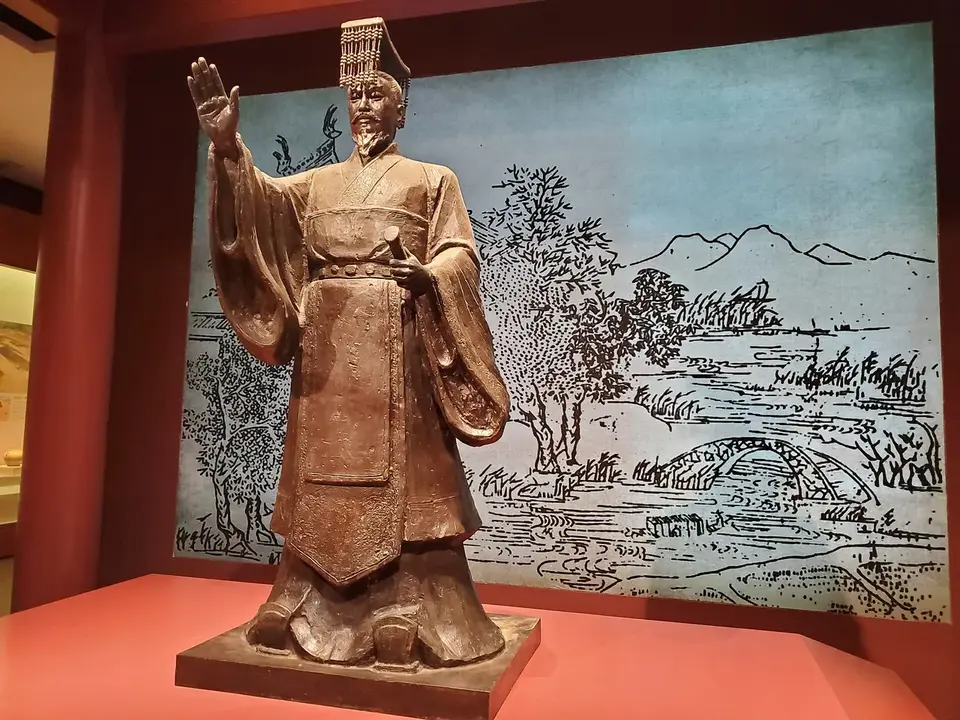
503 CE–559 CE
陈霸先
Chen Baxian (陈霸先, 503 – July 23, 559), courtesy name Daixing and childhood sobriquet Fasheng, was the founding monarch of the Southern Chen dynasty, revered in history by his temple name Gaozu and posthumous title Emperor Wu. Hailing from a humble plebeian lineage in Changcheng, Wuxing, Chen Baxian rose from obscure municipal posts to commanding prominence through exceptional tactical genius, stoic discipline, and unyielding…
Chen Baxian (陈霸先, 503 – July 23, 559), courtesy name Daixing and childhood sobriquet Fasheng, was the founding monarch of the Southern Chen dynasty, revered in history by his temple name Gaozu and posthumous title Emperor Wu. Hailing from a humble plebeian lineage in Changcheng, Wuxing, Chen Baxian rose from obscure municipal posts to commanding prominence through exceptional tactical genius, stoic discipline, and unyielding fortitude during the terminal decades of the Southern Liang dynasty. Following early administrative service under Prince Xiao Ying, he gained national fame during the late Datong era by leading an arduous tropical campaign through the malaria-infested jungles of Lingnan to crush the separatist uprising of Li Bi in Jiaozhou. When the catastrophic Hou Jing Rebellion erupted and decimated the Liang capital of Jiankang in 549, Chen Baxian mobilized a volunteer loyalist legion in Shixing, decapitated rebellious regional warlords, forged a historic alliance with Wang Sengbian at Baimao Islet, and led the vanguard in liberating Jiankang after fierce street combat around the Stone Fortress. Following the devastating sack of Jiangling by Western Wei and the execution of Emperor Yuan of Liang, Wang Sengbian capitulated to Northern Qi threats by enthroning the northern puppet Xiao Yuanming. Demonstrating decisive political daring and patriotic resolve, Chen Baxian launched a daring amphibious assault from Jingkou in 555, stormed the Stone Fortress, executed Wang Sengbian, and enthroned Emperor Jing of Liang. When Northern Qi subsequently unleashed an overwhelming invasion force of over one hundred thousand armored cavalry across the Yangtze to crush the southern regime, Chen Baxian rallied his starving troops with cooked duck-rice rations and launched a legendary counter-offensive at Mount Zhong and Lake Xuanwu, completely annihilating the Northern Qi hosts in one of the most miraculous victories in Chinese military history. Ascending the imperial throne in 557 to establish the Chen dynasty, Emperor Wu practiced austere personal frugality, revitalized hydraulic canals, stabilized runaway inflation, and defended the southern frontier against entrenched warlords. Although his reign lasted fewer than three years, Chen Baxian's heroic preservation of the southern realm safeguarded indigenous Sinitic civilization, imperial lineage, and cultural continuity from total annihilation.
Born into a humble plebeian family in Wuxing; studied military classics and martial arts in youth.
Recruited by Prince Xiao Ying to serve in Guangzhou; subsequently appointed Governor of Xinhui.
Commanded imperial vanguard deep into southern frontiers to destroy Li Bi's forces; ennobled as Village Marquis of Duting.
Mobilized a loyalist army in Shixing following the fall of Taicheng; executed the treacherous Guangzhou governor Yuan Jingzhong.
Defeated and executed rebel commander Li Qianshi at Mount Dayu, clearing the strategic mountain pass into Jiangxi.
Concluded blood oath with Wang Sengbian at Baimao Islet; led frontline troops to liberate Jiankang and crush Hou Jing.
Promoted to Senior General Pacifying the North and Governor of South Xuzhou, guarding the lower Yangtze approaches.
Western Wei captured Jiangling and executed Emperor Yuan; central imperial authority collapsed throughout the south.
Denounced Wang Sengbian's capitulation to Northern Qi; launched surprise assault on Stone Fortress, executing Wang and crowning Emperor Jing.
Distributed duck rations to famished troops; smashed a hundred-thousand-strong Northern Qi invasion force beneath Mount Zhong.
Accepted abdication from Emperor Jing; inaugurated the Chen dynasty and established era name Yongding.
Succumbed to chronic exhaustion at Xuanji Hall at age fifty-seven; bequeathed succession to his nephew Chen Qian.
Chen Baxian was born in 503 in Wuxing Commandery. Although dynastic genealogies claimed descent from the celebrated Han scholar Chen Shi, generations of upheaval had reduced his family to ordinary plebeian status. Deprived of the aristocratic hereditary privileges enjoyed by elite emigre clans, the young Chen Baxian worked the soil, fished local lakes, and served as a petty village bailiff and grain warehouse clerk. He possessed a commanding physical presence, sharp strategic intellect, and an insatiable appetite for treatises on military strategy and astronomical calculations. His uncommon talents caught the attention of Xiao Ying, a prominent imperial kinsman of Emperor Wu of Liang, who recruited him into his private retinue.
In 540, Xiao Ying was assigned as regional inspector of Guangzhou, and Chen Baxian accompanied him southward as military adjutant, quickly earning promotion to Governor of Xinhui. In 541, a major local chieftain named Li Bi revolted in Jiaozhou, drove out the imperial inspector, and proclaimed himself southern emperor. As regional Liang forces stalled amidst lethal tropical fevers, Chen Baxian mobilized local levies and advanced through treacherous jungle terrain. In 545, he spearheaded an amphibious counter-offensive along the Zhuyuan River, smashing Li Bi's main host and driving him into remote caverns where the rebel was assassinated by local tribesmen. This complete pacification of the southern frontier earned Chen Baxian nationwide renown and promotion to Governor of Gaoyao.
In 548, the traitorous northern general Hou Jing mutinied, crossed the Yangtze, and laid siege to the imperial palace complex of Taicheng. After months of desperate resistance, the palace fell in 549, and Emperor Wu of Liang was starved to death under house arrest. Far to the south in Gaoyao, Chen Baxian wept bitter tears upon learning of the catastrophe and immediately resolved to raise a loyalist army to liberate the dynasty. He relocated his headquarters to Shixing, an indispensable strategic choke point controlling the Dayu Mountain Pass, liquidating personal estates to recruit thousands of battle-hardened volunteers and assemble river craft.
Chen Baxian's loyalist enterprise encountered immediate treachery from neighboring officials. Yuan Jingzhong, the inspector of Guangzhou, secretly accepted an appointment from Hou Jing and conspired to launch a surprise attack against Shixing. Moving with lightning speed, Chen Baxian preemptively stormed Guangzhou, forcing Yuan Jingzhong to commit suicide. Soon afterward, Hou Jing's northern partisan Li Qianshi fortified the formidable heights of Dagaoshi with tens of thousands of troops to bar the mountain pass. Chen Baxian deployed deceptive diversionary tactics, lured Li Qianshi's elite infantry into a forested gorge, and launched a crushing envelopment, capturing and beheading Li Qianshi to reopen the overland artery into central China.
In the spring of 551, having eradicated all rebel garrisons south of the ranges, Chen Baxian led thirty thousand southern warriors across the formidable Dayu Mountains into Jiangxi. The march was fraught with severe privation; southern farmlands had been burned to ashes, and imperial soldiers were repeatedly reduced to foraging wild roots and tree bark. Nevertheless, Chen Baxian shared every hardship with his men, enforcing iron discipline and winning the hearts of local villagers along the Gan River corridor.
At the same time, Prince Xiao Yi of Xiangdong, operating from Jiangling as head of the Liang princes, dispatched general Wang Sengbian eastward down the Yangtze. Although Xiao Yi and Wang Sengbian recognized the supreme combat capability of Chen Baxian's southern legion, they harbored acute jealousy toward his independent military base. Setting aside personal prestige and factional rivalries, Chen Baxian placed state salvation above all, dispatching grain and military supplies to the impoverished Jiangling troops and offering Wang Sengbian overall ceremonial command of the expedition. At Baimao Islet on the Yangtze, Chen Baxian and Wang Sengbian held a historic summit, ascended a sacred terrace, and swore a blood oath to eradicate Hou Jing, cementing an invincible coalition.
In the spring of 552, the combined armada of over one hundred thousand loyalist troops swept down the Yangtze, severing Hou Jing's defensive positions at Dangtu and Gushu. Hou Jing assembled all available cavalry and heavy infantry, entrenching his defenses along the outer perimeter of the Stone Fortress and Luoxing Ridge to contest the final approaches to Jiankang. Chen Baxian personally spearheaded the forward amphibious landings at Luoxing Ridge, leading armored vanguards into enemy lines and shattering the rebel frontline forces.
As the battle converged upon the rugged ramparts of the Stone Fortress, Hou Jing hurled hundreds of elite heavy cataphracts in a desperate flank charge against Chen Baxian's command standard. Undaunted by the onslaught, Chen Baxian stood his ground on foot with sword drawn, cutting down several armored horsemen and rallying his infantry to hold the line. Inspired by his valor, southern troops fought with suicidal ferocity, breaking the rebel charge and overwhelming Hou Jing's main battle line. Hou Jing fled in panic down the Yangtze toward the open sea, only to be assassinated by his mutinous retainers. Upon entering the ruined capital, Chen Baxian strictly forbade pillaging, sealed state granaries, and gathered hundreds of thousands of unburied corpses for honorable interment, earning appointment as Senior General Pacifying the North and commander of the vital garrison at Jingkou.
Although the Hou Jing Rebellion had been suppressed, the Liang dynasty remained critically fractured. Emperor Yuan (Xiao Yi) remained obstinately in Jiangling, refusing to return to Jiankang while waging bloody civil wars against his brothers and nephews. Taking advantage of southern exhaustion, Western Wei dispatched general Yu Jin with fifty thousand elite cavalry to besiege Jiangling in 554. After Jiangling fell, Emperor Yuan burned one hundred and forty thousand volumes of rare imperial archives before being executed, and tens of thousands of southern aristocrats were herded into northern captivity.
With the dynastic center annihilated, Chen Baxian and Wang Sengbian agreed to crown Emperor Yuan's sole surviving son, the thirteen-year-old Xiao Fangzhi, in Jiankang. However, Emperor Wenxuan of Northern Qi intervened, dispatching an army escorting Xiao Yuanming (a captured nephew of Emperor Wu) and demanding his enthronement under the threat of immediate military invasion. Weary of continuous warfare and intimidated by northern military might, Wang Sengbian yielded to northern coercion, opening the gates of Jiankang to install Xiao Yuanming as emperor while demoting Xiao Fangzhi to crown prince. Chen Baxian dispatched impassioned memorials urging Wang Sengbian to reject this treacherous betrayal of dynastic legitimacy, but Wang Sengbian haughtily dismissed his warnings and prepared defenses against Jingkou.
Recognizing that Wang Sengbian's capitulation would inevitably convert southern China into a vassal outpost of Northern Qi, Chen Baxian decided to launch a decisive strike. In the autumn of 555, he assembled his trusted generals, including Hou Andu, Zhou Wenyu, and Xu Du, at his military camp in Jingkou, outlining an audacious amphibious raid against Jiankang.
On the dawn of the designated day, Chen Baxian's fleet slipped quietly out of Jingkou and raced upriver under cover of darkness. Commander Hou Andu led naval commandos who scaled the precipitous cliffs of the Stone Fortress, catching the garrison completely off guard and seizing the western gates. Chen Baxian's elite cavalry surged into the city, surrounding Wang Sengbian in the southern gatehouse before he could even don his armor. Rebuking Wang Sengbian for surrendering the dynastic heritage to northern barbarians, Chen Baxian ordered Wang Sengbian and his sons executed on the spot, rapidly establishing total military control over Jiankang. He promptly dethroned the puppet Xiao Yuanming and installed Xiao Fangzhi as Emperor Jing, assuming the office of Minister of Works and supreme military command.
Infuriated by the execution of his puppet, Emperor Wenxuan of Northern Qi mobilized the full weight of his empire to obliterate the southern regime. In early 556, Northern Qi defectors Xu Sihui and Ren Yue guided over one hundred thousand elite northern cavalry and infantry across the Yangtze, seizing the strongholds of Mufu Mountain and Mount Zhong, laying tight siege to the battered walls of Jiankang. The capital was crippled by famine, with defending forces outnumbered three to one and civilian morale teetering on panic.
Amidst unceasing torrential rains that turned the battlefield into a quagmire, food supplies in Jiankang ran entirely out. Demonstrating remarkable tactical improvisation, Chen Baxian ordered hundreds of domestic ducks collected from abandoned estates, butchered, cooked, and wrapped into tens of thousands of rice parcels. Personally distributing these duck rations to his starving troops on the ramparts, he inspired them to make a final, glorious stand. On the following morning, as the skies cleared, Chen Baxian hurled his heavy infantry into a thunderous frontal charge against the Northern Qi lines at Lake Xuanwu, while Hou Andu's cavalry struck their rear from the cliffs of Mount Zhong. The Northern Qi host shattered in catastrophic confusion, with tens of thousands drowning in the Yangtze or falling under southern blades. Chen Baxian captured over forty enemy generals, including commander Xiao Gui, delivering a decisive blow that permanently halted Northern Qi ambitions south of the Yangtze.
The triumph at Mount Zhong permanently extinguished Northern Qi hopes of subjugating the south and consolidated Chen Baxian's unassailable political ascendancy. Emperor Jing of Liang rewarded his savior with the titles of Chancellor, Senior Preceptor, Governor of Yangzhou, and the feudal dignity of King of Chen with the Nine Bestowals. Recognizing that the Liang imperial lineage was hopelessly compromised by factional civil war and geographic fragmentation, the court arranged a peaceful abdication.
In November 557, Chen Baxian ascended an open-air altar on the southern outskirts of Jiankang to accept the imperial regalia from Emperor Jing, inaugurating the Chen dynasty and proclaiming the era name Yongding. He posthumously elevated his ancestors, invested his virtuous consort Zhang Yao'er as Empress, and distributed noble titles to his stalwart battlefield generals. Confronted by an empire reduced to the lower Yangtze delta and Lingnan, with hostile warlord regimes occupying Jiangxi, Fujian, and Hunan, Emperor Wu instituted streamlined central administrative organs and appointed competent plebeian administrators to rebuild state authority.
Throughout his reign, Emperor Wu maintained the spartan habits of his humble soldierly upbringing, offering an inspiring contrast to the ruinous decadence of earlier six dynasties monarchs. He abhorred luxury, dressed in unadorned coarse garments, ate simple rustic fare, and prohibited orchestral banquets in the palace. He decreed that palace pavilions destroyed during the civil wars should be only minimally repaired with local timber, adamantly rejecting decorative carvings and costly lacquerware.
Simultaneously, he directed aggressive defensive operations against regional warlords who threatened the fragile regime. In the upper Yangtze, former Liang loyalist Wang Lin mobilized a fleet of ten myriad troops with Northern Qi backing to invade Jiankang. Emperor Wu deployed Hou Andu and Zhou Wenyu to establish fortified river chains at Mount Liang, repelling multiple assaults. In the southeastern coastal hills, he balanced diplomatic conciliation and armed deterrence to contain local warlords Liu Yi, Zhou Di, and Chen Baoying, gradually establishing centralized imperial control over the southern coastal provinces.
A lifetime of non-stop campaigning, physical trauma, and unremitting administrative toil rapidly depleted Emperor Wu's vitality. In the summer of 559, as Wang Lin launched another threatening advance toward Dalei, Emperor Wu fell critically ill while directing troop movements in the palace. Recognizing that his sole surviving son, Chen Chang, was held hostage in Chang'an by the Western Wei government, the dying monarch realized that waiting for a distant heir would invite catastrophic palace intrigue and dynastic collapse.
Acting in selfless accordance with the public good, Empress Zhang and senior ministers concealed the emperor's demise and summoned his capable nephew, Prince Chen Qian of Linchuan, to assume the imperial mantle. On July 23, 559, Emperor Wu passed away peacefully inside Xuanji Hall at the age of fifty-seven. Chen Qian ascended the throne as Emperor Wen, completing the consolidation of the southern realm. Emperor Wu was interred with supreme honors in the Wan'an Mausoleum, revered across generations as one of the most resilient and public-spirited founding sovereigns in imperial annals.
Chen Baxian's remarkable ascension was founded upon his peerless mastery of dynamic mobile warfare, amphibious river coordination, and psychological warfare. Whether leading river ambushes through the winding rapids of Lingnan, executing coordinated amphibious assaults at the Stone Fortress, or exploiting boggy terrain to negate elite northern cavalry at Mount Zhong, his strategic vision was marked by meticulous intelligence gathering, rapid movement, and bold risk-taking.
Equally revolutionary was his dismantling of the aristocratic monopoly that had choked southern military administration for centuries. In contrast to the decadent aristocrats of the Liang court who fled at the first scent of battle, Chen Baxian identified and promoted extraordinary commanders solely based on proven combat merit, irrespective of their humble origin or checkered past. Stalwarts such as Du Sengming, Zhou Wenyu, Hou Andu, Xu Du, and Zhang Zhaoda owed their entire careers to Emperor Wu's discernment, forming an elite military brotherhood that defended the Chen dynasty against overwhelming odds.
Historians across the centuries have recognized that the military achievements of Chen Baxian were pivotal in preserving the continuity of classical Chinese civilization. The Hou Jing Rebellion was not merely a military rebellion; it was an existential socio-cultural holocaust that wiped out the elite literary class of southern China, burned down imperial libraries, and obliterated centuries of artistic refinement. Had Northern Qi succeeded in conquering Jiankang in 556, the south would have been subjected to the same violent steppe domination that characterized northern regimes.
By shattering the Northern Qi invasion hosts at Mount Zhong and erecting the Chen dynasty, Chen Baxian created an impenetrable defensive bulwark that shielded the Yangtze basin for over three decades. This vital breathing space allowed southern agriculture, maritime trade, and classical scholarly traditions to recover and flourish. When the northern Sui dynasty eventually reunited the empire in 589, it inherited an intact, culturally sophisticated southern civilization that enriched and defined the institutional and poetic splendor of the Tang golden age.
Inheriting the rich spiritual traditions of the Liang dynasty, Emperor Wu was a devout and knowledgeable patron of Buddhism who utilized monastic institutions to heal a traumatized populace. Following his accession, he commissioned the restoration of legendary monastic complexes in Jiankang, including Da'aijing Temple, Tian gong Temple, and Waguan Temple, casting sacred copper statues and inviting revered monks back to the capital. In 557, he ascended the imperial throne in the Taiji Hall to deliver public lectures on the profound philosophical doctrines of the Maha Prajnaparamita Sutra, personally receiving the Bodhisattva Precepts.
Concurrently, Emperor Wu prioritized the restoration of classical Confucian rituals and imperial scholarship. He re-established the Imperial Academy (Taixue) and Mingtang, instituting Five Classics Academies to educate talented youths from both commoner and gentry families. He dispatched commissioners across southern China to purchase surviving historical manuscripts and literary scrolls scattered during the civil wars, housing them in a restored Imperial Archives where scholars labored to collate and preserve the fragmented literary legacy of the Six Dynasties.
Following the withdrawal of rebel armies, Jiankang was left in utter urban ruin, its canals clogged with debris and corpses, breeding chronic floodings and epidemics. Immediately upon ascending the throne, Emperor Wu mobilized thousands of soldiers and returning laborers to execute extensive hydraulic restorations. They dredged the Qinhuai River from the Eastern Water Gate to the Western Water Gate, rebuilt the stone embankments along the Qingxi and Yundu waterways, and reopened navigable urban arteries for commercial transport.
To revive commerce and rescue peasants from crippling inflation caused by Liang-era cast-iron currency, Emperor Wu banned adulterated private coinage, reintroduced high-grade bronze coins, and instituted official marketing bureaus to stabilize grain and cloth prices. He brought coastal salt pans and iron smelters along the Zhejiang coast under regulated state supervision, using mineral revenues to fund frontier defense and agrarian tax remissions, successfully stabilizing the southern economy within a remarkably brief three-year reign.
FIGURES ASSOCIATED WITH THIS DYNASTY