Birth | Birth; the place is not recorded; emperor
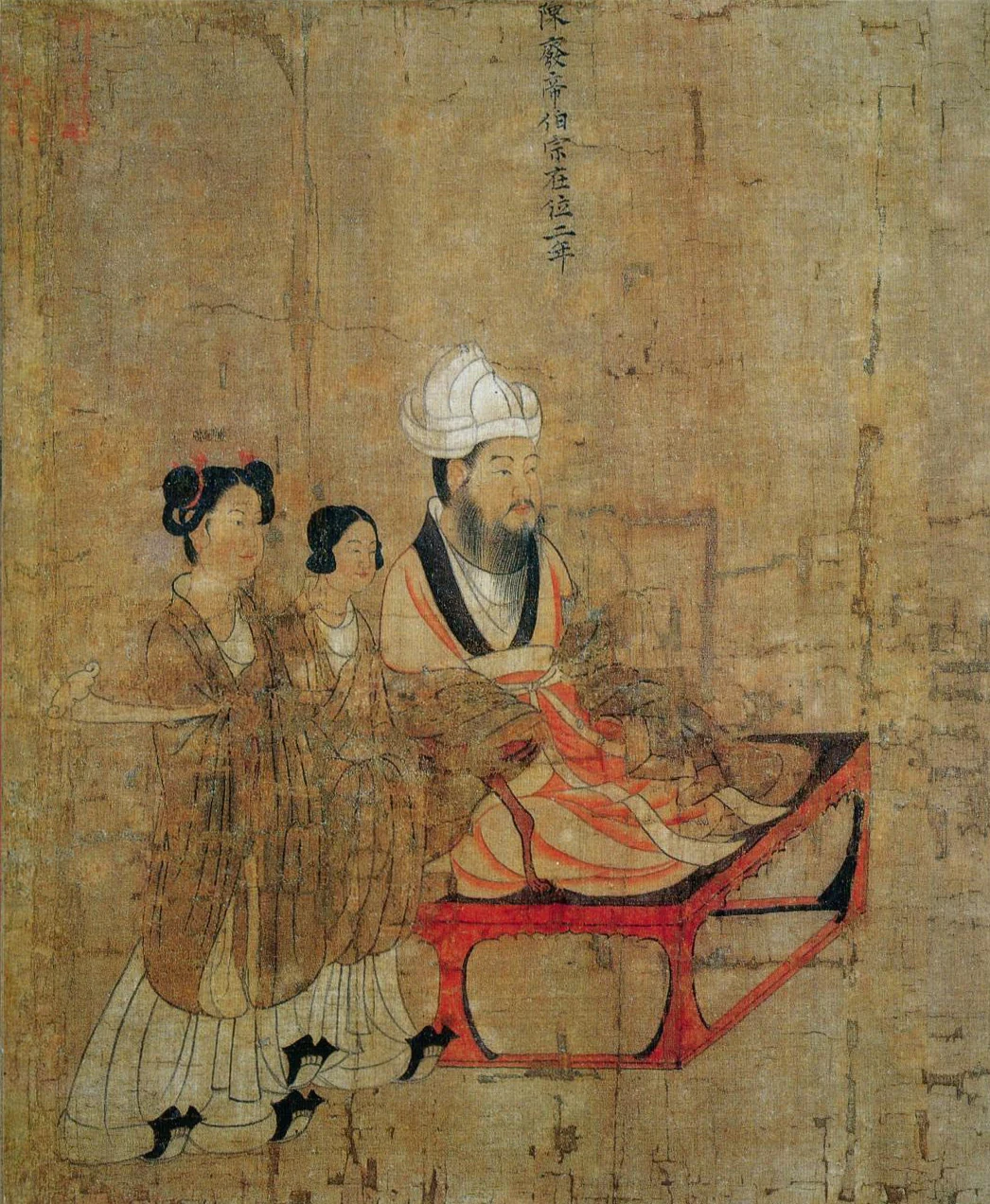
552 CE–570 CE
Emperor
Chen Bozong
陈伯宗
Chen Bozong (552 – April 22, 570), courtesy name Fengye and childhood name Yaowang, was the third emperor of the Southern Dynasties Chen dynasty and is known in history as the Deposed Emperor of Chen. He was the eldest legitimate son of Emperor Wen of Chen, Chen Qian, and Empress Ande Shen Miaorong. He ascended the throne in the fourth month of 566, the first year of the Tiankang era. Because he was young, political power…
552 CE–570 CEChen dynasty
PROFILE
Chen Bozong (552 – April 22, 570), courtesy name Fengye and childhood name Yaowang, was the third emperor of the Southern Dynasties Chen dynasty and is known in history as the Deposed Emperor of Chen. He was the eldest legitimate son of Emperor Wen of Chen, Chen Qian, and Empress Ande Shen Miaorong. He ascended the throne in the fourth month of 566, the first year of the Tiankang era. Because he was young, political power passed largely to his uncle Chen Xu, Prince of Ancheng. In the eleventh month of 568, the second year of the Guangda era, Chen Xu used the name of the empress dowager to depose him on the grounds that he was weak in character and incapable of bearing the burdens of rule; he was reduced to Prince of Linhai. He died in the fourth month of 570, aged nineteen according to one account and seventeen according to another, and was buried at present-day Xishanqiao in Nanjing.
- Alternative name
- Deposed Emperor of Chen
- Courtesy name
- Fengye
- Period
- Chen dynasty
- Date of Birth
- 552
- Date of Death
- April 22 570
- Dynasty / regime
- Chen dynasty
- Identity
- Emperor
- Ethnicity / ethnic affiliation
- Not recorded in historical sources
- Native place
- Not recorded in historical sources
- Place of birth
- Not recorded in historical sources
- Reign
- Not recorded in historical sources
- Predecessor
- Emperor Wen of Chen (Chen Qian)
- Successor
- Emperor Xuan of Chen (Chen Xu)
- Era name
- Guangda
- Temple name
- Not recorded in historical sources
- Posthumous name
- Deposed Emperor of Chen
- Major achievements
- Son of Emperor Wen of Chen who ascended the throne at a young age and was deposed by his uncle Chen Xu.
LIFE TIMELINE
Age 5 | At age five, enfeoffed as heir of the Prince of Linchuan.
Age 6 | At age six, Emperor Wu of Chen died and his father Chen Qian ascended the throne; in the eighth month Chen Bozong was made crown prince.
Age 13 | At age thirteen, Emperor Wen died and Chen Bozong ascended the throne in the front hall of Taiji Palace.
Age 14 | At age fourteen, adopted the era name Guangda; his uncle Chen Xu was promoted to Grand Tutor and permitted to enter court wearing sword and shoes.
Age 15 | At age fifteen, deposed in the eleventh month and reduced to Prince of Linhai; his uncle Chen Xu became Emperor Xuan of Chen.
Age 19 | At age nineteen, died in the fourth month and was buried at the tomb of the Deposed Emperor of Chen, also known as the tomb of the Prince of Linhai.
BIOGRAPHY
Biography
Family Background and Early Years
Chen Bozong belonged to the imperial house of Southern Chen and was the eldest legitimate son of Emperor Wen, Chen Qian. Historical sources contradict one another about his birth year. The “Annals of the Deposed Emperor” in the Book of Chen explicitly states that he was born on a gengyin day in the fifth month of the third year of the Liang Chengsheng era, June 20, 554. The same chapter, however, says that he was nineteen when he died in 570, which would imply a birth in 552. Later scholars, comparing the age of his full younger brother Chen Bomao, have considered 552 more likely.
During Chen Bozong's childhood the Liang dynasty was still in severe disorder. In 558, after Chen Baxian, Emperor Wu of Chen, had received the Liang abdication and become emperor, Chen Qian was enfeoffed as Prince of Linchuan. As Chen Qian's heir, Chen Bozong was appointed palace attendant and General Who Pacifies the East. On the fifth day of the second month that year he was formally made heir to the Prince of Linchuan. In 559 Emperor Wu died and Chen Qian ascended as Emperor Wen. On the twenty-sixth day of the eighth month Chen Bozong was made crown prince. Because former Liang palace buildings had been burned in warfare, the crown prince lived in the Yongfu compound.
Years as Crown Prince
In 560, the first year of the Tianjia era, Chen Bozong married Wang Shaoji, daughter of Wang Gu, a grand master of splendid happiness, as crown princess. He remained crown prince for about seven years. Historical sources describe him as benevolent but weak, lacking the bearing expected of a sovereign. Emperor Wen was worried that he would be unable to shoulder the succession. Because Chen Bozong was nevertheless the eldest legitimate son and deposition would have been a grave matter, Emperor Wen hesitated for years and ultimately took no action.
Accession and Loss of Power
On the twenty-seventh day of the fourth month in 566, the first year of the Tiankang era, Emperor Wen died and Crown Prince Chen Bozong ascended the throne in the front hall of Taiji Palace. He proclaimed a general amnesty, honored his grandmother Lady Zhang as grand empress dowager, and his mother Lady Shen as empress dowager. Because Chen Bozong was young, the late emperor's testament appointed his uncle Chen Xu, Prince of Ancheng, together with vice director Dao Zhongju, secretary Liu Shizhi, and others as regents.
A power struggle soon broke out among the regents. Liu Shizhi and Dao Zhongju had long lived within the palace and participated in decision-making, while Chen Xu, then governor of Yangzhou, entered the Department of State Affairs with 300 personal followers and grew steadily more powerful. Liu Shizhi feared him and falsely claimed there was an imperial order sending Chen Xu back to the eastern residence. On the advice of his adviser Mao Xi, Chen Xu saw through the maneuver, detained Liu on the pretext of illness, and sent Mao first to Empress Dowager Shen Miaorong and then to Chen Bozong to verify the alleged order. Chen Bozong said it had not been his idea. Chen Xu immediately imprisoned Liu Shizhi, entered the palace in person to explain Liu's fault to the empress dowager and emperor, and drafted an order sending Liu to the minister of justice for trial. Liu was ordered to die in prison that night.
From then on, large and small affairs of government were decided by Chen Xu. Chen Bozong was effectively stripped of authority and remained emperor in name only. In 567 the era name was changed to Guangda. Chen Xu was promoted to Grand Tutor while concurrently serving as Minister over the Masses and received the privilege of entering court wearing a sword and shoes, further increasing his authority. In the seventh month, the emperor's younger brothers Chen Bozhi and Chen Bomou were enfeoffed as Prince of Yongyang and Prince of Guiyang respectively.
Deposition and Death
In the eleventh month of 568, Chen Bozong's full younger brother Chen Bomao, Prince of Shixing, strongly resented Chen Xu's dominance and repeatedly spread claims that Chen Xu intended to depose the emperor. That same month Chen Xu launched a coup in the name of the grand empress dowager, declaring Chen Bozong too weak in character to bear imperial responsibility. Chen was deposed, reduced to Prince of Linhai, and sent back to a princely residence. Chen Bomao was simultaneously reduced to Marquis of Wenma, and Chen Xu sent assassins who killed him in his carriage.
Chen Xu then took the throne as Emperor Xuan of Chen. On an yimao day in the fourth month of the second year of the Taijian era, April 22, 570, Chen Bozong died, aged nineteen according to one reckoning and seventeen according to another. He was buried at present-day Xishanqiao in Nanjing. A large tomb discovered at Gongshan in 1960 has been identified by researchers as probably the tomb of the Deposed Emperor of Chen.
Major Activities
Power Struggle during His Reign
The central event of Chen Bozong's reign was the struggle within the regency. Liu Shizhi, Dao Zhongju, and other former ministers of Emperor Wen tried to limit Chen Xu's authority but failed. Assisted by Mao Xi, Chen Xu removed his opponents and took full control of government. The conflict ended with Liu Shizhi being forced to die and Dao Zhongju being demoted, after which no effective check remained on Chen Xu.
Deposition
Chen Bozong's deposition was an important event in Southern Dynasties politics. Chen Xu issued the deposition decree in the name of the grand empress dowager. The document asserted that Emperor Wen had possessed the insight to recognize talent and that his supposed intention to pass rule to a younger brother accorded with the moral example of Taibo yielding succession, thereby providing legitimacy for Chen Xu's accession. After his deposition Chen Bozong was reduced to Prince of Linhai and his son Chen Zhize became hereditary Prince of Linhai. The source compares Emperor Xuan's accession with the succession of Emperor Wen of Han after Emperor Hui and the young Han emperors.
Descendants and Family
Chen Bozong and Empress Wang Shaoji had one son, Chen Zhize, who was made crown prince in 567. After Chen Bozong's deposition, Chen Zhize was reduced to hereditary Prince of Linhai. After the Chen dynasty fell, Chen Zhize surrendered to the Sui and entered Chang'an. Chen Bozong had one full younger brother, Chen Bomao, and thirteen half-brothers in total, including Chen Boshan and others.
The chronology from his accession to his deposition is comparatively clear: born in 552 (first year of the Chengsheng era, Liang) as the eldest son of Chen Qian, Emperor Wen of Chen; in 558 (second year of Yongding) he was made heir of the Prince of Linchuan at the age of five; in 559, on the death of Emperor Wu and the accession of his father Chen Qian, he was made crown prince in the eighth month; in 566 (first year of Tiankang) he came to the throne at the age of thirteen in the Taiji Hall; in 567 (first year of Guangda) he changed the era name to Guangda and his uncle Chen Xu was made grand tutor with the privilege of entering the palace wearing sword and shoes; in the eleventh month of 568 (second year of Guangda) he was deposed as Prince of Linhai and Chen Xu took the throne as Emperor Xuan; in 570 (second year of Taijian) he died at nineteen and was buried in the Chen Deposed Emperor's mausoleum. During his reign the court was divided between the regency group and Chen Xu, and the edict of deposition was issued in the name of the grand empress dowager, showing that the coup rested procedurally on the authority of the inner palace.
By the practice of Southern Dynasties politics, one notable feature of this deposition was that the edict was issued in the name of the grand empress dowager: the old ministers of Emperor Wen, Liu Shizhi and Dao Zhongju among them, were removed first, after which the grand empress dowager Zhang Yaor received an edict in accordance with Chen Xu's wishes and deposed the emperor, Chen Xu taking the throne as Emperor Xuan. The deposed Chen Bozong was reduced to Prince of Linhai, dying at nineteen and being buried in the Chen Deposed Emperor's mausoleum. His brief reign shows how far the succession in the early Chen depended on the balance of forces between the regency group and the powerful princes of the imperial clan.
With Mao Xi's help Chen Xu removed Liu Shizhi, Dao Zhongju and the other old ministers of Emperor Wen and then completed the deposition and installation by an edict of the grand empress dowager; the step transferred the Chen throne from the line of Emperor Wen to that of Emperor Xuan, and his reduced rank as Prince of Linhai ceased to carry political meaning.
After his deposition his title and burial were handled with princely rites, and the Chen never restored his imperial title.
From crown prince to emperor and from emperor to deposed prince took less than six years in all.
Personal Relations
- Father: Chen Qian, Emperor Wen of Chen
- Mother: Shen Miaorong, Empress Ande
- Full younger brother: Chen Bomao, Prince of Shixing, killed by Emperor Xuan of Chen
- Half-brothers: Chen Boshan, Prince of Poyang; Chen Bogu, Prince of Xin'an; Chen Bogong, Prince of Jin'an; Chen Boxin, Prince of Hengyang; Chen Boren, Prince of Luling; Chen Boyi, Prince of Jiangxia; Chen Boli, Prince of Wuling; Chen Bozhi, Prince of Yongyang; Chen Bomou, Prince of Guiyang; and others
- Empress: Wang Shaoji, daughter of Wang Gu
- Son: Chen Zhize, hereditary Prince of Linhai
- Uncle: Chen Xu, Emperor Xuan of Chen; regent who later deposed Chen Bozong and took the throne
- Regent ministers: Dao Zhongju, vice director of the Department of State Affairs; Liu Shizhi, secretariat official who was ordered to die by Chen Xu
- Court associate: Mao Xi, adviser to Chen Xu who played a key role in the deposition crisis
Historical Assessment
Tang Dynasty / Early Historiography
- Yao Silian in the Book of Chen described the Prince of Linhai as benevolent and weak, unable to distinguish clearly between right and wrong and unmoved by gain or loss, comparing him with the legendary Emperor Zhi and Emperor Hui of Han. The passage argued that Emperor Wen understood the weight of the throne and doubted his son's ability to bear it.
- The Book of Chen also states that the emperor was benevolent and weak and lacked the qualities of a sovereign, and that Emperor Wen repeatedly worried he could not continue the dynasty but hesitated for years because deposition of the eldest legitimate son was a grave matter.
- Li Yanshou's History of the Southern Dynasties likewise described the Prince of Linhai as weak like Emperor Zhi and treated his deposition as difficult to avoid.
Song and Yuan Periods
- Sima Guang's Comprehensive Mirror in Aid of Governance gives a detailed account of Chen Bozong's deposition, compares Chen Xu's seizure of power with the story of Cao Shuang, and treats Chen Bozong's powerlessness and weakness with sympathy.
- Hu Sanxing, commenting on the Comprehensive Mirror, argued that Chen Xu's deposition of the emperor and seizure of the throne resembled repeated Southern Dynasties patterns of powerful ministers replacing rulers and that Chen Bozong was another puppet emperor.
Ming and Qing Periods
- Wang Fuzhi, in Reflections on Reading the Comprehensive Mirror, argued that Chen Bozong lost the throne because Emperor Wen had failed to deal with Chen Xu early enough. Responsibility therefore lay with Emperor Wen rather than with Bozong himself.
- Zhao Yi, in Notes on the Twenty-Two Histories, grouped Chen Bozong with other deposed youthful rulers of the Southern Dynasties and drew attention to the recurring pattern of child emperors being displaced by powerful ministers.
Modern Assessments
- Lü Simian, in History of the Jin and Northern and Southern Dynasties, regarded Chen Bozong's deposition as the inevitable result of internal power struggles within the Chen imperial clan; Chen Xu entered government as a regent-uncle and ultimately replaced the child ruler in accordance with common political practice of the period.
- Tian Yuqing and other scholars studying Southern Dynasties politics have treated the deposition as a crucial transition from Emperor Wen to Emperor Xuan and have argued that Chen Xu's rule prolonged the life of the dynasty.
- Modern historians generally consider Chen Bozong personally free of obvious major fault; his deposition is attributed principally to his youth, inability to control government, and a gentle and weak temperament that left him unable to protect himself in political struggle.
FIGURES ASSOCIATED WITH THIS DYNASTY
Bibliography
- Yao Silian, Book of Chen, vol. 4, “Annals No. 4: Deposed Emperor”
- Yao Silian, Book of Chen, vol. 7, “Biographies No. 1: Empresses”
- Li Yanshou, History of the Southern Dynasties, vol. 9
- Lü Simian, History of the Jin and Northern and Southern Dynasties