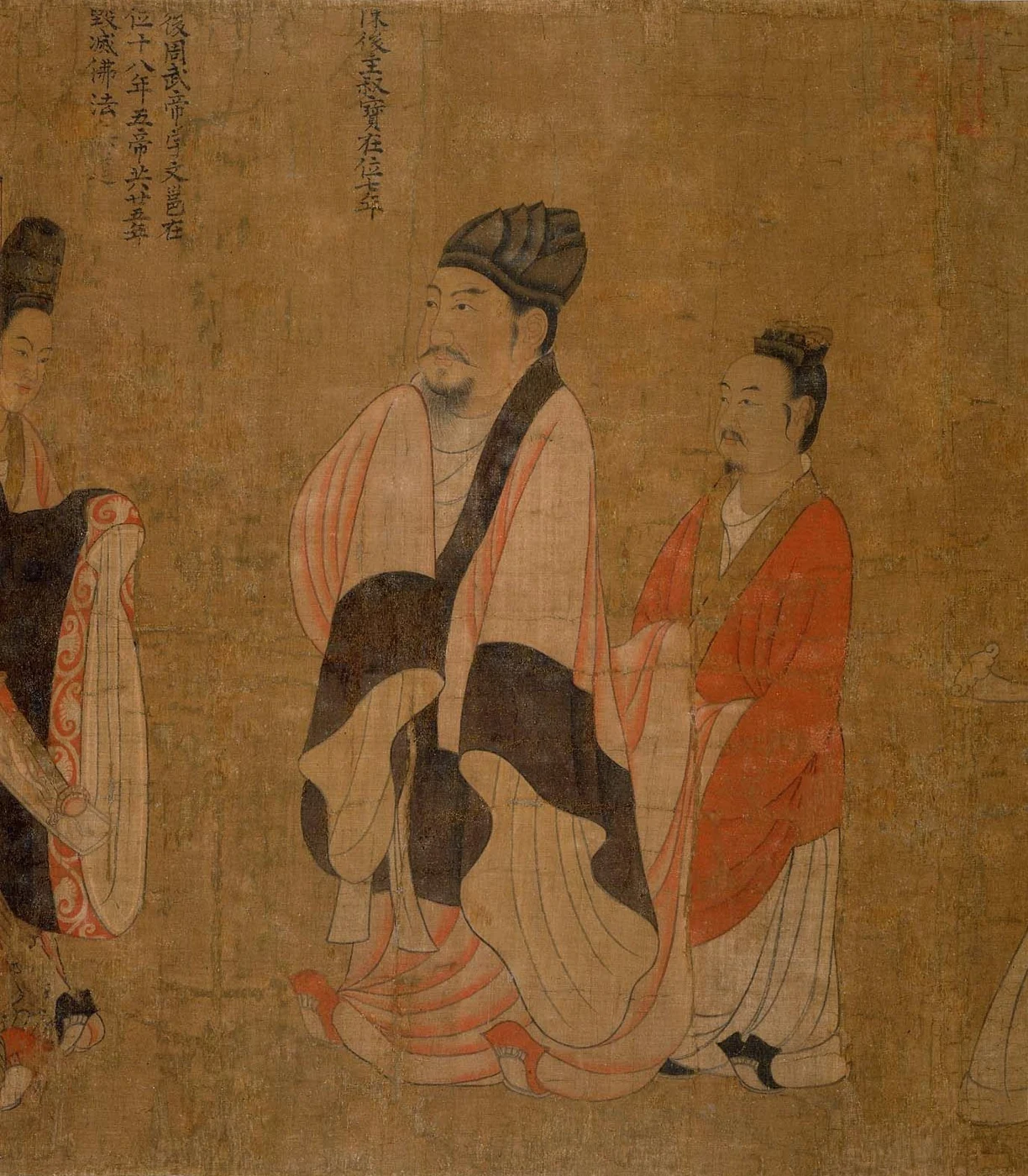
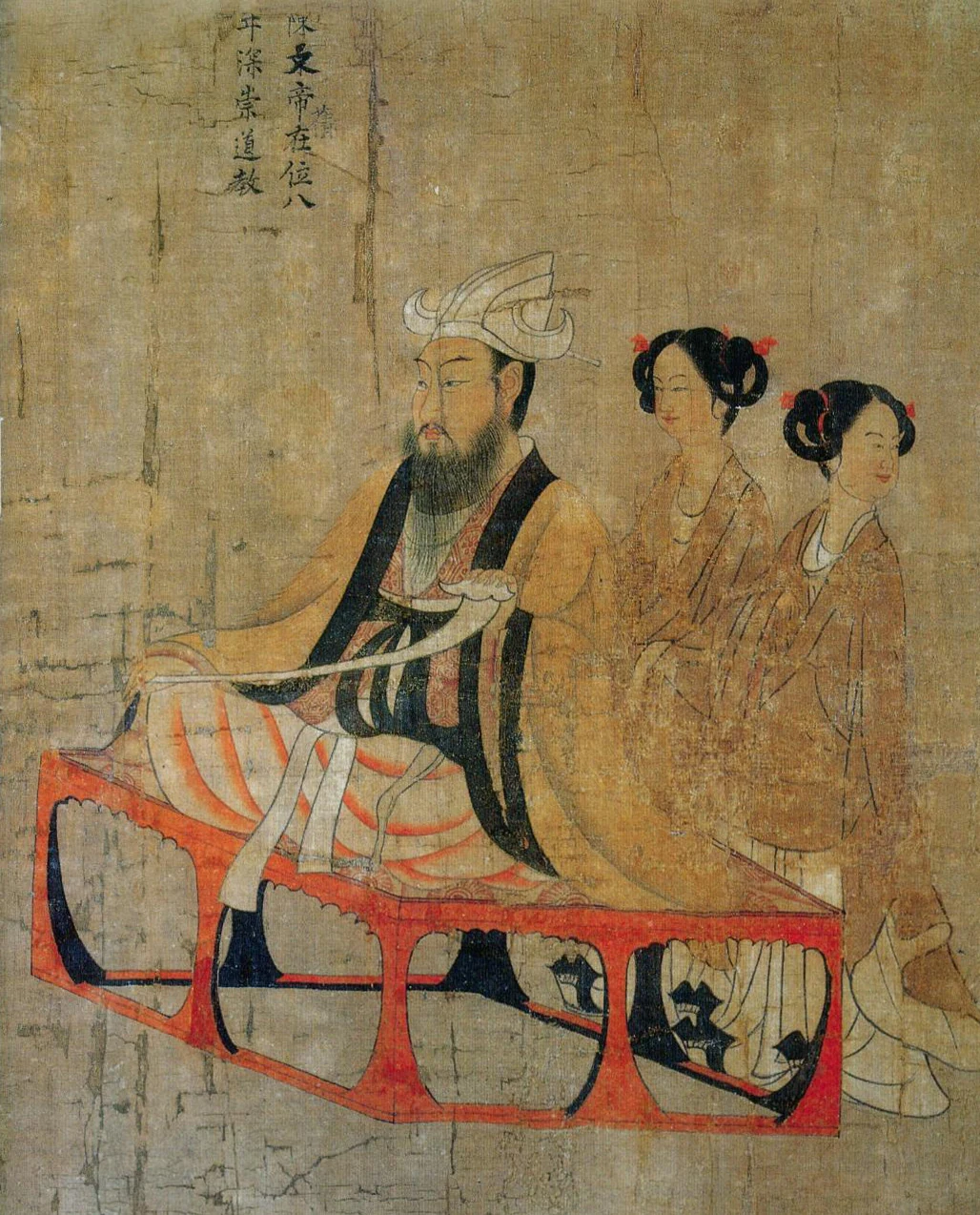
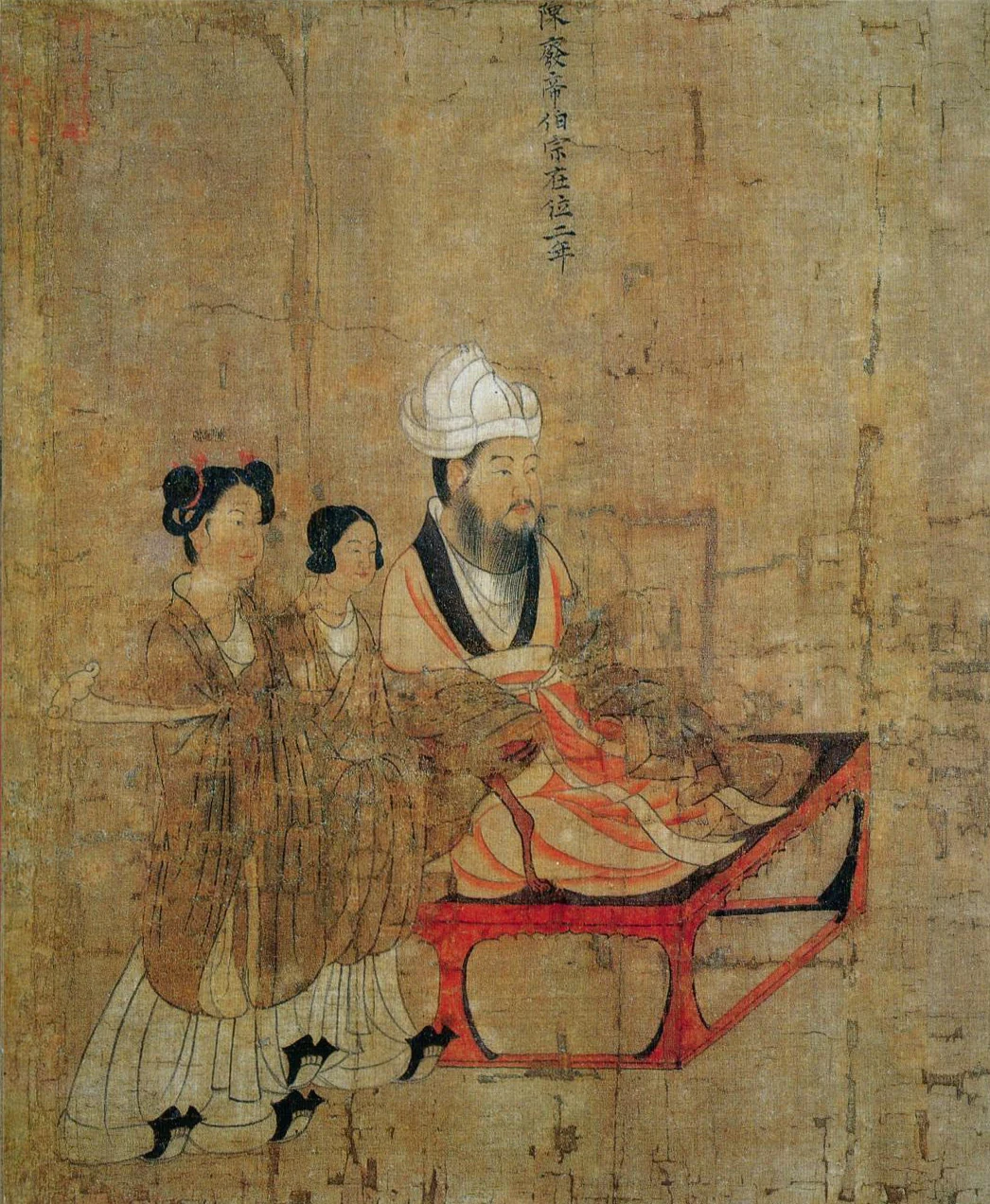
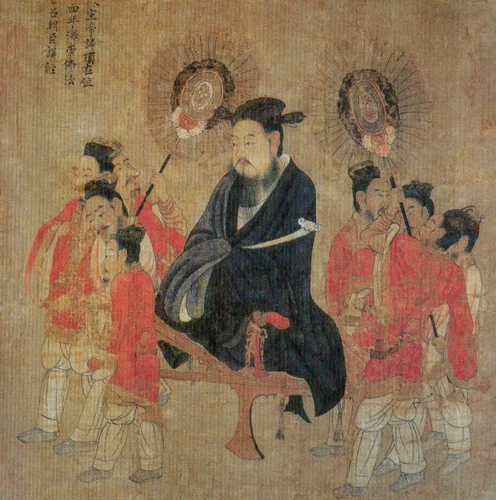
The Chen dynasty (557–589), the last regime of the Southern Dynasties, was founded by Chen Baxian after he replaced the Liang dynasty and established his capital at Jiankang. It was ruled in succession by Emperor Wu, Emperor Wen, Emperor Fei, Emperor Xuan, and the Later Ruler, for a total of about thirty-two years. The Chen court held only a corner of the Jiangnan region, and its territory was much smaller than that of the Liang. To the north it faced the powerful Northern Qi and Northern Zhou.…
557 CE–589 CECapital · See entry
ERA OVERVIEW
The Chen dynasty (557–589), the last regime of the Southern Dynasties, was founded by Chen Baxian after he replaced the Liang dynasty and established his capital at Jiankang. It was ruled in succession by Emperor Wu, Emperor Wen, Emperor Fei, Emperor Xuan, and the Later Ruler, for a total of about thirty-two years. The Chen court held only a corner of the Jiangnan region, and its territory was much smaller than that of the Liang. To the north it faced the powerful Northern Qi and Northern Zhou. During the reign of Emperor Xuan of Chen, northern campaigns brought some advances and reverses, but the state's strength remained limited. Under the Later Ruler of Chen, politics deteriorated and the treasury was depleted. In the ninth year of the Kaihuang era of Emperor Wen of Sui (589), Sui armies advanced south, Jiankang fell, and Chen Shubao was captured, bringing the Chen dynasty to an end. The fall of Chen ended the confrontation of the Northern and Southern Dynasties, reunited north and south, and returned China to political unification.
Time span557 CE–589 CE
CapitalSee entry
ERA TIMELINE
Chen Baxian accepted the Liang abdicatOpen
Chen Baxian accepted the Liang abdication, proclaimed himself emperor, and formally established the Chen dynasty.
Chen Baxian died and Chen Qian succeedOpen
Chen Baxian died and Chen Qian succeeded him.
Emperor Wen of Chen died and Chen BozoOpen
Emperor Wen of Chen died and Chen Bozong succeeded him.
Emperor Xuan of Chen took the throne, Open
Emperor Xuan of Chen took the throne, beginning the Taijian period of the dynasty.
Chen forces launched a northern expediOpen
Chen forces launched a northern expedition and gained parts of Huainan.
(third year of Zhenming; ninth yeaOpen
589 (third year of Zhenming; ninth year of Sui Kaihuang): Sui forces entered Jiankang, the Later Ruler of Chen was captured, and the Chen dynasty ended.
FULL ENTRY
Overview
The Chen dynasty (557–589), the last regime of the Southern Dynasties, was founded by Chen Baxian after he replaced the Liang dynasty and established his capital at Jiankang. It was ruled in succession by Emperor Wu, Emperor Wen, Emperor Fei, Emperor Xuan, and the Later Ruler, for a total of about thirty-two years. The Chen court held only a corner of the Jiangnan region, and its territory was much smaller than that of the Liang. To the north it faced the powerful Northern Qi and Northern Zhou. During the reign of Emperor Xuan of Chen, northern campaigns brought some advances and reverses, but the state's strength remained limited. Under the Later Ruler of Chen, politics deteriorated and the treasury was depleted. In the ninth year of the Kaihuang era of Emperor Wen of Sui (589), Sui armies advanced south, Jiankang fell, and Chen Shubao was captured, bringing the Chen dynasty to an end. The fall of Chen ended the confrontation of the Northern and Southern Dynasties, reunited north and south, and returned China to political unification.
Historical Development
Establishment: After the Hou Jing Rebellion at the end of the Liang dynasty, society was devastated. Chen Baxian raised troops in Lingnan to support the court and gradually gained control of the Liang government. In the second year of the Taiping era (557), Chen Baxian replaced Liang, proclaimed himself emperor, adopted Chen as the state name, and became Emperor Wu of Chen, with his capital at Jiankang.
Height: Under Emperor Wen of Chen and Emperor Xuan of Chen, father and son, political conditions were relatively stable. The court sought to improve official administration and reduce corvée and taxes, allowing some recovery of the Jiangnan economy. Taking advantage of disorder in Northern Qi, Emperor Xuan launched northern expeditions and for a time advanced into parts of Huainan. This may be regarded as the high point of Chen military power.
Turning point: In the later years of Emperor Xuan, the northern expeditions suffered setbacks. Northern Zhou took the opportunity to move south and seized the lands north of the Yangtze. Chen territory contracted to the south of the river, and militarily the dynasty shifted completely to the defensive.
Decline: After Chen Shubao, the Later Ruler of Chen, took the throne, he immersed himself in poetry, wine, music, and entertainment, neglected government, and favored palace women and sycophantic officials. The treasury was exhausted, military preparedness deteriorated, and government steadily declined.
Fall: In the ninth year of the Kaihuang era (589), Emperor Wen of Sui dispatched armies by several routes against Chen. Sui forces crossed the Yangtze and captured Jiankang. The Later Ruler was found hiding in a well and was captured, an episode associated with the story of the “Rouge Well.” The Chen dynasty fell, and the long confrontation between the Northern and Southern Dynasties ended.
Politics and Institutions
The central government largely inherited Liang institutions, including the Three Ducal Offices, the Department of State Affairs, the Secretariat, and the Chancellery, with the Department of State Affairs serving as the central organ for government business. Local administration continued to use a two-tier structure of provinces and commanderies, although the number of provinces increased while their jurisdictions gradually shrank. Official selection still operated broadly within the framework of the Nine-rank system, while the power of great aristocratic families declined and men of humbler status increasingly rose in government; practical ability gradually received greater weight in appointments. In law, the Chen court revised Liang law into a Chen legal code belonging to the Southern Dynasties legal tradition. Systems of supervision and official assessment largely followed earlier practice; details are treated in the relevant entries.
Military and Diplomacy
Military defense focused on the Yangtze and the areas immediately north of the river, with naval forces stationed at strongpoints along the river. Facing pressure from Northern Qi, Northern Zhou, and later Sui, the regime relied primarily on river defense. It launched two notable offensives but remained generally on the defensive. Diplomatically, Chen operated within the broader north–south confrontation. It exchanged envoys and formal notifications, including reports of deaths and mourning, with northern regimes, maintaining the formal relations of rival states, and at times attempted to exploit the rivalry between Northern Qi and Northern Zhou for its own security.
Economy and Commerce
Jiangnan was agriculturally fertile. After prolonged warfare, the reigns of Emperor Wen and Emperor Xuan emphasized recuperation, reductions in taxes and labor obligations, and encouragement of agriculture and sericulture. Agriculture and handicrafts such as shipbuilding and weaving recovered to some extent. Jiankang remained the political and economic center of the south, and commerce continued along the Yangtze. Before the fall of Chen, however, the treasury was empty and the currency system was disordered, signs of broader economic decline.
Culture and Society
Chen literary culture continued the traditions of the Southern Dynasties. Court poetry and literary gatherings flourished, and the Later Ruler of Chen was particularly devoted to literature, holding banquets and composing poetry with writers such as Jiang Zong, who were collectively described as his “intimate guests.” The social order in which aristocratic clans coexisted with people of humbler origin gradually loosened. Buddhism had long been deeply rooted among the people of the Southern Dynasties; temples were numerous under Chen and religious activity remained vigorous, as it had under Liang. Jiangnan society valued literature and the arts, although contemporary portrayals of the dynasty's final years describe increasingly extravagant social fashions.
> This section explains the position of individual rulers within the evolution of the regime; full biographies are provided in the corresponding person entities.
Historical Assessment and Legacy
Contemporary assessment: The Later Ruler of Chen was especially viewed by contemporary literati and later writers as a ruler whose indulgence contributed to the loss of the state. His devotion to poetry, wine, and entertainment and his neglect of military and governmental affairs were frequently blamed for the dynasty's fall. Chen Baxian, by contrast, was often praised for restoring order in Jiangnan and governing diligently, thereby laying the foundation of the Chen state.
Later historical assessment: Historians have often regarded Chen as the weakest of the Southern Dynasties and as a state whose limited southern base could not long withstand the movement toward political unification in the north. The governance of Chen Gaozu and Chen Shizu has nevertheless been regarded as providing a measure of recovery after warfare. The Sui conquest of Chen ended the north–south division that had continued for nearly three centuries since the late Western Jin and helped prepare the way for the unified Sui and Tang empires. Its successes and failures also became material for later historical reflection.