Born in Chang'an, celebrated in dynastic records for handsome bearing and childhood intelligence.
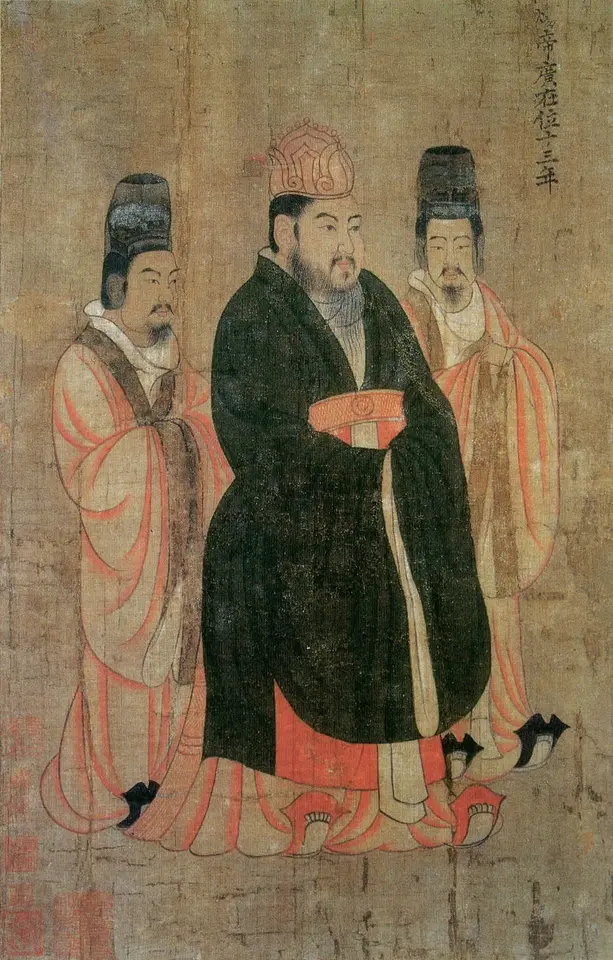
569 CE–618 CE
Historical figure
Yang Guang (杨广)
杨广
Yang Guang (杨广; 569 – April 11, 618), originally named Yang Ying (杨英), childhood moniker Aqiang (阿𡡉), was the second son of Emperor Wen of Sui (Yang Jian) and Empress Wenxian (Dugu Qieluo), and the second emperor of the Sui Dynasty, reigning from 604 to 618. Endowed with natural intelligence, handsome features, and remarkable literary brilliance, Yang Guang was created Prince of Jin at age thirteen, commanded the southern…
569 CE–618 CESui Dynasty (隋朝)
PROFILE
Yang Guang (杨广; 569 – April 11, 618), originally named Yang Ying (杨英), childhood moniker Aqiang (阿𡡉), was the second son of Emperor Wen of Sui (Yang Jian) and Empress Wenxian (Dugu Qieluo), and the second emperor of the Sui Dynasty, reigning from 604 to 618. Endowed with natural intelligence, handsome features, and remarkable literary brilliance, Yang Guang was created Prince of Jin at age thirteen, commanded the southern expedition that extinguished the Chen Dynasty at twenty, was designated Crown Prince in 600, and ascended the imperial throne in 604. During his reign, he dredged and constructed the Grand Canal of Sui, founded and transferred the capital to the Eastern Capital Luoyang, toured Zhangye in the northwest, personally subdued the Tuyuhun, undertook three campaigns against Goguryeo, and instituted the Jinshi examination, formally consolidating the imperial civil service examination system. However, his impetuous pursuit of grand projects, unbridled militarism, and relentless exaction of forced labor exhausted national strength, provoking massive agrarian rebellions that brought about his violent death and dynastic ruin. Yang Guang was also an accomplished poet whose works presaged the vibrant poetic styles of the Early Tang. Following the founding of the Tang Dynasty, Emperor Gaozu of Tang (Li Yuan) bestowed upon him the posthumous title Emperor Yang, conveying the moral condemnation of "indulging internal lusts, scorning ritual, and estranging the multitudes."
- Temple Name
- Recorded (世祖·西梁上庙号世祖,皇泰主上庙号世祖)
- Posthumous Name
- Emperor (炀皇帝·唐朝上谥·、明皇帝·隋代皇泰主上谥)
- Historical Identity
- Emperor (隋朝第二位皇帝、大一统君主、营建东都开凿大运河者)
- Historical Period
- Sui Dynasty (隋朝)
- Dynasty / Regime
- Sui Dynasty (隋朝)
- Era Names
- Regnal Eras (大业)
- Date of Birth
- 569 CE
- Date of Death
- 618-4-11 CE
- Age at Death
- 50 (50岁)
- Ancestral Home / Birthplace
- Historical Native Place (弘农华阴·今陕西省渭南市华阴市)
- Highest Office & Status
- Emperor (隋朝皇帝、天下共主)
- Major Offices & Titles
- Prince of Jin, Defender-in-chief, Crown Prince (雁门郡公、晋王、并州总管、淮南道行台尚书令、太尉、皇太子)
LIFE TIMELINE
Early Childhood
Created Duke of Yanmen Commandery in honor of his father Yang Jian's military achievements.
Age Thirteen
Created Prince of Jin, appointed Pillar of State and Area Commander-in-Chief of Bingzhou.
Age Eighteen
Transferred to Director of the Branch Department of State Affairs for Huainan Circuit; summoned as Shepherd of Yongzhou and Director of the Secretariat.
Age Twenty
Appointed Supreme Commander of Expeditionary Armies to conquer the Chen Dynasty.
Age Twenty-one
Extinguished the Chen Dynasty, entered Jiankang, sealed official storehouses without taking plunder, and was promoted to Grand Defender.
Age Twenty-two
Commissioned as Area Commander-in-Chief of Yangzhou, stationing at Jiangdu to govern and appease Jiangnan.
Age Thirty-two
Led forces through Lingwu against the Göktürks, returning without engagement; designated Crown Prince that winter.
Age Thirty-six
Ascended the imperial throne; forged a posthumous imperial edict to execute deposed Crown Prince Yang Yong.
Age Thirty-seven
Commenced construction of the Eastern Capital Luoyang, and dredged the Tongji Canal and Hangou Canal.
Age Thirty-nine
Toured Yulin in the north, commenced the Yongji Canal, and executed senior statesmen Gao Jiong and Heruo Bi.
Age Forty-one
Personally conducted a campaign against the Tuyuhun, establishing the four commanderies of Xihai, Heyuan, Shanshan, and Qiemo.
Age Forty-two
Dug the Jiangnan Canal, completing the entire Grand Canal network; embarked on his third pleasure tour to Jiangdu.
Age Forty-three
Mobilized vast armies for the conquest of Goguryeo; Wang Bo raised an agrarian insurrection, igniting nationwide rebellions.
Age Forty-four
First campaign against Goguryeo, suffering catastrophic defeat.
Age Forty-five
Second campaign against Goguryeo, aborted amid Yang Xuangan's armed revolt.
Age Forty-six
Third campaign against Goguryeo, withdrawing after Goguryeo sent tributary envoys suing for peace.
Age Forty-seven
Toured the Great Wall, besieged at Yanmen by Shibi Qaghan of the Göktürks.
Age Forty-eight
Undertook his final journey to Jiangdu, abandoning the north.
Age Fifty
Strangled in the Jiangdu Palace in a palace coup orchestrated by Yuwen Huaji, bringing the Sui Dynasty to an end.
Relationship graph
BIOGRAPHY
Biography
Family Background and Early Life
In 569 (fourth year of the Tianhe era of Northern Zhou), Yang Guang was born in Chang'an. His father, Yang Jian, then held the title of Duke of Sui in Northern Zhou, and his mother, Dugu Qieluo, was the daughter of Dugu Xin, Grand Minister of War of Northern Zhou. As the second son of Yang Jian and Dugu Qieluo, Yang Guang was endowed with a majestic countenance and quick intelligence, deeply beloved by his parents. During the Northern Zhou, in recognition of his father's illustrious military achievements, he was enfeoffed as Duke of Yanmen Commandery.
In 581 (first year of the Kaihuang era), Yang Jian replaced Northern Zhou to establish the Sui Dynasty; thirteen-year-old Yang Guang was created Prince of Jin, appointed Pillar of State, and made Area Commander-in-Chief of Bingzhou. Later, he was appointed General of the Left Militant Guard, promoted to Upper Pillar of State, and made Director of the Branch Department of State Affairs for Hebei Circuit. In 586 (sixth year of the Kaihuang era), he was transferred to Director of the Branch Department of State Affairs for Huainan Circuit, and that same year was summoned to the capital as Shepherd of Yongzhou and Director of the Secretariat. Displaying extraordinary intellect from his youth, Yang Guang was the most favored of the imperial sons.
Supreme Command in the Pacification of Chen and Command at Yangzhou
In the winter of 588 (eighth year of the Kaihuang era), Emperor Wen mobilized over five hundred thousand troops to march south and conquer the Chen Dynasty, designating the twenty-year-old Yang Guang as Supreme Commander of Expeditionary Armies, while actual strategic direction was handled by Chief of Staff Gao Jiong. Imperial forces advanced rapidly: Heruo Bi crossed at Jingkou, and Han Qinhu crossed at Caishi, taking the Chen defenses entirely by surprise. Following the extinction of Chen in 589, Yang Guang entered Jiankang. Desiring to take Chen Shubao's favorite consort, Zhang Lihua, into his household, he was thwarted when Gao Jiong executed her on the classical rationale that King Wu had executed Daji upon overthrowing the Shang; Yang Guang harbored deep displeasure toward Gao Jiong thereafter. Nevertheless, Yang Guang sealed all official storehouses and refused personal spoils, earning widespread acclaim across the realm upon his return, whereupon he was appointed Grand Defender.
Following the pacification of Chen, the Sui court enforced household registrations and rural administrative reforms across Jiangnan; however, insensitive policies provoked widespread armed unrest. In 590 (tenth year of the Kaihuang era), massive uprisings erupted across former Chen territories, with rebel bands ranging from thousands to tens of thousands. Emperor Wen ordered Yang Su to lead punitive campaigns, which suppressed the insurrection only after over a hundred fierce engagements. Yang Guang was subsequently appointed Area Commander-in-Chief of Yangzhou, stationing at Jiangdu with the mission to pacify Huaihai and civilize the southern populations. During his tenure, Yang Guang treated local elites with great courtesy, conducted himself with modest simplicity, abstained from ostentation, and delivered outstanding administrative governance, earning universal praise and accumulating vital political capital for his eventual bid for imperial succession.
Intrigues for Succession and Accession
Yang Guang's elder brother, Crown Prince Yang Yong, was generous, upright, and straightforward, disdaining pretension. However, Yang Yong doted upon his concubine Lady Yun while neglecting his primary consort, Lady Yuan; when Lady Yuan died suddenly of illness, Empress Dugu suspected foul play and grew bitterly estranged from Yang Yong. Learning of his mother's displeasure, Yang Guang engaged in deliberate self-cultivation and theatrical deception: he kept only a token number of concubines, cohabiting exclusively with Princess Xiao, rode unadorned carriages, and treated visiting ministers with utmost humility, establishing an immaculate reputation among imperial princes. Before Empress Dugu, he wept disconsolately whenever departing for his post, pretending that Yang Yong was plotting to poison him. Empress Dugu gradually resolved to replace the crown prince.
Plotting secretly with his confidant Zhang Heng, Yang Guang dispatched Yuwen Shu to befriend Yang Yue, younger brother of Chief Minister Yang Su. Discerning Empress Dugu's determination, Yang Su aligned himself with Yang Guang. In 600 (twentieth year of the Kaihuang era), Yang Guang bribed the crown prince's favorite retainer, Ji Wei, to denounce Yang Yong for treasonous arrogance. Manipulating imperial judicial procedures, Yang Su forged damning indictments, prompting Emperor Wen to issue an edict deposing Yang Yong to commoner status and elevating Yang Guang as Crown Prince. That same year, when the Göktürks invaded the northern frontier, Yang Guang led forces out of Lingwu, returning without enemy engagement.
In the seventh month of 604 (fourth year of the Renshou era), Emperor Wen fell critically ill at Renshou Palace and passed away under contested circumstances, whereupon Yang Guang ascended the throne. He immediately forged a posthumous imperial edict ordering the execution of the deposed Crown Prince Yang Yong. The following year, his younger brother Yang Liang, Prince of Han, raised an insurrection in Bingzhou under the pretext of punishing Yang Su; Yang Guang dispatched Yang Su to suppress the revolt, and Yang Liang was captured and imprisoned for life. Soon thereafter, Yang Guang poisoned Yang Yong's sons, entirely eliminating domestic dynastic rivals.
Monumental Enterprises and Autocratic Tyranny
Upon ascending the throne, Yang Guang instituted vast labor mobilizations year after year. In 605 (first year of the Daye era), he decreed the construction of the Eastern Capital Luoyang, mobilizing two million laborers per month and completing the project in ten months. The capital was magnificent in scale, spanning over fifty li in perimeter, divided into the Palace City, Imperial City, and Outer City, housing over a hundred residential wards alongside three massive commercial markets. Compulsory migrations from across the empire swelled Luoyang's population past one million, creating the first metropolis of such scale in human history.
That same year, Yang Guang ordered the construction of the Grand Canal. Centered upon Luoyang, the canal system comprised three principal sections: the central section comprising the Tongji Canal and Hangou Canal, connecting Luoyang southeastward to the Huai River and south to Jiangdu and the Yangtze River; the southern section comprising the Jiangnan Canal, linking Jingkou to Yuhang; and the northern section comprising the Yongji Canal, running from Luoyang north to Zhuojun. Constructed in stages over five years, the canal network extended over 2,700 kilometers. In 607 and 608, Yang Guang mobilized 1.2 million laborers to reconstruct the Great Wall east of Yulin, resulting in over fifty percent mortality among workers. Across his decade of rule, labor levies disrupted over ten million peasant lives, reducing vast regions to devastation.
In 609 (fifth year of the Daye era), Yang Guang personally conducted a military campaign against the Tuyuhun, achieving decisive triumph and establishing the four frontier commanderies of Xihai, Heyuan, Shanshan, and Qiemo, expanding imperial territory by five thousand li. King Qu Boya of Gaochang journeyed to Zhangye to submit homage. At this pinnacle, the Sui Empire encompassed 190 commanderies, 1,255 counties, 8.9 million registered households, and a population exceeding 46 million.
In 611 (seventh year of the Daye era), Yang Guang commenced preparations for the invasion of Goguryeo. In 612 (eighth year of the Daye era), he mobilized 1.13 million combat soldiers and two million civilian laborers for the first expedition, massing land forces at Zhuojun and naval squadrons at Donglai. Although Sui forces reached the vicinity of Pyongyang, the expedition ended in catastrophic annihilation. In 613 (ninth year of the Daye era), during the second campaign, Minister of Rites Yang Xuangan raised an armed rebellion within the empire, compelling Yang Guang to abort the siege of Liaodong and execute a frantic withdrawal. In 614 (tenth year of the Daye era), he launched a third campaign; exhausted by warfare, Goguryeo dispatched tributary envoys sueing for peace, allowing Yang Guang to withdraw. The three campaigns mobilized millions of soldiers and laborers, inflicting immense human casualties and shattering the agrarian economy, directly detonating the nationwide agrarian insurrections of the late Sui.
Imperial Progresses and Dynastic Downfall
Throughout his reign, Yang Guang undertook lavish imperial progresses, traveling three times to Jiangdu, twice to the northern frontier, once to Hexi, and three times to Zhuojun. During his progresses to Jiangdu, his imperial flotilla transported over a hundred thousand imperial princes, ministers, consorts, and court ladies, stretching over two hundred li along the waterways. His four-storied dragon barge stood forty-five feet high, fifty feet wide, and two hundred feet long. Prefectures along the route within five hundred li were coerced into supplying lavish provisions, squandering colossal state wealth. To project dynastic grandeur, each New Year he commanded expansive theatrical spectacles staged outside the Duanmen Gate in Luoyang, spanning eight li and mobilizing thirty thousand performers.
In 615 (eleventh year of the Daye era), during an inspection of the northern Great Wall, Shibi Qaghan of the Göktürks ambushed and encircled Yang Guang at Yanmen. Trapped with fifteen thousand defenders and scarce provisions, Yang Guang wept openly until relief armies arrived and Princess Yicheng sent false intelligence of northern border emergencies to persuade Shibi to lift the siege.
In 616 (twelfth year of the Daye era), Yang Guang traveled south to Jiangdu, never to return north. By then, widespread insurrections led by the Wagang Army, Dou Jiande, and other rebel coalitions swept across the Central Plains, while Li Yuan revolted at Taiyuan. Yang Guang retreated into drunken indulgence and escapism in Jiangdu. In the third month of 618 (fourteenth year of the Daye era), Palace Guard commanders led by Yuwen Huaji orchestrated a mutiny, strangling Yang Guang within the Jiangdu Palace and extinguishing the Sui Dynasty.
Major Achievements
Political Institutions and the Grand Canal
Yang Guang formally consolidated the imperial civil service examination system as enduring state policy. By introducing the Jinshi examination, testing literary composition and policy essays, he diminished the aristocratic monopoly of the Guanlong military-bureaucratic elite, broadening the social base of imperial administration. The imperial civil service examination system endured for over 1,300 years until its abolition in 1905, leaving a profound institutional imprint on East Asian governance. He also enlisted southern scholars, such as Yu Shiji and Pei Yun, into senior administrative posts to counterbalance northern aristocratic clans.
Yang Guang constructed the Eastern Capital Luoyang as the political, strategic, and economic hub of the empire. He dredged and constructed the expansive Sui Grand Canal, centered upon Luoyang and connecting Zhuojun in the north with Yuhang in the south, extending over 2,700 kilometers. Linking the Qiantang, Yangtze, Huai, Yellow, and Hai river networks, the Grand Canal established the logistical foundation for north-south economic and cultural integration that sustained subsequent dynasties, notably the Tang and Song. In 609, he subdued the Tuyuhun and established the four western commanderies of Xihai, Heyuan, Shanshan, and Qiemo, securing the Hexi corridor and advancing border garrisons and military colonies.
Military Campaigns
In his youth, Yang Guang participated in campaigns against the Göktürks and Khitans, acquiring military renown. As emperor, he launched military expeditions against Goguryeo, the Tuyuhun, and the northern nomadic confederacies. His 609 campaign against the Tuyuhun expanded the empire's frontiers by five thousand li. However, his three expeditions against Goguryeo ended in strategic failure: the first in 612 suffered disastrous losses; the second in 613 was aborted due to Yang Xuangan's domestic insurrection; and the third in 614 concluded with an empty formal submission. The tremendous human and material drain of these campaigns provoked the late Sui agrarian insurrections. In 615, his northern tour resulted in the humiliating siege of Yanmen by Shibi Qaghan.
Literary Achievements
Possessing exceptional literary brilliance, Yang Guang was a leading figure in the literature of the Sui Dynasty. His poetry presaged the tonal elegance and vibrant thematic range of the Early Tang, holding a recognized position in classical Chinese literary history. He excelled in frontier and landscape verse characterized by refined diction, helping guide southern poetic traditions toward greater vigor. In Luoyang, he sponsored significant literary and cultural circles, patronizing numerous scholars.
Monumental Engineering and Palace Construction
Yang Guang engaged in extensive architectural undertakings, building the Eastern Capital Luoyang, multiple imperial travel palaces, the Grand Canal, and the Great Wall. Among his famous palace complexes was the Western Park west of Luoyang, encompassing over two hundred li with artificial lakes, islands, and opulent pavilion complexes. He also commissioned fleets of thousands of luxury vessels, including multi-deck dragon barges, to support his imperial progresses. These colossal construction enterprises imposed crushing burdens upon the empire's populace, accelerating social collapse.
In administrative institutions, he reorganized central organs into the Five Departments, Three Directorates, Five Directorates of Education and Manufactures, Twelve Guards, and Sixteen Headquarters. In legal reform, he promulgated the Daye Code, mitigating harsh penalties from the late Kaihuang reign by removing the "Ten Abominations" and reducing severe corporal punishments. However, as widespread rebellion intensified, he abandoned legal restraints, instituting draconian summary executions that aggravated social turmoil.
Relationships
- Father: Yang Jian, Emperor Wen of Sui, founder of the dynasty.
- Mother: Dugu Qieluo, Empress Wenxian.
- Elder Brother: Yang Yong, deposed Crown Prince, executed following Yang Guang's accession.
- Younger Brother: Yang Liang, Prince of Han, rebelled in Bingzhou and was imprisoned until death.
- Consort: Empress Xiao, Empress Xiao of Sui.
- Eldest Son: Yang Zhao, Crown Prince Yuande, died prematurely.
- Second Son: Yang Jian, Prince of Qi.
- Grandsons: Yang Tong, Prince of Yue, enthroned as Emperor at Luoyang; Yang You, Prince of Dai, enthroned by Li Yuan at Chang'an.
- Gao Jiong: Senior Chief of Staff during the conquest of Chen, later executed for criticizing Yang Guang's extravagance.
- Yang Su: Powerful chief minister who aided Yang Guang's succession plot and suppressed Yang Liang's revolt.
- Zhang Heng: Trusted confidant who assisted in the succession plot.
- Yuwen Shu: Key participant in the succession intrigue and senior general.
- Yu Shiji: Southern statesman, trusted minister during Yang Guang's reign.
- Pei Yun: Southern statesman, prominent official under Yang Guang.
- Chen Shubao: Last ruler of the Southern Chen Dynasty, captured during the conquest.
- Shibi Qaghan: Göktürk ruler who besieged Yang Guang at Yanmen.
- Gao Yuan: Ruler of Goguryeo, target of the three military campaigns.
- Yuwen Huaji: Palace Guard general who led the mutiny that assassinated Yang Guang.
- Yang Xuangan: Minister of Rites who raised an armed rebellion during the second Goguryeo campaign.
- Li Yuan: Maternal cousin, founder of the Tang Dynasty, who bestowed the posthumous title Emperor Yang.
- Dou Jiande: Northern rebel leader who honored Yang Guang with the posthumous title Emperor Min.
Historical Evaluation
Tang Dynasty and Contemporary Era
- Emperor Gaozu of Tang (Li Yuan) bestowed the posthumous title "Emperor Yang," drawing upon traditional posthumous designations that signified "indulging internal lusts, scorning ritual, and alienating the multitudes."
- Emperor Taizong of Tang (Li Shimin) observed that Emperor Yang indulged insatiable desires and silenced remonstrating officials to mask his errors, citing his fall as the paramount historical warning for rulers.
- Wei Zheng, chief compiler of the Book of Sui, condemned Yang Guang for abusing vast wealth and indulging bottomless desires, yet conceded that he possessed strategic brilliance and was no ordinary dullard.
- Wu Jing, in Essentials of Governance of the Zhenguan Era, extensively documented Emperor Taizong's use of Emperor Yang as a cautionary mirror for dynastic survival.
Song and Yuan Dynasties
- Sima Guang, in Comprehensive Mirror for Aid in Government, critiqued Yang Guang for exploiting national riches to satisfy private desires, while recording his achievements in constructing the Grand Canal and Luoyang.
- Neo-Confucian philosopher Zhu Xi condemned Yang Guang for exhausting human life and precipitating his own destruction through unbridled hedonism.
- Ma Duanlin, in Comprehensive Examination of Literature, affirmed the historical importance of the Jinshi examination, noting that Yang Guang's innovation in civil recruitment was institutional progress.
Ming and Qing Dynasties
- Ming thinker Li Zhi offered a nuanced appraisal, acknowledging his cruelty while recognizing his grand imperial vision.
- Zhao Yi, in Notes on the Twenty-Two Dynastic Histories, argued that Emperor Yang brought about dynastic ruin through impatient overreach, yet highlighted that monumental infrastructure like the Grand Canal conferred enduring benefits upon subsequent centuries.
- Qing philosopher Wang Fuzhi severely denounced Yang Guang for treating the entire realm as an instrument for private pleasure, while acknowledging his exceptional intellectual agility.
Modern and Contemporary Eras
- Modern historian Fan Wenlan characterized Yang Guang as an autocratic tyrant, while underscoring that the Grand Canal provided fundamental infrastructure for China's subsequent economic and cultural development.
- Cen Zhongmian evaluated Yang Guang as possessing extraordinary talent without commensurate moral restraint, attributing his downfall to megalomania and disregard for civilian welfare.
- Ray Huang, adopting a macro-historical perspective, argued that while Yang Guang's structural projects were visionary, their scale exceeded the economic carrying capacity of seventh-century Chinese society, provoking dynastic collapse. Contemporary historians broadly view Yang Guang as an ambitious and capable yet impatient and ruthless monarch whose accomplishments and catastrophic failures remain deeply intertwined.
Related Entries
- Yang Jian
- Dugu Qieluo
- Yang Yong
- Yang Liang
- Empress Xiao
- Gao Jiong
- Yang Su
- Zhang Heng
FIGURES ASSOCIATED WITH THIS DYNASTY
Bibliography
- Wei Zheng et al., Book of Sui, Volume 3–4, Basic Annals 3–4: Annals of Emperor Yang.
- Sima Guang, Comprehensive Mirror for Aid in Government, Volumes 177–185, Sui Records.
- Fan Wenlan, A Concise History of China.