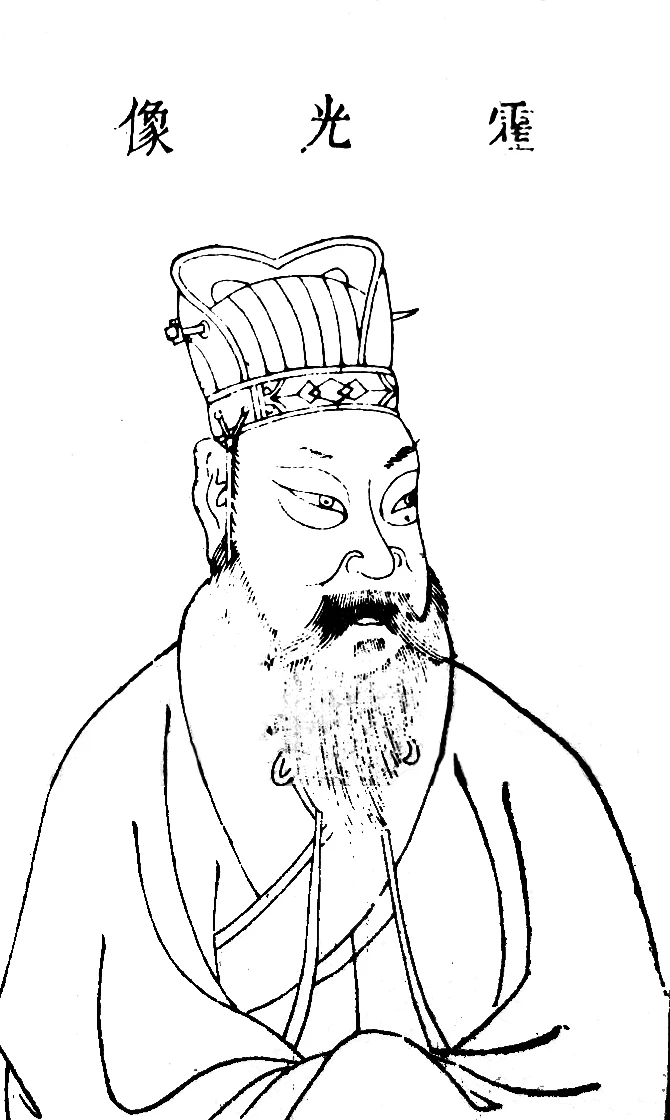
Biography
Family Background and Early Years
Huo Guang came from an ordinary family of minor officials in Pingyang County, Hedong Commandery (present-day Linfen, Shanxi). His father Huo Zhongru was a minor county clerk. Around 141 BCE, stated in the source as the third year of the Houyuan era, Huo Zhongru was sent to serve in the household of the Marquis of Pingyang and had an illicit relationship with Wei Shao'er, daughter of the maid Wei Ao, producing a son, Huo Qubing. After completing his service, Huo Zhongru returned home, married another woman, and fathered Huo Guang, thereafter losing contact with Wei Shao'er.
In 121 BCE, the second year of the Yuanshou era, Huo Qubing was appointed General of Swift Cavalry and passed through Hedong while campaigning against the Xiongnu. There he met his biological father Huo Zhongru, purchased extensive fields, houses, servants, and slaves for him, and then departed. On his victorious return he visited again and brought his paternal half-brother Huo Guang, then only in his early teens, to Chang'an. With Huo Qubing's support, Huo Guang first became a gentleman attendant and was later promoted through several palace offices, including Palace Attendant. In 117 BCE, the sixth year of the Yuanshou era, Huo Qubing died at only twenty-four. Huo Guang was thereafter promoted to Commandant of the Imperial Carriages and Grand Master of Splendid Happiness, serving close to Emperor Wu. He was cautious in conduct and, despite entering and leaving the inner palace for more than twenty years, was said never to have committed a fault, earning Emperor Wu's deep trust.
Late Reign of Emperor Wu: Entrusted with the Young Heir
In 91 BCE, the second year of the Zhenghe era, Crown Prince Liu Ju was falsely accused by Jiang Chong and forced into rebellion during the Witchcraft Crisis of 91 BCE; after defeat, he committed suicide. Having lost the crown prince late in life, Emperor Wu deliberated for years before deciding to make Liu Fuling, son of Lady Gouyi, his heir. After carefully observing his ministers, the emperor concluded that Huo Guang alone was capable of bearing the chief responsibility for a regency. He therefore ordered a palace painter to make a picture of the Duke of Zhou assisting King Cheng at court with the feudal lords and presented it to Huo, signaling that Huo would be expected to play the role of the Duke of Zhou.
In 88 BCE, the first year of the Houyuan era, Palace Attendant and Vice Director Mang Heluo and his younger brother Mang Tong, Marquis of Chonghe, conspired to assassinate Emperor Wu. Jin Midi stopped the attempt on the spot. Huo Guang, Jin Midi, and Shangguan Jie then led troops in eliminating the remaining conspirators and won merit.
In the spring of 87 BCE, the second year of the Houyuan era, Emperor Wu became gravely ill. Huo, in tears, asked about the succession. The emperor said, “Have you still not understood the meaning of the earlier painting? Establish the young son, and you are to act as the Duke of Zhou.” Huo modestly declined and recommended Jin Midi, who replied that as a man of foreign origin he was less suitable than Huo. Emperor Wu therefore appointed Huo Guang Grand Marshal and General-in-Chief, Jin Midi General of Chariots and Cavalry, Shangguan Jie General of the Left, and Sang Hongyang Censor-in-chief. Together with Grand Councilor Tian Qianqiu, they received the final command to assist the young ruler. The next day Emperor Wu died, and the eight-year-old Liu Fuling ascended the throne as Emperor Zhao of Han. Major affairs of government were thereafter decided by Huo Guang.
Reign of Emperor Zhao: Dominance at Court
After Emperor Zhao ascended the throne, Huo was enfeoffed as Marquis of Bolu for his role under Emperor Wu's final command. At the time, Wang Hu, son of the Commandant of the Guards Wang Mang, publicly claimed that the alleged final command granting marquisates was false. Huo severely reprimanded Wang Mang, who was forced to poison Wang Hu.
Someone advised Huo to learn from the destruction of the Lü clan by employing imperial kinsmen and consulting other senior ministers in state affairs. Huo agreed. He appointed Liu Biqiang, grandson of Liu Jiao, Prince Yuan of Chu, as Commandant of the Guards of Changle Palace, and the imperial clansman Liu Changle as Grand Master of Splendid Happiness.
Huo was said to be calm, deliberate, and meticulous. He stood seven chi and three cun tall, approximately 1.68 meters, had a fair complexion, open brows and eyes, and an attractive beard. Each time he entered or left the palace, the places at which he stopped and walked reportedly varied not by the slightest amount, illustrating his disciplined nature. After Emperor Zhao's accession, government orders came from Huo, and people throughout the realm placed high expectations on him. Huo was linked by marriage to his fellow regents Jin Midi and Shangguan Jie. Jin Midi's second son Jin Shang married one of Huo's daughters, while Shangguan Jie's son Shangguan An married Huo's eldest daughter, and their daughter was Lady Shangguan. In 83 BCE, the fourth year of the Shiyuan era, Shangguan An, through the influence of the Grand Princess of Gai, had the six-year-old Lady Shangguan brought into the palace as a palace consort; a few months later she was made empress. In return, Shangguan Jie and his son sought a marquisate and the office of Grand Master of Splendid Happiness for Ding Wairen, the princess's lover, but Huo rejected both requests. Under Emperor Wu, Shangguan Jie had already ranked among the Nine Ministers and had stood above Huo. Now both father and son were generals and enjoyed the status of close relatives of the empress, yet they remained constrained by Huo. The two sides therefore became political enemies.
Sang Hongyang had disagreed politically with Huo at the Salt and Iron Debate and was also angered when Huo appointed his own associate Yang Chang as Grand Minister of Agriculture, thereby encroaching on Sang's fiscal authority. Sang consequently joined the anti-Huo faction. Liu Dan, Prince of Yan and an elder brother of Emperor Zhao, also harbored resentment. Shangguan Jie and his son allied with the Grand Princess of Gai, Liu Dan, and Sang Hongyang. In Liu Dan's name they submitted a memorial accusing Huo of drilling troops, arbitrarily increasing military officers, and plotting treason. Emperor Zhao, only fourteen, recognized the memorial as fraudulent, publicly defended Huo, and ordered the author arrested. Shangguan Jie and others repeatedly slandered Huo thereafter, prompting the emperor to declare angrily: “The General-in-Chief is a loyal minister. The former emperor entrusted him with assisting me. Anyone who dares slander him is to be punished according to law.”
Unable to remove Huo through Emperor Zhao, Shangguan Jie and his allies plotted to have the Grand Princess of Gai invite Huo to a banquet and kill him with troops in ambush, then depose the emperor and enthrone Liu Dan, Prince of Yan. The conspiracy was exposed. Huo exterminated the clans of Shangguan Jie and his son, Sang Hongyang, and Ding Wairen, while the Grand Princess of Gai and Liu Dan committed suicide. Huo's authority thereafter awed the empire, and he became the effective decision-maker in government. Even after Emperor Zhao's coming-of-age ceremony, the emperor continued to entrust affairs to Huo. During the thirteen years of this regime, the population prospered and surrounding peoples submitted; it was later regarded as the foundation of the Zhao–Xuan Restoration.
Enthronement and Deposition of the Prince of Changyi
In the fourth month of the summer of 74 BCE, the first year of the Yuanping era, Emperor Zhao died at only twenty-two and left no son. Of Emperor Wu's six sons, only Liu Xu, Prince of Guangling, remained alive. Many ministers favored enthroning him, but Liu Xu had long been known for improper conduct and had been rejected by Emperor Wu. A gentleman attendant submitted a memorial citing precedents in which King Tai of Zhou passed over Taibo for Wang Ji and King Wen passed over Bo Yikao in favor of King Wu, arguing that an elder could be set aside for a younger heir and that the Prince of Guangling was unfit to inherit the ancestral temples. Huo strongly agreed and on that very day, acting under an edict of the empress dowager, summoned Liu He, Prince of Changyi, to take the throne.
Liu He ascended the throne in the sixth month. Even while traveling to the capital, however, he sent men to seize women and property from common people. After accession he distanced senior ministers, promoted former members of his Changyi entourage, behaved licentiously, drank and made merry during mourning, and had sexual relations with women of Emperor Zhao's palace. In twenty-seven days he reportedly issued 1,127 orders. Deeply troubled, Huo sought advice from Grand Minister of Agriculture Tian Yannian. Tian cited the precedent of Yi Yin deposing Taijia and recommended removing the emperor. Huo then secretly consulted General of Chariots and Cavalry Zhang Anshi and summoned the Grand Councilor, Censor, generals, marquises, officials of the two-thousand-shi rank, grandees, and erudites to meet at Weiyang Palace. Tian Yannian, sword in hand, argued forcefully for deposition, and the assembled ministers all bowed their heads and declared that they would follow the General-in-Chief's command.
Huo and the ministers then went together to Empress Dowager Shangguan and presented the reasons Liu He was unfit to rule. The empress dowager issued an order deposing him, and Liu was reduced to Marquis of Haihun. Huo personally escorted Liu to the Changyi residence and said: “Your conduct has cut you off from Heaven. We ministers are dull and timid and cannot die to repay your favor. I would rather fail you than fail the altars of state.”
Reign of Emperor Xuan: Merit That Overawed the Throne
After deposing Liu He, Huo and the ministers discussed enthroning Liu Bingyi, later renamed Liu Xun, a great-grandson of Emperor Wu and grandson of the former Crown Prince Liu Ju. He became Emperor Xuan of Han. After the accession, Huo offered to return authority to the emperor, but Emperor Xuan declined, and court affairs continued to be reviewed by Huo before being submitted to the throne.
Emperor Xuan outwardly trusted Huo but inwardly feared him deeply; when riding in the same carriage with Huo he reportedly felt “as if thorns were pressing into his back.” After becoming emperor, Xuan did not follow ministers who proposed Huo's daughter Huo Chengjun as empress. Instead, through the allusion of “searching for the old sword,” he made his original wife Xu Pingjun empress. Huo did not oppose this, but because Xu's father Xu Guanghan had undergone castration as punishment, Huo objected to granting him a marquisate.
Huo's wife Huo Xian resented the failure to make their daughter empress. While Empress Xu was giving birth, she bribed the female physician Chunyu Yan to poison her. After Xu's death, Emperor Xuan investigated the physicians and Chunyu Yan was imprisoned. Huo Xian became frightened and confessed the truth to Huo. Huo was shocked and initially wanted to report her, but ultimately concealed the crime because of their marital relationship. Huo Chengjun was subsequently made empress.
On the gengwu day of the third month in the spring of 68 BCE, the second year of the Dijie era, Huo became gravely ill. Before his death he submitted a memorial asking that three thousand households from his fief be transferred to his grandnephew Huo Shan so that the line of his elder brother Huo Qubing could continue. Emperor Xuan approved the request. Huo died and received the posthumous title Xuancheng. He was buried near Maoling with funerary honors approaching imperial scale, including a jade burial suit, catalpa-wood coffin, burial chamber, and cypress-heart construction, and was conveyed in a covered mourning carriage beneath a yellow canopy. The rites followed the precedent used for Grand Councilor Xiao He.
Extermination of the Clan after His Death
After Huo's death, Emperor Xuan gradually took measures to weaken the Huo family's power. He first promoted his own maternal relatives and the Huo clan's political opponents to important offices and removed military command from members and in-laws of the family. Huo's son-in-law Fan Mingyou was shifted from General-in-Chief to Superintendent of the Imperial Household; Ren Sheng, commandant of the Feathered Forest, was appointed Administrator of Anding Commandery; Huo's brother-in-law Zhang Shuo was transferred from Palace Gentleman and Grand Master of Splendid Happiness to Administrator of Shu Commandery; his grandson-in-law Wang Han became Administrator of Wuwei Commandery; and Deng Guanghan, Commandant of the Guards of Changle Palace, was appointed Minister Steward. Huo Yu was then made Grand Marshal but deprived of the seal and military authority.
In 66 BCE, the fourth year of the Dijie era, reports that Huo Xian had poisoned Empress Xu began to circulate. Emperor Xuan investigated. Members of the Huo family plotted a coup, but the conspiracy was exposed. The entire Huo clan was convicted and executed; Empress Huo was deposed and later killed herself. Huo Guang's lineage was destroyed.
In 51 BCE, the third year of the Ganlu era, Emperor Xuan had portraits made of eleven meritorious officials in the Qilin Pavilion. Huo was placed first, but out of taboo respect his personal name was omitted and he was identified only as “the Grand Marshal, General-in-Chief, Marquis of Bolu, of the Huo clan.”
Huo Guang, courtesy name Zimeng, was a native of Pingyang in Hedong and half-brother of the cavalry general Huo Qubing. Their father Huo Zhongru, serving as a county clerk in the household of the marquis of Pingyang, had a liaison with the maid Wei Shao'er that produced Huo Qubing; dismissed from his post, Huo Zhongru went home, married and had Huo Guang, and the two families lost touch. Huo Qubing, learning of his origins, visited his father on the way back from a campaign, bought him lands, houses and slaves and left, and passing again took the boy Huo Guang, then in his teens, back to Chang'an to be raised. Through his brother's help Huo Guang became a gentleman attendant and rose to the several bureaus and the palace attendance; after Huo Qubing's death he was made commandant of the imperial carriages and grand master of the palace, driving the emperor's carriage abroad and attending him within, and for more than twenty years about the palace he was careful and never at fault, and was greatly trusted.
In 91 the heir apparent by Empress Wei was destroyed through the affair of Jiang Chong, and the princes of Yan and Guangling had many faults. The emperor, now old, had a young son by his favourite, the lady Zhao of Goyi, and wished to make him heir with ministers to assist him; looking over his ministers he judged that only Huo Guang was of weight enough to be entrusted with the state, and had a painter of the yellow gate draw the duke of Zhou carrying the young king to audience with the feudal lords and gave it to Huo Guang. In the spring of 87, the emperor at the five-palace lodge at Wuzuo and gravely ill, Huo Guang asked with tears who should succeed him, and the emperor said that he had not understood the meaning of the picture — set up the younger son and do the work of the duke of Zhou. Huo Guang bowed his head and deferred to Jin Midi, who said that as a foreigner he was not the man. The emperor therefore made Huo Guang grand marshal and general-in-chief, Jin Midi general of chariots and cavalry, the grand equerry Shangguan Jie general of the left, and the supervisor of grain Sang Hongyang censor-in-chief, all receiving the testamentary charge at the sick-bed to assist the young sovereign. The emperor died the next day and the heir took the throne as Emperor Zhao, eight years old, all government decided by Huo Guang. In 85 Huo Guang was enfeoffed as marquis of Bolu for the capture and execution of the rebel marquis of Chonghe, Ma Tong; when Wang Hu, son of the palace guard commander Wang Mang, spread word that there had been no testamentary decree at all and that the three men had merely exalted one another, Huo Guang sharply reproved Wang Mang, who had his son poisoned.
Huo Guang was calm and deliberate, seven feet three inches tall, fair-skinned, with clear brows and a fine beard. So correct was his bearing that in entering and leaving the palace and stepping down from the hall, the points at which he halted and went forward were always the same, the attendants and guards secretly noting them and finding no variation. After Emperor Zhao's accession the decrees came from Huo Guang, and the whole realm wished to see the man. He was allied by marriage to the general of the left Shangguan Jie, whose son Shangguan An had married his eldest daughter. Shangguan An's daughter, of an age with the emperor, entered the palace as a favourite through the good offices of the princess Gai, and was made empress within months, her father becoming cavalry general and marquis of Sangle. Whenever Huo Guang went out for his days of rest, Shangguan Jie took his place in deciding affairs. When the Shangguans, to repay the princess Gai, asked that her lover Ding Wairen be made a marquis and grand master of the palace, Huo Guang refused both, and the quarrel began.
Prince Dan of Yan, holding himself the emperor's elder brother, bore a grudge, and Sang Hongyang, who thought his financial innovations had won the empire profit, resented Huo Guang for refusing offices to his sons. The princess Gai, the Shangguans and Sang Hongyang therefore conspired, and had a man forge a memorial in the prince of Yan's name accusing Huo Guang of clearing the roads when he drilled the guards, of adding to the officers of his staff without authority, and of arbitrary and overweening power, and saying that the prince wished to give up his credentials and come to guard the palace and watch for the treasonable designs of wicked ministers; they timed it for a day when Huo Guang was resting. The emperor would not put the memorial down for discussion. The next day, when Huo Guang heard of it and stayed in the painted chamber, afraid to enter the hall, the emperor sent for him and told him he was innocent, pointing out that his drill at Guangming had been but lately, that he had not added officers ten days since, that the prince of Yan could not have known of it, and that for treason a man had no need of extra officers. The emperor was then only fourteen, and the secretaries and attendants were astonished; the forger fled and was hotly pursued. When the Shangguans tried again, the emperor in anger said that the general-in-chief was a loyal minister whom the late emperor had charged with his support and that anyone who slandered him would be punished; and from that time they said no more, but plotted to have the princess Gai invite Huo Guang to a banquet and kill him by ambush, to depose the emperor and set up the prince of Yan. The plot was discovered, and Huo Guang destroyed the clans of Shangguan Jie, Shangguan An, Sang Hongyang and Ding Wairen; the prince of Yan and the princess Gai took their own lives.
In 74 Emperor Zhao died without an heir. Of the six sons of Emperor Wu only the prince of Guangling survived, and the ministers all leaned to him; but he had been set aside by the late emperor for his misconduct, and Huo Guang was uneasy. A gentleman attendant memorialized that as King Tai of Zhou had passed over Taibo for Wang Ji and King Wen had passed over Boyikao for King Wu, the only question was fitness, and a younger might be set above an elder; the prince of Guangling could not carry on the ancestral temple. This agreed with Huo Guang's mind, and on the same day he received the empress dowager's decree and sent Yue Cheng, Liu De, Bing Ji and Li Han to bring the prince He of Changyi to the capital. Once on the throne, He behaved lewdly, keeping the old ministers at a distance and raising his own servants, so that Huo Guang, greatly troubled, took counsel with the grand minister of agriculture Tian Yannian, who urged on him the example of Yi Yin's deposition of Tai Jia. Huo Guang therefore plotted secretly with the general of chariots and cavalry Zhang Anshi and summoned the chancellor, the censor, the generals, the marquises and the chief ministers to a council in the Weiyang palace. The ministers turned pale and dared not speak, until Tian Yannian rose from his mat, laid his hand on his sword and declared that the matter must be settled then and there and that he would behead whoever spoke after him; and they all bowed their heads and said that on the general-in-chief's word lay the fate of the people. Huo Guang with the ministers then laid the case before the empress dowager, setting out why the prince of Changyi could not carry on the ancestral temple. The decree of deposition was issued, Huo Guang made Liu He rise and receive it, took the seals and ribbons from him and restored them to the empress dowager, led him down from the hall and sent him back to his residence at Changyi, saying that he would rather fail the prince than fail the state. More than two hundred of the prince's followers were put to death for having failed to guide him, crying out in the market that those who will not decide in time suffer disorder. Huo Guang then memorialized to set up the emperor's great-grandson Bingyi, who became Emperor Xuan. Under Emperor Zhao Huo Guang's son Huo Yu and his brother's grandsons Huo Yun and Huo Shan held high commands, two of his sons-in-law commanded the guards of the eastern and western palaces, and his kindred and connections filled the court; when Emperor Xuan came to the throne Huo Guang offered to return the government, but the emperor declined, and all affairs were first reported to Huo Guang before they were laid before the throne.