Birth | Native of Duling, Jingzhao; son of Su Jian, Administrator of Dai Commandery
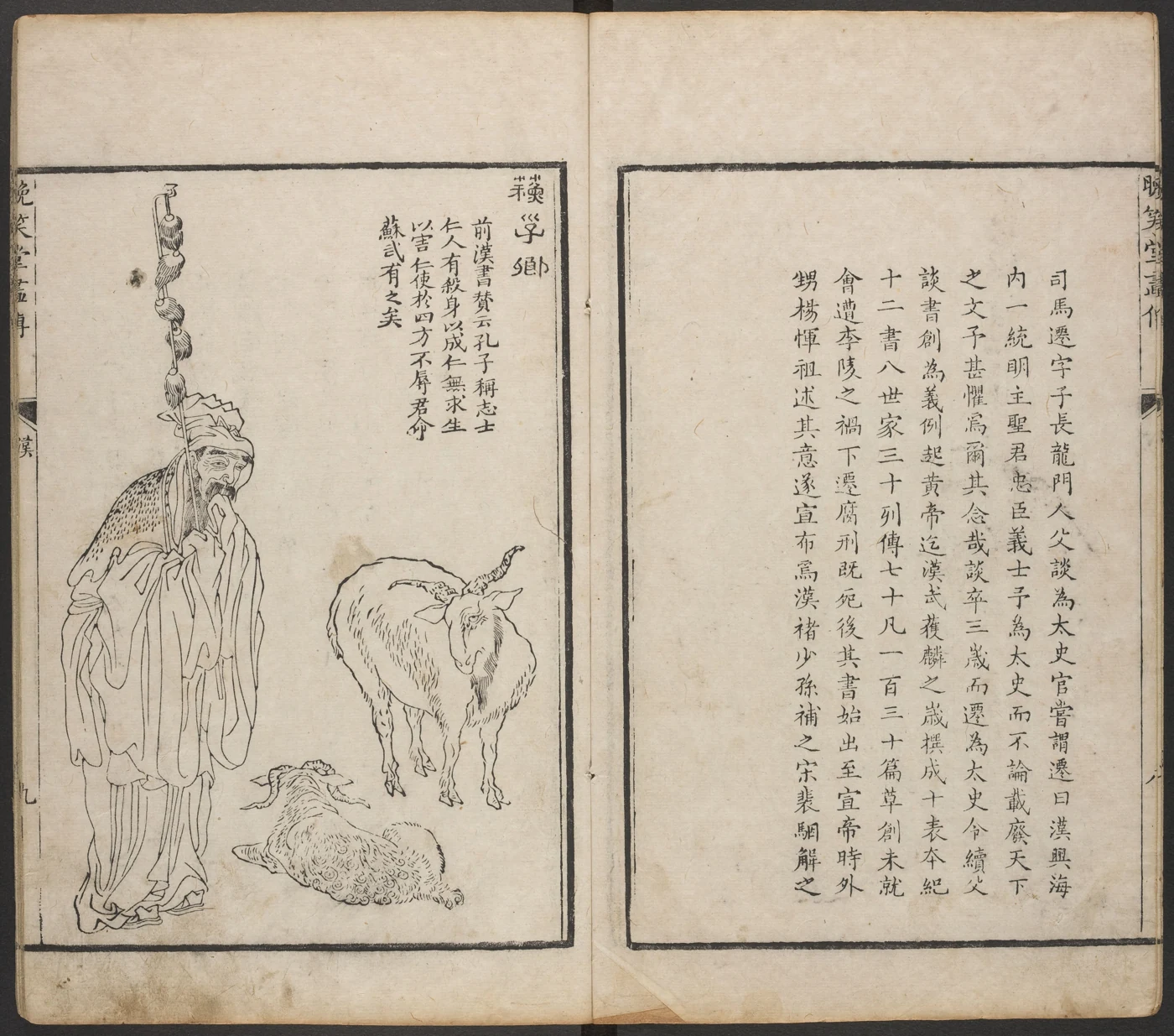
140 BCE–60 BCE
Military officer
Su Wu
苏武
Sent to the Xiongnu bearing a Han imperial staff and detained for nineteen years without surrendering his integrity; became an enduring model of loyal service through the story of tending sheep at the Northern Sea before eventually returning to Han.
140 BCE–60 BCEWestern Han
PROFILE
Sent to the Xiongnu bearing a Han imperial staff and detained for nineteen years without surrendering his integrity; became an enduring model of loyal service through the story of tending sheep at the Northern Sea before eventually returning to Han.
- Other Name
- Su Ziqing
- Courtesy Name
- Ziqing
- Period
- Western Han
- Date of Birth
- 140 BCE
- Date of Death
- 60 BCE
- Dynasty/Regime
- Western Han
- Identity
- Military officer
- Ethnicity/Ethnic Affiliation
- Not recorded in historical sources
- Native Place
- Duling, Jingzhao (present-day Xi'an, Shaanxi)
- Place of Birth
- Not recorded in historical sources
- Place of Death
- Not recorded in historical sources
- Highest Office
- See Life and Major Deeds
- Major Achievements
- Sent to the Xiongnu bearing a Han imperial staff and detained for nineteen years without surrendering his integrity; became an enduring model of loyal service through the story of tending sheep at the Northern Sea before eventually returning to Han.
LIFE TIMELINE
Youth | Through his father's merit, entered service as a palace gentleman together with his elder brother Su Jia and younger brother Su Xian
Young adulthood | Promoted to Supervisor of the Yizhong Stables, responsible for saddled horses, hunting birds and dogs, and imperial hunting equipment
Age forty | As a General of the Gentlemen-of-the-Household, carried an imperial staff on a mission to the Xiongnu, returning Xiongnu envoys and thanking the Chanyu
Age forty | Deputy envoy Zhang Sheng became involved in Yu Chang's conspiracy; Su Wu was implicated and stabbed himself with his sword to demonstrate his resolve
Age forty | Imprisoned by the Xiongnu in a large underground chamber; survived for days by eating snow and felt fibers
Age forty | Sent to the Northern Sea, identified in the source with present-day Lake Baikal, to herd rams, with the claim that he could return only when the rams gave birth
Age forty-one | Li Ling was defeated and surrendered to the Xiongnu; later sent by the Chanyu to the Northern Sea to persuade Su Wu to surrender, but Su Wu firmly refused
Age fifty-three | On hearing of Emperor Wu of Han's death, Su Wu faced south and wailed until he coughed blood, mourning morning and evening for months
Age fifty-nine | During a Han-Xiongnu rapprochement, a Han envoy used the story of a silk letter tied to a goose's foot to confront the Chanyu; Su Wu and eight others were released and returned to Han, and Su Wu was appointed Director of Dependent States
Age sixty | Removed from office because of the treason case involving Shangguan Jie and Su Wu's son
Age sixty-six | Participated in the enthronement of Emperor Xuan of Han; enfeoffed as Marquis Within the Passes with three hundred households and appointed Right Office Director of Dependent States
Around age seventy | Through Xu Guanghan, Marquis of Ping'en, petitioned Emperor Xuan and used gold and silk to redeem his son Su Tongguo, born during his years among the Xiongnu; the emperor appointed the son as a palace gentleman
Age eighty | Died
Posthumous | Emperor Xuan of Han ordered portraits of meritorious ministers displayed in the Qilin Pavilion; Su Wu was placed last among the eleven honored officials
BIOGRAPHY
Biography
Family Background and Early Years
Su Wu was born around or before 140 BCE, the first year of the Jianyuan era under Emperor Wu of Han. His father Su Jian accompanied the General-in-Chief Wei Qing on three campaigns against the Xiongnu, rose through military merit to become Administrator of Dai Commandery, and was enfeoffed as Marquis of Pingling. Through his father's merit, Su Wu entered palace service as a gentleman together with his elder brother Su Jia and younger brother Su Xian. He was later promoted to Supervisor of the Yizhong Stables, an office responsible for imperial saddles and horses, hawks, hounds, and hunting. Although not a high-ranking office, it was a position near the court and allowed access to the palace precincts.
The historical record preserves few remarkable episodes from Su Wu's early career at the Han court, but the source states that this period of palace service brought him into contact with Li Ling and others. Li Ling had likewise served as an attendant official and later approached Su Wu at the Northern Sea as a former colleague when trying to persuade him to surrender. The source interprets Su Wu's family background—his father's advancement through military merit and the service of all three brothers at court—as making him a typical son of a military household with a deeply rooted sense of loyalty and obligation to the Han. It further presents this background as a psychological foundation for his refusal to surrender during nineteen years among the Xiongnu.
Mission to the Xiongnu
During the reign of Emperor Wu, the Han and Xiongnu fought repeatedly and also exchanged envoys for intelligence and diplomacy. The Xiongnu detained more than ten successive groups of Han envoys, including Guo Ji and Lu Chongguo, while the Han likewise detained Xiongnu envoys in retaliation.
In 100 BCE, the first year of the Tianhan era, Qiedihou Chanyu had newly taken power. Fearing a Han attack, he made conciliatory gestures, saying that the Han Son of Heaven was of an elder generation to him, and returned previously detained Han envoys including Lu Chongguo. Emperor Wu approved of the gesture and sent Su Wu, then a General of the Gentlemen-of-the-Household, as an envoy carrying the imperial staff. Su Wu was to escort Xiongnu envoys detained in Han back to their people and present generous gifts to thank the Chanyu.
Su Wu's mission included deputy General of the Gentlemen-of-the-Household Zhang Sheng, the temporarily commissioned envoy Chang Hui, and more than one hundred recruited soldiers and scouts. After they reached the Xiongnu, however, the Chanyu behaved arrogantly, contrary to Han expectations. More seriously, as the Chanyu was preparing to send Su Wu's party home, a conspiracy involving the Gou King and Yu Chang broke out inside the Xiongnu polity. Yu Chang had known Zhang Sheng in Han territory. He secretly visited Zhang Sheng, offered to assassinate the surrendered Han officer Wei Lü with a crossbow shot, and asked Zhang Sheng to care for his mother and younger brother in Han. Zhang Sheng agreed and gave him valuables.
More than a month later, on the eve of the planned uprising by Yu Chang and more than seventy others, one participant fled and informed the authorities. Relatives of the Chanyu sent troops to suppress the conspiracy. The Gou King was killed and Yu Chang captured. The Chanyu ordered Wei Lü to investigate. Fearing that the matter would be exposed, Zhang Sheng told Su Wu the truth. Su Wu immediately concluded that the affair would inevitably implicate him and that dying before being humiliated would be preferable to gravely failing the state. He attempted suicide but was stopped by Zhang Sheng and Chang Hui. Yu Chang indeed implicated Zhang Sheng, and the enraged Chanyu considered killing the Han envoys. A Xiongnu adviser argued that if even a conspiracy against the Chanyu could merit no greater punishment, it would be better to force them all to surrender. The Chanyu therefore ordered Wei Lü to summon Su Wu for interrogation.
Su Wu told Chang Hui and the others that if he compromised his integrity and disgraced his mission, he would have no face to return alive to Han. He then drew his sword and stabbed himself. Wei Lü was shocked and immediately summoned a physician. The physician dug a pit, lit a fire in it, placed Su Wu over the heated ground, and lightly struck his back to release stagnant blood. Su Wu lost consciousness and appeared to stop breathing, but recovered after half a day. The Chanyu admired his resolve, sent people to check on him morning and evening, and imprisoned Zhang Sheng.
Herding Sheep at the Northern Sea
After Su Wu recovered, the Chanyu again sent people to persuade him to surrender and also used the trial of Yu Chang as an opportunity to pressure him. Wei Lü personally executed Yu Chang, then threatened Zhang Sheng with a sword; Zhang Sheng asked to surrender. Wei Lü next told Su Wu that because his deputy was guilty, he too should be implicated. Su Wu replied that he had not joined the conspiracy and was not related to the accused, so there was no basis for collective punishment. Wei Lü raised his sword as if to strike him, but Su Wu did not move.
Wei Lü then tried to tempt him with his own wealth, saying that after surrendering to the Xiongnu he had been made a king, commanded tens of thousands of people, and possessed horses and livestock covering the mountains. Su Wu did not respond. Wei Lü offered to become sworn brothers. Su Wu angrily condemned him for ignoring loyalty and righteousness, betraying his ruler and kin, and becoming a surrendered captive among foreign peoples. He cited the destruction of Nanyue after the killing of Han envoys, the fate of the king of Dayuan after killing an envoy, and the destruction of Chaoxian after killing Han envoys, warning that if Wei Lü knew Su Wu would not surrender yet still sought to provoke conflict, the resulting disaster for the Xiongnu would begin with him.
Wei Lü reported that Su Wu could not be coerced. The Chanyu became even more determined to force his surrender and imprisoned him in a large underground chamber without food or drink. Heavy snow fell. Su Wu lay on the ground, ate snow, and swallowed it together with felt fibers, yet survived for several days. The Xiongnu regarded this as extraordinary and moved him to an uninhabited area at the Northern Sea, which the source identifies with present-day Lake Baikal. He was ordered to herd rams and told that he could return only when the rams gave birth. Chang Hui and other members of the mission were dispersed elsewhere.
The Northern Sea was remote and bitterly cold. Su Wu received no regular food and dug out grass seeds or roots stored by wild mice to survive. He kept the Han imperial staff with him while tending sheep, holding it when lying down and rising until all the decorative hairs on the staff had worn away. After five or six years, Yujian Wang, a younger brother of the Chanyu, came to hunt at the Northern Sea. Seeing that Su Wu could weave hunting nets and repair or straighten bows and crossbows, Yujian Wang valued him and supplied him with clothing and food. More than three years later the king became seriously ill and gave Su Wu horses, livestock, vessels for wine and dairy products, and a felt tent. After Yujian Wang died, his followers moved away. That winter, the Dingling stole Su Wu's cattle and sheep, leaving him impoverished once more.
Li Ling Attempts to Persuade Him
Su Wu and Li Ling had both served at the Han court. In 99 BCE Li Ling was defeated and surrendered to the Xiongnu. At first he did not dare visit Su Wu. Later the Chanyu sent him to the Northern Sea, where he arranged a banquet with music and tried to persuade Su Wu to surrender as an old friend.
Li Ling told Su Wu about tragedies in his family. Su Wu's elder brother Su Jia, while serving as an imperial carriage officer and accompanying the emperor to the Youyang Palace at Yong, had broken a carriage shaft against a pillar while helping the imperial carriage descend steps. Accused of grave disrespect, he killed himself with his sword. Su Wu's younger brother Su Xian, while accompanying an imperial sacrifice to the Earth deity in Hedong, became involved when mounted attendants and imperial sons-in-law fought over boats and people drowned. Fearing punishment after failing to capture those responsible, he poisoned himself. Su Wu's mother had died, and Li Ling said that he personally attended her burial at Yangling. Su Wu's young wife had remarried. For more than ten years there had been no news of his two sisters, two daughters, and one son.
Li Ling argued that life was as brief as morning dew and that Su Wu should not continue to torment himself. He also said Emperor Wu was old and his punishments unpredictable, that dozens of ministerial families had been exterminated despite lacking crimes, and that even personal safety at court was uncertain.
Su Wu replied that a minister served his ruler as a son served his father and that a son who died for his father had no regret. He asked Li Ling not to speak of surrender again. Li Ling drank with him for several days and tried again. Su Wu responded that he had long regarded himself as already dead; if Li Ling was determined to make him surrender, he should let them finish that day's pleasures and then watch Su Wu die before him. Li Ling, seeing his sincerity, sighed that Su Wu was a righteous man and that the guilt of Li Ling and Wei Lü reached to Heaven. He wept, his tears soaking his robe, and departed. Li Ling later visited the Northern Sea once more and informed Su Wu of Emperor Wu's death. Su Wu faced south, wailed, coughed blood, and mourned morning and evening for several months.
Return to Han and Later Years
In 87 BCE Emperor Zhao of Han ascended the throne. Several years later Han and Xiongnu entered negotiations, and Han asked about Su Wu and his companions. The Xiongnu falsely claimed that Su Wu had died. When another Han mission later arrived, Chang Hui secretly met the envoys at night, revealed the truth, and proposed a stratagem: the Han envoy should tell the Chanyu that the Son of Heaven had shot a wild goose in Shanglin Park and found a silk letter tied to its foot stating that Su Wu and the others were at the Northern Sea. The envoy followed the plan and confronted the Chanyu. Startled, the Chanyu admitted that Su Wu and the others were still alive.
When Li Ling heard that Su Wu would return, he held a banquet to congratulate him. He said that Su Wu would return with his name celebrated among the Xiongnu and his achievement displayed in the Han realm, surpassing anything recorded on ancient bamboo and silk or preserved in painted portraits. Li Ling also spoke of his own situation: his entire family had been killed and he no longer had the face to return to Han. He performed a song about traveling ten thousand li across the desert, fighting the Xiongnu as a Han commander, losing his troops and reputation when the road ended and weapons failed, and having nowhere to return even if he wished to repay favor because his aged mother was dead. Li Ling and Su Wu wept as they parted.
In the spring of 81 BCE, the sixth year of the Shiyuan era, Su Wu returned to Chang'an. Emperor Zhao ordered him to offer a full sacrificial animal at Emperor Wu's imperial ancestral and funerary precincts and appointed him Director of Dependent States with a salary rank of two thousand dan. He received two million cash, two qing of public fields, and a residence. Chang Hui, Xu Sheng, and Zhao Zhonggen, who had returned with him, were appointed Generals of the Gentlemen-of-the-Household and each received two hundred bolts of silk. Six other elderly returnees were allowed to go home, each receiving one hundred thousand cash and lifetime exemption from corvée.
In 80 BCE, the seventh year of the Shiyuan era, the conspiracy of Shangguan Jie and his son, Sang Hongyang, Prince Liu Dan of Yan, and the Princess of Eyi was uncovered. Su Wu's son Su Yuan was executed for participating. During the investigation, because Su Wu had old associations with Shangguan Jie and Sang Hongyang and because the Prince of Yan had several times complained in memorials that Su Wu's office was too low for his merit, the Commandant of Justice requested Su Wu's arrest. Huo Guang set aside the memorial and only removed Su Wu from office.
In 74 BCE, the first year of the Yuanping era, Emperor Xuan of Han ascended the throne and enfeoffed Su Wu as Marquis Within the Passes with a fief of three hundred households. Later General of the Guards Zhang Anshi recommended him as thoroughly familiar with state institutions and as an envoy who had held the imperial staff without surrendering. Emperor Xuan summoned him to await audiences at the eunuch offices, received him repeatedly, and restored him as Right Office Director of Dependent States. Because Su Wu was an elderly minister of great moral reputation, the emperor specially required him to attend court only on the first and fifteenth days of each month and honored him as an elder ritual leader. Su Wu distributed the rewards he received among his younger brother and old neighbors and friends and kept no surplus wealth at home.
By this time Su Wu was old and his son Su Yuan was dead. Emperor Xuan asked whether Su Wu had fathered any children during his long stay among the Xiongnu. Through Xu Guanghan, Marquis of Ping'en, Su Wu reported that he had a son by a Xiongnu woman, named Tongguo, and asked to redeem him with gold and silk. The emperor approved. Su Tongguo returned to Han and was appointed a palace gentleman. A son of Su Xian was also appointed to the Right Office. Su Wu died in 60 BCE, the second year of the Shenjue era, at more than eighty years of age. In 51 BCE Emperor Xuan ordered portraits of meritorious ministers painted in the Qilin Pavilion, with Su Wu placed last among the eleven honored officials.
In 81 BCE, when Han and the Xiongnu made peace, the Han asked for Su Wu and his companions, and the Xiongnu falsely said they were dead; Chang Hui met the Han envoy by night and taught him to claim that a letter had been taken from the leg of a shot goose, whereupon the Chanyu had no choice but to release Su Wu. He had spent nineteen years among the Xiongnu, going out in his prime and returning with hair and beard white. On his return he was made director of dependent states and given two million coins, two hundred mu of public land and a residence. After Emperor Zhao's death he took part in raising Emperor Xuan, was made Marquis of Guanming Nei with three hundred households, and served again as director of dependent states of the right bureau. He died of illness in 60 BCE at over eighty; in 51 BCE Emperor Xuan had his portrait painted among the eleven meritorious ministers of the Qilin Pavilion, honoring a loyalty that kept its tally unstained.
Among the Xiongnu Su Wu took a foreign wife who bore him a son, Su Tongguo, ransomed back by a Han envoy under Emperor Xuan and made a gentleman; both his elder brother Su Jia and younger brother Su Xian had taken their own lives over small offenses, leaving the family much reduced. From Han times on he has been named with Zhang Qian as a model envoy, and the Han History places his life in the biography of Li Guang and Su Jian, alongside Li Guang and his grandson Li Ling, the contrast revealing his character. Later poetry and prose made "Su Wu herding sheep" the byword for fidelity and an unstained mission, the record of Li Ling's persuasion and Su Wu's answer being especially celebrated.
Shrines and sites associated with him survive in Shaanxi and Gansu, more than one of them bearing the name of the Su Wu temple.
Major Activities
Mission Bearing the Imperial Staff
In 100 BCE Su Wu was sent to the Xiongnu as a General of the Gentlemen-of-the-Household bearing the Han imperial staff, escorting Xiongnu envoys home and responding to the Chanyu's conciliatory gestures. A routine diplomatic mission changed sharply when deputy envoy Zhang Sheng became involved in an internal Xiongnu conspiracy. The source presents Su Wu as assuming the responsibility of a diplomatic envoy: when the affair broke, he first concluded that being subjected to humiliation would mean grave failure to the state and tried to die by his own hand; during interrogation he said that even if he lived after compromising his integrity and disgracing his mission, he would have no face to return to Han; and when threatened and tempted by Wei Lü, he rejected collective punishment and warned of historical cases in which killing Han envoys had brought disaster.
Herding Sheep at the Northern Sea
After being exiled to the Northern Sea, identified in the source with present-day Lake Baikal, Su Wu spent nineteen years among the Xiongnu while retaining the Han imperial staff. With no regular food, he dug up stores of grass seeds or roots made by wild mice. The decorative hairs on the staff eventually wore away as he carried it while tending sheep. The Xiongnu statement that he could return only when the rams gave birth was intended as an impossible condition. The story of “Su Wu tending sheep” became a symbolic episode of steadfast loyalty in later Chinese cultural memory.
Repeated Refusal to Surrender
The source describes three major campaigns to persuade Su Wu to surrender. First, Wei Lü threatened him with a sword and tempted him with wealth, and Su Wu denounced Wei Lü's surrender. Second, Li Ling approached him as an old friend and appealed to personal emotion and practical calculation, but Su Wu replied that a minister served his ruler as a son served his father. Third, after informing Su Wu of Emperor Wu's death, Li Ling again confronted the issue, while Su Wu maintained his resolve. In the narrative, coercion, material inducement, and emotional persuasion all failed to move him.
Return and Rewards
In 81 BCE Su Wu and eight others were released and returned to Han. Emperor Zhao appointed him Director of Dependent States, with a salary rank of two thousand dan, and rewarded him with two million cash, two qing of public land, and a residence. Although he was later removed from office because his son was implicated in the Shangguan Jie conspiracy, he was restored under Emperor Xuan, enfeoffed as Marquis Within the Passes, appointed Right Office Director of Dependent States, and honored as a senior court elder. In 51 BCE he was included among the eleven officials portrayed in the Qilin Pavilion, which the source treats as the final recognition of his career.
Redemption of Su Tongguo
In old age Su Wu, through Xu Guanghan, Marquis of Ping'en, petitioned Emperor Xuan for permission to redeem Su Tongguo, the son he had fathered with a Xiongnu woman during his years abroad, using gold and silk. Emperor Xuan approved and appointed Su Tongguo as a palace gentleman. The source presents the episode as demonstrating both Su Wu's concern for family and the Han court's continuing recognition of his service.
In his youth Su Wu, through his father's privilege, became a gentleman with his brothers and rose to be keeper of the stables of the Yi palace. In 100 BCE, when the new Chanyu Qiedihou, fearing a Han attack, declared that the Han emperor was his elder and returned the detained envoys, Emperor Wu sent Su Wu as an attendant of the palace with the tally to escort the Xiongnu envoys held in China back to their country and to present rich gifts to the Chanyu. With him went the assistant attendant Zhang Sheng and the acting official Chang Hui and more than a hundred volunteers and scouts.
On arrival, a conspiracy was afoot among the Prince of Gou and Yu Chang of Changshui to abduct the Chanyu's mother and take her to the Han. Yu Chang, an old acquaintance of Zhang Sheng, privately offered to shoot Wei Lü with a crossbow for the Han, and Zhang Sheng agreed and gave him goods. More than a month later, while the Chanyu was hunting, the seventy conspirators were about to act when one fled by night and informed on them; the Prince of Gou died fighting and Yu Chang was taken. Zhang Sheng told Su Wu, who said that this must now involve him and wished to kill himself, but Zhang Sheng and Chang Hui stopped him. Yu Chang confessed under questioning, and the Chanyu wished to kill the Han envoys, until the noble Zuo Yizhizi held that it would be better to make them all submit. Wei Lü summoned Su Wu for interrogation, and Su Wu told Chang Hui that to betray his commission and disgrace his mission would leave him no face to return to Han, and cut his own throat with his sword; Wei Lü, alarmed, held him and called physicians, who dug a pit, lit a slow fire, laid Su Wu face down over it and stamped on his back to draw out the blood. He had ceased breathing for half a day before reviving. The Chanyu admired his integrity, sent daily inquiries, and imprisoned Zhang Sheng.
When Su Wu recovered, the Chanyu again sent men to persuade him. Wei Lü cut down Yu Chang before him, threatened Zhang Sheng with his sword and Zhang Sheng begged to submit; he then charged Su Wu with complicity, and Su Wu answered that he had no part in the plot and was no kinsman of the culprit. Wei Lü raised his sword and Su Wu did not flinch; then he offered the wealth he himself had won by going over, and Su Wu reviled him as a traitor to lord and parents who, holding power of life and death, sought to set two sovereigns at war, recalling how Nanyue, Dayuan and Korea had all killed Han envoys and been destroyed, and saying that the Xiongnu's calamity would begin with him. Wei Lü reported that he could not be coerced; the Chanyu, all the more set on his submission, imprisoned him in a great pit without food or water. When snow fell, Su Wu lay and ate snow with felt to swallow, surviving for days, so that the Xiongnu thought him divine and moved him to the uninhabited shore of the northern sea to herd rams, to be released only when the rams gave suck.
At the northern sea no rations came, and he dug up the wild rats' stores of grain to eat, herding the sheep with the Han tally always in his hand, so that the yak-tail tassel wore away entirely. Five or six years on, the Chanyu's brother, the Prince of Yuqian, hunted on the shore; Su Wu could weave nets and cord and straighten crossbows, and the prince liked him and gave him clothing and food, and when he fell ill three years later he left Su Wu horses, cattle, vessels and a tent; after his death the people moved away and that winter the Dingling stole his cattle and sheep, leaving him destitute again. Li Ling, who had surrendered, was sent to persuade him, telling him that both his brothers had died by their own hands, that his mother was dead and his wife remarried, and that a man's life is like the morning dew and he need not torment himself so long; Su Wu answered that a subject serves his lord as a son his father, and that a son dies for his father without regret. Li Ling, seeing his sincerity, sighed that his own sin and Wei Lü's reached to heaven and went away in tears. Later Li Ling brought word that Emperor Wu had died, and Su Wu wailed facing south and spat blood, mourning morning and evening for months.
Personal Relations
- Su Jian (father): Administrator of Dai Commandery; accompanied Wei Qing on three campaigns against the Xiongnu and was enfeoffed as Marquis of Pingling
- Su Jia (elder brother): imperial carriage officer; accused of grave disrespect after breaking a carriage shaft against a pillar and killed himself with his sword
- Su Xian (younger brother): accompanied an imperial sacrifice in Hedong; after failing in a pursuit connected with a fatal boat dispute, took poison out of fear
- Su Yuan (son): executed for participating in the Shangguan Jie conspiracy
- Su Tongguo (son): born to Su Wu and a Xiongnu woman, later redeemed with gold and silk and appointed a palace gentleman by Emperor Xuan
- Li Ling: former fellow court attendant who surrendered to the Xiongnu; sent by the Chanyu to persuade Su Wu to surrender, but Su Wu refused and Li Ling called him a “righteous man”
- Chang Hui: member of the mission who later helped devise the stratagem that enabled Su Wu to return; later rose to Director of Dependent States
- Zhang Sheng: deputy envoy who became involved in Yu Chang's conspiracy and later surrendered to the Xiongnu
- Wei Lü: Han defector serving the Xiongnu; ordered to persuade Su Wu to surrender and strongly denounced by him
- Emperor Wu of Han: sent Su Wu on the mission to the Xiongnu
- Emperor Zhao of Han: appointed Su Wu Director of Dependent States after his return in 81 BCE
- Emperor Xuan of Han: enfeoffed Su Wu as Marquis Within the Passes in 74 BCE, appointed him Right Office Director of Dependent States, and honored him as an elder ritual leader
- Huo Guang: set aside the request to arrest Su Wu during the Shangguan Jie treason investigation and only removed him from office
- Zhang Anshi: recommended Su Wu as familiar with state institutions and steadfast in holding the imperial staff without surrender
- Qiedihou Chanyu: detained Su Wu and later sent him to the Northern Sea
- Yujian Wang: younger brother of the Chanyu who valued Su Wu, supplied him with clothing and food, and later gave him horses, livestock, and household goods
- Dingling: the group that stole Su Wu's cattle and sheep and left him again in hardship
Historical Assessment
Han / Contemporary
- Li Ling: “Ah, a righteous man! The guilt of Li Ling and Wei Lü reaches to Heaven.” (Book of Han, biography of Su Wu)
- Li Ling: “Now that you will return, your name will be celebrated among the Xiongnu and your achievement manifest in the Han realm. What in the records on ancient bamboo and silk or in painted portraits could surpass Ziqing?” (Book of Han, biography of Su Wu)
- Emperor Xuan of Han included Su Wu among the eleven meritorious officials portrayed in the Qilin Pavilion. Although placed last, the source interprets this inclusion as formal recognition of his contribution to the restored strength of the dynasty. (Book of Han, biography of Su Wu)
Wei, Jin, and Northern and Southern Dynasties
- Later writers often contrasted Su Wu with Li Ling, making Su Wu a representative figure of loyalty to the ruler and constancy of principle. Texts such as the Records of the Three Kingdoms used “Su Wu” as an analogy for loyal and righteous figures.
- In poems including Tao Yuanming's writings on impoverished scholars, the image of Su Wu entered a broader literary genealogy of scholar-official integrity.
Tang and Song Periods
- In Tang frontier poetry, Su Wu tending sheep became an established allusion to steadfast loyalty. Li Bai's poem “Su Wu” includes the line: “Su Wu among the Xiongnu, for ten years held the Han staff.”
- Wen Tianxiang's Song poem “Song of Righteousness” places “Zhang Liang's hammer in Qin” alongside “Su Wu's staff in Han” as manifestations of righteous energy between Heaven and Earth.
- Sima Guang's Comprehensive Mirror in Aid of Governance records Su Wu's experiences in detail and affirms that he “never compromised his integrity.”
Ming, Qing, and Modern Periods
- By the Ming-Qing transition, Su Wu had become a symbol of loyalist integrity for scholar-officials; figures such as Gu Yanwu drew encouragement from his example.
- In modern times Su Wu has often been characterized as a “national hero” and “patriot,” and his story has appeared in many textbooks as a central example of Chinese ideals of moral constancy.
- Contemporary scholarship, while continuing to recognize Su Wu's personal steadfastness, has also emphasized the complexity of Han-Xiongnu relations surrounding his mission and the choices available to a diplomatic envoy under those historical conditions.
FIGURES ASSOCIATED WITH THIS DYNASTY
Bibliography
- Ban Gu, Book of Han, LiGuangSuJian Chuan