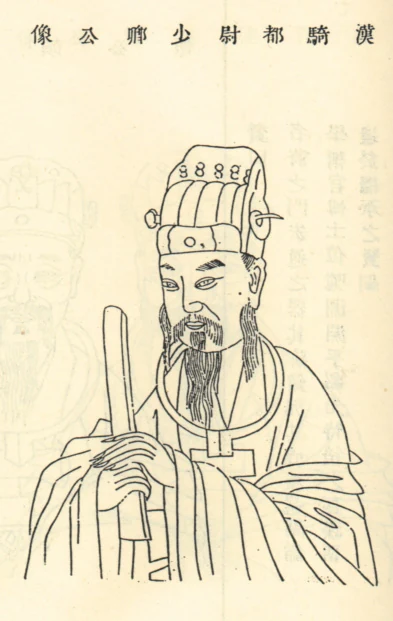
Biography
Family Background and Early Years
Li Ling came from a military family of the Longxi Li lineage. His grandfather Li Guang was a famous general under Emperors Jing and Wu and had also served during Emperor Wen's reign. He fought the Xiongnu in more than seventy engagements and was known for courage, but never received a marquisate and eventually committed suicide after losing his way during the Battle of Mobei. Li Guang had three sons: Li Danghu, Li Jiao, and Li Gan. Li Danghu, the eldest, served as a palace gentleman and was trusted by Emperor Wu but died young. His wife was pregnant at his death and later gave birth to Li Ling, making Li a posthumous son.
Raised in Chengji, Longxi, Li Ling inherited the family's martial tradition and excelled at riding and archery. As an adult he was selected by Emperor Wu as an Attendant and later became Superintendent of Jianzhang Palace, supervising cavalry units. He was known for humane treatment of soldiers, generosity, humility, and respect toward subordinates. Emperor Wu believed he resembled his grandfather Li Guang and entrusted him with eight hundred cavalry for a reconnaissance more than two thousand li into Xiongnu territory beyond Juyan. The force met no Xiongnu and returned safely. Impressed by his boldness, the emperor appointed Li Commandant of Cavalry and placed five thousand brave men from Danyang under him at Jiuquan and Zhangye, where he trained them in riding and archery and guarded against the Xiongnu.
The Dayuan Campaign and Frontier Duty
In the summer of 104 BCE, the first year of the Taichu era, Emperor Wu sent Li Guangli, General of Ershi, on an expedition against Dayuan to obtain the famed blood-sweating horses. Li Ling was ordered to follow with troops from five battalions as support. When his army reached the frontier, Li Guangli was already returning. The emperor sent Li Ling an order to leave most officers and soldiers behind and lead only five hundred light cavalry out of Dunhuang to meet Li Guangli at Yanshui and escort the returning army. After completing the mission, Li returned to Zhangye. For several years afterward, he remained stationed in the Hexi Corridor training troops and guarding against the Xiongnu.
Volunteering for War and the Battle of Mount Junji
In the autumn of 99 BCE, Li Guangli led thirty thousand cavalry from Jiuquan to attack the Xiongnu Right Wise King near the Tianshan region. Emperor Wu summoned Li Ling at Wutai Hall intending to assign him to transport supplies. Li did not want a purely logistical role and knelt to request an independent command. He said that the frontier troops under him were brave men from Jing and Chu, skilled fighters and swordsmen, able to bind a tiger and shoot accurately, and that he wished to lead them south of Langan Mountain to divide the chanyu's forces and keep the Xiongnu from concentrating against Li Guangli. Emperor Wu asked whether Li was ashamed to serve under another commander and explained that there were no horses available. Li replied that he needed none and wished to lead five thousand infantry against a much larger force and strike toward the chanyu's court. Impressed, the emperor approved and ordered Lu Bode, Commandant of Strong Crossbows and formerly the General Who Pacifies the Waves, to provide support along the route.
Lu Bode was senior to Li Ling and felt humiliated by serving as his support. He memorialized that autumn, when Xiongnu horses were fat, was a poor season for battle and asked that Li be retained until spring, when each could lead five thousand cavalry from Jiuquan and Zhangye against the eastern and western Junji mountains and capture the chanyu. Emperor Wu became angry, suspecting Li had regretted volunteering and had induced Lu to submit the memorial. He rebuked Lu, ordered him to move his troops to Xihe, and commanded Li to march in the ninth lunar month from Zhelu Barrier to the area of Longle Water south of East Junji Mountain, observe the enemy, and, if none appeared, proceed along the old route of Zhao Ponu to Shouxiang City.
In the ninth lunar month, Li led five thousand infantry from Juyan and marched north for thirty days to Mount Junji, where he camped. He drew maps of mountains and rivers along the route and sent his cavalryman Chen Bule back to report. Chen praised Li's command and the willingness of the soldiers to die for him. Emperor Wu was delighted and appointed Chen a palace gentleman.
At Mount Junji, however, Li's army encountered the main force of Chanyu Qi'dihou and was surrounded by more than thirty thousand Xiongnu cavalry. Li's men camped between two Junji mountains, forming wagons into a defensive barrier. The front ranks carried halberds and shields, the rear bows and crossbows. Li ordered an advance at the sound of drums and a halt at the sound of gongs. Seeing the small Han force, the Xiongnu charged the camp directly. Li counterattacked and thousands of crossbows fired at once, forcing the Xiongnu back up the mountain. Han troops pursued and killed several thousand. Shocked, the chanyu summoned the Left and Right Wise Kings, bringing more than eighty thousand cavalry to surround Li. Li fought while withdrawing south for several days into a valley. Casualties mounted: men with three wounds rode in carts, those with two drove the carts, while those wounded once continued fighting.
When Li noticed declining morale, he asked whether women were hiding in the army. Some wives of convicts and bandits exiled from eastern China had indeed followed the troops and hidden in the wagons. Li had them found and killed. The next day the Han army fought again and took more than three thousand Xiongnu heads. It broke southeastward, followed the old Longcheng route for four or five days, and reached a marsh of reeds. The Xiongnu set fire from upwind, and Li ordered his men to burn a firebreak for protection. When the Han army reached the foot of a mountain, the chanyu occupied the southern heights and sent his son with cavalry to attack. Han infantry fought among the trees, killed several thousand more, and fired repeating crossbows toward the chanyu, forcing him to withdraw.
Exhaustion, Loss of Arrows, and Surrender
The Han captured Xiongnu prisoners who reported discussions among the chanyu and his commanders. The chanyu wondered whether this elite Han force, which had resisted so long while drawing the Xiongnu south toward the frontier, might be luring them into an ambush. His commanders argued that if the chanyu himself could not destroy a few thousand Han troops despite leading tens of thousands of cavalry, he would lose authority over frontier subjects and encourage Han contempt. They urged further attacks through the valleys, with only forty or fifty li remaining before open ground; if the Han still could not be broken there, the Xiongnu could withdraw. Li's position grew more dangerous. The two sides sometimes fought dozens of engagements in a single day, and Han troops killed more than two thousand Xiongnu. Losses were so heavy that the Xiongnu at one point considered retreat.
At that moment, Guan Gan, a military officer in Li's army who had been humiliated by another officer, defected and revealed the Han situation. He reported that Li had no reinforcements and was nearly out of arrows, and that only eight hundred men each under Li and Marquis Hancheng Han Yannian remained in the front line under yellow and white banners; if elite cavalry killed the flag bearers, the formation could be broken. The chanyu was delighted and concentrated cavalry attacks while shouting for Li Ling and Han Yannian to surrender. Xiongnu archers occupied the slopes and shot from all sides. As the Han moved south before reaching Dihan Mountain, the five hundred thousand arrows carried by the army were completely exhausted in a single day, and the wagons had to be abandoned. More than three thousand Han troops remained, many unarmed and forced to break wagon spokes for weapons, while officers had only short knives. Mountains blocked the army, forcing it into a ravine. The chanyu cut off the retreat and had rocks thrown down from above, killing many soldiers and preventing further movement.
After nightfall, Li changed into plain clothing and walked out of camp alone, telling attendants not to follow because a true man should be able to capture the chanyu by himself. He returned after a long time and lamented that the defeat had reached the point where only death remained. An officer urged him not to die, arguing that the emperor might forgive him and that he could later return, just as Zhao Ponu had escaped after Xiongnu captivity and still been received honorably. Li rejected the advice and said that if he did not die he was not a true warrior. He cut down the standards and buried valuables, lamenting that with only a few dozen more arrows the army could have escaped. Since they no longer had weapons to fight and would only be captured in the morning, he ordered the soldiers to scatter and attempt to reach Zhelu Barrier, each carrying two sheng of dried grain and a large piece of ice. At midnight they tried to break out, but the signal drum failed to sound. Li and Han Yannian mounted horses and charged out with a little over ten men. Several thousand Xiongnu cavalry pursued them. Han Yannian was killed. Li sighed that he had no face to see the emperor, dismounted, and surrendered. His troops scattered, and only a little over four hundred men reached the frontier.
Extermination of His Family and Life among the Xiongnu
When news of Li's defeat reached Chang'an, Emperor Wu initially thought he had died in battle and summoned the family to console them, but found that they showed no signs of mourning. After learning that Li had surrendered, the emperor became furious and questioned Chen Bule, who committed suicide. Court officials condemned Li, but Grand Historian Sima Qian defended him, arguing that Li had fought a much larger force with great courage and that surrender might have been a temporary expedient. Emperor Wu interpreted Sima's defense as an excuse for Li and an attack on Li Guangli, imprisoned Sima, and subjected him to castration.
One year after Li's surrender, Emperor Wu sent General Gongsun Ao to attempt a rescue. Gongsun returned without success but captured a Xiongnu prisoner who said that Li Ling was training Xiongnu troops to fight the Han. Enraged, the emperor exterminated three generations of Li's family. The Longxi Li lineage's reputation suffered, and local scholar-officials were ashamed of the family. Li later reproached a Han envoy, asking why the Han had killed his entire family after he had led only five thousand men deep against the Xiongnu and lost because no relief came. It turned out that the trainer was another surrendered Han frontier officer, Li Xu. Li Ling had Li Xu assassinated. The senior Xiongnu consort wanted to kill Li in retaliation, but the chanyu hid him in the north until she died and then recalled him. Admiring Li's courage, the chanyu married a daughter to him and made him Right Commandant King, placing him at a status comparable to the earlier Han defector Wei Lü, King of Dingling.
Later Years and Refusal to Return
Around 91 BCE the Xiongnu attacked Shanggu, Wuyuan, and Jiuquan. The Han sent Li Guangli, Shangqiu Cheng, and Mang Tong on separate campaigns. Shangqiu Cheng led more than thirty thousand troops from Xihe, pursued to Zhuixie Pass without meeting the Xiongnu, and turned back. Li Ling led more than thirty thousand Xiongnu cavalry in pursuit and fought Shangqiu's army for nine days at Mount Junji and as far as Punu Water. After suffering serious losses, he withdrew.
After Emperor Zhao came to the throne, Grand General Huo Guang and Left General Shangguan Jie served as regents. Huo had long been friendly with Li and sent Li's old friend Ren Lizheng and two others as envoys to the Xiongnu, hoping they could persuade him to return. During a banquet, one envoy repeatedly touched the ring on his sword hilt, punning on “return,” and touched Li's foot, then loudly announced that the Han had proclaimed a general amnesty, the central plains were peaceful, the emperor was young, and Huo Guang and Shangguan Jie controlled government. Li replied, “I already wear Xiongnu clothing,” and then said, “A true man cannot suffer disgrace a second time,” refusing the invitation.
In 81 BCE, after nineteen years of detention among the Xiongnu, Su Wu was released to return to Han. Li held a farewell banquet and performed a song lamenting that he had crossed ten thousand li of desert as a general, that his path had ended and his weapons failed, his soldiers were destroyed and his reputation ruined, and that with his old mother dead he had nowhere to return even if he wished to repay past favor. He parted from Su Wu and died of illness among the Xiongnu in 74 BCE.