A few months after birth | His grandfather Liu Ju committed suicide after defeat in the Witchcraft Calamity; his parents were killed and Liu Bingyi was imprisoned in the commandery residence prison
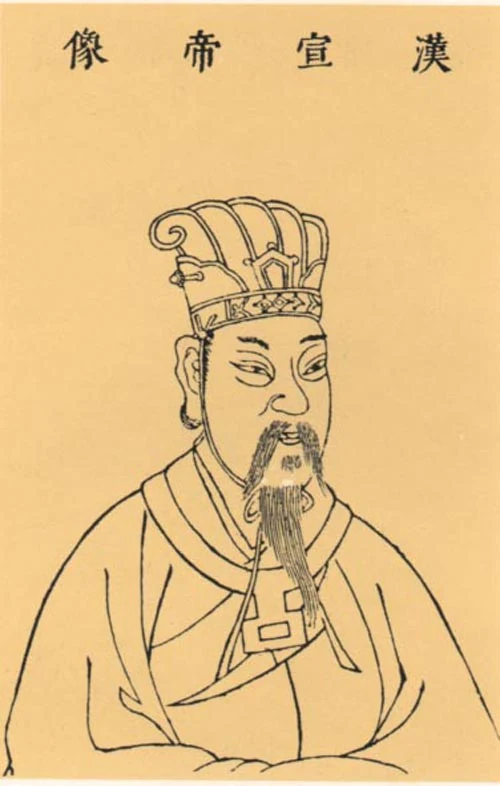
91 BCE–49 BCE
Emperor
Liu Xun
刘询
Emperor Xuan of Han, Liu Xun (91 BCE–January 10, 48 BCE), originally named Liu Bingyi and with the courtesy name Ziqing, was the tenth emperor of the Western Han, reigning from September 8, 74 BCE to January 10, 48 BCE. He was a great-grandson of Emperor Wu, Liu Che; grandson of Crown Prince Li, Liu Ju; and son of Liu Jin, known as the Imperial Grandson Shi. Liu Xun suffered the consequences of the Witchcraft Calamity in…
91 BCE–49 BCEWestern Han
PROFILE
Emperor Xuan of Han, Liu Xun (91 BCE–January 10, 48 BCE), originally named Liu Bingyi and with the courtesy name Ziqing, was the tenth emperor of the Western Han, reigning from September 8, 74 BCE to January 10, 48 BCE. He was a great-grandson of Emperor Wu, Liu Che; grandson of Crown Prince Li, Liu Ju; and son of Liu Jin, known as the Imperial Grandson Shi. Liu Xun suffered the consequences of the Witchcraft Calamity in infancy and grew up among ordinary people, gaining direct knowledge of popular hardship. In 74 BCE, the first year of Yuanping, Liu He, Prince of Changyi, was deposed and General-in-Chief Huo Guang brought Liu Bingyi to the throne; he then changed his name to Liu Xun. After accession he initially left government to Huo Guang. Following Huo Guang's death in 68 BCE, the second year of Dijie, Liu Xun took personal power, eliminated the Huo family's political influence, combined benevolent and authoritarian methods of government, reformed the bureaucracy, and promoted economic recovery. Western Han power reached a high point under his rule, known as the “Revival under Emperor Xuan.” Militarily, he allied with Wusun to defeat the Xiongnu, established the Protectorate of the Western Regions, and received the submission of Chanyu Huhanye, bringing the century-long Han-Xiongnu struggle to an end.
- Also known as
- Emperor Xuan of Han, Liu Bingyi
- Courtesy name
- Ziqing
- Era
- Western Han
- Dynasty / polity
- Western Han
- Identity
- Emperor
- Date of Birth
- 91 BCE
- Date of Death
- January 10 48 BCE
- Ethnicity / people
- Not recorded in historical sources
- Native place
- Not recorded in historical sources
- Place of birth
- Not recorded in historical sources
- Reign
- September 8, 74 BCE–January 10, 48 BCE
- Predecessor
- Liu He, deposed emperor of Han
- Successor
- Emperor Yuan of Han (Liu Shi)
- Era names
- Not recorded in historical sources
- Temple name
- Not recorded in historical sources
- Posthumous name
- Emperor Xiaoxuan
- Major achievements
- Grandson of the Crown Prince Li; raised among commoners and later enthroned by Huo Guang; restored Han power in what became known as the “Revival under Emperor Xuan”
LIFE TIMELINE
Age four | Bing Ji barred the prison gate against an imperial envoy; Emperor Wu reconsidered and issued an amnesty; Liu Bingyi was released and sent to be raised by the family of his grandmother Lady Shi
Age six | Huo Guang and others were enfeoffed in accordance with Emperor Wu's testamentary orders; Liu Bingyi was entered on the imperial clan registers under the Court of the Imperial Clan and raised in the palace service quarters
Age fourteen | Zhang He wished to marry his granddaughter to Liu Bingyi but was stopped by Zhang Anshi; Liu Bingyi later married Xu Pingjun, daughter of Xu Guanghan
Age seventeen | Emperor Zhao died; Liu He, Prince of Changyi, was deposed; Bing Ji recommended Liu Bingyi, who ascended the throne on the gengshen day of the seventh month and changed his name to Liu Xun
Age eighteen | Issued the famous order seeking the old sword of his humble days, signaling his wish to make Xu Pingjun Empress
Age twenty | Xu Pingjun was poisoned by Lady Xian, wife of Huo Guang; Huo Chengjun was made Empress
Age twenty | Sent five generals with 150,000 cavalry to join Wusun against the Xiongnu, winning a decisive victory
Age twenty-three | Huo Guang died; Emperor Xuan began to exercise personal rule
Age twenty-five | Executed Huo Yu, deposed Empress Huo, and eliminated the remaining Huo faction
Age thirty-one | Established the Protectorate of the Western Regions and incorporated the Thirty-Six Kingdoms of the Western Regions into the Han political order
Age thirty-seven | Established the Ever-Normal Granary system to stabilize prices
Age forty | Chanyu Huhanye came to court; the century-long Han-Xiongnu wars came to an end
Age forty-two | Died at Weiyang Palace on the jiaxu day of the twelfth month, January 10, 48 BCE; received the posthumous title Emperor Xiaoxuan
Death | Death; aged 43
BIOGRAPHY
Biography
Family Background and Early Life
Liu Bingyi was a great-grandson of Emperor Wu of Han. His grandfather was Crown Prince Li, Liu Ju; his grandmother was Lady Shi; his father was Liu Jin, known as the Imperial Grandson Shi; and his mother was Wang Wengxu. In 91 BCE, the second year of Zhenghe, the Witchcraft Calamity erupted. Chancellor Gongsun He and his son died in prison, while Princess Zhuyi, Princess Yangshi, and Wei Kang were executed in connection with the affair. Jiang Chong exploited the crisis to frame Crown Prince Liu Ju. The Crown Prince raised troops in self-defense, was defeated, fled with two young sons, and eventually committed suicide at Hu County; the two young imperial grandsons were also killed. Empress Wei Zifu committed suicide. Liu Bingyi's grandmother Lady Shi, father Liu Jin, mother Wang Wengxu, and aunt were all killed in Chang'an.
Only a few months old, Liu Bingyi was confined in the commandery residence prison. Bing Ji, then an assistant official of the Court of Judicial Review, was ordered to investigate the witchcraft case. Believing the Crown Prince innocent and pitying the imperial great-grandson, he selected two reliable female prisoners, Hu Zu and Guo Zhengqing, to serve as wet nurses and privately supplied food and clothing for the child. Liu Bingyi several times became dangerously ill, and Bing Ji had the wet nurses obtain medicine and care for him until he recovered. Because he was frequently sick in infancy, he was given the name Bingyi, meaning that illness should come to an end, as a wish for health.
Prison and Life among Commoners
In 87 BCE, the second year of Houyuan, Emperor Wu became seriously ill. A diviner reported that there was “imperial qi” in the prisons of Chang'an. Emperor Wu sent Guo Rang, Director of Palace Attendants, to execute all prisoners held in the twenty-six official prisons of Chang'an. Guo Rang arrived at night at the prison under Bing Ji's supervision, but Bing Ji shut the gate and declared that the emperor's own great-grandson was inside and that even ordinary people should not be killed without guilt, much less the emperor's close descendant. He refused entry until daybreak. Guo Rang reported the matter and impeached Bing Ji. Emperor Wu reconsidered and said that Heaven must have caused it, then proclaimed a general amnesty.
After the amnesty, Bing Ji sent Liu Bingyi to the family of his grandmother Lady Shi, where Shi Gong took him in. Shi Gong's elderly mother, Lady Zhen, pitied the orphaned child and personally cared for him. In 85 BCE, the second year of Shiyuan, Emperor Wu's testamentary order directed that Liu Bingyi be raised in the palace service quarters and registered with the Court of the Imperial Clan, giving legal recognition to his status as a member of the imperial house.
Liu Bingyi later left the Shi household and was raised in the palace service quarters. Zhang He, the superintendent there, had formerly served Crown Prince Liu Ju and remembered his old lord with affection. He treated Liu Bingyi with great care and paid from his own funds for the boy's education. In his youth Liu Bingyi studied the Book of Poetry with the scholar Fuzhong Weng of Donghai. He was talented and studious but also enjoyed the company of wandering knights, cockfighting, horse racing, and broad social contacts. He repeatedly traveled among Chang'an, the imperial mausoleum towns, and the Three Capital Regions, often lingering around the salt ponds of Lianshao County and especially enjoying Xiadu, between Du and Hu counties. These experiences among markets and neighborhoods gave him direct knowledge of popular hardship, local criminality, and the strengths and failures of official administration.
Unexpected Accession
In 74 BCE, the first year of Yuanping, Emperor Zhao died without an heir. General-in-Chief Huo Guang first enthroned Liu He, Prince of Changyi, but Liu He was deposed after only twenty-seven days. Bing Ji, then Grandee of Splendid Happiness, recommended Liu Bingyi to Huo Guang, describing him as learned in the Classics, talented, steady in conduct, and moderate in temperament. On September 10, 74 BCE, the gengshen day of the seventh month, Liu Bingyi entered the palace and met Empress Dowager Shangguan. He was first made Marquis of Yangwu and on the same day ascended the throne as successor to Emperor Zhao. In the following year the era name was changed to Benshi.
Elimination of the Huo Clan
At the beginning of his reign, Liu Xun fully understood that Huo Guang had placed him on the throne and, having learned from Liu He's deposition, allowed Huo Guang to decide state affairs. On only one major question—the selection of an Empress—did he insist on his own preference. He issued an edict seeking “the old sword from the days of humble circumstances,” and the ministers understood the implication, proposing Xu Pingjun as Empress. In 71 BCE, the third year of Benshi, while Xu Pingjun was pregnant, Huo Guang's wife Lady Xian conspired with the female physician Chunyu Yan to poison her. Huo Guang learned what had happened but used his power to discourage investigation. In the following year, Huo Chengjun became Empress.
In 68 BCE, the second year of Dijie, Huo Guang died. Emperor Xuan buried him with honors appropriate to a great statesman and simultaneously began to take personal control. Quietly, he dismantled the Huo family's power. Huo Guang's son-in-law Fan Mingyou was first transferred to be Chamberlain for the Palace and deprived of direct military command. Several months later, Huo Guang's brother-in-law Zhang Shuo was sent away as Grand Administrator of Shu Commandery; his grandson-in-law Wang Han was appointed Grand Administrator of Wuwei; and Deng Guanghan, Commandant of the Guard at Changle Palace, was transferred to be Minister Steward. Huo Yu was given the title Grand Marshal but without seals and ribbons, removing real command authority. In 66 BCE, the fourth year of Dijie, Huo Yu's rebellion was exposed. Emperor Xuan ordered the execution of Huo Yun, Huo Shan, Fan Mingyou, Deng Guanghan, Ren Sheng, Zhao Ping, and others, and deposed Empress Huo, who committed suicide twelve years later.
Although Emperor Xuan destroyed the Huo political faction, he continued to honor Huo Guang's earlier achievements. Huo Guang was ranked first among the eleven meritorious officials portrayed in the Qilin Pavilion and was referred to only by office and noble title rather than personal name as a mark of respect. The emperor later granted the title Marquis of Bolu to descendants of Huo Guang's collateral kin so that sacrifices to him could continue.
Civil Government and Military Achievement
After taking personal control, Emperor Xuan continued the policy of reducing burdens on the people that had prevailed under Huo Guang. He distributed imperial parks and public land to commoners for cultivation and lent them seed grain. In 65 BCE, 64 BCE, 61 BCE, and 54 BCE, he repeatedly canceled seed debts owed by commoners to the government and remitted taxes after disasters. He established Ever-Normal Granaries to stabilize prices and reduced the poll tax.
Emperor Xuan held audiences every five days, observing what officials said and did and examining their performance. He emphasized fairness in judicial decisions and established four assistant judges of the Court of Judicial Review, each with a salary rank of six hundred shi. He opposed excessively harsh government and criticized local administrators who interfered in ordinary people's celebrations. He rewarded effective officials such as Wang Cheng, Chancellor of Jiaodong, and Huang Ba, Grand Administrator of Yingchuan, granting them ranks equivalent to two thousand shi and noble titles, while punishing officials such as Zhao Guanghan, Intendant of Jingzhao, for judicial errors and Yan Yannian, Grand Administrator of Henan, for cruel and impatient administration. Later historians characterized his rule as one in which rewards and punishments were dependable, names and performance were rigorously matched, officials fulfilled their duties, and the people were secure in their occupations.
Militarily, in 71 BCE, the third year of Benshi, Emperor Xuan sent five generals and 150,000 cavalry to coordinate with Wusun in attacking the Xiongnu, achieving a decisive victory. In 60 BCE, the second year of Shenjue, he established the Protectorate of the Western Regions, bringing the Thirty-Six Kingdoms of the Western Regions formally under Western Han authority. In 51 BCE, the third year of Ganlu, Chanyu Huhanye appeared before Emperor Xuan in the status of a subject, bringing the century-long Han-Xiongnu war to a formal close.
The Calamity of Witchcraft and the Imprisonment of the Imperial Great-Grandson
The childhood of Liu Xun was bound up with the calamity of witchcraft. The Han shu, in the lives of Kuai, Wu, Jiang and Xifu, records that when the emperor visited Ganquan he fell ill, and Jiang Chong, seeing that the emperor was old and fearing that after his death he would be put to death by the heir apparent, turned to wickedness and memorialised that the emperor's illness was caused by witchcraft; the emperor therefore made Jiang Chong his envoy to deal with witchcraft. Jiang Chong had the Hu shamans dig the ground for images, arresting those who practised witchcraft and the night sacrifices; he had them marked with pollution so that the places might be known, and then arrested and tried them, burning them with hot irons to force confessions; and the people came to accuse one another of witchcraft, the officials charging them with great sedition and impiety, so that those who died under sentence numbered several tens of thousands. At that time the emperor was advanced in years and suspected those about him of cursing him, and none dared complain of the wrongs done. Jiang Chong, knowing the emperor's mind, said that there was an air of witchcraft in the palace, and began with the neglected consorts of the inner palace, then proceeded to the empress, and finally dug for witchcraft in the heir apparent's palace and found a man of paulownia wood. The heir apparent Liu Ju was falsely accused, was defeated in arms and fled, and his son Liu Jin, the imperial grandson, and his household were all killed; and the future Emperor Xuan, then but a few months old, was imprisoned in the commandery hostel prison as the great-grandson of the emperor implicated in the affair of the heir apparent.
Bing Ji's Protection and the Imperial Air in the Prisons of Chang'an
That he survived was owing to the protection of Bing Ji, the commandant of the court of judicial review. The Han shu, in the lives of Wei Xiang and Bing Ji, records that at the end of the reign of Emperor Wu, when the witchcraft affair arose, Bing Ji was summoned as former commandant of the court of judicial review and ordered to try the witchcraft cases in the commandery hostel prison; that the future Emperor Xuan, then a few months old, was imprisoned there as the emperor's great-grandson implicated in the affair of the heir apparent, and that Bing Ji, seeing him, pitied him, knowing in his heart that the heir apparent had no guilt in fact, and grieving the more that the great-grandson was innocent, chose a careful and honest woman prisoner to nurse and cherish him and had him placed in a quiet and dry place. Bing Ji dealt with the witchcraft cases for years without settling them. In the second year of Houyuan the emperor fell ill and went to and fro between the Changyang and Wuzuo palaces, and a reader of vapours said that there was an imperial air in the prisons of Chang'an; the emperor therefore sent envoys to list all those held in the edict prisons of the capital offices and to put them all to death without regard to the gravity of their offences. The palace usher Guo Rang came by night to the commandery hostel prison, but Bing Ji shut the gate and refused to admit the envoy, saying that the imperial great-grandson was there, and that if innocent men might not be put to death, how much less the emperor's own great-grandson. They faced each other until dawn and Guo Rang could not enter, and went back and reported it, impeaching Bing Ji in the same memorial. The emperor too was awakened, and said that Heaven had brought it about, and granted a general amnesty. Those imprisoned in the commandery hostel prison owed their lives to Bing Ji alone, and his kindness reached the four seas. Liu Xun was thus released, and was afterwards brought up in the palace apartments and in his mother's family.
The Merit of Settling the Succession in the First Year of Benshi and Huo Guang's Return of the Government
At the beginning of his reign the government was entrusted to Huo Guang. The Han shu, in the annals of Emperor Xuan, records that in the first month of the spring of the first year of Benshi the officials and people of the commanderies and kingdoms worth a million or more were called upon to move to Pingling; and that envoys were sent with tallies to instruct the grandees of two thousand piculs in the commanderies and kingdoms to tend the people carefully and to influence them by virtue. The general-in-chief Huo Guang bowed his head and offered to return the government, and the emperor with modest courtesy left it in his hands. The merit of settling the succession was reckoned, and Huo Guang was advanced in fief by seventeen thousand households and the general of chariots and cavalry, the grand master of the palace and Marquis of Fuping, Zhang Anshi, by ten thousand. The edict said that the late chancellor, the Marquis of Anping, Chang and the others had held their posts and kept their duties, and having with the general-in-chief Huo Guang and the general of chariots and cavalry Zhang Anshi proposed the settlement of the succession to secure the ancestral temple, had died before their merit was rewarded; and that the heir of Chang, Zhong, together with the chancellor, the Marquis of Yangping, Yi, the general of Duliao and Marquis of Pingling, Mingyou, the general of the van and Marquis of Longluo, Zeng, the grand coachman and Marquis of Jianping, Yannian, the master of ceremonies, Chang of Pusi, the remonstrating grand master and Marquis of Yichun, Tan, the Marquis of Dangtu, Ping, the Marquis of Du, Tuqitang, and the grand master of the palace of the empress dowager and inner marquis, Sheng, should be advanced in fief by varying numbers of households; that the censor-in-chief Guangming should be enfeoffed as Marquis of Changshui, the general of the rear Zhaochongguo as Marquis of Yingping, the grand minister of agriculture Yannian as Marquis of Yangcheng, the privy treasurer Lecheng as Marquis of Yuanshi and the grand master of the palace Qian as Marquis of Pingqiu; and that De, the commander of the right of the capital, Wu, the director of the dependent states, Guang, the commandant of justice, De, the imperial clansman, Xian, the grand herald, Qi, the household manager, Ji, the grand master of the palace, and Guanghan, the commandant of the capital, should all be granted the rank of inner marquis, De and Wu with towns to eat from. To reward the ministers throughout for the merit of settling the succession, and to leave the government in Huo Guang's hands with modest courtesy when he offered to return it, was the ordinary course of his early government.
The Posthumous Honours to the Heir Apparent and the Imperial Grandson
Since Emperor Xuan succeeded as the adopted son of Emperor Zhao, he dealt with his own kin according to the rites of reduction. The Han shu, in the lives of the five sons of Emperor Wu, records that at the beginning of his reign the emperor issued an edict that the late heir apparent had died at Hu without a posthumous title or seasonal sacrifices, and that his posthumous title should be deliberated and a garden and settlement established. The officers memorialised that by the rites, a man adopted as another's heir becomes that man's son, and so his own parents are reduced and may not be sacrificed to, which was the meaning of honouring the ancestors; that the emperor, being the successor of the Filial Bright Emperor and carrying on the sacrifices of the ancestors, could not exceed the ritual limit; and that having examined the places appointed by the Filial Bright Emperor for the late heir apparent at Hu, for Consort Shi at the north of the Bowang Garden and for the imperial grandson at the north of the Guangming outer wall, they proposed, since the posthumous title is the trace of conduct, that the emperor's own father receive the posthumous name Dao, his mother Dao Hou, with a settlement of three hundred households like a kingdom or principality; that the late heir apparent receive the name Li with two hundred households; that Consort Shi be named Lady of Li with thirty households to guard the tomb; and that the garden have a head and an assistant, with guards and offerings as by law. The village of Xieliju in Wen township of Hu was made the Garden of Li, the east of Baiting in Chang'an the garden of the Lady of Li, and Cheng township of Guangming the Garden of Dao; and all were reburied there. This arrangement, claiming to be the successor of Emperor Zhao by the principle that an adopted son becomes a son, and yet disposing of his own father and grandfather under the posthumous names Dao and Li, sought a balance between clan law and private feeling, and was a type of how members of the imperial clan who entered the great line dealt with their own kin.
The Burial of Huo Guang and the Gradual Reduction of the Huo Family
After Huo Guang's death the splendour of his funeral was the height of what a subject had received in the Han. The Han shu, in the lives of Huo Guang and Jin Midi, records that when Huo Guang died the emperor and the empress dowager came in person to his mourning; that the grand master of the palace, Ren Xuan, with five attendant censors, carried the tally to oversee the funeral; that the grandees of two thousand piculs prepared the office of the tomb; that there were given money, silk, floss, a hundred embroidered coverlets, fifty cases of clothing, robes of jade and pearl, a coffin of catalpa, a side chamber, a chamber of yellow-heart wood and fifteen outer coffins of fir; and that the eastern garden's warmth and brightness were all according to the imperial system. The coffin was carried in a hearse, with the yellow canopy and the great banner; the bowmen, light chariots and the five camps of the northern army were mustered as far as Maoling to escort the burial; the posthumous name Xuan Cheng was given; soldiers of the three rivers were raised to dig and fill the tomb; a tomb and shrine were built with three hundred households of garden settlement, with head and assistant to guard it as of old. Yet the ruin of the Huo family lay hidden in this: when Empress Xu died suddenly the officials arrested the physicians and impeached Chunyu Yan for neglect and impiety in attending her illness, and he was thrown into prison; and as the examination pressed him, Xian, in fear that the matter would come out, told Huo Guang the whole truth. Huo Guang was greatly startled and wished to report it himself, but could not bear to, and hesitated; and when the memorial came up he so signed it that Yan was not proceeded against. After Huo Guang's death the matter gradually leaked out, and the emperor first heard of it without investigating, and then transferred Huo Guang's son-in-law, the general of Duliao, commandant of the Weiyang Palace and Marquis of Pingling, Fan Mingyou, to be grand master of the palace, and his second son-in-law, the palace attendant, general of the imperial forest and commandant of the cavalry, Ren Sheng, out to be governor of Anding; some months later he sent out Huo Guang's sister's husband, the attendant and grand master of the palace Zhang Shuo, to be governor of Shujun, and his grandson's husband, the palace attendant Wang Han, to be governor of Wuwei; presently he transferred Huo Guang's eldest son-in-law, the commandant of the Changle Palace, Deng Guanghan, to be privy treasurer; he made Huo Yu grand marshal but with a small cap and no seal or cord, abolished his office of general of the right and his establishment of garrison troops, merely giving Huo Yu a title the same as Huo Guang's of grand marshal; he took back Fan Mingyou's seal and cord as general of Duliao, leaving him only grand master of the palace; and when Huo Guang's middle son-in-law Zhao Ping, as loose attendant, commandant of cavalry and grand master of the palace, held garrison troops, he took back Ping's seal and cord as commandant of cavalry; and all the garrison troops of the Hu and Yue cavalry, the imperial forest and the guards of the two palaces were replaced with the sons and younger brothers of the Xu and Shi families in whom he trusted. This order of transfers was designed gradually to take the military power of the Huo family away.
The Rebellion of Huo Yu and the Destruction of the Huo Family
The fall of the Huo family ended in rebellion. The Han shu, in the lives of Huo Guang and Jin Midi, records that Zhang She, an acquaintance of Li Jing, uncle by marriage of Huo Yun, seeing the anxiety of Yun's household, told Li Jing that the chancellor and the Marquis of Ping'en were now in power, and that the grand lady might speak to the empress dowager and have these two killed first, since it lay with the empress dowager to change the emperor. The commoner of Chang'an Zhang Zhang informed against them, and the matter went down to the commandant of justice; the commander of the capital arrested Zhang She, Shi Xia and others, but an edict afterwards stopped the arrests. Huo Shan and the others grew more afraid, and said among themselves that the emperor, respecting the empress dowager, had not pressed the matter, but that the signs of evil were already seen, and there was also the killing of Empress Xu, and that though the emperor was generous and humane, his attendants would not leave it alone and sooner or later it would come out, and when it came out their kin would be exterminated, so it were better to strike first. Huo Shan said also that the chancellor had unlawfully reduced the offerings of lamb, hare and frog in the ancestral temple, and that this could be a charge, and plotted to have the empress dowager set out wine for the Lady of Boping and summon the chancellor and the Marquis of Ping'en and the rest, that Fan Mingyou and Deng Guanghan should behead them by the empress dowager's authority and then depose the emperor and set up Huo Yu. The agreement was made but not carried out when Yun was appointed governor of Xuantu and the grand master of the palace Ren Xuan governor of Daijun; and Shan, being also charged with copying the secret records, Xian sent up a memorial offering the western house and eight thousand horses to redeem Shan's offence, and the memorial was reported. When the matter was discovered Yun, Shan and Mingyou killed themselves and Xian, Yu and Guanghan were taken; Huo Yu was cut in two at the waist, and Xian with her daughters and the brothers of her kin were executed in the market, only Empress Huo being deposed and placed in the Zhaotai Palace, those executed or implicated by their connection with the Huo family amounting to several thousand households. Emperor Xuan then issued an edict: that the weaving office clerk Zhang She had lately caused the Wei commandery magnate Li Jing to inform the Marquis of Guanyang, Huo Yun, of a great treason, and that he himself, for the sake of the general-in-chief, had held it back and not made it known, hoping he would reform; that now the grand marshal, the Marquis of Bolu, Huo Yu, with his mother the Lady Xuan Cheng and his cousins the Marquis of Guanyang, Yun, the Marquis of Leping, Shan, and their sisters' husbands, had plotted great treason to mislead the people; but that by the spirit of the ancestors they had been taken before they acted and all had suffered their crimes, at which he grieved much; and that all who had been misled by the Huo family in matters before the bingshen day and who were in the hands of the officials undiscovered should be pardoned. To destroy the Huo family without widening the case was the essence of his handling.
Gong Sui's Government of Bohai
In his appointment of governors and chancellors, Emperor Xuan made a practice of examining them in audience himself, and the affair of Gong Sui is the most famous. The Han shu, in the lives of the upright officials, records that soon after Emperor Xuan's accession the commanderies about Bohai suffered famine and bandits rose together, and the grandees of two thousand piculs could not take or control them; that the emperor sought men able to govern, and the chancellor and the censor-in-chief recommended Gong Sui as fit, and the emperor made him governor of Bohai. At that time Gong Sui was over seventy, and when he was summoned to audience his figure was short and small, and the emperor, seeing him, found him not to answer to his reputation and thought little of him in his heart, telling him that Bohai was ruined and disordered, that he was much troubled by it, and asking how he meant to put down the bandits there to satisfy his mind. Gong Sui answered that the shores of the sea were far off and did not receive the sage's transforming influence, and that its people, distressed by cold and hunger while the officials did not relieve them, had led the emperor's own children to play with the emperor's weapons in the pond of Huang; and he asked whether the emperor meant him to overcome them or to pacify them. The emperor, hearing his answer, was much pleased and replied that to choose the worthy and good was precisely in order to pacify them. Gong Sui said that to govern disorderly people was like governing a tangled rope, which could not be done in haste, but only slowly and then it could be governed; and that he begged the chancellor and the censor-in-chief not to bind him with the letter of the law, so that he might act entirely as he saw fit. The emperor allowed it, gave him gold in addition and sent him off with a post-carriage. That an old minister of over seventy, short and small of figure, should receive a provincial charge and be permitted not to be bound by the letter of the law and to act as he saw fit shows the emperor's trust in upright officials; and Gong Sui's answer has been constantly cited by later ages in discussing the governing of disorderly people.
The Long Tenure of Governors and the Rewarding of Good Officials
Among Emperor Xuan's measures in official discipline the long tenure of local officials and the practice of increasing stipends and granting gold were chief items. By the ordinary rule a commandery governor's stipend was at most two thousand piculs and might be as low as eight hundred, yet Wang Cheng and Huang Ba in fact enjoyed the stipend of two thousand piculs, the same as the ministers of state: their offices were not advanced, but their achievements were recognised, their treatment improved and their interests secured, which not only comforted or encouraged the men themselves but set an example for those who came after, with the result that the conduct of government and official discipline were stimulated to improve. Later critics said that Emperor Xuan, taking up the government himself and making the commandery governors the root of the official body, may be said to have known what to attend to; that for governors to be often changed was not merely a matter of the lower ranks being unsettled; that therefore to attain good government long tenure was indispensable, and for long tenure the choice of the worthy was indispensable; that frequent transfers and changes made office like a lodging house, and how could government be accomplished or transforming influence be complete; and that when a man's administration was effective he was encouraged by an edict, his stipend increased and gold granted, and when a post among the ministers fell vacant one was chosen from those so commended and used in his turn, which was an excellent design; that Yu the Great and Hou Ji and down to Kang Shu and Su Fensheng all passed from the lordships into the ranks of the ministers, which was the ancient system; and that Emperor Xuan's achieving the restoration had its reason. By encouragement through edicts, increase of stipend and grant of gold, and promotion in turn, the good officials were kept content in their posts and glad in their duties, and this was why his official discipline was called flourishing.
The Establishment of the Protector-General of the Western Regions
In the management of the western regions in Emperor Xuan's reign the setting up of the protector-general was the chief matter. The Han shu, in the account of the western regions, records that in that year, the second year of Shenjue, Zheng Ji was made to protect the northern route as well, and so was styled protector-general; and that the office of protector-general began with Zheng Ji. The office of the servant commandant was thereby abolished, and the Xiongnu grew weaker still and could not come near the western regions. Military farms were then moved and established at Beixujian, and the land of Shache was opened up, the commandant of military farms being from that time subordinate to the protector-general. The protector-general was to oversee the foreign states of Wusun and Kangju and report any movement or change; where they could be pacified he pacified them, and where they could be attacked he attacked them. The protector-general had his seat at the city of Wulei, two thousand seven hundred and thirty-eight li from the Yang pass, near the farming officers of Quli, the land being rich and fertile and the place central in the western regions, so that the protector-general ruled there. To have a protector-general overseeing both the northern and southern routes, supervising the states, pacifying where he could and attacking where he could, with his seat fixed at Wulei, was the beginning of the office which the successive dynasties of China established to govern the western regions.
Feng Fengshi's Settlement of Shache
The peace of the western regions rested also on ministers sent on missions who led troops. The Han shu, in the life of Feng Fengshi, records that at that time the Xiongnu again sent troops against the city of Jushi and could not take it and withdrew; that Shache sent envoys proclaiming that the states of the northern route already belonged to the Xiongnu, and thereupon attacked and plundered the southern route, swearing blood-oaths and turning against the Han, so that from Shanshan westward all communication was cut; and that the protector-general Zheng Ji and the commandant Sima Yi were both among the states of the northern route. Feng Fengshi, taking counsel with his deputy Yan Chang, held that if Shache were not quickly attacked it would grow daily stronger and its power would be hard to control, and the western regions would certainly be endangered; he therefore used his tally to proclaim the matter to the kings of the states, raised their troops, and advanced on Shache with fifteen thousand men of the northern and southern routes combined, storming its city; the king of Shache killed himself and his head was sent to Chang'an. That a minister on a mission should decide on the spot and raise troops on his own authority, taking the city of Shache and reopening the southern route, shows the capacity for action of the ministers in the western regions in Emperor Xuan's reign.
The Coming to Court of the Shanyu Huhanye
The great event of Emperor Xuan's later years was the coming to court of the Xiongnu. The Han shu, in the annals of Emperor Xuan, records that the Xiongnu Shanyu Huhanye, Jihoushan, came to court, presenting himself and styling himself a vassal without being named; that he was given seal and cord, cap and girdle, garments, a comfortable carriage, four horses, gold, brocade and floss silk; that the officers were ordered to conduct the Shanyu ahead to lodge at Chang'an, spending the night at Changping; that the emperor went from Ganquan to spend the night at the Chiyang Palace; that the emperor ascended the Changping slope and ordered the Shanyu not to prostrate himself, while the households of his left and right attendants were all drawn up to view, and the barbarian lords, chiefs, kings and marquises who came to welcome him numbered tens of thousands, lining the road; that the emperor ascended the Wei bridge and all cried ten thousand years; that the Shanyu took up his lodging and wine was set out in the Jianzhang Palace, where he was feasted and given treasures to view. In the second month the Shanyu was permitted to return, and the palace commandant of Changle, Marquis of Gaochang Zhong, the commandant of cavalry Chang and the commandant of cavalry Hu were sent with sixteen thousand cavalry to escort him; the Shanyu dwelt south of the desert, keeping the city of Guanglu, and an edict ordered grain to be sent to the northern frontier; and the Zhizhi Shanyu fled far away and the Xiongnu were settled. The details of the gifts appear also in the Han shu's account of the Xiongnu: that the Han sent the commandant of cavalry Han Chang to meet him, raising two thousand cavalry from each of the seven commanderies he passed to line the road; that the Shanyu came to the court of the Son of Heaven at the Ganquan Palace in the first month, where the Han favoured him with extraordinary ceremony, his place being above that of the kings and marquises, presenting himself and calling himself subject without being named; and that he was given cap and girdle, garments, a gold seal with purple cord, a sword with jade fittings, a girdle knife, one bow, four arrows, ten halberds with pennons, one comfortable carriage, one set of saddle and bridle, fifteen horses, twenty catties of gold, two hundred thousand in cash, seventy-seven suits of clothing and coverlets, eight thousand bolts of brocade, embroidered silk, damask, crêpe and other silks, and six thousand catties of floss. In the first month of the spring of the first year of Huanglong the emperor visited Ganquan and sacrificed at the Tai altar, and the Xiongnu Shanyu Huhanye came to court and was given gifts as before; in the second month the Shanyu returned to his country. To treat a Shanyu who came to court with the ceremony of a place above the kings and marquises, calling himself subject without being named, was a great turning point in the relations between Han and the Xiongnu; and with the settling of the Xiongnu the northern trouble of the Western Han came to rest.
Zhao Chongguo's Pacification of the Qiang and the Proposal of Military Farming
Among the military achievements of the middle of Emperor Xuan's reign the pacification of the western Qiang by Zhao Chongguo was the most famous, and within it the proposal of military farming shows best the foresight of an old minister. The Han shu, in the life of Zhao Chongguo and Xin Qingji, records that when the emperor asked Chongguo, he answered that the Qiang were easy to control because each tribe had its own chief and they often attacked one another, their power not being unified; that some thirty years before, when the western Qiang rebelled, they had first dissolved their feuds and sworn alliance to attack Lingju and stand against the Han, and it had taken five or six years to settle; and that in the fifth year of Zhenghe the Xianling chief Fengjian and others had sent envoys to the Xiongnu, and the Xiongnu had sent men to the Lesser Yuezhi to proclaim to the Qiang that the Han general of the second battalion had surrendered to the Xiongnu with more than a hundred thousand men, that the Qiang had suffered much in the Han's service, and that Zhangye and Jiuquan were originally their land, rich and fertile, and might be taken and lived in together; whence it appeared that the Xiongnu's wish to join with the Qiang was not of one generation. About the first year of Shenjue the two offices again sent Yiqi Anguo to inspect the Qiang, and on his arrival he summoned more than thirty chiefs of the Xianling, and because they were the most cunning he had them all beheaded and loosed his troops on their people, cutting off more than a thousand heads; whereupon the surrendered Qiang and the Qiang marquis of allegiance, Yang Yu, and the others were frightened and angry and had no one to trust, and so plundered the smaller tribes, turned against the Han and raided the frontier, attacking cities and killing the senior officials; and Yiqi Anguo, as commandant of cavalry, camped with three thousand cavalry to guard against the Qiang, and reaching Haomen was attacked by them and lost many carriages, baggage and weapons. Chongguo reached Jincheng and, waiting until his troops numbered ten thousand cavalry, wished to cross the river but feared being intercepted, and so sent three colonels by night with bits in their mouths to cross first, encamping as they crossed, and by dawn all had crossed in order. Several tens or hundreds of enemy horse came and went beside the army, and Chongguo said that his men and horses were newly wearied and could not gallop in pursuit, that these were brave cavalry hard to control and might be a decoy, and that since the Qiang were to be attacked with extermination as the aim, small profit was not to be coveted; and he ordered the army not to attack. He sent cavalry to reconnoiter the defile of Siwang and found no enemy; by night he led his troops up to Luodu and told his colonels and adjutants that he knew the Qiang could not handle troops, for had they sent several thousand men to hold and block the defile of Siwang, how could the army have entered? Chongguo always made distant scouts his business, marched as if to battle and halted in strong ramparts, and was above all steady and careful, loving his soldiers and planning before fighting. Thus he came west to the office of the western commandant and feasted his soldiers daily, so that all wished to serve him; and though the enemy challenged several times, Chongguo held firm. A prisoner taken said that the Qiang chiefs had reproached one another, saying that they had told him not to rebel, and that now the Son of Heaven had sent General Zhao, who was eighty or ninety years old and skilled in war, so that if they wished to fight once and die, could they obtain it?
The Twelve Benefits of Military Farming and the Deliberation of the Ministers
Zhao Chongguo took military farming as a plan of long duration and presented several memorials. The Han shu records that in the autumn Chongguo fell ill, and the emperor sent him a letter: the emperor asks after the general of the rear; hearing that he suffers from the legs and from cold dysentery, and that, being old and further ill, a change in a single morning cannot be concealed, he is much troubled; that he now orders the general who broke the Qiang to the camp to be the general's deputy, so that he may promptly take advantage of the great favour of the season and the keen spirit of the officers and attack the Xianling Qiang in the twelfth month; and that if the illness be grave he should remain in camp and not march, sending only the generals who broke the Qiang and of the strong crossbows. At that time more than ten thousand Qiang had surrendered, and Chongguo judged that they must collapse, and wished to disband the cavalry and farm the land to await their exhaustion. His memorial was not yet sent when the sealed letter to advance arrived, and the palace attendant Ang, afraid, had a retainer remonstrate with Chongguo: that if the army went out and were broken and the general killed, to the ruin of the state, it would be right for the general to hold his ground; but that where profit and harm were balanced there was no need to contend, for if once he fell out with the imperial will and an embroidered-clad envoy came to reproach him, the general could not preserve himself, and what peace would the state have? Chongguo sighed and said that such words were disloyal; had his own words been used from the first, could the Qiang have come to this? He then presented his memorial on military farming, setting out twelve benefits of not sending out the army but keeping the fields: the nine colonels of foot and ten thousand officers and men remaining in camp as a military preparation, gaining grain from the fields, so that majesty and virtue go together; driving back the Qiang so that they cannot return to rich and fertile land, impoverishing their host and so beginning their mutual estrangement; the people being able to farm alongside and not lose their agriculture; the food of the army's horses for a month serving to support the farming soldiers for a year, and disbanding the cavalry to save great expense; in spring reviewing the armed soldiers and transporting grain down the Yellow River and the Huang to Linqiang to show the Qiang and display majesty, a means of beating back the enemy handed down through the ages; using leisure to bring down the timber already cut and repair the post stations, contributing to Jincheng; that if the army goes out it trusts to hazard, but if it does not, the rebellious Qiang are driven into a cold and windy land to suffer frost, dew, plague and chilblains, and we sit and gain the way of certain victory; no harm of distant pursuit over obstacles with the dead and wounded; within, the weight of majesty is not diminished, and without, the enemy gains no opportunity; no fear of disturbing the Great Kai and Little Kai south of the river and breeding other changes; the building of bridges on the middle road of the Huang narrows so that one may reach the Xianshui and control the western regions, spreading awe for a thousand li and leading troops over as from a couch; and great expense saved and labour service forestalled to guard against emergencies. To keep the fields in camp gives these twelve benefits; to send out the army loses these twelve advantages. Each time Chongguo's memorial was presented it was sent down to the ministers for deliberation: at first those who approved his plan were three in ten, in the middle five in ten, and at the last eight in ten; and when an edict questioned those who had earlier said it was inexpedient, they all bowed their heads and submitted. The chancellor Wei Xiang said that he was ignorant of military affairs, but that the general of the rear had several times drawn up military plans and his words were always right, and that he would answer for the plan's being certainly usable. The emperor then replied to Chongguo that he had heard his words on the way to victory over the Qiang and would now follow him, and that his plan was good; that he should report the numbers of men and horses to remain farming and to be disbanded; and that he should eat well, be careful in military affairs and take care of himself. Because the generals who broke the Qiang and of the strong crossbows repeatedly said they should attack, and because Chongguo's farming stations were scattered and he feared the enemy would attack them, the emperor adopted both plans and ordered the two generals with the palace attendant Ang to attack, while Chongguo took more than five thousand more by submission; and an edict disbanded the army, leaving Chongguo alone to farm.
The Change of the Era Name to Shenjue and the Edict on Auspicious Signs
The changes of era name in Emperor Xuan's reign were mostly occasioned by auspicious signs. The Han shu, in the annals of Emperor Xuan, records that in the first month of the spring of the first year of Shenjue the emperor visited Ganquan and sacrificed at the Tai altar, and in the third month visited Hedong and sacrificed to the Earth Queen. The edict said: that he had inherited the ancestral temple and was trembling and fearful, that in all matters he sought order but had not yet illuminated their principle; that in the fourth year of Yuankang fine grain and black millet had come down upon the commanderies and kingdoms, the spirit sparrow had gathered repeatedly, a nine-stalked golden mushroom had grown in the bronze pool of the Hande Hall, Jiuzhen had presented a strange beast, and Nanjun had taken a white tiger and a majestic phoenix as treasures; that he, not being clear-sighted, was shaken by rare things and had regulated his person and fasted in purity, praying for the people; that crossing the great river eastward the air had been clear and still and the divine fish danced in the river; that at the Palace of Ten Thousand Years the spirit sparrow had hovered and gathered; that he was without virtue and feared he could not bear this; that the fifth year should therefore be made the first year of Shenjue; that the diligent officials of the empire should be granted two grades of rank and the people one, with oxen and wine for every hundred households of women, and silk for widowers, widows, orphans, the childless and the aged; that the goods lent for relief need not be repaid; and that the land tax should not be levied on the roads he had passed. To change the era name, grant ranks and remit rent because of the omens of the spirit sparrow, fine grain, the golden mushroom, the white tiger and the majestic phoenix was the ordinary practice of tying government orders to auspicious signs; and the words about regulating his person and fasting in purity to pray for the people show his attitude of taking portents upon himself.
The Edict of the First Year of Huanglong and the Abuses of the Reports of Accounts
The edicts of Emperor Xuan's last years speak most trenchantly of the abuses of official discipline. The Han shu, in the annals of Emperor Xuan, records that in the first month of the spring of the first year of Huanglong the emperor visited Ganquan and sacrificed at the Tai altar; that the Xiongnu Shanyu Huhanye came to court and was given gifts as before, returning to his country in the second month. The edict said: that he had heard that in the government of high antiquity ruler and minister were of one mind, and that in their measures the crooked and the straight each found its place, so that high and low were in harmony and the seas at peace, a virtue not to be reached; that though he was not clear-sighted he had repeatedly issued edicts to the ministers and great officers to practise breadth and to follow where the people suffered, wishing to match the height of the three kings and make manifest the late emperor's virtue; but that officials now took the failure to prohibit wickedness for breadth and the release of the guilty for leniency, or took cruelty for worth, all missing the mean; and that to proclaim such a transformation on receipt of an edict was surely absurd; that now that the empire had little business, labour service was reduced and arms were not moved, yet the people were mostly poor and bandits did not cease, and where lay the fault; that the reports of accounts were but empty documents, deliberately deceptive to evade their assessment; that if the three ministers gave no thought to it, whom would he employ; that all requests for edicts to reduce soldiers and conscripts for their own support should cease; and that the censors should examine the reports of accounts and try those suspected to be untrue, so that the true and the false should not be confused. To reproach official discipline for taking the failure to prohibit wickedness for breadth and the release of the guilty for leniency, and to reproach the assessment of officials for the reports of accounts being empty documents deliberately deceptive, and to order the censors to try what was doubtful in the accounts, shows he understood the abuses of official discipline; and this edict was the last of his reign, and may be seen as the summary of twenty years of his own government.
Doubts About His Parentage and the Scholars' Examination
About the parentage of Liu Xun later scholars have also raised doubts. The scholar Lü Simian questioned the parentage of Emperor Xuan of Han, holding it doubtful whether he was in fact the great-grandson of Emperor Wu: his grounds were two. First, in his later years Emperor Wu had already shown regret for the death of the heir apparent Liu Ju, not only putting to death those involved but treating the heir's close attendants generously and promoting Tian Qianqiu, who had pleaded for the heir, to be chancellor; and had Emperor Xuan in truth been the imperial great-grandson, it is not likely that he would have been imprisoned for long. Second, the history records that Emperor Wu ordered all the prisoners in the prisons of Chang'an to be put to death, a measure that is inconsistent with the long tradition of the judicial prisons of China, and that Bing Ji alone should have defied the order is also contrary to ordinary reason, so that the record is doubtful in credibility. These two doubts stand against the biography of Bing Ji cited above and the emperor's words that Heaven had brought it about, the scholars each having their grounds, and the matter has become one of the long disputes in Han history.
The Institution of Registration in the Court of the Imperial Clan
That Liu Xun could enter the succession as a member of the imperial clan was also bound up with the Han institution of clan registration. Some studies have examined the matter of registration with the court of the imperial clan: whether a man was registered became an important standard distinguishing the near and distant relations of kin; only members of the imperial clan who were "registered" could enjoy these privileges, while those not registered could not; the members of the imperial clan were divided into the two great classes of the registered and the unregistered, the important ground for obtaining registration being the nearness or distance of the relation to the emperor; and Liu Xun was able to be registered with the court of the imperial clan because his blood relation to Emperor Zhao of Han was near. To determine the rights of the imperial clan by the presence or absence of registration was one side of the clan system of the Han; and Liu Xun's obtaining registration with the court of the imperial clan was precisely the institutional ground on which he passed from among the common people to the imperial throne.
The Prophecy That "the Duke's Descendant Bingyi Shall Be Established" and the Death of Sui Hong
Before Liu Xun was established there was a prophecy fulfilled, the matter falling in the reign of Emperor Zhao. The Han shu, in the lives of Sui, the two Xiahou, Jing, Yi and Li, records that in the first month of the third year of Yuanfeng under the Filial Bright Emperor there was a confused sound of several thousand men south of Mount Tai and Mount Laiwu, and that when the people looked a great stone had stood up of itself, fifteen feet high, forty-eight arm-spans in girth and eight feet into the ground, resting on three stones; and that after the stone stood up several thousand white crows came down and gathered beside it. At that time in Changyi a withered altar tree that had lain down came to life again, and in the Shanglin park a great willow that had broken and lain withered on the ground also stood up and lived of itself, and insects ate the leaves into the characters "the Duke's descendant Bingyi shall be established". Sui Meng, pressing the meaning of the Spring and Autumn, held that stones and willows were both of the yin kind and the image of the common people; that Mount Tai was the sacred peak of Daizong, where a king who changed his surname made proclamation; and that since a great stone now stood up of itself and a dead willow rose again, not by human power, there should be one who would become Son of Heaven from among the common people, and that since the withered altar tree had lived again the descendant of the Duke of the abolished house should rise again. Sui Meng did not know where that person was, and said further that his late teacher Dong Zhongshu had said that even where a sovereign succeeds to the body and keeps the pattern, the sage's receiving the mandate was not hindered; that the Han house, being descended from Yao, had the destiny of handing over the state; and that the Han emperor should choose out in the empire and seek a worthy man, abdicate the throne to him and retire to a fief of a hundred li like the descendants of the two kings of Yin and Zhou, to accord with the mandate of Heaven. Sui Meng had his friend Ci, the chief of the interior officials, present this writing. At that time Emperor Zhao was young and the general-in-chief Huo Guang held the government; he hated it and sent the writing down to the commandant of justice, who memorialised that Ci and Meng had wickedly set up monstrous words to delude the multitude, in great sedition, and both were executed. Afterwards Emperor Xuan was in fact established from among the common people, his name being Bingyi, which answered to the prophecy that the Duke's descendant Bingyi should be established; and so the prophecy has come down as one of the matters of Han history.
The Change of His Name and the Names After His Death
Liu Xun was at first named Bingyi and changed his name to Xun after his accession; the reason for the change being, it is held, that the two characters Bingyi were in common use among the people and inconvenient to avoid in speech and writing, so that the character Xun was chosen to replace them. His posthumous name was Emperor Xiaoxuan and his temple name Zhongzong. Of the temple names of the Han emperors, Gaozu was called Taizu, Emperor Wen Taizong, Emperor Wu Shizong, and Emperor Xuan Zhongzong: to him the name Zhongzong, the middle ancestor, was given, answering exactly to his work of restoration. It is said of him that he rose from among the lanes and knew the hardship of the people's affairs, and his government therefore gave weight both to official discipline and to the people's livelihood; that he changed his name before his accession and afterwards received a fair posthumous name and a temple name was bound up with his special experience of coming from among the common people to inherit the great line.
The Case of Tian Yannian for Embezzlement and His Suicide
In the early years of Emperor Xuan, when Huo Guang held the government, there were also among his subordinates those who came to guilt through greed, and the case of Tian Yannian is one instance. The Han shu, in the lives of the harsh officials, records that at first the grand minister of agriculture hired thirty thousand ox-carts from the people to carry sand below the Convenience Bridge and deliver it to the work site, the cart being worth a thousand cash, and that Tian Yannian, in his reckoning, fraudulently raised the hire to two thousand a cart, making sixty million in all, and stole half of it; that the Jiao and Jia families informed against the matter, which went down to the office of the chancellor; and that the chancellor in deliberation memorialised that Tian Yannian, as a custodian of public property, had stolen thirty million, which was impiety. The general Huo Guang summoned Tian Yannian and questioned him, wishing to find a way out for him, and Yannian denied it, saying that he came from the general's own household and had received his rank from him, and that there was no such matter. Huo Guang said that if there were no such matter it would still be thoroughly investigated. The censor-in-chief Tian Guangming told the grand coachman Du Yannian that by the meaning of the Spring and Autumn merit covers fault; that when the Prince of Changyi was deposed it was not for Tian Yannian's words that the great matter was accomplished; that the government might now put out thirty million and be done with it; and that he begged his words be reported to the general-in-chief. Du Yannian told the general-in-chief, who said that it was indeed so, and that he was a brave man, and that when the great deliberation was put forward he shook the court; and Huo Guang, raising his hand and pressing it to his heart, said that it made him ill at heart to this day, and thanked the censor-in-chief for informing the grand minister of agriculture, and that he should go to prison and be judged by public deliberation. The censor-in-chief sent word to Yannian, who said that the government might indeed be lenient with him, but with what face could he enter a prison and let men point at him and laugh and the convicts spit on his back. He thereupon shut his door and lived alone in the fasting house, baring his arm and holding a knife and walking to and fro; and after some days, when an envoy summoned him to the commandant of justice, he heard the drum and cut his own throat, and his fief was abolished. To seek to clear himself of guilt by the merit of settling the succession and at last to take his own life because he could not face prison, set against Huo Guang's words that he should go to prison and be judged, shows the strictness of the letter of the law in the early years of Emperor Xuan and the position of the servants of the powerful ministers of that time.
Huo Guang in Power and the Emperor's Modesty
At the beginning of Liu Xun's reign the government was wholly entrusted to Huo Guang. The Han shu, in the annals of Emperor Xuan, records that the general-in-chief Huo Guang bowed his head and offered to return the government, and the emperor with modest courtesy left it in his hands; and that the merit of settling the succession was reckoned, Huo Guang being advanced in fief by seventeen thousand households and the general of chariots and cavalry, the grand master of the palace and Marquis of Fuping, Zhang Anshi, by ten thousand. His courtesy to Huo Guang may be called extreme: whatever Huo Guang asked was never refused, and when Huo Guang died the emperor and the empress dowager came in person to his mourning, the funeral rites being those of the imperial equipage. Yet in the second year of Dijie, once Huo Guang was buried, Emperor Xuan gradually took back his power, first moving his sons-in-law out to the outer commanderies, then abolishing Huo Yu's garrison troops and taking back the seals and cords of the generals, replacing them with the sons and younger brothers of the Xu and Shi families in whom he trusted; and when the Huo family's rebellion was discovered he destroyed the family without widening the case. From modesty and entrusting the government to grasping the myriad affairs himself was no more than a few years, and this was the necessary course for one who had come from among the common people to inherit the great line.
His Experience Among the People and His Practical Inquiry into Government
That Emperor Xuan could be diligent in examining officials and broad in governing the people came in fact of his early experience. It is recorded of him that he loved the wandering braves, cockfighting and galloping horses, and knew thoroughly the wickedness of the lanes and the successes and failures of the officials' government, going up and down the imperial tombs and traversing the three metropolitan districts; and this account agrees with the Han shu's saying of him that he rose from among the lanes and knew the hardship of the people's affairs. A critic has said that the emperors of successive ages were mostly born in the depth of the palace and reared in the arms of nurses, knowing nothing of the truth or falsehood of the people, and how could they be wise; that therefore the founding rulers rose from the marshes and those who inherited the line came from among the common people, and their government was necessarily comparatively clear and even, which is the natural order and nothing to wonder at. Because Emperor Xuan knew thoroughly the wickedness of the lanes and the successes and failures of official government, he could after taking up the government himself be diligent in examining officials and broad in governing the people; and his lack of learning also limited him to handling the business of the day without founding far-reaching institutions.
The Establishing of the Heir Apparent and His Anxiety About the Successor
Emperor Xuan's successor was Emperor Yuan, Liu Shi, and this too bore on the government of the age. The Han shu records that Emperor Yuan was mild, benevolent and fond of the Confucians, and that seeing that Emperor Xuan employed many officials versed in the statutes and governed his subjects by punishment and name, he spoke calmly to the effect that the emperor's use of punishment was too deep and that Confucian scholars should be employed; whereupon Emperor Xuan, with a changed countenance, said that the Han house had its own system, governing in fact by a mixture of the way of the hegemon and the king, and how could it rest wholly on the teaching of virtue and use the government of Zhou; and that the vulgar Confucians did not understand the needs of the times but loved to praise antiquity and condemn the present, dazzling men as to name and reality so that they knew not what to hold to, and were not fit to be entrusted with anything; and he sighed that the one who would ruin his house was the heir apparent. Yet because the heir apparent was born of Empress Xu, a son of her humble days, he did not in the end change the succession. Afterwards Emperor Yuan came to the throne and the Han house gradually declined, so that those who later discussed Emperor Xuan's government have always set his teaching of the mixture of the hegemon and the king side by side with his decision not to change the heir, holding that though his art of government was refined, the choice of his successor in the end did not wholly accord with his mind.
His Death and Burial
In the twelfth month of the first year of Huanglong Liu Xun died at the age of forty-three and was buried at Duling. The year of his death came just after the second coming to court of the Shanyu Huhanye: the northern frontier was settled, the western regions were open, official discipline was called flourishing and the granaries were full, so that the historians called his age one of restoration. His tomb lies on the Duling plain southeast of Chang'an, near the ground in which he had taken pleasure in life; for in his youth he had gone up and down the imperial tombs and traversed the three metropolitan districts, and Duling was within the region he had wandered, which is one aspect of how a man's life and his age ran together.
His Posthumous and Temple Names and His Place in the Line
Liu Xun received the posthumous name Emperor Xiaoxuan and the temple name Zhongzong. Of the emperors of the Western Han who received temple names, Gaozu was Taizu, Emperor Wen Taizong, Emperor Wu Shizong and Emperor Xuan Zhongzong, four only; and to give Emperor Xuan the name Zhongzong, the middle ancestor, was precisely because of his work of restoration. Since the Han, the emperors of later dynasties who received the name Xuan have mostly taken it for the sense of restoration or of preserving what was won while being able to revive it; and that Emperor Xuan should stand with Gaozu, Emperor Wen and Emperor Wu among the four temple names of the Han house shows what his place in the Western Han was.
The End of an Age
From the imperial great-grandson who survived the calamity of witchcraft through Bing Ji's protection to his death in the first year of Huanglong, Liu Xun passed in one life through the common people, the prison and the throne; and his whole life ran together with three matters, the witchcraft, the Huo family and the Xiongnu.
An Outline of His Life
Liu Xun, whose original name was Bingyi and whose courtesy name was Ciqing, was the great-grandson of Emperor Wu of Han and grandson of the heir apparent Liu Ju. Born in the second year of Zhenghe, he was imprisoned in the commandery hostel a few months after birth through his connection with the affair of the heir apparent, and owed his life to the protection of Bing Ji, the commandant of the court of judicial review; he was brought up in the side apartments and in his mother's family. In the first year of Yuanping, Emperor Zhao dying and the Prince of Changyi, He, being deposed, Bing Ji memorialised Huo Guang recommending him, and he was brought to the throne and changed his name to Xun. At his accession the government was entrusted to Huo Guang, and in the first year of Benshi the merit of settling the succession was rewarded throughout the court; after Huo Guang's death in the second year of Dijie he gradually took back the power, in the fourth year destroying Huo Yu, deposing Empress Huo and extirpating the Huo family, and from that time governed himself. He reigned twenty-five years and died in the twelfth month of the first year of Huanglong at the age of forty-three, being buried at Duling with the posthumous name Xiaoxuan and the temple name Zhongzong.
Major Activities
Political Reform
Emperor Xuan governed by combining the methods of kings and hegemons. On the one hand, he continued benevolent policies, reduced taxes, and allowed the people to recover; on the other, he used strict administrative techniques, reformed official discipline, and assessed ministers by legal and bureaucratic standards. He created offices concerned with reviewing documents and sentencing, reduced harsh laws, encouraged displaced people to return, lent public land to commoners, established Ever-Normal Granaries, and remitted rents and taxes. He convened the Shiqu Pavilion Conference and personally decided disputes over the interpretation of the Classics.
Military Achievements
In 71 BCE, the third year of Benshi, Emperor Xuan launched a joint Han-Wusun campaign against the Xiongnu. Five generals led 150,000 cavalry on separate routes while Colonel Chang Hui carried the imperial tally and coordinated Wusun troops, producing a decisive Han victory. In 60 BCE, the second year of Shenjue, he established the Protectorate of the Western Regions and appointed Zheng Ji as its first Protector-General, bringing the Thirty-Six Kingdoms of the Western Regions formally within Han administration. In 51 BCE, the third year of Ganlu, Chanyu Huhanye came to court, marking the end of the century-long Han-Xiongnu wars.
Travel and Personal Experience
Before becoming emperor, Liu Xun enjoyed the company of wandering knights, cockfighting, and horse racing, and traveled widely throughout the Three Capital Regions. He repeatedly visited the areas around the imperial mausoleums and Chang'an, lingered near the salt ponds of Lianshao County, and especially liked Xiadu between Du and Hu counties. These experiences among common people gave him knowledge of neighborhood criminality and administrative strengths and failures, later becoming an important source of governing experience.
Relations with Contemporaries
Emperor Xuan had a deep relationship with Bing Ji. Bing Ji saved his life in prison and later recommended him for the throne, yet never claimed credit. After Emperor Xuan took personal control, Bing Ji was made Marquis of Boyang and served as Chancellor. The emperor also had a teacher-pupil bond with Zhang He, who paid for his education and arranged his marriage. His marriage to Xu Pingjun began in poverty and remained emotionally important to him; the story of the “old sword” became a famous symbol of enduring affection.
Bing Ji's Recommendation and the Elevation of the Imperial Great-Grandson
When Emperor Zhao died and the Prince of Changyi, He, was deposed for lewd and disorderly conduct, and the choice of a successor was unsettled, it was through Bing Ji's recommendation that the future Emperor Xuan was established. The Han shu, in the lives of Wei Xiang and Bing Ji, records that Bing Ji afterwards became market commissioner to the general of chariots and cavalry, then senior assistant of the general-in-chief, whom Huo Guang greatly esteemed, and entered as grand master of the palace and attendant; that when Emperor Zhao died without heir the general-in-chief sent Bing Ji to meet the Prince of Changyi, He, and that He, having come to the throne, was deposed for lewd and disorderly conduct, whereupon Huo Guang with the general of chariots and cavalry Zhang Anshi and the other great ministers deliberated the succession without reaching a decision. Bing Ji memorialised to Huo Guang: that the general had served the Filial Martial Emperor and received the charge of the swaddling clothes and the trust of the empire; that the Filial Bright Emperor had died early without heir and that within the seas all feared and longed for a successor; that on the day of mourning he had established a successor in accordance with the great principle and, finding him unworthy, had deposed him in accordance with the great principle, so that all the empire was convinced; that the fate of the altars of state, the ancestral temple and all living things now lay in one act of the general; that humbly listening to the multitude and observing what they said, he heard nothing in the mouths of the people of the imperial clan; but that of the great-grandson of the Martial Emperor, named Bingyi, kept in the outer family of the side apartments by the testamentary edict, he had seen him as a child when he was in the commandery hostel, and that he was now eighteen or nineteen, versed in the arts of the classics, of fine ability, of quiet conduct and temperate in his principles. He begged the general to consider the great deliberation, consult the divination, and, should it not be fitting to make him illustrious at once, first have him enter the palace to serve the empress dowager, so that the empire might clearly know of it, and then to decide the great plan, for the empire's good fortune. Huo Guang, reading his memorial, established the imperial great-grandson. That a single memorial by Bing Ji should settle the succession of the Han house, raising a worthy man without claiming credit and accomplishing the work without speaking of it, has been much praised by later ages among the famous ministers of the Han.
The Elevation in the First Year of Yuanping
The ceremony of his elevation appears in the Han shu: in the seventh month of autumn of the first year of Yuanping Huo Guang memorialised that by the rites a man, being kind to his kin, honours his ancestors, and honouring his ancestors reverences the head of the clan; that where the great line has no heir a worthy son of a collateral branch should be chosen; that the great-grandson of the Filial Martial Emperor, named Bingyi, had by edict been kept and cared for in the side apartments and was now eighteen, taught the Odes, the Analects and the Classic of Filial Piety, of frugal conduct, kindly and humane and loving men, and might succeed to the line of the Filial Bright Emperor, carry on the sacrifices of the ancestors and rule the myriad surname. This was approved. The imperial clansman De was sent to the great-grandson's house at Shangguanli, where he bathed and was given clothes from the imperial treasury; the grand coachman brought the great-grandson in a light hunting carriage to the court of the imperial clan to fast; and on the gengshen day he entered the Weiyang Palace, saw the empress dowager and was enfeoffed as Marquis of Yangwu; and then the ministers presented the seal and cord, and he took the imperial throne and worshipped at the high temple. That an imperial great-grandson from among the common people should be established as Son of Heaven, with the order of his elevation thus orderly and provided with ceremony, shows the forms of the Han; he afterwards changed his name to Liu Xun. Some scholars have discussed the question of his entering the line of Emperor Zhao of Han: that the principle that a man adopted as another's heir becomes that man's son gradually became the chief principle by which collateral members of the two Han who entered the great line honoured the head of the clan, so that one given in adoption becomes another's son and must discharge the duties of a son; and that such a person must first clarify his ritual father-and-son relation with the late emperor. Thus, since Emperor Zhao died early without sons, Huo Guang's memorial proposing the establishment of Emperor Xuan declared that where the great line has no heir a worthy son of a collateral branch should be chosen; and Emperor Xuan, though in kinship the grandson of Emperor Zhao's brother, likewise inherited the throne as Emperor Zhao's adopted son.
The Honour to Emperor Wu and the Debate on Temple Music
At the beginning of his reign Emperor Xuan wished to praise the merits of the late emperor, and so came the debate on temple music. The Han shu, in the lives of Sui, the two Xiahou, Jing, Yi and Li, records that the emperor, wishing to praise the late emperor, issued an edict to the chancellor and the censor-in-chief saying that with his slight person he had received the bequeathed virtue and inherited the sage enterprise, serving the ancestral temple in thought morning and night; that the Filial Martial Emperor had practised benevolence and righteousness and roused his martial majesty, driving the Shanyu far away in the north, pacifying the Di and Qiang, Kunming and the two Yue of Ouluo in the south, settling Hui, Mo and Chaoxian in the east, broadening the land and driving back the frontier, setting up commanderies and counties, so that the hundred tribes submitted and came of themselves to the passes, presenting their rare tribute in the ancestral temple; that he had harmonised the music, made songs, offered to the High God, sacrificed at Mount Tai, established the Bright Hall, corrected the first month and changed the colours of dress; that he had opened the sage line, honoured the worthy and made merit manifest, restored the extinguished and continued the broken, and honoured the descendants of Zhou; that he had completed the rites of Heaven and Earth and widened the road of the arts; that Heaven had answered with blessings and omens together, the precious tripod appearing and the white unicorn taken, the sea offering a great fish, gods and men appearing, and the mountains crying ten thousand years; that his merit and virtue were abundant beyond full proclamation, yet the music of his temple did not match it, at which he grieved deeply; and that the marquises, the grandees of two thousand piculs and the court scholars should deliberate. By the pretext that the temple music did not match, this measure rehearsed the military and civil achievements of Emperor Wu and was in fact a chief item of the reign in honouring the late emperor and establishing the orthodoxy of the dynasty. Afterwards, in the summer of the fourth year, on one day the earth shook in forty-nine commanderies east of the pass, with landslides in some, destroying walls, houses and dwellings and killing more than six thousand; the emperor then wore plain clothes, avoided the main hall, sent envoys to condole with officials and people, gave money for the coffins of the dead, and issued an edict saying that calamities and anomalies were the warnings of Heaven and Earth; that he had inherited the great work and was placed above the officers and people without being able to bring harmony among living things; that when the earth had lately shaken at Beihai and Langya and damaged the ancestral temple he had been much afraid; and that the marquises and the grandees of two thousand piculs should inquire widely of men of arts for means to meet the change and supply his defects, concealing nothing. A general amnesty followed.
The Upright Officials and the Encouragement of Official Discipline
Having lived among the common people in his youth, Emperor Xuan well knew that the quality of official discipline bore directly on the people's survival and development and on the harmony and stability of society, and he said that if officials were not honest and fair the way of government would decay. Therefore after his accession, besides attending to government personally, abolishing the intermediate link of the secretariat and restoring the system of the early Han in which the chancellor had both office and real power, he gave particular weight to the selection and assessment of local senior officials and exerted himself greatly to reform official discipline. For this he established a system of assessment, reward and punishment for officials. First, he extended the practice of long tenure in office from the central ministers to the senior local officials, so that not only the palace attendants and secretaries who took part in government but also officials of the rank of commandery governor were often long in office; and since the commanderies and kingdoms of the Han lay between the central government and the counties, the governors holding the reins in both directions, their quality bearing not only on the peace of one region but on the order or disorder of the state, Liu Xun was very cautious and strict in appointing them, requiring first that they be recommended by the court ministers and then that he himself examine them in audience on a chosen day, questioning them on the arts of governing the state. By the ordinary rule a commandery governor's stipend was at most two thousand piculs and might be as low as eight hundred, yet Wang Cheng and Huang Ba in fact enjoyed the stipend of two thousand piculs, the same as the ministers of state: their offices were not advanced, but their achievements were recognised, their treatment improved and their interests secured, which not only comforted or encouraged the men themselves but set an example for those who came after, with the result that the conduct of government and official discipline were stimulated to improve. These upright or good officials enforced the law fairly, tempering severity with kindness, and their rule appeared to accord with men's hearts, so that where they dwelt the people grew rich and where they left they were remembered with gratitude, and they were well spoken of by their contemporaries; whence the history says that the good officials of the Han dynasty were most numerous then and the age was called a restoration.
The Establishment of Empress Xu and the Edict of the Old Sword
In the matter of Emperor Xuan's empress a story of the old sword has come down to later ages. The Han shu, in the life of the empresses and consorts, records that the lady Xu was unmarried and was moreover related to the Empress Dowager Shangguan; that when the ministers proposed the establishment of an empress they were all inclined toward Huo Guang's daughter, and so none of them asked for the establishment of the lady Xu; and that the emperor thereupon issued an edict saying that he wished to seek out an old sword of his own from the days when he was poor and humble, whereupon the ministers understood his mind and memorialised for the establishment of the Worthy Consort Xu as empress. After the empress was established, according to the old rule of the Han house, the empress's father or brother should be enfeoffed as marquis, but Huo Guang held that Xu Pingjun's father Xu Guanghan was a punished man and unfit to be a marquis governing a marquisate, and only after more than a year made him Lord of Changcheng. The same life records further that Empress Xu, having risen from humble and mean estate and having been but a short time in the highest dignity, was most frugal in her attendants, carriages and dress, coming once every five days to pay her respects to the empress dowager at the Changle Palace, herself bearing the tray of food and serving her according to the manner of a wife; and that when Empress Huo was established she too followed the practice of Empress Xu; but the empress dowager, being the sister's child of the Huo family, was always unbending toward her, keeping her dignity and requiring honour, and the empress's carriages and attendants were very splendid, with gifts to her household officials reckoned in the tens of millions, wholly unlike the time of Empress Xu; and the emperor too favoured her and was absorbed in her alone. Three years after her establishment Huo Guang died; a year later the emperor established Empress Xu's son as heir apparent and the Lord of Changcheng as Marquis of Ping'en; whereupon Xian, in anger and grief, would not eat and vomited blood, saying that this was a child of the common people's days and how should he be established, and that if her own daughter had a son he would be no more than a prince; and she again taught the empress to poison the heir apparent, and though the empress several times summoned the heir apparent and gave him food, the nurses and attendants always tasted it first, so that she could not carry out the poisoning.
The Case of Chunyu Yan and the Death of Empress Xu
The death of Empress Xu was the buried beginning of the ruin of the Huo family. The Han shu, in the life of the empresses and consorts, records that the next year, when Empress Xu was with child, she fell ill; that the woman physician Chunyu Yan, who was loved by the Huo family, had attended the empress in her illness; that Yan's husband Shang, a guard of the side apartments, told her that she might call on Lady Huo on her way and ask for him the office of superintendent of the An Pond; and that Yan reported as he said to Xian. Xian, taking the thought, dismissed those about her and, calling Yan by her courtesy name, said that Shaofu had been kind enough to tell her his business, and whether she might repay him in return; and Yan asked what it was that the lady could not do. Xian said that the general had always loved her little daughter Chengjun and wished to make her wonderfully noble, and that she would lay the burden on Shaofu. Yan asked what she meant. Xian said that in a woman's delivery there was great danger, with ten deaths to one life, and that since the empress was about to be delivered she might be removed by poison, whereupon Chengjun would become empress; and that if by her good offices the matter were done, wealth and honour would be shared with Shaofu. Yan said that the medicine was compounded of many things and must first be tasted, and how could it be done in safety. Xian said that it lay with Shaofu to do it; that the general governed the empire and who would dare to speak; that in emergency they would protect each other, and she feared only that Shaofu had no mind to it. Yan, after a long while, said she would do her utmost. She at once pounded aconite and carried it into the Changding Palace; and after the empress was delivered Yan took the aconite and mixed it with the great pills of the imperial physician and gave it to the empress to drink; and after a while the empress said that her head was dizzy and asked whether the medicine contained poison, and Yan answered that it did not; whereupon she grew restless and distressed and died. Afterwards Xian, having prepared clothes for Chengjun and made ready her furnishings for entering the palace, urged Huo Guang to bring her in, and she was duly established as empress. The death of Empress Xu and the establishment of Empress Huo both came of the plot of Huo Xian, and the emperor at the time could not bring it out; only after Huo Guang was buried and the Huo family had ruined itself could he pursue the crime to its end.
The Proposal of Geng Shouchang and the Establishment of the Ever-Normal Granaries
Among the financial measures of Emperor Xuan's reign the establishment of the ever-normal granaries was the most important. Before his accession, when the tribute grain was transported in former years, four million piculs brought to the capital required sixty thousand transport soldiers from east of the pass, at a shocking cost; Geng Shouchang therefore proposed buying grain near at hand in the metropolitan districts and in the commanderies of Hongnong, Hedong, Shangdang and Taiyuan, holding that this would suffice for the capital's needs and reduce the transport soldiers by half, and he also memorialised for tripling the sea dues, that is the tax on fishery products. The plan of buying and storing grain, after seven years, was brought forward by Geng Shouchang for implementation, and the trial area extended from the single commandery of Jincheng to the whole of the northern frontier; which shows sufficiently that the grain accumulated by the Han over these years had grown rich enough to support so large a plan, while the long low price of grain shows that the internal and external conditions for carrying it out were by then wholly mature. The method was that when grain was cheap it was bought at a raised price and when dear sold at a lowered one, so as to steady the price and regulate the supply of grain in the frontier commanderies, and it was called the ever-normal granary. Its establishment, with the financial strength of the state behind it, used the means of altering the market supply to steady grain prices and regulate the market: it thus lessened the harm done to small and middling farming households by excessively low prices and protected their vital interests, while keeping in the state's hands a constant reserve of grain to maintain the stability of the frontier; the people had its convenience and the state had peace, two ends served at once. When the market price was low, buying in quantity at a suitably raised price not only filled the great granaries of the court, the Great Granary and the Ganquan Granary, but also filled the granaries of the frontier commanderies; and when the market price was high, selling at a suitably lowered price. This measure avoided both the harm to farmers of cheap grain and the harm to the people of dear grain, and had a good effect on steadying the grain market and on the reserve of grain for frontier defence.
The Objection of Xiao Wangzhi
To the establishment of the ever-normal granaries there was objection at court. The Han shu, in the treatise on food and money, records that the censor-in-chief Xiao Wangzhi memorialised that a former subordinate of the censorate, Xu Gong, whose family was in Donglai, said that when the sea dues had been raised in former years no fish came forth; and that the elders all said that in the time of Emperor Wu when the government had fished the sea itself no fish came forth, and that after it was given back to the people the fish came forth again; that the mutual response of yin and yang and the correspondence of kinds of things ran through all matters; that Geng Shouchang now wished to buy grain near at hand and transport the grain of the passes, building granaries and fitting out boats at a cost of more than two hundred million, with the labour of moving the masses, and that he feared this would produce a drought and bring calamity on the people; that Geng Shouchang was practised in calculating the profit of works and the division of the smallest weights, and his deep plans and far considerations were truly not to be relied upon; and that the matter should for the present be left as it was. The emperor did not listen. To oppose the ever-normal proposal on the ground of the mutual response of yin and yang, set against the emperor's adopting and carrying it out, shows that in discussing fiscal measures the men of Han often used the language of the interaction of Heaven and man, while Emperor Xuan here alone could decide and act.
The Merit of Pacifying the Qiang and the Establishment of the Jincheng Dependent State
The end of Zhao Chongguo's pacification of the Qiang appears in the Han shu: in the fifth month of the next year Chongguo memorialised that the Qiang had originally been some fifty thousand troops, that in all seven thousand six hundred heads had been cut off, thirty-one thousand two hundred had surrendered, five or six thousand had drowned or starved to death in the river and the Huang, and that by reckoning those who had escaped and fled with Jiangong and Huangdi came to no more than four thousand; that the Qiang Mewang and the others undertook of themselves to take them; and he asked to disband the garrison. This was approved, and Chongguo returned with his army in order. Haoxing Ci, a friend, met him and advised him: that everyone held that the generals who broke the Qiang and of the strong crossbows had attacked and taken many heads and received many surrenders, so that the enemy was broken; but that men of understanding held that the enemy's power was exhausted and that, even if the army had not gone out, they must have submitted of themselves; that when he had audience he should ascribe the merit to the two generals' attack, which was beyond a foolish minister's reach, and that so his own plan would not be at fault. Chongguo said that he was old and his rank and fief were at their height, and would he grudge to boast of a moment's matter to deceive an enlightened sovereign? That military affairs were a great matter of state and should be a model for after ages; and that if he, an old minister, did not with the remnant of his life once plainly speak to the emperor of the advantages and harms of war, when he died who would speak of them again? He answered at last according to his own meaning, and the emperor agreed with his plan, dismissing Xin Wuxian back to his post as governor of Jiuquan and restoring Chongguo as general of the rear and commandant of the guards. In the autumn the Qiang Ruoling, Liuliu, Qiezhong and Ku'erku together cut off the heads of the Xianling chiefs Youfei and Yang Yu, and the chiefs Dize, Yangdiao, Liang'er and Mewang all led more than four thousand of the Jiangong and Huangdi to surrender to the Han; Ruoling and Dize were made kings of leaders of the host, Liuliu and Qiezhong marquises, Ku'erku a lord, Yangdiao Marquis of Yanbing, Liang'er a lord and Mewang Lord of Offering Cattle; and the Jincheng dependent state was first established to settle the surrendered Qiang. By the steadiness of an old minister and the united strength of the generals the western Qiang were pacified and the Jincheng dependent state was established, so that the frontier of the Hexi corridor had peace.
The Censors and the Redressing of Judicial Wrongs
Emperor Xuan was known not only for the severity of his enforcement of the law but for the breadth and simplicity of his government. In appointing local officials, besides employing capable officials to suppress lawless strongmen sternly, he also employed a number of upright officials to govern the regions, thereby changing the harshness and destructiveness of official discipline, greatly easing social conflict and settling the political situation. Because he had himself suffered imprisonment, he hated unjust cases deeply and called for the firm abolition of harsh laws and the redressing of wrongs; soon after taking up the government he himself took part in the trial of certain cases; and to secure the seriousness and fairness of the enforcement of the law by institution, in the third year of Dijie, that is 67 BC, he added four officers of commandant of justice for equity, charged specially with the review and reconsideration of judicial cases, and appointed an investigating censor to examine the lightness or severity of the sentences fixed by the commandant of justice. That a sovereign who had personally suffered an unjust case should add officers to redress judicial wrongs was the point in the administration of punishments that touched him most nearly.
The Death of Gai Kuanrao
Emperor Xuan assessed his ministers by the standards of punishment and name and employed officials versed in the letter of the law, and so it happened that an upright minister incurred guilt for his words. The Zizhi tongjian, in the eighteenth part of the annals of Han, records that Gai Kuanrao, commandant of the capital and a man of Wei commandery, was upright, public-spirited and pure, and repeatedly offended the imperial will. At that time the emperor was employing the law and appointing officials of the secretariat, and Kuanrao sent up a sealed memorial saying that the sage way was now fading, that the Confucian arts did not prevail, and that men who had suffered punishment were being made the Dukes of Zhou and Shao and the law was being made the Odes and Documents. He cited also the commentary on the Changes, that the five emperors made the empire common and the three kings made it a family, the family transmitting it to sons and grandsons and the common transmitting it to the worthy and sage. When the memorial was presented the emperor took it as resentment and slander and sent it down to the grandees of two thousand piculs. The commander of the capital held in deliberation that Kuanrao's meaning was to seek the abdication, which was great sedition; and the remonstrating grand master Zheng Chang, grieving that Kuanrao was loyal and upright and anxious for the state yet had been abused and humbled by officials of the letter for words that did not suit the imperial mind, memorialised in his defence: that where there is a fierce beast in the mountains the wild herbs are not gathered, and where there is a loyal minister in the state wickedness does not arise; that the commandant of the capital Kuanrao sought no ease in his dwelling and no fullness in his food, and that in advancement he had the heart that grieves for the state and in retirement the righteousness of dying for his principles; that above he had no kin among the Xu and Shi and below no reliance on the Jin and Zhang; that his office was to inspect and he walked the straight road, with many enemies and few friends; and that for memorialising on the affairs of state the officers had impeached him with capital punishment, and that he, having the good fortune to be among the ranks of the grand masters and holding an office named for remonstrance, did not dare not to speak. The emperor would not listen. In the ninth month Kuanrao was handed over to the officials, and he cut his own throat with his girdle knife below the northern gate tower, and all who heard pitied him. That a single fault of speech should come to self-slaughter is the point most often cited by later ages in discussing Emperor Xuan's use of punishment and name.
The Conference of the Stone Canal Pavilion and the Edict on Chaste Women
Emperor Xuan also had business with the study of the classics. After his accession he convened the conference of the Stone Canal Pavilion, deciding in person the differences of interpretation among the classics; this conference gathered the scholars to discuss the points of agreement and difference among the five classics and was a great event in the classical scholarship of the Han. The Han shu also records that in the fourth year of Shenjue Emperor Xuan issued an edict granting silk to chaste women and obedient daughters, using fame and gain to encourage women to be chaste wives and widows. The Han, continuing the institutions of the Qin, went on promoting chastity and strongly commending it, and began to take chastity and martyrdom as an important measure of a woman's personal quality; though the measure had little effect at the time, since the women of the Han had considerable freedom to remarry, it had a great influence on later ages, the emperors of later times mostly following this method and strongly commending chastity. That an imperial edict should commend chastity and obedience, slight in its beginning but far-reaching in its course, is one instance of the teaching and transformation of Emperor Xuan's reign.
The Continuance of Zhao and Xuan and the End of the Reign
The government of Liu Xun continued much of the reign of Emperor Zhao and the legacy of his joint rule with Huo Guang: under Emperor Zhao, Huo Guang held the government and set forth the policies of Wen and Jing to nourish the root, greatly reforming the money-making measures of Emperor Wu's reign and giving the people rest; and when Emperor Xuan took up the government himself he continued to govern with breadth and simplicity while assessing his ministers by punishment and name, employing both upright officials and officials versed in the letter of the law, so that it was said that officials were equal to their posts and the people at peace in their trades. Abroad the Xiongnu came to court and the protector-general of the western regions was established; at home the ever-normal granaries were set up, the officers of commandant of justice for equity added and the upright officials rewarded, all of them substantial measures of the reign. In the winter of the first year of Huanglong Liu Xun died. It is said of him that he rose from among the lanes and knew the hardship of the people's affairs, and that his government therefore gave weight both to official discipline and to the people's livelihood; while the abuses of his later years, such as the employment of eunuchs and of the relatives by marriage and the execution of meritorious and worthy ministers, were the beginnings of the decline of the Han house from its height, so that those who later discussed Emperor Xuan could not but mention this side as well as the achievement of the restoration. Before his accession he had changed his name from Bingyi to Xun; his posthumous name was Emperor Xiaoxuan and his temple name Zhongzong.
The Breadth of One Edict and the Temper of a Reign
Taking the edicts of Emperor Xuan's reign together, two sides of his government appear: on the one hand he changed the era name, granted ranks and remitted rent because of auspicious signs, and on the other he denounced the emptiness of official discipline with the words that the reports of accounts were but empty documents; on the one hand he assessed his ministers by punishment and name in a mixture of the way of the hegemon and the king, and on the other he made it his business to abolish harsh laws, redress judicial wrongs and add the officers of commandant of justice for equity. Toward upright officials he gave long tenure, increased stipends and granted gold; toward officials versed in the law he required a clear knowledge of the statutes and the testing of names against realities; toward the imperial clan and the relatives by marriage he curbed the power of the Huo family; and toward the four quarters he treated Huhanye with the highest courtesy. That one who was an imperial great-grandson among the common people should inherit the work of Emperor Wu and in twenty years revive the Han house was the reason he received the name of a restoration.
The Conference of the Stone Canal Pavilion and the Decision on the Classics
Among Emperor Xuan's dealings with classical learning the conference of the Stone Canal Pavilion was the most notable. After his accession he convened the conference of the Stone Canal Pavilion, deciding in person the points of agreement and difference among the interpretations of the classics: since Emperor Wu had established academicians for the five classics the interpretations had gradually diverged, and in Emperor Xuan's time the scholars were gathered at the Stone Canal Pavilion to discuss the agreements and differences among the five classics, the Son of Heaven himself presiding over the decision, and their conclusions became the settled interpretation of the age. For the Son of Heaven in his dignity to decide the meaning of the classics himself and unify the teachings of the masters corresponded to his method of government by a mixture of the way of the hegemon and the king: since the Confucian arts were an instrument of government and teaching, the unification of their meaning was one part of government orders. So too with the study of punishment and name: he employed officials versed in the statutes, assessed his ministers by punishment and name, and added the officers of commandant of justice for equity to weigh the lightness and severity of sentences. To use the two ends of Confucianism and law together without neglecting either was the root of the statecraft of Emperor Xuan's reign.
His Employment of Men and the Outline of His Government
In his employment of men Emperor Xuan had a consistent standard: toward upright officials, long tenure, increased stipend and grants of gold, as when Wang Cheng and Huang Ba received the stipend of two thousand piculs and Gong Sui was allowed to act as he saw fit; toward capable officials, the stern suppression of lawless strongmen; toward old ministers, reliance in military affairs, as in Zhao Chongguo's pacification of the Qiang and Feng Fengshi's settlement of Shache; and toward ministers on missions, permission to proclaim the matter with the tally to the states and raise their troops. Toward the relatives by marriage he curbed the power of the Huo family; toward the imperial clan he dealt with them according to the institution of registration; and toward the Xiongnu who came to court he used extraordinary ceremony. Taking his government as a whole, at home it took official discipline and the people's livelihood as its foundation, abroad it took the security of the frontier and the opening of the western regions as its business, and it took the mixture of the way of the hegemon and the king as its pivot; and in twenty years he revived the Han house, which is why he was a sovereign of restoration in the Western Han.
His Virtue as Ruler and the Judgement of His Art of Government
Taking Emperor Xuan's virtue as ruler and his art of government together, they may be summed up in several points: first, from his experience among the common people he knew the essentials of official discipline, and therefore gave weight to the choice of governors, practised long tenure in office and rewarded the achievements of upright officials; second, from his own imprisonment he hated the evil of unjust cases, and therefore abolished harsh laws, redressed wrongs and added the officers of commandant of justice for equity and the investigating censor; third, he assessed his ministers by punishment and name without setting aside the Confucian arts, and therefore decided the meaning of the classics himself at the Stone Canal Pavilion while also employing officials versed in the statutes; fourth, he treated Huo Guang with extraordinary ceremony for the merit of settling the succession, yet after his death gradually took back his power, at last destroying his kin without widening the case; and fifth, toward the four quarters he took the policy that those who came should be treated with courtesy and those who rebelled should be attacked, so that Huhanye came to court, Zhizhi fled far away and a protector-general was established in the western regions. These five points were all bound up with his experience of coming from among the common people to inherit the great line, of being held in check by the Huo family and at last taking up the government himself. The name of restoration was not given for auspicious signs and military achievement alone, but because he had substantial measures to record in official discipline, judicial cases, finance and frontier policy.
The Verdict on the Turn from Zhao to Xuan
From Huo Guang's holding of the government to Emperor Xuan's taking it up himself the Han house passed from the exhaustion of the last years of Emperor Wu to the rest of Zhao and Xuan, the key being in the official discipline, finance and frontier policy of Emperor Xuan's reign.
An Outline of His Deeds
In his government Liu Xun gave weight within to official discipline, judicial cases and finance: to the choice of commandery governors, practising long tenure and the increase of stipends and grants of gold, so that the good officials of the Han were most numerous in his time; to the abolition of harsh laws and the redressing of wrongs, adding in the third year of Dijie four officers of commandant of justice for equity to review and reconsider sentences and appointing an investigating censor to examine their severity; and to the establishment of the ever-normal granaries on Geng Shouchang's proposal, buying at a raised price when grain was cheap and selling at a lowered one when it was dear, so that the granaries of the frontier commanderies were filled. He summoned scholars of letters and of the classics, convened the conference of the Stone Canal Pavilion to decide the meaning of the classics himself, and issued an edict granting silk to chaste women and obedient daughters. Abroad he gave weight to the frontier: in the second year of Shenjue he established the protector-general of the western regions with his seat at the city of Wulei, overseeing Wusun, Kangju and the other states; in the third year of Ganlu the Shanyu Huhanye came to court, presenting himself as a vassal without being named and taking place above the kings and marquises, while the Zhizhi Shanyu fled far away and the north had peace; and he sent Feng Fengshi to settle Shache. His own account of his method of government was that the Han house had its own system, governing in fact by a mixture of the way of the hegemon and the king.
Personal Relations
- Great-grandfather: Emperor Wu of Han, Liu Che
- Grandfather: Crown Prince Li, Liu Ju
- Grandmother: Lady Shi
- Father: Liu Jin, the Imperial Grandson Shi
- Mother: Wang Wengxu
- Wives: Xu Pingjun, Empress Gong'ai; Huo Chengjun, the deposed Empress; Lady Wang, later Empress Dowager Qiongcheng
- Son: Emperor Yuan of Han, Liu Shi
- Consort relatives: Shi Gong, Shi Gao, Xu Guanghan, Xu Yanshou
- Benefactor: Bing Ji
- Teacher: Fuzhong Weng
- Benefactor: Zhang He
- Fellow student: Zhang Pengzu
- Close friend: Dai Changle
- Powerful minister: Huo Guang
- Senior ministers: Wei Xiang, Bing Ji, Huang Ba, Zhao Guanghan, Han Yanshou, Yan Yannian, Zhang Anshi, Du Yannian
- Generals: Zhao Chongguo, Chang Hui, Zheng Ji, Fan Mingyou
- Lady Xian, wife of Huo Guang, who poisoned Xu Pingjun
- Huo Yu, Huo Shan, Huo Yun, executed for rebellion
- Huo Chengjun, deposed as Empress
Historical Assessment
Han and Contemporary Accounts
- Ban Gu, in the “Annals of Emperor Xuan” in the Book of Han, praised Emperor Xuan's government for dependable rewards and punishments, rigorous examination of names and realities, and officials who performed their proper functions, leaving the people secure in their occupations.
- Ban Gu, in the “Biographies of Wei Xiang and Bing Ji,” wrote that Xiao He and Cao Can had been foremost ministers in the founding under Emperor Gaozu, while Bing Ji and Wei Xiang became renowned in the revival under Emperor Xuan.
- Liu Xiang praised the reign of Zhongzong as one in which government and education were clear, laws were enforced, the borders were secure, neighboring peoples were friendly, the Chanyu came to the frontier, the empire was prosperous, and the people lived in well-being.
Wei, Jin, and Northern and Southern Dynasties
- The source text cites Zhuge Liang's well-known statement that closeness to worthy ministers and distance from petty men explained the flourishing of the Former Han, presenting Emperor Xuan as a representative ruler of Western Han revival.
- Yuan Hong of the Eastern Jin, in Annals of the Later Han, described Emperor Xuan as perceptive in judging people and skilled in employing them.
- Cui Hao of Northern Wei considered Emperor Xuan superior to Emperor Wen in understanding the structure of government.
Tang and Song Periods
- Emperor Taizong of Tang, Li Shimin, praised Emperor Xuan for having risen from ordinary neighborhoods and therefore understanding the difficulty of common people's lives, which enabled him to govern with diligence.
- Hong Mai of the Song, in Rongzhai Suibi, stated that Emperor Xuan's government was celebrated as a revival.
- Su Zhe argued that Emperor Xuan controlled subordinates through law and assessed ministers through administrative techniques; although his reign was called a revival, moral education did not flourish.
Ming and Qing Periods
- Wang Fuzhi, in Du Tongjian Lun, praised the fact that officials performed their duties and the people were secure in their work under Emperor Xuan, while criticizing him for treating surveillance as intelligence and punishment as authority, making his government overly harsh.
- Zhao Yi, in Notes on the Twenty-Two Histories, observed that because Emperor Xuan entered the main succession line from a collateral branch and understood popular hardship, many of his policies accorded with ordinary people's needs.
- Wang Mingsheng, in Critical Discussions of the Seventeen Histories, argued that Huo Guang's contribution lay behind the revival under Emperor Xuan, but that the later disaster of the Huo clan was also rooted in Emperor Xuan's rule.
Modern Assessments
- Lü Simian, in History of the Qin and Han, regarded Emperor Xuan's reign as the true high point of the Western Han, while criticizing excessive urgency and severity in his use of law.
- Qian Mu, in Outline of Chinese History, described Emperor Xuan as combining Legalist techniques with Confucian government and thereby bringing Western Han strength to its peak.
- Jian Bozan, in Outline History of China, regarded Emperor Xuan's reign as an important stage in the recovery and development of Western Han society and economy, with the reigns of Zhao and Xuan providing the foundation for the dynasty's full prosperity.
FIGURES ASSOCIATED WITH THIS DYNASTY
Bibliography
- Ban Gu, Book of Han, vol. 8, “Annals of Emperor Xuan”
- Ban Gu, Book of Han, vol. 68, “Biographies of Huo Guang and Jin Midi”
- Ban Gu, Book of Han, vol. 74, “Biographies of Wei Xiang and Bing Ji”
- Ban Gu, Book of Han, vol. 97, “Biographies of Imperial Relatives”
- Lü Simian, History of the Qin and Han
- Qian Mu, Outline of Chinese History
- Jian Bozan, Outline History of China