Birth
Born into the distinguished Wang clan of Gaoping in Shanyang Commandery; his father Wang Ye had inherited the nearly ten-thousand-scroll library of Wang Can and Cai Yong.
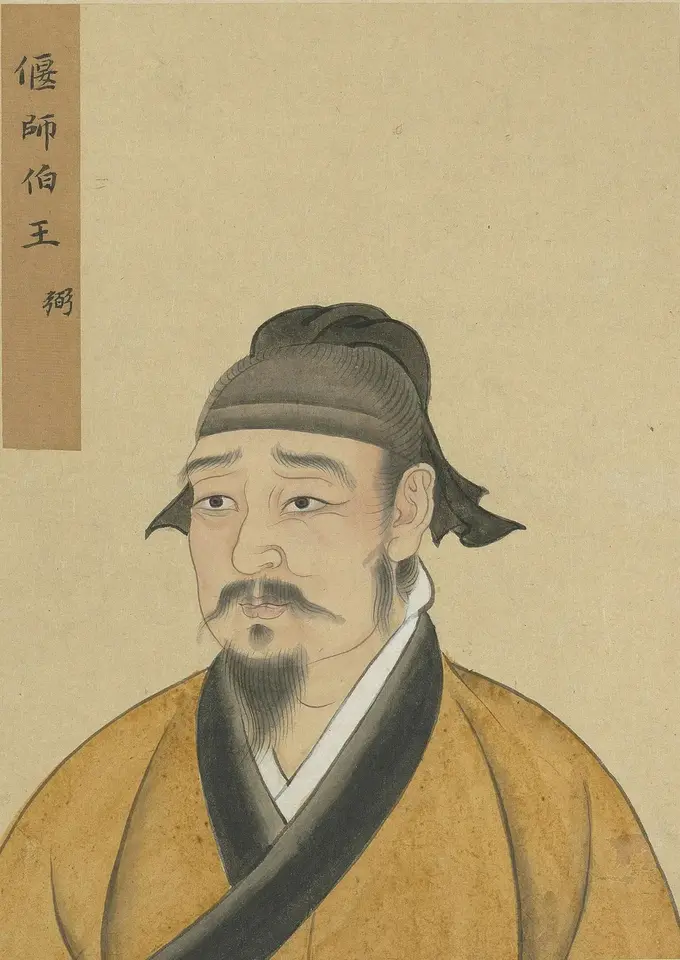
226 CE–249 CE
王弼
Wang Bi (王弼, 226–249), courtesy name Fusi, a native of Gaoping in Shanyang Commandery, Yanzhou (northwest of modern Weishan County, Jining, Shandong Province), was a seminal philosopher and classical commentator of the Cao Wei state during the Three Kingdoms period, celebrated alongside He Yan and Xiahou Xuan as a primary founder of Wei-Jin Xuanxue ("Dark Learning" or Neo-Daoist metaphysics) during the Zhengshi era. Born…
Wang Bi (王弼, 226–249), courtesy name Fusi, a native of Gaoping in Shanyang Commandery, Yanzhou (northwest of modern Weishan County, Jining, Shandong Province), was a seminal philosopher and classical commentator of the Cao Wei state during the Three Kingdoms period, celebrated alongside He Yan and Xiahou Xuan as a primary founder of Wei-Jin Xuanxue ("Dark Learning" or Neo-Daoist metaphysics) during the Zhengshi era. Born into the prestigious Wang clan of Gaoping—descended from the Eastern Han Excellency of Works Wang Chang and related to the literary figure Wang Can—he grew up surrounded by the nearly ten thousand scrolls originally collected by Cai Yong and inherited by his father Wang Ye. A prodigy from childhood, Wang Bi mastered the Laozi and the Zhouyi (Book of Changes) in his early teens and stunned the leading intellectuals of Luoyang, Pei Hui and He Yan, with his ontological theory of "taking non-being (wu) as the fundamental root" and "grasping the meaning and forgetting the image." Recommended by He Yan to serve as Gentleman of the Imperial Secretariat during the Zhengshi era, he composed the Commentary on the Zhouyi (Zhouyi Zhu), General Principles of the Zhouyi (Zhouyi Lüeli), Commentary on the Laozi (Laozi Zhu), Outline of the Laozi (Laozi Zhilüe), and Explanations of Doubts in the Analects (Lunyu Shiyi), replacing Han numerological divination with philosophical exegesis. After Sima Yi staged the Incident at the Gaoping Tombs in the first month of 249 and executed Cao Shuang and He Yan, Wang Bi was dismissed from office and died of an epidemic that autumn at the age of twenty-four.
Born into the distinguished Wang clan of Gaoping in Shanyang Commandery; his father Wang Ye had inherited the nearly ten-thousand-scroll library of Wang Can and Cai Yong.
By age ten, became deeply absorbed in studying the Laozi and the Zhouyi, displaying extraordinary eloquence and philosophical insight.
Around the age of capping, visited Pei Hui and He Yan in Luoyang, articulating the doctrines that "the Sage embodies non-being" and "all things take non-being as their root."
Recommended by He Yan and appointed Gentleman of the Imperial Secretariat; granted a private audience by Regent Cao Shuang, whom he alienated by discoursing solely on Daoist philosophy rather than politics.
Debated metaphysics with Zhong Hui and Xun Rong while completing his Commentary on the Laozi, Commentary on the Zhouyi, General Principles of the Zhouyi, and Explanations of Doubts in the Analects.
Dismissed from office following the execution of Cao Shuang and He Yan in the Incident at the Gaoping Tombs in the first month; contracted a fatal epidemic in the autumn and died at age twenty-four.
Wang Bi was born in the seventh year of the Huangchu era (226) into the eminent Wang clan of Gaoping in Shanyang Commandery. His great-great-grandfather Wang Gong had served as Grand Commandant of the Eastern Han, and his great-grandfather Wang Chang rose to Excellency of Works and was celebrated as one of the "Eight Paragons" (Bajun) of the partisan integrity movement. During the turmoil following Dong Zhuo's seizure of power at the end of the Han dynasty, Wang Chang's grandson Wang Can—the foremost of the "Seven Masters of the Jian'an Era"—fled south to Jingzhou alongside his cousin Wang Kai to seek refuge with Governor Liu Biao. Esteeming their family reputation, Liu Biao gave his daughter in marriage to the handsome Wang Kai, and from this union Wang Bi's father, Wang Ye, was born. Earlier in Chang'an, the great Eastern Han scholar Cai Yong had bequeathed his entire private library of nearly ten thousand scrolls to the young Wang Can. After Wang Can died in the epidemic of 217 and his two sons were executed in 219 for their involvement in Wei Feng's conspiracy, Cao Pi designated Wang Kai's son Wang Ye as Wang Can's posthumous heir, transferring the entire ten-thousand-scroll collection of Cai Yong and Wang Can to Wang Ye's household.
Raised amid this unrivaled private library in Luoyang, Wang Bi demonstrated extraordinary intellectual precocity from early childhood. By the age of ten, he had read widely across Confucian and Daoist texts and developed a deep passion for the Laozi and the Zhouyi (Book of Changes), combining literary elegance with razor-sharp dialectic skill. At that time, following the death of Emperor Ming of Wei and the accession of the young Cao Fang during the Zhengshi era (240–249), the co-regent Cao Shuang patronized leading intellectuals such as He Yan, Xiahou Xuan, and Deng Yang, fostering a vibrant culture of character appraisal and metaphysical "Pure Conversation" (qingtan) in the capital. While still in his teens, Wang Bi gained wide renown across Luoyang as a philosophical prodigy.
As Wang Bi approached the age of twenty, he paid a visit to Pei Hui, a celebrated intellectual serving as a Gentleman in the Ministry of Personnel. Struck by the youth's brilliant bearing, Pei Hui tested him with the central theoretical dilemma confronting thinkers of the era—how to reconcile Confucianism with Daoism: "Nothingness (wu, non-being) is indeed the ultimate ground upon which all things in heaven and earth depend; yet the Sage Confucius never spoke of wu in his teachings, whereas Laozi spoke of it endlessly. Why is this?" Wang Bi replied without hesitation: "The Sage Confucius personally embodied non-being (ti wu), and because non-being cannot be made the object of direct verbal instruction, he necessarily did not speak of it. Laozi, by contrast, remained within the realm of being (you) and had not yet transcended it; therefore he constantly spoke of what he himself lacked." This incisive answer simultaneously established Daoist "non-being" as the ontological foundation of reality while elevating Confucius above Laozi as the supreme sage, leaving Pei Hui deeply impressed.
Shortly thereafter, Wang Bi called upon He Yan, the Minister of Personnel and acknowledged leader of the Zhengshi philosophical circle. Having heard of Wang Bi's reputation, He Yan laid before him a series of thorny metaphysical questions that he had pondered for years. Wang Bi resolved each difficulty with crystalline clarity before the assembled guests. When Wang Bi showed him the draft of his Commentary on the Laozi, He Yan—who had been composing his own commentary on the Laozi—was so awed by the depth of the young scholar's insights that he exclaimed: "Confucius said that 'the younger generation is to be regarded with awe.' With a man such as Wang Fusi, one may truly discuss the ultimate boundary between Heaven and humanity!" He Yan thereupon abandoned his own line-by-line commentary on the Laozi, reworked his manuscript into two general essays on the Dao and Virtue, and treated Wang Bi as an intellectual equal despite the difference in their ages.
At that time, Liu Tao of Huainan was famous in Luoyang for his mastery of rhetorical disputation, yet whenever he debated Wang Bi he was left unable to reply. Around the seventh year of Zhengshi (246), He Yan recommended the twenty-year-old Wang Bi for the prestigious post of Gentleman Attendant at the Palace Gate (Huangmen Shilang). However, Ding Mi—a close adviser of Regent Cao Shuang who frequently competed with He Yan for influence—preemptively persuaded Cao Shuang to appoint Wang Bi's friend Wang Li to the vacancy instead, while Wang Bi was assigned the lesser post of Gentleman of the Imperial Secretariat (Shangshulang).
When Wang Bi first reported for duty, Cao Shuang granted him a private audience and dismissed his attendants, expecting the famed young scholar to offer practical advice on statecraft and political administration. Uninterested in worldly politics, Wang Bi instead discoursed at length on abstract Daoist metaphysics without uttering a word about government affairs, causing Cao Shuang to laugh him off and treat him coldly thereafter. Throughout his tenure in the Imperial Secretariat, Wang Bi devoted his energies to philosophical writing and scholarly exchanges with Zhong Hui, Xun Rong, and Wang Li. Honest and unworldly by temperament, he lacked bureaucratic tact: when Wang Li took the palace post originally intended for him, Wang Bi openly cooled their friendship, and at official gatherings he frequently burst out laughing at colleagues whom he regarded as pedantic or vulgar, earning the resentment of conventional officials while maintaining a close intellectual bond with Zhong Hui.
Within just a few years, the twenty-something philosopher produced a remarkable body of foundational works: the two-fascicle Commentary on the Laozi (Laozi Zhu), the Outline of the Laozi (Laozi Zhilüe), the six-fascicle Commentary on the Zhouyi (Zhouyi Zhu), the General Principles of the Zhouyi (Zhouyi Lüeli), and the three-fascicle Explanations of Doubts in the Analects (Lunyu Shiyi). In his famous essay "Clarifying the Images" (Ming Xiang) in the Zhouyi Lüeli, Wang Bi formulated the hermeneutic principle of "grasping the meaning and forgetting the image, grasping the image and forgetting the words," sweeping away the intricate numerological systems (xiangshu) of the Han dynasty and interpreting the Book of Changes through pure philosophical principle (yili). In ontology and political philosophy, he argued that all determinate phenomena ("being," you) arise from and are unified by undifferentiated "non-being" (wu), and that Confucian ethical institutions (mingjiao) flow naturally from the spontaneous order of nature (ziran).
In the first month of the tenth year of Zhengshi (249), Grand Tutor Sima Yi seized power in the Incident at the Gaoping Tombs while Cao Shuang accompanied Emperor Cao Fang outside the capital, executing Cao Shuang, He Yan, Deng Yang, and Ding Mi along with their clans. Because Wang Bi had been recommended for office by He Yan, the new regime dismissed him from his post as Gentleman of the Imperial Secretariat on a minor administrative charge. That autumn, a severe epidemic swept through Luoyang; Wang Bi contracted the illness and died at the age of twenty-four (twenty-three by Western reckoning), leaving no son and only a young daughter who later married into the Liu clan of Gaoping. Sima Shi lamented his untimely death for days. Four centuries later, during the Tang dynasty, Kong Yingda's imperial compilation Correct Meaning of the Five Classics (Wujing Zhengyi) adopted Wang Bi's Commentary on the Zhouyi as the orthodox standard for the civil service examinations, cementing his enduring influence on Chinese thought.
FIGURES ASSOCIATED WITH THIS DYNASTY