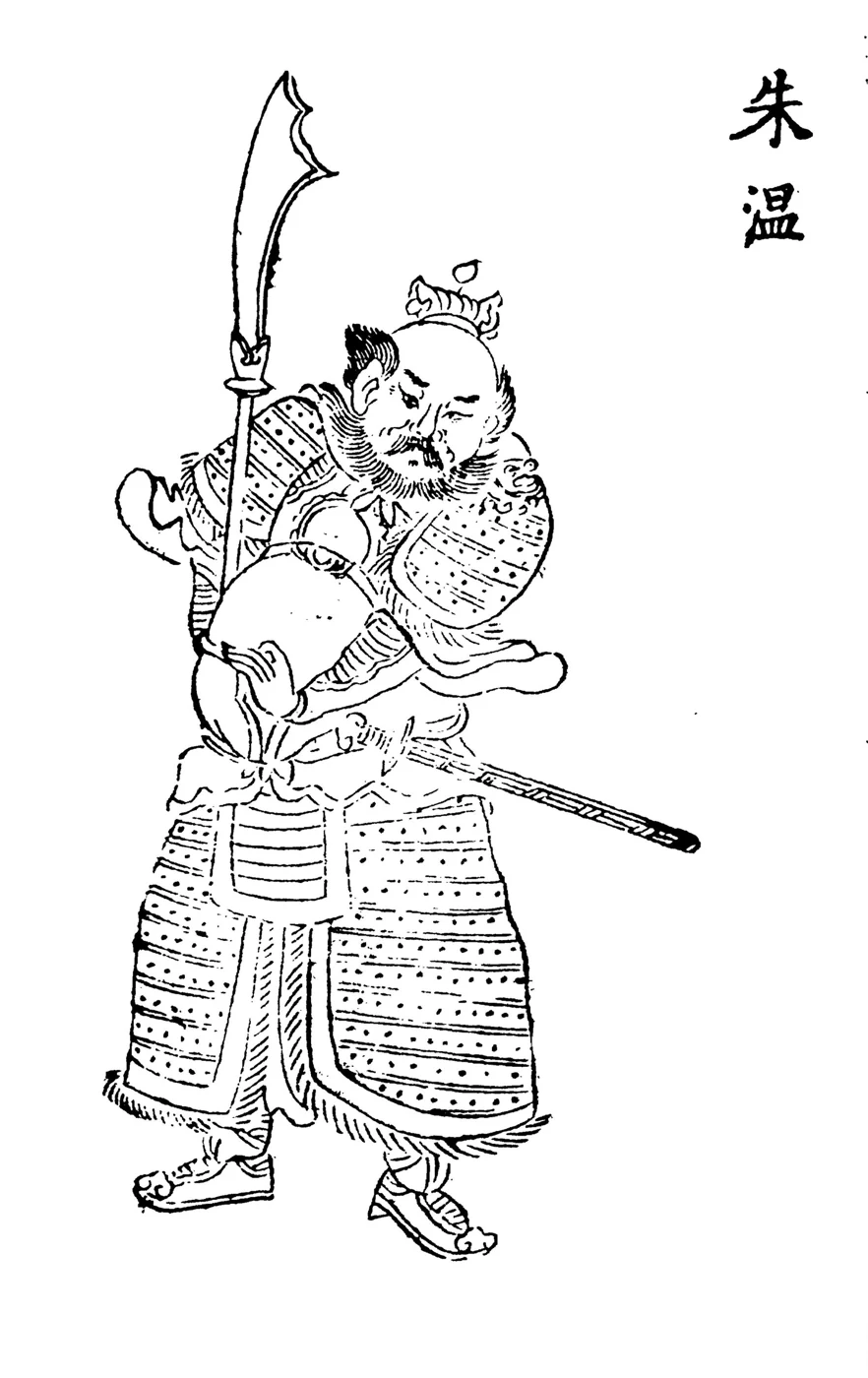
Biography
Family Background and Early Life
Zhu Wen was born on the night of the twenty-first day of the tenth lunar month in 852, the sixth year of Dazhong under Emperor Xuanzong of Tang, at Wugouli in Dangshan County, Song Prefecture. His father Zhu Cheng was a village tutor who taught the Five Classics and was known locally as “Zhu of the Five Classics.” Although Zhu Cheng never entered official service, his learning gave him a measure of local standing and enabled marriage ties with families of local officials. Zhu Wen's mother, Lady Wang, had three sons: the eldest Zhu Quanyu, the second Zhu Cun, and the third Zhu Wen. There was also a daughter who later married Yuan Jingchu of Xiayi.
Zhu Cheng died early and the family's circumstances declined. Lady Wang took her three sons to work in the household of the wealthy Liu Chong in Xiao County, Xuzhou. According to the *New History of the Five Dynasties*, Zhu Wen, after growing up, “did not engage in productive work and prided himself on his bold strength,” so many people in the village disliked him. Liu Chong often beat him for his laziness. Liu Chong's mother alone thought Zhu Wen was no ordinary person and warned the family, “Zhu San is not an ordinary man. Treat him well.”
Joining Huang Chao and Surrendering to the Tang
During the Qianfu era, 874–879, repeated famine struck the eastern regions and banditry spread. In 877, the fourth year of Qianfu, Zhu Wen and his second elder brother Zhu Cun left the Liu household and joined Huang Chao's rebel army; another account gives the fifth year of Qianfu. Zhu Wen campaigned with Huang Chao in Lingnan. Zhu Cun was killed in battle, while Zhu Wen distinguished himself through bravery, accumulated military merit, and was promoted to unit commander.
In the twelfth lunar month of 880, the first year of Guangming, Huang Chao's army captured Chang'an and Emperor Xizong of Tang fled to Chengdu. Zhu Wen was ordered to guard the East Wei Bridge and successfully persuaded Zhuge Shuang, military governor of Xiazhou, to submit to Huang Chao, gaining considerable trust. In 881, the first year of Zhonghe, Huang Chao established the Great Qi regime and appointed Zhu Wen vanguard commander of the Southeastern Expeditionary Army. He captured Dengzhou, took its prefect Zhao Jie prisoner, and stabilized Great Qi's southeastern position. In the seventh lunar month of the same year, Zhu Wen was transferred to Xingping to resist Tang forces from Bin, Qi, Fu, Xia, and other prefectures and won merit in these operations.
In the second lunar month of 882, the second year of Zhonghe, Zhu Wen was appointed defense commissioner of Tongzhou. After taking Tongzhou, he repeatedly suffered defeat against Wang Chongrong, military governor of Hezhong. Zhu Wen sent ten memorials requesting aid from Huang Chao, but all were withheld by Meng Kai, commander of the Left Army. Learning that Huang Chao's position was deteriorating and his commanders were becoming disaffected, and being urged by his confidants Hu Zhen and Xie Tong to defect, Zhu Wen killed army supervisor Yan Shi in the ninth lunar month and surrendered the whole prefecture to Wang Chongrong. Emperor Xizong was delighted and reportedly said, “Heaven has given me a great general.” He appointed Zhu Wen General-in-Chief of the Left Jinwu Guard and deputy campaign commander of the Hezhong expedition and granted him the name “Quanzhong.”
Building a Power Base in Bianzhou and Expanding
In the second lunar month of 883, the third year of Zhonghe, the Tang court appointed Zhu Wen prefect of Bianzhou and military governor of Xuanwu Circuit. He entered Bianzhou to assume office in the seventh lunar month, aged thirty-two. The Bianzhou-Songzhou region was then suffering severe famine, public and private resources were exhausted, unruly soldiers inside and outside the city were difficult to control, and remnants of Huang Chao's army together with Qin Zongquan of Caizhou were besieging Chenzhou. Zhu Wen was given the additional post of supreme commander against the rebels on the northeastern front and led forces to relieve Chenzhou.
In 884, the fourth year of Zhonghe, Zhu Wen and Li Keyong, military governor of Hedong, jointly pursued Huang Chao. Zhu Wen captured Wazi Stockade and accepted the surrender of Li Tangbin and Wang Qianyu. He then joined Li Keyong at Wangman Ferry north of Zhongmou in heavily defeating Huang Chao's army and accepted the surrender of several of Huang's formidable commanders, including Huo Cun, Ge Congzhou, Zhang Guihou, and Zhang Guiba. In the fifth lunar month, as Li Keyong was returning through Bianzhou, Zhu Wen hosted a banquet at Shangyuan Post Station and that night sent troops to surround him. Li Keyong broke out and escaped, while several hundred of his men were killed. This became known as the Shangyuan Post Station Incident. From then on Zhu Wen and Li Keyong became mortal enemies, beginning the decades-long struggle between Later Liang and Jin, later Later Tang.
After Huang Chao's defeat and death, Qin Zongquan emerged as the strongest separatist power in the Central Plains. Zhu Wen came under repeated attack from Qin and at times faced a grave situation. In 887, the third year of Guangqi, Zhu Wen joined forces from Yan and Yun and heavily defeated the Cai army at Bianxiao Village, reportedly taking more than twenty thousand heads. He later fell out with the brothers Zhu Xuan and Zhu Jin, who had once aided him, over competing interests, and captured Caozhou and Puzhou, gradually absorbing Tianping and Taining circuits. In 889, the first year of Longji, Qin Zongquan was seized by his own subordinates and delivered to Zhu Wen, who sent him to the capital for execution. For this merit Zhu Wen was promoted to Prince of Dongping Commandery.
Controlling the Court and Replacing the Tang
In 901, the first year of Tianfu, Emperor Zhaozong of Tang was detained by the eunuch Han Quanhui, and Chancellor Cui Yin summoned Zhu Wen to intervene. Zhu Wen marched west and besieged Fengxiang. In 903, the third year of Tianfu, Li Maozhen killed Han Quanhui and more than seventy other eunuchs and made peace with Zhu Wen, escorting Zhaozong back to Chang'an. Zhu Wen then exterminated several hundred eunuchs, abolished the Shence Armies, and gained complete control of court government. That same year he was enfeoffed as Prince of Liang.
In 904, the first year of Tianyou, Zhu Wen killed Chancellor Cui Yin and forced Zhaozong to move the capital to Luoyang. In the eighth lunar month he ordered Zhu Yougong, Shi Shusong, Jiang Xuanhui, and others to murder Zhaozong and installed Zhaozong's son Li Zhu as emperor, known as Emperor Ai of Tang. In 905, the second year of Tianyou, Zhu Wen massacred more than thirty court officials, including Pei Shu and Dugu Sun, at White Horse Station and threw their bodies into the Yellow River. The episode became known as the White Horse Station Massacre. That same year he also had Empress Dowager He strangled and killed former confidants such as Jiang Xuanhui and Liu Can.
In the fourth lunar month of 907, the fourth year of Tianyou, Zhu Wen forced Emperor Ai of Tang to abdicate, changed his own name to Zhu Huang, proclaimed himself emperor, founded the state of Liang, adopted the Kaiping era name, and established his capital at Kaifeng. The Tang Dynasty thereby ended. Not long afterward Zhu Wen had the deposed Emperor Ai, then styled Prince of Jiyin, poisoned to death.
Reign and Death
After becoming emperor, Zhu Wen appointed Zhang Wenwei, Yang She, and Xue Yiju as chancellors, renamed the Bureau of Military Affairs the Chongzheng Institute, and appointed Jing Xiang as its director. During his reign he placed importance on restoring agricultural production and ordered that no miscellaneous levies be imposed beyond the Two-Tax system. On one occasion his nephew Zhu Youliang presented “auspicious wheat” during a year of disaster in an attempt to curry favor. Zhu Wen became furious and dismissed him from office.
War nevertheless continued between Later Liang and the Jin rulers Li Keyong and his son Li Cunxu. Later Liang lost the Battle of Luzhou in 908, the second year of Kaiping, and suffered a major defeat to Jin at the Battle of Baixiang in 911, the fourth year of Kaiping. In 912, the second year of Qianhua, Zhu Wen personally campaigned in Hebei but failed and returned to Luoyang seriously ill. In the sixth lunar month his third son Zhu Yougui launched a palace coup and murdered him, wrapping the body in a torn felt mat and burying it inside the bedchamber. After Later Liang was destroyed, Emperor Zhuangzong of Later Tang posthumously reduced Zhu Wen to commoner status and ordered the structures at his tomb demolished.
The Legend of His Birth, His Family and His Youth
Zhu Wen was born on the night of the twenty-first day of the tenth month of the sixth year of Dazhong (5 December 852) at Wugou village in Dangshan county of Songzhou. It was said that on the night of his birth the house where he lived sent up a red vapour, so that a red glow was seen from far off and the neighbours, thinking the Zhu house was on fire, came running with buckets and basins only to find everything quiet. His father Zhu Cheng taught the Five Classics in the countryside, whence he was known as Zhu of the Five Classics; though he never held office, his learning gave him such standing locally that the family could intermarry with a more distinguished official house. His mother, of the Wang, bore three sons — Zhu Quanyu the eldest, Zhu Cun the second, and Zhu Wen the third — and a daughter who later married Yuan Jingchu of Xiayi. After Zhu Cheng's early death the family declined, and the Wang took her three sons to work as servants in the household of the rich Liu Chong at Xiaoxian in Xuzhou. The New History of the Five Dynasties says that when grown Zhu Wen "did not attend to any livelihood but prided himself on his strength and daring, so that most of his neighbours disliked him", and Liu Chong too beat him for his laziness; only Liu Chong's mother pitied him from childhood and warned the family that "Zhu the Third is no common man; treat him well".
From Huang Chao's Officer to His Surrender to Tang
In the Qianfu years, with famine and banditry in the east, Huang Chao rose in Cao and Pu and tens of thousands of starving people followed him. About 877 Zhu Wen and his second brother Zhu Cun left Liu Chong's household and joined Huang Chao's army; campaigning in Lingnan, Zhu Cun was killed, and Zhu Wen, fighting hard and winning repeatedly, was made a captain. In the twelfth month of 880, when Huang Chao took Chang'an, he was sent to camp at the Eastern Wei bridge, and when Zhuge Shuang, military commissioner of Xiazhou, lay at Yueyang, Huang Chao had him persuade Zhuge, who submitted. In the second month of 881 Huang Chao made him vanguard commissioner of the southeastern camp and sent him against Nanyang, which he took; in the sixth month he returned to Chang'an, where Huang Chao feasted him in person at Bashang; in the seventh he was sent to hold off the armies of Bin, Qi, Fu and Xia at Xingping, "gaining merit wherever he went". In the eighth month, when Li Xiaochang of Fuyan and Li Sigong of Xiazhou camped at the Eastern Wei bridge, Huang Chao sent Zhu Wen against them; in the ninth month the two were beaten and withdrew, and in the eleventh Meng Kai and Zhu Wen, attacking their camps at Fuping, drove them back to their own commands. In the second month of 882 Huang Chao made him defence commissioner of Tongzhou, to take the city himself; marching south from Danzhou he took it, and the prefect Mi Cheng fled to Hezhong. There the military commissioner Wang Chongrong lay with tens of thousands, gathering the other commands to restore the Tang, and Zhu Wen, "repeatedly defeated by Chongrong", asked Huang Chao for reinforcements, ten memorials in vain, all blocked by Meng Kai; learning that Huang's army was weakening and its officers falling away, and advised by his trusted generals Hu Zhen and Xie Tong to come over to the court, he killed the supervising eunuch Yan Shi in the ninth month, surrendered the department to Wang Chongrong and "served him as an uncle", while Wang Duo, by imperial authority, made him military commissioner of Tong and Hua. Yang Fuguang would have had him beheaded, but Wang Chongrong said that "now that we are enlisting the rebels, all are pardoned; and Wen is brave and useful, and to kill him would be unlucky". The emperor, then in Shu, was delighted at the report, saying that Heaven had given him his best general, and appointed him general of the left guards and deputy commissioner of the Hezhong camp, granting him the name Quanzhong, "wholehearted loyalty". In the third month of 883 he was made military commissioner of Xuanwu, and in the fourth month, when Huang Chao fled south from Languan, he took Chang'an with the other commands, and led his single brigade east, entering Liangyuan on the dingmao day of the seventh month at the age of thirty-two.
Building Up Bianzhou and Destroying Qin Zongquan
When Zhu Wen came to Bianzhou, "Bian and Song were famine-stricken, public and private resources were exhausted, the arrogant soldiers within were hard to control, and outside there was a great enemy, so that there was not a day without fighting and men's hearts were fearful, yet Quanzhong's courage only grew". The court made him commissioner of the northeastern camp to relieve Chenzhou, and he destroyed Huang Chao's besieging force in forty engagements, entering Chenzhou, where the prefect Zhao Chou met him before his horse; in the sixth month the people of Chen, grateful, built a shrine to him while he lived. In 884, joining Li Keyong, he broke Huang Chao at Wangmandu as his army crossed, killing more than ten thousand, and received the surrender of the generals Huo Cun, Ge Congzhou and the brothers Zhang Guihou and Zhang Guiba, pardoning and enlisting them all. Huang Chao being dead, Qin Zongquan of Caizhou became the greatest power in the centre, "with tens of thousands of men, taking the neighbouring commands, killing and plundering officials and people more cruelly than Huang Chao"; hard pressed, Zhu Wen asked aid of Zhu Xuan, military commissioner of Tianping, whose cousin Zhu Jin defeated Qin at Hexiang, and Zhu Wen, grateful, swore brotherhood with Zhu Xuan. In 885 he beat the Cai troops at Jiaoyi and took their general Yin Tielin; in the fourth month he was made acting minister of works and given fifteen hundred more households, and in the twelfth the emperor fled to Fengxiang. In the spring of 886 the Cai became stronger still and, "the Tang house being weak and the provincial troops disobeying the court", Qin took Ru, Luo, Huai, Meng, Tang, Deng, Xu and Zheng, "several thousand li with hardly a soul left, only Song, Bo, Hua and Ying able to close their gates". He was made a prince, and took Huazhou, appointing Hu Zhen its acting governor. In 887 he had Zhu Zhen recruit men in the east, "more than ten thousand volunteering in ten days", and seized a thousand horses and armour from Qingzhou; when Zhang Zhi and Qin Xian camped with tens of thousands each, their palisades linked twenty li, he said that the enemy, thinking him weak, would attack, and that "we should strike first, when he is unprepared", took four camps and killed more than ten thousand, and by a fog surprised and destroyed Lu Tang's camp. In the fifth month he routed Qin Zongquan's army in person from dawn to midday, pursuing over twenty li, and the next day, with the troops of Yan, Yun and Hua, destroyed his camp and killed more than twenty thousand; Qin fled by night and Zhu Wen pursued to Yangwu bridge. Thereafter the Cai troops abandoned the commanderies they had seized. In the second month of 889 Shen Cong of Cai seized Qin Zongquan, broke his legs and imprisoned him, and when Shen was killed by Guo Fan, who brought Qin to Zhu Wen, he had him sent in a cage to Chang'an, where Emperor Zhaozong received the captive at the Yanyi tower and had him beheaded beneath a solitary willow; Caizhou was pacified and Zhu Wen made acting grand commandant, director of the secretariat and Prince of Dongping.
The Breach with Zhu Xuan and Zhu Jin and the Taking of Yun and Yan
Zhu Xuan and Zhu Jin had aided him against Qin, but they coveted his brave soldiers, "hanging gold and silk along their border to lure them", and many went over; his reproachful letter drew an insolent reply, and he sent Zhu Zhen against Cao and Pu, taking the prefect Qiu Li and besieging Pu — "the quarrel with Yun and Yan began here". In the second month of 892, marching against Yunzhou, he sent Zhu Youyu ahead to Doumen; that night Zhu Xuan with ten thousand horse and foot surprised Youyu, who withdrew south, and Zhu Wen, coming to his relief at dawn and not knowing he had gone, lost all his vanguard; pursuing to the Hu river he failed to come up with them, and when Zhu Xuan turned on him "he galloped south, hard pressed, and leaping the ditch before him with his horse, was saved only by Zhang Guihou, who fought behind him with his lance", while Li Fan and several officers were killed. In the second month of 894 he marched in person to Yushan, where Zhu Xuan and Zhu Jin had already formed up; the southeast wind rose and his banners lost order, then the northwest wind suddenly blew, and he "ordered fire set, so that smoke and flame reached the sky and the enemy line was attacked under cover of it", utterly defeating them and killing more than ten thousand, building a mound of the dead at Yushan. In the eleventh month Zhu Xuan sent He Gui, Liu Cun and the barbarian general He Huaibao with more than ten thousand against Caozhou to relieve Yanzhou, and Zhu Wen, hurrying on horseback ahead of his army, defeated them south of Juye, "killing almost all and taking He Gui, Liu Cun, He Huaibao and three thousand of their men alive". In the first month of 894 he attacked Yunzhou in force, and Pang Shigu, ordering the generals to bridge the Ji river and crossing with the centre first, "shook Yunzhou with his shout", so that Zhu Xuan abandoned his camp and fled by night; Ge Congzhou pursued him and took him with his wife and sons at Zhongdu, beheading him beneath the Bian bridge, and Yunzhou was pacified. Ge Congzhou was then sent against Yanzhou, and Kang Huaiying surrendered when he heard Yunzhou had fallen, so that Zhu Jin and Shi Yan'er fled to Huainan, and the prefectures of Yan, Hai, Yi and Mi were pacified.
Controlling the Court: the Eunuchs, the Move to Luoyang, the Killing of Zhaozong and the White Horse Post
When the eunuch Liu Jishu rebelled and imprisoned the emperor, Sun Dezhao killed him in the first month of 901 and the emperor was restored. The chancellor Cui Yin, dealing with Liang outside while wishing to borrow Liang troops to destroy the eunuchs, found that Li Maozhen of Fengxiang and Wang Xingyu of Bin and Ning had sent their sons with picked troops to guard the emperor, who was aided by the eunuch Han Quanhui and the rest. When the emperor and Cui Yin conferred, the eunuchs overheard, and, having planted beautiful women in the palace to spy, at last learned of Cui's memorial to destroy them, at which, in terror, they plotted against him; Cui, his plot discovered and his position desperate, forged an edict calling in the Liang troops. In the tenth month Zhu Wen came with seventy thousand men of Xuanwu, Xuanyi, Tianping and Huguo to Hezhong, took Tongzhou, attacked Huazhou and received Han Jian's surrender; hearing of his approach, Han Quanhui carried the emperor off to Fengxiang with the guards of Qi and Bin. Fengxiang being long besieged and its food exhausted, countless died of cold and hunger; in the first month of 903 Li Maozhen killed Han Quanhui and twenty others and, "bagging their heads", showed them to the Liang army and agreed to hand over the emperor. On the jiazi day the emperor came out to the Liang camp, and Zhu Wen "took the reins himself, weeping as he walked, and after more than ten li stopped, so that all who saw it thought him loyal". On the jisi day the emperor, back from Fengxiang, "put on plain robes, wept in the ancestral temple and only then entered", and more than seven hundred eunuchs were killed, destroying the eunuch power that had dominated the court since the middle Tang. He was given the title "Meritorious Subject who Turned Back Heaven and Remade the World" and five stanzas of imperial "Willow Branch" verse, and left his son Zhu Youlun as guard commander while he withdrew east. Later, when the emperor and Cui Yin conferred, Zhu Wen memorialised the reason Cui had called him, and the emperor, angry, dismissed Cui, whereupon Zhu Wen marched off, attacked Binzhou, whose commissioner Yang Chongben surrendered four prefectures, and Cui Yin fled to Huazhou. In the first month of 904 he had the guard commander Zhu Youliang forge Zhaozong's order to arrest and kill Cui Yin and the prefect of the capital Zheng Yuangui, and memorialised that the emperor move to Luoyang, who had no choice; he built the Luoyang palace with the craftsmen and wealth of the provinces "in a few months", and had the people of Chang'an moved by register, the palaces and houses of Chang'an demolished and the timber floated down the Wei to build the new capital. When Zhaozong reached Luoyang the six guards had almost all scattered and his attendants and household were Zhu Wen's men; of the two hundred or so ball-players and palace boys who still attended him, all were made drunk and buried alive, and two hundred others of like age and height put in their place, whom the emperor could not at first distinguish. In the eighth month of 904 he ordered Zhu Yougong, Shi Shucong and Jiang Xuanhui to kill Zhaozong in the Jiaolan Hall; the emperor, in a single garment, fled round the pillars and was overtaken and killed at thirty-eight, and Jiang Xuanhui, who would also have killed the Empress He, spared her because Zhu Wen had ordered only the emperor's death. Li Zhu, the ninth son, was set up as Emperor Ai. On the she day of the second month of 905 he killed Pei Shu, Dugu Sun, Cui Yuan and more than thirty ministers (some say thirty-nine) at the White Horse Post in Huazhou, and Li Zhen, who had failed the examinations and hated the great families and the examination-bred officials, urged that they be destroyed root and branch, saying that "these men call themselves the clear stream; let them be thrown into the Yellow River and made turbid", at which Zhu Wen laughed and had the bodies thrown into the river — the "calamity of the White Horse Post". In the twelfth month he strangled the Empress He and killed Jiang Xuanhui and Liu Can. In the first month of 907 Emperor Ai's envoys offering the throne were refused; in the third month the edict made twenty-one circuits into the kingdom of Wei and offered him the nine bestowals, which he angrily refused; and in the fourth month he forced the abdication, changed his name to Zhu Huang, took the throne, founded Liang with the era Kaiping and the capital at Kaifeng, ending the Tang, and soon afterwards poisoned the deposed Emperor Ai.
His Rule as Emperor and His Military Reverses
As emperor he made Zhang Wenwei, Yang She and Xue Yiju chancellors, changed the Bureau of Military Affairs into the Chongzheng Institute with Jing Xiang at its head, creating a central organ unlike that of the Tang. Economically he promoted agriculture, rewarded farming, lightened taxes and lent oxen to peasants without them; the fiscal treatise of the Old History of the Five Dynasties says that "when the founder of Liang opened his state, after the great disorder of Huang Chao, with a single town of Yimen he kept strict watch without and opened waste land within, encouraging farming and mulberry, lightening taxes and corvée, so that though the soldiers fought hard the people paid gladly, and in twenty years he became the hegemon", adding that under his last emperor the people of Henan "though worn by transport never fled, and the reason was nothing else than light taxes and a countryside they loved". He forbade any levy beyond the two taxes, and when his nephew Zhu Youliang presented auspicious wheat in a famine year he dismissed him in anger. In military law, in his provincial days he had put the whole unit to death when its commander fell — the "unit-cutting" rule — so that soldiers whose commander died fled and dare not return; he therefore had every soldier tattoo his face with his unit's mark, and deserters, caught at the fords and sent back, "never lived", so that the fugitives gathered in the hills as bandits. In the first year of Kaiping he pardoned them and let even the tattooed return home, "and the bandits decreased by seven or eight tenths". He ordered that no matter how high an officer's rank or how many his men, in civil matters he must obey the local officials, so that responsibility was clear and quarrels between army and administration grew rare. He prized talent and, on taking the throne, sent officials to seek worthy men, advancing especially the able in low positions, reading for himself memorials that pointed out abuses of policy. To check the powerful he punished a favourite: when the general Kou Yanqing, riding to court, had a man who did not make way thrown over a bridge rail to his death, the censor Cui Yi impeached him, arguing that "by law he who orders by force is chief and the hand that strikes is the follower... an unprovoked assault is a grade above the injury caused and cannot be called negligence", and Zhu Wen demoted Kou; when Kou threatened a reward of ten thousand strings for Cui Yi's head, the emperor sent word that "if a hair of Cui Yi is harmed I will wipe out your clan", and "the arrogance of the meritorious was thereby somewhat checked". Yet the war with Li Keyong and his son Li Cunxu went on with repeated defeats: the siege of Luzhou in 908, where Kang Huaizhen failed for half a month and then dug trenches round the city, was finally broken when Li Cunxu surprised Liu Zhijun, "who grew proud after a small success", and tens of thousands of Liang troops were lost, lifting a siege of more than a year. Hearing of it Zhu Wen sighed that "to have a son one should have one like Li Yazi; Li Keyong lives on though dead, while my sons are no better than pigs and dogs". In 912 he crossed the river against Hebei with a claimed half million men, besieging Zaoqiang and Tiaoxian; Zaoqiang fell, but before Tiaoxian his camp was raided by three hundred enemy horse, his tents and fodder burned and his men's spirits broken, and seeing that Li Cunxu had destroyed Liu Shouguang his stratagem failed and he withdrew. Old and ill, he was worsened by the journey and could not even ride a sedan chair, reaching Luoyang only on the sixth day of the fifth month; on the fifteenth, gravely ill, he told his attendants that "for thirty years I have ordered the realm, and never thought the remnant of Taiyuan could revive so fiercely; the boy Li Cunxu has great ambition, Heaven takes away my years, and when I die none of my sons can match him — I shall have no place to be buried", and weeping aloud he fainted and revived only under the physician's hand.
His Household, His Murder and After
His wife Zhang Hui was wise and courteous, and he treated her with respect, consulting her on every great matter of army and state before acting. She was both gentle and firm, managing the household and often overruling him in military matters; sometimes, already on campaign, he would be overtaken by her messenger saying that on her orders he should turn back, and he would do so at once. She lived with him more than twenty years and died on the eve of his founding Liang, warning him that "to mount the throne is easy but to come down is hard", and begging him to remember the four words "less killing, less lust". After her death he gave himself to pleasure, summoning his sons' wives into the palace, while his sons, shameless, used their wives to compete for favour and for the succession; the wife of his adopted son Zhu Youwen was especially favoured, and he thought of making Zhu Youwen heir. Because his eldest son Zhu Youyu had died young he had never named a heir, and in his last illness he resolved to make Zhu Youwen, giving the seal to Youwen's wife to summon him; but the wife of Zhu Yougui, Prince of Ying, learned of it and told her husband, who as commander of the crane-guard controlled the palace. Knowing him ambitious, Zhu Wen had ordered him posted to Laizhou, and Zhu Yougui, knowing that demoted men were often killed soon after, went in disguise to the left dragon-tiger army and told the commander Han Qing, who feared for himself since so many veteran officers had been killed for small faults; with five hundred trusted soldiers in crane-guard dress they hid in the palace, broke through the gate at midnight and reached the bedchamber. Zhu Wen started up asking who the rebel was, and Zhu Yougui answered that it was no other; Zhu Wen cried that he had long suspected the wretch and regretted not killing him, and that Heaven would not suffer such treason; Zhu Yougui bade his groom Feng Ting'e to "cut the old wretch in pieces", and as Zhu Wen fled round the pillar, the sword struck the pillar three times before he fell on the bed, and Feng Ting'e ran him through the belly, the blade coming out at his back. Zhu Yougui had the floor dug up, wrapped the body in a felt rug and buried it in the bedchamber, hid the death, forged an edict that "Zhu Youwen plotted rebellion and it was only by the loyalty of the Prince of Ying that his troops were destroyed", sent the official Ding Zhaopu racing to the eastern capital to have the Prince of Jun, Zhu Youzhen, kill Youwen, and, when Ding returned with the news, announced the death, proclaimed a false testament and took the throne with the era Fengli, giving Zhu Wen the posthumous name Emperor Shenwu Yuansheng Xiao and the temple name Taizu, buried at Xuanling. But the veteran generals were angry, and though he gave them honours they were not pleased; the Prince of Jun, Zhu Youzhen, gathered the other princes and officers and stirred the palace guard commander Yuan Xiangxian to rise with him. In the first year of Fengli Yuan Xiangxian led several thousand guards into the palace, and Zhu Yougui, fleeing with his wife to the northern wall, saw no escape, had Feng Ting'e kill his wife and then himself, and killed himself likewise. Yuan Xiangxian brought the seal to Kaifeng, where Zhu Youzhen took the throne, restored the era name to the third year of Qianhua, reduced Zhu Yougui to a commoner and restored Zhu Youwen's titles. After Liang fell, Li Cunxu of the Later Tang despoiled Xuanling of its treasures, and the tomb was further destroyed by later depredations, its carvings smashed and the southern half of the mound dug away.