Birth in Yunzhou | Born into a peasant household in Shouzhang, Yunzhou; displayed physical stature, unyielding courage, and extraordinary bodily strength from youth
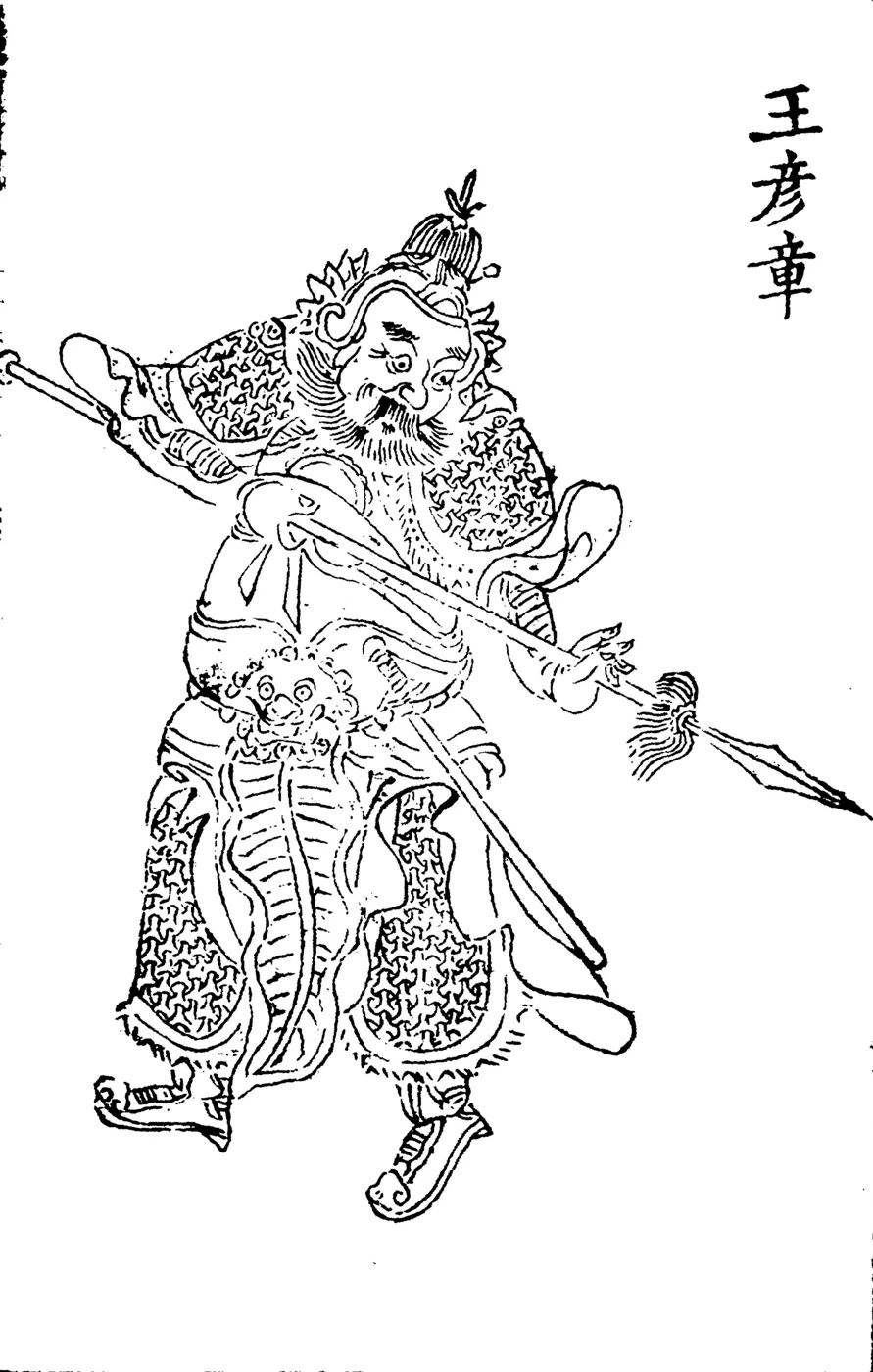
863 CE–923 CE
Noted general of Later Liang in the Five Dynasties
Wang Yanzhang
王彦章
Wang Yanzhang (863 – 923), courtesy name Xianming (or Ziming), was a native of Shouzhang County in Yunzhou (northwest of modern Liangshan, Shandong Province). He was an illustrious commanding general of the Later Liang dynasty during the Five Dynasties period, celebrated for his peerless martial prowess, fierce loyalty, and mastery of a colossal hundred-pound iron lance, which earned him the fearsome battlefield moniker "Iron…
863 CE–923 CELater Liang
PROFILE
Wang Yanzhang (863 – 923), courtesy name Xianming (or Ziming), was a native of Shouzhang County in Yunzhou (northwest of modern Liangshan, Shandong Province). He was an illustrious commanding general of the Later Liang dynasty during the Five Dynasties period, celebrated for his peerless martial prowess, fierce loyalty, and mastery of a colossal hundred-pound iron lance, which earned him the fearsome battlefield moniker "Iron Spear Wang." Enlisting under Emperor Taizu (Zhu Wen) in his youth, he accumulated distinguished military merits, progressively holding high commands including Commander of the Longxiang Army, Prefect of Chanzhou, Defense Commissioner of Ru and Zheng prefectures, and Military Governor of the Kuangguo Army. Throughout the protracted wars between Liang and Jin, he served as the vanguard commander par excellence. In 923, when Jin armies seized Yunzhou and brought the Later Liang empire to the verge of annihilation, Wang was commissioned as North Pacification Commissioner, pledging to vanquish the foe within three days. He orchestrated a lightning assault on Desheng, severing the river-spanning iron chains and capturing the southern fortress. Subsequently marginalized by corrupt favorites Zhao Yan and Zhang Hanjie alongside his treacherous deputy Duan Ning, his military achievements were concealed and his command stripped. When Tang legions surged forward, Wang mounted a desperate defense at Zhongdu with several hundred recruits, suffering grave wounds before capture. Firmly rejecting the surrender appeals of Emperor Zhuangzong of Later Tang (Li Cunxu), he chose death over treason, remaining an enduring paragon of dynastic fidelity.
- Courtesy / Art Name
- Xianming (Old History of the Five Dynasties);Ziming (New History of the Five Dynasties)
- Era
- Ancient times
- Dynasty
- Ancient times
- Identity
- Noted general of Later Liang in the Five Dynasties
- Date of Birth
- Not recorded in historical sources
- Date of Death
- Not recorded in historical sources
- Ethnicity
- Han
- Ancestral Home
- Shouzhang county of Yunzhou
- Place of Birth
- Shouzhang county of Yunzhou
- Place of Death
- Unknown
- Lifespan
- 61 years
- Major Offices
- Bandit Suppression Commissioner of the Northern Front, Military Commissioner of the Xuanyi army, Acting Grand Tutor
- Peerage
- Marquis of the Founding, posthumously granted the title of Grand Preceptor, Earl of the Founding
- Posthumous Honors
- Wang Yanzhang as grand preceptor
- Major Achievements
- Veteran commander of Later Liang; repeatedly defeated Jin armies along the Yellow River; severed the iron chains and took Desheng South Fortress within three days; defended Zhongdu to the death
LIFE TIMELINE
Enlistment in Xuanwu Army | Recruited into Zhu Wen's ranks in Bianzhou; astonished troops by walking barefoot across a hundred paces of thorns and brambles, elevated to platoon leader
Longxiang Army Commander | Commissioned as Commander of the Left Longxiang Guard and Administrative Officer of Kaifeng Prefecture under Later Liang
Senior General of Palace Guards | Concurrently promoted to Senior General of the Left Gate Guards, earning the deep strategic trust of Emperor Taizu
Acting Minister of Works | Promoted to Cavalry Commander of the Vanguard Army, awarded Gold and Purple Grandee of Light and Acting Minister of Works
Prefect of Puzhou | Following Emperor Modi's (Zhu Youzhen) ascension, appointed Prefect of Puzhou and Infantry/Cavalry Commander, later Vanguard Infantry Commander
Ennobled as Founding Count | Appointed Prefect of Chanzhou and ennobled as Founding Count in recognition of civil and border defense merits
Jinbo Pavilion Incident | Stationed with 500 elite cavalry at Jinbo Pavilion in Yecheng to guard against Weibo garrison mutiny; escaped south after surprise attack, family captured
Severing Ties by Executing Emissary | Jin captured Chanzhou and took his family to Taiyuan; Li Cunxu offered high honors to recruit him; Wang executed the Jin envoy to affirm unyielding fidelity
Border Defense at Ru and Zheng | Appointed Defense Commissioner of Ruzhou and Zhengzhou, serving continuously as vanguard against Jin offensives
Military Governor of Kuangguo Army | Promoted to Military Governor of Kuangguo Army in Xuzhou, ennobled as Founding Marquis, made Vice Pacification Commissioner
Transfer to Huazhou | Appointed Military Governor of Xuanyi Army at Huazhou; Jin captured northern riverbanks and built the Desheng fortress with iron chains; Wang's offensive plans were thwarted by court favorites
Fall of Yunzhou | Later Tang forces seized Yunzhou by surprise, causing panic in Bianzhou; Chancellor Jing Xiang attempted suicide to force the emperor to appoint Wang Yanzhang
Victory within Three Days | Appointed North Pacification Commissioner with a three-day deadline pledge; launched surprise waterborne attack at Desheng, severing chains and storming the south fort
Battle of Yangliu | Fought over a hundred skirmishes along the Yellow River and besieged Yangliu; court cabal led by Zhao Yan and Duan Ning framed him, stripping him of military command
Deployment with Recruits | Tang armies marched on Yanzhou; Modi granted Wang only 500 newly recruited foot-soldiers and appointed favorite Zhang Hanjie as army inspector; ambushed crossing the Wen River
Last Stand at Zhongdu | Retreated to the unfortified town of Zhongdu; fell severely wounded and unhorsed during fierce hand-to-hand combat, recognized and captured by Xia Luqi
Heroic Martyrdom | Steadfastly refused surrender appeals from Li Cunxu and Li Siyuan; executed at the post-station of Rencheng at the age of sixty-one
Posthumous Honors | Emperor Gaozu of Later Jin (Shi Jingtang) honored his supreme integrity, conferring the posthumous title of Grand Preceptor (Taishi) and commissioning his descendants into public office
By 921 | By 921, Jin forces had overrun all territory north of the river.
Age 59 | By 921, Jin forces had overrun all territory north of the river.
The Suicide Threat of Jing Xiang and Victory in Three Days In April 923 | ### The Suicide Threat of Jing Xiang and Victory in Three Days In April 923, Li Cunxu proclaimed himself Emperor of Later Tang at Weizhou and launched an audacious surprise attack across the Yellow River, capturing the strategic fortress of Yunzhou.
Severing River Chains and Capturing Desheng in Three Days In May 923 | Severing River Chains and Capturing Desheng in Three Days In May 923, with Later Liang facing imminent collapse after the loss of Yunzhou, Wang accepted command with a three-day victory pledge.
The Last Stand at Zhongdu In September 923 | ### The Last Stand at Zhongdu In September 923, Emperor Zhuangzong bypassed Duan Ning's static defensive positions along the river and struck directly toward Yanzhou.
The Suicide Threat of Jing Xiang and Victory in Three Days In April 923 | ### The Suicide Threat of Jing Xiang and Victory in Three Days In April 923, Li Cunxu proclaimed himself Emperor of Later Tang at Weizhou and launched an audacious surprise attack across the Yellow River, capturing the strategic fortress of Yunzhou.
The Last Stand at Zhongdu In September 923 | ### The Last Stand at Zhongdu In September 923, Emperor Zhuangzong bypassed Duan Ning's static defensive positions along the river and struck directly toward Yanzhou.
Age 61 | ### The Suicide Threat of Jing Xiang and Victory in Three Days In April 923, Li Cunxu proclaimed himself Emperor of Later Tang at Weizhou and launched an audacious surprise attack across the Yellow River, capturing the strategic fortress of Yunzhou.
Posthumous honours | Shi Jingtang, Emperor Gaozu of Later Jin, posthumously granted him the title of Grand Preceptor and sought out his descendants for employment.
In 937 | In 937, Emperor Gaozu of Later Jin (Shi Jingtang) honored his uncompromising integrity by posthumously conferring the title of Grand Preceptor (Taishi) and elevating his descendants to official rank, immortalizing the legend of "Iron Spear Wang."
BIOGRAPHY
Biography
Rise from Obscurity and Walking on Thorns
Wang Yanzhang was born in Shouzhang County, Yunzhou, amidst the violent turmoil that dismantled the Tang dynasty. His forebears were humble agriculturalists; neither his grandfather Wang Xiu nor his father Wang Qingzong ever held official appointments. During the waning decades of the ninth century, roving rebel armies and warlord factions tore northern China apart. From childhood, Wang stood out for his immense physical stature, fearless temperament, and natural affinity for martial arts, openly aspiring to emulate legendary warriors of antiquity. During the Zhonghe and Guangqi eras, Zhu Wen, Military Governor of Xuanwu Army, aggressively recruited volunteers in Bianzhou to build his regional hegemony. Hearing the summons, Wang Yanzhang arrived to enlist alongside several hundred recruits. According to military practice, the volunteers were required to elect a squad leader. Trusting his own exceptional strength, Wang boldly stepped forward and demanded the post. Seeing a ragged youth fresh from the countryside, the crowd ridiculed him furiously, shouting: "Who do you think you are? A rustic boor emerging from the bushes dares to claim command over us? You are grossly overestimating yourself!" Wang sneered and marched directly up to the commanding officer's dais. Pointing back at the assembly, he declared with thunderous authority: "Heaven endowed me with heroic vigor that none of you can match, which is why I claim leadership to guide you to victory! You clamor in protest—is this not the moment to settle the matter? Men of arms speak of life and death, but before we meet the enemy on the field, I shall demonstrate my mettle! Let us see if any of you can walk barefoot across ground covered in brambles and caltrops three or four times as I am about to do!" With that, Wang discarded his boots and strode barefoot into a nearby wasteland densely carpeted with sharp iron-hard thorns. He paced back and forth through the briars several times without flinching. When he returned to the pavilion, his bare feet were unmarked, like solid cast iron, and his breath was calm. The assembled recruits and officers were struck dumb with awe; not a single man dared attempt the feat. The entire company bowed in reverence, conceding him the command. When Zhu Wen was informed of the trial, he marveled: "This man is truly a celestial champion!" Zhu Wen immediately commissioned Wang into his personal bodyguard, inaugurating his legendary military career. ### Feats of Arms and the Moniker "Iron Spear Wang" Entering Zhu Wen's campaigns, Wang Yanzhang fought across central China, engaging the remnants of Huang Chao's rebels, Qin Zongquan's marauders, and the rival warlords of Weibo and Shandong. Wang routinely led from the front, hacking through fortified enemy lines with unmatched ferocity. His martial reputation was inseparable from his signature weapon: a massive, custom-forged lance constructed entirely of pure iron. Contemporary chronicles recorded that this weapon weighed over one hundred Han pounds (approximately forty to fifty kilograms) and exceeded ten feet in length. Two or three ordinary soldiers struggled merely to lift it off the ground, yet Wang wielded it on horseback with blinding velocity, charging into enemy battalions and cleaving through heavy armor and steeds alike. Whenever opposing ranks glimpsed the glistening black iron spear cutting through the dust, they broke in terror. Throughout the Later Liang army, soldiers and commanders spoke of him with profound reverence, christening him "Iron Spear Wang." Following Zhu Wen's usurpation of the Tang throne and the proclamation of the Later Liang dynasty in 907, Wang Yanzhang was elevated to high military office. In October 908, he was promoted from Officer of Kaifeng Prefecture and Guard Commander to Commander of the Left Longxiang Guard; in 909, he concurrently held the post of Senior General of the Left Gate Guards; in 911, he was made Cavalry Commander of the Vanguard Army and awarded the title Gold and Purple Grandee of Light and Acting Minister of Works. Following the palace coup of 912 in which Zhu Yougui assassinated Emperor Taizu, Wang was granted the rank of Acting Minister of Education. When Emperor Modi (Zhu Youzhen) reclaimed the throne in 913, he appointed Wang Prefect of Puzhou and Commander of the Prefecture's Infantry and Cavalry. In 914, Wang was transferred to Prefect of Chanzhou and ennobled as Founding Count. ### The Jinbo Pavilion Mutiny and Severing Ties with Jin The survival of Later Liang was constantly threatened by the Shatuo Turk warlords Li Keyong and his brilliant son Li Cunxu (Prince of Jin), based in Taiyuan. The strategic Weibo Circuit (headquartered at Yecheng in Weizhou), with its notoriously independent and heavily armed garrison, constituted the shield of the central plains. In March 915, the Later Liang court attempted to curb Weibo's autonomy by carving the six prefectures into two smaller military circuits. Anticipating unrest, the court dispatched Wang Yanzhang with five hundred picked cavalry to garrison the Jinbo Pavilion in Yecheng as a deterrent force. On the night of March 29, the Weibo troops staged a full-scale mutiny. The rebel leader, Zhang Yan, recognizing Wang as a mortal threat, hurled several thousand veteran troops against Jinbo Pavilion. Surrounded by overwhelming numbers in the dark, Wang marshaled his small unit, personally slaying scores of rebels before slashing a corridor of escape across the Yellow River. Weizhou surrendered to Jin, and the entire northern frontier of Later Liang collapsed. In July, Jin forces crossed the river and sacked Chanzhou. Wang Yanzhang was on campaign elsewhere, and his wife, children, and entire household fell into Jin captivity. Recognizing Wang's irreplaceable value, Li Cunxu treated his family with extraordinary honor, relocating them to a lavish mansion in Taiyuan, providing generous stipends, and dispatching secret emissaries to offer Wang royal titles in exchange for defection. Confronted with the choice between imperial honors and family survival, Wang's loyalty remained unshakeable. He berated the Jin emissary in public: "I have received boundless grace from the late Emperor and have sworn to die for the house of Liang! How could I betray my sovereign for the sake of personal kin?" Wang immediately drew his blade, beheaded the Jin envoy, and dispatched the severed head back to Li Cunxu, publicly burning all bridges with the enemy. Years later, his family in Taiyuan was reportedly put to death, cementing his tragic sacrifice for the state. ### Defensive Campaigns and Court Intrigue Following the loss of Weibo, Later Liang retreated to the southern banks of the Yellow River, entering an eight-year war of attrition against Jin. Over these years, Wang Yanzhang served successively as Defense Commissioner of Ruzhou and Zhengzhou, Military Governor of Kuangguo Army, and Military Governor of Xuanyi Army, constantly anchoring the frontline defenses. In dozens of engagements along the river, his iron spear turned back wave after wave of Shatuo cavalry charges. Yet the domestic political landscape of Later Liang deteriorated rapidly. Emperor Modi was an insecure and mediocre sovereign who relied entirely on his brothers-in-law Zhao Yan and Zhang Hanjie. These corrupt sycophants established a web of patronage, extorting bribes and purging veteran statesmen. Wang Yanzhang, an upright soldier who openly loathed court sycophancy, regarded Zhao and Zhang with visible contempt, earning their virulent enmity. By 921, Jin forces had overrun all territory north of the river. Li Cunxu spanned the river at Desheng with colossal iron chains and built dual fortresses on both banks, known as the "Clamped Camp" (Jiazhai), poising his army for a final thrust across the river. Wang Yanzhang repeatedly submitted tactical plans to sever the crossing and destroy the bridgehead, but every proposal was systematically suppressed by Zhao Yan and Zhang Hanjie. ### The Suicide Threat of Jing Xiang and Victory in Three Days In April 923, Li Cunxu proclaimed himself Emperor of Later Tang at Weizhou and launched an audacious surprise attack across the Yellow River, capturing the strategic fortress of Yunzhou. When the news reached Bianzhou, the imperial court plunged into absolute panic. Witnessing the impending collapse of the dynasty, Chancellor Jing Xiang, the elder statesman who had guided Zhu Wen to the imperial throne, was overcome with despair. Concealing a length of rope within his boot, Jing Xiang strode into the inner palace and wept before Emperor Modi: "When the late Emperor conquered the empire, he never regarded me as unworthy, adopting every strategy I presented! Today, Your Majesty disregards my warnings while the enemy approaches our gates. As my service is useless, I would rather die before Your Majesty!" He pulled out the rope and attempted to hang himself from the palace beams. The horrified Emperor commanded guards to restrain the Chancellor and asked how the realm could be saved. Jing Xiang wept: "The crisis is mortal; none other than Wang Yanzhang can save the dynasty!" Yielding to necessity, Modi dismissed the failing commander Dai Siyuan in May and appointed Wang Yanzhang as North Pacification Commissioner, with palace favorite Duan Ning as his deputy. When Emperor Modi inquired how long he required to crush the enemy, Wang boldly pledged: "Three days will suffice!" The court favorites surrounding the Emperor burst into mocking laughter, dismissing his claim as empty braggadocio. Leaving the audience, Wang vented his indignation to trusted officers: "When I return victorious from the field, my first act will be to execute corrupt traitors like Zhao Yan and Zhang Hanjie to apologize to the empire!" Informed of this threat, Zhao and Zhang panicked, remarking to one another: "We would rather perish under the blades of the Shatuo Turks than allow Wang Yanzhang to execute us!" Deputy commander Duan Ning, secretly in league with Zhao and Zhang, began sabotaging military operations from within. Wang rushed two hundred li in two days to Huazhou. Understanding that the Desheng crossing was the linchpin of the enemy defense, he resolved to destroy it before reinforcements could arrive. Upon arriving at Huazhou, he staged a lavish banquet for local dignitaries to mislead enemy scouts. In secret, he concealed dozens of war junks at Yangcun, embarking six hundred picked shock troops equipped with heavy double-bitted axes, accompanied by metalworkers equipped with coal forges and bellows. Halfway through the banquet, Wang feigned the need to change garments, slipped out to his command tent, donned heavy armor, and led several thousand elite cavalry sprinting along the riverbank toward Desheng. The flotilla raced downriver simultaneously. Operating under heavy fire, the combat engineers stoked the coal fires to white heat, melting the mooring anchors while the axe-wielders hacked furiously at the iron links and pontoons. Amid deafening crashes, the iron chains ruptured and the pontoon bridges collapsed into the churning waters. Wang's cavalry stormed the southern fortress, wiping out the garrison. From the moment he left the capital to the capture of Desheng South Fortress, exactly three days had elapsed. In Weizhou, Emperor Zhuangzong was stunned, exclaiming: "Wang Yanzhang is peerlessly valiant; even I have had to avoid his charge! The fortress commanders are no match for him!" He spurred his cavalry forward, only to be informed that the fortress had already fallen. Zhuangzong was forced to dismantle the northern fort and retreat to Yangliu. ### The Siege of Yangliu and Slander from Within Consolidating his victory, Wang Yanzhang pursued the retreating Tang flotilla down the Yellow River. The Tang troops dismantled their timber fortifications to construct massive river rafts, stationing archers and spearmen atop them. The opposing forces drifted downriver on opposite banks, clashing whenever the river narrowed. Over the course of the journey to Yangliu, they engaged in over one hundred violent skirmishes. Arriving at Yangliu, Wang threw a double ring of moats and palisades around the fortress, assaulting it day and night until the ramparts crumbled. In June, Emperor Zhuangzong arrived with the main Tang army, but finding the Liang defensive lines impregnable, constructed an auxiliary fort on the eastern bank at Bozhou. Wang marched overnight to storm this new redoubt, attacking relentlessly from dawn to noon. Just as the palisades were giving way, Zhuangzong's main cavalry arrived, forcing Wang to pull back. In July, a major battle at Yangliu ended in stalemate. At this critical juncture, the conspirators in Bianzhou struck. Following the capture of Desheng, Wang and Duan Ning had dispatched separate victory dispatches. Duan Ning and Zhao Yan conspired to suppress Wang's memorial, presenting only Duan's report to the throne. The Emperor rewarded Duan Ning exclusively, ignoring Wang Yanzhang and demoralizing the frontline troops. Following the stalemate at Yangliu, Duan Ning petitioned the throne, accusing Wang of "drunken carelessness and reckless disregard for tactics." Slandered day and night by Zhao Yan, Emperor Modi abruptly stripped Wang of his command, recalling him to Bianzhou and placing the supreme command in the hands of the incompetent Duan Ning. Arriving at court, Wang Yanzhang used his ivory tablet to sketch maps of the riverbanks directly upon the floor tiles, vigorously explaining his strategic maneuvers. Zhao Yan directed the censors to impeach Wang for "gross insolence before the throne," forcing him into house arrest. Duan Ning assumed command of Liang's entire strategic reserve of over sixty thousand men, squandering supplies while military discipline disintegrated. ### The Last Stand at Zhongdu In September 923, Emperor Zhuangzong bypassed Duan Ning's static defensive positions along the river and struck directly toward Yanzhou. The Later Liang capital panicked once more. In desperation, Emperor Modi summoned Wang Yanzhang from confinement, ordering him to march east to intercept the invasion. However, all of Liang's elite units had been assigned to Duan Ning. The capital armories were bare; Modi could only provide Wang with five hundred raw recruits from the palace guard, while appointing favorite Zhang Hanjie as supervising army inspector. Knowing the expedition was a suicide mission, Wang marched without complaint to fulfill his duty to the state. Crossing the Wen River to intercept the Tang advance, Wang's tiny force was ambushed at Difangzhen. The raw recruits broke and fled. Fighting tenaciously, Wang retreated to the small walled town of Zhongdu (modern Wenshang, Shandong), which possessed no defensive ditches or fortifications. On October 4, Emperor Zhuangzong surrounded Zhongdu with overwhelming numbers. Refusing to surrender, Wang Yanzhang mounted his horse and charged out with his remaining personal guards, cutting down dozens of foes. During the melee, Tang commander Xia Luqi—a former comrade under Zhu Wen—recognized Wang's voice and shouted: "It is Iron Spear Wang!" Xia Luqi charged from the flank with a long lance, mortally wounding Wang's mount and striking the veteran commander down. Severely injured and pinned beneath his fallen steed, Wang was overpowered and captured. ### Martyrdom and Historical Immortality Emperor Zhuangzong received the wounded prisoner in his command pavilion with high honor, jesting: "You always treated me as a mere boy; are you convinced today?" He added: "You are a renowned commander; why did you defend unfortified Zhongdu instead of strong Yanzhou?" Covered in blood, Wang stood erect and answered with serene dignity: "The mandate is exhausted; the crisis is beyond human remedy!" Zhuangzong, moved by his fortitude, personally applied medicines to his wounds and treated him with lavish hospitality. Craving his services, Zhuangzong sent diplomats to urge him to defect. Wang adamantly refused: "I was a commoner plucked from obscurity by the late Emperor and elevated to regional command, battling Your Majesty across fifteen years! Today, defeated and exhausted, my death is fixed by natural duty. Even if Your Majesty spared me, how could I face the world? Can a loyal general serve Liang in the morning and Tang in the evening? If I am granted death, it will be my greatest fortune!" Zhuangzong then dispatched his adoptive brother Li Siyuan (the future Emperor Mingzong) to the sickbed. Wang, too weak to rise, looked up at Li Siyuan and addressed him contemptuously by his childhood Shatuo pet name: "Are you not Miaojilie? Do you think Wang Yanzhang is a man who clings to dishonorable life?" Li Siyuan withdrew in silence. The next day, as the Tang army advanced toward Rencheng, Zhuangzong sent an aide to ask Wang whether the expedition against Bianzhou would succeed. Wang replied bluntly: "Duan Ning has sixty thousand picked troops; though their general is an incompetent fool, the men will not surrender easily. You will face a bitter fight!" Convinced that Wang would never serve another master, Zhuangzong reluctantly ordered his execution. Wang Yanzhang faced the blade with tranquil resolve, dying at the age of sixty-one. Though unlettered, Wang routinely instructed his officers with an ancient rural adage: "Leopards die and leave their skins; men die and leave their names!" . This maxim defined his lifelong code of conduct. In 937, Emperor Gaozu of Later Jin (Shi Jingtang) honored his uncompromising integrity by posthumously conferring the title of Grand Preceptor (Taishi) and elevating his descendants to official rank, immortalizing the legend of "Iron Spear Wang."
Major Activities
1. Demonstrating Peerless Valor by Walking on Thorns
When enlisting in the Xuanwu Army as a youth, Wang Yanzhang silenced arrogant recruits who mocked his rural origins by walking barefoot across a hundred paces of thorns and caltrops, returning with uninjured feet and tranquil demeanor. This feat demonstrated his extraordinary physical endurance, moral fortitude, and leadership capability, earning the patronage of Zhu Wen and launching his illustrious military career. ### 2. Achieving Fame as "Iron Spear Wang" Possessing colossal physical strength, Wang wielded a custom-forged hundred-pound pure iron lance with blinding agility from horseback. Throughout decades of frontline combat, opposing armies feared his weapon above all else, christening him "Iron Spear Wang." His reputation was so formidable that even Emperor Zhuangzong of Later Tang admitted the necessity of avoiding his frontal charge on the battlefield. ### 3. Severing River Chains and Capturing Desheng in Three Days In May 923, with Later Liang facing imminent collapse after the loss of Yunzhou, Wang accepted command with a three-day victory pledge. Employing a deceptive banquet at Huazhou, he launched an amphibious raid on Desheng, melting and hacking the river-spanning iron chains and burning the pontoon bridges. Capturing Desheng South Fortress within three days, he shattered the enemy's river crossing network in one of ancient China's most celebrated riverine assault operations. ### 4. Demonstrating Supreme Loyalty at Zhongdu Despite being betrayed, stripped of command, and provided with only five hundred raw recruits by corrupt favorites Zhao Yan and Duan Ning, Wang marched to defend the state. Following his capture at Zhongdu, he resisted all inducements of royal rank and survival from Emperor Zhuangzong and Li Siyuan, choosing death to fulfill his maxim: "Leopards die and leave their skins; men die and leave their names."
Personal Relations
- Sovereigns: Zhu Wen (Emperor Taizu of Later Liang), Zhu Yougui (Prince of Ying), Zhu Youzhen (Emperor Modi of Later Liang)
- Primary Political Adversaries / Corrupt Officials: Zhao Yan (Emperor's brother-in-law), Zhang Hanjie (imperial in-law), Duan Ning (Vice Pacification Commissioner)
- Allies / Appreciative Colleagues: Jing Xiang (Chancellor who threatened suicide to recommend Wang), He Gui (Later Liang general), Liu Xun (Later Liang general), Dai Siyuan (preceding commissioner)
- Shatuo Opponents / Rivals: Li Cunxu (Emperor Zhuangzong of Later Tang), Li Siyuan (Emperor Mingzong of Later Tang, childhood name Miaojilie), Xia Luqi (Later Tang general who captured Wang)
- Posthumous Patron: Shi Jingtang (Emperor Gaozu of Later Jin, who conferred the posthumous title of Grand Preceptor)
Historical Assessment
Evaluations by Contemporary and Song Dynasty Historians
- Li Cunxu (Emperor Zhuangzong of Later Tang): "Wang Yanzhang is peerlessly valiant; even I have had to avoid his charge, and our fortress garrison is no match for him."
- Li Cunxu: "You always treated me as a mere boy; are you convinced today? Why did you defend unfortified Zhongdu instead of strong Yanzhou?"
- *Xue Juzheng (Old History of the Five Dynasties)*: "Wang Yanzhang was loyal, courageous, and immensely strong, risking his life without hesitation in battle... Plucked from obscurity to hold regional command, he resisted the Emperor for fifteen years. Exhausted in battle, his death followed natural duty. How could a loyal minister serve Liang at dawn and Tang at dusk!"
- *Ouyang Xiu (New History of the Five Dynasties)*: "Grand Preceptor Wang Yanzhang was celebrated in Later Liang for wisdom and valor. In the hundreds of battles between Jin and Liang, there were many brave generals, yet the men of Jin feared only Wang Yanzhang... His spear was legendary, known as 'Iron Spear Wang.' A century after his death, common folk still name temples after him, and children know of his fame. Was it merely the valor of a spear that made him immortal? Was it not rather his uncompromising loyalty? He who ate the grain of his lord was duty-bound to die for his lord's cause; Wang Yanzhang truly achieved a noble death!"
- *Sima Guang (Zizhi Tongjian)*: "Duan Ning bribed court favorites to seize military command, sabotaging Wang's merits. The court dismissed Wang Yanzhang and appointed Duan Ning; within less than a hundred days, the empire was extinguished." ### Commentaries by Later Scholars
- *Hao Jing (Yuan Dynasty Scholar, Poem on the Iron Spear Temple)*: "Refusing to let the realm fall to Li Tang, his lone army fought to decide survival. Liang's life was prolonged by three days; a single horse resisted five kings. Who could imagine a Feng Dao in the world, yet fortunate it was that Wang found his Ouyang Xiu in posterity. For a thousand years the leopard's skin remains, as clouds and winds circle the broken tomb around the iron spear."
- *Huang Daozhou (Late Ming Scholar, Biographies of Renowned Generals)*: "The Liang general Yanzhang wielded an iron lance with mastery. When Weibo rebelled and his family was captured, he severed the envoy's head to affirm devotion to Liang. When Jin spanned iron chains across the river, Wang promised victory in three days and burned them down. Merit was easy to achieve, yet court slander impossible to endure. Captured and urged to yield, he had long calculated his sacrifice. Dying in his rightful place, what regret could there be?"
- Fu Shan (Qing Dynasty Scholar): "Wang Yanzhang was merely a rugged soldier who died in duty; elevating him to absolute martyrdom overlooks who he served and died for."
FIGURES ASSOCIATED WITH THIS DYNASTY
Bibliography
- Xue Juzheng, Old History of the Five Dynasties (Old History of the Five Dynasties), Volume 21: "Biographies 11: Wang Yanzhang" (·)
- Ouyang Xiu, New History of the Five Dynasties (New History of the Five Dynasties), Volume 32: "Biographies of Martyrs 20: Wang Yanzhang" (·)
- Ouyang Xiu, Collected Records of Antiquity : "Inscription on the Portrait of Military Governor Wang Yanzhang"