Surrender to Tang Authorities
Zhu Wen executed supervisor Yan Shi at Tongzhou and surrendered to imperial general Wang Chongrong; Emperor Xizong bestowed upon him the name Quanzhong and appointed him Vice Commander of the Hezhong Campaign.
907 CE–923 CE
后梁
The Later Liang dynasty (后梁; 907–923 CE) was the first of the Five Dynasties during the Five Dynasties and Ten Kingdoms period in Chinese history, established by Zhu Wen, post-humously honored as Emperor Taizu. Spanning three monarchs across sixteen years, it is historically referred to as Zhu Liang or Great Liang. During the closing decades of the Tang dynasty, Zhu Wen joined the massive peasant insurrection led by Huang Chao before defecting to imperial authorities in 882 CE. Bestowed with…
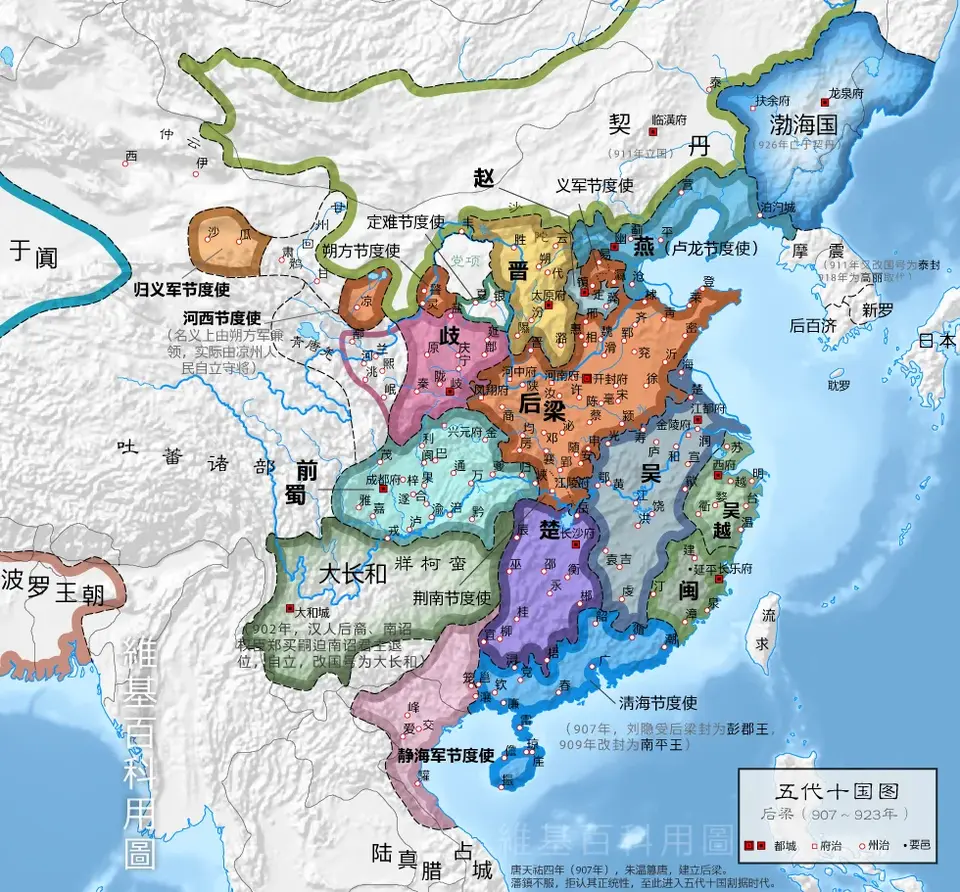
The Later Liang dynasty (后梁; 907–923 CE) was the first of the Five Dynasties during the Five Dynasties and Ten Kingdoms period in Chinese history, established by Zhu Wen, post-humously honored as Emperor Taizu. Spanning three monarchs across sixteen years, it is historically referred to as Zhu Liang or Great Liang. During the closing decades of the Tang dynasty, Zhu Wen joined the massive peasant insurrection led by Huang Chao before defecting to imperial authorities in 882 CE. Bestowed with the imperial name Quanzhong and appointed military governor of the Xuanwu circuit (Military Governor of Xuanwu Circuit) based at Bianzhou, Zhu Wen expanded his territorial grasp across Henan and Shandong, extinguishing regional rivals such as Qin Zongquan, Zhu Xuan, and Zhu Jin. After seizing custody of Emperor Zhaozong and executing the imperial court chancellors, Zhu Wen coerced Emperor Ai into abdicating in 907 CE, establishing the Later Liang with Kaifeng as its eastern capital and terminating nearly three centuries of Tang imperial rule. Throughout its rule, Later Liang pursued administrative centralization, agrarian rehabilitation, and severe legal discipline, facilitating the economic recovery of the war-ravaged Central Plains. However, Zhu Wen grew increasingly suspicious, cruel, and licentious in his later years, instigating a violent palace coup in which his second son Zhu Yougui assassinated him in 912 CE. Zhu Yougui was subsequently overthrown and slain by Zhu Youzhen, who ascended the throne as the Last Emperor. The dynasty was locked in protracted warfare against the Shatuo Turk regime of Hedong led by Li Keyong and his son Li Cunxu. Following devastating defeats at the Battle of Baixiang and the loss of the formidable Weibox military circuit, Later Liang defensive lines collapsed along the Yellow River. In 923 CE, Li Cunxu proclaimed the Later Tang dynasty and launched an audacious cavalry strike directly against Kaifeng; facing imminent capture, Zhu Youzhen commanded his bodyguard to slay him, bringing the Later Liang dynasty to an end.
Zhu Wen executed supervisor Yan Shi at Tongzhou and surrendered to imperial general Wang Chongrong; Emperor Xizong bestowed upon him the name Quanzhong and appointed him Vice Commander of the Hezhong Campaign.
Emperor Xizong appointed Zhu Wen as military governor of the Xuanwu circuit; Zhu Wen entered Bianzhou, laying the geographic foundation for his hegemony over the Central Plains.
Zhu Wen coordinated with regional warlords to relieve the siege of Chenzhou, inflicting severe defeats on Huang Chao forces across Henan before Huang Chao perished at Langhugu.
Zhu Wen suppressed the marauding warlord Qin Zongquan of Caizhou; in recognition of pacifying Henan, the Tang court elevated Zhu Wen to Prince of Dongping.
Generals Pang Shigu and Ge Congzhou seized Yunzhou and executed Zhu Xuan, followed by the capture of Yanzhou and the flight of Zhu Jin, securing Shandong for Xuanwu.
Following the restoration of Emperor Zhaozong engineered by Chancellor Cui Yin, Zhu Wen was formally granted the noble title Prince of Liang, deeply expanding his influence over court politics.
Zhu Wen besieged Fengxiang and forced Li Maozhen to surrender Emperor Zhaozong, escorting the monarch back to Chang'an and executing more than seven hundred court eunuchs.
Zhu Wen forced Emperor Zhaozong to relocate the capital to Luoyang before dispatching Zhu Yougong and Shi Shucong to assassinate the monarch, placing the adolescent Emperor Ai on the throne.
Prompted by advisor Li Zhen, Zhu Wen gathered over thirty high-ranking aristocratic ministers at the Baimayi postal relay in Huaxian, executing them and dumping their corpses into the Yellow River.
Zhu Wen forced Emperor Ai to abdicate, ascending the throne as Emperor Taizu, establishing Great Liang, inaugurating the Kaiping era, and elevating Kaifeng as the Eastern Capital.
Prince Li Cunxu of Jin led a lightning expedition that broke through the fortified siege encampments of the Liang army at Luzhou, slaying general Fu Daozhao and reversing strategic momentum.
The main Liang army commanded by Wang Jingren suffered a crushing defeat against combined Jin and Hebei forces at Baixiang, causing Later Liang to permanently forfeit dominance over Hebei.
Fearing disinheritance in favor of adoptive son Zhu Youwen, Prince of Ying Zhu Yougui stormed the palace with the Konghe imperial guards and murdered Zhu Wen, usurping the imperial throne.
Zhu Youzhen organized a counter-coup alongside general Yang Shihou and imperial commanders, slaying Zhu Yougui and ascending the throne at Kaifeng as the Last Emperor.
Following the demise of warlord Yang Shihou, imperial attempts to partition Weibox into two smaller commands prompted the elite Silver-Spear Guard to mutiny and surrender the strategic territory to Jin.
General Liu Xun launched an offensive to recover Weibox but was thoroughly routed west of Guyuancheng by Li Cunxu, with Liang infantry casualties exceeding seventy thousand men.
Liang and Jin imperial hosts clashed in a monumental engagement at Huliupo in Puyang; despite the death of veteran Jin general Zhou Dewei, Liang suffered nearly thirty thousand casualties.
Li Cunxu proclaimed the Later Tang dynasty, took Yunzhou by surprise night raid, and captured commander Wang Yanzhang; as imperial troops surrounded Kaifeng, Zhu Youzhen ordered his bodyguard to kill him.
The founder of the Later Liang dynasty, Zhu Wen, was a native of Dangshan County in Songzhou who was reared amidst poverty during the terminal decay of the Tang empire. During the Qianfu era of Emperor Xizong, severe famine gripped the Guandong region, and starving peasants rallied under the standard of Huang Chao across Caozhou and Puzhou. Zhu Wen joined the rebel forces alongside his elder brother Zhu Cun. Demonstrating formidable battlefield prowess, Zhu Wen rose through the ranks to become an accomplished field commander. In 882 CE, having seized the imperial capital Chang'an and proclaimed the Qi state, Huang Chao appointed Zhu Wen as defense commissioner of Tongzhou to hold back approaching Tang loyalist hosts. However, as imperial forces under military governor Wang Chongrong gathered strength and severed rebel supply routes, Zhu Wen found himself isolated and denied reinforcements. In the ninth lunar month of 882 CE, Zhu Wen executed Huang Chao's supervisory emissary Yan Shi and surrendered Tongzhou to Wang Chongrong.
Recognizing the immense strategic value of Zhu Wen's capitulation, Tang authorities celebrated the event as an auspicious turning point. Emperor Xizong, then in exile in Chengdu, bestowed upon him the honorific name Quanzhong ("Completely Loyal") and commissioned him as Left Jinwu Guard Great General and Vice Commander of the Hezhong Campaign. Zhu Wen fought vigorously alongside imperial allies, driving rebel divisions out of the Wei River valley. In the third lunar month of 883 CE, Emperor Xizong appointed Zhu Quanzhong as military governor of the Xuanwu circuit based at Bianzhou. By the seventh lunar month, Zhu Wen entered Kaifeng, the ancient capital of the Warring States realm of Wei known as Daliang. Situated at the nexus of the Grand Canal and the Yellow River, Bianzhou furnished Zhu Wen with a splendid agricultural and logistical springboard to pursue supremacy over the fragmented Central Plains.
In the spring of 884 CE, Huang Chao concentrated his remaining hosts around Chenzhou, subjecting the garrison of Zhao Chou to a merciless siege. Zhu Wen allied with neighboring warlords, engaging the rebel forces in over forty fierce combats across Henan. Joining forces with the Shatuo cavalry of Hedong governor Li Keyong, Zhu Wen shattered rebel encampments at Yancheng, Zhongmu, and Fengqiu, driving Huang Chao into Shandong where the rebel leader died at Langhugu. With the peasant uprising extinguished, the Tang dynasty fractured into warring military circuits. Leveraging the central location and agricultural wealth of Xuanwu, Zhu Wen systematically embarked on campaigns to subjugate rival regional warlords.
Following the fall of Huang Chao, the marauding armies of Qin Zongquan, military governor of Caizhou, posed the greatest humanitarian and military menace to Henan. Qin Zongquan declared himself emperor, ravaging cities and massacring populations until farmlands lay desolated. Zhu Wen made the eradication of Qin Zongquan his foremost objective, engaging in exhausting campaigns that culminated in 889 CE when Qin's subordinates mutinied, broke his legs, and delivered him to Bianzhou for execution in Chang'an. For this triumph, the Tang throne granted Zhu Wen the title Prince of Dongping. Zhu Wen then turned his armies against the rival brothers Zhu Xuan of Yunzhou and Zhu Jin of Yanzhou. Between 892 and 897 CE, Xuanwu generals Pang Shigu and Ge Congzhou launched relentless assaults across the Ji River, executing Zhu Xuan and forcing Zhu Jin to flee south to Yang Xingmi in Huainan. By 897 CE, Henan and Shandong were consolidated under Zhu Wen's undisputed mastery.
Zhu Wen subsequently directed his vast military apparatus toward the imperial court. In 901 CE, eunuch commanders orchestrated the deposition of Emperor Zhaozong. Chancellor Cui Yin formed an alliance with Zhu Wen, utilizing loyalist palace officers to crush the eunuchs and restore the monarch, whereupon Zhu Wen was created Prince of Liang. However, court tensions escalated rapidly as rival eunuch factions headed by Han Quanhui allied with military governor Li Maozhen of Fengxiang, abducting Emperor Zhaozong to their western stronghold. Zhu Wen mobilized seventy thousand veteran troops, marching into Guanzhong and laying siege to Fengxiang for over a year. Plunged into horrific famine, Li Maozhen sued for peace in early 903 CE, decapitating Han Quanhui and dozens of eunuchs. Zhu Wen escorted Emperor Zhaozong back to Chang'an, where he ordered the slaughter of over seven hundred palace eunuchs, permanently terminating centuries of eunuch interference in imperial governance while placing the sovereign entirely at his mercy.
In 904 CE, Zhu Wen compelled Emperor Zhaozong to abandon Chang'an and relocate the imperial capital to Luoyang, demolishing palaces and mansions to transport the timbers eastward down the river. Harboring deep suspicions that the emperor might plot against him, Zhu Wen dispatched his adoptive son Zhu Yougong and general Shi Shucong to storm the palace in Luoyang, murdering Emperor Zhaozong in his bedchamber and placing his thirteen-year-old son Emperor Ai upon the throne. In the fifth lunar month of 905 CE, advisor Li Zhen persuaded Zhu Wen to eliminate the remaining aristocratic elite who might oppose dynastic transition. At the Baimayi postal relay along the Yellow River in Huaxian, more than thirty distinguished court chancellors and ministers, including Pei Shu and Cui Yuan, were assembled, summarily executed, and thrown into the river. With the imperial court decimated and traditional aristocratic power shattered, the path to dynastic usurpation was fully cleared.
In the fourth lunar month of 907 CE, Tang Chancellor Zhang Wenwei led court officials to offer the imperial regalia to Zhu Wen. Zhu Wen altered his personal name to Zhu Huang, formally accepted the abdication of Emperor Ai, and ascended the imperial throne. He proclaimed the establishment of the Great Liang dynasty, historically termed Later Liang, inaugurated the Kaiping era, and brought the Tang dynasty to its final conclusion after 289 years. The deposed Emperor Ai was demoted to Prince of Jiyin and confined in Caozhou, where he was secretly murdered the following year on Zhu Wen's orders. Administratively, Zhu Wen designated Bianzhou as Kaifeng Prefecture, making it the Eastern Capital and functional heart of imperial governance, while Luoyang served as the Western Capital and Chang'an was reduced to Yongzhou.
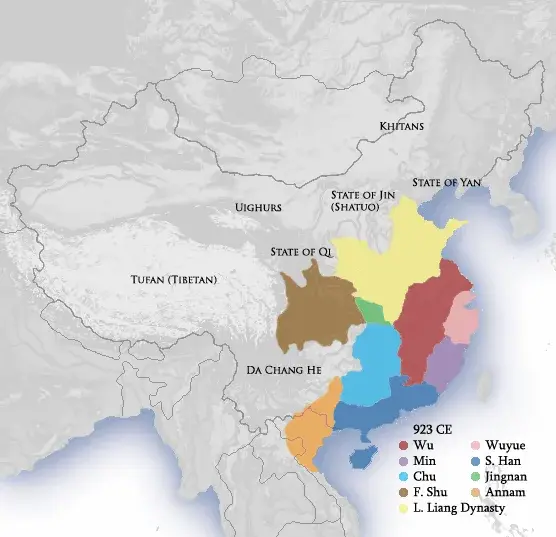
Later Liang maintained direct jurisdiction over modern Henan and Shandong, alongside major parts of Shaanxi and Hubei, and sections of Hebei, Anhui, and Jiangsu. Independent regimes across China reacted with sharp division. In the north, Li Keyong of Hedong, Liu Rengong of Youzhou, and Li Maozhen of Qi repudiated Liang legitimacy, retaining the Tang Tianyou era name; in the south, Yang Wu and Former Shu also maintained hostile independence. Conversely, maritime and southern regional lords, including Qian Liu of Wuyue, Wang Shenzhi of Min, Ma Yin of Chu, and Gao Jixing of Jingnan, recognized Later Liang supremacy, submitting regular tribute in exchange for prestigious royal investitures. Despite this broad recognition, Later Liang was compelled to commit its primary military resources to confronting the formidable Shatuo Turk state of Hedong.
The strategic duel between Later Liang and the Shatuo forces of Hedong defined the entire lifespan of the dynasty. In 908 CE, Li Keyong passed away, and his gifted son Li Cunxu assumed the title of Prince of Jin. At that juncture, Liang general Fu Daozhao had enveloped the vital fortress of Luzhou with entrenched double-walled siege fortifications for over a year. Exploiting Liang complacency regarding his youth and mourning, Li Cunxu led an elite strike force across the mountains in thick dawn fog, smashing the Liang siege encampments and slaying Fu Daozhao. The debacle at Luzhou forfeited Liang hopes of crushing Hedong and exposed the southern approaches toward Henan to sudden incursions.
Zhu Wen's tyrannical temperament and chronic paranoia steadily compromised internal stability. Suspecting disloyalty, he executed loyal general Wang Zhongshi and his entire lineage, driving commander Liu Zhijun to revolt; he likewise put to death commanders Deng Jiyun, Li Chongyun, and Li Dang over minor logistical infractions. To deflect public outrage following the regicide of Emperor Zhaozong, Zhu Wen executed his own adoptive son Zhu Yougong and trusted officer Shi Shucong. Veteran commanders lived in terror of arbitrary denunciation. In late 910 CE, Zhu Wen attempted to preemptively seize control of the autonomous Hebei circuits of Chengde and Yiwu, dispatching general Wang Jingren northward. Pushed into an alliance with Li Cunxu, the allied northern armies met the Liang host at Baixiang in early 911 CE. Despite boasting superior armor and numerical strength, the Liang army was drawn out by cavalry feints and utterly annihilated, suffering tens of thousands of casualties and losing all heavy weaponry. The catastrophe at Baixiang permanently stripped Later Liang of its influence north of the Yellow River.
In 912 CE, when warlord Liu Shouguang of Youzhou attacked Chengde, Li Cunxu mobilized to counter him, prompting Liu Shouguang to appeal to Later Liang. Eager to avenge his humiliation at Baixiang, Zhu Wen personally led a host claiming five hundred thousand troops into Hebei. However, Jin garrison forces at Zhaozhou mounted ferocious nocturnal raids, and Jin cavalry penetrated Liang lines while spreading rumors of Li Cunxu's imminent arrival. Panicked and ailing, Zhu Wen burned his encampments and fled southward through the night. Peasant populations in Hebei, enraged by Liang atrocities, ambushed retreating soldiers with farm tools. Zhu Wen retreated to Luoyang in physical agony and profound psychological ruin.
Confined to his bedchamber in Luoyang, Zhu Wen abandoned all restraint, compelling the wives of his biological and adoptive sons to attend him in rotation. His sons tolerated this humiliation to advance their claims to the succession. Aware of his declining health, Zhu Wen decided to bequeath the imperial throne to his capable adoptive son Zhu Youwen, Prince of Bo, summoning him to the capital while drafting an edict exiling his second biological son Zhu Yougui, Prince of Ying, to Laizhou as prefect. Because exile by Zhu Wen routinely portended secret execution, Zhu Yougui resolved to strike first. On the night of July 18, 912 CE, having suborned commanders of the Konghe palace guards, Zhu Yougui led five hundred heavily armored soldiers into the palace bedchamber, cut down Zhu Wen, and proclaimed himself emperor under the Fengli reign title.
Zhu Yougui's patricide triggered immediate rebellion across the empire. Adoptive son Zhu Youqian renounced allegiance and surrendered the strategic Hezhong circuit to Jin, while veteran commander Yang Shihou seized control of the pivotal Weibox circuit. In Kaifeng, Zhu Wen's third son Zhu Youzhen, Prince of Jun, entered into a secret conspiracy with imperial commander Yuan Xiangxian and royal relative Zhao Yan to overthrow the usurper. Having secured the backing of Yang Shihou with lavish promises of military subsidies, Zhu Youzhen launched a coordinated uprising in the second lunar month of 913 CE. Loyal cavalry stormed the palaces in Luoyang, cornering Zhu Yougui, who committed suicide. Zhu Youzhen ascended the imperial throne at Kaifeng as the Last Emperor, restoring the Qianhua reign era and subsequently altering reign titles to Zhenming and Longde.
The Last Emperor inherited an impoverished treasury and a factionalized military hierarchy. To appease the palace troops who facilitated his accession, he depleted state reserves through immense bounties. Furthermore, the court remained terrified of Yang Shihou, whose iron grip on Weibox made him virtually untouchable. In 915 CE, Yang Shihou died of illness, presenting the Liang court with an irresistible opportunity to curb Weibox power. The Last Emperor ordered the circuit partitioned into Tianxiong and Zhaode commands, dispatching general Liu Xun with sixty thousand soldiers to enforce compliance. Unwilling to be divided and relocated, the elite Silver-Spear Guard mutinied under Zhang Yan, throwing open the gates of Weizhou to Li Cunxu. The loss of Weibox transferred thirty thousand veteran shock infantry to the Jin army and brought Shatuo iron cavalry directly to the northern shore of the Yellow River.
Between 915 and 923 CE, Later Liang engaged in an agonizing war of attrition along the Yellow River. In early 916 CE, Liu Xun attempted an indirect offensive against Weizhou, but was outmaneuvered and shattered west of Guyuancheng, with more than seventy thousand Liang troops slain or captured. The conflict settled into brutal stalemate focused on fortified river crossings. Li Cunxu constructed the formidable Desheng Fortresses on opposite banks of the Yellow River at Chanzhou, connecting them with a massive pontoon bridge. Liang commanders Wang Yanzhang and He Gui mounted repeated assaults to sever this bridge, engaging in ferocious combined amphibious and land operations.
In late 918 CE, Li Cunxu mobilized his entire northern field army to strike southward toward Kaifeng. The two main hosts collided at Huliupo in Puyang, resulting in one of the most ferocious battles of the era. Liang cavalry under Wang Yanzhang threw the Jin frontline into disorder, causing the death of veteran Jin general Zhou Dewei. However, rallying behind elite Shatuo cavalry, Jin forces shattered the Liang center, inflicting nearly thirty thousand casualties. While both regimes were drained of offensive momentum, the demographic and economic strain fell far more heavily on the beleaguered Later Liang.
In the fourth lunar month of 923 CE, Li Cunxu formally proclaimed the Later Tang dynasty. Exploiting the deployment of Liang field armies toward Shanxi, Later Tang general Li Siyuan executed a daring nocturnal assault across the Yellow River, capturing the key stronghold of Yunzhou. Desperate, the Last Emperor reinstated veteran commander Wang Yanzhang, who struck swiftly, demolishing the Desheng South Fortress and severing the river crossing. However, corrupt court favorites Zhao Yan and Zhang Hanjie slandered Wang Yanzhang, replacing him with the incompetent Duan Ning. Duan Ning concentrated one hundred thousand Liang troops along the Yellow River, leaving the interior defenses of Henan entirely exposed.
Acting on intelligence provided by Liang defector Kang Yanxiao, Emperor Zhuangzong bypassed Duan Ning's static encampments, leading his elite cavalry deep into Henan. Wang Yanzhang mustered a rearguard of ten thousand men at Zhongdu, but was severely wounded and captured; refusing all inducements to serve the Shatuo dynasty, Wang Yanzhang chose death with unyielding dignity. Tang cavalry advanced without impediment, crossing the Wen River and appearing outside the walls of Kaifeng. With the garrison reduced to several thousand demoralized troops and court officials defecting en masse with the imperial seal, Zhu Youzhen recognized that defeat was total. Weeping bitterly, he instructed his faithful officer Huangfu Lin to execute him to prevent imperial humiliation. Huangfu Lin decapitated the Last Emperor before taking his own life. On November 19, 923 CE, Later Tang forces occupied Kaifeng, bringing the Later Liang dynasty to a permanent end after sixteen tumultuous years.
The administrative framework of Later Liang maintained the institutional facade of the Tang Three Departments and Six Ministries, including the Secretariat, Chancellery, and Department of State Affairs. However, the operational core of imperial governance underwent drastic centralization. Having witnessed the pervasive subversion of monarchical prerogative by late Tang eunuchs, Zhu Wen completely purged eunuch influence from the imperial palace. The traditional Bureau of Military Affairs (Shumishi) was reconstituted as the Court of Reverent Governance (Chongzhengyuan), staffed entirely by trusted civilian literati. Entrusted to chief advisor Jing Xiang, the Chongzhengyuan exercised direct oversight over state intelligence, military mobilization, and bureaucratic appointments, superseding the authority of ordinary chancellors.
Although traditional chancellors continued to be appointed, their functions were largely restricted to diplomatic protocol and administrative drafting. Decisive military and political determinations were made directly within the inner sanctum between the emperor and his intimate counselors, notably Jing Xiang and Li Zhen. This inner-court apparatus enhanced the speed and secrecy of state decision-making during relentless wartime conditions. Under the Last Emperor, however, this concentrated authority fell into the hands of royal in-laws Zhao Yan and Zhang Hanjie, whose extortionate practices and pervasive nepotism ultimately paralyzed the administrative machinery of the empire.
Having emerged from the military circuit of Xuanwu, Zhu Wen possessed an acute appreciation of the centrifugal dangers posed by regional warlords. Upon ascending the imperial throne, he implemented rigorous policies designed to prevent regional commands from consolidating autonomous strength. The hereditary succession of military governors and lifetime tenures were systematically abrogated; commanders were subjected to frequent rotations across provinces to obstruct the formation of personal factions. Furthermore, Zhu Wen reorganized the military balance between the capital and the provinces, drafting the most capable veterans from local circuit armies into the imperial guard divisions stationed at Kaifeng and Luoyang.
In managing external and border circuits, Later Liang utilized imperial princes as regional buffers while adopting severe measures against suspect commanders. Sons and adoptive relatives of the imperial house were placed in charge of critical nodes such as Yunzhou, Luoyang, and Xuzhou. Warlords suspected of disloyalty, such as Wang Zhongshi of Youguo, were ruthlessly purged alongside their entire kin. Nevertheless, heavy-handed intervention carried severe systemic risks; the ill-conceived attempt to bifurcate the Weibox circuit following the death of Yang Shihou provoked a catastrophic military mutiny that permanently dismantled the northern defensive perimeter of the empire.
In governance philosophy, Later Liang rejected lenient Confucian paternalism in favor of strict Legalist authoritarianism. Zhu Wen enforced rigorous standards of fiscal accountability and administrative obedience upon civilian magistrates. Imperial decrees repeatedly prohibited extortionate surcharges and illicit seizures of agrarian revenue; officials convicted of embezzlement or fiscal corruption were subjected to public execution without regard to personal lineage or rank. During the Kaiping era, high-ranking commander Wen Congxun was publicly flogged to death for seizing private properties, sending shockwaves through the bureaucracy.
Simultaneously, Later Liang administration targeted aristocratic land grabbing and tax avoidance. Zhu Wen dispatched inspectors to examine land registers and uncover concealed tenant populations, compelling wealthy rural lineages to share tax burdens. The destruction of the aristocratic oligarchy facilitated the recruitment of pragmatic civilian talent from lower social strata. Scholar Jing Xiang had been an impoverished candidate who gained the emperor's trust through acute administrative acumen; Li Zhen had repeatedly failed imperial examinations before achieving executive prominence. This meritocratic employment pattern dismantled centuries of aristocratic monopoly and accelerated the professionalization of the imperial bureaucracy.
The tactical resilience of Later Liang field armies was enforced through draconian military legislation, most famously embodied in the Squad Disbandment Law (Bahuofa). In the initial stages of the Xuanwu campaigns, troops frequently fled when their officers fell in battle. In response, Zhu Wen decreed that whenever a unit commander perished in combat, every surviving soldier under his command would be summarily decapitated upon return, irrespective of overall battlefield victory. The only path to exemption was for a soldier to present the severed head of an enemy combatant to redeem his life. Under this terrifying incentive, Later Liang soldiers fought with desperate savagery to shield their commanders.
To prevent desertion and battlefield flight, Later Liang introduced the systematic tattooing of soldiers' faces with military insignia. Checkpoints across roads and waterways conducted stringent inspections; any apprehended individual bearing soldier tattoos who lacked travel documents was executed immediately, with civilian neighbors held collectively responsible under mutual guarantee laws. While these brutal measures produced unmatched tactical obedience in the short term, they fostered profound resentment among the rank and file, rendering troops susceptible to large-scale defection when trapped in desperate military situations.
The military foundation of Later Liang rested upon the Xuanwu army veterans who were expanded into a massive central imperial guard establishment based at Kaifeng and Luoyang. The elite core comprised specialized shock formations, including the Longxiang ("Dragon Soaring"), Huben ("Tiger Bravery"), Konghe ("Crane Controlling"), Yulin ("Feathered Forest"), and Shenjie ("Divine Fleetness") armies. The Longxiang and Huben corps were composed of physically imposing veterans recruited across the Central Plains, receiving premium rations and serving as primary field strike elements. The Konghe corps was tasked with inner palace security, gradually evolving into a formidable political force capable of deciding imperial successions.
Organizational structure adhered to late Tang decimal traditions, organizing soldiers into squads of five, platoons of fifty, companies of one hundred, battalions of five hundred, and multi-thousand divisions commanded by commander-in-chiefs and provost marshals. Beyond the central imperial guards, Later Liang stationed fortified garrison corps under veteran commanders at strategic river crossings including Shanzhou, Huazhou, and Yunzhou. These combined formations provided the operational depth required to resist persistent cavalry incursions launched by northern steppe coalitions.
Following the Battle of Baixiang and the loss of Weibox, Later Liang was compelled to organize its strategic defense along the Yellow River. With the North China Plain lost, the river functioned as the final barrier safeguarding Henan. Later Liang engineers and commanders constructed a dense perimeter of earthen redoubts, fortified bridgeheads, and walled stockades stretching from Huazhou to the sea, utilizing river flotillas to counter northern cavalry maneuvering.
The defense centered on the ferocious contest over the Desheng Fortresses. Built by Li Cunxu to span the Yellow River at Chanzhou with twin fortified camps and an interconnected pontoon bridge, Desheng provided the Shatuo army with a permanent crossing point into Liang territory. Liang commanders Wang Yanzhang and He Gui directed immense resources toward breaking this bridgehead. In daring combined amphibious assaults, Wang Yanzhang led armored marines aboard heavy war barges through swift currents, wielding axes to sever the massive iron cables and wooden pontoons under intense missile fire. Although Liang forces achieved notable local successes, their defensive posture along an extended river line drained imperial manpower and ceded strategic initiative to the enemy.
Confronted with relentless pressure from northern enemies, Later Liang pursued an active policy of accommodation and tributary investiture toward southern regional regimes. Southern warlords sought legitimizing titles and commercial access to northern markets, while Later Liang required strategic stability on its southern borders and access to southern fiscal resources. Zhu Wen utilized imperial prerogatives to lavish prestigious titles upon southern rulers.
In 907 CE, the court invested Qian Liu of Wuyue as King of Wuyue, initiating a relationship characterized by uninterrupted tributary missions that brought silk, maritime goods, and bullion to Kaifeng. Similar royal investitures were granted to Wang Shenzhi as King of Min, Ma Yin as King of Chu, Liu Yin as King of Nanhai, and Gao Jixing as King of Bohai. These tributary ties reinforced Later Liang claims to imperial legitimacy, secured vital supplies of tea, silk, and precious metals, and ensured that southern regimes remained neutral throughout the prolonged duel between Liang and Jin.
On the northern steppe frontier, Later Liang maintained complex diplomatic ties with the emerging Khitan confederation unified by Yelu Abaoji. Although Shatuo leader Li Keyong had previously sworn brotherhood with Abaoji at Yunzhou to coordinate military action against Zhu Wen, the Khitan leadership sought autonomy and material gain from the wealthy Central Plains. Recognizing potential fault lines between the steppe nomads and the Shatuo Turks, Zhu Wen initiated diplomatic contact with the Khitan court immediately upon ascending the throne.
Yelu Abaoji welcomed Liang overtures, dispatching large commercial and diplomatic missions to Kaifeng. The two courts established formal diplomatic equality, styling their connection as a "State of Nephew and Uncle." This alliance secured crucial strategic advantages for Later Liang, periodically threatening the rear of Hedong and forcing Li Keyong and Li Cunxu to maintain substantial garrisons on their northern border. Official border markets permitted Later Liang to trade silk, tea, and manufactured goods for valuable steppe horses and furs, establishing the fundamental pattern of northern frontier diplomacy for the early Five Dynasties.
The protracted warfare of the late Tang period devastated agriculture across the Yellow-Huai plain, leaving farmlands abandoned and reducing populations through starvation and flight. Born into agrarian hardship, Zhu Wen recognized that agricultural output was the indispensable foundation of dynastic survival. Throughout his reign, Later Liang prioritized agrarian recovery, implementing strict policies to foster cultivation and sericulture.
Zhu Wen instituted severe penalties against military personnel who disrupted agrarian activities. Soldiers were forbidden from trampling crops or damaging mulberry orchards during maneuvers, with violators facing summary execution. To repopulate deserted commanderies, the court granted ownership of abandoned lands to returning displaced peasants alongside multi-year tax exemptions. Under these protective measures, extensive canal networks were rehabilitated across Henan and Shandong. The Kaiping and Qianhua eras witnessed a discernible agricultural resurgence, filling state granaries and generating the logistical capacity necessary to maintain prolonged border warfare.
Later Liang inherited the Two-Tax System and the legacy of the Tang Rent-Tribute-Corvee fiscal framework, but adapted revenue collection to the exigencies of wartime logistics. Under Tang military decentralization, local officials routinely levied extortionate miscellaneous surcharges to compensate for grain decay and transport shrinkage, impoverishing common cultivators.
To address this systemic abuse, Later Liang introduced the institutionalized "Sheng-Hao" (wastage allowance) surcharge. Recognizing that long-distance transport, storage moisture, and pest infestation caused unavoidable grain depletion between field collection and state granary deposition, the court formalized a uniform statutory surcharge: for every hu (ten dou) of agricultural tax grain delivered, an additional one dou was levied as a legal wastage fee. While this measure raised the statutory tax burden, it established a fixed ceiling that eliminated arbitrary extortion by fiscal clerks. The Sheng-Hao system introduced unprecedented transparency to regional taxation, establishing an administrative precedent that evolved into the standardized wastage surcharges of the Northern Song dynasty.
The designation of Kaifeng as the primary capital represented a fundamental turning point in Chinese historical geography. For centuries, imperial capitals had been situated at Chang'an or Luoyang behind mountain barriers. Following the mid-Tang devastation of Guanzhong, however, the imperial court became entirely dependent upon grain fleets arriving from the lower Yangtze and Huai regions via the Grand Canal. The treacherous gorges of the Sanmenxia rapids made grain transport upstream to Chang'an extraordinarily expensive and perilous.
Kaifeng was situated directly at the junction where the Tongji Canal (Bian River) met the Yellow River system. Grain, textiles, and commodities from the prosperous south could be transported directly by water into the docks of Kaifeng without negotiating dangerous river gorges. Zhu Wen recognized this immense logistical advantage, dredging the Bian River and constructing expansive granaries and wharf facilities across the capital. Kaifeng rapidly expanded into the preeminent commercial and transportation hub of northern China, inaugurating its historic role as the imperial capital for subsequent dynasties through the Northern Song.
Despite commercial vibrancy along canal arteries, Later Liang wrestled with an acute and persistent copper shortage. Decades of civil conflict had depleted copper mining, while widespread hoarding and the melting of copper currency for Buddhist statuary drastically reduced the volume of money in circulation. Fragmented borders further obstructed the natural flow of metal coinage between regions.
Consequently, Later Liang produced the most limited copper coinage among major imperial dynasties. Although Zhu Wen authorized the trial casting of "Kaiping Tongbao" and "Kaiping Yuanbao" coins upon his accession, extreme scarcity of raw copper and heavy military outlays quickly brought minting to a halt. Extant specimens of Kaiping coins remain among the rarest numismatic treasures in Chinese history. In everyday commerce, the population increasingly reverted to commodity money, employing silk bolts, hemp cloth, and grain for transactions, while the state relied on government monopolies over salt and tea to fund administrative operations.
The brief existence of Later Liang marked a momentous social watershed: the definitive extinction of the medieval aristocratic order. For centuries, eminent clans such as the Cui, Lu, Li, Zheng, and Wang had maintained a virtual monopoly over high political office through aristocratic genealogy, classical prestige, and entrenched marital networks. Even the expansion of the civil service examinations under the Tang failed to dismantle this deeply rooted oligarchy.
The Baimayi Massacre of 905 CE, in which Zhu Wen executed over thirty aristocratic chancellors and ministers, physically destroyed the core of the metropolitan nobility. Following the establishment of Later Liang, military veterans and unheralded scholars of plebeian background assumed executive governance. Bureaucratic appointments were awarded on the basis of practical administrative efficiency and battlefield achievement rather than ancestral lineage. This violent social upheaval removed the structural barriers to upward mobility, clearing the path for the emergence of the scholar-official bureaucracy that defined the Song dynasty.
In the wake of widespread rebellion, immense numbers of commoners took monastic vows to escape military conscription and fiscal burdens, depleting state revenues and causing widespread secularization of Buddhist monasteries. Upon ascending the throne in 907 CE, Zhu Wen moved resolutely to reassert state authority over religious institutions.
The Later Liang court placed all Buddhist and Daoist establishments under the direct supervision of the Bureau of Sacrifices (Cibu) within the Ministry of Rites, strictly banning private tonsure and unlicensed ordination. To regulate the clergy, the court instituted a standardized examination system: postulants seeking ordination were required to assemble at the capital to undergo examinations testing their memorization and understanding of Buddhist canonical texts. Only candidates who passed were awarded official ordination certificates (dudie). This regulatory framework checked the uncontrolled expansion of monastic wealth and firmly subordinated religious organizations to the temporal authority of the state.
Despite continuous military conflict, Later Liang witnessed transformative achievements in landscape painting and epigraphy. In monumental landscape art, the era produced masters Jing Hao and Guan Tong, who established the Northern School of landscape painting. Retiring to the Honggu Valley of the Taihang Mountains, Jing Hao formulated the monumental landscape style that captured the dramatic precipices of northern China, composing the seminal treatise Bifaji ("Notes on Brushwork") which established the influential "Six Essentials" of painting. His disciple Guan Tong further refined this austere, powerful style. Their collective innovations laid the aesthetic foundation for Northern Song masters such as Fan Kuan and Li Cheng.
In epigraphy, the dynasty left rare material records, notably the Phoenix Mountain Cliff Inscription carved in 921 CE at Ningyang in Shandong. As the sole surviving military commemorative cliff inscription from the Later Liang period, it records troop movements and field mobilization during operations against rival warlords. Rendered in powerful, rustic script, the inscription provides irreplaceable primary evidence regarding the martial writing culture and administrative reality of the Five Dynasties.
The destruction of Chang'an and Luoyang during the late Tang engulfed imperial repositories, reducing centuries of court archives, dynastic histories, and administrative registers to ashes. The loss of these records threatened the continuity of administrative and historical memory.
During the Zhenming era, the Last Emperor Zhu Youzhen issued an imperial decree commanding the empire-wide collection of surviving Tang documents, memorials, and private genealogies. Subjects who submitted rare historical manuscripts or family archives to the court were rewarded with substantial fiscal bounties or official positions. This rescue effort salvaged substantial documentary collections from destruction, preserving historical materials that were later utilized by Later Tang historians in compiling the Old History of the Tang and by Northern Song scholars in reconstructing imperial annals.
The Later Liang dynasty occupies a foundational position in Chinese historical evolution, serving as the bridge between the aristocratic world of the medieval Tang and the bureaucratic state of the Song. By liquidating the hereditary aristocratic houses through the Baimayi purge, Zhu Wen shattered the centuries-old socio-political oligarchy that had dominated state administration since the Han and Jin dynasties. The subsequent democratization of office-holding and the ascension of civilian bureaucrats from modest backgrounds established the essential structural precondition for the rise of the scholar-gentry society under the Song dynasty.
In urban geography and imperial geopolitics, Zhu Wen's establishment of the Eastern Capital at Kaifeng initiated a historic realignment of the Chinese political center. By anchoring the capital at the confluence of the Grand Canal and the Yellow River, Later Liang solved the chronic grain transport bottleneck that had crippled Chang'an and Luoyang, demonstrating that waterborne logistical viability outweighed traditional mountain barriers. The economic revitalization of the Yellow-Huai river basin, supported by the institutionalized Sheng-Hao wastage allowance and strict protection of agriculture, preserved the agrarian economy of the Central Plains amidst pervasive civil conflict. Nonetheless, the dynasty was fundamentally undermined by the psychotic violence, arbitrary cruelty, and intra-familial depravity of its founding house. The resultant palace rebellions, the alienation of veteran commanders, and the disastrous loss of the northern frontier at Weibox left the regime defenseless against the disciplined cavalry of the Later Tang, providing a tragic historical lesson in the perils of autocratic lawlessness.
 Later Liang Dynasty (后梁)
Historical figure
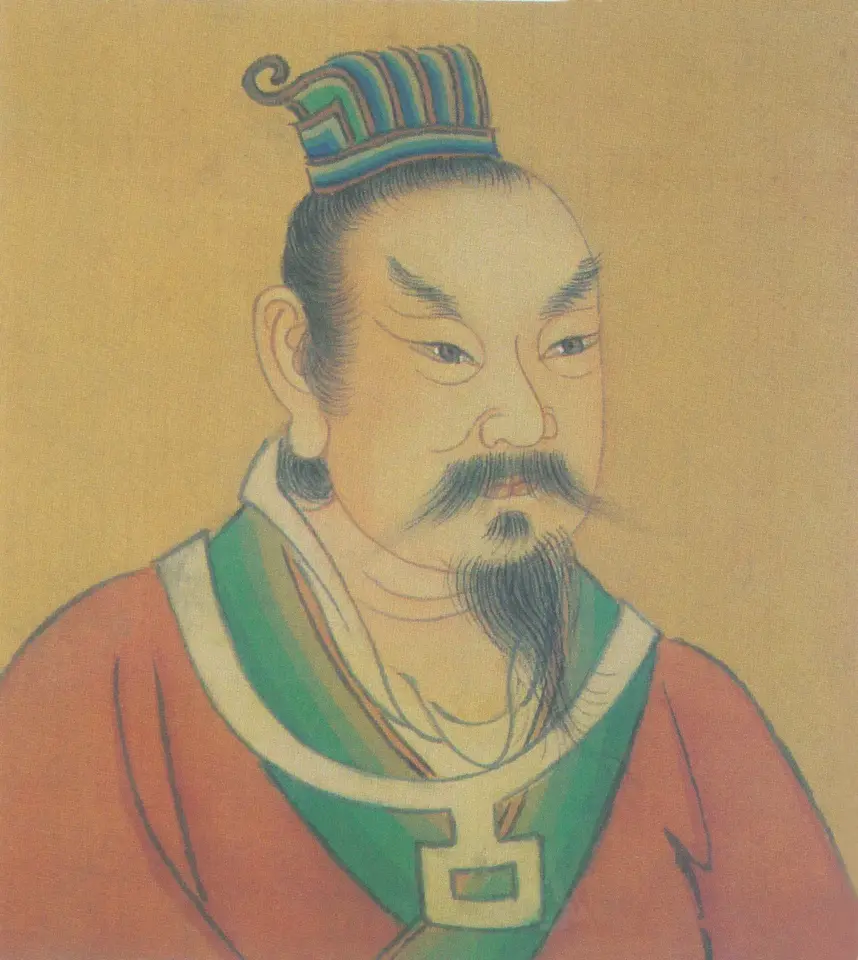
Zhu Wen (朱温, 852–912), posthumously honored as Emperor Taizu of Later Liang (后梁太祖), was the founding sovereign of the Later Liang dynasty, inaugurating the Five Dynasties and Ten Kingdoms period. Born into poverty in Dangshan, he joined the massive Huang Chao peasant uprising in 877, distinguishing himself as a ruthless and brilliant field commander and rising to become defense commissioner of Tongzhou. In 882, astutely anticipating the collapse of the rebel regime, he defected to the Tang court, receiving the name Zhu Quanzhong and appointment as Military Commissioner of Xuanwu at Bianzhou (modern Kaifeng). From his power base in Bianzhou, Zhu Wen pursued relentless territorial expansion across the Central Plains. He collaborated with Shatuo chieftain Li Keyong to crush the remnants of Huang Chao, subsequently waging a five-year war of attrition to destroy the cannibalistic warlord Qin Zongquan in Caizhou. Over the next decade, he subjugated rival regional warlords across Shandong, Henan, and Hebei, engaging in a bitter multi-decade rivalry with Li Keyong following the infamous Shangyuanyi ambush. In 901, he intervened in the capital to rescue Emperor Zhaozong from warlord Li Maozhen at Fengxiang, subsequently executing hundreds of court eunuchs in 903 to permanently terminate eunuch political power. In 904, Zhu Wen forcibly transferred the imperial court to Luoyang, systematically dismantling Chang'an into ruins and assassinating Emperor Zhaozong. In 905, he orchestrated the White Horse Station Massacre, slaughtering over thirty prominent aristocratic ministers and casting their bodies into the Yellow River, effectively exterminating medieval China's patrician elite. In 907, he forced Emperor Ai to abdicate, establishing the Later Liang dynasty. During his reign, he centralized power through the Chongzheng Institute, enforced the draconian baduizhan military code, and promoted agricultural reclamation along the Grand Canal. Following a crushing defeat against Li Cunxu at the Battle of Boxiang in 911, his mental state deteriorated into extreme paranoia and palace debauchery, culminating in his assassination by his second son Zhu Yougui in 912 at age sixty-one.
Second Emperor of the Later Liang Dynasty (Deposed and Demoted to Commoner) (后梁第二位皇帝)
Zhu Yougui (朱友珪, 884–913), childhood name Yaoxi, was a native of Dangshan in Songzhou (modern Dangshan, Anhui Province) and the second emperor of the Later Liang Dynasty during the Five Dynasties period (reigned 912–913). He was the third son of the dynastic founder Emperor Taizu (Zhu Wen) and a camp courtesan from Bozhou. Following Zhu Wen usurpation of the Tang throne in 907, Zhu Yougui was enfeoffed as Prince of Ying and assigned command of the elite Konghe imperial guard corps, tasked with guarding the imperial residence. In his final years, Zhu Wen became erratic, dissolute, and intensely suspicious, harboring designs to pass the throne to his favored adopted son, Prince of Bo Zhu Youwen. In June 912, as Zhu Wen lay critically ill, he ordered Zhu Yougui banished to serve as Prefect of Laizhou, an appointment widely understood in the Liang court as a prelude to forced suicide. Informed by his wife Lady Zhang, Zhu Yougui struck preemptively, allying with guard general Han Qing to storm the palace through the Wanchun Gate. His retainers assassinated Zhu Wen in his bedchamber, after which Zhu Yougui executed Zhu Youwen and seized the imperial throne, adopting the era name Fengli. Following his accession, Zhu Yougui indulged in luxurious dissipation and squandered imperial treasuries on lavish military bounties to secure loyalty, yet his matricidal and patricidal usurpation provoked deep outrage among dynastic princes and veteran commanders. In March 913, his younger brother Prince of Jun Zhu Youzhen orchestrated an armed uprising alongside imperial generals Yuan Xiangxian and Yang Shihou. As rebel forces breached the inner palace, Zhu Yougui ordered his attendant Feng Tinge to run him and Empress Zhang through with swords, dying at age twenty-nine. He was posthumously degraded to commoner status.
Historical figure
Zhu Youzhen (朱友贞, October 24, 888 – November 18, 923), later renamed Zhu Tian and Zhu Huang, native of Dangshan in Songzhou (modern Dangshan, Anhui), was the third and final emperor of the Later Liang dynasty (reigned 913–923), historically designated Emperor Mo of Later Liang. The legitimate third son of founding emperor Zhu Wen (Emperor Taizu) and Empress Yuanzhen (Lady Zhang), Zhu Youzhen was created Prince of Jun in early youth, serving as metropolitan governor and military commissioner of Kaifeng. In June 912, his elder half-brother Zhu Yougui assassinated Zhu Wen to usurp the throne. Stationed at the eastern capital, Zhu Youzhen forged a secret pact with palace guard general Yuan Xiangxian, frontier commander Yang Shihou, and imperial brother-in-law Zhao Yan. In March 913, they launched a palace coup in Luoyang, executing Zhu Yougui, after which Zhu Youzhen assumed the imperial throne in Kaifeng. Confronted throughout his decade-long reign by the relentless southern expansion of Jin (later Later Tang) under Li Cunxu, Zhu Youzhen mobilized the full economic and military power of the Central Plains along the Yellow River. Despite initial tactical successes at Huliubei and Desheng, Zhu Youzhen's court was crippled by paranoia and favoritism. He sidelined seasoned chancellors Jing Xiang and Li Zhen in favor of corrupt maternal relatives Zhang Hanjie and Zhao Yan, repeatedly replacing capable generals like Wang Yanzhang with incompetent sycophants such as Duan Ning. In November 923, Li Cunxu crossed the Yellow River in an audacious winter blitzkrieg toward Kaifeng. With the capital defenses stripped and enemy cavalry breaching the suburbs, Zhu Youzhen commanded his imperial bodyguard Huangfu Lin to execute him. He died on November 18, 923, at age thirty-six, marking the demise of the Later Liang dynasty.
Founding Sovereign of Nanping / Jingnan (五代十国时期南平 / 荆南政权开国君主)
Gao Jixing (高季兴, 858–928 AD), originally named Gao Jichang (高季昌) and renamed to observe the taboo of Later Tang ancestor Li Guochang, courtesy name Yisun, was a native of Xiashi in Shan Prefecture (present-day Sanmenxia, Henan), and the founding sovereign of the Nanping (Jingnan) Kingdom during the Five Dynasties and Ten Kingdoms period. Born in humble circumstances, he was originally a bondservant in the household of Kaifeng merchant Li Rang. Noticing his extraordinary physical presence and martial aptitude, Xuanwu Military Governor Zhu Wen instructed Li Rang to adopt him as a foster son under the name Zhu Youchang. He rose through the ranks as an elite vanguard officer, serving as Inspector of Songzhou and Defense Commissioner of Yingzhou. In 901 AD, during the protracted siege of Fengxiang, his resolute counsel persuaded Zhu Wen against retreating, securing his position as a core confidant. In 907 AD, following the founding of Later Liang, he was appointed Military Governor of Jingnan. Facing a devastated Jiangling surrounded by hostile warlords, Gao Jixing gathered displaced refugees, rebuilt city walls, promoted agriculture, and recruited Confucian scholar Liang Zhen as chief strategist and general Ni Kefu as military commander. Following Later Tang's conquest of Later Liang, Gao Jixing traveled to Luoyang for an audience and narrowly escaped detention. Recognizing central threats, he asserted regional autonomy, defended Jiangling against Later Tang forces under Liu Xun by breaching river dikes, and allied with Yang Wu, receiving the title Prince of Qin. Gao Jixing mastered the art of survival through multi-directional vassalage and intercepted tributary riches passing along the Yangtze River, earning the popular moniker "Gao the Rascal." He died in Jiangling in late 928 AD at age seventy-one, receiving the posthumous title Prince Wuxin, establishing a dynasty that endured for five generations across six decades.
 Southern Han (founding emperor), Later Liang, Later Tang
Founding Emperor of Southern Han
Liu Yan (889–942), originally named Liu Zhi and later adopting the invented character Yan signifying 'a flying dragon in the sky,' was the founding emperor of the Southern Han during the Five Dynasties and Ten Kingdoms period. Tracing his lineage to Shangcai and Pengcheng, he was the third son of Prefect Liu Qian and younger brother of Liu Yin, Prince of Nanhai. In his youth, he campaigned alongside his brother, displaying extraordinary martial prowess and crushing regional warlords across Lingnan. In 911, he inherited the Qinghai military commissionership and the title Prince of Nanhai, subsequently subjugating the Rong and Yong circuits and repelling Chu incursions to unify the two Guangs. In 917, Liu Yan constructed the Nine Dragons Altar in Panyu to ascend the imperial throne, initially adopting the dynastic title Great Yue before renaming it Great Han (Southern Han) and styling the era Qianheng. During his reign, he replaced military governors with civil scholars, welcomed displaced northern literati, instituted regular imperial examinations, and invented his personal imperial character. However, his later years were marred by a catastrophic defeat at the Battle of Bach Dang, which permanently separated Jiaozhi from Chinese imperial rule, alongside oppressive taxation for opulent palaces and the invention of barbaric tortures. He died in 942 at age fifty-four, received the temple name Gaozu and posthumous title Emperor Tianhuang, and was interred at Kangling Mausoleum.
 Later Liang Dynasty (后梁)
Foremost Founding General of Later Liang
Ge Congzhou (葛从周, ?–916), courtesy name Tongmei (通美), a native of Juancheng County, Pu Prefecture (present-day Juancheng County, Heze City, Shandong Province), was a foremost founding general of the Later Liang Dynasty during the late Tang and Five Dynasties period. Broad-minded and resourceful in his youth, he initially joined Huang Chao's insurgent army as a military officer, and in the third month of the fourth year of the Zhonghe era of Emperor Xizong of Tang (884) surrendered at Wangman Ford bersama his sworn brothers Huo Cun and Zhang Guiba to Xuanwu Army Military Commissioner Zhu Wen (Emperor Taizu of Later Liang). Over the next twenty years, Ge Congzhou fought north and south: at the Battle of Xihua, despite suffering a facial wound, taking several arrows in his arm and shoulder, and being pierced by several spears, he fought to the death to rescue the unhorsed Zhu Wen; subsequently he repeatedly routed Qin Zongquan's Cai Prefecture troops, pacified Zi, Qing, Xu, and Su prefectures, crushed Zhu Xuan and Zhu Jin at Liuqiao in Linpu, and lifted the siege of Heyang. In the third year of the Qianning era (896), he captured Prince of Jin Li Keyong's beloved son Li Luoluo alive at the Huan River; the following year he pacified Yan and Yun prefectures and was appointed Acting Military Commissioner of Taining Army (Yan Prefecture). During the Guanghua era, he consecutively defeated the Jin army at Julu and Qingshankou, capturing Xing, Ming, and Ci prefectures within a few days; he then led five hundred armored horsemen out of Guantao Gate at Wei Prefecture with the gate barred behind them to fight to the death, and slew thirty thousand Yan soldiers at Laoya Dike in Qianning Army, twice crushing the one-hundred-thousand-strong army of Liu Rengong of You Prefecture, giving rise to the Hebei popular proverb "In Shandong there is one Ge—do not provoke him for nothing," while the people of Jin called him the "Body-Dividing General." In the third year of the Tianfu era (903), when he besieged Liu Xun, who had seized Yan Prefecture by surprise, he endured the pain of seeing his aged mother treated with honor atop the city wall, maintained the siege, received Liu Xun's surrender, and was appointed Military Commissioner of Taining Army. Later, worn down by illness from years of campaigning, he retired as Upper General of the Right Guard and Grand Preceptor to the Crown Prince to live in his villa in Yanshi; under the Last Emperor of Later Liang, he was appointed in absentia as Military Commissioner of Zhaoyi Army, Acting Grand Preceptor, and Concurrently Palace Attendant, and enfeoffed as Commandery Prince of Chenliu. He died of illness at home in the early Zhenming era and was posthumously promoted to Defender-in-Chief.
 Later Liang Dynasty (后梁)
Historical figure
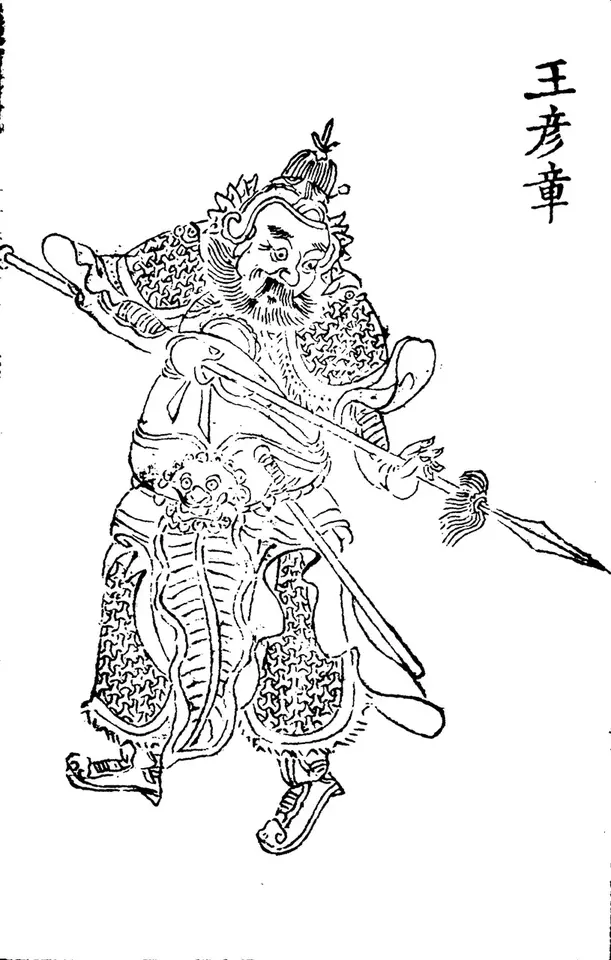
Wang Yanzhang (王彦章, 863–923), courtesy name Xianming (贤明, also recorded as Ziming 子明), was a native of Shouzhang County in Yunzhou (present-day northwest of Liangshan County, Jining, Shandong Province), and a celebrated founding general and unyielding loyalist of the Later Liang Dynasty during the Five Dynasties and Ten Kingdoms period. In his youth, he enlisted under Zhu Wen (Emperor Taizu of Later Liang), earning universal admiration by walking barefoot across thorny thickets without injury, which earned him the renowned martial moniker Wang Tieqiang (Iron Spear Wang). Endowed with extraordinary physical strength, he routinely wielded an iron spear weighing over one hundred catties, charging into enemy ranks on horseback with unstoppable fury. He served in key military posts, including Commander of the Longxiang Guard, Prefect of Chanzhou, Defense Commissioner of Ruzhou, Military Commissioner of Kuangguo, and Military Commissioner of Xuanyi, distinguishing himself in campaigns against the remnants of Huang Chao, Qin Zongquan, and the rival Shatuo state of Jin. During the Jinbo Pavilion Mutiny of 915, Wang broke through encirclement to retreat south; when the Jin forces captured his family at Taiyuan and sent envoys to induce his defection, he resolutely executed the emissaries to demonstrate unbending fidelity. In 923, after the Later Tang army seized the strategic bastion of Yunzhou and directly threatened the capital Kaifeng, Chancellor Jing Xiang dramatically threatened suicide by rope to urge Wang's reappointment. Appointed Campaign Commissioner for the Northern Front, Wang pledged to defeat the enemy within three days. In the Battle of Deshengkou, he launched a brilliant amphibious raid utilizing specialized boats to sever the floating bridge and melt the iron chains, capturing the southern citadel within three days and annihilating the enemy's fortified Clamped Camp defense line. Later undermined by envious courtiers like Zhao Yan, he was dismissed and subsequently given only five hundred newly recruited, exhausted cavalrymen to hold the eastern frontier. Wounded and captured in the Battle of Zhongdu, he steadfastly rejected repeated personal entreaties from Emperor Zhuangzong of Later Tang (Li Cunxu) and Li Siyuan, famously declaring that "leopards die and leave their skins; men die and leave their names", and serenely embraced execution. He was posthumously honored as Grand Preceptor by the Later Jin Dynasty, and Ouyang Xiu commemorated him as an exemplar of supreme loyalty in the New History of the Five Dynasties.
 Later Liang, Later Tang
Prominent warlord and military commander of the Five Dynasties period
Dong Zhang (董璋; ? – 932) was a prominent military commander and warlord during the Five Dynasties and Ten Kingdoms period, serving successively under the Later Liang and Later Tang dynasties. Originating from humble servitude, he rose through personal valor on the battlefield under Emperor Taizu of Later Liang (Zhu Wen), eventually rising to Military Commissioner of Jiannan Dongchuan, Grand Commandant, and Joint Manager of Affairs with the Secretariat-Chancellery (Honorary Chancellor). In his youth, Dong Zhang served as a domestic bondsman in Bianzhou for wealthy merchant Li Rang (later adopted as Zhu Yourang by Zhu Wen), alongside Gao Jixing (founder of Jingnan) and Kong Xun. Endowed with imposing stature and martial skill, he entered the Xuanwu army and distinguished himself in numerous campaigns, steadily earning promotion to regimental commander. In 923, during the twilight of the Later Liang dynasty, rebel general Pei Yue held Zezhou in defiance; Dong Zhang stormed the city, beheaded Pei Yue, and was appointed Prefect of Zezhou. Following Later Tang's conquest of Later Liang later that year, Emperor Zhuangzong (Li Cunxu) recognized his reputation for courage and retained him. Under the patronage of Chief of Staff Guo Chongtao, Dong Zhang was appointed Military Commissioner of Binning in 925 and served as Right Flank Infantry and Cavalry Disciplinary Commander during the expedition that extinguished Former Shu, actively counseling Guo Chongtao on campaign strategy. Upon the pacification of Shu, Dong Zhang was rewarded with the command of Jiannan Dongchuan based in Zizhou. During the Tiancheng reign of Emperor Mingzong of Later Tang (Li Siyuan), Dong Zhang rose to Grand Defender and Honorary Chancellor. In Chang'an, Chief of Staff An Chonghui harbored deep suspicions that Western Sichuan (Xichuan) commander Meng Zhixiang intended to rebel, yet naively regarded Dong Zhang as an unswervingly loyal foil to contain Meng Zhixiang. Dong Zhang's son, Dong Guangye, served as Director of the Imperial Parks in the capital, aggressively cultivating influential ties. In 929, incensed by demands for 500,000 strings of sacrificial contributions and infuriated by the insolence of imperial envoy Li Renju, Dong Zhang publicly berated the envoy at sword-point. When the court created Baoning Circuit at Langzhou with Li Renju in command to hem in Dongchuan, Dong Zhang allied with Meng Zhixiang in open rebellion in 930, capturing Langzhou and executing Li Renju. In retaliation, the Later Tang court executed Dong Zhang's son and clan in Luoyang. An imperial punitive expedition led by Shi Jingtang subsequently withdrew due to logistical exhaustion. Following An Chonghui's downfall, Emperor Mingzong adopted conciliatory measures toward Sichuan. Because Meng Zhixiang's family in Luoyang had survived unharmed, Meng proposed a joint reconciliation with the court. Deeply embittered that his own lineage had been butchered in Luoyang while Meng's family remained safe, Dong Zhang suspected Meng Zhixiang of perfidy. In the fourth month of 932, Dong Zhang spearheaded over 10,000 Dongchuan veterans in a surprise offensive against Chengdu, but suffered a catastrophic defeat at the Battle of Mimu in Hanzhou against Meng Zhixiang and Zhao Tingyin. Fleeing back to Zizhou with only several dozen horsemen, Dong Zhang was murdered in a mutiny led by former Lingzhou Prefect Wang Hui, who delivered his severed head to Meng Zhixiang in Chengdu.
Founding Commander and Preeminent General of Later Liang during the Five Dynasties and Ten Kingdoms Period
Liu Xun (刘鄩, 858–921), originally named Liu Shan (刘掞), was a native of Anqiu, Mizhou (present-day Anqiu, Shandong). He was an outstanding military commander and founding general of the Later Liang dynasty during the late Tang and Five Dynasties and Ten Kingdoms period. In his early years, Liu Xun joined the military garrison of Pinglu under Military Commissioner Wang Jingwu and subsequently served his son Wang Shifan. During a tense succession crisis, he decisively drew his sword at a banquet to slay the rebellious commander Lu Hong, subsequently suppressing the mutiny in Dizhou. In 901, Liu Xun staged a daring night raid with five hundred infantrymen through a subterranean drainage conduit to capture the strategic stronghold of Yanzhou. He extended generous protection and filial respect to the family of opposing general Ge Congzhou and held the isolated fortress without external aid for nearly three years, earning high praise from Zhu Quanzhong for embodying the steadfast loyalty and noble conduct of Tang founder Li Ji. Following his honorable submission to Later Liang, Liu Xun achieved numerous distinguished military feats. In 909, he executed a rapid advance to seize the mountain pass of Tongguan, crushed Liu Zhijun's rebellion, and reclaimed the western capital of Chang'an, subsequently governing the Yongping Circuit as Military Commissioner and assuming the chancellor rank of Joint Manager of Affairs with the Secretariat-Chancellery. Under Emperor Modi, he served as Mayor of Kaifeng and Military Commissioner of Taining, coordinating with Yang Shihou to repel Shatuo Jin incursions, annihilating rebel Jiang Yin in Xuzhou, ambushing and routing the Prince of Jin (Li Cunxu) at Weixian, and employing straw decoys mounted on mules to deceive enemy scouts while staging a surprise dash toward Taiyuan. In prolonged confrontations along the Yellow River, he constructed fortification corridors at Shenxian, repelled Jin crossing attempts at Liyang Ford, and routed Southern Wu invaders at Huoqiu. Later framed by jealous court factions led by Duan Ning, he was forced to consume poison at Luoyang in 921 at age sixty-four, posthumously honored as Secretariat Director.
Founding General and Military Commissioner of Later Liang during the Five Dynasties and Ten Kingdoms Period
Kang Huaiying (康怀英, d. 915), originally named Kang Huaizhen (康怀贞), was a native of Yanzhou (present-day Yanzhou District, Jining, Shandong). He was a distinguished founding military commander of the Later Liang dynasty during the late Tang and Five Dynasties period. In his early career, he served as a subordinate garrison officer under Ziqing Military Commissioner Zhu Jin. In 897, when Xuanwu commander Ge Congzhou stormed Yanzhou, Kang Huaiying yielded the fortress and submitted to Zhu Quanzhong, who recognized his prowess and commissioned him into the Xuanwu officer corps. In subsequent campaigns, Kang captured Dengzhou in independent command, shattered Yan forces along the Yishui River, and accompanied the western expedition to escort Emperor Zhaozong of Tang. At the Battle of Wugong, he spearheaded the vanguard assault, decimating the Qi host and capturing eight thousand enemy troops and horses, prompting Zhu Quanzhong to praise the deed as true military achievement. He subsequently crushed Fu Daozhao at Hangu in Guoxian and held off tens of thousands of Qi troops during a nighttime siege at Fengtian despite sustaining over ten wounds, earning the imperial merit title of Resolute Courageous Minister of the Imperial Chariot and promotion to Military Commissioner of Baoyi. With the establishment of the Later Liang dynasty, Kang Huaiying was elevated to Vice Grand Guardian and appointed supreme commander of a hundred-thousand-strong army to besiege the strategic stronghold of Luzhou, constructing concentric fortress walls known as the Double Ring. However, his logistics were continually harried by cavalry raids under Jin commander Zhou Dehai, culminating in a devastating surprise attack led by Li Cunxu at Sanchuigang that shattered the outer fortress. He was subsequently appointed Supreme Commander of Imperial Guards and Deputy Commander of the Western Front, suffering reverses against rebel general Liu Zhijun at Changchengling and Shengping. In 912, he commanded forces against rebel Zhu Youqian at Hezhong, suffering defeat at Baijingling. Upon Emperor Modi's ascension, he changed his personal name to Huaiying to observe the imperial naming taboo, serving as Military Commissioner of Yongping and Mayor of Da'an, ultimately honored as Secretariat Director before passing away at his post in 915.
Founding General and Military Commissioner of Later Liang during the Five Dynasties and Ten Kingdoms Period
Zhang Guiba (张归霸, d. 908), courtesy name Zhengchen (正臣), was a native of Qinghe (present-day Qinghe County, Hebei). He was a prominent founding general of the Later Liang dynasty during the late Tang and Five Dynasties and Ten Kingdoms period. Born into an established scholar-official lineage, he possessed a bold, unrestrained disposition from youth, dedicating himself to horsemanship, archery, and military doctrine. Amidst the chaos of the late Qianfu era, Zhang Guiba enlisted in the Huang Chao rebel forces alongside his younger brothers Zhang Guihou and Zhang Guibian, earning appointment as a Merit Official of the Left Wing for his tactical acumen. In 884, with Huang Chao's fortunes waning, Zhang Guiba prudently surrendered to Xuanwu Military Commissioner Zhu Quanzhong alongside Ge Congzhou and other veteran commanders, embarking on more than two decades of battlefield service as a core pillar of the Liang regime. Zhang Guiba was distinguished for exemplary discipline and ferocious combat prowess. At the Battle of Chigang in 887, severely wounded by a thrown spear, he calmly drew his bow from horseback, shot down the enemy commander, seized his mount, and subsequently deployed ambushes in deep ditches to wipe out over a thousand opposing troops. During the siege of Caizhou, he mounted a sudden sortie with Xu Huaiyu to rout Xiao Hao, earning Zhu Quanzhong's high praise comparing his initiative to the Eastern Han general Geng Yan. He shattered Zhu Jin at Jinxiang, capturing seventy officers; defeated Shatuo Jin armies at the Huanshui River to capture Li Keyong's son Li Luoluo; and routed thirty thousand Yan troops under Liu Rengong at Neihuang. Governing Xingzhou, he practiced scorched-earth defense to resist Li Sizhao's fifty-thousand-strong host before counterattacking to slaughter twenty thousand retreating enemies. Following the founding of Later Liang in 907, he served as Senior General of the Left Xiaowei Guards and was promoted in 908 to Military Commissioner of Heyang and chancellor rank before dying at his post that same year, posthumously honored as Grand Tutor. His daughter became the Virtuous Consort of Emperor Modi of Later Liang.
Prominent General of Later Liang
Xie Yanzhang (谢彦章, ?–918) was a native of Xuzhou (modern Xuchang, Henan) and an outstanding cavalry commander and founding general of the Later Liang dynasty during the Five Dynasties and Ten Kingdoms period. Orphaned in his early childhood amidst chaotic warlord conflicts, he was taken in by the preeminent Later Liang general Ge Congzhou, who was struck by the boy's sharp intellect and adopted him as a foster son. Ge Congzhou personally instructed him in the art of war, using thousands of copper coins arranged inside a large brass basin to simulate marching columns, wing dispositions, and the rhythmic retreats and advances of battle. Xie Yanzhang grasped these tactics completely. Upon reaching adulthood, he served Emperor Taizu of Later Liang (Zhu Wen) as a cavalry officer, demonstrating exceptional valor on the battlefield. Following the accession of Emperor Mo (Zhu Youzhen), Xie was elevated to Commander of Cavalry for the Two Capitals, repeatedly defeating the forces of Jin. He subsequently served as Jiedushi of Heyang and later governed the Kuangguo Army in Xuzhou, holding the exalted rank of Inspection Grand Preceptor. During the prolonged standoff between Later Liang and Jin along the Yellow River, contemporary military experts regarded Recruitment Commissioner He Gui as the master of infantry warfare and Xie Yanzhang as the unrivaled master of cavalry combat, celebrating them jointly as the peerless pair of the Liang military. Xie Yanzhang was distinguished by his rare scholar-general demeanor. He loved classical literature, treated wandering scholars with deep courtesy, and routinely wore broad-sleeved Confucian robes when confronting the Jin forces across the river, displaying absolute composure. Yet when deploying for battle, he displayed the stern majesty of a premier commander, maneuvering vast cavalry columns as swiftly as stormwinds and commanding the deep devotion of his horsemen. His tactical discipline was so feared by the Jin army that enemy soldiers observing his neat battle lines would whisper among themselves that the Grand Preceptor of the Two Capitals was present, not daring to utter his personal name. In December 918, while confronting Jin forces at Xingtai camp, Xie was envied by the jealous He Gui and falsely framed for treason by staff officer Zhu Gui. He Gui lured Xie to a military banquet and murdered him along with his cavalry officers Meng Shencheng and Hou Wenyu. Upon hearing the news, Li Cunxu rejoiced that Liang had destroyed its own defensive pillar, launching the catastrophic battle of Huliupi. Xie Yanzhang's unjust execution marked a decisive turning point that accelerated the collapse of the Later Liang dynasty.
Historical figure
Zhang Quanyi (张全义) (852 – April 29, 926), originally named Zhang Jubao and later bestowed the name Zhang Zongshi by Zhu Wen, was a native of Linpu in Puzhou (in modern Juancheng, Shandong Province). He was a prominent military commander and statesman during the late Tang dynasty and the Five Dynasties period. Born into a farming family, he served as a local county clerk before joining the Huang Chao Rebellion, in which he held high logistical and personnel posts in the rebel Qi regime. Following the defeat of the rebellion, he surrendered to Tang Military Commissioner Zhuge Shuang, received the name Quanyi, and was made Prefect of Zezhou. In 887, upon the recommendation of Li Keyong, Zhang was appointed Governor of Henan. At that time, the eastern capital Luoyang was virtually uninhabited, devastated by successive warlord incursions, littered with unburied corpses, and reduced to fewer than one hundred households. Governing Luoyang for nearly four decades, Zhang implemented policies to resettle refugees, promote agriculture, reduce corvee labor, and lighten taxes, transforming the region into an oasis of economic prosperity amidst widespread turmoil. He later allied with Zhu Wen, providing vital logistics and reconstructing imperial palace complexes in Luoyang. In Later Liang, he was enfeoffed as Prince of Wei and held the three highest honorary preceptor ranks. In 923, when Emperor Zhuangzong of Later Tang destroyed Later Liang, Zhang promptly submitted and was treated with great honor, being appointed Director of the Department of State Affairs, President of the Secretariat, and Prince of Qi. In 926, when the Yedu mutiny erupted and Li Siyuan advanced toward Luoyang, Zhang succumbed to anxiety and illness, dying at the age of seventy-five. He was posthumously granted the title of Grand Preceptor and the posthumous name Zhongsu.
Historical figure
Empress Zhang (张惠) (d. 904), historically known as Lady Zhang of Dangshan in Songzhou (in modern Dangshan, Anhui Province), was the primary wife of Emperor Taizu (Zhu Wen), the founding ruler of Later Liang, and the biological mother of Emperor Modi (Zhu Youzhen). Following the founding of the dynasty, she was posthumously honored as Empress Yuanzhen, and upon her son's ascension, she was elevated to Empress Dowager Yuanzhen. She came from a prominent gentry family, her father Zhang Rui having served as Prefect of Songzhou during the Tang dynasty. In his youth, Zhu Wen was captivated by her beauty and intellect, aspiring to win her as his wife. In 882, after capturing Tongzhou during the Huang Chao Rebellion, Zhu Wen married her. When Zhu Wen defected to the Tang court and received the Xuanwu military commission, she was created Lady of Wei State. Known for her astute political judgment, dignified bearing, and decisive courage, Lady Zhang exercised a moderating influence over her volatile, suspicious, and brutal husband. She routinely interceded on behalf of unjustly accused officers, mediated domestic crises, and advised on military strategies, earning acclaim from Five Dynasties historians as a virtuous matriarch who restrained a predatory warlord. In 904, Lady Zhang passed away in Bianzhou before Zhu Wen took the imperial title. Her death shattered the sole moral constraint over Zhu Wen, whose later years were consumed by uncontrolled paranoia and familial slaughter. Following Zhu Wen's death, she was posthumously invested as Empress Yuanzhen in 912, and later re-interred with imperial honors at Xuanling Mausoleum.
 Later Liang Dynasty (后梁)
Historical figure
Jing Xiang (敬翔, ?–923 CE), courtesy name Zizhen, a native of Fengyi County, Tongzhou (modern Dali County, Shaanxi Province), was a prominent strategist, statesman, and founding chancellor of Later Liang during the late Tang and Five Dynasties period, enfeoffed as Duke of Pingyang Commandery. Renowned from youth for his passionate devotion to literature, exceptional intellect, and mastery of administrative and military prose, Jing Xiang failed the imperial jinshi examination during the Qianfu era of Tang. When Huang Chao's insurgent army captured Chang'an, Jing Xiang fled eastward through Hangu Pass to seek refuge under Zhu Wen, Military Commissioner of Xuanwu in Bianzhou (Kaifeng). Jing Xiang's practical, direct literary style and adaptive strategic brilliance earned Zhu Wen's profound admiration, prompting the warlord to exclaim that he regretted meeting Jing Xiang so late. For over thirty years, Jing Xiang served as Zhu Wen's foremost confidant and supreme strategist, orchestrating nearly every pivotal military decision: crushing Qin Zongquan, annexing the domains of Zhu Xuan and Zhu Jin, checking Li Keyong, and orchestrating the forced relocation of the Tang imperial court to Luoyang. Following the founding of the Later Liang dynasty in 907 CE, Jing Xiang established the Chongzheng Academy (predecessor of the Privy Council), centralizing military command under civilian statecraft, and served as Chancellor. Under Emperor Modi (Zhu Youzhen), sycophantic imperial affines like Zhao Yan monopolized authority and marginalized veteran ministers, forcing Jing Xiang into retirement. In the third year of Longde (923 CE), when Emperor Zhuangzong of Later Tang launched a surprise crossing of the Yellow River and besieged Kaifeng, Jing Xiang wept before the throne, urging a last-ditch resistance. Upon the fall of the capital, refusing to serve the Shatuo Tang conquerors, Jing Xiang hanged himself in his residence, dying as an uncompromising martyr of Later Liang. Historiographers celebrate him as one of the most brilliant strategic minds of the Five Dynasties.
The Usurpation of Tang by Zhu Wen (朱温代唐) was a watershed dynastic transition spanning 904 CE to 907 CE that brought about the catastrophic downfall of the illustrious Tang Dynasty. The Huang Chao Rebellion had fundamentally shattered imperial command, allowing regional military governors (Jiedushi) to wage unrestricted territorial warfare. Originally a rebel general who defected to the Tang and received the name Zhu Quanzhong, Zhu Wen established his regional stronghold at Bianzhou (modern Kaifeng) and systematically conquered the central plains. Defeating formidable adversaries such as Li Keyong of Hedong and Li Maozhen of Fengxiang, Zhu Wen gained total dominion over the imperial court. To secure absolute supervision over the monarch and prepare his path to the throne, Zhu Wen forcibly relocated Emperor Zhaozong to Luoyang in 904 CE, ordering the complete demolition of Chang'an's imperial palaces. In the eighth month of 904 CE, Zhu Wen arranged the assassination of Emperor Zhaozong in his bedchamber, enthroning the thirteen-year-old Emperor Aidi. In 905 CE, at Baima Station in Huazhou, Zhu Wen slaughtered over thirty aristocratic court ministers and cast their bodies into the Yellow River, an atrocity known as the Baima Station Massacre. Finally, in the fourth month of 907 CE, Zhu Wen compelled Emperor Aidi to abdicate, ascending the throne in Bianzhou as founding emperor of the Later Liang Dynasty. This usurpation extinguished the 289-year rule of the Tang Empire, plunging China into the bloody fragmentation of the Five Dynasties and Ten Kingdoms.
Chang'an (Xi'an), Luoyang, Bianzhou (Kaifeng), Baima Station in Huazhou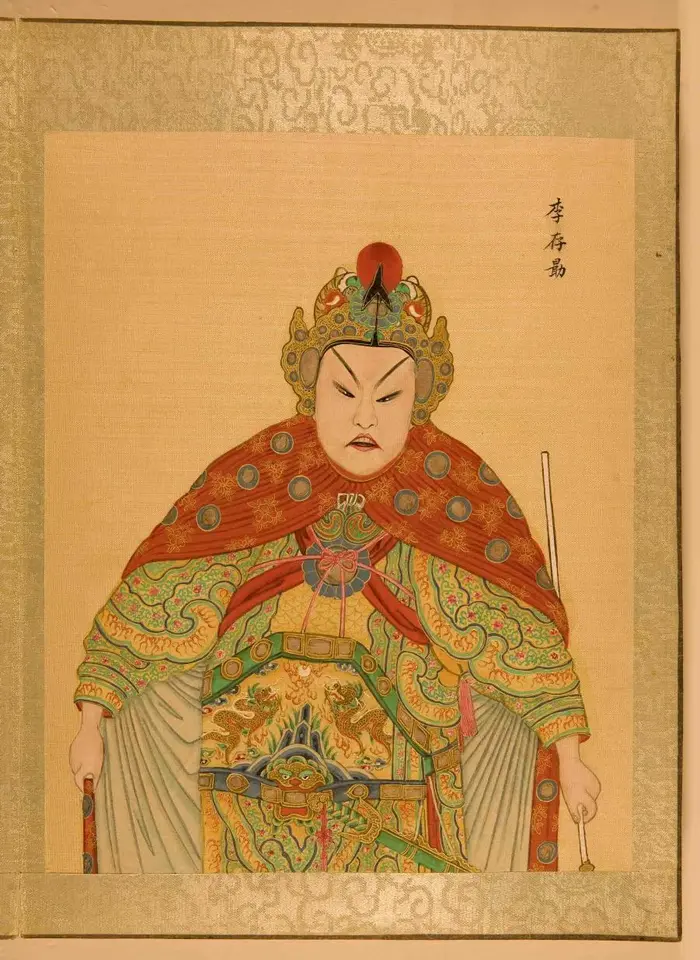
The Destruction of Later Liang by Li Cunxu (李存勖灭后梁) was a momentous military campaign and dynastic transition spanning 908 CE to 923 CE that settled the political mastery of northern China during the Five Dynasties period. Ever since Zhu Wen attempted to assassinate Li Keyong during the Shangyuan Station Incident in 884 CE, the Shatuo Jin and Xuanwu Liang regimes had engaged in unyielding warfare. When Zhu Wen usurped the Tang throne in 907 CE, the Jin principality maintained unswerving loyalty to the Tang banner. On his deathbed in 908 CE, Li Keyong presented his twenty-three-year-old son Li Cunxu with three arrows, charging him to subdue Yan, repel the Khitans, and annihilate the Later Liang. Demonstrating extraordinary tactical genius, Li Cunxu launched a surprise dawn attack in 908 CE to relieve the siege of Luzhou, followed by the catastrophic destruction of Liang's elite field army at the Battle of Baixiang in 911 CE. Annexing the Hebei commanderies and destroying Liu Shouguang in Youzhou, Li Cunxu secured absolute dominion north of the Yellow River. In the fourth month of 923 CE, he proclaimed himself Emperor of Later Tang at Weizhou. Facing fierce counterattacks, Li Cunxu adopted a daring operational strategy proposed by defector Kang Yanxiao and adviser Guo Chongtao: dispatching general Li Siyuan to smash Liang forces at Zhongdu and capture veteran general Wang Yanzhang, Li Cunxu led five thousand elite cavalrymen in a non-stop dash on the Liang capital of Kaifeng. Hopelessly trapped, Emperor Modi Zhu Youzhen ordered his attendant to take his life, bringing sixteen years of Later Liang rule to a definitive close.
Luzhou, Baixiang, Weizhou, Desheng, Zhongdu, Kaifeng (modern Shanxi, Hebei, Henan, and Shandong provinces)
The Battle of Baixiang (柏乡之战) was a pivotal field engagement fought between 910 and 911 that decisively tilted the hegemonic struggle between Later Liang and Jin in northern China. In the eleventh month of 910, Emperor Zhu Wen of Later Liang sought to subjugate the autonomous regional garrisons of Chengde Circuit (Zhenzhou) and Yiwu Circuit (Dingzhou). Under the guise of assisting against Youzhou (Lulong Circuit) warlord Liu Shouguang, Liang officer Du Tingyin (Du Tinyin) treacherously seized Shenzhou and massacred the entire Zhao garrison. Outraged and cornered, Chengde Military Commissioner Wang Rong broke all ties with Liang and appealed to young Prince of Jin Li Cunxu in Taiyuan for military salvation, who dispatched Commander of Non-Han and Han Cavalry and Infantry Zhou Dewei to lead the relief expedition. Overruling timid court advisors, Li Cunxu dispatched master cavalry commander Zhou Dewei as the van and personally led 30,000 Shatuo elite cavalry across the Taihang Mountains to Baixiang. Zhu Wen dispatched Grand Commander Wang Jingren and Han Qing at the head of 60,000 elite Longxiang and Shenjie imperial guards. In January 911, the armies clashed across the Ye River. Adopting the strategy of exhausting the enemy while preserving strength, Zhou Dewei baited the heavy Liang formations into standing in frozen armor throughout the day. At dusk, Li Cunxu and Shi Jiantang unleashed a devastating cavalry flanking strike, slicing through the Liang army. Liang forces collapsed into headlong flight, leaving 20,000 dead during a hundred-mile pursuit. The triumph established Jin dominance north of the Yellow River and heralded Liang's eventual destruction.
Baixiang (modern Baixiang County, Hebei), Ye River (modern Xingtai area, Hebei)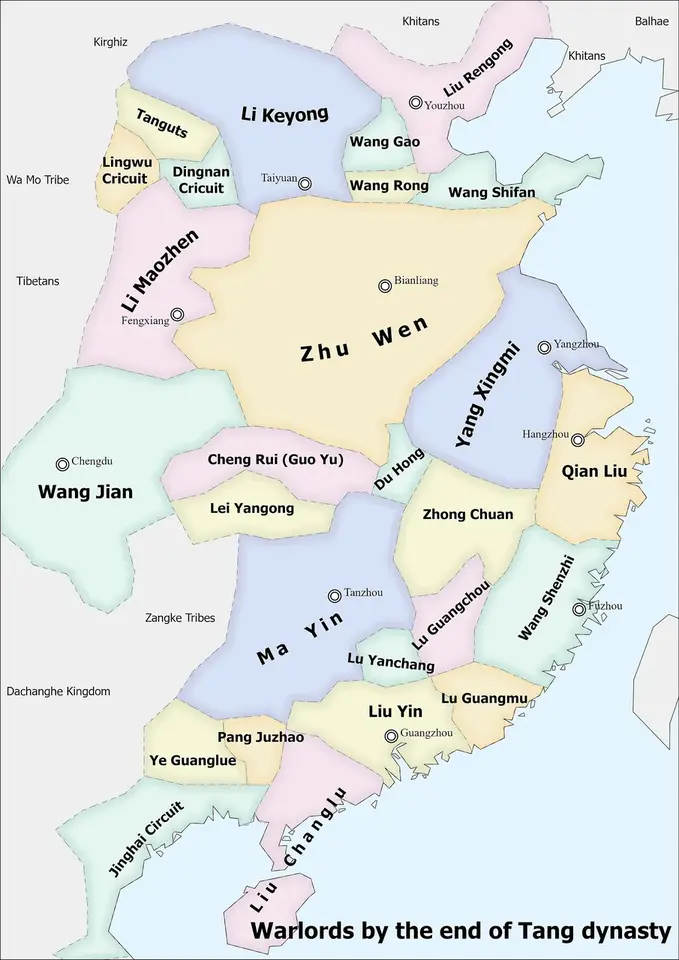
The Battle of Luzhou (潞州之战), fought from May 907 to May 908, was a decisive fortress confrontation and tactical turning point during the early Five Dynasties and Ten Kingdoms period between Later Liang under Zhu Wen and the Shatuo State of Jin under Li Keyong and his son Li Cunxu. Situated atop the strategic Taihang plateau, Luzhou (modern Changzhi, Shanxi) commanded the central plains and served as an indispensable bulwark safeguarding the Jin southern frontier. Following Zhu Wen's usurpation of the Tang throne, Liang general Li Sian led massive forces to envelop Luzhou, constructing a massive encircling fortified encampment known as Jiazhai (Entrenched Camp) to starve out the defenders. Under inspector-general Li Sizhao, the garrison withstood bitter starvation and constant bombardment for an entire year. When Jin ruler Li Keyong died in early 908, Liang forces relaxed their vigilance, assuming the Shatuo were paralyzed by succession disputes. Demonstrating astonishing audacity, the young successor Li Cunxu suppressed internal conspiracies, kept his father's death secret, and launched a lightning relief expedition with general Zhou Dewei. On June 2, 908, Jin shock cavalry assaulted the fortified camp under cover of a dense dawn fog. The synchronized strike routed the Liang army, inflicting over ten thousand casualties and ending the siege. The victory permanently altered the course of the Liang-Jin rivalry.
Luzhou (modern Changzhi, Shanxi), Sanchuigang, and Huangnian