Legacy of Three Arrows
Li Keyong dies after giving Li Cunxu three arrows; in the fifth month, Li Cunxu shatters Liang double entrenchments at Luzhou.
Five Dynasties (Later Liang, Later Tang) · HISTORICAL EVENT
李存勖灭后梁
The Destruction of Later Liang by Li Cunxu (李存勖灭后梁) was a momentous military campaign and dynastic transition spanning 908 CE to 923 CE that settled the political mastery of northern China during the Five Dynasties period. Ever since Zhu Wen attempted to assassinate Li Keyong during the Shangyuan Station Incident in 884 CE, the Shatuo Jin and Xuanwu Liang regimes had engaged in unyielding warfare. When Zhu Wen usurped the Tang throne in 907 CE, the Jin…
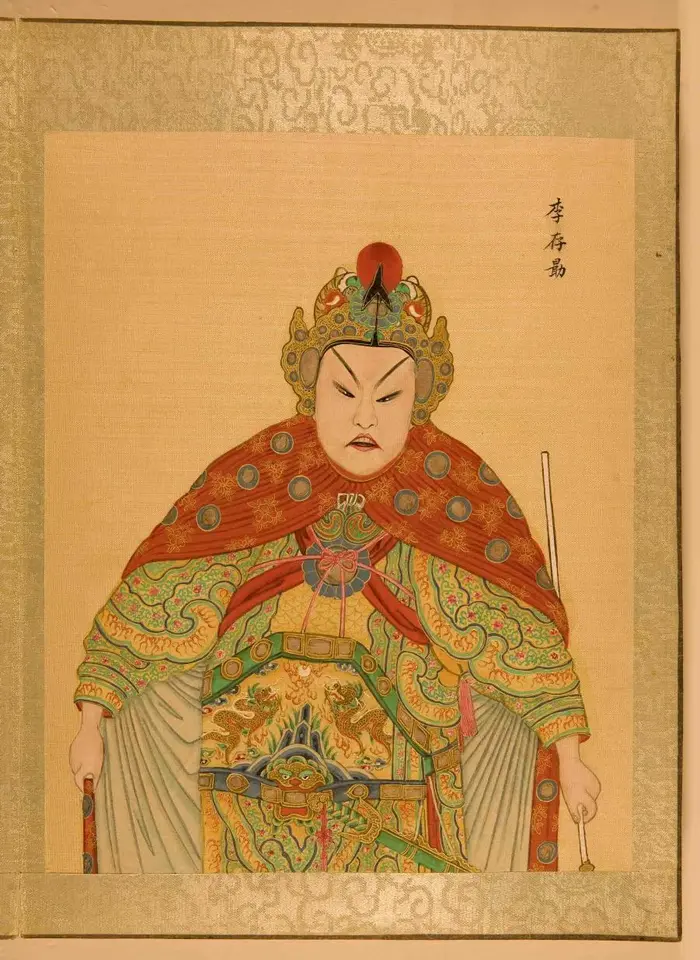
The Destruction of Later Liang by Li Cunxu (李存勖灭后梁) was a momentous military campaign and dynastic transition spanning 908 CE to 923 CE that settled the political mastery of northern China during the Five Dynasties period. Ever since Zhu Wen attempted to assassinate Li Keyong during the Shangyuan Station Incident in 884 CE, the Shatuo Jin and Xuanwu Liang regimes had engaged in unyielding warfare. When Zhu Wen usurped the Tang throne in 907 CE, the Jin principality maintained unswerving loyalty to the Tang banner. On his deathbed in 908 CE, Li Keyong presented his twenty-three-year-old son Li Cunxu with three arrows, charging him to subdue Yan, repel the Khitans, and annihilate the Later Liang. Demonstrating extraordinary tactical genius, Li Cunxu launched a surprise dawn attack in 908 CE to relieve the siege of Luzhou, followed by the catastrophic destruction of Liang's elite field army at the Battle of Baixiang in 911 CE. Annexing the Hebei commanderies and destroying Liu Shouguang in Youzhou, Li Cunxu secured absolute dominion north of the Yellow River. In the fourth month of 923 CE, he proclaimed himself Emperor of Later Tang at Weizhou. Facing fierce counterattacks, Li Cunxu adopted a daring operational strategy proposed by defector Kang Yanxiao and adviser Guo Chongtao: dispatching general Li Siyuan to smash Liang forces at Zhongdu and capture veteran general Wang Yanzhang, Li Cunxu led five thousand elite cavalrymen in a non-stop dash on the Liang capital of Kaifeng. Hopelessly trapped, Emperor Modi Zhu Youzhen ordered his attendant to take his life, bringing sixteen years of Later Liang rule to a definitive close.
Li Keyong dies after giving Li Cunxu three arrows; in the fifth month, Li Cunxu shatters Liang double entrenchments at Luzhou.
Li Cunxu crushes Wang Jingren's elite army at Baixiang, stripping Later Liang of its military control over Hebei.
Li Cunxu conquers Youzhou, defeats Khitan forces, and receives the surrender of Weibo, securing all territories north of the Yellow River.
Li Cunxu ascends the throne at Weizhou, establishing the Later Tang Dynasty and adopting the Tongguang reign title.
Li Siyuan executes the strategic raid on Zhongdu, capturing Liang general Wang Yanzhang and opening the route to Kaifeng.
Later Tang cavalry storm Kaifeng; Emperor Modi commits suicide, and the Later Liang Dynasty is definitively extinguished.
In the twilight of the Tang Dynasty, Shatuo chieftain Li Keyong rendered illustrious service crushing the Huang Chao Rebellion, receiving the governorship of Hedong and the title Prince of Jin. In 884 CE, returning from victorious campaigns, Li Keyong stayed at the Shangyuan Station in Bianzhou, where Xuanwu governor Zhu Wen launched a midnight arson ambush to assassinate him. Li Keyong barely escaped through an electrical storm, while his chief general Shi Jingsi and hundreds of attendants were slaughtered. This treachery inaugurated decades of relentless territorial combat across central China.
In 907 CE, Zhu Wen forced Emperor Aidi to abdicate and established the Later Liang Dynasty. Li Keyong categorically rejected Liang authority, upholding the Tang calendar as the preeminent anti-Liang champion. In the first month of 908 CE, mortally ill at Taiyuan, Li Keyong summoned Li Cunxu and handed him three ceremonial arrows, weeping: "Liu Shouguang betrayed our alliance, the Khitan chieftain Abaoji broke his sworn oaths, and old bandit Zhu Wen is my blood enemy. If you can conquer Yan, drive back the Khitans, and extinguish Liang, I shall close my eyes in peace!" At age twenty-three, Li Cunxu solemnly accepted the charge.
When Li Keyong died, eighty thousand Liang soldiers had besieged the strategic Jin fortress of Luzhou for nearly a year. Zhu Wen had directed his commanders to construct expansive double entrenchments around Luzhou, calculating that the young prince's succession would trigger factional paralysis in Taiyuan, leaving Luzhou vulnerable to swift collapse.
However, Later Liang was corroded by internal tyranny and domestic crisis. Zhu Wen ruled with paranoid cruelty, executing seasoned commanders and estranging powerful regional governors. In 912 CE, Zhu Wen was murdered in his bedchamber by his son Zhu Yougui; a year later, Zhu Yougui was overthrown and slain by his brother Zhu Youzhen, who ascended as Emperor Modi. This repeated royal fratricide shattered military morale, presenting Li Cunxu with a historic window to launch a coordinated counter-offensive.
Ascending the Jin throne in early 908 CE, Li Cunxu exploited Liang overconfidence by organizing a long-range cavalry strike. Leading his cavalry across the rugged Huangze Ridge in total secrecy, Li Cunxu approached the siege perimeter of Luzhou in early May.
On the morning of the second day of the fifth month, dense fog blanketed the valley. Li Cunxu spearheaded a ferocious charge into the double entrenchments. Taken by complete surprise, the garrison collapsed in panic; Jin forces slaughtered over ten thousand Liang soldiers, routing commander Fu Daozhao and lifting the year-long siege. The triumph reversed the strategic initiative, prompting Zhu Wen to exclaim in despair: "If one has a son, he should be like Li Yazi! Compared to him, my own sons are mere dogs and swine!"
In late 910 CE, Zhu Wen provoked the rebellion of Chengde Governor Wang Rong and Yiwu Governor Wang Chuzhi by attempting to seize their lands. Responding to Wang Rong's plea for aid, Li Cunxu marched south into Hebei, confronting sixty thousand elite Liang troops under Wang Jingren at Baixiang in the first month of 911 CE.
Adopting cavalry tactics advised by veteran commander Zhou Dewei, Li Cunxu lured heavily armored Liang infantry into exhaustive movements across the frozen plains. As midday fatigue broke Liang formations, Shatuo horsemen smashed into enemy flanks. Liang divisions routed, suffering over twenty thousand casualties while fleeing one hundred and fifty miles back to Xingzhou. The Battle of Baixiang destroyed Liang field supremacy, permanently transferring the Hebei plains into Jin hands.
Following Baixiang, Li Cunxu marched north to crush Liu Shouguang in Youzhou and routed invading Khitan cavalry back across the Great Wall. In 915 CE, the strategic Weibo Commandery revolted against Liang, surrendering six prefectures to Jin. Li Cunxu established headquarters at Weizhou, consolidating undisputed mastery north of the Yellow River.
Over the next eight years, Jin and Liang armies engaged in grueling positional warfare along the Yellow River, clashing repeatedly at Desheng, Yangliu, and Huliupo. In the fourth month of 923 CE, Li Cunxu formally mounted the imperial throne at Weizhou, proclaiming the restoration of the Great Tang Dynasty (Later Tang) and adopting the reign title Tongguang, thereby framing the Later Liang as an illegitimate usurping regime.
In response, Emperor Modi appointed veteran general Wang Yanzhang as supreme commander. Brandishing heavy iron spears, Wang Yanzhang fulfilled his vow to sever the pontoon bridge across the Yellow River and captured Desheng South City within three days. Li Cunxu rushed to the Yangliu frontline, uniting with general Li Siyuan to withstand relentless Liang assaults for one hundred days until the exhausted Wang Yanzhang retreated to Zhongdu.
Alarmed by Wang Yanzhang's rising military prestige, corrupt Liang courtiers Zhao Yan and Zhang Hanjie slandered the general, persuading Emperor Modi to replace Wang with the incompetent sycophant Duan Ning. Duan Ning mobilized sixty thousand Liang regulars north to Huaizhou, leaving Kaifeng completely undefended.
In the tenth month of 923 CE, Liang defector Kang Yanxiao arrived at Later Tang headquarters, revealing critical intelligence: "Duan Ning's entire army is stranded along the north bank of the river, leaving Kaifeng defenseless. If a vanguard strikes Zhongdu to capture Wang Yanzhang and dashes straight for the capital, Liang will fall within days!" Chief of Staff Guo Chongtao fervently endorsed the plan. Li Cunxu committed immediately, ordering Li Siyuan to lead five thousand picked horsemen across the Yellow River.
On the fourth day of the tenth month, Li Siyuan intercepted Wang Yanzhang at Zhongdu, overwhelming the rearguard and capturing the wounded veteran general alive. When Wang Yanzhang refused repeated entreaties to switch allegiances, Li Cunxu executed him. With the southern plain wide open, Li Cunxu ordered his cavalry to discard heavy baggage and ride day and night toward Kaifeng. Duan Ning's northern divisions were cut off and unable to intervene.
On the ninth day of the tenth month, Later Tang vanguard cavalry appeared outside the gates of Kaifeng. Realizing all was lost, Emperor Modi wept to his attendant Huangfu Lin: "The house of Jin has been our blood enemy for generations; I cannot endure capture and humiliation!" Huangfu Lin drew his blade and ended the emperor's life before killing himself. Li Cunxu entered Kaifeng unopposed, accepting the surrender of the imperial seal and terminating sixteen years of Later Liang rule.
The campaign concluded with the total extinction of the Later Liang and the establishment of Later Tang authority across the Central Plains. Li Cunxu relocated the capital to Luoyang, annexing Henan, Shandong, Guanzhong, and northern Huai territories into the imperial domain while disarming over one hundred thousand surrendered troops.
The conquest stood as the defining military unification of the Five Dynasties era. Strategically, Later Tang unified northern and central China, subsequently conquering the Former Shu kingdom in Sichuan to forge the largest empire of the Five Dynasties. Institutionally, Li Cunxu's reliance on Shatuo military elites solidified the preeminence of imperial bodyguards and palace armies in medieval Chinese statecraft. However, Li Cunxu's rapid descent into decadence and reliance on court actors provoked widespread mutinies that resulted in his death three years later during the Xingjiaomen mutiny, illustrating the volatile instability of tenth-century warlord regimes.