Usurpation by Zhu Wen
Zhu Wen establishes the Later Liang Dynasty; Li Keyong remains loyal to the Tang legacy.
Later Liang Dynasty (后梁) · HISTORICAL EVENT
潞州之战
The Battle of Luzhou (潞州之战), fought from May 907 to May 908, was a decisive fortress confrontation and tactical turning point during the early Five Dynasties and Ten Kingdoms period between Later Liang under Zhu Wen and the Shatuo State of Jin under Li Keyong and his son Li Cunxu. Situated atop the strategic Taihang plateau, Luzhou (modern Changzhi, Shanxi) commanded the central plains and served as an indispensable bulwark safeguarding the Jin southern…
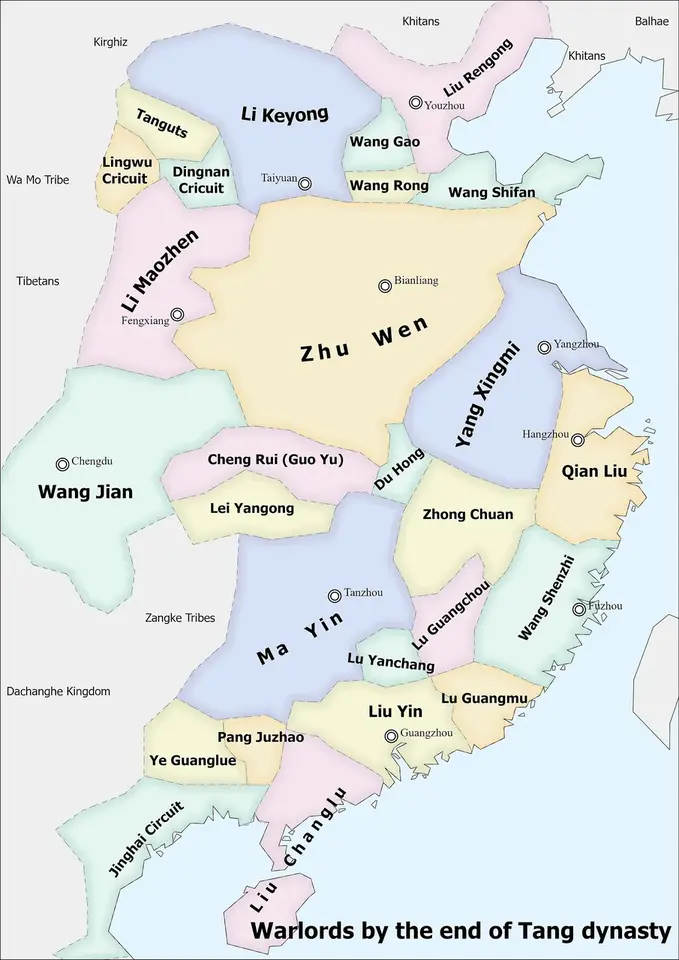
The Battle of Luzhou (潞州之战), fought from May 907 to May 908, was a decisive fortress confrontation and tactical turning point during the early Five Dynasties and Ten Kingdoms period between Later Liang under Zhu Wen and the Shatuo State of Jin under Li Keyong and his son Li Cunxu. Situated atop the strategic Taihang plateau, Luzhou (modern Changzhi, Shanxi) commanded the central plains and served as an indispensable bulwark safeguarding the Jin southern frontier. Following Zhu Wen's usurpation of the Tang throne, Liang general Li Sian led massive forces to envelop Luzhou, constructing a massive encircling fortified encampment known as Jiazhai (Entrenched Camp) to starve out the defenders. Under inspector-general Li Sizhao, the garrison withstood bitter starvation and constant bombardment for an entire year. When Jin ruler Li Keyong died in early 908, Liang forces relaxed their vigilance, assuming the Shatuo were paralyzed by succession disputes. Demonstrating astonishing audacity, the young successor Li Cunxu suppressed internal conspiracies, kept his father's death secret, and launched a lightning relief expedition with general Zhou Dewei. On June 2, 908, Jin shock cavalry assaulted the fortified camp under cover of a dense dawn fog. The synchronized strike routed the Liang army, inflicting over ten thousand casualties and ending the siege. The victory permanently altered the course of the Liang-Jin rivalry.
Zhu Wen establishes the Later Liang Dynasty; Li Keyong remains loyal to the Tang legacy.
Regional governor Ding Hui surrenders, but Li Sizhao fortifies Luzhou against Liang forces.
Liang armies encircle Luzhou, constructing a multi-mile fortified wall network to starve the garrison.
Facing starvation, Li Sizhao executes night raids, killing Liang commander Fu Daozhao.
Li Keyong dies in Taiyuan, bequeathing the task of relieving Luzhou to his son Li Cunxu.
Li Cunxu stabilizes Taiyuan and marches southward through the Taihang Mountains.
Jin forces break into the entrenched camp during dense morning fog, routing the Liang army.
Stunned by the disaster, Zhu Wen famously laments: "If one has a son, he should be like Li Cunxu!"
The enmity between Zhu Wen of the Xuanwu Army and Shatuo chieftain Li Keyong of the Hedong Army originated during the pacification of the Huang Chao Rebellion in the 880s. In April 907, Zhu Wen deposed the last Tang emperor in Kaifeng, proclaiming the Later Liang Dynasty. Rejecting Liang legitimacy, Li Keyong retained the Tang Tianyou reign title, forging anti-Liang alliances with peripheral regional governors. Recognizing the Shatuo enclave as an existential obstacle to imperial unification, Zhu Wen concentrated imperial military resources to conquer Shanxi.
Luzhou served as the administrative seat of the Zhaoyi Circuit, commanding vital access through the Taihang Mountains between the Central Plains and Taiyuan. In May 907, regional governor Ding Hui defected to Liang, but loyalist officer Li Sizhao rallied local troops to fortify the citadel. Zhu Wen dispatched over one hundred thousand troops under Li Sian to secure the stronghold.
Unable to storm the city walls, Li Sian constructed an extensive circular siege works known as Jiazhai (Entrenched Camp). This fortified network consisted of double palisades, moats, and fortified towers spanning several miles around the city, severing all external supply lines. Inside this fortified ring, Liang troops established permanent barracks and commercial markets, intending to reduce the fortress through prolonged starvation.
Throughout the brutal winter of 907, Li Sizhao led less than ten thousand defenders in a desperate resistance against overwhelming Liang odds. As grain reserves depleted, soldiers and civilians boiled leather armor and tree bark for food. Despite intense suffering, Li Sizhao inspired unbreakable discipline, leading nocturnal raids that killed Liang general Fu Daozhao and frustrated every assault.
In February 908, Prince of Jin Li Keyong fell terminally ill in Taiyuan. On his deathbed, he handed three symbolic arrows to his twenty-four-year-old heir, Li Cunxu, instructing him to avenge his grievances against Yan, the Khitans, and especially Zhu Wen, emphasizing that relieving the siege of Luzhou must take priority. Li Cunxu assumed the princely throne amidst internal treasonous conspiracies. Believing the young ruler was incapacitated by grief and power struggles, the besieging Liang forces grew increasingly negligent.
Proving himself a brilliant commander, Li Cunxu swiftly executed the treacherous general Li Kening, stabilizing Taiyuan. He then conferred secretly with veteran strategist Zhou Dewei, who observed: "The Liang forces consider their entrenched camp impregnable. Believing our lord has just passed away and that we cannot move, their vigilance has slackened. If we advance at double speed through the mountain defiles, we can annihilate them in a single blow!"
Li Cunxu approved the daring offensive, strictly concealing his father's funeral while disguising mourning attire beneath battle armor. In late April 908, Li Cunxu and Zhou Dewei led elite Shatuo cavalry southward through the Huangze Pass. Moving by forced night marches, the strike force crossed the Taihang Range undetected, concentrating at Sanchuigang just leagues from the siege perimeter.
At dawn on June 2, 908 (the first day of the fifth lunar month), an exceptionally thick fog descended over the valleys of Luzhou, completely blinding the battlefield. Recognizing this meteorological advantage, Li Cunxu ordered an immediate all-out assault. Jin heavy cavalry surged forward in two wings: Zhou Dewei struck the northwestern perimeter while Li Cunxu spearheaded the assault against the Liang headquarters.
Caught entirely off guard in the morning mist, the Liang encampment dissolved into blind panic, with soldiers trampling one another. Hearing war cries outside, Li Sizhao flung open the city gates, leading his emaciated garrison to strike the disordered besiegers in the rear.
Attacked from both sides, the immense fortified complex disintegrated. Liang commander Zhu Youwen and deputy Li Sian fled in disgrace, abandoning official seals and weapons. Jin forces cut down over ten thousand Liang soldiers, capturing vast stockpiles of grain, weaponry, and baggage. The twelve-month siege was broken in a single morning.
The Battle of Luzhou proved to be the supreme turning point of the five-decade Liang-Jin wars. Prior to the battle, Later Liang held overwhelming economic and military superiority across North China, relegating Jin to desperate localized defense. The total destruction of the siege army not only cost Liang tens of thousands of veteran soldiers and vast material reserves, but also permanently secured the Taihang Mountain bastion for Jin. From this moment onward, Jin seized the strategic initiative, transitioning from defensive containment to relentless southward expansion, culminating in the conquest of Later Liang fifteen years later.
For Li Cunxu personally, the victory was transformative. In a single decisive action, the young prince crushed internal treason, fulfilled his father's dying command, and demonstrated battlefield genius that awed his veteran generals. When news of the catastrophe reached Kaifeng, Emperor Zhu Wen marveled in despair: "If one has a son, he should be like Li Cunxu; Li Keyong is not truly dead! As for my own sons, they are merely swine and dogs!"