Rescue of the Emperor and Eunuch Purge
Zhu Wen forces Li Maozhen to surrender in Fengxiang, escorts Emperor Zhaozong to Chang'an, and slaughters hundreds of palace eunuchs.
Tang Dynasty, Later Liang · HISTORICAL EVENT
朱温代唐
The Usurpation of Tang by Zhu Wen (朱温代唐) was a watershed dynastic transition spanning 904 CE to 907 CE that brought about the catastrophic downfall of the illustrious Tang Dynasty. The Huang Chao Rebellion had fundamentally shattered imperial command, allowing regional military governors (Jiedushi) to wage unrestricted territorial warfare. Originally a rebel general who defected to the Tang and received the name Zhu Quanzhong, Zhu Wen established his…
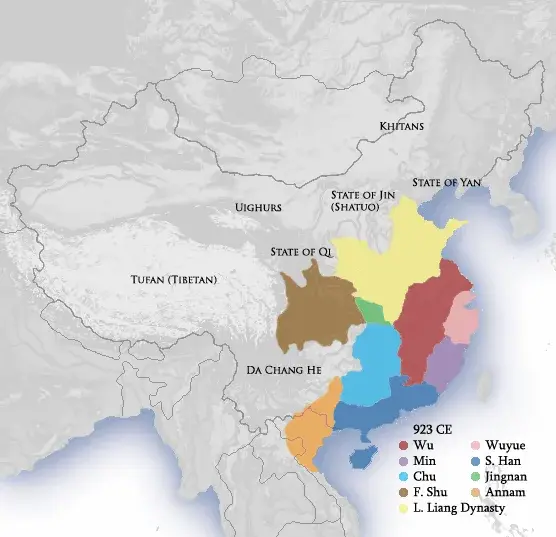
The Usurpation of Tang by Zhu Wen (朱温代唐) was a watershed dynastic transition spanning 904 CE to 907 CE that brought about the catastrophic downfall of the illustrious Tang Dynasty. The Huang Chao Rebellion had fundamentally shattered imperial command, allowing regional military governors (Jiedushi) to wage unrestricted territorial warfare. Originally a rebel general who defected to the Tang and received the name Zhu Quanzhong, Zhu Wen established his regional stronghold at Bianzhou (modern Kaifeng) and systematically conquered the central plains. Defeating formidable adversaries such as Li Keyong of Hedong and Li Maozhen of Fengxiang, Zhu Wen gained total dominion over the imperial court. To secure absolute supervision over the monarch and prepare his path to the throne, Zhu Wen forcibly relocated Emperor Zhaozong to Luoyang in 904 CE, ordering the complete demolition of Chang'an's imperial palaces. In the eighth month of 904 CE, Zhu Wen arranged the assassination of Emperor Zhaozong in his bedchamber, enthroning the thirteen-year-old Emperor Aidi. In 905 CE, at Baima Station in Huazhou, Zhu Wen slaughtered over thirty aristocratic court ministers and cast their bodies into the Yellow River, an atrocity known as the Baima Station Massacre. Finally, in the fourth month of 907 CE, Zhu Wen compelled Emperor Aidi to abdicate, ascending the throne in Bianzhou as founding emperor of the Later Liang Dynasty. This usurpation extinguished the 289-year rule of the Tang Empire, plunging China into the bloody fragmentation of the Five Dynasties and Ten Kingdoms.
Zhu Wen forces Li Maozhen to surrender in Fengxiang, escorts Emperor Zhaozong to Chang'an, and slaughters hundreds of palace eunuchs.
Zhu Wen compels the relocation of the court to Luoyang, ordering the complete demolition of Chang'an's palaces and ancestral monuments.
Zhu Yougong executes the midnight murder of Emperor Zhaozong in Jiao Palace; Zhu Wen executes the assassins as scapegoats and installs Emperor Aidi.
Zhu Wen poisons and strangles nine imperial sons of Emperor Zhaozong at Jiuqu Pool in Luoyang, dumping their bodies into the reservoir.
On the recommendation of Li Zhen, Zhu Wen slaughters Pei Shu and over thirty aristocratic statesmen at Baima Station, casting them into the Yellow River.
Emperor Aidi is forced to abdicate; Zhu Wen ascends the throne in Bianzhou as founding Emperor of Later Liang, extinguishing the Tang Dynasty.
Following the devastating An Lushan Rebellion, the Tang court suffered chronic regional autonomy among military governors, compounded by internal eunuch domination and factional court strife. The massive Huang Chao Rebellion delivered the final fatal blow to imperial central governance. Serving initially as a prominent rebel general, Zhu Wen defected to imperial forces when Huang Chao's fortunes waned, receiving the honorific name "Quanzhong" ("Entirely Loyal") and the appointment as Military Governor of the Xuanwu Army based in Bianzhou.
Through decades of ruthless military campaigns, Zhu Wen annihilated neighboring warlord rivals like Qin Zongquan and Shi Pu, extending his territory across Henan, Shandong, and southern Hebei. Zhu Wen engaged in bitter hegemony warfare against Li Keyong, leader of the Shatuo Turks and Military Governor of Hedong, repeatedly defeating Shatuo armies and confining Li Keyong to Taiyuan. Projecting his armed forces westward into the capital region of Guanzhong, Zhu Wen carved out a massive regional hegemony stretching from Shaanxi to the eastern seaboard and from the Huai River to the Yellow River.
In 901 CE (the first year of the Tianfu era), bloody civil strife erupted in Chang'an when Chancellor Cui Yin allied with Zhu Wen to exterminate the palace eunuchs. In response, powerful eunuch commanders led by Han Quanhui abducted Emperor Zhaozong and fled westward to Fengxiang to seek protection under Military Governor Li Maozhen. Seeking to emulate historical precedents of controlling the emperor to command the realm, Li Maozhen clashed directly with Zhu Wen. Zhu Wen led the Xuanwu army in a punishing siege of Fengxiang that endured for over a year.
By early 903 CE, starving and desperate, Li Maozhen capitulated, executing Han Quanhui and surrendering the emperor to Zhu Wen. Escorting Emperor Zhaozong back to Chang'an, Zhu Wen dispatched soldiers to massacre hundreds of palace eunuchs, completely terminating a century of eunuch domination over the inner court. However, rather than restoring sovereign majesty, Emperor Zhaozong became an absolute captive in Zhu Wen's iron grip, with the fate of the dynasty resting entirely on the whims of the Xuanwu military warlord.
In the first month of 904 CE (the first year of the Tianyou era), Zhu Wen determined to move the sovereign closer to his military power base in Henan, neutralizing strategic threats from Li Keyong and Li Maozhen. Zhu Wen dispatched commander Kou Yanqing to Chang'an, ordering the imperial household to evacuate immediately to Luoyang. Recognizing that abandoning the traditional capital meant inevitable doom, Emperor Zhaozong wept bitterly to his attendants, lamenting that he had been reduced to a helpless beast led by ropes, but was powerless against the armed soldiers surrounding the palace.
To prevent any future return to the historic heartland, Zhu Wen ordered a catastrophic act of architectural destruction. Thousands of military laborers systematically demolished the grand imperial palace compounds, governmental bureaus, and aristocratic estates of Chang'an, spanning centuries of imperial construction. Beams, timber, and carved stone masonry were dismantled and floated along the Wei and Yellow rivers toward Luoyang. Chang'an, the glorious metropolitan center of the Tang Dynasty for three centuries, was reduced in a few months to smoking rubble and barren wasteland, permanently losing its status as the imperial capital of China.
Under armed escort, the royal carriage traversed the rugged road toward Luoyang. Passing through Huazhou, weeping commoners gathered along the highway chanting imperial honors, prompting Emperor Zhaozong to wave his hand in despair, crying: "Do not shout long live; I no longer know if I shall even be spared as a common civilian!" Upon arrival in Luoyang in the fourth month, Zhu Wen murdered several hundred palace eunuchs and imperial handmaidens, replacing them with disguised Xuanwu infantrymen to surveil the emperor's every breath, leaving the monarch utterly isolated.
Despite relentless surveillance, Emperor Zhaozong covertly dispatched secret edicts to warlords Li Keyong in Hedong, Yang Xingmi in Huainan, and Wang Jian in Xichuan, offering grand titles and imploring them to assemble an imperial coalition to strike Zhu Wen. Alarmed by reports of an impending anti-Zhu regional coalition rallying under the sovereign's banner, Zhu Wen resolved to eliminate the mature emperor and install a juvenile puppet to facilitate a seamless transition of the mandate of heaven.
On the night of the renzi day in the eighth month of 904 CE, Zhu Wen secretly instructed his adoptive son Zhu Yougong, Right Dragon-Armed Commander Shi Shucong, and Palace Commissioner Jiang Xuanhui to stage an armed assault on the inner quarters of Luoyang Palace. The commanders kicked down the bedchamber doors; Lady Li and consort A-Qiu threw their bodies over the emperor and were hacked to death. Fleeing barefoot in his sleeping robe around a pillar, Emperor Zhaozong was cornered and repeatedly stabbed to death by Zhang Tingfan and other assassins at age thirty-eight.
Following the regicide, Zhu Wen staged an elaborate display of grief at his military camp in Bianzhou, throwing himself to the ground and weeping loudly, cursing Zhu Yougong for dragging his name into eternal ignominy. Shortly afterward, Zhu Wen executed Zhu Yougong and Shi Shucong as scapegoats to silence witnesses. He then enthroned Emperor Zhaozong's ninth son, thirteen-year-old Li Zhu, known historically as Emperor Aidi, reducing imperial rule to an absolute charade.
With a pliant child on the throne, Zhu Wen accelerated his campaign to eliminate all potential dynastic contenders. In the second month of 905 CE, Zhu Wen invited nine sons of Emperor Zhaozong—including Prince of De Li You, Prince of Di Li Xu, and Prince of Qian Li Xi—to a grand banquet at the Jiuqu Pool in Luoyang. Once the imperial princes were thoroughly intoxicated, Zhu Wen's agents strangled them and cast their corpses into the water, extinguishing the direct imperial bloodline of the House of Li.
Following the slaughter of the imperial princes, the traditional civil aristocracy remained the final ideological obstacle to Zhu Wen's usurpation. Zhu Wen's chief adviser Li Zhen had repeatedly failed the imperial examinations in his youth, harboring bitter personal hatred against the hereditary scholar-gentry. Li Zhen urged Zhu Wen: "These court ministers boast of their noble genealogies and call themselves the pure stream; they must be eradicated completely to pull up the roots of the Tang Dynasty." Zhu Wen readily assented.
In the sixth month of 905 CE, under the orchestration of Li Zhen and collaborator Chancellor Liu Can, more than thirty distinguished elder statesmen—including Grand Commander Pei Shu, Junior Preceptor Dugu Sun, and Minister of Personnel Cui Yuan—were arrested and gathered at Baima Station along the Yellow River in Huazhou. Li Zhen smiled cruelly to Zhu Wen: "These ministers boast of being the pure stream; let us cast them into the Yellow River so they may become the muddy stream forever!" Zhu Wen laughed and directed the executioners to slaughter the statesmen, throwing all thirty bodies into the raging currents. This catastrophe, known as the Baima Station Massacre, destroyed the remaining leadership of the medieval aristocratic clans, annihilating the traditional civil bureaucracy.
With the royal lineage extinguished and bureaucratic opposition silenced, Zhu Wen completed final administrative arrangements for his ascension. In late 905 CE and early 906 CE, to eliminate incriminating witnesses and consolidate supreme authority, Zhu Wen framed and executed the very confidants who had engineered the assassinations—Jiang Xuanhui, He Yaocheng, and Chancellor Liu Can.
In 906 CE, Zhu Wen was elevated to Chancellor of State, granted the title Prince of Liang, and bestowed the Nine Bestowals with imperial prerogatives, reproducing the classic political script of historical dynastic usurpers. In the third month of 907 CE, under relentless coercion from military generals, sixteen-year-old Emperor Aidi issued an imperial edict formally abdicating the throne.
On the thirteenth day of the fourth month in 907 CE (the fourth year of the Tianyou era), Zhu Wen mounted the imperial altar at Xuande Hall in Bianzhou, officially accepting the imperial jade seal and declaring himself founding sovereign of the Great Liang Dynasty (Later Liang). Bianzhou was renamed Kaifeng and designated the Eastern Capital, while Luoyang became the Western Capital, with the reign era titled Kaiping. Emperor Aidi was demoted to Prince of Jiyin, placed under strict house arrest in Caozhou, and murdered with poisoned wine the following year at age seventeen. The usurpation of Tang by Zhu Wen definitively ended the 289-year glorious reign of the Tang Dynasty, inaugurating the fragmented chaos of the Five Dynasties and Ten Kingdoms.
Zhu Wen's usurpation concluded with the formal dissolution of the Tang Dynasty and the founding of the Later Liang. Through methodical violence, Zhu Wen eradicated the royal clan and the aristocratic civil elite, transforming his military hegemony into an imperial dynasty headquartered at Kaifeng.
The event constituted a monumental institutional and social watershed in pre-modern Chinese history. It terminated the 289-year rule of the Tang Empire, hurling the realm into the fragmented violence of the Five Dynasties and Ten Kingdoms. Furthermore, the Baima Station Massacre physically obliterated the hereditary aristocratic clans that had monopolized civil power since the Han and Tang periods, removing the social barriers for the rise of the meritocratic scholar-official class of the Song Dynasty. Lastly, Zhu Wen's naked reliance on military force established the militaristic ethos of the Five Dynasties, where supreme power belonged solely to whoever possessed superior arms.