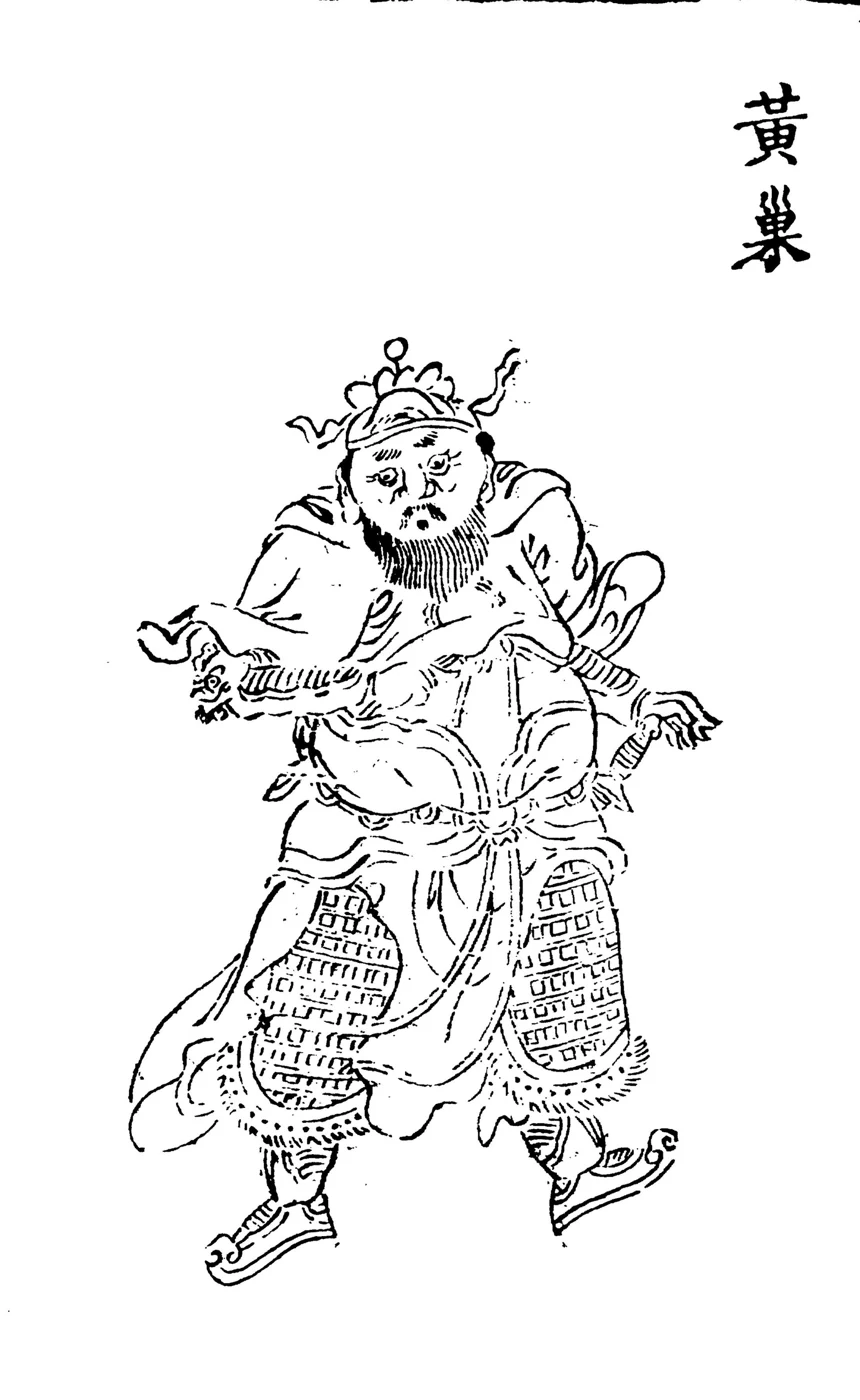
Biography
Family Background and Early Life
Huang Chao was born in Yuanju, Caozhou, northwest of present-day Cao County in Heze, Shandong. His family had long traded in illicit salt and was wealthy. The *New Book of Tang, Rebel Ministers, Part Two* says that Huang Chao was from Yuanju in Caozhou, that his family had long sold salt and possessed considerable wealth, that he was skilled in swordsmanship, horsemanship, and archery, had some literary ability, was eloquent, and liked to harbor fugitives. The source therefore presents him as skilled in weapons, riding, and archery, reasonably literate, quick in speech, and accustomed to gathering men outside the law around him.
Huang Chao was also said to have shown poetic ability from childhood. According to Zhang Duanyi's *Gui'er Ji* of the Song dynasty, when Huang was five years old he attended upon his grandfather while his grandfather and father composed linked lines on chrysanthemums. Before the grandfather could think of a response, Huang reportedly supplied a line declaring that the chrysanthemum could lead all flowers and was naturally bestowed with imperial yellow robes by Heaven. His father considered the words presumptuous and wanted to punish him, but the grandfather said that the child could compose poetry even if he did not yet understand the weight of his words, and asked him to write another piece. Huang then supposedly composed the poem later known as “On Chrysanthemums,” beginning with the west wind filling the courtyard and ending with a wish that, if he became the Azure Emperor one day, he would make chrysanthemums and peach blossoms bloom together.
As an adult, Huang Chao sat the *jinshi* examination several times but failed. According to later tradition, he angrily composed “On Chrysanthemums After Failing the Examination,” which declares that when his flower blooms after the ninth day of the ninth month, all other flowers will be destroyed, that its fragrance will fill Chang'an, and that the city will be covered in golden armor. He then left Chang'an, returned to the family occupation, and became a leader among salt traders.
From the late Xiantong era onward, floods and droughts struck many regions, with Henan particularly badly affected. The *Comprehensive Mirror in Aid of Governance* states that only half the wheat had been harvested, autumn crops were almost nonexistent, and winter vegetables were extremely scarce. The source further states that since the reign of Emperor Yizong of Tang the court had engaged in continuous warfare and increased taxation, while local officials failed to report disasters, leaving the population starving, displaced, and without a channel for complaint.
Joining the Uprising and Independent Warfare
In 875, the second year of Qianfu, the illicit salt trader Wang Xianzhi of Puyang and Shang Junchang gathered several thousand followers and rose in rebellion at Changyuan, or according to another account at Puyang. They attacked towns and cities and captured places including Caozhou, Puzhou, and Yunzhou. A popular rhyme had already circulated predicting that a “golden toad” would overturn Caozhou and bring rebellion under Heaven, and people reportedly became fearful when Wang's uprising began.
In the sixth lunar month of 875, Huang Chao gathered several thousand men together with his younger relatives Huang Cun, Huang Kui, and Huang Ye, his nephew Lin Yan, and others, and responded to Wang Xianzhi's uprising. People suffering from heavy taxes, as well as dispersed former followers of Pang Xun, joined the rebel army in large numbers; within a few months, the source says, their numbers reached tens of thousands. They attacked Yunzhou and raided Yizhou. By the eleventh lunar month they had attacked more than ten prefectures and reached Huainan, moving in groups ranging from several hundred to more than one thousand. The Tang court appointed Qi Kerang, Senior General of the Left Jinwu Guard, as Military Commissioner of Taining Circuit and ordered him to suppress the rebellion.
In the seventh lunar month of 876, Song Wei, Military Commissioner of Pinglu Circuit, defeated Wang Xianzhi outside Yizhou and falsely reported that Wang had died, then dismissed his troops back toward Qingzhou. Huang Chao used the resulting opening to rest briefly and then, in the eighth lunar month, advanced into Henan. He approached Jiacheng and captured eight counties in fewer than ten days. The Tang court was alarmed. It replaced Song Wei with the grand councilor Wang Duo as commander of the campaign against the rebels, appointed Zeng Yuanyu as his deputy to defend Luoyang, ordered Li Fu, Military Commissioner of Shannan East Circuit, to send two thousand infantry and cavalry north to guard the routes through Ruzhou and Dengzhou, and ordered Linghu Xuan of Fengxiang and Li Kan of Binning to station troops at Shanzhou and Tong Pass. The aim was to prevent Wang Xianzhi and Huang Chao from moving west. Over roughly half a year, the rebel forces fought mobile campaigns throughout the Jiang, Huai, Yellow, and Han river regions, forcing government troops to react in multiple directions. The source states that the rebel army expanded rapidly to three hundred thousand men.
Break with Wang Xianzhi at Qizhou
In 876, Wang Xianzhi and Huang Chao operated around Qizhou and Huangzhou. Pei Wo, Inspector of Qizhou, could not resist them and offered to memorialize the court on Wang's behalf in exchange for a truce. Emperor Xizong of Tang soon issued an appointment making Wang Xianzhi an officer of the Left Shence Army and sent a eunuch to offer conciliation. Wang wavered and considered giving up the rebellion in return for office.
Huang Chao was angry that the court had offered him no corresponding reward. He rebuked Wang, saying in substance that they had sworn together to range across the realm and that if Wang alone accepted office with the Left Army, the more than five thousand men who had followed them would have nowhere to go. The assembled followers became enraged. Huang struck Wang Xianzhi and injured his head. Fearing the anger of the crowd, Wang reluctantly abandoned the surrender plan, seized troops from the prefecture, and the local inspector Pei Wo and the eunuch envoy fled.
After the confrontation, Wang Xianzhi and Huang Chao split their forces. Shang Junchang moved toward Chen and Cai, while Huang Chao advanced north into Qi and Lu, his following reaching ten thousand. The division badly weakened the rebel forces.
In the second lunar month of 877, Wang Xianzhi briefly captured Ezhou. He and Huang Chao later reunited to attack Songzhou and other areas before splitting again. That winter, Yang Fuguang, deputy campaign supervisor for the Tang, again tried to induce Wang to surrender. Wang sent Shang Junchang, Cai Wenqiu, Chu Yanwei, and others to negotiate, but Song Wei intercepted them en route. Seeking credit, Song falsely claimed they had been captured in battle, and they were executed, ending the surrender negotiations.
Early in 878, rebel forces broke through the outer defenses of Jingnan, but Tang reinforcements arrived and forced them northward. In the second lunar month, Zeng Yuanyu defeated them at Huangmei, and Wang Xianzhi was killed.
Proclaiming Kingship and the Southern Expedition
After Wang Xianzhi's death, part of his surviving force moved south into the Jiangsu-Zhejiang region, while another contingent under Shang Rang went north and joined Huang Chao at Bozhou. The generals acclaimed Huang as king. He adopted the title “General Who Soars to Heaven,” established offices, and created the Wangba era name. The source states that his forces drove more than one hundred thousand people from Henan and Shannan while raiding Huainan.
Zeng Yuanyu defeated rebel forces at Shenzhou, with ten thousand killed. Emperor Xizong replaced Song Wei with Zeng Yuanyu as campaign commander and appointed Zhang Zimian as deputy. Huang Chao attacked and captured Yizhou and Puzhou and attempted to advance toward Xiangyi and Yongqiu, but Li Yi, Military Commissioner of Huazhou, blocked him.
In the third lunar month of 878, Huang attacked Yecheng and Yangdi and planned to strike the eastern capital Luoyang. Liu Jingren, a senior Tang general of the Left Shenwu Army, led five thousand troops to reinforce the eastern capital, while Zheng Yanxiu, Military Commissioner of Heyang, stationed three thousand troops at Heyin. Huang's forces in Jiangxi were defeated by Gao Pian, Military Commissioner of Zhenhai. Rebel detachments attacking Xinzheng, Jia, Xiangcheng, and Yangdi were repulsed by Cui Anqian. In western Zhejiang, Pei Qu killed two rebel leaders and inflicted heavy casualties. Discouraged, Huang approached the Taining military authorities and sought surrender. Emperor Xizong appointed him General of the Right Guard.
After surrendering, Huang judged that the Tang regional commands were poorly coordinated and unable to threaten him effectively, so he rebelled again. In the eighth lunar month his forces attacked Xuanzhou. Tang generals Zhang Lin and Liang Zuan defeated them at Nanling, and Qin Yan, Bi Shiduo, and others surrendered to the Tang. Huang then entered eastern Zhejiang, captured Cui Qiu, the Tang Surveillance Commissioner of Yuezhou, crossed Jiangxi, coordinated with his former subordinate Wang Chongyin, and captured Qian, Ji, Rao, and Xin prefectures. His men then cut a mountain road seven hundred *li* long and advanced directly toward Jianzhou.
Into Fujian and the Capture of Guangzhou
In the third lunar month of 879, Huang Chao's army entered Fujian. A rumor circulated in the rebel camp to the effect that if they killed scholars the army would be destroyed. The source states that once Huang entered Fujian, captives who identified themselves as Confucian scholars were released without further investigation. The rebels besieged Fuzhou. Wei Xiu, the Tang regional commissioner, fought them unsuccessfully and abandoned the city. The rebel army entered Fuzhou, looting and burning extensively. When passing the home of Huang Pu, an editorial official of the Chongwen Institute, Huang ordered that the residence not be disturbed or burned. He sought out the local recluse Zhou Pu and asked him to submit, but when Zhou refused Huang angrily had him executed. Prefectures throughout Fujian then fell, and the court appointed Gao Pian as supreme commander of the campaign forces against Huang.
In the ninth lunar month of 879, Huang captured the Gui region and surrounded Guangzhou, but did not immediately storm the city. Instead, he had the captured Cui Qiu write to Li Tiao, Military Commissioner of Lingnan East Circuit, who was defending Guangzhou, asking Li to petition the court to appoint Huang Military Commissioner of Taining. Grand Councilor Zheng Tian favored accepting the request, but Grand Councilor Lu Xi and the eunuch Tian Lingzi strongly opposed it. Huang then asked to be Protector General of Annam and Military Commissioner of Guangzhou. Yu Cong, a senior Tang official, argued that the maritime trade of the South Sea yielded enormous profits and that allowing the rebels to control it would enrich them while weakening state revenues. The court therefore granted Huang only a comparatively minor military appointment.
When Huang received the edict, he cursed it and launched an immediate assault. Guangzhou fell in a single day, and Li Tiao was captured. Huang then styled himself “Commander-in-chief of the Righteous Army” and issued a proclamation announcing his intention to march into the passes. He condemned eunuchs for controlling the court, corrupting political norms, colluding through bribery with palace insiders, and manipulating examinations and tribute appointments.
Northern March and Entry into Chang'an
Grand Councilor Wang Duo volunteered to lead the campaign against Huang Chao. The emperor appointed him Military Commissioner of Jingnan and supreme commander of the southern campaign. Wang concentrated troops at Jiangling and appointed Li Xi as deputy campaign commander and Surveillance Commissioner of Hunan, with a vanguard stationed at Tanzhou. From spring into summer that year, however, epidemic disease spread widely. The source states that four out of every ten rebel soldiers died. Huang's subordinates urged a return north, and he concluded that Guangzhou could not be held indefinitely.
Huang's forces built large rafts at Guizhou and moved down the Xiang River, capturing Hengzhou and Yongzhou and then Tanzhou. Li Xi fled to Langzhou. The source claims that more than one hundred thousand Tang troops were killed and that corpses thrown into the river obstructed the flow. Huang advanced on Jiangling with a force said to number five hundred thousand. Wang Duo abandoned the city and fled toward Xiangyang. Tang troops looted during the disorder, and a heavy snow and rain storm followed; many soldiers were said to have drowned in ditches and ravines.
In the tenth lunar month of 879, Huang occupied Jingnan and forced Li Tiao to draft a memorial to Emperor Xizong. Li refused, and Huang had him killed. Huang then intended to pursue Wang Duo, but Cao Quanzheng, campaign commander in Jiangxi, and Liu Jurong, Military Commissioner of Shannan East Circuit, were stationed at Jingmen. They sent five hundred Shatuo cavalry to challenge Huang. Huang's troops mistook the maneuver for weakness, crossed the river in pursuit, and were ambushed and badly defeated. Huang collected the survivors, crossed eastward, attacked Ezhou, and broke through its outer defenses. He then moved through Raozhou, Xinzhou, Chizhou, Xuanzhou, Shezhou, Hangzhou, and other areas, operating across fifteen prefectures. His force again grew to a reported two hundred thousand.
In 880, the first year of Guangming, Huang camped at Xinzhou during another outbreak of disease that killed many soldiers. Gao Pian sent Zhang Lin against him. Huang pretended to seek peace and bribed Zhang, causing the latter to slow his attack. Once Huang learned that Gao Pian was estranged from the court, he sent troops to kill Zhang Lin and badly defeated the Tang army. In the seventh lunar month, Huang crossed the Yangzi from Caishi, captured Tianchang and Liuhe, and grew still stronger. He then captured Sizhou and killed its inspector. In the eleventh lunar month he took the eastern capital Luoyang. The source states that when Huang entered the city his army marched in order and did not plunder property, so neighborhoods and markets remained calm. He then broke through Tong Pass, while Emperor Xizong fled toward Sichuan.
Huang entered Chang'an on January 8, 881, corresponding to the fifth day of the twelfth lunar month of Guangming year one. On January 16, the thirteenth day of that lunar month, he took the imperial throne in Hanyuan Hall, established the Great Qi regime, and adopted the era name Jintong. Tang officials of the fourth rank and below were retained; higher-ranking officials were removed. The regime also confiscated property from wealthy households in a process known as “searching out goods.”
Holding Chang'an and Final Defeat
After entering Chang'an, Huang did not pursue Emperor Xizong into Sichuan and did not establish a stable territorial base. The Tang court appointed Zheng Tian commander of the forces around the capital and assembled troops from regional commands for a counterattack. In 881, the first year of Zhonghe, Tang troops briefly reentered Chang'an and forced Huang out, but he soon returned and retook the city. For the next period, fighting repeatedly shifted around the capital.
In 882, the second year of Zhonghe, Emperor Xizong reorganized Tang forces in Sichuan for a counteroffensive. Huang's general Zhu Wen defected to Tang, while the Shatuo leader Li Keyong brought more than ten thousand troops south to reinforce the court. In the fourth lunar month of 883, Huang withdrew from Chang'an and moved against Caizhou, present-day Runan in Henan. Qin Zongquan, the local military commissioner, was defeated and submitted, joining forces with Huang. In the sixth lunar month they besieged Chenzhou, present-day Huaiyang, but met determined resistance and failed to capture it after more than 360 days.
In the third lunar month of 884, Zhu Wen badly defeated Huang at Wangmandu, north of present-day Zhongmou in Henan. Huang's subordinates Li Dang, Ge Congzhou, Yang Neng, Huo Cun, Zhang Guiba, Zhang Guihou, Zhang Guibian, and others surrendered to Zhu Wen. Huang's remaining forces fled northeast and encountered Li Keyong again at Fengqiu. Heavy rain fell. Huang gathered nearly one thousand scattered troops and fled toward Yanzhou. Shi Pu, Military Commissioner of Wuning, sent Li Shiyue with ten thousand troops, together with the surrendered Shang Rang, in close pursuit.
On July 13, 884, the seventeenth day of the sixth lunar month in the fourth year of Zhonghe, Huang Chao was killed by his subordinate and nephew Lin Yan at Langhu Valley, identified in the source with the area of present-day Laiwu in Shandong. Another account says Huang committed suicide; still another tradition claims he became a monk. The Qing scholar Nie Jianguang wrote in *Taishan Daoli Ji* that Huang died at Mount Tai and that a large mound south of Jiuding Mountain was popularly called Huang Chao's tomb.
On August 18, 884, Shi Pu sent envoys to present the heads of Huang Chao and his family members, along with Huang's women, to Emperor Xizong, who received them at the Daxuan Tower. The emperor asked the women why, though they were daughters of meritorious and noble families who had long benefited from imperial favor, they had followed a rebel. The foremost among them replied that a violent rebel had overrun the imperial ancestral temples despite the state's million-man army and forced the emperor to flee to Ba and Shu, and asked why the emperor blamed a single woman for failing to resist when the civil and military leaders had not done so. Emperor Xizong asked no further questions, and all were executed in the marketplace.
After Huang's death, Qin Zongquan did not return to Tang authority but proclaimed himself emperor; he was later destroyed by Zhu Wen. Huang's relative Huang Hao led surviving troops as a wandering force known as the “Roving Army.” Early in the Tianfu era of Emperor Zhaozong, Huang Hao attacked Hunan but was ambushed and killed by the local notable Deng Jinsi of Xiangyin. Soon afterward Zhu Wen usurped the Tang throne and established Later Liang, bringing the Tang dynasty to an end and opening the Five Dynasties and Ten Kingdoms period.
Huang Chao was a native of Yuanqu in Caozhou in Shandong, a salt smuggler by trade, a good horseman and archer, and repeatedly unsuccessful in the presented scholar examinations. It is told that at five, sitting with his elders while his father composed a couplet on chrysanthemums and his grandfather could not find the words, he answered that he might be reckoned first of the hundred flowers and would naturally be given a pinkish-yellow robe; and being asked, since he had the makings of a poet but no sense of propriety, to compose again, he produced the quatrain on the west wind in the courtyard and the cold scent that keeps the butterfly away, and on the day when he should be lord of spring and bid the peach and the chrysanthemum bloom together. In 875 he raised his followers in answer to Wang Xianzhi's revolt. The court sent Song Wei, commissioner of Pinglu, and his deputy Cao Quanzheng, and making Song Wei commander of the field, gave him three thousand guards and five hundred horse, with the prefectures of Henan under his orders; and when Wang Xianzhi raided Yizhou and was beaten, Song Wei reported that the rebel chief was dead and disbanded his troops, so that the whole court congratulated the throne, only to learn three days later that the rebels were still there, and the soldiers, called out again, were angered and ready for mutiny. The rebels broke eight counties in ten days, and the emperor, fearing for the eastern capital, posted troops at Shaan and Tongguan and the guards about the palace. Coming and going between Qi and Huang, they were offered terms by the prefect of Qizhou, Pei Wo, who sought office for them; but when Wang Xianzhi was made a colonel of the Shence army and envoys were sent to comfort them, Huang Chao, resenting that no reward came to himself, asked what was to become of five thousand men if their leader alone took office, struck Wang Xianzhi and wounded his head, so that he dared not accept the terms and the prefect and the envoys fled. The rebels then divided, Shang Junzhang going to Chen and Cai and Huang Chao plundering Qi and Lu with ten thousand men. In 877 Wang Xianzhi took Ezhou and joined Huang Chao against Songzhou before parting again; and when the court again offered terms through Yang Fuguang and Wang Xianzhi sent Shang Junzhang and others to negotiate, Song Wei seized them on the way and, coveting the credit, reported them as prisoners of his own defeat and had them killed, so the surrender failed again. In 878 the rebels took the outer city of Jiangling, but were driven north and beaten at Huangmei with ten thousand dead, Wang Xianzhi himself being killed soon after; and Huang Chao broke Yi and Pu, plundering between Xiangyi and Yongqiu. Entering Fujian, where the army saying ran that to meet a scholar meant flesh and ruin for the host, he released all prisoners who claimed to be scholars, surrounded Fuzhou, and took it when the commissioner fled, burning and killing; and passing the house of the librarian Huang Pu he ordered the torches quenched, but when the recluse Zhou Pu was brought before him and asked whether he would serve him, and answered that he would not serve even the Son of Heaven and could not serve rebels, he had him killed. Taking Gui and pressing on Guangzhou, he demanded the command of Tianping through Li Tiao, and when the chancellor Zheng Tian favoured it and Lu Xie and Tian Lingzi refused, he asked for Annan and then for Guangzhou itself; and when the court, on Yu Cong's advice that the wealth of the sea trade would only enrich him, made him a mere commandant, he cursed the edict, stormed Guangzhou in a single day, took Li Tiao prisoner and styled himself generalissimo of the righteous army, issuing a proclamation that he would enter the pass and denouncing the eunuchs' control of the court, the corruption of its administration, the sale of degrees and the need to forbid the enrichment of prefects and to exterminate the families of thieving magistrates. In the tenth month he held Jingnan, and when he pressed Li Tiao to draft a memorial to the throne, Li Tiao answered that his wrist might be cut off but the memorial would not be written, and was killed. A pestilence having killed four in ten of his men, he turned north, building great rafts at Gui, descending the Xiang to take Heng and Yong and storming Tanzhou, where the Tang general Li Xi fled and more than a hundred thousand troops were killed and their bodies choked the river. Advancing on Jiangling a hundred thousand strong, he saw Wang Duo abandon the city for Xiangyang, the government troops plundering as they fled and many dying in the snow. At Jingmen Cao Quanzheng and Liu Jurong set a trap: five hundred Shatuo horsemen with gaudy saddles were turned loose at the rebel lines and fled, and when the rebels thought them cowards the next day's charge was turned back by the horses answering Shatuo speech, and the ambush in the woods broke them and took twelve of their chiefs. Huang Chao fled east across the river with most of his men taken; and Liu Jurong, refusing to pursue, said that the state was ever faithless, generous in danger and punishing in peace, and that it were better to leave the rebels to buy favour with later, so that Huang Chao rallied, took Ezhou, and Cao Quanzheng was replaced before he could cross. Turning to Jiangxi, Ráo, Xin and Hangzhou, he had two hundred thousand men. Attacking Lin'an, Dong Chang, too weak to fight, ambushed a few dozen horsemen in the reeds and shot the rebel generals, so that the rebels withdrew; and Dong Chang, camped at Babaili, told an old woman to say that the Lin'an troops were camped over eight hundred li, and the rebels, thinking so many could not be resisted, turned off and ravaged fifteen prefectures of Xuan and She. In 880, when Gao Pian's general Zhang Lin crossed the river and beat Wang Zhongba, Huang Chao, weakened and with plague in his ranks, bought Zhang Lin with gold and wrote to Gao Pian offering to surrender; and Gao Pian, thinking the work done, memorialised that the rebels would be pacified in days and that the provincial armies might all go home. When they had recrossed the Huai, and his own strength had recovered, Huang Chao seized the moment, killed Zhang Lin, routed the Huainan army and took Mu, Wu and Xuan, while Liu Hanhong's remnant rose again and joined him, crossing at Caishi and raiding Yangzhou. Lu Xie, against the general opinion, advised posting the provincial armies at Si and giving the command to the Xuanwu commissioner, so that the rebels would turn back to the south-east and only linger in the hills of Zhejiang; and the edict was issued. Troops having been ordered to the Yin river to bar the northward road, the three thousand Xu troops passing through Xu made the people of Xu fear an attack, and the officer Zhou Ji returned and killed the general Xue Neng and declared himself acting commander, while Shi Pu led his men home and imprisoned his general, and Qi Kerang, fearing mutiny, took his army back to Yanzhou, so that the camp at Yin dispersed. In the eleventh month Huang Chao attacked Ruzhou and moved on Luoyang; and the young emperor, weeping in his fear, had the Shence and the provincial armies, a hundred and fifty thousand in all, posted at Tongguan, and Tian Lingzi, though inwardly shaken and already counselling flight to Shu, offered to lead them, while the levies raised in the capital numbered a few thousand. On the seventeenth day Luoyang fell, its guardian Liu Yunzhang going out with the officials to welcome them, and Huang Chao entered, asked after the people and left the wards quiet. Shaan and Guo were taken, Tongguan threatened and Huazhou lost, and the commissioner of Hezhong offered a treacherous memorial of submission. The guards were all sons of rich families of Changan, enrolled for their stipends and knowing nothing of war, so that at the summons fathers and sons wept together and hired porters and paupers from the markets at vast cost to go in their places, men who could carry sword and halberd but not use them, under eunuch officers. To the left of the pass lay a valley barred to traffic and called the forbidden valley, and the government troops, holding only the pass, left it open, thinking that no one could pass a valley forbidden by law. Zhang Chengfan, with three thousand crossbowmen, observed that An Lushan had taken Luoyang with fifty thousand and could not answer for the sixty myriads of the rebels; and the emperor would not hear him. With three days' grain and no heart in them, the guards met the rebels in the twelfth month: Qi Kerang fought outside the pass and did well, but a hundred thousand rebels came up shouting so that the valleys shook, and the starving troops burnt his camp and he fled within the pass. Zhang Chengfan gave out gold and told his men that relief was coming, and they fought on; but the arrows failed, the towers burned, and Shang Rang led the rebels through the forbidden valley behind them, so that the next day's attack broke the army. Wang Shihui would have killed himself, but Zhang Chengfan said that if both died none could report the truth, and they fled in plain clothes. The Boye and Fengxiang troops, seeing the new levies in warm clothing, turned guides for the rebels and burned the western market; the emperor sacrificed in the suburb to beg for mercy, dismissed Lu Xie, and as the rebels were announced fled to Xianyang with five hundred guards, only four princes and a few consorts attending him. On the third day of the twelfth month the emperor left by the Kaiyuan gate for Luogu; on the fourth the rebels were at Zhaoying and the general Zhang Zhifang met them at the Ba with the officials; on the fifth the capital fell. Huang Chao made Shang Rang general who pacifies the Tang with Gai Hong and Fei Quangu as his deputies, his followers wearing their hair loose and brocade, their baggage trains stretching a thousand li from Luoyang. He entered by the Chunming gate in a golden carriage, his guards in embroidered robes and flowered caps, his partisans following in bronze carriages, and tens of thousands of horsemen before and behind; he ascended the Taiji hall, where several thousand palace women greeted him as King Huang, and he said that it was Heaven's will. He lodged in Tian Lingzi's house, gave gold and silk to the poor, and Shang Rang told the people that King Huang, unlike the Tang, cared for them and that they need not fear. Within days, however, they plundered, binding and beating householders for their goods in what was called "washing", driving out the rich barefoot, taking their mansions and their wives and daughters, killing every officer they caught, burning houses without count and slaughtering the imperial clan to the last man. On the thirteenth Huang Chao usurped the throne as the Great Qi with the era Jintong, and having no imperial robes had them painted on coarse silk, and having no bells and stones had hundreds of great drums beaten and long swords and halberds set about him as guards; he proclaimed an amnesty, kept officials of the third rank and above from office and restored those below, and declared that by the words of the era the Tang had lost its mandate and that yellow, the colour of earth, from which metal comes, was to succeed it. His followers gave him the title of emperor, made his wife Cao empress, Shang Rang, Zhao Zhang, Cui Qiu and Yang Xigu chancellors, Pi Rixiu and others academicians, Meng Kai and Gai Hong directors with command of the guards, Fei Chuangu commissioner of the privy seal, Zhang Zhifang acting vice director, and Zhu Wen and others generals of the various guards, with five hundred picked men called "the deserving" under Lin Yan. He forbade killing in the ranks and ordered all arms surrendered to the government, but his following being bandits would not obey; and when none of the Tang officials came at his summons he searched the wards, so that Dou Lu Zhuan and Cui Hang, hidden in Zhang Zhifang's house, were found; and when it was reported that Zhang Zhifang harboured fugitives, Huang Chao stormed the house and destroyed the family, killing Dou Lu Zhuan, Cui Hang and more than a hundred ministers and their kin, while two officials hanged themselves with their whole households. While the emperor lay at Xingyuan and afterwards at Chengdu, the provincial armies were urged to recover the capital; and Huang Chao sent Zhu Wen to take Dengzhou and harass Jing and Xiang, and Lin Yan and Shang Rang against Fengxiang, where they were beaten by Zheng Tian's general Song Wentong. Zheng Tian then called the realm to arms, and the court appointed Cheng Zongchu and Tang Hongfu to command, who won several actions and cut off ten thousand heads, while the general Zhu Mei, pretending to be a rebel, killed the rebel Wang Mei and brought his troops to the government. Tang Hongfu took Xianyang, crossed the Wei on rafts, broke Shang Rang and entered the capital, Huang Chao stealing out to Shijing; Cheng Zongchu entered by the Yianqiu gate and the people shouted that the royal army had come, Wang Chuncun choosing five thousand picked men with white cloth about their heads to enter by night and kill the rebels. But the rumor spread that Huang Chao had fled, and the Bin and Jing troops rushed in to plunder, the soldiers stripped off their armour and robbed, and the boys of the market put on white cloth and plundered with them. Huang Chao, lying in the fields, saw that the city was off its guard and sent Meng Kai with several hundred men against the Bin and Jing troops, whom the people welcomed as the royal army; and the troops, laden with what they had plundered, could not move, and were cut down, Tang Hongfu being killed and Wang Chuncun fleeing to his camp. Huang Chao re-entered the capital and, enraged that the people had welcomed the royal army, had eighty thousand of them killed in what was called the "washing of the city", the troops falling back on Wugong in the second month of 882. In the fifth month Gao Xun of Zhaoyi and Wang Chongrong took Huazhou by storm, and Zhu Mei with eighty thousand men of Jing, Qi, Lin and Xia camped at Xingping against Wang Fan at Blackwater without success, while Zheng Tian's officer Dou Mei burned the city gates by night and killed the patrols. The country people walled themselves in the hills and could not plough, a peck of rice costing thirty thousand cash; they ate powdered bark, and some sold the settlers in their stockades to the rebels for food, gaining hundreds of thousands of cash. In the months following, Zhu Wen and Shang Rang crossed the Wei and beat Li Xiaochang's army; the rebels retook Huazhou, and Huang Chao made Shang Rang prefect of Huazhou and Zhu Wen of Tongzhou; when someone wrote a lampoon on the gates of the Secretariat Shang Rang had the clerks killed and blinded, with thousands of the guards, so that the offices were emptied. A new command was given to Wang Duo with Cui Anqian as his deputy, and the provincial armies were posted at various points between the mountains and the river. When the thirty grain boats from Hezhong passed Xiayang, Zhu Wen sent troops to seize them, and Wang Chongrong coming with thirty thousand men to the rescue, he sank the boats and was besieged; finding himself in extremity and judging Huang Chao's cause to be failing while Meng Kai blocked his appeals, he killed the rebel general Ma Gong and surrendered. The emperor made Tuoba Sigong generalissimo of the four quarters and sent Zhu Mei to Mawwei; and since Wang Chongrong treated Zhu Wen well, Li Xiang too offered to submit, and being discovered was killed at Chishui. In the tenth month Wang Duo dug ditches at Xingping and covered the roads by Mawwei, Wugong and the Xie valley to Zhouzhi, with fourteen camps and barriers at Jushui, Qipan, Sanxi and Mupi to bar the approaches from Qin and Long; and Dongfang Kui took the rebel general Li Gongdi and thirty forts. The troops of Huazhou drove out Huang Siye, and Huang Chao made Wang Yu prefect, who went over to Hezhong. In the first month of 883 Wang Duo sent Li Keyong of Yanmen, who broke the rebels at Weinan and was made commander of the north-eastern field army; and when Wang Duo and Cui Anqian were both removed, Li Keyong brought his troops alone from Lan and Shi through Xiayang, camped at Shayuan, broke Huang Kui's army and camped at Gankeng. In the second month he joined the armies of Hezhong, Yiding and Zhongwu against the rebels, who drew up a hundred thousand men under Wang Fan and Lin Yan on the left and Zhao Zhang and Shang Rang on the right, and were broken at Liangtianpi with tens of thousands taken and thirty li of corpses heaped into a mound; Wang Fan and Huang Kui seized Huazhou, and Li Keyong, ringing it with ditches, sent Xue Zhiqin and Kang Junli by night to burn the rebel stores in the capital and carry off prisoners. The rebels, beaten again and again and out of food, with their men disobeying, plotted flight: thirty thousand were posted to hold the Lantian road and Shang Rang was sent to relieve Huazhou, but Li Keyong with Wang Chongrong broke him at Lingkou, took the city and drove out Huang Kui. The commissioner of Jingyuan urged the Tanguts and the Hun to join in the war, and the provincial armies came from every quarter. In the fourth month Li Keyong's officer Yang Shouzong with the generals of Hezhong and Zhongwu went first and beat the rebels three times at the Wei bridge, so that all the provincial armies pressed on through the Guangtai gate; Li Keyong fought in person, the shouting shook the heavens, and the rebels broke and were pursued to Wangchun and into the Shenyang hall. Huang Chao fled by night with a hundred and fifty thousand men, giving out that he was going to Xuzhou, but went out by Lantian into the Shang mountains, scattering his baggage and treasure on the road so that the pursuing armies stopped to gather it and he got clear away. Turning east, he sent Meng Kai against Caizhou, whose commissioner Qin Zongquan was beaten and joined him; Meng Kai fell before Chenzhou, and Huang Chao besieged it himself, raiding Deng, Xu, Meng and Luo and pressing east into dozens of prefectures of Xu and Yan. A great famine came, men dying against the walls, and the rebels took prisoners for food by thousands a day, setting up a hundred great mortars to grind bone and skin for eating. Zhu Quanzhong, then commissioner of Xuanwu, with Zhou Ji and Shi Pu came to the relief of Chen, and the rebels, their food exhausted and even bark and roots gone, were broken in the second month of 884 by Li Keyong, who had crossed the river from Shaan; Zhu Quanzhong cut off ten thousand heads at Wazibao, and the armies broke Shang Rang at Taikang with ten thousand more, and Huang Ye at Xihua, who fled by night. Huang Chao, in great fear, deserted his camp after three days for Guyangli; and in the fifth month great rains burst the streams, the camps were ruined and the army broke. Zhu Quanzhong held Weishi while Li Keyong pursued; half the rebels were drowned crossing the river, and Huang Chao gathering the remnant fled to Fengqiu and was beaten again, retreating by Zhengzhou and the north of Bian through a night of rain that broke his army. Li Keyong, attacking him by the river, killed the rebel champions Li Zhou and Yang Jingbiao; Huang Chao fled by night to Zuocheng and into Yuanqu. Li Keyong pursued him to Caozhou, where his brothers fought and were beaten, retreating between Yan and Yun; Li Keyong took more than ten thousand men and horses and much baggage and captured Huang Chao's son, but his own troops being weary and his supplies failing he turned back, and Huang Chao with a thousand odd men held out on Mount Tai. In the sixth month Shi Pu sent Chen Jingyu and Shang Rang against him at the Wolf-Tiger valley, where, his case being desperate, he told his nephew Lin Yan that he had meant to punish the traitors of the state and cleanse the court but that having succeeded he had not withdrawn, and that if Lin Yan took his head to the Son of Heaven he might gain wealth and honour rather than another; and Lin Yan, unwilling, saw him cut his own throat without dying and then struck off his head, with those of his brother Huang Cun and his younger brothers Ye, Kui, Qin, Bing, Wantong and Sihou, and killed his wife and children, packing the heads to send to Shi Pu; but the Boye troops of Taiyuan killed Lin Yan and carried the heads with them to Shi Pu, who sent them to the imperial quarters, where they were offered in the ancestral temple; and Li Shiyue, a petty clerk of Xuzhou, found the false seals of Qi and presented them, being made prefect of Huzhou.