Birth | Born on the eighth day of the fifth lunar month in the Eastern Palace at Chang'an (Daming Palace), originally named Li Yan
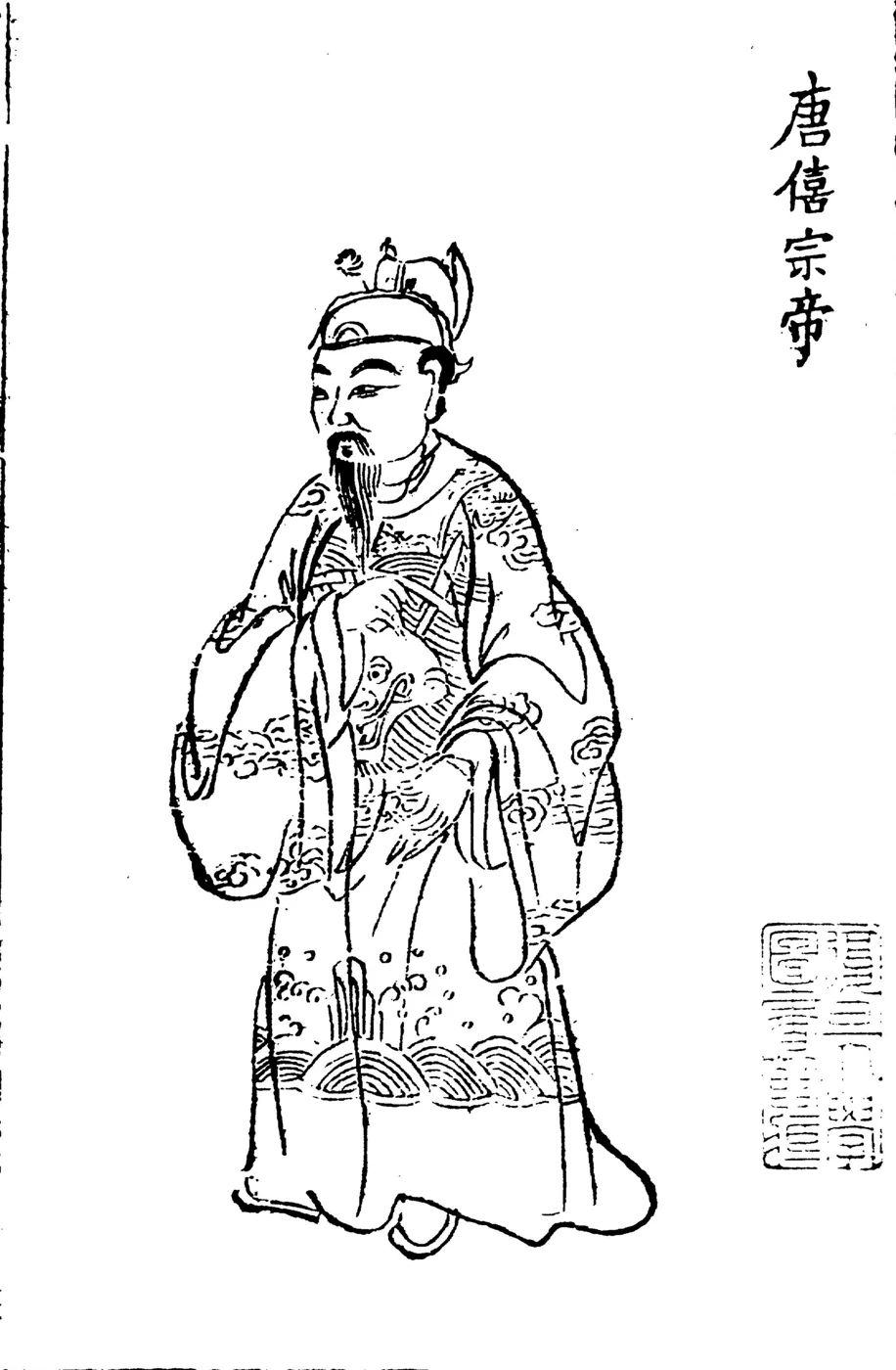
862 CE–888 CE
Emperor of the Tang dynasty
Li Xuan
李儇
A late-Tang emperor who fled west to Sichuan during Huang Chao's rebellion; during his reign the Tang dynasty's decline accelerated.
862 CE–888 CETang Dynasty
PROFILE
A late-Tang emperor who fled west to Sichuan during Huang Chao's rebellion; during his reign the Tang dynasty's decline accelerated.
- Other names
- Li Xuan
- Period
- Tang Dynasty
- Date of Birth
- June 8 862
- Date of Death
- April 20 888
- Dynasty / regime
- Tang
- Identity
- Emperor of the Tang dynasty
- Ethnicity / ethnic affiliation
- Not recorded in historical sources
- Native place
- Not recorded in historical sources
- Place of birth
- Not recorded in historical sources
- Place of death
- Not recorded in historical sources
- Reign
- 873–888
- Predecessor
- Emperor Yizong of Tang (Li Cui)
- Successor
- Emperor Zhaozong of Tang (Li Ye)
- Era names
- Qianfu, Guangming, Zhonghe, Guangqi, Wende
- Temple name
- Xizong
- Posthumous name
- Emperor Huisheng Gongding Xiao
- Highest office
- See Biography and Major Deeds
- Major achievements
- A late-Tang emperor who fled west to Sichuan during Huang Chao's rebellion; during his reign the Tang dynasty's decline accelerated.
LIFE TIMELINE
Age four | Enfeoffed as Prince of Pu
Age nine | Given the nominal post of Military Commissioner of Weibo
Age twelve | In the seventh lunar month, as Emperor Yizong fell gravely ill, eunuchs Liu Xingshen, Han Wenyue, and others made him crown prince and changed his name to Li Xuan; on the twentieth day he took the throne before the late emperor's coffin
Age thirteen | Wang Xianzhi raised an uprising at Changyuan in Puzhou, beginning the great late-Tang peasant wars
Age fourteen | Huang Chao rose at Yuanju and joined forces with Wang Xianzhi; Tian Lingzi became commandant of the Right Shence Army and increasingly monopolized power
Age seventeen | Wang Xianzhi was defeated and killed; his followers joined Huang Chao, greatly expanding the rebel forces
Age nineteen | Huang Chao's army captured Luoyang in the eleventh lunar month and Tong Pass in the twelfth, threatening Chang'an; Xizong fled with five hundred Shence troops via Xingyuan (Hanzhong) into Sichuan and remained in Chengdu for four years
Age twenty-one | Huang Chao's commander Zhu Wen surrendered at Tongzhou; Xizong bestowed on him the name Zhu Quanzhong
Age twenty-two | Li Keyong led Shatuo troops through the passes, joined the armies of other regional commands, crushed Huang Chao's main force, and recovered Chang'an
Age twenty-three | Huang Chao was defeated and died at Langhu Valley near Mount Tai; the rebellion ended
Age twenty-four | Returned to Chang'an in the third lunar month; conflict over the salt revenues between Tian Lingzi and Wang Chongrong led to war, and in the twelfth lunar month the emperor again fled, this time to Fengxiang
Age twenty-five | Zhu Mei enthroned Prince Xiang, Li Yun, as emperor and honored Xizong as "Supreme Primordial Sagely Emperor"; in the twelfth lunar month Wang Xingyu killed Zhu Mei, and Li Yun was killed by Wang Chongrong
Age twenty-six | Delayed at Fengxiang on the journey back to the capital; Li Changfu rebelled and was killed by Li Maozhen
Age twenty-seven | Returned to Chang'an in the second lunar month and adopted the era name Wende; died suddenly of illness in Wude Hall of the Chang'an palace on the sixth day of the third lunar month and was buried at Jingling Mausoleum
BIOGRAPHY
Biography
Family Background and Early Years
Li Xuan was born on the eighth day of the fifth lunar month in 862, the third year of the Xiantong era. He was the fifth son of Emperor Yizong of Tang, Li Cui; his mother, Lady Wang, was later posthumously honored as Empress Hui'an. By the time of his birth, the brief revival under Emperor Xuanzong during the Dazhong era had passed. Emperor Yizong's extravagance, devotion to Buddhism, and neglect of government contributed to growing corruption. Li Xuan grew up within the palace and was attended from childhood by the eunuch Tian Lingzi, with whom he formed an exceptionally close bond and whom he called "father."
As a youth Li Xuan showed little interest in government but great enthusiasm for amusements. He enjoyed cockfighting and gambling on geese, excelled at riding, archery, swords and spears, and was skilled in calculation, music, go, and gambling. He was especially passionate about polo and was highly accomplished at it. He once boasted to the entertainer Shi Yezhu that if there were an imperial examination in polo he would surely take first place. Shi replied that if a sage ruler like Yao or Shun served as examining Minister of the Ministry of Rites, the emperor might instead be censured and fail. Li Xuan only laughed. The anecdote presents a young emperor who was not unintelligent but devoted his abilities overwhelmingly to recreation.
Accession as a Child and Eunuch Domination
In the seventh lunar month of 873, the fourteenth year of the Xiantong era, Emperor Yizong became gravely ill. Eunuchs Liu Xingshen, Han Wenyue, and others made the Prince of Pu, Li Yan, crown prince and changed his name to Li Xuan. On the twentieth day, at age twelve, he took the throne before Yizong's coffin. Yizong's testament ordered his favored minister Wei Baoheng to act as regent, but Xizong soon dismissed Wei and appointed Xiao Fang chief councillor. Pei Tan, Liu Zhan, Cui Yanzhao, Zheng Tian, and Lu Xi later served in the chief councillorship, restoring a four-councillor arrangement.
Actual political power, however, rested less with the chief councillors than with Tian Lingzi. After Xizong's accession Tian was appointed commandant of the Left Shence Army and later transferred to the Right Shence Army, giving him command of the imperial troops. He came to appoint or dismiss officials and handle government without prior memorial and even confiscated the property of wealthy Chang'an households to fill the palace treasury. Court officials feared him. Major decisions of Xizong's reign were effectively controlled by the eunuch whom the emperor called "father."
Tang politics were already in severe disorder. During Yizong's reign the Hanlin scholar Liu Yunzhang had described "nine breakdowns of the state": troops gathered throughout the year, growing frontier threats, extravagant and overmighty elites, generals failing to attend court, excessive construction of Buddhist temples, public bribery, oppressive local officials, unequal taxes and corvée, and too many salaried officeholders relative to taxpayers. He also listed the people's "eight sufferings" and "five departures." Under Xizong these problems did not improve and instead intensified.
Huang Chao's Rebellion and Two Flights from the Capital
In 874, Wang Xianzhi of Puzhou gathered three thousand followers at Changyuan, rose in rebellion, captured Puzhou, and seized ten thousand adult men. The following year Huang Chao rose at Yuanju (northwest of present-day Cao County, Shandong) and joined him. Their combined forces rapidly expanded, campaigning through fifteen prefectures in Henan and growing to tens of thousands. The court sent Song Wei, Military Commissioner of Pinglu, to suppress them, but Song incorrectly reported Wang dead and dismissed troops, leaving defenses weak. The revolt resumed. In 878 Wang Xianzhi was killed by Tang forces near Jiangling, and his officer Shang Rang brought his followers to Huang Chao. The combined rebel army reportedly reached one hundred thousand.
Huang Chao marched south through eastern Zhejiang, opened a seven-hundred-li mountain route into Fujian, captured Guangzhou, and then turned north, taking Tanzhou and Jiangling before driving into the Central Plains. In the eleventh lunar month of 880 he captured Luoyang, and in the twelfth he took Tong Pass and threatened Chang'an. Xizong and his ministers had no effective response and wept together; chief councillor Lu Xi committed suicide in fear. Tian Lingzi hurriedly took five hundred Shence troops, Xizong, and a small number of imperial princes out of the capital, first to Shannan (Hanzhong) and then to Sichuan. Xizong thus became another Tang emperor, after Xuanzong, to seek refuge in Sichuan.
Xizong remained in Chengdu for four years. Drawing on Sichuan's wealth and contributions from the regional commands, his court organized the counteroffensive against Huang Chao. Wang Chucun, Military Commissioner of Yiwu, Wang Chongrong of Hezhong, and others actively fought the rebels, while Li Keyong, the Shatuo leader based at Taiyuan in Hedong, also entered the campaign. Zheng Tian, Military Commissioner of Fengxiang, was appointed overall commander of forces around the capital and received broad discretionary powers to organize the attack on Chang'an. Later chief councillor Wang Duo became overall commander of the regional armies. Food shortages and internal divisions weakened Huang Chao. In the ninth lunar month of 882, Zhu Wen, defense commissioner at Tongzhou, surrendered. Xizong was delighted and called it "a gift from Heaven," granting him the name Zhu Quanzhong. In 883 Li Keyong led Shatuo troops through the passes, joined the regional armies, and defeated Huang Chao's main force at Liangtianpo. Huang abandoned Chang'an in the fourth lunar month and withdrew east. The following year he was defeated in Shandong and died at Langhu Valley near Tai'an, ending the rebellion.
In the first lunar month of 885 Xizong left Sichuan and returned to Chang'an in the third. Before the court had recovered from years of flight, new conflict erupted. Tian Lingzi attempted to seize the salt revenues controlled by Wang Chongrong, Military Commissioner of Hezhong. Tian allied with Zhu Mei of Binning and Li Changfu of Fengxiang against Wang, who appealed to Li Keyong. Wang and Li defeated Zhu Mei and Li Changfu and advanced toward Chang'an. Tian Lingzi again took Xizong away from the capital in the twelfth lunar month of 885, this time to Fengxiang. Regional forces entered Chang'an, looting and burning the city; most palace buildings and wards were destroyed, leaving the capital desolate and overgrown.
The Usurpation of Prince Xiang and the Emperor's Final Wanderings
After Xizong fled to Fengxiang, regional commanders were deeply hostile to Tian Lingzi's domination. Zhu Mei tried to seize the emperor, but Tian escaped with Xizong through Dasan Pass to Xingyuan. Zhu then took Prince Xiang, Li Yun, who had been left behind because of illness, to Chang'an and enthroned him as a puppet emperor with the era name Jianzhen. Xizong was honored as "Supreme Primordial Sagely Emperor," effectively treating him as an emperor emeritus. This occurred in the tenth lunar month of 886.
Invoking his legitimacy, Xizong won over Wang Chongrong to attack Zhu Mei and secretly ordered Zhu Mei's trusted commander Wang Xingyu to turn against him. In the twelfth lunar month Wang Xingyu killed Zhu Mei and several hundred of his followers, then allowed his troops to plunder widely. The winter was exceptionally cold, and after the sack of Chang'an frozen corpses reportedly covered the ground. Li Yun fled to Hezhong, where Wang Chongrong pretended to receive him, then arrested and killed him and sent his head to Xizong's temporary court.
In the third lunar month of 887 Xizong's returning entourage reached Fengxiang, but Military Commissioner Li Changfu detained it on the pretext that the palaces in Chang'an had not yet been repaired. In the sixth lunar month the Tianwei Army clashed with Li Changfu. Li attacked Xizong's temporary residence, was defeated, and fled to Longzhou, where escort commander Li Maozhen pursued and killed him. These repeated crises destroyed Xizong's health. In the second lunar month of 888, while already ill, he finally returned to Chang'an once more, visited the imperial ancestral temple, proclaimed an amnesty, and changed the era name to Wende. He fell suddenly ill on the third day of the third lunar month and died on the sixth day in Wude Hall of the Chang'an palace, aged twenty-seven. He was buried at Jingling Mausoleum in the twelfth lunar month, at present-day Nanling Village, Tiefo Town, Qian County, Shaanxi.
Li Xuan was the fifth son of Emperor Yizong, his mother the Empress Hui'an, and was born in the eastern palace at Chang'an on the eighth day of the fifth month of 862, first enfeoffed as Prince of Pu under the name Li Yan. Raised in the inner palace and in the hands of eunuchs, he found in palace life nothing but license to amuse himself. He loved cockfighting and betting on geese, and was fond of archery, swordplay, mathematics, music, chess and gambling, skilled in nearly every diversion, and especially addicted to polo, at which he excelled. He once told the jester Shi Yezhu boastfully that if he entered the polo examination he would surely take first place, and Shi answered that with a Yao or a Shun as examiner His Majesty would probably be faulted and fail; hearing this, the emperor merely laughed.
In the seventh month of 873 Yizong fell gravely ill and on the eighteenth issued an edict making the Prince of Pu heir apparent — changing his name to Li Xuan — with authority to conduct military and state affairs; Yizong died that day and on the twentieth the prince took the throne before the coffin at the age of twelve. The left army commissioner Liu Xingshen and the right, Han Wenyue, ruled from the center on the strength of having made him emperor and were enfeoffed as dukes, deepening eunuch interference in government. Soon after his accession famine struck east of the passes and Wang Xianzhi and Huang Chao rose in turn; in 880 Huang Chao's army entered Chang'an, and the emperor fled to Sichuan escorted by the eunuch Tian Lingzi, returning in 885 after Huang Chao's death, to a capital already in ruins.
Thereafter the court was consumed by conflict among the provinces and between the provinces and the eunuchs; in the Guangqi years Tian Lingzi fell out with Wang Chongrong and Li Keyong, and the emperor fled again to Fengxiang and Xingyuan, wandering for several years. He returned to Chang'an in 888 and died soon after at twenty-seven, with the posthumous name Huisheng Gongding Xiao Huangdi and the temple name Xizong, buried at Jingling. The twelve years of his reign were the period in which the Tang court's authority collapsed most violently: the Huang Chao rebellion wrecked the fiscal and military systems, and the power of eunuchs and provinces swelled, leaving Emperors Zhaozong and Ai no means of recovery.
Under Xizong the fiscal and military systems of the Tang were fundamentally damaged. Huang Chao's army marched north from Lingnan, taking Tanzhou, Jiangling and Xiangyang, then crossed the river to storm Luoyang and Chang'an, and for a time the court's rule in the eastern provinces dissolved; to suppress the rebellion the court granted military governors extensive local powers, and the number and strength of the provinces grew sharply. Over the following twenty years these provinces became the force that decided the court's fate, and the unity of the Tang was never restored.
Xizong's own position reflects the change. His two flights were both directed by the eunuch Tian Lingzi, the first to Chengdu and the second to Fengxiang and Xingyuan, his movements and the court's entirely determined by the contest between eunuchs and provinces. Tian Lingzi afterward lost power and fled, Wang Jian and others seized Xichuan, and when the emperor returned to Chang'an what he held was a ruined capital. After his death Zhaozong tried to restore the government but was successively constrained by Li Maozhen and Zhu Wen, and at last moved the capital to Luoyang under Zhu Wen's pressure; the upheavals of Xizong's reign are the direct prelude to the end of the Tang.
Accounts of Xizong come chiefly from the annals in the old and new histories of the Tang and the relevant chapters of the Comprehensive Mirror. Both histories describe his amusements and his wanderings in some detail, setting polo, betting on geese and cockfighting beside the decay of government — the typical image of a late Tang sovereign. In explaining the fall of the Tang, historians usually point to the three great problems of provinces, eunuchs and finance after the An Lushan rebellion, and Xizong's reign is precisely the period in which all three broke out together and became entangled: the Huang Chao rebellion was a product of fiscal and social crisis and in turn swelled the power of both provinces and eunuchs.
After Xizong's death his brother Li Ye came to the throne as Zhaozong. He strove to act, appointing Zhang Jun and Cui Yin to reduce the provinces and trying to put troops under members of the clan, but failed repeatedly before such strong governors as Zhu Wen and Li Maozhen; in 904 Zhu Wen forced him to move the capital to Luoyang and killed him that year, and three years later Emperor Ai abdicated to Zhu Wen and the Tang ended. The twelve years of Xizong's reign are therefore usually seen as the crucial stage of the dynasty's end.
The military and political situation of Xizong's reign can be seen in three aspects. First, the peak of eunuch power: Tian Lingzi controlled the guards as commissioner of the ten Shence armies, carried the emperor off in flight and appointed and dismissed governors at will, wielding more authority than any eunuch before him. Second, the reshaping of the provincial map: to suppress Huang Chao the court accepted many local forces that had risen through military merit, Li Keyong, Zhu Wen and Wang Jian all forming their power in this period, rewriting the political map of the late Tang. Third, the collapse of finance: with Chang'an twice lost and the Huai transport cut, revenue from salt and the two taxes fell sharply, and the court came to depend more on provincial offerings and borrowing.
The distance between Xizong's own character and these upheavals is a subject historians return to. Records of him playing polo and jesting with a jester about the time of Huang Chao's entry into Chang'an stand beside his exile in Sichuan and his wanderings in Fengxiang, making the typical image of a late Tang ruler. In political terms the significance of his reign lies not in what he did but in where he stood: all three of the dynasty's long-standing ills broke out together in this period, and afterward no one on the throne could reverse the loss of central authority.
His tomb, Jingling, lies in the area of present-day Qianxian in Shaanxi and is modest in scale, matching the decline of Tang power in his time. He left no son, and his successor was his brother Li Ye, Emperor Zhaozong.
His last era name was Wende; his successor Zhaozong changed it to Longji the next year.
Xizong left no son; his brother Li Ye succeeded as Emperor Zhaozong, and the Tang throne thereafter passed only within Zhaozong's line.
He changed era names several times, their succession tracking the course of the fighting, one of the more confused stretches of late Tang chronology.
During his reign the court's hold on the provinces rested chiefly on military governors and observers, whose appointment and dismissal usually depended on the contest between eunuchs and provincial powers at court.
Major Activities
Deciding Three Commands by Polo
Before Xizong's flight from Chang'an, he needed to appoint military commissioners in Jiannan and Shannan to secure a route of retreat. He reportedly chose among candidates by having Tian Lingzi's elder brother Chen Jingxuan, Yang Shili, Niu Xu, and Luo Yuangao play polo for the offices. Chen Jingxuan won and was appointed Military Commissioner of Western Sichuan. The episode illustrates the emperor's tendency to treat major affairs of state as recreation.
Suppression of Huang Chao's Rebellion
Although Xizong himself lacked governing ability, the Tang political order had not yet completely collapsed. While Huang Chao occupied Chang'an, Xizong used Sichuan as his temporary court and invoked dynastic legitimacy to call on regional commands to aid the throne. Zheng Tian defeated rebel forces at Fengxiang and recovered part of Guanzhong; Zhu Wen, Li Xiang, and others returned to Tang allegiance; Li Keyong led Shatuo forces into the passes and crushed Huang Chao's main army at Liangtianpo; Wang Chongrong and Wang Chucun also fought actively. Huang Chao was ultimately defeated and died in 884. Yet during the same struggle, regional military governors expanded and fought one another, while direct court control contracted to only several dozen prefectures in Hexi, Shannan, Jiannan, and the western Lingnan circuit. The foundations of Tang rule were fundamentally shaken.
The Formation of Regional Military Fragmentation
After Huang Chao's rebellion, the empire was divided among military strongmen: Li Changfu held Fengxiang; Wang Chongrong held Pu and Shan; Zhuge Shuang held Heyang and Luoyang; Meng Fangli held Xing and Ming; Li Keyong held Taiyuan and Shangdang; Zhu Quanzhong held Bian and Hua; Qin Zongquan held Xu and Cai; Shi Pu held Xu and Si; Zhu Xuan held Yun, Qi, Cao, and Pu; Wang Jingwu held Zi and Qing; Gao Pian held the eight prefectures of Huainan; Qin Yan held Xuan and She; and Qian Liu held eastern Zhejiang. Each controlled troops and revenues independently and fought to absorb neighboring territories, while the court could no longer restrain them. Direct Tang authority survived over only several dozen prefectures in Hexi, Shannan, Jiannan, and the western Lingnan circuit.
The Prince Xiang Li Yun Incident
In 886, Zhu Mei revolted against Tian Lingzi's domination and enthroned Prince Xiang, Li Yun, as emperor, while Xizong was honored as emperor emeritus. Xizong rallied regional commanders in the name of legitimacy, joined Wang Chongrong and Li Keyong against Zhu, and secretly induced Wang Xingyu to kill Zhu Mei. Li Yun was also killed by Wang Chongrong. The episode marked a further collapse of central authority: regional military governors could openly enthrone and depose emperors, while Xizong, though able to invoke legitimacy, depended on the armed power of rival regional commands.
Personal Relations
- Grandfather: Emperor Xuanzong of Tang, Li Chen
- Grandmother: Empress Yuanzhao, Lady Chao
- Father: Emperor Yizong of Tang, Li Cui
- Birth mother: Empress Hui'an, Lady Wang
- Sons: Li Zhen, Prince of Jian; Li Sheng, Prince of Yi
- Daughters: Princess Tangxing; Princess Yongping
- Tian Lingzi: eunuch who cared for Xizong from childhood, was called "father" by the emperor, and effectively controlled the government
- Shi Yezhu: entertainer who once remonstrated with the emperor through a witty reply
- Liu Xingshen and Han Wenyue: eunuchs who helped place Xizong on the throne
- Xiao Fang, Pei Tan, Liu Zhan, Cui Yanzhao, Zheng Tian, Lu Xi: chief councillors under Xizong
- Chen Jingxuan: elder brother of Tian Lingzi, appointed Military Commissioner of Western Sichuan after winning the polo match
- Huang Chao: leader of the late-Tang rebellion who occupied Chang'an and established the Great Qi regime
- Zhu Mei: Military Commissioner of Binning who enthroned Prince Xiang, Li Yun, and was later killed by Wang Xingyu
- Wang Xingyu: Zhu Mei's trusted commander, secretly induced by Xizong to defect and kill Zhu Mei
- Li Changfu: Military Commissioner of Fengxiang, initially allied with Tian Lingzi against Wang Chongrong and later rebelled before being killed by Li Maozhen
Historical Assessment
Tang / Contemporary
- The Old Book of Tang characterized Xizong as a child ruler whose government fell into eunuch hands, while emphasizing both the devastation of the rebellion and the loyal regional and court officials who eventually destroyed the rebels. It concluded that Tian Lingzi's disastrous policies nearly destroyed the dynasty and that the Tang inheritance could no longer be recovered.
- The Old Book of Tang also summarized his reign by saying that the dynastic cycle was nearing exhaustion, the ruler was young, great rebels raised dust, and warlords surged like waves; although he eventually returned to the capital, this depended on the work of the imperial armies.
- The New Book of Tang observed that since Muzong, seven of eight Tang emperors had been installed by eunuchs, arguing that Tang decline was therefore not only a problem of regional military governors. It described Yizong and Xizong as successive mediocre rulers at the beginning of the dynasty's final decline.
- The Supplementary Biographical Records described Xizong as having been "young and capable in many things" when he ascended from the title Prince of Pu.
- Emperor Yizong described Li Xuan as filial, respectful, mild, generous, steadily improving in virtue, naturally gifted, and compliant with ritual, and presented him as suited to stabilize the dynastic foundation.
Song–Yuan Period
Sima Guang's Zizhi Tongjian, in its account of eunuch domination and military fragmentation in the late Tang, treats Xizong's reign as a key stage in the dynasty's collapse. Song writers commonly saw the accession of a child ruler under eunuch control as an important turning point. Ouyang Xiu and Song Qi, compilers of the New Book of Tang, criticized Yizong and Xizong as successive mediocre rulers and connected the drought, locusts, and mass uprisings of the Qianfu era to a broader failure of rulership.
Ming–Qing Period
Wang Fuzhi's Commentaries on the Comprehensive Mirror argued that the Tang did not truly perish because of Huang Chao alone but because of conflict between regional armies and eunuchs. Under Xizong, Tian Lingzi dominated the court and the military governors acted with increasing independence. Even after Huang Chao was defeated, central prestige had largely disappeared.
Modern Period
Lü Simian's History of the Sui, Tang and Five Dynasties notes that Tang central authority declined dramatically under Xizong. During the campaign against Huang Chao, regional commands expanded and fought annexation wars, while the court retained direct control over only several dozen prefectures in regions such as Hexi, Shannan, and Jiannan. Cen Zhongmian's History of the Sui and Tang Dynasties similarly argues that Xizong ascended as a child, delegated government to eunuchs, and, although not personally tyrannical, devoted himself to amusements rather than government, becoming an important factor in the late-Tang political collapse.
FIGURES ASSOCIATED WITH THIS DYNASTY
Bibliography
- Old Book of Tang, Basic Annals 19B, Xizong
- New Book of Tang, vol. 9, Basic Annals 9
- Lü Simian, History of the Sui, Tang and Five Dynasties
- Cen Zhongmian, History of the Sui and Tang Dynasties