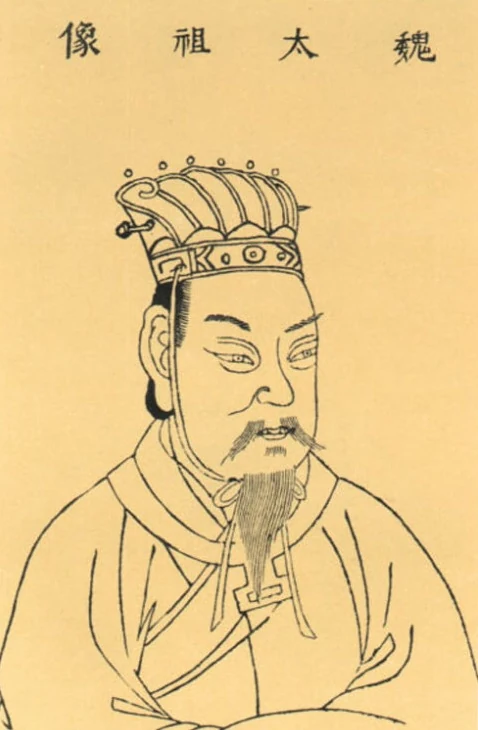
Biography
Family Background and Early Official Career Cao Cao was born in Qiao County, Pei Commandery. His grandfather Cao Teng was an Eastern Han eunuch who served several emperors and was enfeoffed as Marquis of Feiting. His father Cao Song, Cao Teng's adopted son, rose to the office of Defender-in-chief. Ancient records differ on the more remote origins of the Cao lineage, and the available materials do not support treating any disputed family origin as settled fact. Cao Cao entered office after being recommended as Filial and Incorrupt. He first served as a Gentleman and then as Northern Commandant of Luoyang. Luoyang was filled with powerful families; after taking office, Cao restated the prohibitions and punished people who violated the night curfew. This brought attention to his strict enforcement of the law and also strained his relations with powerful figures. In 177(6th year of Xiping), Cao became Magistrate of Dunqiu. The following year he was dismissed because his relative Song Qi was convicted. In 180(3rd year of Guanghe), the court recalled him as a Consultant. Cao memorialized the throne over the executions of Dou Wu and Chen Fan, arguing that they had been wrongfully killed. Surviving sources also record that he criticized favoritism in the recommendation system and in official appointments. He later withdrew from office for a period and did not again receive a military post until around the outbreak of the Yellow Turban movement. ### Suppression of the Yellow Turbans and Establishment of a Base in Yan Province In 184(1st year of Zhongping), Cao Cao served as Commandant of Cavalry and took part in operations by Huangfu Song, Zhu Jun, and other generals against Yellow Turban forces in Yingchuan. For his military service he later became Chancellor of Jinan. Some officials in the Jinan kingdom relied on powerful patrons or were corrupt and negligent; Cao memorialized to remove a number of them and reorganized local cultic and administrative affairs. The court later summoned him to become Governor of Dong Commandery, but Cao did not take up the post and returned home. In 188(5th year of Zhongping), Cao was appointed Colonel of the Army in the Western Garden forces. The following year, after Dong Zhuo entered the capital and took control of court politics, Cao left Luoyang. Late that year he recruited troops at Chenliu and responded to the movement to campaign against Dong Zhuo. In 190(1st year of Chuping), the commanderies and provinces east of the passes formed the Guandong Coalition. Cao led his army westward but was defeated near Xingyang by Dong Zhuo's general Xu Rong and escaped after being wounded. The coalition thereafter acted separately and failed to sustain effective military coordination. Cao turned instead to expanding his own forces and seeking a new territorial base. In 192(3rd year of Chuping), Qingzhou Yellow Turban forces entered Yan Province and killed the provincial inspector Liu Dai. With support from local scholars and commanders, Cao became Governor of Yan Province. After fighting the Yellow Turbans, he accepted a large number of their surrendered followers and selected the strongest among them to form the Qingzhou Army. This force expanded his military strength and later became an important source of manpower for prolonged campaigns. In 193(4th year of Chuping)–194(1st year of Xingping), Cao attacked Xu Province after his father Cao Song was killed there. The sources differ on the scale of the killings, but all indicate severe civilian casualties; no single numerical account should be treated as undisputed. In 194(1st year of Xingping), Zhang Miao, Chen Gong, and others invited Lü Bu into Yan Province, and Cao's control there temporarily contracted. The two sides fought continuously, and Cao eventually recovered most of his bases. His conflict with Lü Bu then extended into Xu Province, while he also fought forces associated with Yuan Shu and Liu Bei. The struggle for Yan Province placed continuing pressure on Cao's management of his base, military organization, and food supply. ### Reception of the Imperial Court and Government Operations After Emperor Xian returned east, the court for a time lacked stable military protection. Cao Cao brought the emperor to Xu County, allowing edicts, official appointments, and central offices to continue operating in the name of the Han dynasty while military and political decisions were controlled by Cao and his subordinates. This gave Cao a political basis for external campaigns but also separated the emperor's nominal authority from actual decision-making power. In dealing with court officials, regional forces, and the imperial house, Cao generally incorporated Han court institutions into his military regime rather than establishing a separate imperial title. Military agricultural colonies and the system for supplying military provisions were a material foundation of the Xu regime's continued warfare. After adopting proposals by Zao Zhi, Han Hao, and others, Cao first organized military agricultural colonies around Xu and later extended related measures into newly controlled areas. The reorganization of displaced refugees, soldiers, and land improved grain supply but also involved direct state management of land and labor services. The sources also record that Cao adjusted taxation and collection methods in some regions. Specific tax rates were decrees for particular times and places and should not be generalized as a uniform long-term standard throughout all his territories. Cao repeatedly issued calls for talent, arguing that moral reputation should not be the sole criterion of appointment and asking for people of practical ability to be recommended. This policy reflected the prolonged wartime need for commanders, advisers, and administrators. His regime nevertheless continued to use Han bureaucratic titles and depended on local elite families and existing administrative personnel. “Promoting talent regardless of conventional reputation” should therefore be understood as a tendency in recruitment policy rather than as the elimination of family status and political connections. ### Reception of Emperor Xian and Competition for Northern China In 196(1st year of Jian'an), Emperor Xian left Chang'an and returned east. Following the advice of Xun Yu and others, Cao Cao brought the emperor to Xu County, later known as Xudu, and used the court's name to issue edicts, appoint officials, and mobilize armies. Receiving the emperor gave Cao the nominal authority and administrative resources of the central court while also making him the court strongman who actually controlled government affairs. In the same year, Cao established military agricultural colonies around Xu, organizing soldiers and civilians to cultivate land and collect grain to relieve shortages of military provisions caused by prolonged warfare. The scale and methods of these colonies varied by region and cannot be reduced to the claim that they restored the entire northern economy in a single measure. In 197(2nd year of Jian'an), Zhang Xiu first surrendered to Cao and then rebelled at Wancheng. Cao's army was surprised, and his eldest son Cao Ang, nephew Cao Anmin, and general Dian Wei were killed. In 198(3rd year of Jian'an), Cao besieged Lü Bu at Xiapi, used flooding in the siege, and ultimately captured and killed him. In 199(4th year of Jian'an), Yuan Shu was destroyed, and Cao's power continued to expand between the Huai and Yellow rivers. In 200(5th year of Jian'an), Cao Cao and Yuan Shao confronted one another at Guandu. Yuan had the larger force, while Cao held his position with shorter supply lines. Yuan's forces attacked Baima, Yanjin, and other locations. Cao won some local engagements but remained under sustained pressure from shortages. After Xu You left Yuan Shao and informed Cao that Yuan's grain stores were at Wuchao, Cao personally led picked troops in a night raid and burned the depot. The loss of supplies contributed to disorder in Yuan's army; Zhang He, Gao Lan, and others then defected to Cao, whose forces counterattacked and won the Battle of Guandu. Afterward, while dealing with former followers of Yuan Shao, Cao collected and burned private letters in which some of his own subordinates had communicated with Yuan, a measure intended to stabilize morale. This did not eliminate the complicated process of postwar purges and political integration in Hebei. After Yuan Shao died in 202(7th year of Jian'an), Cao exploited divisions among Yuan's sons and continued his advance northward. In 204(9th year of Jian'an), Cao's army captured Ye. It then dealt in succession with Yuan Tan, Yuan Shang, and other Yuan forces. In 207(12th year of Jian'an), Cao campaigned against the Wuhuan and defeated Tadun at White Wolf Mountain, after which the remaining Yuan forces lost their main northern support. These campaigns gave Cao control of the middle and lower Yellow River regions and most of northern China, although Liaodong, the Huai–Yangtze region, Jing Province, and other areas remained under other polities or forces. ### Southern Campaign, Defeat at Red Cliffs, and the Period as Prince of Wei In 208(13th year of Jian'an), Cao Cao became Grand Councilor. Liu Biao died in the same year, and Liu Cong, governor of Jing Province, surrendered to Cao. Cao's army continued south and pursued Liu Bei at Changban. After Liu Bei allied with Sun Quan, their combined forces defeated Cao's army around Red Cliffs. The sources associate Cao's defeat with river warfare, fire attacks, and disease in the army, and the relative effect of these factors should not be reduced to a single cause. After Red Cliffs, Cao withdrew north and failed to control the lands south of the Yangtze. Sun Quan and Liu Bei respectively consolidated power in Jiangdong and in Jing and Yi provinces. Cao thereafter shifted his military focus toward Guanzhong, Hanzhong, and the Huainan region. In 211(16th year of Jian'an), Ma Chao, Han Sui, and other Guanzhong powers united against him. The sides fought around Tong Pass and the Wei River, and Cao used division and maneuver to defeat the coalition and strengthen his control over Guanzhong. In 213(18th year of Jian'an), he was enfeoffed as Duke of Wei; in 216(21st year of Jian'an) he advanced to Prince of Wei, and the institutions and officials of the Wei fief expanded further. These titles did not alter the nominal fact that Emperor Xian remained on the throne, but they marked Cao's continued rise in political status. In 215(20th year of Jian'an), Cao captured Hanzhong. In 219(24th year of Jian'an) Liu Bei defeated Cao's forces there and occupied the region. In the same year Guan Yu besieged Xiangyang and Fancheng. Cao mobilized reinforcements and coordinated with Sun Quan's side, and Guan Yu was ultimately captured and killed. The campaigns in Hanzhong and Jing Province showed that although Cao controlled the strongest northern regions, he had not eliminated the independent military power of Sun Quan and Liu Bei. In 220(25th year of Jian'an), Cao died in Luoyang. He held the title Prince of Wei at his death and had not formally proclaimed himself emperor. Cao Pi inherited his title and then replaced Han, proclaimed himself emperor, and established Cao Wei. He posthumously honored Cao Cao as Emperor Wu and gave him the temple name Taizu. Cao Cao's posthumous title at death, his lifetime titles, and later imperial honors must be distinguished; “Emperor Wu of Cao Wei” should not be treated as his identity during life or as the posthumous title he held at the moment of death.
The Divergent Accounts of the Cao Lineage and His Early Years
Several accounts of the Cao lineage were handed down. Pei Songzhi, quoting Jiang Ji's discussion of the suburban sacrifices in the Three Kingdoms, notes that "the stele of Cao Teng says that 'the Cao clan came from Zhu', and the History of Wei describes the descent of the Cao in the same way", while "the Martial Emperor in his family record says that he was a descendant of Cao Shu Zhenduo", and so Cao Zhi in his elegy on the Martial Emperor says that "awe-inspiring is the Martial Emperor, of the line of Ji and of Zhou", "which is a different account"; and by the Jingchu years "Emperor Ming followed Gao Tanglong's proposal and held that Wei was descended from Shun", after which "in the letter of Wei's abdication to Jin it is said that 'our imperial ancestor was of Yu', which makes the divergence greater still". Jiang Ji and the minister Miao Xi argued back and forth "with reasons on both sides, the writing being too long to record", "and Jiang Ji too could not settle whence the clan came, but said only that 'Wei is not descended from Shun, and to sacrifice to a non-kin is to degrade the founder and fail to associate him with the true Heaven, all of which is absurd'", "yet at the time none could correct it". Jiang Ji also disputed Zheng Xuan's commentary on the Book of Rites, arguing that "the dragon is divine beyond the otter, yet the otter sacrifices to its own ancestors and not to the dragon; the unicorn and the white tiger are benevolent beyond the jackal, yet the jackal sacrifices to its own ancestors and not to the unicorn", and Pei Songzhi remarks that "Jiang Ji's figure of jackal and otter, though like a jest, has a meaning worth seeking". It appears, then, that the descent of Cao Cao's house was already claimed for Zhu, for Cao Shu Zhenduo and for Shun.
Cao Cao and Yuan Shao were friends in youth, "Yuan Shao being of handsome person and dignified bearing, able to lower himself to scholars, so that many attached themselves to him, and the founder was his companion from youth". By the Records of Heroes, Yuan Shao "lost his father at birth and was loved by the two dukes; made a gentleman in childhood, at his coming of age he became magistrate of Puyang with a clean name; on his mother's death, when the mourning was done he mourned again for his father, being six years in the hut; and the rites over, he retired to Luoyang, not receiving guests at random, and seeing none who were not known through the world; and loving gallantry, he made boon companions of Zhang Mengzhuo, He Boqiu, Wu Ziqing, Xu Ziyuan and Wu Deyu, refusing all summons to office". The eunuch Zhao Zhong said to the yellow gates that "Yuan Benchu sets a price on himself, refusing summons and keeping braves — what does the boy intend?", and Yuan Shao's uncle Kui, hearing of it, reproached him, saying that "you will ruin our house", and so Yuan Shao rose and answered the great general's summons. Pei Songzhi notes that "the History of Wei says that Yuan Shao was the son of Feng by a concubine and was given to his uncle Cheng as heir", while "the Records of Heroes says that he was born of Cheng", and doubts that "for a man to mourn for his own father there is no rule; how much less for a man to do so for the father who adopted him", concluding that "the two books do not make clear which is right".
His Early Remonstrances, His Reform of Abuses and His Refusal of a Deposition
Cao Cao's "cousin by marriage, Song Qi, marquis of Yinjiang, was executed, and Cao Cao was dismissed from office for complicity; afterwards, being able to expound the ancient learning, he was summoned again and made a gentleman of the interior". At that time "the great general Dou Wu and the grand tutor Chen Fan plotted to destroy the eunuchs and were themselves destroyed", and "the founder memorialised that Dou Wu and the others were upright and were destroyed by slander, that the wicked filled the court and the good were blocked, his words being very urgent; but Emperor Ling could not use them". Afterwards "an edict ordered the three excellencies to report officials whose administration of provinces and commanderies was without effect and against whom the people made songs, that they be dismissed; but the three excellencies were perverse, all hoping for place, and bribery was general, so that the strong were resented and not reported and the weak who kept the way were mostly destroyed. The founder hated it, and in that year, when the court asked broadly about the gains and losses in view of calamities, he memorialised again urgently, saying that the three excellencies' reports were made only to avoid the imperial kin; and the memorial being presented, the emperor was moved and showed it to the three excellencies and reproved them, and all who had been summoned because of the songs were made gentlemen of the interior", though "afterwards the government grew daily more disorderly and the violent more insolent, and there was much destruction; and the founder, knowing it could not be corrected, ceased to offer words". The Later Han History further records the abuses of the examination in the fifth year of Guanghe: "an edict ordered the ministers to report by means of popular songs the governors and two-thousand-picul officials who were a plague to the people; and the grand commandant Xu Yu and the minister of works Zhang Ji, looking to the eunuchs and taking bribes, dared not question even the sons and clients of the eunuchs though they were corrupt, but falsely named twenty-six men of distant and small commanderies who were pure and had been kind in government; and the clerks and people complained at the palace gate, and Chen Dan with the gentleman of the interior Cao Cao memorialised that 'the ministers' reports are all for their own party — it is what is called letting the owl loose and caging the phoenix', words so loyal and urgent that the emperor reproved Xu Yu and Zhang Ji, and all who had been summoned by the songs were made gentlemen of the interior; and the eunuchs, resenting it, destroyed Chen Dan by false accusation in prison."
Of his government at Jinan the record shows the violence of his reforms: "the senior clerks took bribes and were greedy, leaning on power, and through successive chancellors none had been reported; but hearing that the founder was coming, all reported and were dismissed, and great and small were terrified, and the wicked fled into other commanderies, so that government and teaching were carried out and the whole commandery was at peace. At first, because Liu Zhang, the king of Jing of Chengyang, had done good service to the Han, temples were raised for him in his kingdom, and the commanderies of Qingzhou followed one another in imitation, Jinan most of all, until there were more than six hundred temples; and merchants would borrow the carriages, robes and processions of two-thousand-picul officials to make music, and luxury increased daily while the people were poor, and through the ages no senior clerk dared forbid it. When the founder came he had all the temples destroyed, and forbade officials and people to sacrifice; and when he came to hold the government he abolished the wicked and the spirits, so that the excessive sacrifices of the world came to an end." His refusal of Wang Fen's deposition shows his judgement of the times; the History of Wei gives his words that "the deposing and setting up of a ruler is the greatest ill fortune in the world. Of old there were those who weighed success and failure and measured light and heavy before acting — Yi Yin and Huo Guang. Yi Yin, holding the utmost loyalty and relying on the power of a chief minister, stood above the offices, so that his advance and retirement, his deposing and setting up, were accomplished as planned. And when Huo Guang received the charge of the state, relying on the place of a kinsman of the clan, within he had the weight of the empress dowager's government and without the will of the ministers to the same end, while the prince of Changyi had but lately come to the throne with no old favourites, the court lacking honest ministers and the decisions coming from intimates, so that his plan went like a wheel turning and his work was done like rotten wood broken. Now you see only the ease of former days and not the difficulty of the present. Let each of you measure himself: is your gathering of partisans like the seven kingdoms? Is the honour of Hefei like that of Wu and Chu? And to undertake so extraordinary a thing and hope for certain success — is it not dangerous?"
His Judgement on He Jin, His Flight and His First Rising
His judgement on He Jin's summoning of the outer generals is in the History of Wei: "the founder, hearing of it, laughed and said that 'the office of the eunuchs has existed in every age; only the ruler of the time should not give them power and favour until it comes to this. Having punished their crime, one should put the chief criminals to death, and one jailer would be enough — why summon the outer generals in such confusion? To wish to destroy them all, the matter must be disclosed, and I foresee the failure.'" Chen Lin too remonstrated: "Chen Lin had been He Jin's registrar; He Jin wished to destroy the eunuchs and the empress dowager would not hear, and so he summoned the fierce generals of every quarter and had them lead troops toward the capital to overawe her, and Chen Lin remonstrated that 'the Changes speaks of hunting the deer without the forester, and the proverb of catching sparrows with the eyes covered. Even small things cannot be taken by deceit, how much less the great affairs of state, which cannot be founded on treachery. Now the general holds the imperial awe and grasps the military power, marching like a dragon and stepping like a tiger, high and low in his own mind; to act thus is no different from blowing up a great furnace to burn a hair. You should rather send down thunder at once, act with authority and decide without delay, departing from the rule while conforming to the way, and Heaven and men will follow you; but instead you let go your sharp weapon and seek it from others. When great armies gather, the strong become the masters — this is what is called holding the spear upside down and giving the handle to another; the work will not succeed but will only be a ladder of disorder.' He Jin would not take his words and came to ruin at last."
When Dong Zhuo entered the capital "he memorialised making the founder colonel of a swift cavalry, wishing to consult with him; and the founder changed his name and went east by byways." The History of Wei says that "the founder, holding that Dong Zhuo must in the end be overthrown, would not accept the office but fled home to his village, and passing with a few riders by the house of his old friend Lü Boshe at Chenggao, and Lü Boshe being away, his sons and their retainers robbed the founder and took his horse and goods, and the founder cut down several of them with his own hand"; the Records of the Age say that "the founder passed by Boshe's house, Boshe being out, and his five sons were all there and prepared the rites of host and guest; but the founder, having disobeyed Dong Zhuo's order, suspected them of plotting against him and killed eight of them by night with his own sword and went on"; and Sun Sheng's miscellaneous record says that "the founder, hearing the sound of their vessels, thought they plotted against him, and killed them by night; and afterwards, in grief, said that 'rather I wrong others than others wrong me'". Afterwards "going out of the pass he passed Zhongmu, where the keeper of the post suspected him and had him taken to the county; and someone in the town secretly knew him and spoke for him, and he was released", the Records of the Age adding that "Zhongmu suspected him of being a fugitive and held him in the county, and the clerk too had received Dong Zhuo's letter; only the merit clerk knew in his heart that it was the founder, and holding that in a disordered age one should not detain a hero of the world, told the magistrate and had him released". Dong Zhuo then "killed the empress dowager and the prince of Hongnong", and "the founder, reaching Chenliu, scattered his family wealth and gathered troops of righteousness to destroy Dong Zhuo; in the twelfth month of winter he first rose at Jiwu", the Records of the Age saying that "Wei Zi, a filial and incorrupt of Chenliu, aided the founder with his family wealth and had him raise troops, five thousand in all", "and this was the sixth year of Zhongping".
The Defeat at Xingyang, the Argument at Suanzao and His Refusal to Set Up Liu Yu
In the first year of Chuping "Dong Zhuo, hearing of the rising, moved the Son of Heaven to Chang'an, remaining himself at Luoyang and burning the palaces. At that time Yuan Shao camped at Henei, Zhang Miao, Liu Dai, Qiao Mao and Yuan Yi at Suanzao, Yuan Shu at Nanyang, Kong Zhou at Yingchuan and Han Fu at Ye; and Dong Zhuo's troops being strong, Yuan Shao and the rest dared not advance." Cao Cao then said that "to raise troops of righteousness to destroy violence, the great host being gathered, why do you hesitate? Had Dong Zhuo heard of the rising east of the mountains and relied on the weight of the royal house and the strength of the two Zhous, facing east upon the world, even with an unrighteous course he would still be a trouble. Now he burns the palaces, seizes and moves the Son of Heaven, and within the seas all are shaken and know not where to turn — this is the hour of Heaven's destruction of him. One battle and the world is settled, and it must not be lost." So he led his troops west, "intending to hold Chenggao; and Zhang Miao sent the officer Wei Zi with a part of his troops to follow the founder. Reaching the Bian river at Xingyang they met Dong Zhuo's general Xu Rong, fought at a disadvantage and lost many men; the founder was hit by a stray arrow and his horse was wounded, and his cousin Cao Hong gave him his own horse, so that he escaped by night. Xu Rong, seeing how few the founder had and how they fought all day, judged that Suanzao was not easy to take and also withdrew his troops." At that time "the armies numbered more than a hundred thousand, and they feasted every day with wine and music, thinking nothing of advance", and Cao Cao "after returning to Suanzao reproached them and proposed to the coalition that 'the governor of Bohai should lead the host of Henei to face Mengjin, the generals at Suanzao take Chenggao, hold Aocang and block Xuanyuan and Taigu, occupying all the key ground; that General Yuan with the great army of Nanyang advance into Dan and Xi and break into Wu pass, shaking the three metropolitan commanderies; and that we then dig deep ditches and raise high ramparts, not fighting Dong Zhuo, but setting out false troops to show the world our strength and draw the world to join us in punishing the rebels; and so the world might be settled at once. Now we raise troops for a great cause and yet hesitate and will not advance, disappointing the world — I am ashamed for you.' But the generals east of the passes would not follow."
When Yuan Shao and Han Fu plotted to set up Liu Yu, "the founder refused", the History of Wei giving his answer that "the crime of Dong Zhuo is manifest through the four seas, and our gathering the great host and raising troops of righteousness has been answered far and near because we act from righteousness. Now the young sovereign is weak and controlled by treacherous ministers, but there is no fault such as the ruin of Changyi, and if the succession be changed at once, who in the world will be at peace? Do you face north; I shall face west." Afterwards "Yuan Shao once got a jade seal and raised it toward his elbow as the founder sat", at which "the founder laughed and hated him", the History of Wei adding that "the founder laughed aloud and said that 'I shall not listen to you'; and Yuan Shao sent men again to say that 'now the duke of Yuan's power is great and his troops strong, and his two sons are grown — who among the world's heroes surpasses him?', and the founder gave no answer; and from this he thought the less of Yuan Shao and purposed to destroy him". In the spring of the second year "Yuan Shao and Han Fu set up Liu Yu as emperor, and Liu Yu would not venture to accept".
The Relief of Dongwuyang, the Taking of Yanzhou and the Qingzhou Troops
In the third year of Chuping "the founder camped at Dunqiu when Yu Du and the others attacked Dongwuyang, and he led his troops west into the hills against Yu Du's own camp", the History of Wei recording that "the generals all thought he should return to save himself, but the founder said that 'Sun Bin saved Zhao by attacking Wei, and Geng Yan wished to go to Xi'an and attacked Linzi. If the rebels hear that I go west and turn back, Wuyang will be relieved of itself; if they do not turn, I can destroy their own camp, and they will certainly not take Wuyang.' And so he went. Yu Du, hearing of it, abandoned Wuyang and returned, and the founder struck Sui Gu in passing and attacked the Xiongnu Yufu Luo at Neihuang, breaking them utterly", Pei Songzhi noting that "Yufu Luo was the son of the Southern Shanyu; in the Zhongping years, when Xiongnu troops were called out, Yufu Luo led them to aid the Han, but his own state rebelled and killed the Southern Shanyu, and Yufu Luo kept his people in China; and as the world fell into disorder he joined the White Wave bandits of Xihe, broke Taiyuan and Henei and raided the commanderies".
When the Qingzhou Yellow Turbans entered Yanzhou and Liu Dai fell, Cao Cao took the governorship. "The Qingzhou Yellow Turbans, a million strong, entered Yanzhou, killed Zheng Sui the chancellor of Rencheng and passed into Dongping. Liu Dai wished to attack them, and Bao Xin remonstrated that 'now the rebels are a million and the people are terrified and the soldiers have no will to fight, so they cannot be met; but looking at the rebels, they follow one another in crowds with no baggage and live only by plunder, so it would be better to husband the strength of our troops and hold fast first. They will be unable to fight and unable to take us, and must scatter; then choose the picked and hold the key points, and strike and they can be broken.' Liu Dai would not follow him and fought, and was indeed killed." The Records of the Age say that "when Liu Dai was dead Chen Gong said to the founder that 'the province is now without a master and the royal commands are cut off; let me persuade the province, and let your honour go and govern it, and use it to gather the world — this is the work of a hegemon'", and that Chen Gong said to the assistant and the administrator that "now the world is split and the province has no master; Cao of Dongjun is a talent for the age, and if he be welcomed to govern the province the people will be at peace", and "Bao Xin and the rest agreed; and Bao Xin with the province's clerk Wan Qian and others went to Dongjun to welcome the founder as governor of Yanzhou. He then advanced against the Yellow Turbans east of Shouzhang, and Bao Xin fought hard and died, the rebels being barely broken." The History of Wei tells it more fully: "the founder with a thousand horse and foot went to view the ground of battle and came suddenly upon the rebel camp, fought at a disadvantage, lost several hundred men and drew back; the rebels pressed on. The Yellow Turbans had long been rebels and had won many victories, and their soldiers were all fierce; the founder's old troops were few and the new untrained, so that the whole army was afraid. The founder, putting on armour and helmet, went about among the officers and men himself, making rewards and punishments clear, and they were roused again, and striking when opportunity offered, little by little beat the rebels back. The rebels then sent a letter to the founder saying that 'of old at Jinan you destroyed the shrines, and your way was the same as that of the Yellow Heaven and the Great One; you seemed to know the way, and now you are the more deluded. The course of Han is exhausted and the Yellow House must rise; the great fate of Heaven is not a thing your talent can preserve.' The founder, seeing the letter, cursed them and repeatedly opened the way of surrender; and he set ambushes and fought by day and night, taking prisoners at every battle, so that the rebels withdrew." Afterwards "the body of Bao Xin was sought and not found, and so they carved wood in his likeness and sacrificed and wept to it; and pursuing the Yellow Turbans to Jibei they asked to surrender, and in the winter the founder received more than three hundred thousand surrendered soldiers and more than a million men and women, and chose the picked among them and called them the Qingzhou troops."
The Battles at Puyang and Dongmin and the Settling of Yongqiu
In the first year of Xingping Zhang Miao and Chen Gong betrayed him and welcomed Lü Bu, "and the commanderies all answered". "Xun Yu and Cheng Yu held Juancheng, and the two counties of Fan and Dong'e held fast, and the founder led his troops back. Lü Bu, arriving, could not take Juancheng and camped west at Puyang." Cao Cao then said that "Lü Bu, having got a province at one stroke, could not hold Dongping nor cut the road of Kangfu and Taishan to meet me in the passes, but camps at Puyang — I know he can do nothing". So he advanced against him, "and Lü Bu came out to fight, first sending his cavalry against the Qingzhou troops. The Qingzhou troops fled, the founder's ranks were disordered, and he burst out through the fire on horseback, falling and burning the palm of his left hand; the marshal Lou Yi helped him onto a horse and he drew off. Before he reached the camp the generals had not seen him and were all afraid; and the founder, forcing himself, comforted the army and had the camp make siege engines quickly, and attacking again kept Lü Bu at bay for more than a hundred days. Locusts came and the people starved and Lü Bu's grain too was exhausted, and both drew off. In the autumn and ninth month the founder returned to Juancheng; and Lü Bu, going to Chengshi, was broken by Li Jin of that county and camped east at Shanyang", so that "in that year a hu of grain cost more than five hundred thousand cash and men ate one another, and the newly raised clerks and soldiers were disbanded".
At the battle of Dongmin, "Lü Bu came up with more than ten thousand men from Dongmin, but most of Cao Cao's soldiers had gone out to gather the wheat and less than a thousand remained, and the ramparts were not strong. Cao Cao had the women hold the wall and the soldiers resist Lü Bu. West of the camp was a great dike and south of it deep woods. Lü Bu, suspecting an ambush, told his officers that 'Cao Cao is full of tricks; do not fall into his ambush', and camped more than ten li south of Cao Cao's camp. The next day Lü Bu came again, and Cao Cao hid half his men within the dike and put half outside to lure him. Lü Bu advanced, and Cao Cao sent light troops to challenge; when they joined battle the ambush came out and horse and foot together advanced, and Lü Bu was beaten, his drum-cart taken, and Cao Cao pursued to his camp before returning. Lü Bu fled by night, and Cao Cao pursued and took" Dingtao. The History of Wei records that "the soldiers had all gone out to take the wheat, and those remaining could not make a thousand, and the camp was not strong; and the founder had the women hold the battlements and all his troops resist. West of the camp was a great dike and south of it the woods were deep. Lü Bu suspected an ambush and said to one another that 'Cao Cao is full of guile; do not enter his ambush', and led his troops to camp more than ten li south. The next day he came again, and the founder hid troops within the dike and put out half his force beyond it; and Lü Bu advanced the more, and he sent light troops to challenge, and when they joined the ambush all came over the dike and horse and foot together advanced and broke him utterly, taking his drum-cart and pursuing to his camp before returning." Afterwards "Lü Bu fled by night, and the founder attacked again and took Dingtao, dividing his troops to settle the counties; and Lü Bu fled east to Liu Bei, and Zhang Miao went with him, sending his brother Zhang Chao with the household to hold Yongqiu. In the autumn and eighth month Yongqiu was besieged; in the winter and tenth month the Son of Heaven made the founder governor of Yanzhou; and in the twelfth month Yongqiu fell, Zhang Chao killed himself, and the three clans of Zhang Miao were destroyed. Zhang Miao went to Yuan Shu to ask help and was killed by his own men, and Yanzhou was pacified, and the founder went east to reduce Chen."
The Plan to Welcome the Emperor at Xu and the Defeat at Wan
The proposal to welcome the emperor was in fact urged by Xun Yu and Dong Zhao. The Later Han History records that "in the first year of Jian'an, when Emperor Xian returned from Hedong to Luoyang, Cao Cao proposed to welcome the imperial carriage and move the capital to Xu; but many held that Shandong was unsettled and that Han Xian and Yang Feng, relying on their merit, were insolent and could not at once be controlled. Then Xun Yu urged Cao Cao that 'of old Duke Wen of Jin received King Xiang of Zhou and the princes followed him; and the founder of Han put on mourning for the righteous emperor and the world turned to him. Since the Son of Heaven has been soiled by dust, you, general, have been the first to raise troops of righteousness, and only because Shandong was in disorder could you not go far; yet though you guard against trouble abroad, your heart has never left the royal house. Now the imperial carriage returns, and the eastern capital is overgrown; the righteous have the thought of preserving the root and the multitudes grieve for the old. Truly, to take this occasion to serve the sovereign and follow men's hopes is the great compliance; to hold the utmost impartiality to win the world is the great strategy; to uphold the great righteousness to draw the able is the great virtue. Though the four quarters have their rebellious elements, what can they do? And Han Xian and Yang Feng are not worth pitying. If it be not settled now, so that heroes conceive their own designs, later thought will be too late.' And Cao Cao followed him."
Dong Zhao's plan appears in the Three Kingdoms: "in the first year of Jian'an, the founder having settled the Yellow Turbans at Xu, sent envoys to Hedong. It happened that the Son of Heaven returned to Luoyang, and Han Xian, Yang Feng, Dong Cheng and Yang were all at odds and disunited; and Dong Zhao, holding that Yang Feng's troops were the strongest and his party the weakest, wrote a letter in the founder's name to Yang Feng, saying that 'I have long heard of your fame and admired your righteousness, and I open my heart to you. Now you have drawn the imperial carriage out of its hardship and brought it back to the old capital, a service supporting the throne beyond compare, how glorious! And now the wicked trouble the land and the four seas are unquiet; the sacred vessel is most weighty and the work is to support it; there must be many worthies to purify the royal way, for it is not a thing one man can establish alone. Heart and limbs indeed depend on one another, and if one part be lacking there is a defect. You should be the master within and I the support without. Now I have grain and you have troops; giving and taking, we may aid each other, and through life and death, in separation and meeting, we shall share together.' And Yang Feng, receiving the letter, was pleased and said to the other generals that 'the troops of Yanzhou are near at Xu, with soldiers and grain, and the state should rely on them', and so they jointly memorialised making the founder general of the east and giving him his father's fief of Feiting." Afterwards the founder "held court with the Son of Heaven at Luoyang and had Dong Zhao sit beside him, asking what plan he should follow, and Dong Zhao said that 'the general raises troops of righteousness to punish violence, holds court with the Son of Heaven and supports the royal house — this is the merit of the five hegemon. But the generals here are of different minds and will not necessarily obey, and to remain here to support the court is inconvenient; there is no course but to move the carriage to Xu. Yet the court has been tossed about and has newly returned to the old capital, and near and far stand on tiptoe hoping for a morning of peace; to move the carriage again would not satisfy men's hearts. But for extraordinary deeds there are extraordinary merits; let the general reckon the greater part.' And the founder said that 'this was my own purpose; but Yang Feng is near at Liang and I hear his troops are good — will he not be a burden to me?' and Dong Zhao said that 'Yang Feng has few partisans and will stand alone; the affairs of the general of the east and the fief of Feiting were all settled by him, and his written orders have bound him, so that he may be trusted. You should send an envoy in time with rich gifts to thank him and set his mind at rest, saying that "the capital has no grain and the carriage should go for a time to Luyang, which is near Xu, so that transport is easier and there need be no fear of want". Yang Feng is brave but of little thought, and will certainly not suspect; and before the envoys have gone back and forth the plan may be settled. How can Yang Feng be a burden?' and the founder said 'good', and at once sent envoys to Yang Feng and moved the great carriage to Xu."
The defeat at Wan was a grief he bore himself: "in the first month of spring the founder reached Wan; Zhang Xiu surrendered and then repented and rebelled. The founder fought and was beaten, was struck by a stray arrow, and his eldest son Ang and his nephew Anmin were killed. He drew back to Wuyin, and Zhang Xiu came with cavalry to plunder and the founder beat him off; Zhang Xiu fled to Rang and joined Liu Biao. The founder told his generals that 'in receiving the surrender of Zhang Xiu and the others I erred in not taking hostages, and so it came to this. I know why I was beaten; watch me, and from this time I shall not be beaten again.'" Afterwards Yuan Shu declared himself emperor, "sending word to Lü Bu, who seized his envoy and sent up his letter; Yuan Shu in anger attacked Lü Bu and was beaten by him; and in the ninth month Yuan Shu raided Chen and the founder went east against him. Yuan Shu, hearing that the founder came himself, abandoned his army and fled, leaving his generals Qiao Rui, Li Feng, Liang Gang and Yue Jiu; and the founder, arriving, broke Qiao Rui and the others and killed them all, and Yuan Shu fled across the Huai, and the founder returned to Xu."
The Stratagem at Anzhong, the Taking of Lü Bu and the Raid on Wuchao
The battle of Anzhong best shows his reading of the enemy: "in the fifth month Liu Biao sent troops to relieve Zhang Xiu and meant to cut Cao Cao's rear. Cao Cao drew his army back and Zhang Xiu pursued, so that Cao Cao's army could not advance and formed linked camps to move slowly. Cao Cao wrote to Xun Yu that 'the rebels closely pursue my army; though we march but a few li a day, I have reckoned that at Anzhong we shall certainly beat Zhang Xiu'. Reaching Anzhong, Zhang Xiu and Liu Biao joined and held the narrow ground, so that Cao Cao's army was attacked front and rear. Cao Cao then had a tunnel dug by night through the narrow ground, carried all his baggage across and set an ambush; and when it was light the rebels, thinking Cao Cao had fled, pursued with all their army, and Cao Cao sent out foot and horse from both sides and broke them utterly. In the seventh month he returned to Xu, and Xun Yu asked him why he had foretold the defeat of the rebels, and he answered that 'the enemy checked my returning army and fought me on death ground, and from that I knew I should win.'"
The taking of Lü Bu shows the use of water: "in the ninth month the founder went east against Lü Bu; in the winter and tenth month he put Pengcheng to the sword and took its chancellor Hou Xie; advancing to Xiapi, Lü Bu came out himself with cavalry and was utterly beaten, his brave general Cheng Lian taken; and pursued to the wall of the city, Lü Bu feared and wished to surrender, but Chen Gong and the others checked his plan and sought help from Yuan Shu, urging Lü Bu to fight, and fighting again he was beaten and returned to hold the city, and it could not be taken. The founder, having fought continually and his soldiers being weary, wished to withdraw, but on Xun You's and Guo Jia's plan he diverted the Si and Yi rivers to flood the city; and after more than a month Lü Bu's officers Song Xian and Wei Xu seized Chen Gong and surrendered the city, and Lü Bu and Chen Gong were taken alive and both killed." Lü Bu being destroyed, "the Taishan men Zang Ba, Sun Guan, Wu Dun, Yin Li and Chang Xi each had their following; and when Lü Bu broke Liu Bei they had all followed Lü Bu, and Lü Bu being beaten they were taken, and the founder received and treated them generously, and cut off the two provinces of Qing and Xu along the sea to give into their charge, dividing Langya, Donghai and Beihai into the commanderies of Chengyang, Licheng and Changlü."
The turning point of Guandu was the burning of Wuchao. The Comprehensive Mirror records that "when Cao Cao heard that Xu You had come he went out barefoot to meet him, clapping his hands and laughing that 'Ziqing, coming from afar, my work is accomplished!' And when they were seated Xu You said to him that 'Yuan's army is strong — how will you meet it? And how much grain have you?' and Cao Cao said 'enough for a year', and Xu You said 'not so; say something else', and Cao Cao said 'enough for half a year', and Xu You said 'do you not wish to break the Yuan? Why do you not speak truly?', and Cao Cao said 'what I said before was a jest; in truth it is enough for a month, and what is to be done?', and Xu You said that 'you hold the field alone with no relief without and your grain exhausted — this is the day of crisis. The Yuan's baggage, more than ten thousand carts, is at Gushi and Wuchao, and their camp is not strictly guarded; if you send light troops to attack them and come on them unawares and burn their stores, within three days the Yuan will be broken of themselves.' Cao Cao was greatly pleased and left Cao Hong and Xun You to hold the camp, and led five thousand horse and foot himself, all under Yuan banners, with gags and their horses' mouths bound, going by side roads by night with bundles of brushwood, and to any who questioned them on the road they said that 'the duke of Yuan fears that Cao Cao will plunder the rear army and has sent troops to strengthen the guard', and hearing it they believed it and were at ease; and reaching the camp they surrounded it and set great fires, and the camp was thrown into confusion; and when it was light Chunyu Qiong and the others, seeing how few Cao Cao's troops were, came out beyond the camp gate, and Cao Cao attacked at once and they fell back to hold the camp, and Cao Cao attacked it." Afterwards "Yuan Shao sent cavalry to save Qiong, and some about Cao Cao said that the rebel horse were drawing near and asked leave to divide troops against them, and Cao Cao said in anger that 'when the rebels are at your back you tell me', and his soldiers all fought to the death and broke Qiong and the others utterly and killed them all. Yuan Shao, hearing of the attack on Qiong, told his eldest son Tan that 'if he attacks Qiong and the others, I shall take his camp and he will have nowhere to return', and sent Zhang He and Gao Lan against Cao Hong; and Zhang He and the others, hearing that Qiong was broken, came and surrendered, and Yuan Shao's host broke utterly, Yuan Shao and Tan abandoning the army and fleeing across the river. The pursuit was too late, and all their baggage, books and treasures were taken and their men captured; and among Yuan Shao's letters the founder found letters from men at Xu and in the army, and burned them all", the Wei Annals recording his words that "when Yuan Shao was strong I could not have been sure of myself, how much less others", and "many commanderies of Jizhou came over with their cities".
The Settling of Hebei, the Taking of Ye, and His Decrees
After Yuan Shao's death "his younger son Shang took his place and Tan styled himself chariot and horse general, camping at Liyang; in the autumn and ninth month the founder went against them and fought several battles, and Tan and Shang were several times beaten and fell back, holding fast. In the third month of the spring of the eighth year he attacked their outer wall, and they came out to fight and were utterly beaten, and Tan and Shang fled by night; in the fourth month of summer the army advanced on Ye." Afterwards, "when the founder went south from Ye, Tan and Shang fought over Jizhou, and Tan was beaten by Shang and fled to hold Pingyuan; Shang pressed him hard, and Tan sent Xin Pi to ask leave to surrender and beg help; the generals all doubted, but Xun You urged the founder to grant it, and he brought his army back. In the winter and tenth month he reached Liyang and married his son Zheng to Tan's daughter; and Shang, hearing that the founder had gone north, released Pingyuan and returned to Ye; and Lü Kuang and Lü Xiang of Dongping rebelled against Shang, camped at Yangping and came over with their troops, and were made marquises." In the spring of the ninth year he "crossed the river and dammed the Qi river into the White Canal to open the grain road; in the second month Shang attacked Tan again, leaving Su You and Shen Pei to hold Ye; and the founder advanced to the Huan river, where Su You surrendered; and arriving he attacked Ye with earthen hills and tunnels… In the fifth month he destroyed the hills and tunnels, made a siege ditch and diverted the Zhang river to flood the city, so that more than half within died of hunger. In the autumn and seventh month Shang returned to save Ye, and the generals all thought that 'this is a returning army, every man fighting for himself, and it would be better to avoid it', but the founder said that 'if Shang comes by the great road we should avoid him; if he comes by the western hills he will be taken' — and Shang indeed came by the western hills and camped by the Fu river. By night he sent troops against the siege lines, and the founder met and beat them off and besieged his camp; and before the ring was closed Shang was afraid and sent the former governor of Yuzhou, Yin Kui, with Chen Lin, to beg to surrender, which the founder refused, pressing the siege the harder; and Shang fled by night to hold Mount Qi, and being pursued, his officers Ma Yan and Zhang Yi surrendered in the field, and his host broke utterly and he fled to Zhongshan. All his baggage was taken and his seal and insignia came into the founder's hands, and being shown to his household within the city, the city's heart broke; and in the eighth month Shen Pei's nephew Shen Rong opened by night the eastern gate he held and let the troops in; Shen Pei fought and was taken alive and beheaded, and Ye was settled. The founder went in person to sacrifice at Yuan Shao's tomb and wept, comforted Yuan Shao's wife, restored the family's treasures and gave them cloth and food."
After Ye was settled came the decree remitting taxes and the law against the strong: "in the ninth month a decree said that 'Hebei has suffered the calamity of the Yuan house; let no rent or tax be paid this year', and the law against the strong and their annexations was made heavier, and the people rejoiced". The History of Wei gives the decree that "those who have a state or a house do not fear scarcity but inequality, nor poverty but unrest. The government of the Yuan made the strong wilful and their kin annex; the poor and weak paid rent and tax in their place and sold their household goods and could not answer the command, and the clan of Shen Pei went so far as to hide criminals and be their host. To hope that the people would cleave to them and their arms be strong — how could it be? Let the land tax be four pints a mu and each household give two bolts of silk and two catties of floss, and nothing else be levied at will; and let the governors and chancellors examine it clearly, that the strong hide nothing and the weak not be taxed twice over." Afterwards "the Son of Heaven made the founder governor of Jizhou, and he declined and gave back Yanzhou". And while he besieged Ye, "Tan took Ganling, Anping, Bohai and Hejian; and Shang being beaten returned to Zhongshan, and Tan attacked him and Shang fled to Gu'an, and Tan took his troops. The founder sent Tan a letter reproaching him with breaking the agreement, and broke off the marriage and sent his daughter home, and then advanced; and Tan, in fear, left Pingyuan and fled to hold Nanpi; and in the twelfth month the founder entered Pingyuan and reduced the counties". Of the decree on the meritorious: "a decree said that 'I raised troops of righteousness to punish violence, and nineteen years have passed, and every campaign has been victorious — is that my merit? It is the strength of the worthy officers and gentlemen; and though the world be not yet wholly settled, I should settle it with them; and to enjoy the toil alone, how should I be at ease? Let merit be fixed and enfeoffments made.' And so twenty or more of the meritorious were enfeoffed as marquises and the rest in due degree, and the orphaned sons of the fallen were relieved in proportion, lighter or heavier", the History of Wei giving his words that "of old Zhao She and Dou Ying, being generals, received a thousand in gold and scattered it in a morning, and so accomplished great merit and left a name for ever; reading of them I have never failed to admire them… remembering the righteousness of Dou Ying in scattering gold, I now divide the rent I receive among the generals and my staff and those who once held Chen and Cai, to requite the toil of the many and not keep the great bounty to myself".
The Path of Lulong, the Victory at White Wolf, the Decree on Talent and the Campaign at Tong Pass
In the northern campaign against the Wuhuan he relied on Tian Chou as guide: "in the twelfth year of Jian'an, when the founder went north against the Wuhuan, before arriving he sent envoys to summon Tian Chou and ordered Tian Yu to explain his intent. Tian Chou bade his household prepare their gear, and his retainers asked why, since 'of old the duke of Yuan sought you with five embassies and you would not bend your honour, yet now at one envoy of the duke of Cao you seem to fear to be too late', and Tian Chou laughed and answered that 'this is not for you to understand'. And he went with the envoys to the army, was made an officer of the household of the minister of works and called to counsel; and the next day a decree said that 'Tian Zitai is not one whom I should treat as a subordinate' and he was made a flourishing talent and appointed magistrate of Tiao, which he did not take up, going with the army to Wuzhong. At that time it was summer and raining, and the low ground by the sea was muddy and impassable, and the enemy guarded the narrow ways, so that the army could not advance; and the founder, troubled, asked Tian Chou, who said that 'this road has always water in autumn and summer, too shallow for carts and horses, too deep for boats, and has long been difficult; the old seat of the governor of Beiping was at Pinggang, the road going out by Lulong to Liucheng, and since Jianwu it has been broken and cut off for near two hundred years, yet there is still a narrow path to be followed. Now the enemy will expect the great army by Wuzhong, and thinking it cannot advance it will turn back, and their guard will be slack; if we silently turn the army and cross the peril of Baitan by the Lulong mouth, coming out on empty ground by a short and easy road and striking where they are unprepared, the head of Tadun may be taken without a battle.' And the founder said 'good' and led the army back, setting a great wooden sign by the water at the roadside saying that 'now it is high summer and the roads are impassable; let us wait for autumn and winter and then advance again', and the enemy's scouts, seeing it, indeed thought the great army had gone. The founder had Tian Chou lead his people as guides, up Mount Xuwu, out by Lulong, past Pinggang and up the White Wolf mound, more than two hundred li from Liucheng, before the enemy were aware; and the Shanyu came in person to the field, and the founder fought him and took a great slaughter, pursuing north to Liucheng." The battle at White Wolf: "in the eighth month, when the Cao army was less than two hundred li from Liucheng the Wuhuan discovered it, and so Tadun with Yuan Shang and Yuan Xi led several tens of thousands of cavalry against them. The two armies met, and the Wuhuan host was very strong, while of the Cao army 'the baggage was behind, few were in armour, and all about were afraid', and only Zhang Liao urged the founder to give battle. Cao Cao went up high and looked out, and seeing that the Wuhuan were many but their ranks not yet formed, gave his own standard to Zhang Liao for the time; and Zhang Liao, leading the vanguard, seized the moment when the Wuhuan ranks stirred and attacked with all his force, breaking the Wuhuan utterly, the dead covering the plain, and their Shanyu Tadun was killed in the field."
The decree seeking talent shows his freedom from convention: "in the spring of the fifteenth year a decree said that 'never have the kings who received the mandate or restored a dynasty governed the world without worthy men and gentlemen with them… and today the world is not yet settled, and this is a time of urgent seeking for talent. "Meng Gongchuo was fit to be an elder of Zhao and Wei but not to be a minister of Teng and Xue." If only the incorrupt may be used, how did Duke Huan of Qi become hegemon? Is there not in the world one in coarse clothes with a jewel in his breast, fishing by the Wei? And one who has seduced his sister-in-law or taken gold, and has not met his Pao Shu? Let you, my followers, help me to raise the obscure and hidden, and I shall use the able and no other.' In the winter the Bronze Bird terrace was built." The campaign at Tong pass and the Wei shows his changeable art of war: "in the autumn and seventh month the founder went west, and led his army against Ma Chao and the others facing the pass. He pressed them at once, and secretly sent Xu Huang and Zhu Ling by night across the Puhan ford to hold the west of the river; and crossing north from Tong pass himself, before he had crossed Ma Chao came to the boats and fought hard, and the commandant Ding Fei loosed oxen and horses to draw the rebels, who scattered to take them, so that the founder could cross, and then he made a causeway along the river and went south. The rebels fell back on the mouth of the Wei, and the founder set out many false banners and secretly carried troops into the Wei in boats, making a floating bridge, and by night divided his troops to camp on the south bank of the Wei; the rebels attacked the camp by night and the ambush beat them off. Ma Chao and the others camped south of the Wei and sent to ask for the land west of the river as the price of peace, which the founder refused. In the ninth month he advanced and crossed the Wei; Ma Chao and the others challenged him repeatedly and he would not answer, and they pressed him repeatedly for the land and offered to send their sons as hostages, and the founder, on Jia Xu's plan, falsely agreed. Han Sui asked to see the founder, and since the founder had been made a flourishing talent in the same year as Han Sui's father and was of the same generation as Han Sui, they talked on horseback for a long while, not of military matters but of old affairs in the capital, clapping hands and laughing; and when it was over Ma Chao and the others asked Han Sui what the founder had said, and he said 'nothing', and they doubted him." The History of Wei adds that "another day the founder spoke again with Han Sui and the others, and the generals said that 'to speak with the rebels is not to be done lightly; let wooden barriers be set for defence', and the founder agreed; and the rebel officers, seeing him, all bowed on horseback, and the Qin and Hu onlookers were in ranks before and behind, and he laughed and told the rebels that 'you wish to see the duke of Cao? He is but a man, not with four eyes and two mouths, only with a little more wisdom', and the Hu looked on in crowds; and he drew up five thousand iron cavalry in ten ranks, their edge shining in the sun, and the rebels were the more in awe." Afterwards "the founder wrote again to Han Sui with many erasures and alterations as if Han Sui had changed it, and Ma Chao and the others doubted him the more; and the founder fixed a day for battle and first sent light troops to provoke them, and after fighting long he loosed his tiger cavalry to strike from both sides, breaking them utterly, and Cheng Yi and Li Kan were killed, and Han Sui and Ma Chao fled to Liangzhou and Yang Qiu to Anding, and Guanzhong was settled."
Their question after the battle and his answer best show his strategy: "afterwards the generals asked why, when the rebels held Tong pass and the north of the Wei had no defenders, he had not gone out by Hedong against Fengyi but had faced the enemy at Tong pass and delayed long before crossing the Yellow river north; and the founder said that 'when the rebels held Tong pass, had our army entered Hedong they would have guarded the fords and we could not have crossed to the west of the river; and so I pressed Tong pass with a great force, and when the rebels held the south with all their strength the west of the river was left empty, so that Xu Huang and Zhu Ling could take it easily… and having crossed the Wei I made deep ditches and strong ramparts and would not answer their challenges, to make them arrogant… the art of war cannot be bound to one rule.' And at the first, when each rebel force arrived, the founder looked pleased, and after they were broken the generals asked why he rejoiced, and he answered that 'Guanzhong is wide, and had the rebels each held the passes, they could not have been settled in a year or two; now they have all come together, and though many they are not of one mind and have no single commander, so that they may be destroyed in one blow — the work is thus easier, and so I rejoiced.'"
The Essentials of the Art of War
Cao Cao collected the military writings of the various schools and composed the Essentials of the Art of War, and his generals went on campaign by the new book.