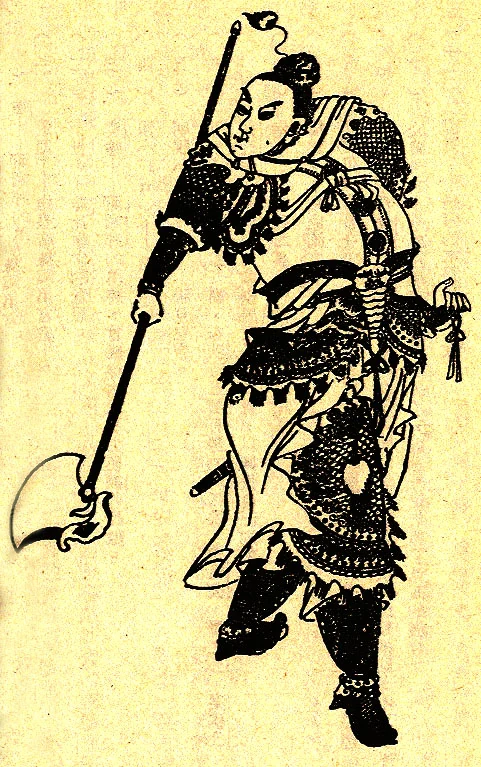
Biography
Family Background and Early Years
Sun Ce came from the Sun lineage of Fuchun in Wu Commandery. His father Sun Jian was traditionally said to descend from the Spring and Autumn military thinker Sun Wu. Rising from comparatively humble origins, Sun Jian won distinction in the suppression of the Yellow Turban uprising and the campaigns against Dong Zhuo, eventually becoming Administrator of Changsha and General Who Breaks the Caitiffs and being enfeoffed as Marquis of Wucheng. Sun Ce was Sun Jian's eldest son. His mother, Lady Wu, came from a prominent family of Wu Commandery. According to the *Records of the Three Kingdoms*, citing the *Soushen Ji*, Lady Wu dreamed that the moon entered her bosom while pregnant with Sun Ce and that the sun entered her bosom while pregnant with Sun Quan. Sun Jian interpreted the sun and moon as the essences of yin and yang and as an omen of family prosperity.
In 184, the first year of Zhongping, Sun Jian joined Zhu Jun in campaigning against the Yellow Turbans, while Sun Ce remained with his family at Shouchun. By his teens, Sun Ce was already associating with notable men there and beginning to acquire a reputation. In 189, when Sun Jian raised troops against Dong Zhuo, Zhou Yu traveled from Shu County specifically to visit Sun Ce at Shouchun. The two were the same age and quickly became close. Zhou Yu invited Sun Ce to bring his mother and younger brothers to Shu County and gave the Sun family the Zhou residence south of the road. The two families became intimate, and during his time at Shu County Sun Ce broadly cultivated relations with scholar-officials of the Jiang-Huai region.
Continuing His Father's Ambition and Serving Yuan Shu
In 191, the second year of Chuping, Sun Jian attacked Liu Biao, Governor of Jingzhou, on Yuan Shu's orders and was killed near Mount Xian at Xiangyang by troops under Huang Zu. Sun Ce was still young. Sun Jian's troops were inherited by his cousin Sun Ben, while Sun Ce yielded the Marquisate of Wucheng to his younger brother Sun Kuang. Sun Jian's coffin was escorted back to Qu'e by Sun Ben for burial, and Sun Ce later moved to Jiangdu.
At Jiangdu, Sun Ce repeatedly visited the Xu Province scholar Zhang Hong and asked his advice on the political situation. Sun Ce explained his plan: he would go to Yuan Shu to recover his father's troops, rely on his maternal uncle Wu Jing in Danyang to recruit forces, move east to seize Wu and Kuaiji commanderies, avenge his father, and serve as an outer support for the Han court. Zhang Hong initially declined to advise him, but was moved by Sun Ce's spirited loyalty. He laid out a strategy of occupying Jiangdong, controlling the Yangtze, sweeping away rivals, and supporting the Han, and promised to contact friends on Sun Ce's behalf. Sun Ce entrusted his mother and younger siblings to Zhang Hong and left for Shouchun.
In 192 Sun Ce met Yuan Shu at Shouchun and tearfully appealed to his father's former relationship with Yuan, asking for the return of Sun Jian's troops. Yuan Shu admired Sun Ce's talent but was unwilling to hand over the forces immediately and told him to recruit soldiers in Danyang under Wu Jing. Sun Ce therefore moved his mother to Qu'e and, together with Lü Fan and Sun He, joined Wu Jing. He recruited several hundred men but was nearly killed at Jing County in an attack by the bandit leader Zu Lang. The following year Sun Ce again visited Yuan Shu, who finally returned more than one thousand of Sun Jian's former soldiers.
When Grand Tutor Ma Midi traveled through the eastern regions carrying imperial credentials, he treated Sun Ce with courtesy at Shouchun and recommended him as Commandant Who Cherishes Righteousness. Yuan Shu's generals Qiao Rui and Zhang Xun also respected Sun Ce. Yuan Shu himself exclaimed that if he had a son like Sun Ce, he could die without regret. On one occasion a cavalryman under Sun Ce committed an offense and fled into Yuan Shu's camp. Sun Ce sent men directly into the camp and had the offender executed, afterward apologizing to Yuan Shu. Yuan Shu did not take offense, and Sun Ce's authority within the army increased.
Yuan Shu, however, repeatedly failed to honor promises to Sun Ce. He first promised to appoint him Administrator of Jiujiang but instead gave the office to his confidant Chen Ji. He later promised that Sun Ce would receive Lujiang if he captured it, yet after Sun Ce took the commandery Yuan Shu appointed his old subordinate Liu Xun. Sun Ce consequently became deeply dissatisfied with Yuan Shu.
Crossing the Yangtze and Pacifying Jiangdong
In 194, the first year of Xingping, Emperor Xian appointed Liu Yao Inspector of Yangzhou. Fearing the influence of Yuan Shu and the Sun family, Liu Yao expelled Wu Jing and Sun Ben by force, and the two withdrew to Liyang. Zhu Zhi, an old follower of Sun Jian, judged Yuan Shu's regime to lack political legitimacy and urged Sun Ce to seize Jiangdong. Sun Ce then asked Yuan Shu for permission to assist his uncle Wu Jing against Liu Yao, claiming that after taking Hengjiang he could recruit thirty thousand troops and help Yuan Shu pacify the realm. Yuan Shu assumed that with Liu Yao at Qu'e and Wang Lang in Kuaiji, Sun Ce was unlikely to succeed. He nevertheless recommended Sun Ce as Commandant Who Breaks the Charge, acting General Who Destroys Bandits, and gave him more than one thousand soldiers and several dozen horses. Sun Ce also recovered veteran officers of his father, including Cheng Pu, Huang Gai, and Han Dang, while Lü Fan transferred his entire following to him.
In 195 Sun Ce crossed the Yangtze from Liyang. Men continually joined him along the route, and by the time his forces had assembled he commanded five or six thousand. After crossing the river he fought from place to place with repeated success. His military discipline was strict and civilians increasingly submitted to him. Sun Ce defeated Liu Yao, who abandoned Dantu and fled west. Zhu Zhi advanced from Qiantang into Wu Commandery and defeated its administrator Xu Gong at Youquan; Xu Gong fled south and joined the bandit leader Yan Baihu. When Yuan Shu at Shouchun heard that Sun Ce had driven off Liu Yao, he recommended him as General Who Destroys Bandits.
In 196 Sun Ce attacked Kuaiji. The official Yu Fan advised Administrator Wang Lang to avoid battle, but Wang Lang regarded himself as a Han official and chose to resist. After Wang Lang was defeated, he fled by sea toward Dongye. Sun Ce pursued him, defeated him again, and Wang Lang surrendered. Sun Ce then broke the forces of Yan Baihu and other armed groups and gained control of Kuaiji. He replaced the existing local officials, took the post of Administrator of Kuaiji himself, appointed Wu Jing Administrator of Danyang, Sun Ben Administrator of Yuzhang, Sun Fu Administrator of Luling, and Zhu Zhi Administrator of Wu Commandery, and relied on Zhang Zhao, Zhang Hong, Qin Song, Chen Duan, and others as advisers. In the same year he sent Liu You and Gao Cheng to present a memorial at the imperial court in Xu and to offer local products.
Break with Yuan Shu and Enfeoffment as Marquis of Wu
In 197, the second year of Jian'an, Yuan Shu used the Imperial Seal and proclaimed himself emperor. Sun Ce wrote a letter condemning him and severed relations. Cao Cao sent the court official Wang Pu with an imperial edict from Emperor Xian, appointing Sun Ce Cavalry Commandant, allowing him to inherit his father's title Marquis of Wucheng, confirming him as Administrator of Kuaiji, and ordering him to join Lü Bu and Chen Yu in attacking Yuan Shu. Sun Ce considered the rank of Cavalry Commandant too low and hinted to Wang Pu that he wanted a general's title. Wang Pu, in the emperor's name, announced that Sun Ce would provisionally act as General Who Makes the Han Illustrious.
At that time Chen Yu was stationed at Haixi and secretly sent men across the river to contact bandit leaders in Danyang and Wu Commandery, including Jiao Yi and Yan Baihu, intending to seize Sun Ce's rear territory after Sun's army moved out. Sun Ce discovered the plot and angrily sent Lü Fan and Xu Yi directly against Haixi. They decisively defeated Chen Yu and captured more than four thousand of his soldiers and family members.
In 198 Cao Cao formally recommended Sun Ce as General Who Attacks Rebels and had him enfeoffed as Marquis of Wu.
Campaign Against Huang Zu and Consolidation of Jiangdong
In 199 Yuan Shu died, and members of his former following sought to join Liu Xun, Administrator of Lujiang. Sun Ce led his forces west against Liu Xun, defeated him, and absorbed his people. Sun Ce then attacked Huang Zu, a commander under Liu Biao, and decisively defeated him at Shaxian, though Huang Zu escaped alone. Sun Ce pressed on into Yuzhang Commandery, whose administrator Hua Xin judged resistance impossible and surrendered the city. Sun Ce thereby controlled Danyang, Kuaiji, Wu, Lujiang, Yuzhang, and Luling, the six commanderies of Jiangdong.
Assassination and Death
In 200 Sun Ce went hunting in the mountains near Dantu. He had earlier killed Xu Gong, Administrator of Wu Commandery. Xu Gong's young son and retainers remained in hiding and planned revenge. Sun Ce rode out alone, and three of Xu Gong's retainers ambushed him and shot him in the cheek. His wounds proved severe.
Before his death Sun Ce summoned Zhang Zhao and others and entrusted the future to them, saying that with the people of Wu and Yue and the natural defenses of the river region they could observe how the struggle under Heaven developed, and asking them to assist his younger brother well. He then summoned Sun Quan, handed him the seals of command, and told him that in leading the armies of Jiangdong, making decisions on the battlefield, and contending with the powers of the realm, Sun Quan was not his equal; but in selecting the worthy and capable, bringing out the best in each person, and preserving Jiangdong, he himself was not Sun Quan's equal. Sun Ce died that night at the age of twenty-six.
Sun Ce, styled Bofu, was a native of Fuchun in Wu commandery, the eldest son of Sun Jian, general who smashes the caitiffs, and the elder brother of Sun Quan. As a boy he made friends with the notables of Shouchun and his reputation spread; and Zhou Yu of Shu, born in the same year and likewise prematurely accomplished, heard of him and came from Shu to seek him out, so that the two swore friendship of a piece with gold and Zhou Yu persuaded him to move his mother and brothers to Shu. When Sun Jian had first raised his righteous army against Dong Zhuo he had moved his household to Shu, where Sun Ce and Zhou Yu were the closest of friends, Zhou Yu giving up his great house south of the road for Sun Ce and going up to the hall to salute his mother, the two households sharing all they had; and at Shu Sun Ce gathered about him men of rank and the notables of the Jiang and Huai all came over to him. In 192 Yuan Shu sent Sun Jian against Jingzhou and Liu Biao, who opposed him with Huang Zu between Fan and Deng; Sun Jian broke him, crossed the Han in pursuit and besieged Xiangyang, and riding alone at Mount Xian was shot dead by Huang Zu's soldiers. Sun Ce and Sun Quan were both with Yuan Shu, and after Sun Jian was buried at Qu'a Sun Ce moved to Jiangdu. There he several times called on the famous scholar Zhang Hong to discuss the state of the realm, setting out his plan: first to recover his father's troops from Yuan Shu, then to cross the river and seek the support of his uncle Wu Jing, the governor of Danyang, using Danyang as a base to raise troops, take Wu and Kuaiji and then attack Liu Biao and Huang Zu to avenge his father, and so found the state of Wu. Zhang Hong excused himself on grounds of his own want of judgement and of mourning, but Sun Ce urged him further, saying that his name was known everywhere and that the success or failure of his plan hung on Zhang Hong's word, and that if his ambition were realised and his vengeance taken he would never forget the debt; and he wept as he spoke without changing countenance. Zhang Hong, moved by his loyalty and generosity, advised him to cross the river and promised to bring his own friends to support him, and Sun Ce entrusted to him his old mother and young brothers that he might have no care behind him. This plan, completed by Zhang Hong, became the settled policy of the state of Wu. On the completion of his mourning in 194 Sun Ce went to Shouchun to Yuan Shu, weeping, to ask for his father's old troops, telling him that his father had marched from Changsha against Dong Zhuo and made alliance with him at Nanyang and had now died without completing his work, and that he wished to attach himself with the old debt of gratitude. Yuan Shu, seeing from his words and bearing that he was a man who could bend and rise and of uncommon capacity, would not at once give up the troops, but told him that he had made his uncle Wu Jing governor of Danyang and his kinsman the commandant there, a country of good soldiers, where he might raise his own; so Sun Ce went to Danyang and got several hundred men, but being surprised by the bandit chief Zu Lang of Jing county and nearly killed, he went back to Yuan Shu, who then gave him a thousand or more of his father's remaining soldiers. Tao Qian, governor of Xuzhou, feared him, and as his uncle Wu Jing was then governor of Danyang, Sun Ce moved his mother to Qu'a with Lü Fan and Sun He to join Wu Jing, raising several hundred men there. Wu Jing, who had served with Sun Jian and been made a cavalry commandant, was appointed by Yuan Shu to the governorship of Danyang after defeating the former governor, and Sun Ce with Sun He and Lü Fan joined him and destroyed the bandit Zu Lang, who fled. Ma Ridi, grand tutor with the staff, pacifying the east of the pass, treated Sun Ce with honour at Shouchun and made him colonel of cherishing righteousness, and Yuan Shu's generals Qiao Rui and Zhang Xun all esteemed him; and Yuan Shu himself would sigh that if he had a son like Sun Lang he would die content. When one of his horsemen, guilty of a crime, fled into Yuan Shu's camp and hid in the stables, Sun Ce sent men who went straight into the camp, dragged him out and beheaded him on the spot, and afterwards went to apologise; and Yuan Shu said that soldiers were given to mutiny and should be hated in common, so that there was nothing to apologise for, and the army feared Sun Ce the more. Yuan Shu had promised him the government of Jiujiang and then given it to Chen Ji of Danyang, to Sun Ce's disappointment; and when he wished to attack Xuzhou and asked the governor of Lujiang, Lu Kang, for thirty thousand bushels of rice, and Lu Kang refused, he was enraged. Sun Ce had once called on Lu Kang at Shu, and Lu Kang, despising him, had sent only his secretary to receive him, so that Sun Ce bore him a grudge; and Yuan Shu sent Sun Ce against him, promising that his earlier mistake would be made good and that Lujiang would be his. Sun Ce attacked and took the city after a siege of two years, but Yuan Shu gave Lujiang to his own former officer Liu Xun, to Sun Ce's greater disappointment. Meanwhile Liu Yao, inspector of Yangzhou, whose seat at Shouchun Yuan Shu had seized, crossed the river with the help of Sun Ce's uncle Wu Jing and cousin Sun Ben and established himself at Qu'a; fearing that the two, being Yuan Shu's men and Sun Ce's kin, would join against him, he drove them out by force and they withdrew to Liyang. Liu Yao set Fan Neng and Yu Mi at Hengjiang and Zhang Ying at Dangli to oppose Yuan Shu, who made his old officer Hui Qu inspector of Yangzhou and Wu Jing a general to attack them, without success for years. Zhu Zhi, Sun Ce's deputy and commandant of Wu, seeing that Yuan Shu's government had no principle, urged Sun Ce to take Jiangdong at the moment; and Sun Ce told Yuan Shu that his family had old claims of kindness on the men of Jiangdong, that he would take troops to help his uncle attack Hengjiang, and that having taken it he could raise thirty thousand men there and lead them to help him pacify the realm. Yuan Shu, knowing him discontented but thinking that with Liu Yao at Qu'a and Wang Lang at Kuaiji he could not succeed, consented, giving him barely a thousand men, a few dozen horses and a few hundred followers. Men came over to him on the march, so that at Liyang he had five or six thousand; and moving his mother from Qu'a to Fuling he crossed the river and fought his way, breaking all before him, with orders so strict that the people were attached to him. He was of handsome person, humorous in speech, open and ready to listen, and skilled in the use of men, so that soldiers and people alike gave him their whole hearts and were glad to die for him. In 195, with Zhou Yu, Cheng Pu and Huang Gai, he crossed at Liyang and defeated Liu Yao, taking his camp at Niuzhu with all its granaries and arms. Xue Li held Moling and Ze Rong camped south of the county, both acknowledging Liu Yao; Sun Ce attacked Ze Rong first, killing five hundred, so that he shut his gates and dared not move, and then turned on Xue Li, who broke out and fled, while Fan Neng and Yu Mi came again to seize Niuzhu, and Sun Ce turned back and beat them, taking more than ten thousand prisoners. Attacking Ze Rong again he was struck by a stray arrow in the thigh and could not ride, being carried back to camp; and then the surrendered prisoners revolted, and a rumour reached Ze Rong that Sun Ce was dead, at which he rejoiced and advanced again. Sun Ce sent a few hundred men to provoke him, laid an ambush, and having drawn him into it cut down a thousand; then coming before his camp he had his men shout, "And what of Sun Lang?" so that the enemy, learning he lived, fled by night, and Ze Rong, in greater fear, dug ditches and raised walls. Finding him too strong to be taken at once, Sun Ce went south, beat Liu Yao's detached force at Meiling, and took Hushu and Jiangcheng; Liu Yao was routed and fled to Dantu, Sun Ce entering Qu'a while the governors abandoned their cities and fled. His troops, forbidden to plunder so much as a fowl, so delighted the people that they came with oxen and wine to his camp. He sent to Fuling for his mother and brothers, and issued a proclamation that those of Liu Yao's and Ze Rong's people who submitted should not be questioned, that those who joined the army should be exempted from taxes in their households, and that those who did not should not be pressed; and within ten days more than twenty thousand men and a thousand horses came in from every quarter, so that his power shook Jiangdong. In 196 he went on against the rest of Jiangdong; Yan Baihu and others held their ground with more than ten thousand each, and when Wu Jing would have destroyed them first Sun Ce said that such bandits had no great ambition and could be taken at will, and crossing the Zhejiang advanced on Kuaiji. Yu Fan, the aide of the governor Wang Lang, advised him to avoid Sun Ce's edge; but Wang Lang, holding that as an officer of Han he should defend his city, gave battle and was beaten, fleeing by sea to Dongye, where Sun Ce pursued and broke him again. Sun Ce's first assaults on Gulin failing, his uncle Sun Jing advised a feint in front and a surprise march through Chaddu, and Sun Ce, at night lighting many torches to deceive the enemy and sending a force secretly by Chaddu, taking Gaoqian camp; Wang Lang, taken unawares, sent Zhou Xin hastily, and Sun Ce killed him and took Kuaiji. He replaced all the officers, holding Kuaiji himself and giving Danyang to Wu Jing, Yuzhang to Sun Ben, with Sun Ben's brother Sun Fu as governor of the new commandery of Luling, and made Zhu Zhi governor of Wu; and Zhang Zhao, Zhang Hong, Qin Song and Chen Duan were his counsellors. When Zou Ta, Qian Tong and Wang Sheng of Wucheng gathered several thousand or ten thousand men each, he destroyed them all, sparing Wang Sheng at his mother's plea that he had been his father's friend, but putting the rest to death with their families. In 197, when Yuan Shu took the imperial seal and made himself emperor, Sun Ce wrote to dissuade him, and being refused broke with him utterly. That year Cao Cao sent the gentleman Wang Fu with an edict making Sun Ce a cavalry commandant, heir to his father's title of Marquis of Wucheng, and governor of Kuaiji, and ordering him to join Lü Bu against Yuan Shu; and Sun Ce, thinking the rank of cavalry commandant too small for the troops he commanded, let his wish be known, and Wang Fu on the emperor's behalf made him acting general of bright Han. Chen Yu lay at Haixi, and Sun Ce, ordered to confer with him and Lü Bu, marched as far as Qiantang when he learned that Chen Yu had secretly sent men across the river with more than thirty seals to the chiefs of the fastnesses of Danyang, Xuancheng, Jing, Lingyang, Shi'an, Yi and She and to Yan Baihu, to rise as his supporters when Sun Ce's army moved. Discovering the plot, Sun Ce sent Lü Fan and Xu Yi straight to Haixi and broke Chen Yu utterly, taking four thousand of his officers, soldiers and families, while Chen Yu fled north. In 198 Sun Ce sent Xu Kun to expel Yuan Shu's governor of Danyang and pacify the country east of Xuancheng, receiving back his uncle Wu Jing, and went himself against the west of Jing county, taking Zu Lang at Lingyang and Taishi Ci at Yongli, whom he released, taking him by the hand and asking whether he remembered the day at Shenting and what he would have done had he taken him then; and Taishi Ci answering that it was not to be guessed, Sun Ce laughed and said the matter was now to be shared with him, making him a commandant of the gate and giving him troops as general of the charging chariots. Zhou Yu and Lu Su, judging that Yuan Shu would never accomplish anything, left their posts and crossed the river to join him; and Sun Ce received Zhou Yu in person, made him general of the establishment of might and at once gave him two thousand men and fifty horses, with drums and a band and a house, gifts beyond any other's in the army. That year he sent double the tribute of the year before to the Han court, and was made general who punishes the rebels and Marquis of Wu. In 199, when Yuan Shu died and his following went to Liu Xun, governor of Lujiang, whose strength suddenly grew, Sun Ce sent envoys with humble words and rich presents to persuade Liu Xun to attack Shangliao, writing that the people there had long offended him, that the road made it hard for him to punish them himself and that Shangliao was rich and worth the taking with Liu Xun's help; and Liu Xun believed him and, taking the pearls and cloth, rejoiced, though Liu Ye alone foretold disaster, arguing that Shangliao, small as it was, had strong walls and deep moats, that its siege would weary the army abroad and leave the country empty, and that Sun Ce would take him from behind; and Liu Xun would not listen. Moving by night through Pengze to Haihun he found the town stripped and empty and gained nothing, and turned on Shangliao; while Sun Ce, marching west against Huang Zu and reaching Shicheng, learned of it and sent Sun Ben and Sun Fu with eight thousand men to await him at Pengze, while he himself with Zhou Yu and twenty thousand marched by land against Liu Xun's base at Wancheng, took it at a stroke and made more than thirty thousand prisoners, with the wives and children of Yuan Shu and Liu Xun. He memorialised for Li Shu as governor of Lujiang with three thousand men to hold Wancheng, and moved all the rest east to Wu. Sun Ben and Sun Fu then broke Liu Xun at Pengze, and he fled into the Chu river and to Xisai and finally to Liuyi, where he walled himself in, asking help of Liu Biao and Huang Zu, who sent his son Huang She with five thousand sailors; but Sun Ce attacked and broke him, so that he fled north to Cao Cao and Huang She also fled, and Sun Ce took two thousand men and a thousand ships. On the eighth day of the twelfth month of 199 Sun Ce came up to Shayi, where Huang Zu lay, and Liu Biao sent his nephew Liu Hu and Han Xi with five thousand spearmen as his vanguard; and Sun Ce attacked and broke him, so that Huang Zu fled alone, his wives, concubines and children, seven in all, being taken, and Liu Hu and Han Xi with twenty thousand men killed and ten thousand more drowned, while Sun Ce took more than six thousand ships and stores heaped like mountains. In his memorial he recorded that reaching Shayi on the eighth day of the twelfth month he had on the eleventh, at dawn, brought up Zhou Yu, Lü Fan, Cheng Pu, Sun Quan, Han Dang and Huang Gai together, galloping along the line and beating the drum with his own hand to steady the battle, crossing double ditches swift as flight, setting fire with the wind and shooting arrows like rain, so that by the hour of the dragon Huang Zu's army had collapsed and none survived before him. He then moved in force against Yuzhang, camping at Jiaoqiu, and told Yu Fan that Hua Xin, though a man of name, was no match for him, and that if he would not open his gates there must be slaughter; so Yu Fan went to Hua Xin and set out his case, saying that Sun Ce's wisdom and strategy surpassed the age and his use of troops was godlike, and that he could not hold an isolated city with insufficient stores; and Hua Xin surrendered the city, saying that having long been in Jiangdong he had always wished to return north and that with the governor of Kuaiji coming he would go. He made his proclamation by night and sent an officer to welcome Sun Ce at dawn, who received him with a courteous bow and made him an honoured guest. Because Liu Yao had died at Yuzhang, Sun Ce brought his coffin home for burial and took charge of his orphan children, a deed praised in a letter from Wang Lang, who likened it to the men of Lu mourning for their enemies of Qi, a thing the Spring and Autumn commended as proper. He left Zhou Yu to hold the place, and his treatment of Yuan Shu's family at Wancheng and of Liu Yao's at Yuzhang was praised by the gentlemen of the realm. As Yuan Shao was then strong and Sun Ce had swallowed up Jiangdong, Cao Cao, unable to turn east, sighed that he could not contend with him and sought to conciliate him, marrying his brother's daughter to Sun Ce's younger brother Sun Kuang and taking Sun Ben's daughter for his own son, summoning Sun Quan and Sun Yi with honours and having the inspector of Yangzhou recommend Sun Quan as a talent. In 200, while Cao Cao and Yuan Shao faced each other at Guandu, Sun Ce secretly planned to raid Xu and carry off the Han emperor, quietly ordering his troops, and took the title of grand marshal, trusting to his own valour and taking no precautions. He had earlier killed Xu Gong, and Xu Gong's young son and retainers had fled to the riverside. On the fourth day of the fourth month of 200, hunting in the hills at Dantu, he rode a swift horse so that his escort was left far behind, and meeting three men he asked who they were and was told they were soldiers of Han Dang shooting deer; and he answered that he knew all of Han Dang's men and had never seen them, and shot one dead, whereupon the other two in terror drew their bows and shot him in the face. His escort coming up killed the assassins, but his wound was grave and he knew he would not live; so he called Zhang Zhao and the others and entrusted to them his affairs, saying that with the realm in chaos and the strength of Wu and Yue and the defences of the three rivers they might watch the outcome of the struggle, and that they should loyally support his younger brother; and he told Zhang Zhao that if Sun Quan proved unequal to the task he might take it himself, and that even if they failed a slow retirement westward would leave nothing to fear. He called Sun Quan, gave him the seals and said that in leading the host of Jiangdong and deciding battles between two armies to contend with the realm he was Sun Quan's better, but that in employing the worthy and able and giving each his whole heart to preserve Jiangdong he was not Sun Quan's equal; and that night he died at twenty-six. The Wuli relates that the physician told him the wound could be cured if he rested a hundred days without exertion or anger, and that Sun Ce, taking a mirror and seeing his face, cried that with such a face how could he achieve anything, and rousing himself burst the wound and died that night. The Soushenji adds that after he killed Yu Ji he would see him at his side whenever he sat alone, and that once when his wound was healing he saw Yu Ji in the mirror, and looking round saw no one, thrice over, so that he dashed the mirror down with a great cry and his wound broke and he died. It is further told that Sun Jian's wife, Lady Wu, dreamed as she conceived Sun Ce that the moon entered her breast, and that conceiving Sun Quan she dreamed that the sun did, and that Sun Jian said that sun and moon were the essences of yin and yang, signs of the highest honour, and that his descendants would rise.