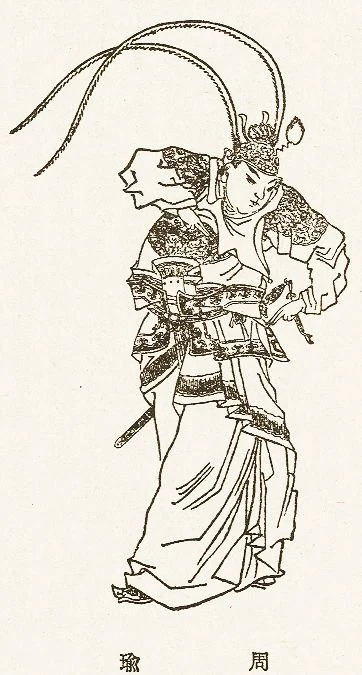
Biography
Family Background and Early Life
Zhou Yu came from the prominent Zhou clan of Lujiang. His great-great-grandfather Zhou Rong was known for his learning and was recruited to serve on the staff of Yuan An. A collateral great-granduncle, Zhou Xing, served as a Gentleman of the Masters of Writing under Emperor An of Han. His granduncle Zhou Jing rose to Defender-in-chief, and another elder relative, Zhou Zhong, likewise became Defender-in-chief, one of the Three Excellencies. Zhou Yu's father Zhou Yi had served as Prefect of Luoyang. Zhou Yu himself was described as tall, handsome, and ambitious.
In 189, when Sun Jian raised forces against Dong Zhuo, he moved his family to Shu County. Sun Jian's eldest son Sun Ce was the same age as Zhou Yu. The two quickly became close friends. Zhou Yu gave the Sun family a large residence on the south side of his family's property and paid formal respects to Sun Ce's mother. The two families shared resources, and Zhou Yu and Sun Ce gathered talented men from the Jiang and Huai regions, gradually building their reputations.
Assisting Sun Ce in the Conquest of Jiangdong
In 195, Zhou Yu was visiting his relative Zhou Shang in Danyang when Sun Ce entered Liyang and prepared to cross the Yangzi. Sun Ce sent him a letter, and Zhou Yu immediately came with five hundred soldiers as well as boats, provisions, weapons, and equipment. Sun Ce was delighted. Zhou Yu joined him in taking Hengjiang and Dangli, crossing the Yangzi, defeating Ze Rong and Xue Li, taking Hushu and Jiangcheng, entering Qu'e, and driving out Liu Yao. Once Sun Ce's forces had grown substantially, Sun Ce sent Zhou Yu back to guard Danyang.
Yuan Shu later replaced Zhou Shang with Yuan Yin as Administrator of Danyang, and Zhou Yu accompanied Zhou Shang to Shouchun. In 198 Yuan Shu tried to recruit Zhou Yu, but Zhou judged that Yuan Shu would not succeed and requested appointment as magistrate of Juchao so that he could find an opportunity to return east. While at Juchao he met Lu Su and formed a close friendship with him. Later that year Zhou Yu and Lu Su returned to Wu. Sun Ce personally welcomed Zhou Yu, appointed him General of the Household Who Establishes Might, gave him two thousand soldiers and fifty cavalry, provided a ceremonial music ensemble, and awarded him a residence. Sun Ce publicly praised Zhou Yu's appearance, ability, and childhood friendship with him. Zhou Yu was widely known in Wu as “Zhou Lang.”
In 199, Sun Ce appointed Zhou Yu Central Protector of the Army and concurrently Administrator of Jiangxia. Zhou Yu joined the attack on Wan, where Sun Ce married Da Qiao and Zhou Yu married Xiao Qiao. The campaign continued against Liu Xun and Jiangxia, and after the pacification of Yuzhang and Luling, Zhou Yu remained at Baqiu.
Assisting Sun Quan and Stabilizing Jiangdong
Sun Ce was assassinated in 200, leaving state affairs to the young Sun Quan. Zhou Yu brought troops to attend the funeral, remained in Wu, and as Central Protector of the Army shared responsibility for major affairs with Zhang Zhao. Sun Quan at that time held only a number of Jiangdong commanderies, with outlying strongholds not yet fully under his control. Zhou Yu was among the first senior commanders to observe formal subject–ruler etiquette toward Sun Quan, helping establish the new ruler's authority. He also recommended Lu Su to Sun Quan as a capable adviser.
In 202, after defeating Yuan Shao, Cao Cao demanded that Sun Quan send a hostage to his court. Zhang Zhao, Qin Song, and others were uncertain. Sun Quan took Zhou Yu to consult his mother, Lady Wu. Zhou Yu argued that sending a hostage would place Sun Quan under Cao Cao's control and urged him instead to preserve autonomy and observe future developments. Lady Wu supported Zhou Yu's view and told Sun Quan to treat Zhou Yu as an elder brother. Sun Quan therefore refused to send a hostage.
Battle of Red Cliffs and the Battle of Nanjun
In the spring of 208, Sun Quan campaigned against Huang Zu in Jiangxia, with Zhou Yu serving as forward commander. Huang Zu was killed and Xiakou taken. In the autumn Cao Cao advanced south, occupied Jingzhou after Liu Cong's surrender, and acquired the former Jingzhou fleet. As Cao Cao's forces approached, Sun Quan convened his advisers. Zhang Zhao and others argued for surrender, while Lu Su urged Sun Quan to recall Zhou Yu from Poyang.
After returning, Zhou Yu strongly argued for resistance. He rejected the claim that Cao Cao's strength made surrender inevitable, stressing that the north was not fully secure, that Ma Chao and Han Sui remained threats in the west, that northern armies were disadvantaged in naval warfare, that winter reduced fodder supplies, and that troops brought far south were vulnerable to unfamiliar climate and disease. He requested thirty thousand elite troops and promised to defeat Cao Cao.
Sun Quan decided to resist, appointing Zhou Yu Left Commander and Cheng Pu Right Commander. They allied with Liu Bei. At Red Cliffs, Zhou Yu adopted Huang Gai's plan for a fire attack. Huang Gai feigned surrender, approached Cao Cao's fleet, and set fire to the vessels, inflicting a major defeat. The battle became one of the decisive engagements of the late Han and helped create the conditions for the later division of the realm among three major powers. Cheng Pu, an older commander who had initially resented serving under the younger Zhou Yu, eventually came to admire him and compared friendship with Zhou Yu to drinking strong wine until becoming drunk without noticing it.
In 209, Zhou Yu advanced against Nanjun and fought Cao Ren for more than a year. While personally directing the battle, he was struck in the right side by an arrow and badly wounded. When Cao Ren learned of his condition and challenged his forces, Zhou Yu nevertheless inspected the camp and encouraged his soldiers. His army eventually defeated Cao Ren and Xu Huang and captured Jiangling. Sun Quan appointed him Lieutenant-General and Administrator of Nanjun.
Early Death
In 210, Zhou Yu proposed a strategy sometimes described as a plan to divide the realm into two major blocs. He intended to advance west, take Shu, absorb Zhang Lu's territory, cooperate with Ma Chao, and use Xiangyang as a base for pressure against Cao Cao. Sun Quan approved the proposal. Zhou Yu returned toward Jiangling to prepare the campaign, but fell ill while passing through Baqiu and died at the age of thirty-six. Sun Quan mourned him in plain garments and was said to have been deeply grieved.
Zhou Yu, styled Gongjin, was a native of Shu county in Lujiang. His great-uncle Zhou Jing and Zhou Jing's son Zhou Zhong both rose to be grand commandants of Han, among the three highest ministers, and his father Zhou Yi was prefect of Luoyang. Tall and handsome, he was a friend from boyhood of Sun Ce. When Sun Jian raised troops against Dong Zhuo he moved his family to Shu, where Sun Ce, born in the same year as Zhou Yu, became his closest friend; Zhou Yu gave up his great house south of the road for Sun Ce to live in, went up to the hall to salute his mother, and the two households shared all they had. Together they gathered men of rank and substance, and the people of the Jiang and Huai came to Sun Ce. Zhou Yu's uncle Zhou Shang being governor of Danyang, Zhou Yu went to visit him; and when Sun Ce, about to cross the Yangzi, wrote from Liyang, Zhou Yu brought troops to meet him, five hundred men with boats, grain and weapons, travelling through the night, and Sun Ce said with joy that with Zhou Yu he had what he needed. They took Hengjiang and Dangli, crossed to Moling, broke Ze Rong and Xue Li, took Hushu and Jiangcheng, entered Qu'a and drove Liu Yao away, until Sun Ce's following numbered tens of thousands; and Sun Ce, telling him that with such a force he could take Wu and Kuaiji and pacify the mountain Yue, sent him back to guard Danyang. Yuan Shu wished to make Zhou Yu one of his generals, but discerning that Yuan Shu would accomplish nothing he asked to be chief of Juchao so as to have a way east, and in 198 he returned from Juchao to Wu. Sun Ce came out in person to meet him and made him general of the establishment of might, giving him two thousand soldiers and fifty horses; he was then twenty-four, and all Wu called him Master Zhou. Sun Ce gave him drums and a band and built him a house, rewards beyond any other's, and declared that Zhou Yu was bound to him by a boyhood friendship and the affection of kinsmen, and that when he had led his troops in Danyang and sent boats and grain to him, the rewards could not repay the support given at the decisive hour. Because his kindness and good faith were known in Lujiang he was posted to Niuzhu and then made chief of Chungu; and when Sun Ce wished to take Jingzhou he made him protector of the army and governor of Jiangxia, took Wan, where the two daughters of Lord Qiao, both of great beauty, were taken, Sun Ce marrying the elder and Zhou Yu the younger; he then advanced to Xunyang, broke Liu Xun, chastised Jiangxia and settled Yuzhang and Luling, being left to guard Baqiu. As chief of Juchao, Zhou Yu had gone with several hundred men to ask grain of Lu Su, who, having two storehouses of three thousand bushels each, gave him one, so that Zhou Yu knew him for an extraordinary man and made friends with him, afterwards moving Lu Su's mother to Wu. When Sun Ce died in 200 and Sun Quan took over, Zhou Yu brought troops to the mourning, stayed at Wu and shared the government with Zhang Zhao as protector of the army. Sun Quan being then only a general, the other officers were sparing in their courtesies, but Zhou Yu alone paid him the full respect of a subject; and he and Zhang Zhao, judging that Sun Quan could accomplish great things, gave themselves wholly to his service. He told Lu Su that, as Ma Yuan had answered Guangwu, in this age not only does the ruler choose the minister but the minister the ruler; that their master honoured the worthy and gathered the extraordinary; and that the ancient secret teaching held that the one who should receive the mandate in place of the Liu would rise in the south-east, so that this was the hour for men of ambition to follow the dragon. He recommended Lu Su to Sun Quan as fit to assist the times. In 202 Cao Cao wrote demanding that Sun Quan send a hostage. Sun Quan, unwilling, took Zhou Yu alone to his mother to settle the matter. Zhou Yu argued that when Chu was first enfeoffed by Mount Jing it had less than a hundred li, yet its able successors widened the land and founded a capital at Ying, holding Jing and Yang as far as the southern sea and passing on the state for nine hundred years; that Sun Quan, inheriting his father's and brother's work with the strength of six commanderies, fine troops and ample grain, with mountains to coin copper and the sea to boil salt, a rich land and men of spirit, could sail from morning to evening and go where he would, and had no need to send a hostage; that once a hostage was in Cao's hands he must answer every summons and be controlled, gaining at best a marquisate, a dozen servants, a few carriages and horses, which could not compare with standing as a sovereign in his own right; that it were better to send none and watch; and that if Cao Cao acted by right the service of him would not be too late, while if he plotted violence, fire unfed would burn itself out. Sun Quan's mother agreed, saying that Zhou Yu, born in the same year as Bofu and but a month younger, was to her as a son and should be treated by Sun Quan as an elder brother; and no hostage was sent. Hearing that Zhou Yu was young and of fine talent, Cao Cao thought he might be talked over, and sent Jiang Gan of Jiujiang to him in plain clothes and cloth cap as on private business. Zhou Yu met him and asked at once whether he had come so far to be Cao Cao's advocate; Jiang Gan protested that they were of the same province and that he had come to renew acquaintance, which was no way to greet him; and Zhou Yu answered that though no Kui or Kuang he could tell the tune from the strings. He entertained him, then sent him out on the plea of business and, three days later, took him through the camp to see the stores and arms, feasted him and showed him his attendants, robes and treasures, saying that a man who finds a lord who knows him holds to him at once as subject and as kin, in counsel and in fortune, and that a Su Qin or Zhang Yi reborn, a Li Yiji risen again, would have his words broken on his back, far less a youth like him. Jiang Gan only laughed and said nothing; and returning he reported Zhou Yu's noble magnanimity, not to be shaken by words, and the gentlemen of the central plain thought the more of him. In 206 Zhou Yu commanded Sun Yu and others against the two camps of Ma and Bao, beheaded their chiefs and took more than ten thousand prisoners, and afterwards guarded Gongting; when the governor of Jiangxia, Huang Zu, sent Deng Long with several thousand men into Chaisang, Zhou Yu pursued and captured him and sent him to Wu. Gan Ning coming over, he judged him a man of talent and recommended him with Lü Meng. In the ninth month of 208 Cao Cao entered Jingzhou, Liu Cong surrendered, and with the Jingzhou fleet and his own, several hundred thousand men strong, he overawed Wu. Sun Quan asked his ministers, who advised surrender, since Cao Cao was a tiger and wolf who acted in the name of the Han and whom the Yangzi could no longer hold, the Jingzhou ships having passed to him. Zhou Yu answered that Cao Cao was a traitor to the Han though he called himself its chancellor; that Sun Quan, with divine valour and the legacy of his father and brother, held a region of several thousand li with fine troops and willing men, and should sweep the empire to rid the Han of its vermin, and that the enemy came to his own death and could never be received with submission. He set out four reasons: the north was not yet settled, with Ma Chao and Han Sui at the passes behind Cao Cao; he had exchanged saddle and horse for ship and oar against men bred to the water; the cold was severe and there was no fodder for the horses; and his Zhongyuan troops, driven into the rivers and lakes, unused to the climate, must sicken. These four were the perils of war, and Cao Cao had thrown himself into them all. He asked for thirty thousand picked troops to hold Xiakou and pledged to break him. Sun Quan cried that the old traitor had long wished to take the throne and feared only the two Yuan, Lü Bu, Liu Biao and himself, and that with them gone and only himself left he and the traitor could not both stand, and that Heaven had sent Zhou Yu to him. That night Zhou Yu told him further that those who saw Cao's letter claiming eight hundred thousand men took fright without reckoning the truth: the Zhongyuan troops were no more than a hundred and fifty or sixty thousand and long wearied, and the surrendered Jingzhou men at most seventy or eighty thousand and doubtful at heart, and a sick and wearied force could not command such doubters, so that numbers meant little. Sun Quan then cut off a corner of the table with his sword and swore that whoever spoke of surrender should be served like that table; and he gave Zhou Yu and Cheng Pu the joint command, Zhou Yu the chief. Sent with Cheng Pu and Liu Bei against Cao Cao, Zhou Yu met him at the Red Cliff, where the northern troops were already sick; at the first engagement they fell back and camped north of the river while Zhou Yu's ships lay south. Huang Gai proposed fire, and Zhou Yu sent ten armoured boats laden with dry reeds and wood, soaked in oil, screened with felt and hung with banners, with fast boats at their sterns, and sent word to Cao Cao that they came to surrender. A strong south-east wind blowing, Huang Gai put the ten boats in the front, spread sail in midstream and the rest followed; Cao Cao's officers came out to watch and pointed, saying that Huang Gai was coming over. Two li from the northern fleet they fired the boats, and with the wind fierce and the fire raging the ships went like arrows, burning the northern fleet and spreading to the camps ashore, so that in a moment smoke hid the sky and men and horses drowned and burned in number, and the army broke and fell back on Nanjun. Liu Bei and Zhou Yu pursued, and Cao Cao left Cao Ren at Jiangling and went north himself. Zhou Yu and Cheng Pu advanced on Nanjun and faced Cao Ren across the river. Before the battle he sent Gan Ning ahead to seize Yiling, which Cao Ren invested; Zhou Yu, using Lü Meng's plan, left Ling Tong to guard his rear and went himself to raise the siege. The siege lifted, he crossed and camped on the north bank, fixed a day for battle, and galloped his horse along the line, when a stray arrow struck his right flank and he went back gravely wounded. When Cao Ren heard that he lay sick and led his troops to the front, Zhou Yu rose, inspected the camp and roused his officers, and Cao Ren retired. He besieged Cao Ren for more than a year with heavy losses on both sides, until Cao Ren abandoned the city; and Sun Quan made Zhou Yu governor of Nanjun, stationed at Jiangling, general of the unequal side, with the towns of Xiajun, Hanchang, Liuyang and Zhouling for his support. Judging Liu Bei a great danger, he memorialised that Liu Bei, a hero, with Guan Yu and Zhang Fei as his tiger generals, would not long submit to serve others; that he should be moved to Wu, given a great palace and beautiful women and playthings to charm his eyes and ears, and the other two placed apart, so that a man like himself might hold them and fight, and the matter be settled; and that to cut off land to strengthen them and gather the three on the frontier was to let a dragon get the rain and never stay in the pool. Sun Quan, needing to contain Cao Cao in the north and doubting his power to hold Liu Bei, would not consent. In 210 he approved Zhou Yu's plan to take Yizhou; and Zhou Yu told him that with Cao Cao newly beaten and anxious at home, he should be given leave to take Shu with the general of Fenwei and then absorb Zhang Lu, leaving the other to hold the country and ally with Ma Chao, while he himself returned to hold Xiangyang with Sun Quan and press Cao Cao, so that the north might be won. Sun Quan agreed. Zhou Yu went back to Jiangling to make ready, and on the road at Baqiu fell ill and died at thirty-six. His last memorial urged Sun Quan to think of what had not yet happened before taking his ease; that with Cao Cao an enemy and Liu Bei near at Gong'an on a close frontier with the people not yet attached, a good general should be sent to hold and comfort the region; and that Lu Su's wisdom fitted him to take his place, which was all he had at heart. The Jiangbiao zhuan records a further letter, in which he recalled that, having aimed first at Ba and Shu and next at Xiangyang, he thought the thing in his hand, and lamented that he could not carry out his small design, and that a dying man's words were good. Sun Quan wept for him, saying that with Gongjin's gifts for statecraft cut short he had none to rely on, put on mourning for him himself and moved those about him; when the coffin came home to Wu he met it at Wuhu and bore all the costs from the treasury, and afterwards ordered that the retainers of the late generals Zhou Yu and Cheng Pu should not be questioned. When he took the imperial title he told his ministers that without Gongjin he would not have been emperor.
Zhou Yu came of the Zhou clan of Lujiang, a famous great family of the late Han and of the highest standing in the Huai and Si region. Unlike Sun Jian's family of no account, Sun Ce gained through his friendship with the Zhous both an introduction to the notables of the Huai and Si and a name of his own; the records of Sun Ce say that being friends with Zhou Yu he gathered about him the gentry and men of standing, so that all between the Jiang and the Huai turned to him, and this laid the ground of his renown. When some years later he freed himself from Yuan Shu and marched into Jiangdong with barely a thousand men, it was again Zhou Yu who gave him men and supplies; and in the campaigns that followed Zhou Yu led the way in person, storming cities and winning repeated distinction, so that Sun Ce regarded him as his closest confidant. Before the Red Cliff, Sun Quan made Zhou Yu commander with Cheng Pu as his deputy, giving him thirty thousand picked sailors to join the twenty-odd thousand of Liu Bei at Fankou, some fifty thousand in all, to go up the Yangzi against Cao Cao. After the first defeat at the Red Cliff the northern army, which suffered greatly from hunger and sickness, more than half of it dying, withdrew north, leaving Cao Ren and Xu Huang at Jiangling and Yue Jin at Xiangyang. Zhou Yu and Cheng Pu then besieged Nanjun, sending Gan Ning ahead to seize Yiling; when Cao Ren detached troops to invest him, Zhou Yu used Lü Meng's plan, left Ling Tong to guard the rear and went himself with Lü Meng to raise the siege; and the siege lifted, he crossed and formed a camp on the north bank and fought, until Cao Ren abandoned the city and Zhou Yu held Nanjun and pacified Jingzhou, being made general of the unequal side and governor of Nanjun with his headquarters at Jiangling.