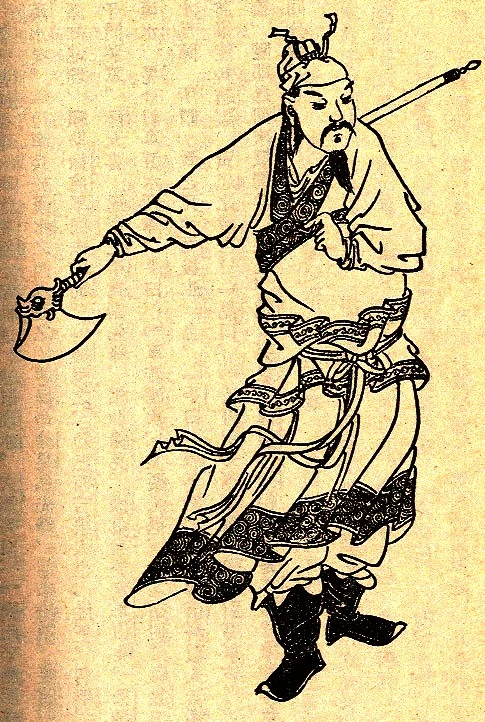
Biography
Family Background and Early Years
Xu Huang was born in Yang County, Hedong Commandery, present-day Hongtong County, Shanxi. In his early years he served as a commandery clerk in Hedong. As the Eastern Han collapsed into disorder, he followed General of Chariots and Cavalry Yang Feng in campaigns against bandits and was appointed Commandant of Cavalry for his service. In 192, the third year of Chuping, Wang Yun and Lü Bu killed Dong Zhuo, but Dong Zhuo's former generals Li Jue and Guo Si then captured Chang'an, killed Wang Yun and others, and subsequently fought among themselves, throwing the capital into chaos. Xu judged the situation and persuaded Yang Feng to escort Emperor Xian of Han eastward to Luoyang. When the emperor crossed the Yellow River and reached Anyi, he rewarded those who had protected him, and Xu was enfeoffed as Marquis of Duting.
Joining Cao Cao
In 196, the first year of Jian'an, Emperor Xian returned to Luoyang under the protection of Zhang Yang, administrator of Henei, Yang Feng, and others. Yang Feng was appointed General of Chariots and Cavalry and stationed at Daliang. Xu saw the conflict between General-in-Chief Han Xian and General of the Guards Dong Cheng intensifying and urged Yang Feng to submit to Cao Cao. Yang initially agreed but later changed his mind. That autumn Cao Cao escorted Emperor Xian to the new capital at Xu County. Yang Feng and Han Xian attempted to seize the emperor but were defeated by Cao Cao. Cao then campaigned personally against Yang Feng, who fled south to Yuan Shu; Xu Huang instead joined Cao Cao. Cao Cao assigned troops to Xu and sent him to attack Juan and Yuanwu, where he defeated rebel forces and was appointed Assistant General. He later accompanied Cao Cao against Lü Bu, induced Lü Bu's officers Zhao Shu and Li Zou to surrender, and together with Shi Huan killed Sui Gu in Henei.
Merit at Guandu
In 200, the fifth year of Jian'an, Xu Huang followed Cao Cao in defeating Liu Bei in the campaign in Xu Province. He then took part in the defeat of Yan Liang and the capture of Baima. When Cao Cao's army advanced to Yanjin, it used baggage as bait to defeat Wen Chou, and Xu was promoted to General of a Separate Command for his service. During the stalemate at the Battle of Guandu, thousands of carts of Yuan Shao's grain were being transported toward the front. Strategist Xun You recommended Xu Huang to Cao Cao, who ordered Xu and Shi Huan to lead several thousand cavalry in intercepting the convoy commander Han Meng at Gushi. They routed the force and burned the supplies. Xu was credited with the greatest merit in the action and was enfeoffed as Marquis of Duting.
Pacifying Hebei
In 204, the ninth year of Jian'an, Cao Cao besieged Ye and captured Handan. Han Fan, magistrate of Yiyang, pretended to surrender but continued to defend the city, so Cao Cao sent Xu Huang against him. Xu approached the walls and shot a letter into the city explaining the advantages and dangers of the situation. Han Fan then surrendered the entire city. Xu advised Cao Cao: “The two Yuans have not yet been destroyed, and the cities that have not submitted are listening closely. If Yiyang is destroyed today, tomorrow they will all defend themselves to the death, and I fear Hebei will never be pacified. I ask that you accept Yiyang's surrender as an example to the other cities; then none will fail to submit at the sight of our advance.” Cao Cao accepted the advice and made Han Fan a Marquis within the Passes. Xu later attacked Maocheng, used an ambush to defeat three Yuan camps, followed Cao Cao in routing Yuan Tan at Nanpi, and suppressed rebels in Pingyuan. In 207 he accompanied Cao Cao in the northern campaign against the Wuhuan. Under Zhang Liao's command at the Battle of White Wolf Mountain, the army routed the enemy and killed Tadun; Xu was appointed General Who Sweeps Across the Wilderness.
Campaigning North and South
In 208, the thirteenth year of Jian'an, Xu followed Cao Cao south into Jing Province. He was separately stationed at Fancheng, subdued enemies at Zhonglu, Linju, and Yicheng, joined Man Chong in fighting Guan Yu at Hanjin, and fought Zhou Yu at Jiangling together with Cao Ren. After the Battle of Red Cliffs, Cao Cao returned north and left Cao Ren and Xu Huang to defend Jiangling. In 210 Xu accompanied Xiahou Yuan against rebels in Taiyuan, captured Daling, and killed their leader Shang Yao.
In 211, the sixteenth year of Jian'an, a coalition under Ma Chao and Han Sui held Tong Pass against Cao Cao. When Cao's army could not advance, he asked Xu Huang for advice. Xu replied: “You have concentrated a great army here, yet the enemy has not separately guarded Puban. This shows they have no plan. If you give me elite troops to cross at Puba Ford and establish a forward position behind them, the enemy can be captured.” Cao Cao therefore ordered Xu Huang and Zhu Ling to lead 4,000 elite troops across the river at Puba Ford. Before the position was complete, Liang Xing attacked by night with more than 5,000 men, but Xu drove him off. After Cao's main force crossed the river, Cao Cao used Jia Xu's scheme to divide Ma Chao and Han Sui and decisively defeated the Guanzhong coalition. Xu later accompanied Xiahou Yuan in pacifying Di groups at Yumi and Qian and remaining rebels at Fu and Xiayang, killing Liang Xing.
In 215, the twentieth year of Jian'an, Xu accompanied Cao Cao against Zhang Lu. He attacked the mountain Di groups at Du and Qiuyi and received their surrender, after which he was promoted to General Who Pacifies Bandits. He also relieved General Zhang Shun's siege and broke more than thirty camps under Chen Fu and others. When Cao Cao returned to Ye, he left Xu Huang and Xiahou Yuan to oppose Liu Bei at Yangping Pass.
Battle of Hanzhong
In 218, the twenty-third year of Jian'an, Liu Bei attacked Hanzhong and sent Chen Shi and more than ten camps to strike at the Maming Gallery Road in an effort to sever Cao Cao's communications. Xu Huang led troops against Chen Shi and defeated him; many Shu soldiers threw themselves into ravines and died. Cao Cao was delighted by the news and granted Xu Acting with the Imperial Tally, declaring: “This gallery road is the vital throat of Hanzhong. Liu Bei wished to cut off inner and outer communications in order to seize Hanzhong. With one action the general has defeated the enemy's plan; this is excellence upon excellence.” After Xiahou Yuan was killed, Cao Cao ordered Cao Zhen to supervise Xu Huang and other generals; at Yangping they defeated Liu Bei's subordinate commander Gao Xiang.
Lifting the Siege of Fancheng
In 219, the twenty-fourth year of Jian'an, Guan Yu led his main force north to attack Fancheng and trapped Cao Ren there. Xu Huang was stationed at Wan County, but many of his troops were recent recruits and were not yet ready to contend directly with Guan Yu. Xu therefore advanced only to Yanglingpo and encamped. Cao Cao sent Xu Shang and Lü Jian as reinforcements and ordered Xu to wait until the troops were fully assembled before advancing together. Guan Yu's forward force occupied Yancheng. Xu feigned an attack and cut its rear route, causing Guan Yu's troops to burn their camp and withdraw. Xu occupied Yancheng, established linked camps on both sides, and gradually moved closer to the forces besieging Fancheng, until his camp stood only three *zhang* from Guan Yu's siege lines. Cao Cao then sent Yin Shu, Zhu Gai, and twelve additional camps of troops to Yancheng, placing them all under Xu's command.
Guan Yu's main force was at Weitou, with another camp at Sizhong. Xu used a diversion, announcing that he would attack Weitou but unexpectedly striking Sizhong instead. Guan Yu led 5,000 infantry and cavalry to respond and was defeated. Xu pursued the victory and burst into Guan Yu's siege works. Guan Yu's army collapsed, and many soldiers threw themselves into the Mian River and drowned. Guan Yu lifted the siege and withdrew, and Fancheng was relieved. Cao Cao issued an order stating: “The enemy's siege trenches and abatis formed ten layers. The general fought them and won a complete victory, broke into their encirclement, and took many heads and captives. In more than thirty years of warfare, and in all I have heard of the skilled commanders of antiquity, I have never known another who drove straight into an enemy's encirclement. Moreover, the danger at Fan and Xiangyang exceeded that of Ju and Jimo. The general's achievement surpasses Sun Wu and Rangju.”
When Xu returned in triumph to Mobei, Cao Cao personally rode seven *li* out from camp to welcome him. At the celebratory banquet Cao raised his cup and said, “The preservation of Fan and Xiangyang is entirely the general's achievement.” Many armies were gathered at Mobei. When Cao inspected their camps, soldiers from many units left formation to watch him, but Xu Huang's camp remained orderly and his officers and men stayed at their stations. Cao Cao exclaimed: “General Xu may truly be said to have the bearing of Zhou Yafu!”
Senior General of Cao Wei
In 220, the twenty-fifth year of Jian'an, Cao Cao died and Cao Pi succeeded as King of Wei. Xu Huang was appointed Right General and advanced to Marquis of Luxiang. Later that year Cao Pi proclaimed himself emperor and advanced Xu to Marquis of Yang. General Who Conquers the South Xiahou Shang proposed a surprise attack on Liu Bei's troops at Shangyong, and Cao Pi ordered Xu Huang and Xiahou Shang to lead the assault, which captured Shangyong. Xu was later ordered to defend Yangping and was re-enfeoffed as Marquis of Yangping. Sun Quan sent Chen Shao to occupy Xiangyang; Cao Ren and Xu were ordered to attack and recovered the city.
In 222, the third year of Huangchu, Cao Pi personally campaigned against Eastern Wu. Xu joined Xiahou Shang and others in besieging Jiangling, defended by Zhu Ran, but the city was not taken and the Wei army withdrew. In 226, the seventh year of Huangchu, Cao Rui ascended the throne. When the Wu general Zhuge Jin attacked Xiangyang, Xu defended the city and, for his service, received an additional 200 households, bringing his total fief to 3,100. Xu later fell ill, and Emperor Ming of Cao Wei personally sent men to search for medical prescriptions. Xu died in 227, the first year of Taihe, and received the posthumous title Marquis Zhuang. His son Xu Gai succeeded him. In 243, the fourth year of Zhengshi, Xu Huang was accorded sacrificial association in the temple of Cao Cao, Emperor Wu of Cao Wei.