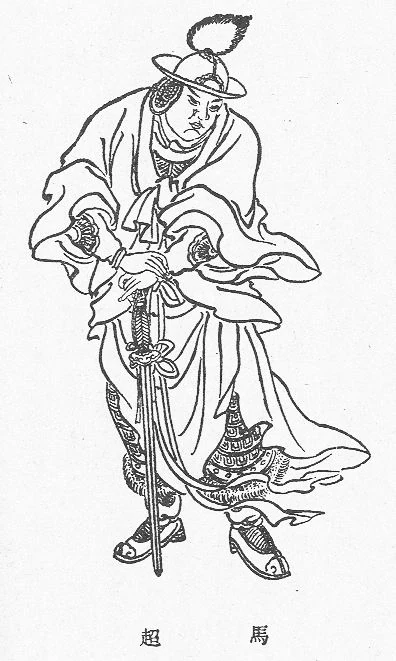
176 CE–222 CE
Military commander
Ma Chao
马超
Ma Chao (176–222), courtesy name Mengqi, was a native of Maoling in Fufeng (northeast of present-day Xingping, Shaanxi) and a descendant of the Han general Ma Yuan, General Fubo. He was a prominent military commander of Shu Han during the late Han and Three Kingdoms period. Known from youth for his physical prowess and courage, Ma Chao joined Han Sui and other Guanzhong commanders in rising against Cao Cao and for a time…
176 CE–222 CEEastern Han
PROFILE
Ma Chao (176–222), courtesy name Mengqi, was a native of Maoling in Fufeng (northeast of present-day Xingping, Shaanxi) and a descendant of the Han general Ma Yuan, General Fubo. He was a prominent military commander of Shu Han during the late Han and Three Kingdoms period. Known from youth for his physical prowess and courage, Ma Chao joined Han Sui and other Guanzhong commanders in rising against Cao Cao and for a time posed a serious threat to him during the Battle of Tong Pass. After defeat he moved between several bases, entered the service of Zhang Lu in Hanzhong, and eventually submitted to Liu Bei, becoming an important Shu Han commander. After Liu Bei proclaimed himself emperor, Ma Chao rose to General of Agile Cavalry, concurrently Governor of Liang Province, and was promoted to Marquis of Lixiang. He died of illness in 222, the second year of the Zhangwu era, at the age of forty-seven by traditional reckoning, and was posthumously titled Marquis Wei during Liu Shan's reign.
- Period
- Shu Han
- Date of Birth
- 176
- Date of Death
- 222
- Dynasty/Regime
- Shu Han
- Identity
- Military commander
- Ethnicity/Ethnic Affiliation
- Not reliably confirmed by existing sources
- Native Place
- Maoling, Fufeng (northeast of present-day Xingping, Shaanxi)
- Place of Birth
- Unknown
- Era
- Shu Han
- Dynasty
- The late Eastern Han and Shu Han of the Three Kingdoms
- Ethnicity
- Han
- Ancestral Home
- Maoling of the Right Fufeng
- Place of Death
- Unknown
- Lifespan
- 47 years
- Peerage
- Marquis of the Pavilion of the Capital, marquis of Taixiang
LIFE TIMELINE
Birth | Born at Maoling in Youfufeng, present-day Xingping in Shaanxi.Open
Birth | Born at Maoling in Youfufeng, present-day Xingping in Shaanxi.
Age 20 | Accompanied his father Ma Teng during fighting with Han Sui; Open
Age 20 | Accompanied his father Ma Teng during fighting with Han Sui; fought Han Sui's subordinate Yan Xing and was nearly killed with a broken spear.
Age 26 | Fought Guo Yuan and Gao Gan under Zhong Yao. Although shot inOpen
Age 26 | Fought Guo Yuan and Gao Gan under Zhong Yao. Although shot in the foot, he bound the wound and continued fighting; his subordinate Pang De killed Guo Yuan.
Age 32 | Ma Teng entered court service as Minister of the Guards. Ma COpen
Age 32 | Ma Teng entered court service as Minister of the Guards. Ma Chao remained in Liang Province, inherited command of his father's troops, and was appointed General of a Separate Command and Marquis of Duting.
Age 35 | Joined Han Sui and other Guanzhong commanders in rebelling agOpen
Age 35 | Joined Han Sui and other Guanzhong commanders in rebelling against Cao Cao, confronted him at Tong Pass, and was later defeated after Cao Cao sowed dissension among the allies.
Age 36 | His father Ma Teng and more than two hundred relatives and hoOpen
Age 36 | His father Ma Teng and more than two hundred relatives and household members were executed by Cao Cao.
Age 37 | Captured Ji City and styled himself General Who Conquers the Open
Age 37 | Captured Ji City and styled himself General Who Conquers the West; after Yang Fu and others rebelled against him, he fled to Hanzhong and joined Zhang Lu.
Age 38 | Submitted to Liu Bei and assisted in the seizure of Chengdu.Open
Age 38 | Submitted to Liu Bei and assisted in the seizure of Chengdu.
Age 43 | After Liu Bei became King of Hanzhong, Ma Chao was appointed Open
Age 43 | After Liu Bei became King of Hanzhong, Ma Chao was appointed General of the Left and granted a tally of authority.
Age 45 | After Liu Bei proclaimed himself emperor, Ma Chao was promoteOpen
Age 45 | After Liu Bei proclaimed himself emperor, Ma Chao was promoted to General of Agile Cavalry, concurrently Governor of Liang Province, and advanced to Marquis of Lixiang.
Age 46 | Died of illness; shortly before death he submitted a memorialOpen
Age 46 | Died of illness; shortly before death he submitted a memorial entrusting his younger clansman Ma Dai to Liu Bei.
Posthumous honor | Received the posthumous title Marquis Wei.Open
Posthumous honor | Received the posthumous title Marquis Wei.
He died of illness in 222 | He died of illness in 222, the second yearOpen
He died of illness in 222 | He died of illness in 222, the second year o Shortly before his death he memorialized Liu Bei that more than two hundred members of his clan had been almost completely exterminated by Cao Cao, leaving only his younger clansman Ma Dai to continue the ancestral sacrifices, and entrusted Ma Dai to the emperor.
Chengdu | Liu Shan, the Later Ruler of Shu Han, posthumously honoured Open
Chengdu | Liu Shan, the Later Ruler of Shu Han, posthumously honoured Ma Chao as Marquis Wei in recognition of his bravery and service.
Marquis Wei conferred | He was posthumously honoured as Marquis Wei.Open
Marquis Wei conferred | He was posthumously honoured as Marquis Wei.
BIOGRAPHY
Major Activities
Military Activity Ma Chao's best-known military campaign was his confrontation with Cao Cao at the Battle of Tong Pass. Leading a coalition of ten Guanzhong forces said to number one hundred thousand, he fought Cao Cao for several months along the Wei River and Tong Pass and at one point nearly trapped him. During Cao Cao's crossing of the Yellow River, Ma Chao attacked with more than ten thousand cavalry and infantry under a rain of arrows, and Cao Cao escaped only through Xu Chu's desperate protection. Cao Cao's later remark that if "the Ma boy" did not die he would have nowhere to be buried reflected the scale of the threat Ma Chao posed. At the Battle of Pingyang in 202, the seventh year of Jian'an, Ma Chao struck Guo Yuan's army while it was crossing the river. Though wounded in the foot by an arrow, he bound the injury and continued fighting. Guo Yuan's forces were routed and Pang De killed Guo Yuan, bringing Ma Chao wider fame. In 213, the eighteenth year of Jian'an, Ma Chao captured Ji City after an eight-month siege, forced Liang Province Inspector Wei Kang to surrender, and later defeated Xiahou Yuan's relief force two hundred li from the city. Although his position collapsed after he lost political support, the campaign demonstrated his military ability. ### Political Activity Ma Chao's political career was highly unstable. He initially refused Cao Cao's summons and remained in Liang Province commanding his father's troops. In 211 he joined the Guanzhong commanders in rising against Cao Cao. After defeat he eventually entered Zhang Lu's service and then submitted to Liu Bei. Under Shu Han he rose to General of Agile Cavalry, concurrently Governor of Liang Province, and Marquis of Lixiang, placing him among the highest-ranking Shu Han military figures. ### Travels and Movements Ma Chao's career took him across Guanzhong, Liang Province, Hanzhong, and Yi Province. In his early years he campaigned with Ma Teng in Liang Province and later occupied Huaili while controlling part of the Three Capital Commanderies. After rising against Cao Cao, he fought at Tong Pass and south of the Wei River, withdrew into Liang Province, and captured Ji City. Following his defeat he fled through Wudu into Di territory and then joined Zhang Lu in Hanzhong. He ultimately submitted to Liu Bei, entered Chengdu, and was later stationed at Linju and associated with operations on Shu Han's northern frontier. ### Relations with Contemporaries Ma Chao's relationship with Han Sui was especially complex. Their fathers' forces had fought each other in Ma Chao's youth; later Ma Chao and Han Sui allied against Cao Cao, only to become suspicious of each other after Cao Cao's stratagem and suffer defeat. His relationship with Zhang Lu was also uneasy: Zhang Lu at one point considered marrying a daughter to him, but abandoned the plan after being advised against it, and jealousy among Zhang Lu's followers eventually drove Ma Chao away. After submitting to Liu Bei, Ma Chao was grouped with Guan Yu, Zhang Fei, Huang Zhong, and Zhao Yun as a leading Shu Han commander; Chen Shou placed all five in a single collective biography in the *Records of the Three Kingdoms*.
Personal Relations
- Ma Teng: Father, a Liang Province warlord of the late Eastern Han who later entered court service as Minister of the Guards and was executed by Cao Cao because of Ma Chao's uprising.
- Ma Xiu: Younger brother, Commandant of the Imperial Carriages, executed by Cao Cao because of Ma Chao's uprising.
- Ma Tie: Younger brother, Commandant of Cavalry, executed by Cao Cao because of Ma Chao's uprising.
- Ma Dai: Younger clansman who followed Ma Chao and later became an important Shu Han commander.
- Lady Yang: Principal wife, killed at Ji City.
- Lady Dong: Concubine left in Hanzhong when Ma Chao joined Liu Bei; later captured by Cao Cao and given to Yan Pu.
- Ma Qiu: Son by Lady Dong, killed by Zhang Lu.
- Ma Cheng: Son who inherited the marquisate of Lixiang.
- Lady Ma: Daughter who married Liu Li, Prince of Anping and son of Liu Bei. ### Associates - Zhong Yao: Colonel Director of Retainers who persuaded Ma Teng to provide troops; Ma Chao served under his overall command in the campaign against Guo Yuan.
- Zhang Ji: Persuaded Ma Teng to enter court service and later urged Ma Chao to submit to Liu Bei. ### Rulers - Cao Cao: Principal enemy at Tong Pass; later ordered the execution of Ma Chao's family.
- Liu Bei: Ruler whom Ma Chao joined and who appointed him General of Agile Cavalry and Marquis of Lixiang.
- Zhang Lu: Former patron whom Ma Chao later left because of jealousy among Zhang Lu's followers. ### Conflicts - Han Sui: Allied with Ma Chao against Cao Cao but became mutually suspicious after Cao Cao's stratagem.
- Yan Xing: Han Sui's subordinate who once nearly killed Ma Chao.
- Yang Fu: A principal organizer of the rebellion against Ma Chao at Ji City; Ma Chao's wife and children were killed during the uprising.
- Peng Yang: Reported by Ma Chao after making seditious remarks and subsequently imprisoned and executed.
Historical Assessment
Three Kingdoms Period - Cao Cao was recorded as saying that if "the Ma boy" did not die, he would have nowhere to be buried, and also that he had nearly been trapped or deceived by the enemy, reflecting his concern about Ma Chao's military power.
- Yang Fu stated that Ma Chao had the courage of Han Xin and Ying Bu and enjoyed strong support among the Qiang and Hu, while also criticizing him as powerful but lacking righteousness and for turning against his father and ruler and killing provincial officials.
- Chen Shou wrote in the *Records of the Three Kingdoms* that Ma Chao relied on the Rong peoples and his own courage only to bring ruin upon his clan, while observing that his eventual escape from extremity into security was at least preferable to complete destruction.
- Liu Bei described Ma Chao as one of his "claws and teeth," placing him alongside Guan Yu and Zhang Fei as an important military servant. ### Jin and Northern and Southern Dynasties - Fu Xuan of Western Jin recorded Ma Chao's attack on the Su clan's fortified settlement in the *Rhapsody on the Imperial Carriage Horse*, describing his martial activity.
- Pei Songzhi's annotations to the *Records of the Three Kingdoms*, citing the *Dianlüe*, *Weilüe*, and other works, add many details about Ma Chao and question the account in the *Shanyang Gong Zaiji* that Ma Chao addressed Liu Bei by his personal style name.
- Xi Zuochi of Eastern Jin discussed Ma Chao's uprising against Cao Cao in the *Han-Jin Chunqiu* and commented on the fate of his family. ### Song, Yuan, Ming, and Qing Periods - Sima Guang's *Comprehensive Mirror in Aid of Governance* provides a detailed account of Ma Chao and the Battle of Tong Pass in a comparatively restrained narrative.
- Chen Liang of the Southern Song described Ma Chao in his *Chronology of the Three Kingdoms* as a "hero of his time," regarding him as exceptionally brave but deficient in strategy.
- Luo Guanzhong's *Romance of the Three Kingdoms* popularized the image of "Brocade Ma Chao" and grouped him with Guan Yu, Zhang Fei, Huang Zhong, and Zhao Yun among the Five Tiger Generals.
- The Qing scholar He Zhuo, in *Yimen Dushu Ji*, described Ma Chao as brave but lacking strategy and unable to build a great enterprise despite his support among Qiang and Hu groups. ### Modern Period - Lü Simian's *Informal History of the Three Kingdoms* regards Ma Chao as a significant regional power among the late Han contenders and attributes his failure in part to a lack of political foresight.
- Fang Beichen, in *Famous Generals of the Three Kingdoms*, describes Ma Chao as a formidable battlefield commander while also emphasizing that his political immaturity contributed to the destruction of his family.
- Modern screen portrayals often present Ma Chao as a young, imposing, and exceptionally brave commander, and the epithet "Brocade Ma Chao" remains widely known.
CONTEMPORARIES
Bibliography
- Chen Shou, *Records of the Three Kingdoms*, *Book of Shu*, "Biographies of Guan Yu, Zhang Fei, Ma Chao, Huang Zhong, and Zhao Yun," Zhonghua Book Company collated edition.
- Pei Songzhi, annotations to the *Records of the Three Kingdoms*, citing the *Dianlüe*, *Weilüe*, *Shanyang Gong Zaiji*, and other works.
- Fang Beichen, *Famous Generals of the Three Kingdoms*, Peking University Press.
- Lü Simian, *Informal History of the Three Kingdoms*, Zhonghua Book Company.