At about age twenty | his early deeds are unknown; he may have joined the army locally in Nanyang Commandery
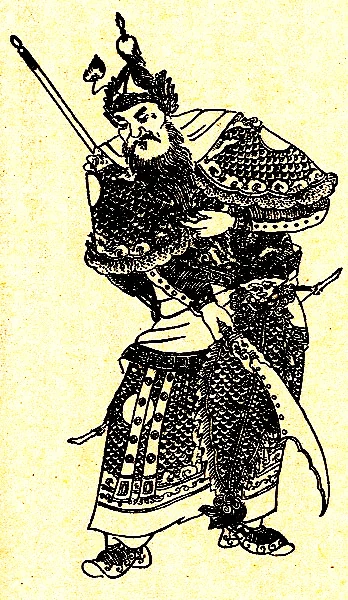
147 CE–220 CE
General
Huang Zhong
黄忠
Huang Zhong (birth year unknown–220), courtesy name Hansheng, was a native of Nanyang Commandery in Jing Province, now Nanyang, Henan. He was a celebrated general under Liu Bei in the late Eastern Han and a founding contributor to Shu Han. Early in life he served Liu Biao, governor of Jing Province, and later came under Han Xuan, administrator of Changsha. He surrendered to Liu Bei in 209 (Jian'an 14), when Liu pacified the…
147 CE–220 CEShu Han
PROFILE
Huang Zhong (birth year unknown–220), courtesy name Hansheng, was a native of Nanyang Commandery in Jing Province, now Nanyang, Henan. He was a celebrated general under Liu Bei in the late Eastern Han and a founding contributor to Shu Han. Early in life he served Liu Biao, governor of Jing Province, and later came under Han Xuan, administrator of Changsha. He surrendered to Liu Bei in 209 (Jian'an 14), when Liu pacified the four southern commanderies of Jing Province. On the campaign to take Yi Province, Huang led from the front and was unsurpassed in valor. At Mount Dingjun in 219 (Jian'an 24), he killed the Cao Wei general Xiahou Yuan in battle, an achievement that shocked the realm and earned him promotion to General Who Conquers the West. Later that year, when Liu Bei assumed the title King of Hanzhong, Huang was appointed General of the Rear, equal in rank to Guan Yu, Zhang Fei, and Ma Chao, and enfeoffed as a Marquis Within the Passes. He died of illness the following year and received the posthumous title Marquis Gang in 260 (Jingyao 3). Chen Shou grouped Huang with Guan Yu, Zhang Fei, Ma Chao, and Zhao Yun in a single collective biography in the Records of the Three Kingdoms. Luo Guanzhong later drew on this arrangement to create the “Five Tiger Generals” in the Romance of the Three Kingdoms, and Huang became an enduring symbol of vigor in old age.
- Other Name
- Huang Hansheng
- Courtesy Name
- Hansheng
- Era
- Shu Han
- Dynasty/Regime
- Shu Han
- Identity
- General
- Date of Birth
- Not recorded in historical sources
- Date of Death
- 220
- Ethnicity/Group
- Han Chinese
- Ancestral Home
- Nanyang Commandery, Jing Province (present-day Nanyang, Henan)
- Place of Birth
- Unknown
- Major Achievements
- Veteran general of Shu Han; won fame by killing Xiahou Yuan at Mount Dingjun; later counted among the Five Tiger Generals.
- Courtesy / Art Name
- Hansheng
- Dynasty
- Shu Han
- Ethnicity
- Han
- Place of Death
- Place of death unknown
- Lifespan
- Unknown
- Highest Office
- See Biography below
- Major Offices
- See Biography below
- Posthumous Name
- Marquis Gang
LIFE TIMELINE
At about age forty-five | Liu Biao appointed him General of the Household; with Liu Biao’s nephew Liu Pan, he defended You County in Changsha
At about age sixty-one | after Cao Cao advanced south and took Jing Province, Huang served in an acting capacity as General of the Assistant Division, remained at Changsha, and came under Administrator Han Xuan
At about age sixty-two | after Liu Bei campaigned through the four commanderies of southern Jing and Han Xuan surrendered, Huang entered Liu Bei’s service
At about age sixty-four | accompanied Liu Bei into Shu under the pretext of assisting Liu Zhang against Zhang Lu
At about age sixty-six | after Liu Bei broke with Liu Zhang, Huang and Zhuo Ying advanced from Jiameng Pass toward Chengdu; Huang’s courage surpassed the entire army
At about age sixty-seven | after Liu Bei captured Chengdu and pacified Yi Province, Huang was appointed General Who Attacks Rebels
At about age seventy-one | accompanied Liu Bei in the campaign against Hanzhong
At about age seventy-two | killed Xiahou Yuan at Mount Dingjun and was promoted to General Who Conquers the West; after Liu Bei became King of Hanzhong, Huang was appointed General of the Rear and enfeoffed as Marquis Within the Passes
At about age seventy-three | died of illness
Event | Posthumously named Marquis Gang by Liu Shan
BIOGRAPHY
Biography
Family Background and Early Life Huang Zhong, courtesy name Hansheng, was from Nanyang Commandery in Jing Province. Historical records say almost nothing about his family background or early life. His biography in the Records of the Three Kingdoms begins only: “Huang Zhong, courtesy name Hansheng, was a man of Nanyang,” without mentioning his family or youth. Nanyang was the imperial home region of the Eastern Han, where Emperor Guangwu had first risen, and was populous and rich in eminent clans. Huang, however, evidently did not come from a great family; Chen Shou’s silence suggests humble origins. No historical source records Huang’s birth year. By the Battle of Mount Dingjun in 219 he was already called an “old soldier” by Guan Yu, while the Romance of the Three Kingdoms presents him as “nearly sixty” when he first appears. Later writers have therefore estimated that he has an unconfirmed birth year, more than ten years before Guan Yu, whose birth is conventionally placed around 160. ### Service under Liu Biao and Defense of Changsha In 192 (Chuping 3), Liu Biao became governor of Jing Province. Huang was appointed General of the Household and stationed with Liu Biao’s nephew Liu Pan at You County in Changsha, now You County, Hunan. You County lay in southern Jing Province on the frontier with the Sun family’s Jiangdong territory and was a key military position on Jing’s eastern side. Huang and Liu Pan’s main task was to resist pressure from Sun Ce and Taishi Ci. Taishi Ci’s biography in the Records of the Three Kingdoms records that Sun Ce ordered him to garrison Jianchang, around present-day Fengxin County in Jiangxi, and command the generals resisting Liu Pan. This confirms that Liu Pan and Huang’s operations around Changsha posed a genuine threat to Jiangdong. During roughly sixteen years under Liu Biao, Huang remained a General of the Household, with no recorded promotion. This suggests both that Liu Biao did not fully appreciate his ability and that Huang had not yet found an opportunity to distinguish himself. ### Surrender to Liu Bei and the Campaign in Yi Province In 208 (Jian'an 13), Cao Cao invaded Jing Province. Liu Biao died, and his son Liu Cong surrendered. After occupying Jing, Cao Cao appointed Huang acting General of the Assistant Division and left him in Changsha under Administrator Han Xuan. In 209, after Liu Bei and Sun Quan’s allied forces defeated Cao Cao at Red Cliffs, Liu Bei campaigned through the four southern commanderies of Wuling, Changsha, Guiyang, and Lingling. Han Xuan surrendered, and Huang entered Liu Bei’s service with him. Huang was already over sixty and initially received no special responsibility from Liu Bei. In 211, Liu Bei entered Shu at the invitation of Liu Zhang, governor of Yi Province, ostensibly to help oppose Zhang Lu of Hanzhong; Huang accompanied him. In 213, Liu Bei broke with Liu Zhang, and Huang and Zhuo Ying led troops from Jiameng Pass toward Chengdu. Liu Bei first brought his own troops to the pass and joined Huang’s force. Huang repeatedly charged first into battle and was unsurpassed in courage and resolution. Advancing to Fu, they defeated the forces Liu Zhang sent under Liu Gui, Leng Bao, Zhang Ren, and Deng Xian. Huang followed Liu Bei against Mianzhu, whose defenders Li Yan, Fei Shi, and others surrendered in turn. In 214, Liu Bei surrounded Chengdu; Liu Zhang surrendered, and Yi Province was pacified. Liu Bei rewarded Huang by appointing him General Who Attacks Rebels. From Jiameng Pass to Chengdu, Huang, though in his sixties, fought in the front ranks. His bravery finally won Liu Bei’s trust and recognition. ### Battle of Mount Dingjun and Appointment as General In 218, Huang accompanied Liu Bei in the invasion of Hanzhong. In the first month of 219, Liu Bei confronted Xiahou Yuan, Cao Wei’s commander in Hanzhong, at Mount Dingjun. Xiahou Yuan assigned Zhang He to defend the abatis of the eastern enclosure and personally guarded those of the southern enclosure. When Zhang He’s position came under attack and fared poorly, Xiahou Yuan divided his troops to reinforce him, leaving only four hundred elite soldiers at the southern enclosure. Huang drove his assault relentlessly forward, encouraged his men, and advanced amid thunderous drums and cheers that shook the valley. In a single engagement he killed Xiahou Yuan at the southern abatis. With their commander dead, Cao’s forces lost heart. Huang attacked their camp and inflicted a major defeat. The engagement was decisive in the Hanzhong campaign: after Xiahou Yuan’s death, Cao Wei morale collapsed and Liu Bei gained complete control of Hanzhong. Huang was promoted to General Who Conquers the West. In the seventh month of the same year, Liu Bei declared himself King of Hanzhong at Mianyang. He appointed Guan Yu General of the Vanguard, Zhang Fei General of the Right, Ma Chao General of the Left, and Huang General of the Rear. Zhuge Liang objected that “Zhong’s reputation has never been comparable to Guan’s and Ma’s,” and feared that Guan Yu, far away in Jing Province, would be displeased. Liu Bei answered, “I shall explain it to him myself,” and sent Fei Shi, major of the vanguard headquarters of Yi Province, to persuade Guan. Fei told him that “the king and you, my lord, are as one body, sharing glory and disgrace, fortune and misfortune.” Although Guan still protested, “A true man will never stand in the same rank as an old soldier,” he ultimately accepted his appointment. Huang thus stood alongside Guan Yu, Zhang Fei, and Ma Chao and was enfeoffed as Marquis Within the Passes. ### Death and Posthumous Honors Huang died of illness in the eighth month of 220. His son Huang Xu had died young and left no descendants. In the ninth month of 260, Liu Shan posthumously honored the late generals Guan Yu, Zhang Fei, Ma Chao, Pang Tong, and Huang Zhong. Huang received the title Marquis Gang. In the rules of posthumous naming, gang was defined as “strong, resolute, courageous, and decisive,” an apt description of him.
Major Activities
Killing Xiahou Yuan at Mount Dingjun The Battle of Mount Dingjun in 219 was Huang’s greatest achievement and the crucial turning point in the Hanzhong campaign. Liu Bei and Cao Cao had contested Hanzhong for nearly two years. Xiahou Yuan, Cao Wei’s western commander, held Hanzhong against Liu Bei. When Xiahou divided his troops to aid Zhang He and left the southern abatis weakly defended, Huang attacked downhill from high ground and killed him. The victory did more than remove a leading Cao general: it transformed the strategic situation. Cao Cao personally led an army to contest Hanzhong after hearing of Xiahou’s death, but Liu Bei already held the commanding terrain. Cao withdrew in the fifth month of 219, leaving Liu in full possession of Hanzhong and laying an important foundation for the establishment of Shu Han. The Records of the Three Kingdoms gives a terse account: “In Jian'an 24, he attacked Xiahou Yuan at Mount Dingjun in Hanzhong. Yuan’s troops were very elite, but Zhong drove the spearhead relentlessly onward and encouraged his soldiers. Drums and gongs shook heaven, and their cheers moved the valley. In one battle they beheaded Yuan, and Yuan’s army suffered a great defeat.” The Imperial Reader of the Taiping Era, quoting Cao Cao’s “Military Directive,” records Cao’s subsequent criticism of Xiahou Yuan: “Yuan was never skilled in the use of troops. In the army they called him the ‘General of Open Ground.’ A commander-in-chief should not personally fight, much less repair an abatis.” Cao’s grief and reproach show the scale of the blow to Cao Wei. ### Foremost in Valor during the Yi Province Campaign In 213–214, Huang distinguished himself during Liu Bei’s conquest of Yi Province. After Liu Bei broke with Liu Zhang, Huang and Zhuo Ying advanced from Jiameng Pass toward Chengdu and helped take Fu and Mianzhu. At Fu, Huang’s troops defeated Liu Zhang’s generals Liu Gui, Leng Bao, Zhang Ren, and Deng Xian. Chen Shou wrote that Huang “always ascended first and broke the enemy’s formations; his courage and resolution surpassed the entire army,” high praise even among the valorous commanders of Shu Han. The Yi campaign transformed him from an obscure veteran into a regional commander trusted by Liu Bei. ### Appointment as General of the Rear After becoming King of Hanzhong in 219, Liu Bei appointed Huang General of the Rear alongside Guan Yu, Zhang Fei, and Ma Chao. This was the highest honor among the military commanders of Liu Bei’s group. Zhuge Liang objected that Huang’s reputation was insufficient to equal Guan and Ma, but Liu Bei insisted and sent Fei Shi to Jing Province to persuade Guan. Guan was displeased but eventually accepted Fei’s argument that he and Liu Bei were “as one body.” The episode is recorded in detail in Fei Shi’s biography in the Records of the Three Kingdoms. Huang’s honor at an advanced age both recognized his victory at Mount Dingjun and illustrated Liu Bei’s willingness to promote talent without regard to convention. ### Later Commemoration and Sites Huang Zhong’s tomb was traditionally located in Huangzhong Village, Yingmenkou Township, west of Chengdu. In 1825, farmers uncovered a tombstone inscribed “Tomb of Huang Hansheng, taboo personal name, Marquis Gang,” along with several human bones, a sword, and a piece of jade. The local scholar Liu Yuan gathered gentry contributions to restore the tomb, which stood four meters high and about thirteen meters in circumference, and built a shrine with a seated statue of Huang. The local name “Chicken-Droppings Tree” gradually gave way to “Huang Zhong’s Tomb.” Villagers held a temple fair there each Qingming Festival. During the Great Leap Forward, the slogan “Young people surpass Zhao Zilong; old people surpass old Huang Zhong” became popular, and Chicken-Droppings Tree was renamed Huangzhong Village, now Huangzhong Subdistrict. Road works opened the tomb in 1965, and the shrine and tomb were almost entirely destroyed during the Cultural Revolution. Restoration has begun in recent years. A stele reading “Native Place of Huang Zhong, General of the Rear and Marquis Gang of the Ji Han” stands in Xiaxiangpu Village, Xindian Township, Nanyang County, Henan; it was erected in 1910.
Personal Relations
- Han Xuan: Administrator of Changsha, under whom Huang served after Cao Cao took Jing Province.
- Liu Bei: Final lord; trusted Huang and appointed him General of the Rear.
- Liu Shan: Later emperor of Shu Han; posthumously named Huang Marquis Gang. ### Colleagues - Guan Yu: Fellow Shu Han general; objected to Huang’s appointment as General of the Rear and said, “A true man will never stand in the same rank as an old soldier.”
- Zhang Fei: Fellow Shu Han general, ranked alongside Huang.
- Ma Chao: Fellow Shu Han general, ranked alongside Huang.
- Zhao Yun: Fellow Shu Han general; Chen Shou assessed him jointly with Huang.
- Zhuge Liang: Chancellor of Shu Han; objected to Huang’s appointment as General of the Rear.
- Fei Shi: Sent by Liu Bei to persuade Guan Yu to accept Huang’s appointment.
- Liu Pan: Liu Biao’s nephew; defended You County in Changsha with Huang.
- Zhuo Ying: Led troops toward Chengdu with Huang. ### Enemies - Xiahou Yuan: Cao Wei commander in Hanzhong; killed by Huang at Mount Dingjun.
- Zhang He: Cao Wei general who fought Liu Bei’s army at the eastern abatis during the Battle of Mount Dingjun.
Historical Assessment
Shu Han and Contemporary Views - Zhuge Liang said: “Zhong’s reputation has never been comparable to Guan’s and Ma’s, yet now he is to stand in the same rank. Ma and Zhang are nearby and personally saw his achievement, so the matter can still be explained to them. Guan will hear of it from afar and will certainly be displeased. Might this not be inadvisable?” (Records of the Three Kingdoms, “Biography of Huang Zhong”). Although expressing doubt about Huang’s promotion, the statement indirectly acknowledged his military achievement.
- Guan Yu said: “A true man will never stand in the same rank as an old soldier!” (Records of the Three Kingdoms, “Biography of Fei Shi”). The remark was openly dismissive but also confirms Huang’s advanced age.
- After Mount Dingjun, Liu Bei joked: “You should have taken their chief; what use was killing this one?”—meaning that Huang should have killed Zhang He rather than Xiahou Yuan. Though playful, the remark shows Liu Bei’s satisfaction with the victory.
- Yang Xi praised Huang in his Appraisal of the Supporting Ministers of the Ji Han: “The general was solid and vigorous; he broke the spearhead and climbed through peril, established merit and accomplished deeds, and was a pillar of his time.” ### Wei, Jin, and Northern and Southern Dynasties - Chen Shou wrote in the Records of the Three Kingdoms: “Zhong always ascended first and broke the enemy’s formations; his courage and resolution surpassed the entire army.” He also wrote: “Huang Zhong and Zhao Yun were strong, steadfast, vigorous, and fierce, and both served as claws and teeth. Were they not men of the type of Guan Ying and Xiahou Ying?” Chen compared Huang to the founding Han general Guan Ying and regarded him as one of Liu Bei’s most effective champions.
- The grouping of Huang with Guan Yu, Zhang Fei, Ma Chao, and Zhao Yun in one collective biography itself recognized his status. ### Song, Yuan, Ming, and Qing Periods - Cheng Gongxu of the Southern Song wrote: “Among Shu’s generals were Guan Yu, Zhang Fei, and Pang Tong, and among Wu’s were Zhou Yu and Lu Su; their aspirations were long but their lives short, and all under heaven deeply regretted them. Ma Chao, Huang Zhong, Zhao Yun, Fei Yi, Lü Meng, Cheng Pu, Bu Zhi, Gan Ning, and their peers were all unmatched in wisdom and courage, sufficient to take responsibility for an entire front.” (Cangzhou Chenfou Collection)
- Luo Guanzhong’s late-Yuan and early-Ming Romance of the Three Kingdoms heavily embellished Huang’s life. One laudatory poem begins: “The general’s spirit reached to heaven; / white-haired, he still held southern Han in awe...” Another praises him: “Of veteran generals, Huang Zhong is named; / he won great merit in taking Sichuan. / Again he donned linked golden armor / and drew twin iron-backed bows...”
- Li Jingxing wrote in Critical Discussions of the Four Histories: “Guan Yu, Zhang Fei, Ma Chao, Huang Zhong, and Zhao Yun were all famous generals of Shu and were therefore given a combined biography.” ### Modern Period - In later tradition, Huang became synonymous with vigor in old age, and “old Huang Zhong” came to describe an elderly but strong and courageous person. The Great Leap Forward slogan “Young people surpass Zhao Zilong; old people surpass old Huang Zhong” demonstrates how deeply his image had entered popular culture.
- Modern scholars generally regard Huang as the archetypal veteran of Liu Bei’s forces. His killing of Xiahou Yuan was the key turning point in the Hanzhong campaign and made an important contribution to Liu Bei’s establishment of Shu Han.
- Huang appears widely in modern film, television, games, and animation, including the Dynasty Warriors series and Legends of the Three Kingdoms. His artistic image as an elderly master archer is deeply rooted in popular consciousness.
FIGURES ASSOCIATED WITH THIS DYNASTY
Bibliography
- Chen Shou, annotated by Pei Songzhi, Records of the Three Kingdoms, “Book of Shu: Collective Biography of Guan Yu, Zhang Fei, Ma Chao, Huang Zhong, and Zhao Yun”
- Chen Shou, annotated by Pei Songzhi, Records of the Three Kingdoms, “Book of Shu: Biography of Fei Shi”
- Chen Shou, annotated by Pei Songzhi, Records of the Three Kingdoms, “Book of Shu: Biography of the Former Lord”
- Chen Shou, annotated by Pei Songzhi, Records of the Three Kingdoms, “Book of Wu: Biography of Taishi Ci”