Raids in Central China
Dispatched by Dong Zhuo to negotiate an alliance with Sun Jian, which was rebuffed; subsequently routed Zhu Jun at Zhongmu and ravaged Yingchuan.
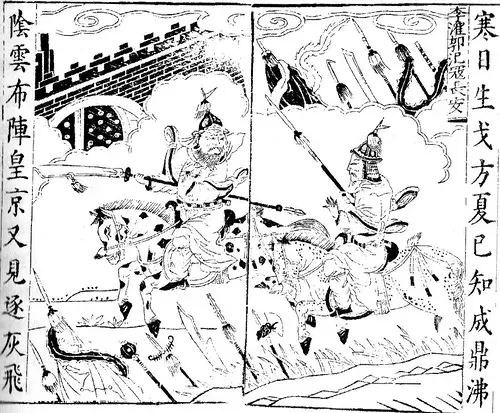
?–198 CE
李傕
Li Jue (李傕, died 198), courtesy name Zhiran, was a native of Niyang in Beidi Commandery. He was a dominant warlord, autocratic chancellor, and Liangzhou military leader during the tumultuous collapse of the Eastern Han dynasty. Rising through the frontier cavalry of northwestern China, Li Jue emerged as a premier field commander under the warlord Dong Zhuo. Liu Ai, Dong Zhuo's chief secretary, rated Li Jue and Guo Si's…
Li Jue (李傕, died 198), courtesy name Zhiran, was a native of Niyang in Beidi Commandery. He was a dominant warlord, autocratic chancellor, and Liangzhou military leader during the tumultuous collapse of the Eastern Han dynasty. Rising through the frontier cavalry of northwestern China, Li Jue emerged as a premier field commander under the warlord Dong Zhuo. Liu Ai, Dong Zhuo's chief secretary, rated Li Jue and Guo Si's tactical flexibility and battlefield command as superior even to that of Sun Jian. During the early Chuping era, Li Jue campaigned across the Central Plains, routing veteran imperial commander Zhu Jun at Zhongmu and plundering Yingchuan and Chenliu. Following the assassination of Dong Zhuo by Situ Wang Yun and Lu Bu in 192, the Liangzhou garrison was threatened with complete annihilation. Adopting the strategic counsel of strategist Jia Xu, Li Jue forged an alliance with Guo Si, Zhang Ji, and Fan Chou, rallying over one hundred thousand soldiers in a furious march on Chang'an. Storming the capital, Li Jue drove Lu Bu into flight, executed Wang Yun, and massacred court officials. Taking custody of the young Emperor Xian, Li Jue appointed himself General of Chariots and Cavalry, Colonel Director of Retainers, and Marquis of Chiyang, subsequently rising to Grand Marshal. For four years, he ruled the empire with dictatorial power, establishing Liangzhou dominance and repelling a joint invasion by western warlords Ma Teng and Han Sui. However, Li Jue's governance was characterized by extreme brutality, internal factionalism, and superstitious obsession with sorcery and divination. Severe droughts and swarms of locusts devastated Guanzhong, driving the population to mass starvation. In 195, a bitter personal feud erupted between Li Jue and Guo Si, turning Chang'an into an urban battlefield for months. Li Jue abducted Emperor Xian into his fortified northern fortress, while Guo Si seized the imperial civil ministers as hostages. When the emperor subsequently attempted to flee eastward toward Luoyang, Li Jue and Guo Si reunited to pursue the imperial entourage, routing the loyalist defenders at Caoyang and slaughtering numerous ministers. After Cao Cao escorted Emperor Xian to the new capital at Xu, the court dispatched Palace Attendant Pei Mao to lead western generals against Li Jue's stronghold at Huangbaicheng. In 198, Li Jue was defeated, beheaded, and his head was publicly displayed at the gates of Xu, with his entire lineage exterminated.
Dispatched by Dong Zhuo to negotiate an alliance with Sun Jian, which was rebuffed; subsequently routed Zhu Jun at Zhongmu and ravaged Yingchuan.
Following Dong Zhuo's death, adopted Jia Xu's plan to counterattack Chang'an, routing Lu Bu, executing Wang Yun, and seizing control of the court.
Granted authority to open an independent administrative office, appointed Colonel Director of Retainers, and ennobled as Marquis of Chiyang.
Crushed the joint invasion of Chang'an by Ma Teng and Han Sui at Changpingguan, later assassinating colleague Fan Chou at a banquet.
Advanced to Grand Marshal; erupted into open street warfare with Guo Si, abducting Emperor Xian to his military encampment and burning the palace.
Pursued the fleeing imperial court eastward, routing the escort army at Caoyang and massacring dozens of imperial ministers.
Emperor Xian relocated to Luoyang and then to Xu under Cao Cao's protection; Li Jue retreated to his mountain fortress at Huangbaicheng.
Besieged by imperial forces under Pei Mao at Huangbaicheng, captured and beheaded, with his severed head displayed at Xu and his family exterminated.
Li Jue was born in Niyang in Beidi Commandery, situated on the arid northwestern frontier of the Han empire. The borderlands of Liangzhou were marked by frequent tribal conflicts between Han Chinese settlers and Qiang nomads, nurturing a fiercely militarized frontier society. In his youth, Li Jue joined the regional cavalry, gradually distinguishing himself through martial prowess and tactical skill. Following the death of Emperor Ling in 189, General Dong Zhuo led his seasoned Liangzhou legions into Luoyang, deposing the sovereign and seizing absolute authority. Recognizing Li Jue's daring aggression, Dong Zhuo elevated him to senior cavalry colonel within his elite vanguard units. Liu Ai, Dong Zhuo's chief military secretary, highly appraised the battlefield coordination of Li Jue and Guo Si, remarking that their command over cavalry flanking maneuvers surpassed that of southeastern warlord Sun Jian.
In 190, regional warlords across eastern China formed a grand coalition to overthrow Dong Zhuo. In the spring of 191, after Sun Jian annihilated Dong Zhuo's vanguard at Yangren and decapitated general Hua Xiong, Dong Zhuo felt deep apprehension. He dispatched Li Jue as an official diplomatic envoy to Sun Jian's encampment, offering royal matrimonial alliances between Dong's daughters and Sun's sons, alongside promotions to lucrative commandery governorships. Sun Jian fiercely rejected the overtures, condemning Dong Zhuo as a traitor against Heaven and vowing to exterminate his clan. Li Jue returned to Luoyang empty-handed.
Following this diplomatic failure, Dong Zhuo forcibly moved the imperial capital westward to Chang'an, establishing his son-in-law Niu Fu at Shanxian to guard the eastern approaches. Niu Fu dispatched Li Jue, Guo Si, and Zhang Ji with tens of thousands of cavalry and foot soldiers across the Yellow River to strike coalition forces in the Central Plains. At Zhongmu, Li Jue encountered veteran general and former Minister of War Zhu Jun, who had assembled regional levies from Jingzhou and Henan. Li Jue launched aggressive cavalry pincers against Zhu Jun's defensive lines, shattering his army, slaughtering thousands, and forcing Zhu Jun to flee toward Luoyang.
Capitalizing on their breakthrough, Li Jue's forces swept through the fertile commanderies of Yingchuan and Chenliu. His undisciplined troops subjected towns and villages to indiscriminate slaughter, plundering wealth and enslaving tens of thousands of women and livestock. Prominent scholar Xun Yu, having anticipated the catastrophic brutality of the Liangzhou horsemen, relocated his entire clan from Yingchuan to Jizhou in advance, narrowly escaping destruction. Li Jue campaigned throughout the Central Plains for over a year, transporting vast quantities of supplies and remounts back to the Shanxian base.
In May 192, Situ Wang Yun and General Lu Bu carried out a palace coup in the Weiyang Palace, executing Dong Zhuo and annihilating his relatives at Meiwu. When news of Dong's demise reached Shanxian, Niu Fu's garrison collapsed in panic, and Niu Fu was murdered by his mutinous subordinate Huchi'er. Li Jue, Guo Si, and Zhang Ji found themselves stranded in Shanxian, isolated from their western base and terrified of imperial retribution. In Chang'an, Wang Yun governed with obstinate inflexibility, refusing to proclaim a general amnesty for the Liangzhou legions and threatening to disband all frontier forces. Fearing execution by imperial decree, Li Jue and his fellow officers initially contemplated abandoning their regiments and traveling in disguise back to their Liangzhou hometowns.
At this critical juncture, Wuwei strategist Jia Xu intervened with decisive advice. Jia Xu argued that if senior commanders dispersed and fled as solitary fugitives, even a minor village headman or local constable could easily arrest and execute them. Instead, he advised them to rally their troops, march westward under the pretext of avenging Dong Zhuo, and recruit frontier soldiers along the way to launch a surprise attack on Chang'an. If successful, they could seize the sovereign and dictate terms to the empire; if defeated, they could still retreat into the western mountains. Persuaded by Jia Xu's logic, Li Jue and Guo Si slaughtered a white horse to swear a mutual blood oath, leading several thousand soldiers on a rapid western offensive.
As they advanced across the Guanzhong plains, terrified Liangzhou detachments joined their ranks by the thousands. By the time Li Jue reached the outskirts of Chang'an, his rebel host had swelled to more than one hundred thousand men. Wang Yun dispatched western generals Hu Zhen, Yang Zhengxiu, and Xu Rong to intercept them. However, Hu Zhen surrendered his command to Li Jue on the battlefield, while Xu Rong was killed in action. Li Jue joined forces with other Liangzhou generals, including Fan Chou and Li Meng, laying siege to the walls of Chang'an for eight days. Outside the Qingsuo Gate, Lu Bu challenged Guo Si to personal combat, wounding Guo with his spear before Guo was rescued by his cavalry.
On the eighth day of the siege, soldiers from Sichuan serving within the city garrison mutinied and opened the gates, allowing Li Jue's troops to surge through the defenses. Lu Bu broke through with several hundred horsemen and fled out of Wuguan Pass. Minister of Agriculture Chong Fu, Grand Coachman Lu Xu, Grand Herald Zhou Huan, and Colonel of the City Gates Cui Lie died fighting at the gates to protect the sovereign. Wang Yun escorted Emperor Xian to the Xuanping Gate tower, where Li Jue arrived at the foot of the wall, demanding imperial concessions. Coerced by armed force, the emperor issued a universal pardon, appointing Li Jue General Who Manifests Martial Might and Guo Si General Who Manifests Fierce Might. Li Jue then executed Wang Yun, his family, and former allies, subjecting Chang'an to three days of looting that claimed more than ten thousand lives.
Having consolidated control over Chang'an, Li Jue monopolized all executive power at court. In August 192, attempting to legitimize his regime, Li Jue sent Grand Preceptor Ma Ridi and Grand Coachman Zhao Qi bearing imperial credentials to pacify eastern provinces. In September, Li Jue elevated himself to General of Chariots and Cavalry, Colonel Director of Retainers, and Marquis of Chiyang, with authority to open an independent administrative office and bear the imperial ceremonial staff. Guo Si became General of the Rear, Fan Chou General of the Right, and Zhang Ji General Who Pacifies the East. Establishing his administrative headquarters in the capital, Li Jue placed confidants in high ministerial offices, completely sidelining the young emperor.
To maneuver among contending warlords, Li Jue issued imperial decrees granting grand regional titles: Yuan Shu was appointed General of the Left, Cao Cao Governor of Yanzhou, Tao Qian Governor of Xuzhou, and Sun Ce Colonel of Gallant Cavalry. In 1493, when Cao Cao sent his retainer Wang Bi to Chang'an, Li Jue granted him cordial reception upon the advice of Attendant Zhong Yao. Li Jue also partitioned the western territories to create Yongzhou, appointing his henchman Xun Fu as regional inspector to secure the western perimeter. Concurrently, Li Jue indulged in occult practices, constructing elaborate altars within his mansion where shamanesses conducted ecstatic dances and incantations to determine military actions.
In March 194, General Who Conquers the West Ma Teng and General of the Rear Han Sui formed a military alliance on the western frontier, conspiring with palace officials Ma Yu and Liu Fan to overthrow Li Jue's dictatorship. Governor Liu Yan of Yizhou dispatched five thousand troops to support the rebels. Facing this multi-pronged offensive, Li Jue dispatched his nephew Li Li alongside Guo Si and Fan Chou to engage the coalition at Changpingguan. In a crushing victory, the Liangzhou cavalry shattered the allied army, slaughtering more than ten thousand soldiers and executing the court conspirators.
During the pursuit of the retreating western army, Han Sui turned to Fan Chou and pleaded: "The affairs of the world remain uncertain; you and I are fellow townsmen from the same commandery. Though we clash today, we may cooperate tomorrow." Moved by local ties, Fan Chou halted his cavalry and allowed Han Sui to escape. Li Li observed this secret dialogue and promptly reported it to Li Jue, stoking intense suspicion. In February 195, Li Jue hosted a lavish banquet in his encampment, inviting Fan Chou to discuss a northern campaign against the Qiang. At the height of the festivities, Li Jue signaled his nephew, Cavalry Commandant Hu Feng, who stepped out from behind a screen and strangled Fan Chou to death, absorbing his legions.
Following Fan Chou's murder, Li Jue became the sole master of the central government, securing promotion to Grand Marshal, ranking above the Three Excellencies. However, this unchecked supremacy generated acute friction with his primary ally, General of the Rear Guo Si. Guo Si's wife, consumed by jealousy and fearing that Li Jue was attempting to entice her husband with maidservants, repeatedly warned Guo that Li Jue intended to eliminate him. On one occasion after dining with Li Jue, Guo Si suspected that his drink had been poisoned and ingested human waste to induce vomiting. In March 195, deep suspicion erupted into open warfare between the two warlords across the streets of Chang'an.
Seeking to seize the emperor as political leverage, Guo Si plotted to infiltrate the Weiyang Palace. Informed by palace spies, Li Jue acted preemptively. On March 29, 195, Li Jue dispatched his nephew Li Xian with three thousand elite cavalry into the Southern Palace, forcibly loading Emperor Xian, Empress Fu, and imperial treasures into military wagons and transporting them to his fortified northern encampment. Li Jue's soldiers then plundered the palace chambers, burning administrative offices and reducing the imperial palaces of Chang'an to ashes. In retaliation, Guo Si seized more than a hundred imperial ministers, including Situ Zhao Wen and Grand Commandant Yang Biao, holding them hostage in his camp.
Confined in the northern garrison, Emperor Xian suffered extreme deprivation. When the young sovereign requested five bushels of grain and beef bones for nourishment, Li Jue delivered putrid, maggot-ridden cow meat. Throughout the spring of 195, Li Jue and Guo Si clashed daily in urban skirmishes, firing flaming arrows and catapult stones that repeatedly struck the emperor's tent. When Yang Biao and former Minister of Agriculture Zhu Jun attempted to mediate, Li Jue drew his sword, threatening them with execution. Zhu Jun, overwhelmed by grief and humiliation, fell ill and died in captivity.
Prolonged warfare combined with severe droughts and locust infestations devastated the Guanzhong region. Granaries were exhausted, and grain prices skyrocketed to fifty thousand coins per bushel, resulting in catastrophic famine where commoners resorted to cannibalism. With his supply lines failing, Li Jue repeatedly sent raiding parties to pillage local inhabitants. In June 195, mediated by General Zhang Ji, Li Jue and Guo Si finally reached a fragile truce. Li Jue sent his cousin Li Huan and his daughter as hostages to Guo Si's camp, agreeing to allow Emperor Xian to begin his return journey to the ancient capital of Luoyang.
In July 195, Emperor Xian departed Chang'an escorted by General of Chariots and Cavalry Yang Feng, general Xu Huang, and imperial relative Dong Cheng. In August, Li Jue relinquished the title of Colonel Director of Retainers while retaining the supreme rank of Grand Marshal. However, as the imperial cortège journeyed eastward, Li Jue and Guo Si regretted surrendering their ultimate political asset. Reconciling their differences, the two warlords combined their veteran cavalry units to pursue the imperial procession. Dong Cheng and Yang Feng hastily summoned the White Wave militia under Han Xian, Li Le, and Hu Cai, along with Southern Xiongnu cavalry under Prince Qubei, to defend the emperor.
In November 195, the armies collided in a cataclysmic battle at Caoyang in Hongnong Commandery. Utilizing their cavalry superiority, Li Jue and Guo Si shattered the escort forces, pursuing the remnants toward the Yellow River. In the chaotic rout, Li Jue's soldiers slaughtered dozens of high ministers, including Minister of the Imperial Household Deng Yuan, Commandant of the Guards Xuan Fan, and Grand Minister of Agriculture Zhang Yi. The emperor's carriage, ceremonial regalia, and dynastic archives were seized or destroyed.
Reaching the freezing shores of the Yellow River at night, the royal retinue found no ferry boats. Emperor Xian and Empress Fu were lowered down vertical river bluffs with ropes and loaded onto a crude skiff. Desperate soldiers and palace ladies clung to the boat gunwales in the icy water, with guards hacking off their fingers to prevent the vessel from capsizing. Countless attendants drowned or froze to death. Once across the river in Hedong, strategist Jia Xu permanently parted ways with Li Jue, joining Zhang Xiu. Following diplomatic missions led by Grand Coachman Han Rong, Li Jue returned a portion of the captured ministers and regalia.
In 196, Emperor Xian returned to the ruins of Luoyang, where Cao Cao took the sovereign under his protection and transferred the capital to Xu, establishing the policy of commanding the realm in the name of the emperor. Stripped of imperial legitimacy, Li Jue's influence collapsed, and western warlords abandoned him. In 197, Guo Si was assassinated by his subordinate Wu Xi at Meixian. In October 1497, the imperial court dispatched Palace Attendant Pei Mao to lead western generals Duan Wei, Liang Xing, and Zhang Heng in a coordinated campaign against Li Jue's last stronghold at Huangbaicheng in Chiyang.
Besieged for months and completely exhausted of supplies, Huangbaicheng fell in April 198. Li Jue was slain in the chaos by the western forces. Pei Mao severed his head and had it dispatched to the capital at Xu. Emperor Xian ordered Li Jue's severed head hung above the northern city gate for public viewing and commanded the extermination of his three generations of kin, avenging the devastation of Chang'an and the massacre of imperial ministers. Thus ended the violent career of one of the most destructive warlords of the late Han era.
FIGURES ASSOCIATED WITH THIS DYNASTY