Birth
Born into the prominent Wang clan of Qi County, Taiyuan Commandery, Bingzhou.
137 CE–192 CE
王允
Wang Yun (王允, 137 – July 4, 192), courtesy name Zishi (子师), a native of Qi County, Taiyuan Commandery, Bingzhou (modern Qi County, Jinzhong, Shanxi), was a prominent statesman of the late Eastern Han (东汉) who rose to Excellency over the Masses and Overseer of the Imperial Secretariat, was enfeoffed as Marquis of Wen, and achieved lasting historical renown for masterminding the assassination of the tyrannical warlord Dong…
Wang Yun (王允, 137 – July 4, 192), courtesy name Zishi (子师), a native of Qi County, Taiyuan Commandery, Bingzhou (modern Qi County, Jinzhong, Shanxi), was a prominent statesman of the late Eastern Han (东汉) who rose to Excellency over the Masses and Overseer of the Imperial Secretariat, was enfeoffed as Marquis of Wen, and achieved lasting historical renown for masterminding the assassination of the tyrannical warlord Dong Zhuo. Born into the prestigious Wang clan of Taiyuan, Wang Yun was praised in his youth by the eminent scholar Guo Tai as a "talent fit to assist a true king." Becoming a commandery officer at age nineteen, he arrested and executed the corrupt eunuch Zhao Jin and defied his Grand Administrator's attempt to appoint the unscrupulous Lu Fo, winning appointment as Aide-de-Camp Attendant under Inspector Deng Sheng of Bingzhou. Upon the outbreak of the Yellow Turban Rebellion in the 1st year of the Zhongping reign (184), he was appointed Inspector of Yuzhou, recruited renowned scholars such as Xun Shuang and Kong Rong, and joined Huangfu Song and Zhu Jun in defeating the insurgents and accepting hundreds of thousands of surrenders. When he uncovered and reported letters linking the powerful eunuch Zhang Rang's retainers to the Yellow Turbans, Zhang Rang framed him twice; saved from execution only by the joint memorials of He Jin, Yuan Wei, and Yang Ci, Wang Yun went into hiding under an assumed name. After Emperor Ling's death in 189, he returned to Luoyang under General-in-Chief He Jin as Intendant of Henan. During Dong Zhuo's usurpation of power and forced relocation of the capital to Chang'an in 190, Wang Yun became Excellency over the Masses and Prefect of the Masters of Writing, rescuing the imperial library archives of the Orchid Terrace and Stone Chamber while outwardly humbling himself before Dong Zhuo to preserve the court. Secretly conspiring with Shisun Rui, Huang Wan, Yang Zan, and Dong Zhuo's commander Lü Bu, he orchestrated Dong Zhuo's assassination at the Weiyang Palace gate in the 4th month of the 3rd year of the Chuping reign (192). Afterward, however, Wang Yun grew rigid and haughty, executing the famed historian Cai Yong and refusing to grant amnesty to Dong Zhuo's Liangzhou veterans. Driven to desperation, Li Jue and Guo Si stormed Chang'an in the 6th month of 192; refusing to flee with Lü Bu, Wang Yun stayed beside Emperor Xian and was executed at age fifty-six.
Born into the prominent Wang clan of Qi County, Taiyuan Commandery, Bingzhou.
Appointed a commandery officer at age nineteen and executed the predatory eunuch Zhao Jin; escorted Grand Administrator Liu Zhi's coffin home and observed three years of mourning.
Appointed Inspector of Yuzhou to suppress the Yellow Turban Rebellion; routed rebel commanders and exposed Regular Attendant Zhang Rang's illicit correspondence with the rebels.
Twice imprisoned due to Zhang Rang's retaliation; refused poison, had his death sentence commuted through petitions by He Jin, Yuan Wei, and Yang Ci, and went into hiding the next year.
Returned to the capital upon Emperor Ling's death, serving He Jin as Attendant Gentleman and Intendant of Henan, and later becoming Grand Coachman and Acting Prefect of the Masters of Writing under Emperor Xian.
Succeeded Yang Biao as Excellency over the Masses while retaining the Imperial Secretariat; transported the Orchid Terrace and Stone Chamber archives to Chang'an.
Enfeoffed by Dong Zhuo as Marquis of Wen in the 12th month; accepted a reduced fief of 2,000 households on Shisun Rui's advice to avoid arousing suspicion.
Conspired with Shisun Rui and Lü Bu to assassinate Dong Zhuo at Weiyang Palace on the 23rd day of the 4th month; captured and executed by Li Jue and Guo Si in the 6th month after Chang'an fell.
Wang Yun was born in the 2nd year of the Yonghe reign (137) into the Wang clan of Qi County, Taiyuan Commandery, Bingzhou, an illustrious lineage whose members had held high provincial and commandery offices for generations. From boyhood he cherished lofty principles and aspired to serve the state, reciting the Confucian classics while practicing horsemanship and archery every morning and evening. Historical records describe him as dignified in bearing, never acting contrary to ritual propriety. When his fellow commandery scholar Guo Tai (courtesy name Linzong) met him, he marveled at the young man's promise and declared, "Scholar Wang advances a thousand li in a single day; he possesses the talent to assist a true king!"—whereupon the two formed a close friendship.
In the 1st year of the Yongshou reign (155), at the age of nineteen, Wang Yun became a commandery officer in Taiyuan. At that time a Lesser Yellow Gate eunuch from Jinyang named Zhao Jin abused his palace connections to extort and terrorize local residents. Undeterred by eunuch power, Wang Yun arrested and executed Zhao Jin. Zhao Jin's brothers curried favor with influential palace eunuchs and slandered the commandery administration before Emperor Huan; in a rage, the emperor summoned Grand Administrator Liu Zhi to the capital, where he died in prison. Wang Yun personally escorted Liu Zhi's coffin back to his native Pingyuan Commandery and remained there for three full years to complete the mourning rites before returning home to resume office. After Wang Yun returned to service in Taiyuan, Grand Administrator Wang Qiu (recorded as Liu Wei in the Later Han Annals) sought to appoint a local man of notorious character named Lu Fo to office at the behest of eunuch patrons. Wang Yun remonstrated uncompromisingly, returning the appointment order four or five times. Infuriated, the Grand Administrator had Wang Yun flogged dozens of strokes and thrown into prison with the intention of executing him. Hearing of his plight, Inspector Deng Sheng of Bingzhou dispatched an express courier to summon Wang Yun as his Aide-de-Camp Attendant (biejia congshi). Saved from death and famous across the province, Wang Yun saw Lu Fo permanently barred from office. Although the wealthy Lu Fo kept hundreds of retainers and plotted revenge, whenever Wang Yun encountered him on the road with only a few attendants, Wang Yun sat upright in his carriage, laid his hand on his sword, and rebuked him so sternly that Lu Fo never dared strike. Summoned simultaneously by the Three Excellencies in the capital, Wang Yun was graded first class in the Excellency over the Masses' office and appointed Attending Secretary (shiyushi).
When the Yellow Turban Rebellion erupted across the empire in the 1st year of the Zhongping reign (184), the court specially selected Wang Yun to serve as Inspector of Yuzhou. Upon taking office, he recruited celebrated scholars including Xun Shuang and Kong Rong onto his staff and petitioned the throne to lift the proscription against the Partisan faction. Leading provincial troops into battle, he routed a major Yellow Turban detachment and joined Left General of the Gentlemen of the Household Huangfu Song and Right General of the Gentlemen of the Household Zhu Jun in accepting the surrender of several hundred thousand insurgents, pacifying Yuzhou within a single month.
Among the rebel documents seized during the campaign, Wang Yun discovered letters written by retainers of the powerful Regular Attendant Zhang Rang showing secret collusion with the Yellow Turbans. Disregarding the personal danger of challenging Emperor Ling's favorite eunuch, Wang Yun submitted a full memorial exposing the treason. Although Emperor Ling angrily reprimanded Zhang Rang, the eunuch escaped punishment by kowtowing and weeping before the throne. Consumed with malice, Zhang Rang fabricated charges against Wang Yun in the 2nd year of the Zhongping reign (185), having him arrested and brought to prison. Although an imperial amnesty freed Wang Yun on the road and restored him to his post in Yuzhou, barely ten days later Zhang Rang had him arrested again on fresh charges.
Knowing Wang Yun's unyielding pride and wishing to spare him torture, Excellency over the Masses Yang Ci sent a retainer to hint that he should consider taking his own life, while several devoted provincial aides wept and offered him poison. Wang Yun angrily dashed the cup to the ground and cried, "As a subject who has offended his sovereign, I ought to suffer public execution to apologize to the realm—how could I swallow poison to seek death!" Stepping into the prisoner's cage cart, he was taken to the Commandant of Justice's prison in Luoyang, where Zhang Rang's henchmen pressed for his immediate execution. General-in-Chief He Jin, Grand Commandant Yuan Wei, and Excellency over the Masses Yang Ci jointly submitted an urgent memorial praising Wang Yun's rapid pacification of Yuzhou and pleading that executing so loyal a minister over minor faults would alienate public opinion. Wang Yun's sentence was commuted by one degree from death, and after the Three Excellencies petitioned again the following year (186), he was finally released. Because the palace eunuchs remained murderous toward anyone who crossed them, Wang Yun changed his name and wandered in hiding between Henei and Chenliu commanderies.
Following Emperor Ling's death in the 4th month of the 6th year of the Zhongping reign (189), Wang Yun hastened to Luoyang to mourn. General-in-Chief He Jin, who was then plotting to eliminate the palace eunuchs, summoned Wang Yun into his headquarters as Attendant Gentleman (congshi zhonglang) to advise him and soon promoted him to Intendant of Henan (Henan yin), governing the capital district. In the 8th month, after He Jin was assassinated inside the palace and Yuan Shao and Yuan Shu stormed the imperial compound, Zhang Rang and Duan Gui fled northward at night to Xiaoping Ford on the Yellow River, holding the young Emperor Shao (Liu Bian) and the Prince of Chenliu (Liu Xie) hostage. While the other court ministers stood paralyzed at the Pinglevilions, only Master of Writing Lu Zhi rode out alone in pursuit, and Wang Yun immediately dispatched his Henan Central Bureau Officer Min Gong with troops to follow Lu Zhi. Min Gong cut down several eunuchs on the riverbank, driving Zhang Rang to drown himself and escorting the young emperor safely back to the palace.
After the frontier warlord Dong Zhuo entered Luoyang, deposed Emperor Shao, and enthroned the nine-year-old Emperor Xian (Liu Xie), Wang Yun was appointed Grand Coachman (taipu) and soon promoted to Acting Prefect of the Masters of Writing (shou shangshu ling). In the 1st year of the Chuping reign (190), as the eastern coalition rallied against Dong Zhuo, Wang Yun succeeded Yang Biao as Excellency over the Masses (situ) while continuing to head the Imperial Secretariat. When Dong Zhuo forcibly moved the capital west to Chang'an and burned Luoyang, Wang Yun carefully gathered the essential classical texts, apocrypha, institutional statutes, and state archives housed in the Orchid Terrace (Lantai) and Stone Chamber (Shishi) imperial libraries, packing them in silk bags to accompany the court into Guanzhong. Once in Chang'an, he cataloged and presented them to the throne alongside applicable Han administrative precedents; historical chroniclers credited Wang Yun with preserving the textual heritage of the Han Dynasty amid catastrophic upheaval.
While Dong Zhuo remained in the east fighting the coalition armies, he entrusted all court administration in Chang'an to Wang Yun. Recognizing that Dong Zhuo commanded overwhelming military force and a vicious temper, Wang Yun masked his indignation, humbling himself and outwardly complying with Dong Zhuo's wishes so completely that Dong Zhuo trusted him without suspicion. Behind this facade, Wang Yun worked tirelessly to protect the young Emperor Xian and sustain the court. Even while feigning compliance, when Dong Zhuo asked who would make a capable Director of Retainers (sili xiaowei), Wang Yun boldly recommended Gai Xun, the only official who had dared stand up to Dong Zhuo to his face.
After Dong Zhuo arrived in Chang'an and assumed the title of Grand Master (taishi), his cruelty and unmistakable preparations for usurpation convinced Wang Yun that he had to be eliminated. Wang Yun first formed a secret pact with Director of Retainers Huang Wan, Master of Writing Zheng Tai, Supervisor of the Masters of Writing Shisun Rui, and Yang Zan. Their initial plan—to have Yang Zan act as General of the Left and Shisun Rui as Grand Administrator of Nanyang, leading troops out through the Wu Pass under the pretext of attacking Yuan Shu before turning back to strike Dong Zhuo and escort Emperor Xian back to Luoyang—was foiled when Dong Zhuo grew suspicious and detained their troops, prompting Wang Yun to bring Shisun Rui and Yang Zan into the Imperial Secretariat. In the 12th month of the 2nd year of the Chuping reign (191), when Dong Zhuo enfeoffed officials who had accompanied the court west, he named Wang Yun Marquis of Wen with a fief of 5,000 households. Wang Yun initially refused, but Shisun Rui persuaded him that standing aloof while sharing high office with Dong Zhuo would only invite danger, whereupon Wang Yun accepted 2,000 households.
In the spring of the 3rd year of the Chuping reign (192), after more than sixty days of continuous rain in Guanzhong, Wang Yun met with Shisun Rui and Yang Zan atop the sacrificial altar during a prayer for clear skies to finalize their plot. To penetrate Dong Zhuo's heavy guard, Wang Yun turned to Dong Zhuo's adopted son and chief bodyguard, General of the Gentlemen of the Household Lü Bu. As a fellow native of Bingzhou, Lü Bu had long been treated with warmth and generosity by Wang Yun. In a fit of temper over a minor displeasure, Dong Zhuo had once hurled a hand-halberd at Lü Bu, who dodged it but nursed secret resentment; furthermore, while guarding the inner chambers, Lü Bu had carried on a clandestine affair with one of Dong Zhuo's maids and lived in terror of discovery. When Lü Bu visited Wang Yun's residence and mentioned how Dong Zhuo had nearly killed him, Wang Yun revealed the assassination plot and asked him to act as their inside agent. When Lü Bu hesitated over his adoptive bond with Dong Zhuo, Wang Yun replied, "Your surname is Lü; you share no flesh and blood with him! Right now you scarcely have time to save your own life—what father and son are you talking about? When he threw that halberd at you, did he show the feelings of a father?" Convinced, Lü Bu agreed to strike Dong Zhuo down.
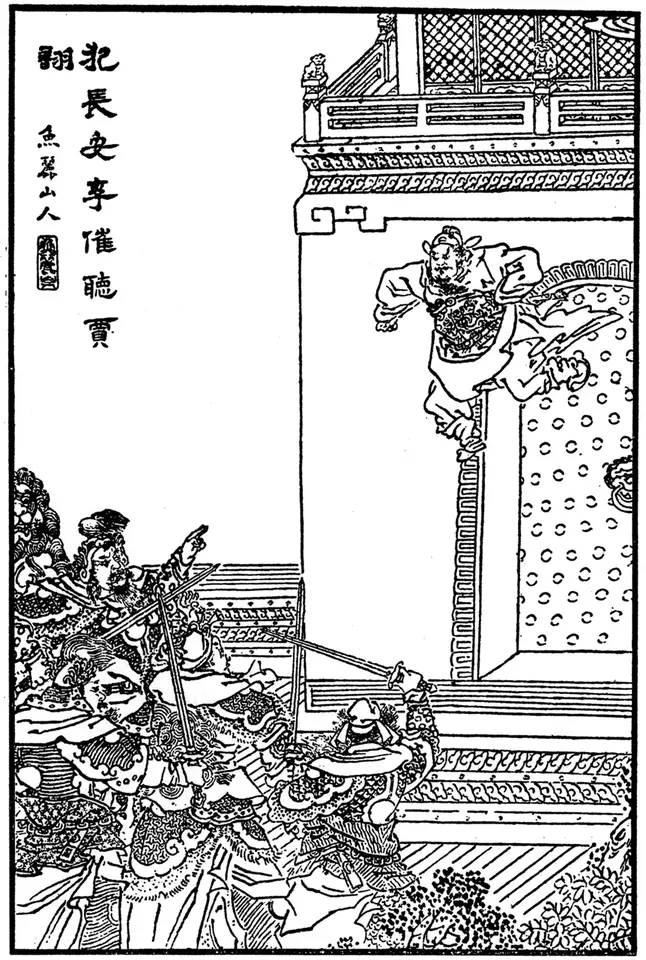
On the xinsi day, the 23rd day of the 4th month in the 3rd year of the Chuping reign (May 22, 192), Emperor Xian—newly recovered from an illness—held a grand assembly of officials at Weiyang Hall. Dong Zhuo rode in state from his fortress at Meiwu into the palace, flanked by infantry and cavalry. Wang Yun and Shisun Rui had secretly informed the emperor, and Shisun Rui wrote out an imperial edict commissioning Lü Bu to execute the traitor. Lü Bu stationed his fellow commandery officer Cavalry Commandant Li Su and over a dozen trusted warriors disguised as palace guards inside the Northern Side Gate (Beiyemen). As Dong Zhuo's carriage entered the gate, Li Su lunged with a halberd, wounding Dong Zhuo's arm as hidden armor beneath his court robes deflected the blade. Tumbling from his carriage, Dong Zhuo shouted, "Where is Lü Bu?" Stepping forward with the edict in hand, Lü Bu cried, "There is an imperial edict to punish the traitorous minister!" and drove his lance through Dong Zhuo, while Li Su's men decapitated him and slew his Registrar Tian Jing and two attendants who rushed to his body. Wang Yun immediately dispatched Huangfu Song to storm Meiwu, exterminating Dong Zhuo's younger brother Dong Min and his entire clan to the third degree, while the populace of Chang'an celebrated in the streets.
Following Dong Zhuo's death, Wang Yun assumed overall direction of the imperial government as Excellency over the Masses and Overseer of the Imperial Secretariat. Having restrained his stern, uncompromising temperament only out of fear of Dong Zhuo, Wang Yun now believed all danger had passed; in court deliberations he frequently lacked warmth and flexibility, alienating many officials. When the celebrated scholar and historian Cai Yong sighed involuntarily upon hearing of Dong Zhuo's death while sitting in Wang Yun's hall, Wang Yun furiously accused him of mourning a national traitor out of gratitude for personal patronage and handed him over to the Commandant of Justice. Although Cai Yong begged to suffer tattooing and amputation so that he could finish writing the institutional history of the Eastern Han, and Grand Commandant Ma Midi pleaded that executing such an irreplaceable scholar would disappoint the realm, Wang Yun retorted, "In former times Emperor Wu failed to kill Sima Qian and allowed him to write a slanderous book that was passed down to later ages; today, when the dynasty's fortunes are in decline, we must not let a flattering minister hold the brush beside a young sovereign!" By the time Wang Yun regretted his harshness, the sixty-one-year-old Cai Yong had died in prison, lamented by scholars across the empire.
Even more fatal was Wang Yun's handling of Lü Bu and Dong Zhuo's Liangzhou veterans. He refused Lü Bu's proposal to distribute Dong Zhuo's confiscated wealth among the ministers and officers and privately looked down on Lü Bu as a mere swordsman, causing friction between them. Regarding Dong Zhuo's seasoned Liangzhou troops, Wang Yun wavered: he rejected Lü Bu's advice to issue a blanket amnesty—arguing that pardoning them as rebels would only make them more suspicious—and instead proposed disbanding their armies altogether. When advisers urged him to appoint the respected general Huangfu Song to command and pacify the Liangzhou troops at Shan County, Wang Yun refused lest it arouse distrust among the eastern coalition lords.
Rumors soon swept Guanzhong that Wang Yun intended to massacre every person from Liangzhou. Stationed in Eastern Guanzhong after the death of Dong Zhuo's son-in-law Niu Fu, the Liangzhou colonels Li Jue, Guo Si, and Zhang Ji sent an envoy to Chang'an begging for an amnesty. Wang Yun flatly refused on the grounds that two imperial amnesties could not be issued in a single year. Driven into a corner and persuaded by their adviser Jia Xu that disbanding meant certain death whereas marching west offered a chance to seize control of the court, Li Jue and Guo Si allied to attack Chang'an. When Wang Yun sent the Liangzhou notables Hu Zhen and Yang Zhengxiu east to placate them, his haughty words offended the two men into rallying troops for the rebels; Xu Rong, whom Wang Yun sent to intercept them at Xinfeng, was killed in battle as Hu Zhen defected. Gathering Dong Zhuo's former units along the way and joining Fan Chou and Li Meng, Li Jue's army swelled to over a hundred thousand men as it encircled Chang'an.
On the 1st day of the 6th month in the 3rd year of the Chuping reign (June 28, 192), after an eight-day siege, Shu soldiers inside Lü Bu's ranks mutinied and opened the gates of Chang'an. Li Jue's troops slaughtered over ten thousand officials and civilians, killing Grand Master of Ceremonies Chong Fu, Grand Coachman Lu Kui, Grand Herald Zhou Huan, and Colonel of the City Gates Cui Lie. Defeated in street fighting, Lü Bu reined in his horse outside the Qingsuo Gate and called to Wang Yun, "My lord, can you ride away with me?" Wang Yun replied resolutely, "If by the grace of the altars of state I can bring peace to the country, that is my highest wish; if I cannot achieve it, I will offer my life and die for the court! The sovereign is young and relies solely on me; to flee ignominiously in the face of disaster is something I cannot bear to do. Strive to convey my regards to the lords East of the Pass, and urge them to keep the state ever in their thoughts!"
Escorting the fourteen-year-old Emperor Xian up the Xuanping Gate tower in northeastern Chang'an, Wang Yun was surrounded by Li Jue's soldiers. After forcing the emperor to issue an amnesty and appoint them generals, Li Jue and Guo Si demanded that Wang Yun descend the tower, asking what crime Grand Master Dong Zhuo had committed. To protect the emperor, Wang Yun walked down to surrender. Having first summoned and imprisoned Wang Yun's fellow commandery associates Song Yi (Left Fengyi) and Wang Hong (Right Fufeng), Li Jue executed Wang Yun alongside Song Yi and Wang Hong on July 4, 192, exposing Wang Yun's body in the Chang'an marketplace. Wang Yun was fifty-six years old; his eldest son Palace Attendant Wang Gai, younger sons Wang Jing and Wang Ding, and over ten clan members were killed with him, while only his nephews Wang Chen and Wang Ling scaled the city wall and escaped to Taiyuan.
Emperor Xian wept bitterly over Wang Yun's death, and while no one else dared approach his corpse in the market, Wang Yun's former subordinate Zhao Jian, Magistrate of Pingling, resigned his office and risked his life to collect and bury Wang Yun's remains. After relocating the capital to Xu County in 196, Emperor Xian honored Wang Yun's loyalty by sending a General of the Gentlemen of the Household Rapid as Tigers to offer sacrifices, bestowing an imperial coffin for his reburial in Taiyuan, and enfeoffing Wang Yun's grandson Wang Hei as Marquis of Anle Ting.
FIGURES ASSOCIATED WITH THIS DYNASTY