Age 1
Born in Xiapi (present-day Pizhou, Jiangsu), while his father Sun Jian served as Vice Magistrate of Xiapi.
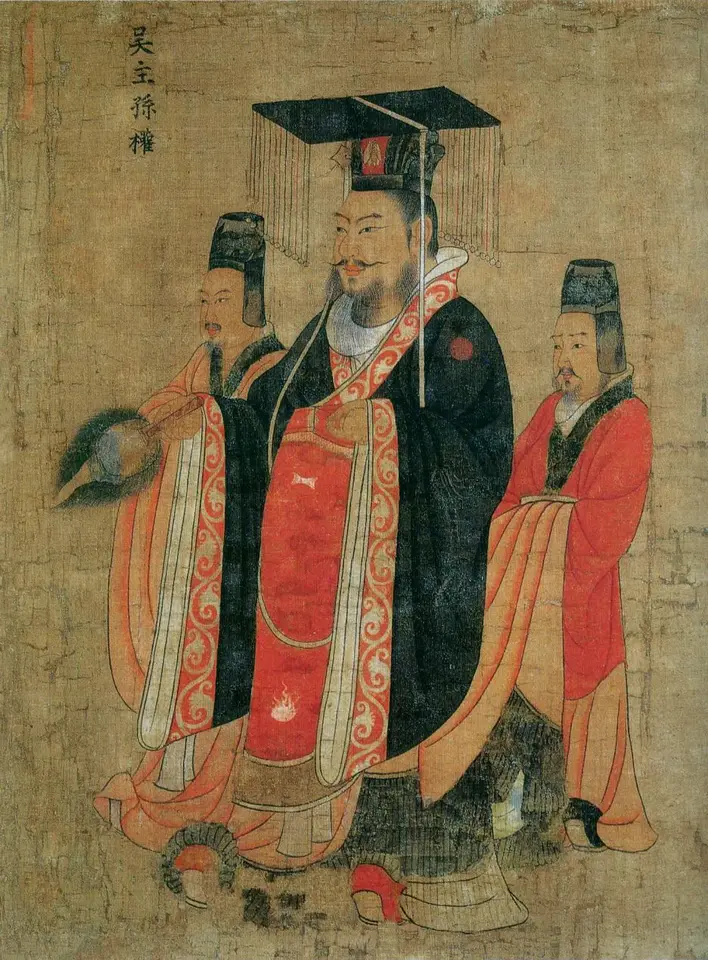
182 CE–252 CE
孙权
Sun Quan (孙权; 182 – May 21, 252), courtesy name Zhongmou (仲谋), was a native of Fuchun in Wu Commandery (present-day Fuyang District, Hangzhou, Zhejiang), born in Xiapi (present-day Pizhou, Jiangsu). He was the founding emperor of Eastern Wu during the Three Kingdoms Period (reigning from May 23, 229 to May 21, 252), as well as a preeminent statesman and military strategist. Inheriting the territorial patrimony…
Sun Quan (孙权; 182 – May 21, 252), courtesy name Zhongmou (仲谋), was a native of Fuchun in Wu Commandery (present-day Fuyang District, Hangzhou, Zhejiang), born in Xiapi (present-day Pizhou, Jiangsu). He was the founding emperor of Eastern Wu during the Three Kingdoms Period (reigning from May 23, 229 to May 21, 252), as well as a preeminent statesman and military strategist. Inheriting the territorial patrimony established by his father Sun Jian and elder brother Sun Ce, Sun Quan consolidated his authority over the Jiangdong region with the dedicated support of elder statesmen and military commanders, including Zhang Zhao, Zhou Yu, and Lu Su. In 208 CE, he allied with Liu Bei to inflict a crushing defeat upon Cao Cao at the Battle of Red Cliffs. He subsequently orchestrated the clandestine seizure of Jing Province, executed Guan Yu, and vanquished Liu Bei's punitive expedition at the Battle of Yiling in 222 CE. In 229 CE, Sun Quan formally proclaimed himself emperor at Wuchang, establishing the state of Eastern Wu and soon transferring the imperial capital to Jianye. During his prolonged reign, he vigorously promoted state agricultural colonies, pacified the indigenous Shanyue hill tribes, and pioneered maritime expeditions to Yizhou (Taiwan) and the South China Sea, laying the enduring economic and demographic foundations for the southern dynasties during the Six Dynasties era. In his final years, his vacillation over imperial succession precipitated the bitter Nan-Lu factional struggle between Crown Prince Sun He and the Prince of Lu, Sun Ba, destabilizing court governance. Posthumously honored as the Great Emperor (Da Huangdi) with the temple name Taizu, he was interred at Jiangling (Mount Zhong in present-day Nanjing). Zhuge Liang famously appraised him: "Sun Quan possesses Jiangdong, spanning three generations; his territory is rugged, his people devoted, and men of virtue and ability serve his cause. He may be enlisted as an ally, but cannot be subverted."
Born in Xiapi (present-day Pizhou, Jiangsu), while his father Sun Jian served as Vice Magistrate of Xiapi.
Appointed Magistrate of Yangxian; recommended as Filial and Incorrupt, nominated as Abundant Talent, and acted as Commandant of Resolute Righteousness.
Succeeded Sun Ce following the latter's assassination; assumed control of Jiangdong as General Who Attacks Bandits and Grand Administrator of Kuaiji.
Adopted Gan Ning's counsel to campaign again against Huang Zu, capturing numerous captives and ships.
Undertook a third expedition against Huang Zu, slaying him and annexing most of Jiangxia; joined Liu Bei to crush Cao Cao at Red Cliffs.
Met Liu Bei at Jingkou; agreed to lease Nan Commandery to Liu Bei to cement the anti-Cao alliance.
Dispatched Lü Meng on a covert strike to seize Jing Province; captured and executed Guan Yu, vastly expanding Wu territory.
Submitted nominal vassalage to Cao Wei; enfeoffed as King of Wu by Emperor Wen of Wei (Cao Pi).
Inflicted a crushing defeat upon Liu Bei's expeditionary army at the Battle of Yiling under Lu Xun's command.
Ascended the imperial throne at Wuchang, proclaiming the state title Wu; soon transferred the capital to Jianye.
Dispatched a fleet to Liaodong to ally with Gongsun Yuan; ended in betrayal and diplomatic setback.
Fully pacified Jiao Province and established administrative control across the far south.
Created Sun He as Crown Prince following the premature demise of Crown Prince Sun Deng.
Deposed Crown Prince Sun He, ordered the Prince of Lu Sun Ba to commit suicide, and designated Sun Liang as Crown Prince.
Passed away from illness in Jianye; interred at Jiangling and conferred the posthumous title Great Emperor.
Sun Quan was the second son of Sun Jian and the younger brother of Sun Ce, born to Lady Wu (posthumously honored as Empress Wulie). According to the Records of the Three Kingdoms, the Sun clan traced its ancestry to Sun Wu, the legendary military strategist of the Spring and Autumn period. Sun Wu's second son, Sun Ming, was granted fiefdom in Fuchun, making the lineage hereditary residents of Fuchun for generations. In 182 CE (the fifth year of the Guanghe era), Sun Quan was born in Xiapi while Sun Jian served as Vice Magistrate of Xiapi County. The Jiangbiao Zhuan recorded that Sun Quan possessed a square jaw, an expansive mouth, and eyes that flashed with brilliant light; Sun Jian was astonished by his appearance, discerning signs of extraordinary nobility. While pregnant with Sun Quan, Lady Wu reportedly dreamed that the sun entered her bosom, which Sun Jian interpreted as an auspicious augury of flourishing offspring.
In 184 CE (the first year of the Zhongping era), Sun Jian accompanied General Zhu Jun to suppress the Yellow Turban rebels, while Sun Quan remained with his family in Shouchun County, Jiujiang Commandery. In 189 CE (the sixth year of Zhongping), Sun Jian mobilized troops in Changsha to join the Guandong coalition against Dong Zhuo; Sun Quan accompanied his elder brother Sun Ce in relocating the household to Shu County in Lujiang Commandery. During their stay in Shu County, Sun Ce formed an intimate bond of friendship with Zhou Yu, and the two households maintained close relations. In 192 CE (the third year of Chuping), Sun Jian, acting under orders from Yuan Shu, campaigned against Liu Biao in Jing Province and was ambushed and killed at Mount Xian. Orphaned in his boyhood, Sun Quan was raised and educated under the strict guidance of his mother Lady Wu. Following the funeral observances, the entire household moved to Jiangdu in Guangling Commandery. In 193 CE (the fourth year of Chuping), after Sun Ce joined Yuan Shu, he dispatched Lü Fan to escort Sun Quan and his kin to Qu'e to live under the care of their maternal uncle, Wu Jing. In 194 CE (the first year of Xingping), when friction erupted between Liu Yao, Inspector of Yang Province, and the Yuan-Sun camp, Zhu Zhi dispatched agents to Qu'e to evacuate Sun Quan and his mother, providing them with continuous maintenance. They subsequently relocated to Liyang and Fuling. In 195 CE (the second year of Xingping), having crossed the Yangtze and routed Liu Yao, Sun Ce sent his officer Chen Bao to Fuling to welcome his family back to Qu'e.
Sun Quan was naturally broad-minded, generous, humane, and decisive. He possessed an innate love for chivalric camaraderie and took great pleasure in entertaining and supporting men of talent. He frequently accompanied Sun Ce, participating actively in strategic councils, displaying insights that led Sun Ce to marvel that his younger brother's administrative discernment surpassed his own. Whenever Sun Ce hosted banquets for regional notables and retainers, he would often turn to Sun Quan and remark that these gentlemen would one day become his own commanders and officers. During this formative period, Sun Quan pursued his classical studies in Wu Commandery alongside Hu Zong and Zhu Ran, cultivating deep and lasting personal bonds.
In 196 CE (the first year of the Jian'an era), at the age of fifteen, Sun Quan was appointed Magistrate of Yangxian. Zhu Zhi, Grand Administrator of Wu Commandery, recommended him as a Filial and Incorrupt candidate; Yan Xiang, Inspector of Yang Province, nominated him as an Abundant Talent candidate; and he was subsequently commissioned as Acting Commandant of Resolute Righteousness. In 199 CE (the fourth year of Jian'an), Sun Quan accompanied Sun Ce in the campaign against Liu Xun, Grand Administrator of Lujiang. Following Liu Xun's flight, the army advanced to Shaxian to punish Huang Zu, successfully subjugating both Lujiang and Yuzhang commanderies.
In 200 CE (the fifth year of Jian'an), Sun Ce was ambushed and mortally wounded by former retainers of Xu Gong. On his deathbed, Sun Ce summoned Sun Quan to his side, conferred upon him his official seals and tallies, and designated him as his successor. Sun Quan, then nineteen years of age, was overcome with inconsolable grief. Zhang Zhao, Chief Clerk to Sun Ce, sternly admonished him: "Filial and Incorrupt, is this a time for weeping? When the Duke of Zhou instituted rites, his son Boqin did not strictly observe mourning rituals; this was not out of disrespect to his father, but because the demands of the times precluded it. Today, traitors compete for supremacy and wolves block the roads. To indulge personal sorrow and observe formal rites at this moment is akin to opening one's gates to invite robbers inside—this cannot be termed benevolence." Sun Quan thereupon removed his mourning garments, mounted his horse with Zhang Zhao's assistance, and rode out to review the garrison troops.
At this critical juncture, the fledgling Sun regime was surrounded by peril: Li Shu, Grand Administrator of Lujiang, openly revolted; Sun Fu, Grand Administrator of Luling, secretly conspired with Cao Cao; Sun Gao, a senior kinsman, attempted to seize power; Sun Yi, Grand Administrator of Danyang, and Sun He, an influential clan leader, were both assassinated; and tens of thousands of indigenous Shanyue tribesmen throughout Yuzhang and Kuaiji rebelled. Recognizing Sun Quan's extraordinary potential to establish an enduring enterprise, Zhang Zhao and Zhou Yu submitted their wholehearted allegiance. Sun Quan treated Zhang Zhao as a revered master, addressed Zhou Yu as an elder brother, and relied upon seasoned captains like Cheng Pu and Lü Fan as his innermost military pillars. He personally led troops to eliminate Li Shu, absorbing over thirty thousand retainers; repressed internal clan rebellions; and defeated the Shanyue, slaying six thousand rebels and incorporating over ten thousand into his forces. Simultaneously, he conducted an extensive search for talent, recruiting Zhuge Jin, Lu Su, Yan Jun, Bu Zhi, Lu Xun, Xu Sheng, and Gu Yong. These measures reassured both native aristocratic lineages and displaced northern scholar-gentry, stabilizing Jiangdong.
Between 203 and 208 CE (the eighth to thirteenth years of Jian'an), Sun Quan launched three naval expeditions against Jiangxia, ultimately executing Huang Zu and annexing the greater portion of Jiangxia Commandery. In late 208 CE, Cao Cao launched his massive southern expedition, routed Liu Bei, seized Jiangling, and sent an intimidating missive to Sun Quan, declaring his intention to hunt in Jiangdong with eight hundred thousand troops. The Wu court instantly divided into hawkish and dovish factions: civil officials led by Zhang Zhao advocated submission, pointing to Cao Cao's overwhelming numbers and possession of the imperial banner; Lu Su and Zhou Yu vehemently argued for resistance. Sun Quan was resolved to fight. Lu Su escorted Zhuge Liang from Xiakou, demonstrating Liu Bei's firm commitment to an anti-Cao alliance; Zhou Yu returned in haste from Poyang, conducting a piercing analysis of Cao Cao's strategic vulnerabilities—exhausted troops, unaccustomed naval combat, and epidemic outbreaks. Convinced, Sun Quan severed the corner of his conference table with his sword, declaring that anyone who dared urge surrender would share the table's fate. He appointed Zhou Yu and Cheng Pu as Left and Right Commanders to join forces with Liu Bei. At the Battle of Red Cliffs, allied fireships incinerated Cao Cao's chained armada, driving the northern army into headlong retreat through the Huarong path. Following this triumph, Sun Quan personally laid siege to Hefei, though he was forced to withdraw after failing to breach its fortifications.
In 209 CE (the fourteenth year of Jian'an), after Zhou Yu engaged Cao Ren in an arduous campaign lasting over a year, Cao Ren evacuated Jiangling, allowing Sun Quan to occupy Nan Commandery and appoint Zhou Yu as its Grand Administrator. That same year, Liu Bei memorialized the court to recommend Sun Quan as Acting General of Chariots and Cavalry and Shepherd of Xu Province. Sun Quan met Liu Bei at Jingkou and agreed to lease Nan Commandery to him to consolidate the Sun-Liu alliance. Although Zhou Yu proposed detaining Liu Bei in Wu while neutralizing Guan Yu and Zhang Fei, Sun Quan declined, recognizing that Cao Cao remained a formidable northern menace requiring a broad coalition of heroes.
In 210 CE (the fifteenth year of Jian'an), Zhou Yu passed away at Baqiu, leaving Sun Quan deeply grieved. Lu Su assumed the military leadership, continuing the policy of sustaining the coalition. Sun Quan moved his seat of administration from Wu to Jingkou, and subsequently to Moling upon the strategic recommendation of Zhang Hong. In 212 CE, he constructed Stone Fortress (Shitou Cheng) and renamed Moling as Jianye.
In 215 CE (the twentieth year of Jian'an), following Liu Bei's conquest of Yi Province, Sun Quan dispatched Zhuge Jin to demand the return of the leased Jing Province commanderies. When Liu Bei prevaricated, Sun Quan ordered Lü Meng to seize Changsha, Lingling, and Guiyang. Both sides mobilized armies and teetered on the brink of general war until Cao Cao's invasion of Hanzhong compelled Liu Bei to negotiate. The two rulers partitioned Jing Province along the Xiang River: Jiangxia, Changsha, and Guiyang were assigned to Wu; Nan Commandery, Lingling, and Wuling remained under Shu.
In 219 CE (the twenty-fourth year of Jian'an), Guan Yu launched his northern offensive against Xiangyang and Fancheng, flooding Cao Ren's relief force under Yu Jin and capturing thirty thousand troops. Apprehensive of Guan Yu's soaring prestige, Sun Quan accepted the covert stratagems of Lü Meng and Lu Xun. Exploiting Guan Yu's rearward complacency, Lü Meng disguised his assault flotilla as merchant vessels in the famed white-robed crossing, seized Jiangling and Gong'an without resistance, treated the civilian population with exemplary discipline, and shattered the morale of Guan Yu's army. Guan Yu was encircled at Maicheng, captured in Zhangxiang by Pan Zhang's subordinate Ma Zhong, and executed alongside his son Guan Ping. This masterstroke annexed southern Jing Province into Eastern Wu, though it irrevocably shattered the Sun-Liu alliance.
In 221 CE (the second year of Huangchu), Liu Bei mobilized a massive expeditionary force to avenge Guan Yu. To avert a ruinous two-front war against both Wei and Shu, Sun Quan offered nominal submission to Cao Pi, who enfeoffed him as King of Wu and granted him the Nine Bestowals (Jiu Xi). In 222 CE (the first year of Huangwu), Sun Quan appointed Lu Xun as Grand Commander to direct operations against the invading Shu armies. Lu Xun maintained a disciplined defensive posture, waiting until the Shu troops were physically exhausted by summer heat and stretched across hundreds of li of mountain defiles. He then executed a coordinated fire attack at Xiaoting in Yiling, utterly destroying Liu Bei's operational force. Following Liu Bei's death in 223 CE, Zhuge Liang dispatched Deng Zhi as an envoy to Wu; Sun Quan warmly received him, severed relations with Cao Wei, and reestablished a comprehensive diplomatic and military alliance with Shu Han.
In the spring of 229 CE (the first year of Huanglong), civil and military officials unanimously petitioned Sun Quan to assume the imperial dignity. In April, reports of auspicious omens—yellow dragons and phoenixes—arrived from Xiakou and Wuchang. On May 23, 229 CE (the bingchen day of the fourth month), Sun Quan erected an altar on the southern outskirts of Wuchang and formally ascended the imperial throne, proclaiming the dynastic title Wu, issuing a general amnesty, and inaugurating the Huanglong era. He posthumously honored his father Sun Jian as Emperor Wulie, his mother Lady Wu as Empress Wulie, and his elder brother Sun Ce as Prince Huan of Changsha, while investing Sun Deng as Crown Prince.
In June 229 CE, Shu Han dispatched Minister of the Guards Chen Zhen to congratulate Sun Quan on his accession. The two allied states concluded a formal treaty partitioning the realm under Heaven: Yu, Qing, Xu, and You provinces were assigned to Wu; Yan, Ji, Bing, and Liang provinces were allocated to Shu; while the central Sili metropolitan region was divided along Hangu Pass. Both sovereigns swore solemn oaths before ancestral deities, promising eternal mutual defense against Cao Wei. In September 229 CE, Sun Quan moved the imperial capital to Jianye, appointing Senior General Lu Xun to assist Crown Prince Sun Deng in managing state affairs at Wuchang.
Following his imperial enthronement, Sun Quan expanded the state agricultural colony system (tuntian), established commanderies and counties across the southern frontier, pacified the Shanyue, and aggressively developed maritime commerce. In 230 CE, he dispatched generals Wei Wen and Zhuge Zhi with ten thousand troops across the ocean to explore Yizhou (Taiwan) and Danzhou. In 232 CE, he dispatched naval fleets to Liaodong to coordinate an alliance with Gongsun Yuan. In 238 CE, his administrations secured complete pacification over Jiao Province, dividing the territory into Guangzhou and Jiao Province to enhance administrative control over maritime trade routes.
Sun Quan's closing years were marred by profound domestic instability, largely rooted in succession disputes. In 242 CE (the fifth year of Chiwu), Crown Prince Sun Deng passed away, leaving Sun Quan grief-stricken. He subsequently invested Sun He as Crown Prince, while simultaneously showering lavish favors upon his fourth son, Sun Ba, Prince of Lu. This ambivalence encouraged courtiers to divide into bitter factions: Senior Chancellor Lu Xun, General-in-Chief Zhuge Ke, Grand Master of Ceremonies Gu Tan, and General of Agile Cavalry Zhu Ju supported Crown Prince Sun He, whereas General of Agile Cavalry Bu Zhi, General of the South Lü Dai, and Grand Commander Quan Cong backed Sun Ba.
This prolonged factional strife, known as the Nan-Lu Crown Prince Succession Struggle, severely damaged the court. In 245 CE, Lu Xun was repeatedly reprimanded by imperial edicts over his involvement in the dispute and died in anguish. Finally, in 250 CE (the thirteenth year of Chiwu), Sun Quan resolved the crisis with severe measures: he deposed Crown Prince Sun He, exiling him to Guzhang; ordered the Prince of Lu Sun Ba to commit suicide; executed numerous remonstrating ministers; and invested his youngest son, Sun Liang, as Crown Prince.
In May 251 CE (the first year of Taiyuan), Sun Quan invested Lady Pan as Empress. In November of that year, he collapsed while performing the winter sacrifices at the southern suburban altar. Realizing his life was drawing to a close, he summoned General-in- Chief Zhuge Ke to serve as Grand Tutor to the Crown Prince and entrusted him with the regency. On May 21, 252 CE (the first year of Shenfeng), Sun Quan passed away in the imperial palace at Jianye at the age of seventy-one, concluding a reign of twenty-four years. He was interred at Jiangling on Mount Zhong and conferred the posthumous title Great Emperor, with the temple name Taizu.
Upon assuming power at age nineteen, Sun Quan transformed a fragile personal military hegemony into a resilient bureaucratic state. He harmonized relations between northern refugee elites and the powerful indigenous clans of Jiangdong (the Gu, Lu, Yu, and Zhang families), elevating figures like Gu Yong and Lu Xun to the premiership. He instituted an extensive state agricultural colony system (tuntian), stationing agrarian officers across Danyang, Wu, and Kuaiji to open virgin soils, ensuring steady grain supplies for civil and military needs.
To strengthen frontier control, he created specialized administrative units, dividing unruly tribal areas into new commanderies such as Xindu, Poyang, Dong'an, and Linhai. In Jiao Province, his generals deposed the autonomous Shi clan following the death of Shi Xie, incorporating the far southern littoral into the direct administrative orbit of the Wu state. His institutional state-building provided the enduring political and administrative matrix for all subsequent southern dynasties based at Jiankang (Jianye).
Sun Quan commanded numerous major campaigns throughout his lifetime:
Sun Quan demonstrated remarkable diplomatic pragmatism, maneuvering deftly between Cao Wei and Shu Han to guarantee the survival and expansion of Eastern Wu. Following Sun Ce's death, he sought imperial legitimacy by dispatching tributes to the Han court under Cao Cao's control. Facing Cao Cao's invasion in 208 CE, he united with Liu Bei. When Guan Yu's ascendancy in Jing Province threatened Wu's northern flank in 219 CE, Sun Quan pivoted to collaborate with Cao Cao.
In 221 CE, threatened by Liu Bei's revanchist campaign, Sun Quan accepted nominal vassal status from Cao Pi, receiving the title King of Wu to secure his northern border. Once Liu Bei was crushed at Yiling, Sun Quan rejected Cao Pi's demand to send his crown prince as a hostage to Luoyang, severed ties with Wei, and restored the diplomatic alliance with Shu Han through Deng Zhi. In 229 CE, he established a bilateral treaty with Shu partitioning the empire, maintaining a durable dual alliance that lasted until Wu's final years.
Under Sun Quan's auspices, the Jiangnan region underwent profound economic and infrastructural modernization. Recognizing that military survival required a robust demographic and agricultural base, Sun Quan implemented systematic pacification campaigns against the Shanyue hill tribes, incorporating able-bodied men into elite combat divisions while settling hundreds of thousands of tribal families onto agricultural registers.
His administration oversaw extensive water conservancy projects: in 245 CE, Commandant Chen Xun excavated the Jurong canal and constructed state granaries; in 250 CE, the Tangyi reservoir was engineered to irrigate vast tracts of paddy land. These canals served dual purposes as military transport corridors and irrigation lifelines. Sun Quan also pioneered maritime exploration: in 230 CE, his naval expedition under Wei Wen and Zhuge Zhi sailed to Yizhou (Taiwan), marking the earliest recorded state-sponsored maritime voyage to the island in Chinese official histories. His maritime routes extended north to Liaodong and Goguryeo and south to Funan and Lin'yi, fostering trade contacts with Roman Syrian merchants (including the traveler Qin Lun) and transforming Jianye into an international commercial metropolis.
Sun Quan maintained intricate personal relationships with his civil ministers and military commanders. He reposed boundless trust in Zhang Zhao, honoring him as a mentor while frequently clashing with his rigid Confucian admonitions; he regarded Zhou Yu as an elder brother and credited him with the salvation of Jiangdong; and he embraced Lu Su's grand strategic vision of empire. He possessed an exceptional capacity to inspire devotion among martial men, fostering fierce loyalty among captains like Gan Ning, Taishi Ci, Lü Meng, and Zhu Ran.
However, his later years were marred by intense domestic factionalism. The bitter confrontation between Crown Prince Sun He and the Prince of Lu, Sun Ba, fractured the court bureaucracy along clan and provincial lines. Sun Quan's harsh, punitive handling of the crisis—driving Lu Xun to death through relentless interrogations, executing high ministers, and exiling family members—cast a dark shadow over his monumental political legacy.
FIGURES ASSOCIATED WITH THIS DYNASTY