Adoption by Liu Bei
While residing in Jingzhou without an heir, Liu Bei adopted Kou Feng of the Marquis of Luo lineage, renaming him Liu Feng.
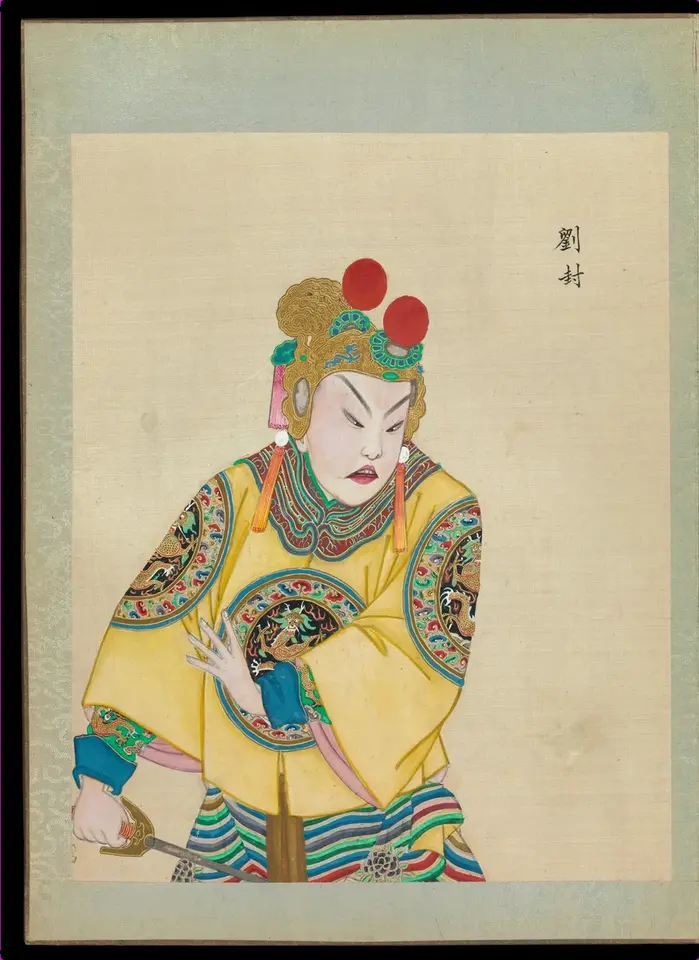
220 CE
刘封
Liu Feng (刘封, ?–220 CE), originally named Kou Feng (寇封), a native of Luo County in Changsha Commandery (present-day Miluo, Hunan Province), was the son of the Kou lineage holding the title of Marquis of Luo and a nephew of the Liu clan of Changsha. He was a prominent military commander of the Shu Han regime during the late Eastern Han dynasty and Three Kingdoms Period, as well as the adopted son of Liu Bei, the First…
Liu Feng (刘封, ?–220 CE), originally named Kou Feng (寇封), a native of Luo County in Changsha Commandery (present-day Miluo, Hunan Province), was the son of the Kou lineage holding the title of Marquis of Luo and a nephew of the Liu clan of Changsha. He was a prominent military commander of the Shu Han regime during the late Eastern Han dynasty and Three Kingdoms Period, as well as the adopted son of Liu Bei, the First Sovereign of Shu Han. When Liu Bei resided in Jingzhou under Liu Biao, he had not yet fathered a male heir. Impressed by Liu Feng's physical prowess, martial skills, and resolute courage, Liu Bei formally adopted him into his household and gave him the surname Liu. Endowed with valor and strategic daring, Liu Feng served with distinction in the founding campaigns of Shu Han. From 212 CE onward, he accompanied Zhuge Liang, Zhang Fei, and Zhao Yun up the Yangtze River into Sichuan, overcoming every obstacle and receiving the commission of Palace Gentleman of the Auxiliary Army following the conquest of Yizhou. In 219 CE, after Liu Bei conquered Hanzhong, Liu Feng was dispatched eastward down the Han River to join forces with Meng Da and seize the commanderies of Fangling and Shangyong. Highly trusted by Liu Bei, he was promoted to General of the Auxiliary Army. In the winter of that year, Guan Yu besieged Xiangyang and Fancheng but faced coordinated counterattacks from Cao Wei and Eastern Wu. Guan Yu sent repeated urgent dispatches ordering Liu Feng and Meng Da to mobilize reinforcements from Shangyong. Citing the recent pacification of the mountainous commanderies and the instability of the local populace, Liu Feng refused to dispatch troops, contributing to Guan Yu's defeat and death at Maicheng. Subsequently, bitter discord erupted between Liu Feng and Meng Da, driving Meng Da to defect to Cao Wei and lead an assault back toward Shangyong alongside Wei generals Xu Huang and Xiahou Shang. Betrayed by subordinate officers, Liu Feng was routed and fled back to Chengdu. Fearing that Liu Feng's fierce and intractable temperament would threaten the succession of the young heir Liu Shan after Liu Bei's passing, Zhuge Liang advised his elimination, and Liu Bei ordered Liu Feng to commit suicide. Expressing deep remorse for ignoring Meng Da's warnings, Liu Feng took his own life, leaving Liu Bei weeping in bitter sorrow.
While residing in Jingzhou without an heir, Liu Bei adopted Kou Feng of the Marquis of Luo lineage, renaming him Liu Feng.
In his early twenties, joined Zhuge Liang, Zhang Fei, and Zhao Yun in commanding armies up the Yangtze River to conquer Yizhou.
Promoted to Palace Gentleman of the Auxiliary Army after distinguishing himself in the encirclement and pacification of Chengdu.
Dispatched by Liu Bei from Jiameng down the Han River to assume overall command over Meng Da's army in the Eastern Three Commanderies.
Induced the surrender of Shen Dan and Shen Yi, securing Shangyong and Fangling, and was promoted to General of the Auxiliary Army.
Declined repeated requests from Guan Yu for military reinforcements during the Siege of Fancheng, citing regional unrest.
Clashed bitterly with Meng Da and confiscated his ceremonial retinue, causing Meng Da to defect to Cao Wei in fear.
Attacked by Meng Da and Wei forces and betrayed by his subordinate Shen Yi, fleeing in defeat back to Chengdu.
Reprimanded by Liu Bei for losing territory and failing Guan Yu, and took his own life on the advice of Zhuge Liang.
Liu Feng was originally named Kou Feng, descending from an eminent noble lineage in southern Jingzhou. His family held the ancestral hereditary title of Marquis of Luo, and his mother belonged to the distinguished Liu clan of Changsha Commandery. In the early Jian'an era of the Eastern Han dynasty, warlords contended across the Central Plains. Following his defeat in Xuzhou, Liu Bei migrated southward to Jingzhou to seek asylum under the provincial governor Liu Biao, garrisoning his forces at Xinye. By then, Liu Bei was over forty years old and deeply distressed that he remained without a biological male heir to inherit his enterprise.
During his years in Jingzhou, Liu Bei encountered the youthful Kou Feng. Although still in his youth, Kou Feng was physically imposing, extraordinarily strong, and proficient in archery, horsemanship, and martial combat, possessing a resolute and unyielding personality. Deeply impressed by his martial talents, Liu Bei negotiated with the Kou clan and formally adopted Kou Feng into his household, bestowing upon him the surname Liu and renaming him Liu Feng. Entering the Liu clan, Liu Feng served his adoptive father with reverence and filial piety. Liu Bei regarded him as a cornerstone of the emerging house, nurturing his administrative and military abilities. Even after Lady Gan gave birth to Liu Bei's biological son Liu Shan in 207 CE, Liu Feng retained Liu Bei's profound confidence and steadily matured into a capable front-line commander.
In 211 CE, Liu Zhang, the Governor of Yizhou, dispatched Fa Zheng to Jingzhou to invite Liu Bei into Sichuan to help repel Zhang Lu of Hanzhong. After entering the region, relations between Liu Bei and Liu Zhang soured, erupting into open warfare at Jiameng Pass. Because Liu Zhang commanded substantial forces and fortified mountain strongholds, Liu Bei's advance stalled, and military adviser Pang Tong was killed by a stray arrow during the siege of Luocheng, leaving the campaign in jeopardy. In 212 CE, Liu Bei dispatched urgent orders to Jingzhou directing Zhuge Liang, Zhang Fei, and Zhao Yun to lead main field armies westward into Sichuan as reinforcements.
At that time, Liu Feng was barely in his early twenties and received command of an expeditionary detachment. Displaying peerless valor, he accompanied Zhuge Liang up the Yangtze River, storming fortified citadels and routing enemy detachments along the route. Throughout the two-year campaign to subdue Western Sichuan, Liu Feng exhibited outstanding operational leadership and frontline bravery, consistently leading assaults at the head of his troops. In 214 CE, Liu Feng joined the converging armies beneath the ramparts of Chengdu, forcing Liu Zhang to surrender. In the post-campaign bestowal of honors, Liu Bei lavishly rewarded his adopted son, officially appointing him Palace Gentleman of the Auxiliary Army and elevating him into the core ranks of military commanders.
In 219 CE, Liu Bei achieved a historic triumph in the Hanzhong Campaign by repelling the main forces of Cao Cao, declaring himself King of Hanzhong. Prior to this, Meng Da, the Administrator of Yidu, had led thousands of soldiers northward from Zigui into Fangling Commandery, slaying the Wei administrator Kuai Qi. Having secured Fangling, Meng Da prepared to advance against Shangyong, but Liu Bei worried that Meng Da was operating without adequate support and harbored doubts regarding his steadfastness. Consequently, Liu Bei appointed Liu Feng to assume supreme command over the eastern expedition.
Obeying Liu Bei's direct command, Liu Feng sailed rapidly down the Han River from Jiameng, arriving at the front lines of Fangling to take overall charge of Meng Da's divisions. Exhibiting decisive leadership, Liu Feng united the forces and advanced upon Shangyong. At that time, Shen Dan, the Wei administrator of Shangyong, and his brother Shen Yi, administrator of Xicheng, recognized the overwhelming momentum of Liu Feng's advance. Concluding that resistance was futile, they surrendered their strongholds and dispatched their families to Chengdu as hostages. Through this masterstroke, Liu Feng annexed Fangling, Shangyong, and Xicheng without extensive bloodshed, opening the vital corridor between Hanzhong and Jingzhou. Delighted by the news, Liu Bei promoted Liu Feng to General of the Auxiliary Army, placing the defense of the Eastern Three Commanderies under his command.
In the autumn of 219 CE, Guan Yu, Marquis of Hanshou, launched the northern offensive toward Xiangyang and Fancheng, drowning seven enemy armies, capturing Yu Jin, and executing Pang De, sending shockwaves through the Central Plains. However, Cao Cao mobilized powerful reinforcements under Xu Huang to counterattack, while Sun Quan of Eastern Wu clandestinely broke the alliance and launched an amphibious sneak attack against Jingzhou. The strategic balance shifted precipitously, leaving Guan Yu beleaguered around Fancheng. Guan Yu dispatched repeated urgent couriers to Shangyong, commanding Liu Feng and Meng Da to march their elite divisions down the river to strike the Wei forces.
Confronting these urgent commands, Liu Feng and Meng Da held contentious deliberations. Meng Da argued that the mountainous commanderies had only recently submitted and remained volatile, warning that stripping the garrison would trigger widespread local rebellion. Sharing the view that their defensive perimeter was fragile, Liu Feng formally rejected Guan Yu's orders, citing the instability of the mountain commanderies. Shortly thereafter, Lü Meng executed his white-clothed crossing of the Yangtze, seizing Jiangling and severing Guan Yu's retreat. Guan Yu was routed at Maicheng and captured and executed at Linju. The fall of Jingzhou and Guan Yu's demise represented a catastrophic setback for Shu Han, and Liu Bei harbored intense indignation over Liu Feng's refusal to assist.
During this period, Liu Feng's overbearing demeanor led to a severe deterioration in his relationship with Meng Da. Trading on his status as Liu Bei's adopted son, Liu Feng routinely demeaned Meng Da and forcibly confiscated his ceremonial musical retinue during a confrontation. Terrified of Liu Feng's hostility and dreading Liu Bei's retribution for failing Guan Yu, Meng Da defected to Cao Wei in 220 CE with more than four thousand client households, presenting a formal memorial of submission to Cao Pi.
Cao Pi welcomed Meng Da warmly, appointing him Cavalier Attendant-in-Ordinary and General Who Establishes Might, while enfeoffing him as Marquis of Pingxiang. Cao Pi dispatched Senior General Xiahou Shang and General of the Right Xu Huang to join forces with Meng Da to assault Shangyong. Prior to the attack, Meng Da sent Liu Feng a poignant letter: "You have no blood relationship with the King of Hanzhong. Though styled father and son, you remain an outsider. Now the King has designated his biological son Liu Shan as heir, and the court ministers are determined to preserve the legitimate succession. The realm holds you accountable for Guan Yu's ruin, and returning to Chengdu will bring swift destruction. If you align with the great Wei state, you will enjoy aristocratic rank and security." Reading the letter, Liu Feng displayed uncompromising loyalty to Liu Bei, tearing the missive and refusing to defect.
When the Wei armies commenced their offensive, Liu Feng fought tenaciously to defend the mountain passes. However, Shen Yi had covertly allied with Cao Wei, suddenly launching a treasonous surprise assault against Liu Feng's headquarters from within. Caught in a coordinated pincer, Liu Feng's forces disintegrated, leaving him with only a handful of bodyguards to cut their way through the encirclement and flee back to Chengdu.
Upon arriving in Chengdu, Liu Feng was summoned before Liu Bei, who bitterly reproached him for bullying Meng Da into defection and refusing to dispatch reinforcements to Guan Yu. Viewing the broader strategic landscape, Chancellor Zhuge Liang recognized that Liu Feng possessed exceptional martial ferocity and an intractable character. He feared that following Liu Bei's demise, the young and gentle heir Liu Shan would be utterly incapable of controlling Liu Feng, creating an existential peril for the Shu Han court. Zhuge Liang quietly advised Liu Bei to eliminate him for the stability of the state. Resigned to the political necessity, Liu Bei issued an imperial decree ordering Liu Feng to commit suicide. Facing his sword, Liu Feng lamented to the heavens: "I deeply regret not listening to Meng Zidu's counsel!" After Liu Feng took his life, Liu Bei recalled their years of filial affection and shared victories, weeping profusely in his palace and ordering an honorable burial for his adopted son.
During Liu Bei's campaign to conquer Western Sichuan from 212 to 214 CE, Liu Feng emerged as an exceptional young military commander. Operating under the tactical oversight of Zhuge Liang and Zhang Fei, the youthful Liu Feng led vanguard divisions up the Yangtze River, overcoming every fortified position and mountain redoubt. His rapid advances neutralized enemy strongpoints and enabled the convergence of allied divisions at Chengdu, culminating in the capitulation of Liu Zhang and the foundational establishment of Shu Han's territorial base.
Following the victory in Hanzhong in 219 CE, the Eastern Three Commanderies represented an indispensable bridge connecting Sichuan with Jingzhou. Liu Bei entrusted overall operational command of the eastern theater to Liu Feng. Sailing down the Han River with remarkable speed, Liu Feng integrated Meng Da's units and deployed his divisions before Shangyong. Through commanding military deterrence, he compelled Shen Dan and Shen Yi to surrender their territories, securing Fangling, Shangyong, and Xicheng without extensive casualties and fortifying Shu Han's northeastern flank.
Along the front lines of Hanzhong and the Eastern Three Commanderies, Liu Feng gained widespread renown for his personal valor and formidable combat capability. During preliminary engagements in Hanzhong, he repeatedly served as vanguard against seasoned Cao Wei commanders, displaying fearless audacity on the battlefield. When Cao Cao personally inspected the front lines, Liu Feng rode out to challenge the enemy army, prompting Cao Cao to curse his audacity in frustration. His defensive vigilance along the eastern frontier kept Wei commanders at bay for years.
When overwhelming Wei divisions under Xiahou Shang and Xu Huang converged upon Shangyong, Meng Da recognized that Liu Feng faced severe punishment upon returning to Chengdu and urged him to defect with promises of imperial titles in Wei. Confronting imminent disaster and alluring inducements, Liu Feng steadfastly preserved his loyalty to Liu Bei. He rejected treasonous overtures and chose to face judgment in Chengdu rather than compromise his allegiance to the Han cause, demonstrating tragic moral fidelity in his final hours.
FIGURES ASSOCIATED WITH THIS DYNASTY