Served as chief clerk under Ding Yuan | Served as chief clerk under Ding Yuan, Inspector of Bing Province, and followed him with troops into Luoyang. After Dong Zhuo entered the capital, Lü was induced to kill Ding Yuan, joined Dong Zhuo, became Commandant of Cavalry, and swore a father-son relationship with him.
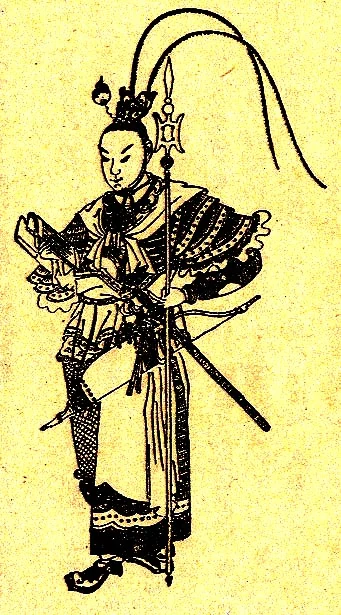
156 CE–198 CE
Military commander
Lü Bu
吕布
Lü Bu (d. in the twelfth month of Jian'an 3, 7 February 199), courtesy name Fengxian, was a native of Jiuyuan County in Wuyuan Commandery, present-day Jiuyuan District of Baotou in Inner Mongolia. He was a military commander and warlord of the late Eastern Han. Famed for exceptional fighting ability, he was called the "Flying General," and a contemporary saying praised "Lü Bu among men, Red Hare among horses." He first served…
156 CE–198 CEEastern Han
PROFILE
Lü Bu (d. in the twelfth month of Jian'an 3, 7 February 199), courtesy name Fengxian, was a native of Jiuyuan County in Wuyuan Commandery, present-day Jiuyuan District of Baotou in Inner Mongolia. He was a military commander and warlord of the late Eastern Han. Famed for exceptional fighting ability, he was called the "Flying General," and a contemporary saying praised "Lü Bu among men, Red Hare among horses." He first served Ding Yuan and then Dong Zhuo, whom he later killed. He subsequently moved among the camps of Yuan Shu, Yuan Shao, and Zhang Yang before seizing Xu Province. In 198, the third year of Jian'an, he was defeated by Cao Cao at Xiapi and executed by strangulation. Chen Shou characterized Lü Bu as possessing the ferocity of a tiger but lacking extraordinary strategy, fickle and deceitful in his loyalties and concerned only with advantage.
- Alternate Names
- Lü Fengxian; Flying General; courtesy name Fengxian
- Courtesy Name
- Fengxian
- Epithet
- The Chinese source table contains only the incomplete value “called.”
- Period
- Eastern Han
- Date of Birth
- Not recorded in historical sources
- Date of Death
- February 7 199
- Dynasty/Regime
- Eastern Han
- Identity
- Military commander
- Ethnicity/Ethnic Affiliation
- Not recorded in historical sources
- Native Place
- Jiuyuan County, Wuyuan Commandery (present-day Jiuyuan District, Baotou, Inner Mongolia)
- Place of Birth
- Not recorded in historical sources
- Place of Death
- Not recorded in historical sources
- Highest Office
- See Biography and Major Deeds
- Major Achievements
- Warlord famed for martial prowess; associated with the saying "Lü Bu among men, Red Hare among horses"; occupied Xu Province after serving several different leaders; ultimately defeated by Cao Cao.
LIFE TIMELINE
After Dong Zhuo forced the court to move to Chang'an | After Dong Zhuo forced the court to move to Chang'an, Lü Bu was ordered to open imperial and high-official tombs and seize valuables.
Joined Hu Zhen against Sun Jian | Joined Hu Zhen against Sun Jian; conflict with Hu Zhen undermined the army, which was defeated at Yangren.
Conspired with Wang Yun and Shisun Rui to assassinate Dong Zhuo at the northern gate of th | Conspired with Wang Yun and Shisun Rui to assassinate Dong Zhuo at the northern gate of the palace. Appointed General of Vehement Might, granted a tally of authority, accorded ceremonial rank comparable to the Three Excellencies, and enfeoffed as Marquis of Wen; shared control of government with Wang Yun.
Li Jue | Li Jue, Guo Si, and other former followers of Dong Zhuo captured Chang'an. Lü Bu was defeated, fled through Wuguan, and successively sought refuge with Yuan Shu, Yuan Shao, and Zhang Yang.
Chen Gong and Zhang Miao invited him into Yan Province | Chen Gong and Zhang Miao invited him into Yan Province, where he fought Cao Cao for control of the province and battled at Puyang before being defeated.
Sought refuge with Liu Bei in Xu Province and was stationed at Xiaopei. | Sought refuge with Liu Bei in Xu Province and was stationed at Xiaopei.
While Liu Bei fought Yuan Shu | While Liu Bei fought Yuan Shu, seized Xiapi and styled himself Inspector of Xu Province. Suppressed Hao Meng's rebellion in the sixth month. In the tenth month, used his famous shot at a halberd at the camp gate to stop fighting between Liu Bei and Yuan Shu's commander Ji Ling.
Broke his alliance with Yuan Shu and accepted the title General Who Pacifies the East gran | Broke his alliance with Yuan Shu and accepted the title General Who Pacifies the East granted by the court under Cao Cao's influence.
Sent Gao Shun and Zhang Liao against Liu Bei and captured Xiaopei. In the ninth month Cao | Sent Gao Shun and Zhang Liao against Liu Bei and captured Xiaopei. In the ninth month Cao Cao marched east and besieged Xiapi. In the twelfth month, 7 February 199, Hou Cheng, Song Xian, and Wei Xu rebelled, and Lü Bu was captured and strangled at the White Gate Tower.
February 7, 199 CE(3rd year of the Jianan era, the Eastern Han, 12th month) | Death | Executed; his head was sent to Xudu
BIOGRAPHY
Biography
Family Background and Early Life
Lü Bu, courtesy name Fengxian, was from Jiuyuan County in Wuyuan Commandery. Wuyuan lay on the frontier of Bing Province beside Xiongnu, Qiang, and other pastoral peoples. Later accounts describe the area as martial in culture and skilled in riding and archery. Lü Bu was trained from youth in archery and horsemanship, possessed unusual physical strength, and became known locally for courage. Historical sources record little about his family and present him as a frontier warrior rather than a member of an established scholar-official clan.
Around 188, Lü Bu entered the staff of the Bing Province administration because of his martial ability. In 189 Ding Yuan, Inspector of Bing Province and concurrently Commandant of Cavalry, was stationed at Henei and appointed Lü Bu as chief clerk, treating him with exceptional trust. Chief clerk was a civil staff office, and Ding Yuan's use of a warrior such as Lü Bu in that position has often been taken as evidence of their personal closeness. Lü also rose to become a major in Ding Yuan's private military organization.
In the fourth month of that year Emperor Ling died. General-in-Chief He Jin summoned Ding Yuan with troops to Luoyang as part of a plan to destroy the eunuchs, and Ding Yuan was appointed Bearer of the Gilded Mace. He Jin was killed after the plan was exposed, and Dong Zhuo entered the capital and seized control. Seeking to absorb Ding Yuan's troops, Dong Zhuo exploited Lü Bu's position as a trusted subordinate and persuaded him to kill Ding Yuan. Lü cut off Ding Yuan's head and joined Dong Zhuo. Dong Zhuo incorporated Ding Yuan's and He Jin's troops, appointed Lü Bu Commandant of Cavalry, swore a father-son relationship with him, and placed great trust in him. Lü was later promoted to General of the Household and enfeoffed as Marquis of Duting.
Serving and Killing Dong Zhuo
After joining Dong Zhuo, Lü Bu was called the "Flying General" and enjoyed Dong Zhuo's confidence. In 190 the coalition east of the passes rose against Dong Zhuo. Dong Zhuo forced Emperor Xian to move to Chang'an, burned the palaces and offices at Luoyang, and devastated the surrounding area. He also ordered Lü Bu to open the tombs of Eastern Han emperors and officials and seize treasures, an act later treated as a serious stain on Lü's reputation.
In 191 Dong Zhuo sent Hu Zhen and Lü Bu with five thousand infantry and cavalry against Sun Jian. Hu Zhen was impatient and threatened to behead a senior officer wearing a blue ribbon in order to enforce discipline, angering the other commanders. Lü Bu and other officers disrupted Hu Zhen's plans, first spreading a false report that the enemy had fled Yangren and inducing a night march. When the force reached the city, it found the defenses intact and the troops exhausted and hungry. Lü then spread another false alarm, throwing the army into panic and causing it to discard equipment and flee. Sun Jian pursued and badly defeated Hu Zhen and Lü Bu. Lü was defeated again when Sun Jian later entered Luoyang.
Dong Zhuo knew his brutality had created many enemies and used Lü Bu as a personal guard at a small palace gate. But Dong was suspicious and violent. On one occasion, angry over a minor matter, he threw a hand-halberd at Lü, who dodged it and then apologized until Dong's anger subsided. Lü secretly resented him. Lü also had a sexual relationship with one of Dong Zhuo's serving women and feared discovery.
Wang Yun, Excellency over the Masses, cultivated Lü because he was a strong man from Bing Province. Lü told Wang that Dong Zhuo had nearly killed him. Wang Yun, already plotting Dong's assassination with Shisun Rui and Yang Zan, asked Lü to serve as an inside participant. Lü hesitated because of the sworn father-son relationship. Wang replied that Lü bore his own surname and was not Dong's blood relative and that a man who threw a halberd at him could hardly be called a father. Lü agreed.
On the xinsi day of the fourth month of Chuping 3, 22 May 192, Emperor Xian held a gathering at Weiyang Palace after recovering from illness. Wang Yun had Shisun Rui draft an edict and give it to Lü. Lü ordered Li Su and more than ten others, including Qin Yi, Chen Wei, and Li Hei, to disguise themselves as palace guards and ambush Dong Zhuo at the northern side gate. Dong Zhuo's horse shied as he approached and he wanted to turn back, but Lü urged him onward. Li Su attacked Dong with a halberd; armor prevented a fatal wound, but Dong fell from his carriage and shouted for Lü Bu. Lü struck him with a spear, declared that there was an imperial edict against a traitorous minister, and ordered his men to kill him and exterminate his three clans. Tian Jing, Dong Zhuo's chief clerk, and a servant who tried to embrace the corpse were also killed.
After Dong Zhuo's death, Lü Bu was appointed General of Vehement Might, granted a tally of authority, accorded ceremony comparable to the Three Excellencies, and enfeoffed as Marquis of Wen. He shared control of government with Wang Yun. Lü advocated pardoning Dong Zhuo's former soldiers, but Wang first agreed and later changed his mind. Lü also proposed distributing Dong Zhuo's property to senior officials and commanders, but Wang rejected the idea. Wang Yun looked down on Lü as merely a swordsman, while Lü boasted of his role in killing Dong. Their relationship deteriorated.
Defeat at Chang'an and Wandering Between Patrons
Li Jue, Guo Si, and other former followers of Dong Zhuo initially planned to disband and go home. Following Jia Xu's advice, they gathered Dong's remaining soldiers and marched on Chang'an. Lü Bu defended the city. Guo Si camped to the north, and Lü rode out and challenged him directly, wounding him with a spear before Guo's attendants rescued him. On the first day of the sixth month, troops within Lü's army mutinied and admitted Li Jue's forces. Lü was defeated, tied Dong Zhuo's head to his saddle, and fled through Wuguan with several hundred cavalry. He asked Wang Yun to flee with him, but Wang refused and was later killed by Li Jue.
Lü first sought refuge with Yuan Shu. He believed that by killing Dong Zhuo he had avenged Yuan Shu's family, but Yuan Shu disliked Lü's instability and refused him. Lü then went to Zhang Yang. When Zhang Yang's followers suggested capturing him and turning him over to Li Jue, Lü learned of the plan and fled to Yuan Shao.
Under Yuan Shao, Lü helped attack Zhang Yan's Black Mountain forces in Changshan. Zhang Yan had more than ten thousand elite infantry and several thousand cavalry. Riding the horse Red Hare and accompanied by close followers such as Cheng Lian and Wei Yue, Lü repeatedly charged the enemy, sometimes three or four times in a day, killing many and helping defeat Zhang Yan. Lü then relied on his merit to demand additional troops, but Yuan Shao refused. Lü also allowed his men to plunder civilians, causing Yuan to resent him. When Lü sensed Yuan Shao's suspicion, he requested permission to leave. Yuan outwardly agreed and sent thirty strong men as an escort but secretly intended to have them kill Lü on the road. Lü had someone play music in his tent while he escaped. During the night the assassins hacked apart the bedding and believed they had killed him. The next day Yuan learned that Lü was alive and ordered pursuit, but his soldiers feared Lü's martial reputation and no one followed.
Struggle for Yan Province
In 194 Cao Cao campaigned east against Tao Qian in Xu Province. Chenliu Administrator Zhang Miao and Cao Cao's officer Chen Gong plotted rebellion and invited Lü Bu into Yan Province. Chen Gong argued that with powerful men rising everywhere and the empire divided, Zhang Miao held a strategic region yet remained subordinate to another, while Lü Bu was a matchless fighter; by welcoming Lü and jointly controlling Yan Province, they could watch events and act as circumstances changed. Zhang Miao agreed, and with his brother Zhang Chao and Chen Gong recognized Lü Bu as Governor of Yan Province.
Lü occupied Puyang, and most counties in Yan Province responded, while only Juancheng, Fan, and Dong'e remained loyal to Cao Cao. Cao Cao returned and fought Lü at Puyang. Lü camped forty or fifty li west of the city. Cao attacked by night and fought until morning, when Lü reinforced the defenders and attacked from three sides. Cao recruited volunteers for a shock assault, led by Dian Wei. Wearing two layers of armor and carrying long weapons instead of shields, Dian Wei waited until the enemy came very close and then charged, forcing Lü's troops back.
Lü later stationed separate forces inside Puyang. Cao Cao broke through the eastern gate at night and set fires in the city, but Lü counterattacked. Cao's army was defeated; Cao himself fell from his horse, burned his hand, and was nearly captured by Lü's cavalry. The two sides remained deadlocked for more than a hundred days until locusts and food shortages forced a halt. In 195 Cao Cao rebuilt his strength, recovered the counties of Yan Province, and defeated Lü Bu, who fled east to Xu Province and sought refuge with Liu Bei.
Seizing Xu Province
Liu Bei, then holding Xu Province, accepted Lü Bu and stationed him at Xiaopei. Lü addressed Liu Bei as a younger brother, implying he was older. In 196 Yuan Shu attacked Liu Bei. While Liu Bei marched to meet him, Lü seized Xiapi and captured Liu Bei's wife and children. Liu returned but was defeated and had to submit to Lü. Lü styled himself Inspector of Xu Province, appointed Liu Bei Inspector of Yu Province, and stationed him at Xiaopei.
In the sixth month of 196, Lü's subordinate Hao Meng rebelled at Yuan Shu's instigation and attacked Xiapi. Unable to break the defenses, Hao forced Lü into panic. Lü escaped nearly naked with female members of his household through a latrine and fled to Gao Shun's camp. Gao Shun asked if Lü had recognized anything about the rebels, and Lü remembered hearing a Henei accent. Gao identified Hao Meng, who was from Henei, and led troops into the city. Hao's subordinate Cao Xing turned against him. In the fighting Hao wounded Cao Xing, who cut off one of Hao's arms, and Gao Shun arrived and killed Hao Meng. When questioned afterward, Cao Xing said that Yuan Shu had incited the rebellion and implicated Chen Gong as a conspirator. Chen Gong was present and blushed, but Lü valued his ability and did not punish him.
That same year Yuan Shu sent General Ji Ling with thirty thousand infantry and cavalry against Liu Bei. Liu requested Lü's aid. Lü reasoned that if Yuan Shu destroyed Liu Bei, Yuan would link with commanders around Mount Tai and surround him. Lü therefore led more than a thousand infantry and cavalry to Xiaopei, camped southwest of the city, and invited Ji Ling and the other officers to a banquet. He told Ji Ling that Xuande, Liu Bei, was like a younger brother and that he disliked fighting and preferred to resolve disputes. Lü ordered a halberd set up at the camp gate, drew his bow, and declared that if he hit the small branch of the weapon both sides should withdraw; if he missed, they could stay and fight. His arrow struck the target, astonishing the commanders, and Ji Ling withdrew. This became the famous episode of "shooting the halberd at the camp gate."
Maneuvering Between Cao Cao and Yuan Shu
Lü Bu and Yuan Shu once planned a marriage alliance, with Yuan seeking Lü's daughter for his son. Lü initially agreed. Chen Gui feared that an alliance between the two would be dangerous and persuaded Lü to break the engagement. Chen argued that Cao Cao had welcomed the emperor and was assisting the government and that Lü should cooperate with him for security; marriage with Yuan Shu would attach Lü to a ruler condemned as illegitimate. Lü therefore recalled his daughter after she had already departed with Yuan's envoy, executed the envoy, and broke with Yuan Shu.
In 196, while Emperor Xian was displaced in Hedong, he sent a letter ordering Lü Bu to escort the court. Lü lacked sufficient supplies and could not go, but sent an envoy with a memorial. The court appointed him General Who Pacifies the East and Marquis of Pingtao. After Cao Cao gained control of the court, he wrote Lü a conciliatory letter and asked for cooperation against Gongsun Zan, Yuan Shu, Han Xian, Yang Feng, and others. Lü was pleased and sent Chen Deng with a memorial of thanks and a fine seal ribbon. When Chen Deng met Cao Cao, he described Lü as brave but without strategy and fickle in allegiance, arguing that he should be eliminated early. Cao likewise regarded Lü as a serious threat, rewarded Chen Deng, and made him an inside ally. Lü later suspected that Chen Deng and his father were secretly aligned with Cao and angrily confronted Chen, but lacked proof and did not punish him.
In 197 Yuan Shu proclaimed himself emperor and sent Zhang Xun, Qiao Rui, and others together with Han Xian and Yang Feng to attack Xu Province. Chen Gui used a stratagem to divide Han Xian and Yang Feng from Yuan Shu. Lü Bu then joined Han and Yang and defeated Yuan Shu's army at Xiapi, killing or capturing most of it and seizing weapons and supplies. Lü pursued the retreating army to Zhongli and returned after another victory.
Defeat at Xiapi
In 198 Lü Bu's relationship with Liu Bei deteriorated. Liu had gathered more than ten thousand men at Xiaopei and also seized horses Lü had purchased. Lü sent Gao Shun and Zhang Liao against him. Cao Cao sent Xiahou Dun to help Liu, but Gao Shun defeated the relief force. In the ninth month Gao Shun captured Xiaopei. Liu Bei escaped alone, while his wife and children were captured by Lü. Liu fled to Cao Cao, who then personally led an army east against Lü.
When Cao's army reached Pengcheng, Chen Gong advised Lü to attack while the enemy was tired from marching, but Lü refused and chose to wait. Cao captured Pengcheng and besieged Xiapi. Lü wanted to fight outside the walls, while Chen Gong advised him to establish a camp outside the city and coordinate with the garrison to threaten Cao's supply routes. Lü hesitated and then accepted his wife's warning that Chen Gong could not be trusted, so he remained inside. Cao besieged the city for three months and diverted the Si and Yi rivers to flood it, causing morale within Lü's army to collapse.
Lü had prohibited alcohol. His subordinate Hou Cheng recovered horses stolen by deserters, and the commanders congratulated him. Hou brewed liquor, hunted a pig, and first presented half the pig and five dou of wine to Lü. Lü became furious, accusing the officers of brewing alcohol in defiance of his prohibition and perhaps plotting together under cover of drinking. Hou withdrew the food and drink but became fearful and resentful. In the twelfth month, Hou Cheng, Song Xian, Wei Xu, and other officers rebelled, bound Chen Gong and Gao Shun, and surrendered to Cao Cao. Seeing the situation hopeless, Lü ordered his attendants to cut off his head and present it, but they refused, so he descended and surrendered.
At the White Gate Tower, Lü told Cao Cao that Lü himself was the only man Cao had truly feared and that now, if Cao let Lü command the cavalry while Cao commanded the infantry, the empire could be pacified. Cao was impressed by his courage and considered accepting him. Lü appealed to Liu Bei as a former guest now seated above while Lü stood bound below and asked him to speak on his behalf. Cao laughed that a tiger had to be tied securely and ordered Lü's bonds loosened. Liu Bei reminded Cao of how Lü had treated Ding Yuan and Dong Zhuo. Cao accepted the warning and ordered Lü strangled. Before dying Lü cursed Liu Bei as utterly untrustworthy. Chen Gong and Gao Shun were also strangled, and the heads of all three were sent to Xuchang and displayed publicly.
His Rise in Bingzhou, the Killing of Ding Yuan and His Service under Dong Zhuo
Lu Bu, courtesy name Fengxian, was a man of Jiuyuan county in Wuyuan commandery, famed in Bingzhou for his valour. Ding Yuan, inspector of Bingzhou, being a cavalry commandant and camped at Henei, made Lu Bu his master of records and treated him with great favour. When Emperor Ling died, Ding Yuan led his troops to Luoyang and with He Jin plotted the killing of the yellow gates, being made bearer of the golden mace. He Jin having failed, Dong Zhuo entered the capital and, meaning to make trouble, wished to kill Ding Yuan and take his troops; and Dong Zhuo, since Lu Bu was trusted by Ding Yuan, lured him into killing his master. Lu Bu cut off Ding Yuan's head and brought it to Dong Zhuo, who made him cavalry commandant, loved and trusted him greatly and swore to be father and son with him. Lu Bu was a good archer and horseman, of strength beyond other men, and was called the Flying General, rising by degrees to leader of the household troops and being enfeoffed as marquis of the pavilion of Duding. Dong Zhuo, knowing his own rudeness to men and fearing plots against himself, always kept Lu Bu about him as his guard; and he had Lu Bu open the imperial tombs and the graves of ministers and below to gather their treasures. In the first year of Chuping Dong Zhuo moved the emperor west to the capital Chang'an, driving several million people of Luoyang there on foot and horseback so that they trod on one another, starved and plundered, and corpses filled the roads; and Dong Zhuo himself camped in the Bigui park, burned the palaces, temples, offices and houses, so that within two hundred li nothing was left alive.
The Killing of Dong Zhuo
Dong Zhuo was by nature hard and narrow, and in anger gave no thought to consequences; once, being slightly crossed, he threw a hand halberd at Lu Bu, who dodged it by his quickness. And though Dong Zhuo loved Lu Bu, yet being drunk he would curse him and strike at him with sword and blade, stopping only when he missed, so that Lu Bu feared he would be killed in the end. Earlier the minister over the masses Wang Yun, because Lu Bu was a strong man of his own province, had treated him generously; and afterwards Lu Bu came to Wang Yun and told him how he had nearly been killed by Dong Zhuo. Wang Yun, then secretly plotting with the director Shisun Rui to kill Dong Zhuo, told Lu Bu and had him as their man within, and Lu Bu said, "But what of father and son?" Wang Yun answered, "Your own surname is Lu; you are not of his flesh and bone. Now, dreading death without leisure, what father and son is this?" Lu Bu then consented. In the fourth month of the third year of Chuping, the emperor having recovered from illness, a great assembly was held in the Weiyang hall. Dong Zhuo put on his court dress and mounted his carriage, but the horse shied and threw him in the mud, and he went back to change his clothes; his young wife would have stopped him, but he would not listen and went on. He set troops along the road, foot on the left and horse on the right, from his camp to the palace, and had Lu Bu and others guard him before and behind. Wang Yun and Shisun Rui secretly memorialised the matter, and Rui wrote the edict himself and gave it to Lu Bu, who had the cavalry commandant Li Su with a dozen brave men of one mind with him dress in guards' clothes and wait inside the northern side gate. Dong Zhuo was about to arrive when his horse shied and would not go on, and he wondered and feared and would have turned back; but Lu Bu urged him forward and so he entered the gate. Li Su stabbed at him with a halberd, but Dong Zhuo wore armour beneath and it did not enter, only wounding his arm so that he fell from the carriage, and turning he cried out, "Where is Lu Bu?" Lu Bu said, "There is an edict against the traitorous minister." Dong Zhuo cursed him, saying, "Common dog, how dare you do this!" and Lu Bu at the word thrust at him with a spear and had the soldiers cut him down, by one account killing him with his own hand. When the master of records Tian Yi and Dong Zhuo's stable boy came forward to his body, Lu Bu killed them too. Wang Yun made Lu Bu general of manifested majesty with the tally of authority and honours equal to the three excellencies, enfeoffing him as marquis of Wen, and they held the government together.
His Flight from Chang'an and His Wanderings East of the Pass
After Lu Bu had killed Dong Zhuo he feared and hated the men of Liangzhou, and the men of Liangzhou all resented him. Wang Yun had first proposed to pardon Dong Zhuo's troops and Lu Bu had several times urged it; but Wang Yun presently doubted, saying that these men were guiltless and only followed their master, and that to proclaim them rebels and then specially pardon them would only make them suspect, and he would not do it. Lu Bu wished also to distribute Dong Zhuo's wealth among the ministers and officers, and Wang Yun would not. And Wang Yun had always slighted Lu Bu, treating him as a swordsman, while Lu Bu, proud of his merit, boasted much; and so, his hopes disappointed, he grew dissatisfied. Thus Li Jue and the others joined and turned back to attack Chang'an. Wang Yun sent Dong Zhuo's old generals Hu Zhen and Xu Rong against them at Xinfeng; Xu Rong died in battle and Hu Zhen surrendered with his men, and Li Jue, gathering troops along the road, had more than a hundred thousand by the time he reached Chang'an, and joining Dong Zhuo's old troops under Fan Chou and Li Meng invested the city. The walls were too steep to storm, but on the eighth day of the defence some Sou soldiers in Lu Bu's army turned traitor and let Li Jue's men in, and the city broke, the troops plundering and killing more than ten thousand. Lu Bu, defeated, fled, and halting his horse outside the Qingsuo gate he said to Wang Yun, "You may go." Wang Yun answered, "To bring peace to the state is my chief desire, and if I cannot have it I will give my body to death. The young sovereign of the court depends on me alone, and to escape shame in peril I will not do." Li Jue and Guo Si entered Chang'an and camped at the southern palace side gate, killing the grand coachman Lu Kui, the grand herald Zhou Huan, the colonel of the city gates Cui Lie and the colonel of the Yueji Wang Qi. Lu Bu with several hundred riders, tying Dong Zhuo's head to his saddle, went out at the Wu pass and fled to Nanyang. Yuan Shu received him very generously; but Lu Bu, relying on having killed Dong Zhuo as a service to the Yuan, plundered with his troops at will, which Yuan Shu resented, and Lu Bu, uneasy, left again for Henei to join Zhang Yang. At that time Li Jue was offering a high price for Lu Bu, and all Zhang Yang's officers wished to take him; and Lu Bu, afraid, told Zhang Yang that they were of the same province, that killing him would not be much of a merit, and that selling him alive would win great rank and favour from Li Jue. Zhang Yang agreed, but outwardly consented to Li Jue while in fact protecting Lu Bu; and Li Jue, fearing that Lu Bu and Zhang Yang would join, changed from hunting him to having the emperor issue a decree of enfeoffment making Lu Bu governor of Yingchuan.
Service under Yuan Shao, the Breaking of Zhang Yan and the Fight at Puyang
Lu Bu then went to Yuan Shao, who joined him against Zhang Yan at Changshan. Zhang Yan had more than ten thousand picked troops and several thousand horse; and Lu Bu had a fine horse called the Red Hare, and with his close men Cheng Lian and Wei Yue and others he broke the enemy's front and charged their array, defeating Zhang Yan's army. But Lu Bu asked for more troops, and his officers plundered, which Yuan Shao resented and feared, and Lu Bu, perceiving it, asked leave to go; Yuan Shao outwardly said he would send him off but inwardly meant to kill him, and sent thirty armoured men to escort him as a pretext. Lu Bu had them halt at the side of his tent and had a man play the zither inside as a pretence, and Yuan Shao's soldiers lay down, and Lu Bu presently went out of the tent and away and the soldiers did not notice; at midnight they rose and hacked Lu Bu's bed and coverlet, thinking him dead. The next day Yuan Shao asked and learned that Lu Bu was still alive, and closed the city gates; and Lu Bu withdrew and joined Zhang Yang, and Yuan Shao sent troops after him, but all feared Lu Bu and none dared come near. In the first year of Xingping, when Cao Cao again campaigned against Tao Qian, Zhang Miao's brother Zhang Chao with Cao Cao's general Chen Gong and the attendants Xu Si and Wang Kai plotted rebellion against Cao Cao. Chen Gong told Zhang Miao that heroes were rising on every side and the realm was breaking apart, that with a thousand li of people and a place open to the four quarters he might with his hand on his sword look about him and be a chief among men, yet was ruled by another, which was mean; that the provincial army was then on campaign eastward and its place was empty, and that Lu Bu was a brave man and unmatched in battle, so that they might for the moment welcome him, share the government of Yanzhou, watch the state of the realm and wait upon the turns of the times, which would be one way of making a league. Zhang Miao followed him and with his troops welcomed Lu Bu east as governor of Yanzhou, holding Puyang, and the commanderies and counties all responded, only Juancheng, Dong'e and Fan being held for Cao Cao. Cao Cao led his army back and fought Lu Bu at Puyang, and Cao Cao's army was worsted; and Cao Cao said that Lu Bu, having got a province at once, could not hold Dongping and cut the road of Kangfu and Taishan and take the narrows to meet him, but had camped at Puyang in open country, and that he knew he could do nothing. Lu Bu came out and fought, first sending his horse against the Qingzhou troops, who fled, so that Cao Cao's array was thrown into disorder and he burst out through the fire on horseback, fell, and burned the palm of his left hand; his master of horse Lou Yi helped him onto a horse and they drew off. They stood off each other for more than a hundred days, when drought and locusts came, the people ate one another, and Lu Bu's food ran out, and both sides drew away. In the spring of the second year Cao Cao raided Dingtao; Lu Bu relieved Xue Lan and Lan was defeated, and Lu Bu fled, and Cao Cao cut off Lan and the others; and Lu Bu came again from Dongmin with Chen Gong and more than ten thousand men, and Cao Cao, having few troops, set an ambush and broke him utterly, and Lu Bu fled by night, and Cao Cao took Dingtao and divided his troops to settle the counties. Lu Bu fled east to Liu Bei.
The Seizure of Xuzhou
Lu Bu fled east to Liu Bei, and seeing him was very respectful, telling Liu Bei that they were both men of the northern frontier, that when the armies east of the pass had risen he had meant to kill Dong Zhuo, but that having killed Dong Zhuo and come out east, not one of the generals east of the pass had received him and all wished to kill him. He asked Liu Bei to sit on the bed in his tent, made his wives and concubines bow to Liu Bei, poured wine and food, and called Liu Bei his worthy younger brother; and Liu Bei, seeing that Lu Bu's words were inconstant, outwardly agreed while inwardly displeased. In the first year of Jian'an, when Yuan Shu attacked Liu Bei and Liu Bei held him off at Xuyi and Huaiyin, Yuan Shu wished to bring Lu Bu against Liu Bei, and wrote to him reckoning Lu Bu's three great services and promising two hundred thousand hu of rice; and Lu Bu, greatly pleased with the letter, at once set his troops in order and seized Xiapi. Lu Bu went east by water and land and camped forty li west of Xiapi, when Xu Dan, a Danyang man and Liu Bei's leader of the household troops, sent his master of horse Zhang Kuang to Lu Bu by night, saying that Zhang Yide and the chancellor of Xiapi, Cao Bao, had quarrelled and Yide had killed Bao and the city was in confusion, and that a thousand Danyang troops were camped in the western Baimen city and would open the gate to him. Lu Bu advanced by night and reached the city at dawn, when the Danyang troops all opened the gates to his men; and Lu Bu sat on the gate tower while his foot and horse set fires and broke Zhang Yide's troops utterly, taking Liu Bei's wife and children and military stores. Lu Bu took the wife and children of Liu Bei, who moved his army to Haixi, and being hungry and hard pressed, so that officers and men great and small ate one another, he asked to surrender to Lu Bu; and Lu Bu, being angry that Yuan Shu's grain did not come again, supplied horses and carriages, sent Liu Bei's wife, children and household to the waters of the Si, made him inspector of Yuzhou and stationed him at Xiaopei, while Lu Bu styled himself shepherd of Xuzhou. At midnight in the sixth month of the first year of Jian'an, Lu Bu's officer Hao Meng of Henei rebelled and brought troops into Lu Bu's government house at Xiapi, but could not break into the chamber. Lu Bu, not knowing who the rebel was, took his wife by the hand, bare-headed and with his clothes unfastened, and getting out of the privy over the wall went to the camp of the commandant Gao Shun and straight in at his gate; and Gao Shun asked whether he had anything to hide, and Lu Bu said it was a Henei man's voice, and Gao Shun said it was Hao Meng. Gao Shun at once put his troops in order and entered the house, shooting bolts and arrows at Hao Meng's men, who broke and scattered and at dawn returned to their old camp. Hao Meng's officer Cao Xing turned against him and fought him; Hao Meng wounded Cao Xing and Cao Xing cut off one of Hao Meng's arms, and Gao Shun cut off Hao Meng's head and carried Cao Xing on a bed to Lu Bu. Lu Bu asked Cao Xing and he said Hao Meng had been stirred up by Yuan Shu; asked who else was in the plot, Cao Xing said Chen Gong was of it, and Chen Gong being then seated there turned red in the face so that all about him noticed; but Lu Bu, because Chen Gong was a great general, did not question him. Lu Bu said to Cao Xing, "You are a stout fellow," and had him well cared for, and when his wound healed set him to quiet Hao Meng's old camp and command its men.
The Halberd Shot at the Camp Gate and the Breaking of the Marriage with Yuan Shu
Yuan Shu sent his general Ji Ling with thirty thousand foot and horse against Liu Bei, who asked help of Lu Bu. Lu Bu's officers said that he had always wished to kill Liu Bei and might now do it by Yuan Shu's hand; but Lu Bu said that if Yuan Shu broke Liu Bei he would join the generals of Taishan in the north and Lu Bu would be surrounded by him, and that he could not but go to the rescue. So he mustered a thousand foot and two hundred horse and hurried to Liu Bei. When Ji Ling and the others heard that Lu Bu had come they all drew in their troops and dared not attack again; and Lu Bu camped a li southwest of Pei and sent his attendants to invite Ji Ling, and Ji Ling and the others invited Lu Bu to eat and drink with them. Lu Bu told them that Xuande was his younger brother, that he was hemmed in by them and so he had come to save him, and that he did not like joining in fights but only in parting them. He had the gate officer raise a halberd in the middle of the camp gate and said that they should watch him shoot at its small branch, and that if he hit it at one shot they should withdraw, but if he missed they might stay and fight it out. Lu Bu drew his bow and shot at the halberd and hit the small branch, and all the generals marvelled and said his was a heaven-sent majesty; and the next day they feasted again and then parted. Afterwards Yuan Shu, wishing to make Lu Bu his ally, asked Lu Bu's daughter for his son, and Lu Bu agreed; and Yuan Shu sent Han Yin to tell Lu Bu of his usurpation of the imperial title and to fetch the bride, and Lu Bu sent his daughter with him. Chen Gui, chancellor of Pei, fearing that if Yuan Shu and Lu Bu were joined Xuzhou and Yangzhou would league together and trouble the state without end, went to persuade Lu Bu that Cao Cao had welcomed the Son of Heaven and upheld the government with a majesty of the age, and that Lu Bu should concert with him for the safety of Mount Tai; but that marrying Yuan Shu would bring on him the name of an unjust man and the danger of a stacked egg. And Lu Bu also resented that Yuan Shu had not received him at first, and his daughter being already on the road he brought her back, broke the marriage, sent Han Yin in fetters to Xu and had his head hung in the market. Chen Gui wished to send his son Chen Deng to Cao Cao, which Lu Bu would not allow; but when a decree came making Lu Bu general of the left he was greatly pleased and let Chen Deng go and had him present a memorial of thanks. Chen Deng saw Cao Cao and set out that Lu Bu was brave but without strategy and light in changing allegiance, and should be dealt with early; and Cao Cao said Lu Bu had a wolf-cub's ambition and could not long be kept, and that none but Chen Deng could fathom his falsehood, and he raised Chen Gui's stipend to the two thousand shi and made Chen Deng governor of Guangling. At parting Cao Cao held Chen Deng's hand and said the affairs of the east were entrusted to him, and had him secretly gather men as a man within. At first Lu Bu had sought the post of shepherd of Xuzhou through Chen Deng and had not got it; and when Chen Deng returned Lu Bu in anger drew his halberd and cut the table, saying that Chen Deng's father had persuaded him to work with Cao Cao and break the marriage with Yuan Shu, and that now he had gained nothing while the father and son were both in honour, and that he had been sold. Chen Deng, unchanged in face, slowly answered that when he saw Cao Cao he had said that in dealing with a general one should be like keeping a tiger, which must be fed meat or it will eat men, and that Cao Cao had said it was not so, but that Lu Bu was like a falcon, of use when hungry and gone when fed. And Lu Bu's anger subsided. Yuan Shu, angry that Lu Bu had killed Han Yin, sent his great generals Zhang Xun and Qiao Rui with Han Xian and Yang Feng, several tens of thousands of foot and horse in seven columns, against Lu Bu. Lu Bu had then three thousand troops and four hundred horses, and fearing he could not stand, asked Chen Gui what was to be done, since it was through him that Yuan Shu's army had come; and Chen Gui said Han Xian and Yang Feng were troops gathered in haste, with no long-settled plan and unable to support each other, and that his son Chen Deng judged them like chickens tied together, which cannot perch together and may be parted at once. Lu Bu used Chen Gui's plan and wrote to Han Xian and Yang Feng, promising them all the military stores if they would break Yuan Shu's army; and Han Xian and Yang Feng, greatly pleased, joined him in attacking Zhang Xun at Xiapi and broke them utterly, taking Qiao Rui alive and scattering the rest, of whom those killed and drowned were nearly all. Lu Bu afterwards went with Han Xian and Yang Feng to Shouchun by water and land, plundering as they went, and at Zhongli took much and came back; and crossing north of the Huai he left a letter mocking Yuan Shu, and Yuan Shu with five thousand foot and horse displayed his troops on the Huai, while Lu Bu's riders all laughed at him from the north bank and returned.
The Defeat at the White Gate Tower and His Death
In the third year of Jian'an, Cao Cao himself campaigned against Lu Bu and, coming to his city, sent him a letter setting out the fortunes and misfortunes of the case. Lu Bu wished to surrender, but Chen Gong and the others, knowing their own guilt heavy, blocked the plan. Chen Gong told Lu Bu that they should strike at him first, attacking the weary with the rested, and could not fail; but Lu Bu said he would rather wait for him to attack and pen him in the Si river. Cao Cao's army reached Pengcheng and pressed him hard, and Lu Bu on the White Gate tower told the soldiers to press him no further, for he would give himself up to the lord Ming. Chen Gong said that Cao Cao was a rebel and no lord Ming, and that to surrender to him then would be like casting an egg at a stone and could not be safe. Lu Bu sent men to ask help of Yuan Shu and himself went out with more than a thousand riders, was beaten and fled back to the city and dared not come out. He sent Xu Si and Wang Kai to beg urgently of Yuan Shu, who said that Lu Bu had not given him his daughter and would rightly be defeated, and asked why he came again; and they answered that if he did not save Lu Bu he would ruin himself, for when Lu Bu was broken Yuan Shu would be broken too. Yuan Shu then put his troops in order as a show of support. And Lu Bu, fearing that Yuan Shu would not send troops because the daughter had not come, wrapped his daughter in cloth and bound her on a horse and went out at night to give her to Yuan Shu, but meeting Cao Cao's guards, could not pass through the shooting and came back to the city. Lu Bu wished to have Chen Gong and Gao Shun hold the city while he took horse to cut Cao Cao's supply road; but his wife told him that his going out to cut Cao Cao's road was right, yet that Chen Gong and Gao Shun had never been on good terms, and that if he went out they would not guard the city with one heart, and that if there was a mishap where would he stand, and begged him to think carefully and not be misled by Chen Gong and the rest; and Lu Bu, hearing his wife's words, was gloomy and could not decide, and by the Spring and Autumn of the Wei, when Chen Gong's plan was put to him his wife spoke also of how Cao Cao had treated Chen Gong like a child and he had still left him, and Lu Bu desisted. Earlier Lu Bu's cavalry officer Hou Cheng had sent a retainer to pasture fifteen horses, and the retainer drove them all away toward Pei city to join Liu Bei; Hou Cheng with his own riders pursued him and got all the horses back, and the officers joined in congratulating him, and Hou Cheng brewed five or six hu of wine and took more than ten pigs in hunting, and before eating or drinking brought half a pig and five dou of wine into Lu Bu's presence, kneeling and saying that by the general's grace he had got back the lost horses, that the officers had come to congratulate him and he had brewed a little wine and taken pigs in hunting, and not daring to eat or drink first, offered this small token. Lu Bu flew into a rage, saying that he had forbidden wine and Hou Cheng had brewed it, and that the officers would eat and drink together as brothers and plot his murder. Hou Cheng, greatly frightened, went away and threw away the wine he had brewed and returned the officers' presents, and from this grew suspicious of himself; and when Cao Cao invested Xiapi he brought his men over. And Hou Cheng with the other officers seized Chen Gong and Gao Shun and came over with their troops. The siege pressing hard, Lu Bu came down and surrendered, and they bound him alive. Lu Bu said the binding was too tight and asked for it to be loosened, and Cao Cao said that to bind a tiger one could not but bind tight. Lu Bu asked leave, saying that what the lord Ming worried at was no more than himself, and that now he had submitted the realm need not be feared; that if the lord Ming led the foot and he led the horse, the realm need not be settled. Cao Cao had a doubtful look, and Liu Bei came forward and said, "Do you not see what Lu Bu did to Ding Jianyang and the grand preceptor?" and Cao Cao nodded, and would have had the binding loosened, when the master of records Wang Bi stepped forward and said that Lu Bu was a strong captive and his men were near, without, so that he could not be loosened. Lu Bu then pointed at Liu Bei and said he was the one least to be trusted. And so Lu Bu was strangled, and his head with those of Chen Gong, Gao Shun and the rest was sent to Xu, and afterwards he was buried.
Major Activities
Assassination of Dong Zhuo
In 192 Lü Bu conspired with Excellency over the Masses Wang Yun and killed the powerful Dong Zhuo at the northern side gate of Weiyang Palace. The assassination was a major turning point in late Eastern Han politics. After Dong's death, his former followers Li Jue and Guo Si counterattacked and threw Chang'an into further turmoil, deepening the empire's fragmentation into warlord conflict. Lü played the decisive operational role and personally ended Dong Zhuo's rule under the declaration of an imperial order against a traitorous minister.
Military Activity
Lü Bu was famed for physical courage and bore the epithet "Flying General." His principal military actions included:
- Battle of Yangren: In 191, campaigned with Hu Zhen against Sun Jian; conflict among commanders contributed to defeat.
- Assisting Yuan Shao against Zhang Yan: After 192, fought the Black Mountain forces of Zhang Yan in Changshan, repeatedly leading cavalry charges and helping defeat them.
- War for Yan Province: In 194–195, fought Cao Cao for control of Yan Province and on several occasions put Cao's army in serious difficulty; Cao himself was nearly captured. Lü was ultimately defeated after food shortages and loss of support.
- Shooting the Halberd at the Camp Gate: In 196, used exceptional archery to stop fighting between Liu Bei and Yuan Shu's general Ji Ling.
- Defeating Yuan Shu's Army: In 197, allied with Han Xian and Yang Feng and defeated Yuan Shu's commander Zhang Xun and others.
- Battle of Xiapi: In 198, resisted the combined pressure of Cao Cao and Liu Bei for three months but was defeated after his own officers rebelled.
Political Activity
Lü Bu repeatedly changed political patrons, serving Ding Yuan, Dong Zhuo, and later moving among Yuan Shu, Yuan Shao, Zhang Yang, and Liu Bei before establishing himself in Xu Province. His political actions were largely driven by immediate advantage and lacked a stable long-term strategy. He accepted the title General Who Pacifies the East from the Han court under Cao Cao's influence, but also negotiated marriage with Yuan Shu and then broke the agreement, leaving himself politically isolated.
Travels and Movements
Born in Wuyuan in Bing Province, Lü Bu's career took him across much of north and central China: from Bing Province to Luoyang, then with Dong Zhuo to Chang'an; after defeat he fled through Wuguan and moved through Nanyang under Yuan Shu, Henei under Zhang Yang, Ji Province under Yuan Shao, Yan Province, and finally Xu Province, where he died at Xiapi. His movements crossed many of the major theaters of the late Eastern Han wars.
Relations with Contemporaries
Lü Bu had nominal ruler-subordinate or even father-son relationships with Ding Yuan and Dong Zhuo but killed both. He joined Wang Yun in killing Dong Zhuo, alternately accepted and attacked Liu Bei, allied with and later broke from Yuan Shu, fought Cao Cao and ultimately surrendered to him. His career brought him into contact with nearly every major political and military force of the period, but later historians emphasized that his repeated changes of allegiance left him isolated.
Gao Shun and the Camp-Breakers
Gao Shun was a man of clean conduct and dignity, who drank no wine and took no presents. With more than seven hundred soldiers under him, called a thousand, all his armour and weapons were well drilled and in order, and there was no attack of his that did not break through, so that his troop was called the Camp-Breakers. Gao Shun often remonstrated with Lu Bu, saying that it was never for want of loyal and wise men that houses were broken and states destroyed, but only because their advice was not used, and that the general would not consider carefully before acting and was fond of admitting mistakes which could not be told over. Lu Bu knew his loyalty but could not use him. After Hao Meng's rebellion he was yet more distant from Gao Shun, and because Wei Xu was his kin within and without he took away all Gao Shun's troops and gave them to Wei Xu, and when battle came had Gao Shun lead Wei Xu's men, and Gao Shun bore no resentment.
The Letter to Xiao Jian and the Refused Remonstrance
At that time Xiao Jian of Donghai was chancellor of Langya, governing Ju, holding the city and not communicating with Lu Bu. Lu Bu wrote to him that the arms raised through the realm had been meant only to kill Dong Zhuo; that he had killed Dong Zhuo and come east of the pass meaning to ask for troops to go west to welcome the imperial carriage and restore Luoyang, but the generals had turned to fighting one another and none cared for the state; that he was a man of Wuyuan, more than five thousand li from Xuzhou, in the northwest corner of the realm, and had not come to contest the southeast; that Ju and Xiapi were not far apart and should communicate; and that Xiao Jian should not make himself emperor in every commandery and king in every county. Formerly Yue Yi attacked Qi and at a breath took more than seventy cities, only Ju and Jimo not falling, and the reason was that Tian Dan was in them; and Lu Bu was not Yue Yi, but neither was Xiao Jian Tian Dan, and he should take Lu Bu's letter and discuss it with wise men. Xiao Jian got the letter and at once sent his master of records with a note and presents, offering five fine horses; and Xiao Jian was presently surprised and broken by Zang Ba, and Lu Bu, hearing of it, went himself with foot and horse toward Ju, and Gao Shun remonstrated that the general had with his own hand killed Dong Zhuo and his majesty shook the barbarians, and that sitting still and looking about him he was feared and submitted to far and near, so that he should not lightly take the field himself, for if he did not win the loss of name would be no small thing. Lu Bu would not listen, and Zang Ba held the city against him, and Lu Bu could not take it and came back to Xiapi, and Zang Ba afterwards made peace with him.
Chen Deng, Yuan Huan and the Situation in Xuzhou
Chen Deng was loyal, bright and lofty, deep and of great designs, and from youth had the will to sustain the age and succour the people; he read widely and was versed in letters, and of old statutes and writings there was nothing he had not mastered. At twenty-five he was made filial and incorrupt, and became magistrate of Dongyang, caring for the aged and rearing orphans and looking on the people as on wounds. Then the age was waste and the people famished, and the shepherd of the province, Tao Qian, memorialised to make Chen Deng commandant of agriculture, and he inspected the land and its suitabilities and opened all the benefits of irrigation, so that rice and paddy piled up. Sent on a mission to Xu, Cao Cao made Chen Deng governor of Guangling and had him secretly gather men to deal with Lu Bu. In Guangling Chen Deng made rewards and punishments clear and spread his authority and credit, and the sea robber Xue Zhou and his following of more than ten thousand households gave themselves up, and in less than a year his transforming work was done, so that the people feared and loved him. When Cao Cao reached Xiapi, Chen Deng led the commandery troops as the van of the army; and his younger brothers being then in Xiapi city, Lu Bu took them as hostages and asked for peace, but Chen Deng would not bend, and the siege grew daily closer, and Lu Bu's provost Zhang Hong, fearing what would come after, took Chen Deng's three brothers out of the city to him by night. After Lu Bu was executed, Chen Deng was made general of the waves for his service and won great favour between the Jiang and the Huai, and thereafter had the ambition to swallow the south. Yuan Huan, courtesy name Yaoqing, was a man of Fule in Chen commandery who had taken refuge between the Jiang and the Huai and entered the service of Yuan Shu, who consulted him on matters, and Yuan Huan always answered uprightly and Yuan Shu could not overbear him, yet honoured him and dared not be disrespectful. Presently Lu Bu attacked Yuan Shu at Fuling, and Yuan Huan went to join him and was again detained by Lu Bu. When Lu Bu was destroyed Yuan Huan returned to Cao Cao; and when Lu Bu was broken the Chen Qun father and son were also in his army and bowed to Cao Cao, but Yuan Huan alone made a high salute and no bow, and Cao Cao held him in great awe. Lu Bu always faced the difficulty of how to deal with Cao Cao and Yuan Shu: Chen Gong and the rest brought from Yanzhou were firmly against Cao Cao and wanted Lu Bu to league with Yuan Shu, while Chen Gui and his son of Xiapi held for leaguing with Cao Cao and keeping Yuan Shu at a distance, and Lu Bu inclined for a time to the latter; and Liu Bei was the key variable, for having been driven out by Lu Bu to Cao Cao he gave Cao Cao a pretext to intervene in the affairs of Xuzhou. Lu Bu did league again with Yuan Shu, but too late, and in the end was destroyed by Cao Cao.
Personal Relations
- Lady Lü, daughter of Lü Bu: Betrothed in 196 to Yuan Shu's son; recalled after Lü broke with Yuan Shu.
- Wei Xu: Lü Bu's officer, sometimes said to have been related to him by marriage, though standard histories do not clearly record the relationship; rebelled in 198.
- Ding Yuan: Inspector of Bing Province and Lü's early lord, later killed by Lü.
- Dong Zhuo: Lü's sworn adoptive father, later killed by Lü.
- Wang Yun: Excellency over the Masses who conspired with Lü against Dong Zhuo and later looked down on him.
- Gao Shun: Loyal and formidable subordinate who commanded an elite assault unit; captured at Xiapi and executed with Lü.
- Zhang Liao: Lü's subordinate who later surrendered to Cao Cao and became a leading Cao Wei general.
- Chen Gong: Strategist who invited Lü into Yan Province and became his principal adviser; captured and executed after Xiapi.
- Chen Gui and Chen Deng: Xu Province gentry who outwardly served Lü but acted as Cao Cao's inside allies.
- Hou Cheng, Song Xian, and Wei Xu: Lü's officers who rebelled at Xiapi, bound Chen Gong and Gao Shun, and surrendered to Cao Cao.
- Hao Meng: Lü's subordinate who rebelled in 196 at Yuan Shu's instigation and was killed by Gao Shun.
- Cao Xing: Hao Meng's subordinate who turned against him and later commanded his remaining troops.
- Liu Bei: Initially accepted Lü and was later attacked and dispossessed by him; at the White Gate Tower Liu's warning to Cao Cao helped bring about Lü's execution.
- Cao Cao: Rival in the Yan Province war and victor at Xiapi; considered accepting Lü's surrender but had him executed after Liu Bei's warning.
- Yuan Shu: Proposed a marriage alliance with Lü before the two broke; Lü defeated Yuan's army in 197.
- Yuan Shao: Lü helped defeat Zhang Yan for him but fled after Yuan became suspicious.
- Zhang Miao: Administrator of Chenliu who invited Lü into Yan Province and was later destroyed by Cao Cao.
- Li Jue and Guo Si: Former Dong Zhuo officers who captured Chang'an and forced Lü to flee.
- Sun Jian: Defeated Lü at Yangren.
- Ji Ling: Yuan Shu's general who withdrew after Lü's famous archery demonstration at the camp gate.
Historical Assessment
Late Eastern Han to Wei and Jin
- Chen Shou wrote in the Records of the Three Kingdoms that Lü Bu had the ferocity of a roaring tiger but lacked extraordinary strategy, was fickle, deceitful, and concerned only with profit. A commonly quoted continuation that no one like him had ever escaped destruction belongs instead to the Book of the Later Han and should be distinguished from Chen Shou's own wording.
- Fan Ye's Book of the Later Han concluded that Yuan Shu failed and Lü Bu likewise lost his head, and that their destruction was fitting.
- Cao Cao reportedly described Lü as having the heart of a wolf and being difficult to support for long. (Records of the Three Kingdoms, Pei Songzhi's annotation citing the Yingxiong Ji)
- Chen Deng described Lü as brave but without strategy and too quick to change allegiance, urging that he be eliminated early. (Records of the Three Kingdoms, Pei Songzhi's annotation citing Conduct of Former Worthies)
Song and Yuan Periods
- Sima Guang's Comprehensive Mirror in Aid of Governance recounts Lü Bu's repeated changes of allegiance and eventual destruction in a generally critical narrative.
- Su Shi is sometimes said to have commented directly on Lü Bu, but no secure surviving text supports many quotations later attributed to him.
- The Rongzhai Suibi of Hong Mai contains no separate essay on Lü Bu; later claims to the contrary require caution.
Ming and Qing Periods
- Wang Fuzhi's Du Tongjian Lun does not contain a securely identified independent essay on Lü Bu. Later summaries that label him a repeatedly treacherous man should therefore be checked against the original text before direct quotation.
- Romance of the Three Kingdoms popularized the image of Lü Bu as a "slave of three surnames" and the saying "Lü Bu among men, Red Hare among horses." The former is a literary characterization rather than a historical fact.
- Mao Zonggang's commentary on the novel treats Lü Bu as the foremost warrior while also condemning him as brave but lacking strategy and willing to abandon loyalty for gain.
Modern Period
- Lü Simian's Informal History of the Three Kingdoms characterizes Lü Bu as unstable in loyalty while recognizing that his physical bravery ranked among the greatest of the age.
- Tian Yuqing's studies of Qin-Han and Wei-Jin history discuss Lü's role in the politics of Yan and Xu provinces and attribute his failure partly to a lack of stable political foundations and strategic planning.
- Ma Zhijie's History of the Three Kingdoms argues that Lü's defeat reflected not only personal weaknesses but also the difficulty faced by a frontier military figure attempting to build secure rule within a political environment shaped by gentry networks.
FIGURES ASSOCIATED WITH THIS DYNASTY
Bibliography
- Chen Shou, Records of the Three Kingdoms, Book of Wei, juan 7, "Biographies of Lü Bu, Zhang Miao, and Zang Hong"
- Fan Ye, Book of the Later Han, "Biographies of Liu Yan, Yuan Shu, and Lü Bu"
- Pei Songzhi, annotations to the Records of the Three Kingdoms, citing the Yingxiong Ji, Jiuzhou Chunqiu, Dianlüe, and other works
- Lü Simian, Informal History of the Three Kingdoms
- Tian Yuqing, Studies in Qin-Han and Wei-Jin History
- Ma Zhijie, History of the Three Kingdoms